9-Layered Earth Model: A Conception of Being
9-Layered Earth Model: A Conception of Being. In Sufism, this corresponds to the levels of the nafs. Particularly, nafs al-ammāra and nafs al-lawwāma reflect the coarse and refined forms of the domain of desire. In Hinduism, kama is not merely sensual desire, but the principle of inclination and lon
9-Layered Earth Model: A Conception of Being
Bibliography: DÜNYA'NIN İÇ YÜZÜ
Contents
Introduction
Method and Reading Framework
Fundamental Assumptions of the Layered Earth Idea
First Layer: Physical Layer – Matter / Visible Realm
Second Layer: Transparent Layer – Breath / Energy / Field of Life
Third Layer: Desire Layer – Astral / Emotional Body
Fourth Layer: Architect Layer – Intellect / Form / Divine Plan
Relationship Between Microcosm and Macrocosm
Fifth Layer: Holy Spirit, Seed, and the Secret of Life
Sixth Layer: The Spirit of the Transparent Body and Universal Sensitivity
Seventh Layer: Realm of the True Spirit, Justice, and Cosmic Record
Eighth Layer: Realm of Pure Spirits, Archetype, and Manifestation
Ninth Layer: Divine Unity and the Threshold of Manifestation
The Question of Essence: Beyond the Layers
Interreligious Comparative Table and Interpretive Conclusions
Ethics, Cosmos, and Human: Practical Implications
Conclusion
Introduction
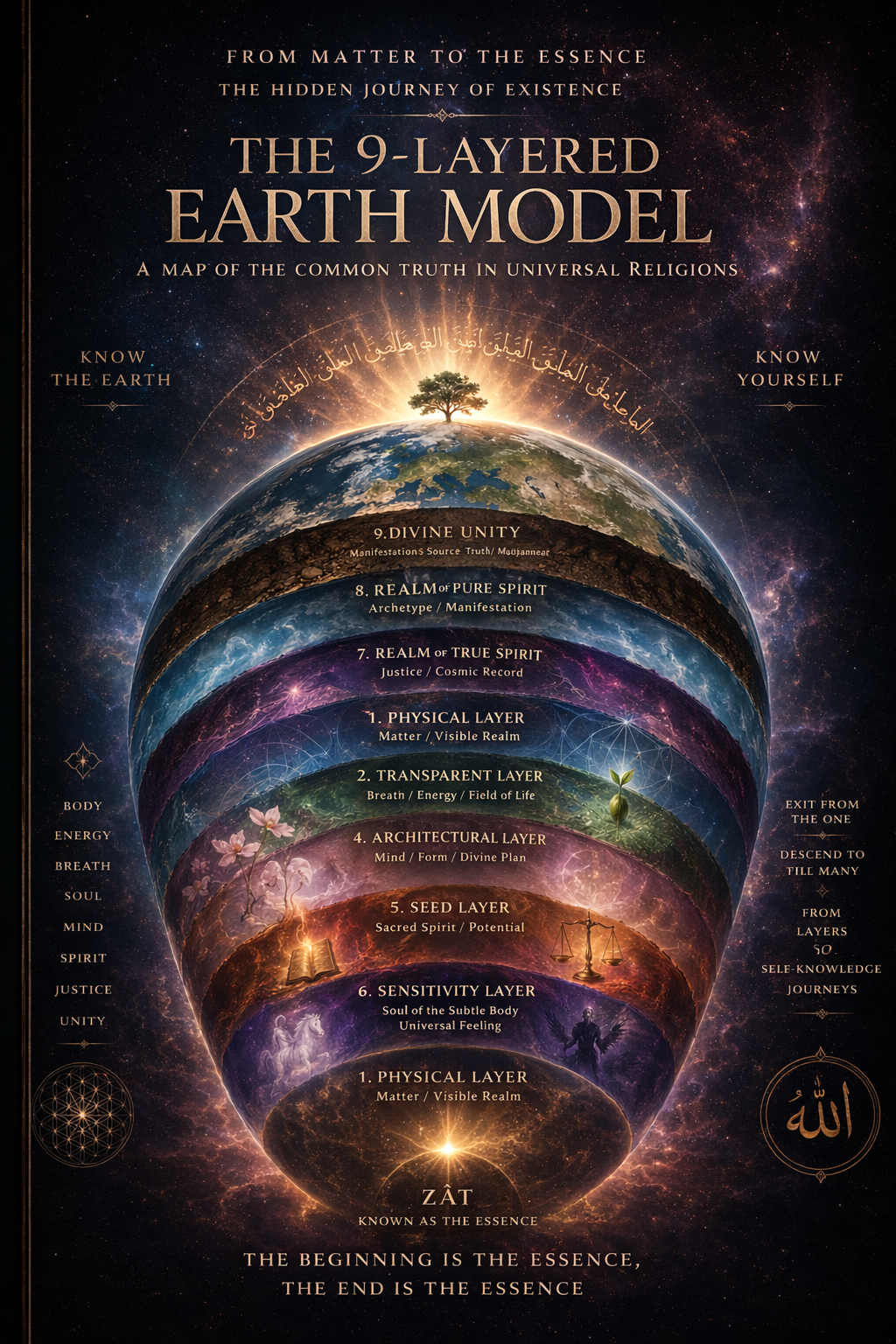
At first glance, the idea of a “Layered Earth” may appear as a mythological, poetic, or symbolic narrative. However, when examined carefully, it points to a much deeper conception of being. This conception approaches the world not merely as a geological surface or a physical planet, but as a multilayered whole composed of interwoven degrees of density, consciousness, sensitivity, and divine manifestation. Such an approach has appeared throughout history in different geographies and religious traditions under various names. In Islamic mysticism, levels such as mulk, malakut, jabarut, and lahut; in Hindu thought, stratifications centered around lokas, prana, kama, and Brahman; in Buddhism, levels of form, desire, and consciousness; in Kabbalah, the line of Assiyah, Yetzirah, Beriah, and Atziluth; and in Christian mysticism, the relationship between body, soul, spirit, and God—all point to a shared cosmological intuition expressed in different terminologies.
In this text, the “9-Layered Earth Model” will be addressed not only as the explanation of a single text, but also as a comprehensive model that reveals the shared currents of interreligious esoteric thought. The aim here is not to present different traditions in a reductionist manner as mere repetitions of the same thing. Rather, the goal is to demonstrate how humanity’s shared metaphysical intuition produces remarkably similar structures, and to situate the sequence of layers given in the text within this broader framework.
The layered Earth model explains not only the external world but also the human being. In this model, Earth is not merely the “ground” outside; rather, the human body, energy, desires, mind, spirit, memory, ethical burden, archetypal essence, and divine origin are all internal correspondences of the same layers. In other words, Earth is not only a cosmological foundation but also an anthropological map. For this reason, the call in the text to “Know the Earth” is not merely geographical or cosmological, but also psychological and spiritual: to know the Earth is to know oneself.
Throughout this study, each layer will be examined individually; its function within the text, symbolic value, esoteric meaning, and parallels in different religions and traditions will be analyzed. Then, the relationship of all these layers with the human being, society, ethics, history, and the understanding of divine unity will be revealed. Ultimately, it will be seen that this model is not merely a metaphysical theory, but also a comprehensive structure of consciousness that transforms one’s perspective on life, nature, society, and the inner world of the human being.
Method and Reading Framework
This text approaches the poetic and esoteric material it addresses not through a literal, but through a symbolic and comparative method. That is, concepts such as “layer,” “seed,” “holy spirit,” “fire,” “Preserved Tablet,” “pure spirits,” “true spirit,” and “essence” are not taken merely in their dogmatic or superficial meanings. Rather, they are treated as symbolic nodal points that express different degrees of manifestation of being. Likewise, similarities between concepts in different religions are interpreted not as direct equivalences of dogmas, but as structural and functional parallels.
The fundamental approach used here is as follows: although concepts in different traditions are not expressed with the same words, they sometimes develop similar models to solve the same metaphysical problems. What is the human being? What is the source of life? Why can desire be both creative and destructive? Does justice manifest only in the hereafter, or is it inscribed within the cosmic order? Are there recurring patterns of consciousness in history? What is the relationship between the ultimate unity of being and the visible multiplicity? The 9-Layered Earth model provides answers to these questions within a multilayered framework.
Therefore, three principles have guided the writing of this text. First, to preserve the conceptual backbone of the given main text. Second, to organize it into a more systematic structure. Third, to evaluate it within as broad an interreligious and esoteric horizon as possible. Thus, what emerges is neither merely an interpretive essay nor simply a summary of beliefs; rather, it is a theoretically elaborated version of a poetic-spiritual cosmology.
Fundamental Assumptions of the Layered Earth Idea
In order to properly understand the 9-Layered Earth model, it is first necessary to clarify some fundamental assumptions upon which this model is based.
The first assumption is that reality is not single-layered. The visible world is not the entirety of truth; it is only the densest, thickest, most solidified surface. Behind it lie subtler, more dynamic, more conscious, and more encompassing levels.
The second assumption is that the human being is not separate from the universe. There is a deep structural similarity between the microcosm and the macrocosm. In other words, the layers that exist in the universe also exist within the human being. For this reason, a mirror-like relationship is established between the Earth outside and the self within.
The third assumption is that life cannot be reduced to matter. Life is not merely the sum of physiological processes; it is the manifestation of a subtler level of being. Therefore, the body does not produce life; rather, life forms the body.
The fourth assumption is that ethics is not merely a social contract. Ethics is inscribed within the cosmic order. Good and evil are not merely ethical names for individual choices; they are states of harmony or disharmony with the cosmic balance.
The fifth assumption is that history does not unfold randomly. There are recurring patterns of consciousness, archetypes, and essential forms throughout history. Even if individuals change, these patterns may persist.
The sixth assumption is that all multiplicity ultimately rests upon unity. At the highest level—or beyond all layers—there exists an absolute center upon which all appearances depend. This center has been referred to in various traditions as Allah, Brahman, Ein Sof, God, Essence, and similar names.
These six assumptions form the backbone of the 9-layered structure. It is now possible to examine these layers one by one.
First Layer: Physical Layer – Matter / Visible Realm
The first layer is defined as the physical body of the Earth. This is the plane that is seen with the eye, touched by the hand, measured and weighed, and characterized by material density. The geological, biological, and physical world exists here. From the human perspective, this layer is the domain of the body, the senses, and coarse perception. Being acquires mass here; time, space, and cause-and-effect relationships become dominant at this level.
From an esoteric perspective, the physical layer is the level where truth is veiled by its densest covering. What appears in this layer is often assumed to be self-sufficient. However, this model does not grant ultimate reality to appearances. The visible is the outer shell, garment, and manifestation of deeper layers. Just as the human body is not the entirety of the human being, the physical surface of the Earth is not the entirety of the Earth.
The interreligious correspondences of this understanding are noteworthy. In Islamic thought, this level can be associated with mulk or the “realm of witnessing.” Mulk refers to the visible, possessed, and محسوس world. In Hindu tradition, Bhurloka is the plane of embodied and material existence. In Buddhism, rūpa represents the realm of form and visible appearance. In Christianity, the “flesh” or worldly level refers to the limited, material, and fragile nature of human existence.
The physical layer is not an insignificant level. On the contrary, the entire journey begins here. For the visible is the gateway to the invisible. However, remaining confined to this layer means living only on the outer shell of truth. The call in the text gains its meaning precisely at this point: “Do not pass over the ground you tread upon as mere soil.” This is not to belittle the physical layer, but to recognize that it is only the first layer.
In human life, the counterpart of this layer is the body. The body is not an obstacle to the spiritual journey; yet it is not its final destination either. The body is the first tablet upon which deeper levels are inscribed. Experiences such as hunger, satiety, pain, pleasure, space, movement, and limitation all occur within this layer. Yet none of these can be reduced solely to biology; for even the body itself is the condensed result of subtler orders that will unfold in subsequent layers.
For this reason, the first layer is both a beginning and a field of trial. Matter can either bind or awaken the human being. It binds if one assumes it to be the ultimate reality. It awakens if one perceives within it the traces of a deeper truth.
Second Layer: Transparent Layer – Breath / Energy / Field of Life
The second layer is described in the text as a transparent layer filled with gas. At first glance, this description evokes the physical atmosphere. However, from an esoteric reading, it carries a much deeper meaning. Transparency here symbolizes invisibility, while gas symbolizes flow and circulation. Thus, this layer represents the subtle order that cannot be grasped by the senses yet continuously sustains existence.
The expression in the text, “if the pressure were removed, it would destroy,” is highly significant. It emphasizes that life is sustained not by coarse matter, but by an unseen balance. If this subtle balance is disrupted, the physical layer cannot remain standing. Therefore, the visible world rests upon an invisible order.
In interreligious parallels, this layer spans a wide range. In Islamic mysticism, the “Breath of Rahman” may be understood as the divine breath that continuously gives life to existence. In Hinduism, prana is the life force that animates body and mind. In Chinese thought, qi is the vital energy that circulates within the universe and the body. In Christian mysticism, the spirit or holy breath signifies the unseen yet life-giving divine influence.
Within the human being, the counterpart of the second layer is not limited to biological breathing, but extends to the energy body or the fabric of vitality. A person may sometimes feel “drained” without being physically ill, or feel “alive” despite fatigue. This experience demonstrates that existence cannot be explained solely through the body. Vitality is the activity of a subtler layer.
Likewise, this layer can be considered for societies, cities, and civilizations. A society is not defined solely by its population or institutions; it also possesses an unseen state of spirit, an energetic texture. When that texture is disturbed, systems may appear intact outwardly, yet begin to collapse from within. Thus, the second layer is the invisible field of continuity for both individual and collective life.
In esoteric interpretation, the transparent layer can also be read through the relationship between breath and rhythm. The rhythm of the universe, the cycle of seasons, the alternation of day and night, tides, heartbeat, states of sleep and wakefulness—all of these can be seen as material reflections of an invisible order. In this sense, the second layer is the unseen harmony that governs the visible.
Third Layer: Desire Layer – Astral / Emotional Body
The third layer is defined as the “desire body.” This is the level where the pulse of life is first felt—where attraction and repulsion, wanting and avoidance, orientation and withdrawal begin. If the second layer represents the circulation of life, the third layer represents the inner magnet that gives direction to this circulation.
Desire here is not an ordinary wish. Desire is the root of movement. A being that desires nothing does not move. What makes life visible is not only biological energy, but also orientation. In this sense, desire is understood as the pulse of life. For life is not merely to exist; it is to flow toward something, to want something, to respond to something.
However, the desire layer has a dual nature. Desire can elevate a person or bring them down. Unrefined desire can transform into addiction, passion, jealousy, anger, possessiveness, and destructiveness. Refined desire, on the other hand, can become love, curiosity, the search for wisdom, divine longing, and creative power. Therefore, the desire layer constitutes the most dangerous yet most productive threshold in the spiritual journey.
In Sufism, this corresponds to the levels of the nafs. Particularly, nafs al-ammāra and nafs al-lawwāma reflect the coarse and refined forms of the domain of desire. In Hinduism, kama is not merely sensual desire, but the principle of inclination and longing in general. In Buddhism, taṇhā expresses attachment and craving as one of the roots of suffering. In Western esotericism, the astral body is the plane of emotions, images, and desires.
From the perspective of human psychology, the third layer is highly determinative. A person may have a healthy body and a strong intellect; yet if their desires are distorted, the direction of their life becomes corrupted. Likewise, a deep longing, a search for truth, or an aesthetic love can elevate a person to higher levels of consciousness. Thus, desire is not only the engine of downfall but also of ascent.
The cosmic counterpart of this layer is the network of attractions in the universe. The seed turning toward light, the flow of water, the reproductive impulse of animals, the artist’s search for form, the sage’s hunger for truth—all these can be read as manifestations of the third layer at different levels. Therefore, desire is not a simple instinct, but the movement of being toward its own completion.
Fourth Layer: Architect Layer – Intellect / Form / Divine Plan
The fourth layer is called the “architect.” This is a highly striking designation. For here, no longer coarse matter or raw desire is at play, but rather the ordering intellect and the form-giving plan. The phrase in the text, “the first drawn template,” implies that existence does not arise randomly; everything is first designed on a subtler plane.
The most important feature of this layer is that it contains the schema of form before it becomes a physical object. Just as a house is designed before it is built, existence first takes shape in a subtler plane and then becomes visible in matter. In this sense, the fourth layer is the mental or cosmic architectural plane of creation.
In the Islamic context, this layer can be associated with the “Preserved Tablet.” Of course, the Preserved Tablet is not merely a passive record, but can also be understood as the metaphysical ground of destiny, measure, and decree. Plato’s world of ideas describes the original forms behind visible things. In Hindu tradition, Akasha may be understood not merely as space, but as a field of cosmic record and vibration. In Kabbalah, Binah and Chokmah point to the dimensions of formation and wisdom within the divine intellect.
For the human being, the counterpart of this layer is not merely the capacity for reasoning. The human mind possesses the power to construct symbols, design, foresee, imagine, interpret, and give form. Thus, the human intellect is not simply a camera recording the external world, but a creative architect that builds inner orders. For this reason, the purification or corruption of the mind affects the entire structure of life.
This layer also contains an ethical and aesthetic dimension. For a plan is not merely a neutral schema; it also embodies the beauty and wisdom of order. A thing does not merely exist—it exists within a certain measure, proportion, and meaning. The metaphor of architecture expresses precisely this: existence is both constructed, measured, and established according to a certain order.
The fourth layer provides a higher interpretation of the first three layers. Matter gains meaning here, energy is organized here, and desire finds its direction and form here. Therefore, the architect layer is the threshold that transforms chaos into cosmos.
Relationship Between Microcosm and Macrocosm
After the first four layers, the fundamental logic of the model becomes clearer: the layers of the Earth and the layers of the human being exist in a mirror-like relationship. This relationship is known in ancient esoteric traditions as the principle of microcosm and macrocosm. According to this principle, the human being is a small universe, and the universe is a great human.
In the human being, the body corresponds to the first layer, the flow of energy to the second layer, emotions and desires to the third layer, and intellect and mental structure to the fourth layer. From this perspective, the “earth” outside is not merely a geographical ground, but the inner topography of the human being. Thus, the calls “know yourself” and “know the Earth” converge on the same axis.
This principle has ontological, ethical, and pedagogical consequences. Ontologically, the human being is not separate from the universe but is its small-scale reflection. Ethically, the inner imbalance of the human being resonates in the external world. Pedagogically, one who does not understand their inner world cannot understand the outer world. Therefore, this model sees knowledge not only as the study of external objects, but also as the exploration of inner layers.
From this point onward, the model begins to unfold not only the sequence of matter–energy–desire–intellect, but also higher levels such as life, sensitivity, justice, archetype, and unity.
Fifth Layer: Holy Spirit, Seed, and the Secret of Life
The fifth layer is one of the most critical turning points of the model. For here, the issue is no longer merely form and order, but directly the source of life itself. The images of the “Holy Spirit” and the “seed” are two powerful symbols chosen to describe the inner mechanism of creation.
One of the key emphases in the text is that life is not something added afterward. The rejection of the notion that “the Holy Spirit revives a dead body” implies that life is not a mechanically added element from the outside, but a reality that already exists potentially. Life is not a quality that things acquire after coming into being; it is the deepest essence of being itself.
The seed here is a profound metaphysical symbol. From the outside, the seed appears dry, motionless, almost dead. Yet within it lies a complete program of life. Under the right conditions, it unfolds, embodies, and becomes visible. Thus, birth is not the creation of life out of nothing, but the manifestation of a hidden life.
This idea resonates across many traditions through different concepts. In Sufism, the origin of the spirit from the realm of command indicates that it is not merely a material composition. In Hinduism, the unborn and undying nature of Atman emphasizes that life exists before and beyond the body. In Buddhism, the continuity of the life process suggests an uninterrupted becoming beyond changing forms. In Kabbalah, the divine spark points to the hidden life-light within existence.
The statement “life does not enter the body; it wears the body” is the key sentence of the fifth layer. This reverses the common materialist conception. In the common view, first there is the body, and then the soul enters it. In the esoteric understanding, first there is life; it forms the appropriate shape for itself, namely the body. Thus, the body becomes not the house of life, but its garment.
This perspective also radically transforms the understanding of death. The statement “the dead is only stale” indicates that death is not nonexistence, but the aging and completion of a form. Life itself does not die; forms change. In this sense, death is not the end of existence, but the transformation of appearance.
The theological peak of the fifth layer is expressed in the phrase: “Allah’s living name: Life.” Here, life is treated at the level of the divine name. Life is not merely a quality of created beings, but a reality belonging to Absolute Being itself. Therefore, the fifth layer understands the spirit not merely as a part of the body, but as the field of manifestation of divine life.
Sixth Layer: The Spirit of the Transparent Body and Universal Sensitivity
The sixth layer is a level that makes the ethical and ontological depth of the model more explicit. Here, the issue is not only that the human being feels, but that the Earth itself is conceived as a feeling being. The statement, “Only the spiritless crowd thinks the Earth to be without feeling,” is a powerful objection to treating the world as an inanimate object.
At this layer, the Earth is not merely the sum of stone, soil, water, gas, and biological organisms. It is a whole that feels, responds, and resonates. This feeling does not have to be explained in the modern biological sense through a nervous system. What is meant here is that being itself is a network bearing consciousness and sensitivity.
The parallels of this idea are quite broad. In Sufism, the understanding that “everything performs dhikr” implies that existence carries a kind of awareness. In Hinduism, Prithvi is not merely the physical Earth, but a living cosmic mother. In shamanism, nature is woven with spirits and conscious forces. In Christian mysticism, the idea that creation is alive in God carries a similar direction.
The example of fruit and tree in the text beautifully explains the ethical logic of the sixth layer. Plucking a fruit may produce pleasure, but uprooting the tree produces pain. Here, the difference between superficial contact and intervention at the root is emphasized. The example that cutting hair gives pleasure while tearing it out by the root causes pain supports the same logic. In other words, being may tolerate superficial changes, but attacks directed at its root structure produce deep resonances.
This layer teaches us the following: our actions do not produce only mechanical consequences; they also leave traces in the field of sensitivity. Actions that shake a living being, a tree, a society, a culture, or even a human heart from the root produce pain in the deeper layers of being. Therefore, ethics here becomes not an abstract rule, but a sensual-cosmic responsibility.
Within the human being, the counterpart of the sixth layer is the domain of the heart and subtle sensitivity. Not only emotions, but the root of emotions is located here. At this level, the person begins to realize not only their own pain, but also that they are connected to the whole. This transforms empathy from an individual psychology into a cosmic principle.
Seventh Layer: The Realm of the Spirit of Lord, Justice, and Cosmic Record
The seventh layer forms the axis of justice in the model. The expression “Realm of the Spirit of Lord” describes not only the spirit of what is right, but the dimension of truth that weighs, records, and responds. Here, the universe is seen not as a neutral and indifferent field, but as an order inscribed with the principle of justice.
The sentence in the text, “Collective sins and good deeds are paid into this layer,” is highly important. This expression shows that individual actions do not have merely individual consequences; collective good and evil are also inscribed into the cosmic balance. Thus, ethics moves beyond the level of personal conscience and gains a social and cosmic dimension.
The interreligious similarities of this layer can be clearly seen. In Islam, the scale and divine justice are not merely judgments postponed to the afterlife; they are principles of measure placed within the cosmos itself. In Hinduism, karma expresses the subtle yet unavoidable bond between action and consequence. In Buddhism, causality and the chain of karma make moral structure part of existential order. In Christianity, the idea of the Last Judgment symbolizes the final manifestation of divine justice.
At this layer, the Preserved Tablet appears as cosmic memory and a living field of record. Nothing is lost here. Every thought, every intention, every action, every social wave leaves a trace. This record is not a dead archive; it is an active field of consciousness. The past is not something finished and gone; it is a layer whose effects continue within being.
The expression “layer of fire” is also important at this level. Fire is not only a symbol of punishment, but of purification and rebalancing. Natural disasters are therefore read in this text not merely as physical events, but as cosmic resonances of imbalances. This interpretation does not have to establish a literal theology of disaster; yet it emphasizes this: the cosmos is not indifferent to what is done.
Another striking aspect of the seventh layer is that “hell” is interpreted as a layer of consciousness. Dark regions point to compressed and intensified states of consciousness. Thus, hell becomes less a geographical place than a spiritual and existential density.
As for its counterpart within the human being, the seventh layer is the level of conscience, record, response, and ethical reckoning. Here, the person becomes aware not only of what they desire, but of what is right and what kinds of resonances their actions produce. Thus, ethics becomes not a law imposed from outside, but the voice of the inner structure of being itself.
Eighth Layer: Realm of Pure Spirits, Archetype, and Manifestation
The eighth layer is one of the most striking parts of the model in terms of history and human typology. Here, the expression “photocopy center” should be read symbolically, not literally. What is meant is not that the same individuals return exactly, but that essential patterns, archetypes, and forms of consciousness manifest again at different times.
This layer is the realm of pure forms that lie beyond the individual. Human beings are born, live, and die; yet certain patterns of leadership, destructive character structures, savior types, founding figures, tyrannical ruler patterns, or axes of wisdom appear again and again throughout history. Therefore, the eighth layer can be read as a metaphysical explanation of the feeling of repetition in history.
The Sufi notion of a‘yān al-thābita points to the fixed essences of things. Platonic ideas describe the enduring forms behind visible beings. In Hinduism, Mahat or the cosmic mind may be understood as the field of regulatory patterns beyond the individual mind. In Kabbalah, Atziluth serves a similar function as the pure plane of divine manifestation.
At this layer, good and evil can also be understood as archetypal forms. Constructive and protective archetypes may emerge when society enters crisis. Destructive archetypes, on the other hand, manifest when they find a suitable field of consciousness. This is why the text says, “negative clichés wait in line.” Evil here is understood not as an eternal and independent force in itself, but as a pattern that takes shape when it finds suitable ground.
The sentence “if society awakens, it ends” summarizes the collective-consciousness dimension of the eighth layer very well. Archetypes are not absolute destiny; when human and social consciousness rise, certain dark patterns may lose their effect. This means that history is the product not only of external conditions, but also of fields of consciousness.
The statement “the Qutb cannot be copied” makes a very subtle distinction. Archetypes may recur, but the central point of consciousness, that is, the spiritual axis of an age, is unique. This shows how singularity is preserved within metaphysical continuity.
Within the human being, the counterpart of the eighth layer concerns the essential patterns one carries beyond one’s individual personality. A person may sometimes be the bearer not only of personal choices, but also of deeper historical and collective patterns. Once this is recognized, the individual begins to read their destiny not only through psychology, but through a deeper archetypal awareness.
Ninth Layer: Divine Unity and the Threshold of Manifestation
The ninth layer is the summit of the entire layered structure. Here, the unity that is the source of multiplicity becomes visible. The statement “the ninth layer is ALLAH” does not describe a spatial layer with boundaries, but the field of absolute unity upon which all layers depend. This layer is both the end and the source.
The analogy of the “circle of the seed” allows multiplicity to be understood as rings connected to a center. If the layers are circles opening outward, this layer is the central unity upon which they rest. Thus, multiplicity and unity cease to be opposites; multiplicity becomes the unfolding of unity.
The triad “Lord – Muhammad – Ali” in the text, when taken symbolically, represents the axis of truth, consciousness, and perfection. What is at stake here is not so much historical personalities as modes of manifestation of truth. Lord is absolute reality; Muhammad is the purest point at which consciousness reflects this reality; and Ali is perfection, sublimity, and completed manifestation.
This triadic structure also resonates in other traditions. In Christianity, Father-Son-Holy Spirit; in Hinduism, Brahma-Vishnu-Shiva; in Kabbalah, Keter-Hokmah-Binah—such triadic systems express in different languages the functioning of unity within multiplicity. These similarities do not mean that the dogmas are identical; rather, they show humanity’s metaphysical intuition toward triadic patterns of manifestation.
The ninth layer is experienced within the human being as consciousness of unity, awareness of tawhid, and the thinning of the veil of separation. Here, the person no longer remains only at the level of body, energy, desire, intellect, life, sensitivity, justice, or archetype; rather, they realize that all of these are different unfoldings of a single truth. This realization is not merely theological knowledge, but an ontological transformation.
The Question of Essence: Beyond the Layers
The indication of “the tenth layer” after the ninth layer in the text, pointing to Essence, is highly meaningful. For here, the very idea of layers is transcended. Essence cannot be contained within any layer; it is the absolute center upon which all layers depend, yet it cannot be reduced to any of them.
In Sufism, the Absolute Essence refers to the absolute being that is beyond even the divine names and attributes. In Hinduism, Nirguna Brahman points to an attributeless absolute. In Kabbalah, Ein Sof expresses that which is infinite and cannot be limited. In apophatic theology, God is seen as a mystery that can only be approached by stating what He is not.
In this sense, speaking about Essence is paradoxical. For every definition imposes a limit, and to impose a limit diminishes the absolute. Therefore, the expression in the text, “neither shorten nor prolong,” finds its place precisely here. Essence is the truth that is intuited at the end of thought, yet never fully surrendered to conceptual grasp.
Nevertheless, the idea of Essence is necessary for the layered model. For if there is no absolute unity at the final stage, the layers would remain as endlessly fragmented parts. Essence is the silent center upon which all scattered appearances depend.
Interreligious Comparative Table and Interpretive Conclusions
The 9-Layered Earth model offers the possibility of structurally bringing together the fundamental metaphysical stages of different traditions. In the first layer, the material world appears; in the second, life energy; in the third, desire and emotion; in the fourth, the form-giving intellect. In the fifth layer, one passes to the pure source of life. In the sixth, universal sensitivity unfolds. In the seventh, justice, record, and cosmic response come into play. In the eighth, archetypes and essential patterns become visible. In the ninth, it is realized that all of these are grounded in unity. Essence, however, is the absolute horizon toward which all these discourses point in silence.
This table shows us the following: differences between religions are not always essential conflicts, but often differences of language, emphasis, and symbol. The same metaphysical tensions have produced different images in different cultures. For this reason, the 9-Layered Earth model functions as a bridge that reveals shared intuitive fields without reducing religions to one another.
Ethics, Cosmos, and Human: Practical Implications
This model is not merely a theoretical metaphysical scheme. It produces powerful conclusions applicable to life. If the world is a sensitive whole, then our actions toward nature are not ordinary technical operations. If life is not the product of the body, then it is insufficient to view the human being as merely a biological machine. If desire is the engine of both spiritual ascent and descent, then education must be not only the transmission of knowledge, but also the cultivation of desire. If justice is part of the cosmic structure, then oppression is not only a social problem but an ontological corruption. If history operates through waves of archetypes, then politics and culture cannot be understood solely through current events. If multiplicity is the unfolding of unity, then the fundamental crisis of the human being is the illusion of separation.
These conclusions also apply to the individual. A person must pay attention separately to their body, energy, emotions, mind, conscience, and spiritual orientation. Every neglected layer within the inner world produces imbalance in the whole structure. Therefore, true education, true ethics, and true contemplation must be multilayered.
Conclusion
The 9-Layered Earth model, beyond being a poetic cosmology, is a profound map of relationships established between the human being, the universe, and divine truth. In this model, the Earth is not merely the ground we step on; it is also the outer mirror of the layered existence we carry within. The journey that begins with matter extends to energy, desires, intellect, life, sensitivity, justice, archetypes, and ultimately unity. Essence is both the source and the silent horizon of this entire unfolding.
The greatest strength of this model lies in its ability to make visible the shared metaphysical currents of different religions and traditions without reducing them to crude equivalences. Islamic mysticism, Hindu thought, Buddhist analyses of consciousness, Kabbalah, and Christian mysticism—all approach the same great question in different tones: What is being? What is the human being? What is life? What is separation? What is unity?
The 9-Layered Earth model gives the following fundamental answer: the visible world is only the surface; the human being exists not to be lost in this surface, but to comprehend the transitions between layers. One who considers the Earth ordinary considers themselves ordinary. One who recognizes the layers of the Earth realizes that their own existence is also layered. And in the end, one understands that the beginning is Him and the end is Him; the ascent is toward Him, the descent is from Him; all layers are the visible rings of His journey of self-knowing.