A MASONIC FANTASY
A MASONIC FANTASY. Since Masonry admits no woman into its lodge’s place, Let her say unto her husband: “I am a true widow — go from my face!” The husband, finally coming to his senses, runs unto the lodge in haste: “My father was not a jinn, but Adam!” he tells his master with haste.
APOCALYPSE BOOK
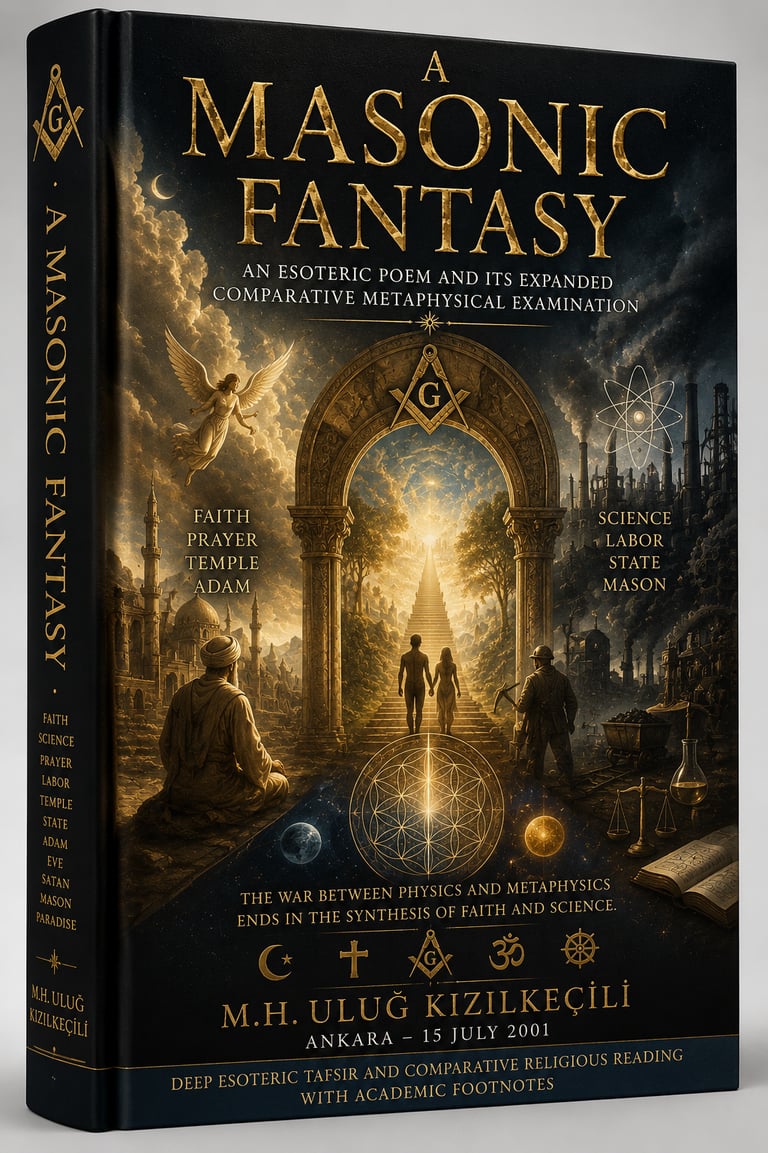
A MASONIC FANTASY
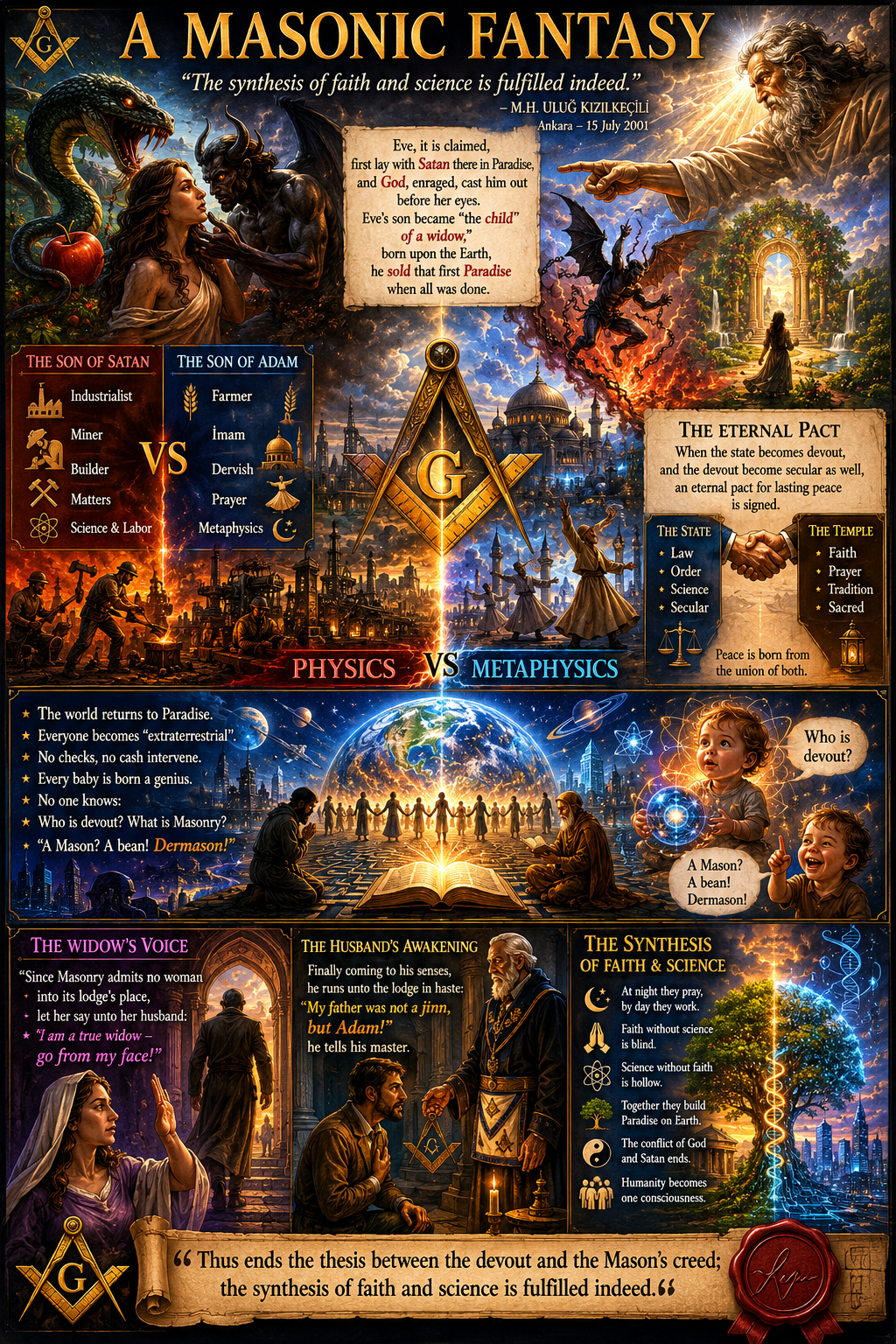
Eve, it is claimed, first lay with Satan there in Paradise,
And God, enraged at Satan, cast him out before her eyes.
Eve’s son became “the child of a widow,” so the tale was spun;
Born upon the Earth, he sold that first Paradise when all was done.
Then God took Adam and gave him unto Eve instead;
The son born from him, God loved greatly, it is said.
The son of Satan became industrialist and miner by trade;
The son of Adam became farmer, imam, or dervish in shade.
The son of Satan labors: “Let this Earth become Paradise once more!”
For the son of Adam, worship and prayer remain the sacred chore.
This is the war between physics and metaphysics in their sphere;
They divide the state and the temple in differing manners here.
When the state becomes devout, and the devout become secular as well,
An eternal pact for lasting peace is signed, so the story will tell.
The world returns to Paradise, first as it once had been;
Everyone becomes “extraterrestrial”; no checks nor cash intervene.
No one any longer knows: Who is devout? What is Masonry then?
The conflict between God and Satan comes at last unto its end.
Every baby is born a genius; ask, “Who is devout?” — they stare.
And what is a Mason? He replies: “A bean! Dermason!” with flair.
Thus ends the thesis between the devout and the Mason’s creed;
The synthesis of faith and science is fulfilled indeed.
At night they pray, by day they go to work and strive;
And now my fantasy for the “widow’s child” arrives:
Since Masonry admits no woman into its lodge’s place,
Let her say unto her husband: “I am a true widow — go from my face!”
The husband, finally coming to his senses, runs unto the lodge in haste:
“My father was not a jinn, but Adam!” he tells his master with haste.
M.H. ULUĞ KIZILKEÇİLİ
Ankara — 15 July 2001
(From this point onward, the written section has no relation to the author, and the author cannot be held responsible for any errors made!)
Deep Esoteric Tafsir, Comparative Religious Reading, and Academic Metaphysical Prose with Footnotes
Preliminary Note
This examination has been prepared not for the purpose of affirming the poem’s direct historical or doctrinal claims, but rather to analyze the symbols within the poem from literary, esoteric, comparative religious, and metaphysical-anthropological perspectives. Figures such as “God,” “Satan,” “Eve,” “Adam,” “Mason,” “the devout,” “the state,” “the temple,” “science,” and “paradise” are treated here not as literal historical individuals or institutions, but as forces of consciousness, civilizational tendencies, and metaphysical oppositions within human history.
The language of the poem is at times ironic, provocative, and subversive. For this reason, the text should not be read as a direct repetition of classical dogmatic narratives, but rather as a reconstruction of myth, an inversion of symbols, and a movement toward the synthesis of opposites. At the center of the text is not a conflict between “the devout” and “the Mason”; the true center is the question of whether faith and science, temple and laboratory, prayer and labor, metaphysics and physics can unite within the same human consciousness.
I. The Main Thesis of the Text: Not the War of Opposites, but Their Synthesis
The poem titled “A Masonic Fantasy” outwardly constructs an ironic narrative concerning Masonry, religion, Adam, Eve, Satan, and modern civilization. Yet when one examines the deeper structure of the poem, it becomes clear that the text’s purpose is neither to glorify nor to humiliate any side. The poem confronts two great currents within human history.
The first current is the metaphysical current. This current is represented through prayer, worship, the temple, tradition, sacredness, Adam, dervishhood, imamate, and fidelity to divine order.
The second current is the physical and technical current. This current is represented through mining, industry, labor, construction, transformation, Masonry, the state, science, and the will to build civilization.
The most important aspect of the poem is that it does not leave these two currents as eternal enemies. At the conclusion, the text speaks of “the synthesis of faith and science.” Thus, the poem’s true aim is not to deepen conflict and polarization, but to reintegrate humanity’s fragmented history.
In this sense, the poem touches one of the greatest problems of the modern age: Humanity possesses knowledge, but does it possess wisdom? It possesses technical power, but has it preserved meaning? If the praying human being does not produce, the world remains incomplete; if the producing human being does not pray, the spirit becomes hollow. This is precisely the central issue of the poem.
II. The Alternative Myth of the Fall: Eve, Satan, and the Birth of Civilization
The poem’s opening narrative concerning Eve and Satan is a conscious inversion of classical religious narratives. If this section is read literally, the text may appear provocative; however, from an esoteric perspective, what is described here is not a biological relationship but a cosmic rupture.
In many traditions, Eve is the gateway of life. The feminine figure represents not merely biological motherhood, but the passage into matter, the gaining of form, and the birth of invisible truth into the visible world. For this reason, Eve in the text is not a passive figure, but the threshold of becoming.
Satan, meanwhile, appears here not so much as absolute evil but as the activating principle. In classical theology, Satan symbolizes rebellion, pride, and deviation. Yet within esoteric and mythological readings, “rebellion” is sometimes interpreted as the dark threshold of the birth of consciousness itself. The association of the serpent with knowledge in Gnostic texts, Prometheus stealing fire and bringing civilization to humanity, Loki’s role as both disordering and transformative force, and the nigredo phase in alchemy may all be cited as examples of this structure.
It is therefore not accidental that the descendants of Satan are portrayed in the poem as industrialists and miners. The mine is the secret of the underworld. The miner descends into the dark womb of the earth and extracts the hidden ore. This movement is both technical and esoteric. For in all initiatory traditions, descent underground symbolizes descent into the unconscious. Humanity cannot discover gold without descending into darkness; it cannot attain wisdom without confronting its own shadow.
For this reason, the line described as the “lineage of Satan” symbolizes not merely sin, but labor, mining, industry, technique, and the will to transform the world.
III. The Son of Adam and the Son of Satan: The Human Being Who Prays and the Human Being Who Builds
In the poem, the son of Adam is portrayed as farmer, imam, or dervish, while the son of Satan appears as industrialist and miner. This distinction is profoundly symbolic.
The son of Adam remains bound to the earth. As farmer, he waits for the seed. As imam, he sustains worship. As dervish, he turns inward. He belongs to the natural rhythm of time. Patience, surrender, tradition, and sacred order are his domain.
The son of Satan, however, excavates the earth, extracts ore, and transforms the world. He does not wait; he intervenes. He does not leave nature untouched; he works it, transforms it, shapes it. In this sense, he is the founding figure of modern civilization.
In the deeper reading of the poem, these two figures are not enemies but incomplete halves of one another. If only the son of Adam exists, the world stagnates. If only the son of Satan exists, the world becomes spiritless. One preserves meaning; the other changes form. One prays; the other labors. One looks toward heaven; the other digs into the earth. Humanity is born from the tension between the two.
This structure recalls the Yin-Yang duality in Taoism. Yin and Yang are not enemies, but two complementary poles of existence. Similarly, in Kabbalah, Hesed and Gevurah — mercy and severity — are balanced upon the middle pillar. In Sufism, جمال (jamāl, beauty) and جلال (jalāl, majesty) are the two faces of divine manifestation. Likewise in the poem, prayer and labor, faith and technique, temple and state appear as two dimensions of the same great order of being.
IV. “Let This Earth Become Paradise”: The Reconstruction of the Lost Paradise
In the poem, the goal of the son of Satan is given as follows:
“Let this Earth become Paradise!”
This expression is one of the poem’s most powerful utopian statements. Here, paradise ceases to be merely a realm of postmortem reward; it becomes the sacred order that must be reconstructed upon the earth itself.
In classical religious narratives, paradise is often either the place lost at the beginning or the place to be attained in the future. The poem, however, develops a third interpretation: Paradise may be brought down again into the world through human labor, science, faith, and synthesis.
This idea appears in different forms across many traditions. In Jewish-Christian apocalyptic tradition, the idea of the New Jerusalem is the vision of a sacred city descending upon the earth. In Islamic Sufism, the world regains meaning through the perception of the Insān al-Kāmil (Perfect Human). In the Hermetic tradition, humanity is charged with establishing below the order that exists above. In alchemy, the Philosopher’s Stone represents not merely the transformation of metal, but the transformation of all existence.
The poem’s idea that “the Earth should become Paradise” does not merely signify material prosperity. For technical progress alone cannot establish Paradise. The text understands this very clearly. Thus, the poem ultimately arrives at “the synthesis of faith and science.”
Paradise here can be established not through spiritless technology, but through knowledge that has acquired spirit.
V. The War Between Physics and Metaphysics
The poem openly declares:
“This is the war between physics and metaphysics.”
This sentence summarizes the fundamental split within modern humanity. Physics represents the measurable world; metaphysics represents the realm of meaning, purpose, truth, and invisible order.
The modern age exalted physics, while often dismissing metaphysics as superstition. In response, certain traditionalist currents defended metaphysics while viewing physics and science as threats. Thus humanity became divided against itself.
The poem opposes this division. For the human being is not merely matter; nor is he merely spirit. Humanity is the intersection of both. It lives through the body, yet gives meaning through the spirit. It stands upon the earth, yet turns toward the heavens.
At this point, the Hermetic principle becomes essential: “As above, so below.” According to this principle, the physical world and the metaphysical order are not disconnected. The visible is the language of the invisible; matter is the condensed form of spirit.
Likewise in Sufism, ẓāhir (the outward) and bāṭin (the inward) are inseparable. The outward is the shell of the inward; the inward is the soul of the outward. The poem’s synthesis of physics and metaphysics gains its meaning precisely here.
VI. The State and the Temple: Two Forms of Power
The poem’s division between the state and the temple is highly significant. The state represents worldly order, while the temple represents sacred order. Throughout history, these two powers have at times united, at times fought, and at times instrumentalized one another.
The state is the order of the body. Law, economy, security, borders, and governance belong to its sphere. The temple, however, is the order of the soul. Meaning, sacredness, worship, symbol, and transcendence belong to its domain.
The poem does not wish these two realms to destroy one another, but rather to become balanced. The expression:
“When the state becomes devout, and the devout become secular”
constitutes a paradoxical synthesis in this sense. Here, the devotion of the state may be interpreted as carrying ethics instead of oppression; while the secularism of the devout may be interpreted as refusing to transform the sacred into an instrument of power.
This interpretation lifts the text beyond dogmatic political sloganism and transforms it into an ethical-metaphysical search for balance.
VII. The Esoteric Meaning of the Mason Figure
Within the poem, the Mason figure functions less as a historical institution than as the archetype of “the human being who builds.” The word Mason is associated with stonecraft. In operative Masonry, stone is literally carved; in speculative Masonry, however, the stone is the human being himself.
The rough stone symbolizes the unrefined human being. The cubic stone symbolizes the human being shaped through discipline, knowledge, virtue, and inner labor. This symbolism appears in many esoteric traditions.
In Sufism, the disciplining of the nafs; in alchemy, the transformation of lead into gold; in Buddhism, the purification of the mind; in Christian mysticism, the death of the old human being and the birth of the new human being — all share the same initiatory structure.
Within the poem, the Mason is not merely an organizational identity, but the consciousness that builds the world, transforms matter, carves the stone, and brings order out of chaos.
Yet the poem does not present the Mason as an absolute savior either. For the human being who only builds but does not pray produces spiritless technique. Thus the Mason must enter into synthesis with the devout.
VIII. The Esoteric Meaning of the Devout Figure
The figure of the devout within the poem is likewise multidimensional. The devout person represents not merely ritualism, but the human being who preserves meaning, sacred memory, traditional continuity, and metaphysical roots.
Yet the poem also criticizes the devout person who only prays without transforming the world. For prayer, when not united with labor, may turn into passivity. Thus the text establishes the ideal balance through the line:
“At night they pray; by day they go to work.”
This verse is the poem’s most mature statement of synthesis. To pray at night is to preserve one’s inner center. To work by day is to assume responsibility for the world.
In Sufism, this may be compared to “khalwat dar anjuman”: inwardly being with the Lord while outwardly laboring among people. Humanity must neither flee from the world nor become lost within it.
IX. The Synthesis of Faith and Science
As the poem explicitly states:
“The synthesis of faith and science is fulfilled.”
This sentence constitutes the text’s principal conclusion. Here, science is not merely laboratory knowledge; it is the power to understand and transform the physical world. Faith, meanwhile, is not merely dogma; it is the sense of meaning, direction, and transcendent purpose.
If science remains without faith, it produces instruments but cannot produce purpose. If faith remains without science, it may generate meaning but fail to transform the world effectively. The poem argues that these two domains must unite.
Within Islamic thought, the distinction between ‘ilm and ḥikmah becomes important here. ‘Ilm is knowledge; ḥikmah is the right application of knowledge. In the modern age, knowledge is abundant, yet wisdom is lacking. The poem’s critique is directed precisely toward this deficiency.
In the Hermetic tradition as well, knowledge is sacred — yet not merely technical knowledge, but knowledge that comprehends existence as a whole. In Kabbalah, wisdom and understanding are sefirotic dimensions of the creative order. In Hinduism, jñāna — wisdom — is one of the paths of liberation. In Buddhism, prajñā — transcendent insight — is the foundation of enlightenment.
The poem’s search for synthesis aligns with this universal line of wisdom.
X. “Everyone Becomes Extraterrestrial”: Post-Human Consciousness
The expression “everyone becomes extraterrestrial” appears humorous on the surface. Yet from an esoteric perspective, it is an extraordinarily profound symbol.
Here, the extraterrestrial is not a biological being arriving from another planet. It is consciousness that has transcended the present human identity. When humanity surpasses the narrow limits of tribe, sect, class, nation, and ego, it ceases even to be merely “earthbound”; it becomes cosmic being.
The concept of the noosphere developed by Pierre Teilhard de Chardin may here be recalled. According to Chardin, humanity progresses beyond biological evolution toward conscious evolution. Human minds become increasingly connected to a greater collective field of consciousness.
The “extraterrestrial” in the poem is, in this sense, the human being of cosmic consciousness. Such a being exists no longer through identity labels, but through the level of consciousness itself.
This interpretation may be compared with the Insān al-Kāmil in Sufism, the jīvanmukta in Hinduism, the bodhisattva in Buddhism, the human being who completes the process of tikkun in Kabbalah, and the reborn human being in the Hermetic tradition.
XI. The Transcendence of Money and Property
In the poem, it is said: “no checks nor cash are needed.” This is not merely an economic dream. It symbolizes the transcendence of exchange economy and the consciousness of lack.
Money is a symbol founded upon lack. Something is not in my possession; I pay in order to obtain it. Yet in the poem’s utopia, humanity reaches such a level of wholeness that need and sharing are reorganized.
In Thomas More’s Utopia, Marx’s ideal of a classless society, certain monastic traditions, the Sufi ethics of futuwwah, and Shamanic sharing societies, the transformation of property has been treated as an ethical matter.
In the poem, this economic transformation appears not as a political program, but as the result of a transformation of consciousness.
If the human being changes, the economy changes as well.
XII. The End of the Opposition Between God and Satan
One of the poem’s most striking lines is:
“The conflict between God and Satan comes to an end.”
This expression must be read carefully from a theological perspective. What is meant here is not the identification or equalization of God and Satan. On the esoteric level, what is described is the reconciliation, at a higher level, of the fragmented perceptions within human consciousness: good–evil, order–chaos, prayer–labor, temple–laboratory, metaphysics–physics.
In Taoism, Yin and Yang are not enemies. In alchemy, wholeness does not arise until the sun and moon unite. In Kabbalah, the right and left pillars are balanced in the middle pillar. In Sufism, jalāl and jamāl are two modes of manifestation of the same truth.
In the poem, “Satan” is symbolized as the principle of movement, rebellion, technique, mining, and transformation. “God,” however, remains the principle of order, meaning, the sacred center, and ultimate truth. Synthesis does not mean confusing these; it means placing their functions within human consciousness in their proper order.
Therefore, the poem establishes not a theological equalization, but a symbolic dialectic.
XIII. Eve’s Symbolism as the Widow
The expression “the child of a widow” in the poem may be associated with the “widow’s son” motif in Masonic tradition. In Masonic symbolism, the widow’s son is interpreted as a symbol of the lost father, the lost center, and the initiatory search.
On the esoteric level, the widow may be seen as the world that has lost its heavenly spouse — that is, matter separated from the sacred center. The widow’s son is the seeker born within this separation. He is born from lack and also strives to complete that lack.
The poem uses this motif ironically. Through the issue of women not being admitted into the lodge, the text also satirizes the male-centered structure of esoteric traditions. This satire is important, because the text criticizes not only the devout person, but also the Mason. In other words, the poem is not propaganda for one side. It reveals the blind spots of both sides.
XIV. Woman, Gate, and Threshold Symbolism
Eve appears at the beginning of the poem; the motif of the widow reappears at the end. This structural repetition shows that woman is not merely a social figure in the text. Here, woman is threshold, womb, passage, birth, and the gate of transformation.
In the history of religions, the female figure has often been interpreted both as the source of life and as the threshold of the Fall. In patriarchal theologies, this dual interpretation has often taken an accusatory form. Yet in esoteric traditions, woman also represents creative depth as Sophia, Shekinah, Prakriti, Maya, Anima, and Womb.
The poem’s placing of Eve at the center shows that human history cannot be explained solely through male figures. Civilization cannot begin without passing through the gate of birth.
XV. Prometheus, Satan, and the Mason: The Figure Who Brings Fire
The Satan–Mason line in the poem recalls the myth of Prometheus. Prometheus steals fire from the gods and gives it to humanity. Fire here is not merely physical fire; it is the symbol of technology, consciousness, culture, and independence.
Prometheus is punished because he has brought down to humanity knowledge that belonged to the divine monopoly. This narrative meets the rebellion of Satan and the constructive intellect of the Mason within the same symbolic field.
Yet the poem does not regard the Promethean movement alone as sufficient. Fire is necessary, but wisdom is also necessary to govern fire. Otherwise, fire can burn civilization just as it can build civilization.
Atomic energy, artificial intelligence, genetic engineering, and modern war technologies may be considered contemporary projections of this symbol. When knowledge remains without wisdom, it produces not salvation but disaster.
XVI. Alchemy and the Symbolism of Mining
Mining is a central symbol in the poem. In the alchemical tradition, metals represent different states of the human soul. Lead represents rawness; gold represents perfection. While the alchemist transforms metal outwardly, he is in fact transforming himself inwardly.
For this reason, the miner is the initiate who descends underground. The underground is the unconscious. There dwell fears, desires, repressed powers, and raw ores. The human being cannot find his own gold without descending into his own darkness.
In Jung’s interpretations of alchemy, this process is the journey of individuation. The person confronts his shadow, recognizes his opposites, integrates his fragments, and reaches a wider field of selfhood.
The fact that the son of Satan is a miner in the poem shows his relation to darkness; yet this darkness is not merely evil. It is the place where transformation begins.
XVII. The Union of Temple and Laboratory
The ultimate utopia of the text is the union of temple and laboratory. The temple represents meaning; the laboratory represents method. The temple gives purpose; the laboratory produces means. The temple shows direction; the laboratory provides possibility.
The modern age enlarged the laboratory and diminished the temple. Certain traditionalist reactions, however, rejected the laboratory in order to preserve the temple. The poem regards both extremes as insufficient.
The ideal human being is the one who prays at night and works by day. This sentence summarizes the practical wisdom of the text.
Prayer establishes the inner center.
Labor orders the outer world.
When the two unite, the human being becomes complete.
XVIII. The Esoteric Function of Humor
The humorous expression “A bean! Dermason!” at the end of the poem shows that the text is not merely a heavy metaphysical work. Humor here functions to soften truth, break fanaticism, and dissolve rigid identities.
In esoteric traditions, the fool, the trickster, Nasreddin Hodja, the paradoxical answers of Zen masters, and Sufi jokes often perform a similar function. Humor breaks the rigid patterns of the mind.
The poem reduces the devout–Mason conflict to a childish question and thereby mocks the absoluteness of identities. When the baby is asked, “What is a Mason?” he gives no serious ideological answer; he says, “a bean.” This answer reveals the meaninglessness of the entire adult conflict.
Truth sometimes appears in the simplicity of a child’s consciousness.
XIX. The Theological Limits of the Text
When this text is interpreted on an academic and esoteric level, certain theological sensitivities must be observed. The end of the opposition between God and Satan in the poem does not mean, in a theological sense, the vindication of Satan or his equalization with God.
The analysis here is symbolic. Within the text, Satan is used as a symbol of movement, rebellion, technique, and transformative power. This symbolic reading does not replace classical theological judgment.
Likewise, the Mason figure is treated not as a historical institution, but as the archetype of the human being who builds. The devout figure also represents not all religious people, but the symbolic metaphysical current within the text.
This limitation is important. For the poem works with provocative symbols; however, academic interpretation must preserve the distinction between symbol and doctrine.
XX. Conclusion: Consciousness That Recognizes Its Opposite
Although “A Masonic Fantasy” appears outwardly to be an ironic text on religion, Masonry, Satan, and civilization, within its deeper structure it carries the desire to heal humanity’s fragmented consciousness.
The main idea of the text is this:
Humanity has been divided in two.
One side prays but fears transforming the world.
The other transforms the world but forgets to pray.
One side preserves the temple but excludes the laboratory.
The other enlarges the laboratory but demolishes the temple.
The poem opposes this division.
The true human being is not merely devout or merely Mason. The true human being is the one who can unite faith and science, prayer and labor, physics and metaphysics, state and temple, past and future within the same consciousness.
For this reason, opposition ends at the conclusion of the poem. For the human being realizes that what he thought to be his enemy was in fact his own missing part.
The Mason remains spiritless without the devout.
The devout remains worldless without the Mason.
Science remains directionless without faith.
Faith remains ineffective without science.
Prayer remains incomplete without labor.
Labor becomes blind without prayer.
This is the poem’s ultimate thesis:
Paradise is not merely a reward awaited in heaven; it is the sacred balance that humanity will establish on earth by reconciling the opposites within itself.
ACADEMIC FOOTNOTES
The “Mason” figure in the poem may be interpreted not so much as the historical institution of Masonry, but as the archetype of the “human being who builds” in esoteric symbolism. In the passage from operative to speculative Masonry, stonework became a moral and initiatory symbol meaning the shaping of one’s own raw nafs.
The expression “the child of a widow” may be associated with the “widow’s son” motif in Masonic tradition. This motif carries the themes of the lost father, the lost center, initiatory search, and the completion of lack.
The Eve–Satan narrative in the poem should be read as an inverted allegorical version of the Fall myth in the classical Abrahamic religions. What is at stake here is not a biological or historical claim, but a symbolic rupture explaining the birth of civilization.
In Gnostic traditions, the serpent figure has in certain texts been interpreted not only as a symbol of evil, but also of knowledge and awakening. This makes it possible to read the Satan figure in the poem not as absolute evil, but as movement and a rupture of consciousness.
The myth of Prometheus offers an important comparison for understanding the Satan–miner–industrialist line in the poem. Prometheus stealing fire from the gods and giving it to humanity is a classical mythological example showing civilization beginning through a transgression against a divine boundary.
In the alchemical tradition, the working of metal is the symbol of the transformation of the human soul. The transformation of lead into gold represents raw consciousness being purified and perfected.
Carl Gustav Jung interpreted alchemical symbols as images of the psychological process of individuation. In this context, the miner figure represents the human being who descends into the dark regions of the unconscious and extracts ore from there.
The poem’s expression “war between physics and metaphysics” may be associated with the crisis of meaning in modernity. Modern science has achieved great success in explaining the physical world, yet it has often left aside the question of meaning and wisdom.
In Martin Heidegger’s critique of technology, modern humanity has begun to see being as “resource.” The danger of technical civilization becoming spiritless in the poem may be interpreted in this context.
In Sufism, a distinction is made between ‘ilm and ḥikmah. If knowledge does not unite with wisdom, it may become dry and directionless. The poem’s synthesis of faith and science is directed toward overcoming this division.
The line “At night they pray; by day they go to work” evokes the Sufi principle of “khalwat dar anjuman”: inwardly being with the Lord while outwardly working among people.
In the Hermetic tradition, the principle “As above, so below” argues that the physical and metaphysical orders reflect one another. The poem’s synthesis of physics and metaphysics may be compared with this principle.
In Taoism, Yin and Yang are not opposing but complementary forces. The poem’s movement of oppositions such as God–Satan, devout–Mason, and prayer–labor toward a final synthesis parallels this thought.
In Kabbalah, opposing divine qualities such as Hesed and Gevurah are balanced in the middle pillar. The poem’s oppositions of state–temple, physics–metaphysics, and devout–Mason carry a similar search for balance.
The expression “Let this Earth become Paradise” carries the idea of the lost paradise being reestablished in the world. This motif may be compared with images of the New Jerusalem, earthly paradise, utopia, and the sacred city.
The expression “no checks nor cash” may be read as a metaphysical utopia concerning the transcendence of property and the exchange economy. This interpretation may be compared with Thomas More’s Utopia, futuwwah ethics, and certain communal mystical traditions.
The expression “everyone becomes extraterrestrial” may be interpreted not as a biological extraterrestrial being, but as humanity reaching a level of cosmic consciousness by transcending its present identities.
Teilhard de Chardin’s concept of the noosphere carries the idea that humanity evolves toward a collective field of consciousness. The post-human consciousness image in the poem may be evaluated within this framework.
The poem’s humorous ending has the function of breaking the absoluteness of ideological identities. In esoteric traditions, the trickster, the fool, Nasreddin Hodja, and Zen paradoxes similarly break mental rigidity.
The text does not establish a direct theological doctrine; rather, it discusses the division of human consciousness and the possibility of synthesis through symbolic oppositions. Therefore, the figures in the poem should be evaluated on an allegorical level rather than on a literal one.
SHORT BIBLIOGRAPHY
• René Guénon, The Crisis of the Modern World
• René Guénon, Studies in Freemasonry and Compagnonnage
• Mircea Eliade, Myth and Reality
• Mircea Eliade, The Forge and the Crucible
• Carl Gustav Jung, Psychology and Alchemy
• Elaine Pagels, The Gnostic Gospels
• Martin Heidegger, The Question Concerning Technology
• Gershom Scholem, Major Trends in Jewish Mysticism
• Titus Burckhardt, Alchemy
• Henry Corbin, Creative Imagination in the Sufism of Ibn Arabi
• Ibn ‘Arabī, Fuṣūṣ al-Ḥikam
• Qushayrī, Risālah
• Lao Tzu, Tao Te Ching
• Plato, Republic
• Thomas More, Utopia
• Teilhard de Chardin, The Phenomenon of Man