ADAM and HUMAN
ADAM and HUMAN. The Life (body) that loses its Spirit becomes a phantom — do not shout! It hides its face with jinn — never summon the dead! If it were to reveal its monstrous face even for a moment, Know that those who call Spirits would lose both mind and Life!
APOCALYPSE BOOK
ADAM and HUMAN
The Prophet’s final word was: “O exalted companion!”
You too, call such a companion — and cross this path!
For the Life (body) that emerges pure, the Spirit is its companion!
It is the only cure that guards it from becoming a phantom.
The body’s essence is earth! The Life (body) is smokeless fire!
If the Spirit gives no company, the Life (body) burns in that flame!
“The fuel of Hell is human and stone!” — Why so?
Because a Spiritless Life (body) becomes a quarry of stone!
In Jerusalem there was a place where refuse burned: “Cahinum!”
Say to your Spirit: “Come! Or my end becomes mere waste!”
The body decays on earth! The Life (body) gives life on the Moon!
The form called “human devil” melts away as fire!
The Spirit sparks a new Life (body) in place of the torn one!
Through this vehicle it longs to descend again to Earth!
If the Life (body) has listened even a little to conscience,
The Spirit tears away and takes its share from it!
That tearing away is called the second death!
Long and arduous — the Life (body) dies piece by piece!
The Life (body) that loses its Spirit becomes a phantom — do not shout!
It hides its face with jinn — never summon the dead!
If it were to reveal its monstrous face even for a moment,
Know that those who call Spirits would lose both mind and Life!
It has no awareness, no memory, no knowledge!
It steals these when it binds with a medium!
As it burns, it shifts from form to form!
Like a vampire it feeds on fresh flowing blood!
Its aim is to cause accidents and provoke wars!
Thus lies the root of sacrificial customs among religions!
Lord says: “Neither Life nor blood of sacrifice reaches Me!”
“Remember Me within your Spirit with heart and soul!”
Your “animal Life (body)” — the beast called sacrifice!
But one who reaches Lord finds the flowing Spirit as Life’s companion!
When a human is put to sleep by hypnosis in a séance,
The protective circle of the Spirit dissolves at that moment!
The phantom enters the spine and seizes the brain!
And medicine says: “Madman! Schizophrenic! Or psychopath!”
Drug, shock, or prayer gives no profit at all!
Only when a Saint descends the Spirit does it depart!
The raving mad is not human — it is a phantom’s intrusion!
The physical body is four types of jinn — and the Life (body) is Iblis, know this!
Lives (bodies) give impulses — that is instinct!
To the fire-spitting Life (body) the Spirit says: “This is a trial — stop!”
Jinn within us are officers of execution!
They make us pay for our crimes — listening to the ifrit!
Ifrits of fire, air, water, and earth command:
“Make every Life (body) repay its former life!”
The jinn outside are workers of nature!
They manufacture all things — religions say: “On the right path!”
An air-jinn stones houses with “ectoplasm”!
Only when it burns does saltpeter drive it away!
If the Life (body) fully obeys conscience,
It is spared from “dying again and again in Hell!”
It enters the Spirit and lives paradise!
There every desire blossoms into life!
Seeing its former life it says: “Everything was just!”
It never blames Lord — it understands destiny!
After “two thousand years” it descends into a worthy body!
The Spirit says: “This time, try to die before dying!”
For “three days” the heart stops — cleansed of the four elements!
When revived, the Life (body) is swaddled by the Spirit!
When death comes, within the Spirit it sees all its lives!
With the consciousness of “we,” it casts away the feeling of “I”!
It descends again to Earth and borrows a pure body!
In that form it remains as “mercy to the worlds”!
Human means one who forms intimacy — one who harmonizes!
It laughs with the Spirit and weeps with the Life (body)!
Human is Life (body)! Adam is SPIRIT! See how they interlace!
Body is corpse to Life (body); Life (body) is corpse to Spirit — never forget!
Master M.H. Ulug Kizilkecili
Türkiye/İzmir - April 21, 1997
IMPORTANT NOTE :The original text is poetic, and the author cannot be held responsible for any errors in the English translation! To read the original Turkish text, click HERE! The following section is not the author's work, and the author cannot be held responsible for any errors made!
Expanded Academic Footnotes (English)
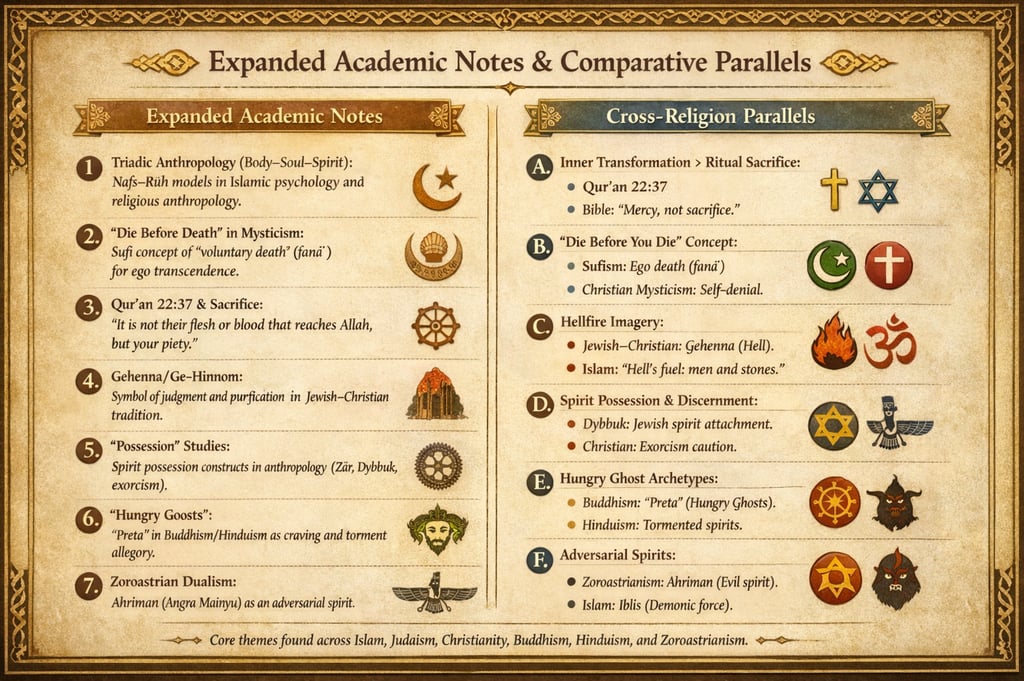
Triadic anthropology (body–soul–spirit / nafs–rūḥ): The poem’s layered human constitution aligns with long-running comparative debates on “body/soul/spirit” models in religious anthropology and psychology, including Islamic frameworks where rūḥ and nafs are analytically distinguished in spiritual-ethical discourse.
Mystical “death before death”: The poem’s “die before dying” theme maps closely to Sufi ethical-ascetic language around voluntary ego-death (fanāʾ / “mawt-i irādī”), widely documented in modern scholarship on Sufism.
“Mutū qabla an tamūtū” as a received maxim: While often circulated as a Prophetic ḥadīth in popular contexts, in academic treatments it functions as a normative Sufi watchword framing self-renunciation; see scholarly discussions that treat it explicitly as a “Prophetic Tradition” in Sufi conceptual history.
Sacrifice critique (intent over substance): The poem’s line that neither flesh nor blood reaches Allah closely echoes Qur’ān 22:37’s doctrinal emphasis on piety/taqwā over material offering.
Parallel prophetic critiques in the Hebrew Bible: Analogous polemics against empty ritual appear in Jewish scripture, emphasizing mercy/inner contrition as superior to sacrifice—an important cross-tradition convergence with the poem’s moral logic (ritual ≠ spiritual transformation).
Gehenna / Ge-Hinnom historical layer: The poem’s “Cahinum” evokes the valley tradition behind Gehenna, whose imagery (child sacrifice associations; later punitive/purgative imagination) is treated in reference scholarship on Jewish–Christian eschatology.
Gehenna as purgative/punitive in Jewish tradition: Reference treatments note both punitive and purifying conceptions; this matters because the poem alternates between “burning waste” imagery and moral purification logic (conscience → spared repeated death).
Possession discourse across cultures (anthropological baseline): The poem’s “intrusion/attachment” model (a being “enters,” “seizes,” “feeds”) matches cross-cultural ethnographic patterns where spirit-possession is a stable interpretive frame for distress/altered states. Standard syntheses in anthropology treat possession as widespread, socially patterned experience.
Possession as social language (Zār studies): The poem’s moral warnings (risk, vulnerability, protective “circle”) resemble how possession idioms function as a moral and social semiotics in many societies; classic Zār ethnography shows possession as meaningful discourse, not mere “superstition.”
Clinical caution inside religious exorcism frameworks: The poem contrasts medical labels (e.g., schizophrenia) with spirit-intrusion claims. Notably, even institutional Christian doctrine explicitly warns not to confuse demonic presence with illness—showing an internal “discernment” ethic parallel to modern clinical caution.
Dybbuk as “attachment” model: The poem’s “clinging/intruding entity” parallels Jewish dybbuk lore where a malevolent spirit “clings” to a living host—useful for comparative mapping of “attachment possession” types.
Zoroastrian dualist demonology (Ahriman / Angra Mainyu): The poem’s “Iblis-like” adversarial Life (body) impulse and punitive agents can be compared to Zoroastrian cosmology of a destructive principle opposed to divine order; Encyclopaedia Iranica provides an authoritative overview of Ahriman/Angra Mainyu.
Fire imagery as moral cosmology: The poem’s “smokeless fire” metaphysics and “hellfire” moralization parallels broader West Asian symbolic economies where fire marks purification, punishment, and ontological intensity; the Gehenna tradition is a major conduit into Jewish–Christian “hellfire” imaginaries.
Hungry ghosts / preta (desire as suffering): The poem’s vampiric “feeding” and insatiability resonates strongly with the Buddhist/Hindu “preta” (hungry ghost) class: beings defined by craving and deprivation, frequently read as ethical-psychological allegory for addiction/greed.
“Spiritually dead” as moral condition (Christian parallel): The poem’s “spiritless Life (body) = ruin” can be compared (carefully, without collapsing categories) to Pauline imagery of being “dead in trespasses and sins,” where “death” is moral-spiritual separation rather than biological cessation.
Gehenna’s Jewish origins in the Gospels (historical development): For academically careful readers, modern scholarship traces how Gehenna language is inherited, adapted, and redeployed in early Christianity, with Jewish canonical/extracanonical roots foregrounded.
Cross-Religious Parallels (Comparative Similarities Map)
A) Inner transformation > ritual substance (sacrifice critique)
Islam: Qur’ān 22:37 (piety reaches Allah, not blood).
Judaism/Christianity: Prophetic critiques (mercy/contrition > offerings) and later moral readings of sacrifice.
Poem-parallel: “blood doesn’t reach” + “remember within your Spirit.”
B) “Voluntary death” / ego-stripping as spiritual method
Sufism: “die before you die” as ascetic-mystical program; scholarly treatments in Schimmel and Sufi historiography.
Christian mysticism: “purgation/stripping” language appears in classic mystical theology (e.g., “purgation of the soul” traditions).
Poem-parallel: “second death,” “piece by piece,” “die before dying.”
C) Hellfire / burning-place imagery as moral pedagogy
Jewish–Christian: Gehenna’s evolution into “hellfire” imagery; sometimes purgative, sometimes punitive.
Islam: Qur’ānic “fuel” imagery resonates with the poem’s “human and stone.” (The poem poetically glosses this moral logic rather than quoting a verse.)
Poem-parallel: “Cahinum,” “fuel,” “burning refuse,” “repeated dying.”
D) Possession / intrusion idioms and the illness boundary
Anthropology (cross-cultural): Possession as widespread, socially meaningful pattern of experience.
Catholic Christianity: institutional insistence on distinguishing illness from “evil one” presence.
Jewish folklore: dybbuk as “attachment/clinging spirit.”
Poem-parallel: “phantom enters,” “seizes,” “discernment,” “don’t summon.”
E) Desire-as-torment entities (vampiric hunger / hungry ghosts)
Buddhism/Hinduism: preta (hungry ghost) as craving embodied; ethics-through-cosmology.
Poem-parallel: “feeds on blood,” “shifts forms,” “insatiable harm.”
F) Adversarial spirit-cosmologies
Zoroastrianism: Ahriman/Angra Mainyu as adversarial principle; demonological moral universe.
Poem-parallel: “Iblis-like” Life (body) impulses; punitive agents; moral causality.
The Chinvat Bridge (Činvat / Činwad) Doctrine in Zoroastrianism
In Zoroastrianism, one of the central symbols of the post-mortem fate is the Chinvat Bridge (Avestan činvatō peretūm; Middle Persian Činwad Puhl). Meaning “the bridge that separates, that discriminates/chooses,” this concept represents the threshold where a person’s thoughts, words, and deeds in worldly life (good thoughts–good words–good deeds) are weighed on a moral scale. After death, the soul must pass over this bridge; it is also a boundary line where cosmic justice operates.
In Zoroastrian cosmology, the soul remains in a position close to the world during the first three nights after death. This period is a liminal time in which the spiritual reverberations of one’s life become manifest. On the fourth day, the soul proceeds toward the Chinvat Bridge. There, the person’s deeds are evaluated by representatives of the divine order and by recorders of destiny.
If a person’s life has conformed to the principle of righteousness (aša), the bridge becomes wide and safe. The soul reaches, on the far shore, a paradisal realm described as filled with beauty and light. During this passage, the soul encounters a guide who appears in the form of “a beautiful young maiden,” as a symbolic manifestation of the person’s good deeds. This figure is the concretized form of the person’s virtuous life.
By contrast, for those who live on the path of evil and falsehood (druj), the bridge narrows, becomes razor-sharp, and turns impassable. The soul confronts an ugly manifestation of its own evil deeds and falls downward into a dark plane of existence. Thus, the Chinvat Bridge is not merely a point of passage; it is an ontological mirror in which a human being faces one’s own actions.
In Zoroastrian teaching, this process is not the final endpoint of destiny. Cosmic history is completed with a universal renewal called “Frashokereti.” In this ultimate moment of purification, evil will be wholly eliminated, creation will return to its pure state, and justice will fully manifest. The Chinvat Bridge gains meaning as the symbolic stage of individual reckoning and differentiation on the way toward this great renewal.
In this context, the doctrine of the Chinvat Bridge is a powerful metaphor that carries moral responsibility beyond death: the human being is the architect of one’s own fate; the bridge is less an external obstacle than a passage shaped by one’s own deeds.
Frashokereti (Frashō.kərəti) — The Zoroastrian Doctrine of Cosmic Renewal
Frashokereti is the doctrine of “universal renewal” in Zoroastrianism, expressing the final phase of cosmic history. The Avestan term frašaō.kərəti carries meanings such as “renewal, being made into its best state, being restored.” In this teaching, at the end of the long struggle between good and evil, the universe will be completely purified; creation will be returned to its original pure order (aša).
According to Zoroastrian cosmology, history is a linear process of struggle: the principle of truth and order, Aša, is in conflict with Druj, falsehood and destructive force. The human being is not a passive spectator of this struggle but an active participant; through the principle of “good thoughts, good words, good deeds,” one contributes to the strengthening of cosmic order. Frashokereti is the ultimate fruit of these moral contributions.
In eschatological narration, Frashokereti occurs in several stages:
The advent of the Saoshyant (the Savior figure): According to Zoroastrian tradition, at the end of time a savior appears and consolidates the victory of truth.
The resurrection of the dead: All humans are resurrected; body and soul are reunited.
Universal judgment and purification: The texts describe a purifying process symbolized as a “river of molten metal.” This fire feels like warm milk to the righteous, while to the wicked it becomes a purifying torment. The aim is not so much punishment as cleansing.
The complete elimination of evil: Angra Mainyu (the destructive principle) is rendered powerless; death, illness, and decay come to an end.
Immortality and perfection: Human beings attain a renewed existence, bodily and spiritually; the wearing effect of time is removed.
A striking aspect of the doctrine of Frashokereti is the idea of ultimate universal reconciliation. Evil does not endure forever; at the end of the purification process, creation is wholly healed. In this respect, Zoroastrian eschatology points not to the absolutization of an eternal dualism, but to a final wholeness.
From the perspective of comparative religions, Frashokereti bears similarities to the Abrahamic doctrines of “the apocalypse and resurrection,” as well as to certain early apocalyptic texts. However, the motif of purifying fire and the emphasis on universal restoration in Zoroastrianism focus more on cosmic healing than on punishment. For this reason, Frashokereti is not merely an end, but a completion in which existence reaches its most perfected form.
In summary, Frashokereti places human moral action within a cosmic frame: every righteous choice contributes to the universe’s ultimate healing. History is not a narrative of collapse, but a process that advances—through purification—toward perfection.
Anatta / Anatman (The Doctrine of Non-Self)
Anatta (Pali) or Anatman (Sanskrit) is one of the foundational concepts of Buddhist thought and means the “absence of a permanent, unchanging essence/soul.” According to this doctrine, what a human being calls “I” is not a fixed entity, but a composite of continuously changing physical and mental processes.
The Five Aggregates (Pañcakkhandha)
According to the Buddha, “personhood” consists of five aggregates (skandhas):
Rūpa – Material form/body
Vedanā – Sensations/feelings
Saññā (Sañjñā) – Perception
Saṅkhāra (Saṃskāra) – Mental formations, dispositions
Viññāṇa (Vijñāna) – Consciousness
These elements are in constant change. A person appropriates them as “I” or “mine”; but according to Buddhism, this appropriation is a delusion. For something that changes cannot be a permanent essence. Therefore, “selfhood” is a process that gives the impression of continuity; it is not an essential entity.
The Three Marks of Existence (Tilakkhana)
The doctrine of anatta is one of the three basic characteristics of Buddhist ontology:
• Anicca – Impermanence
• Dukkha – Unsatisfactoriness / suffering
• Anatta – Non-self
Everything is impermanent (anicca); attachment to what is impermanent produces suffering (dukkha); therefore nothing possesses a permanent essence (atta).
The Problem of Reincarnation: “Who is reborn?”
Buddhism accepts the doctrine of rebirth (samsara), but it does not explain this as “the transmigration of an unchanging soul.” The analogy of a flame passing from one candle to another is used: it is not the same, yet not entirely different either. There is causal continuity, but no essential identity. This approach differs from the Hindu doctrine of Atman (a permanent essence).
Philosophical Consequences of Anatman
• Ego dissolution: Understanding the delusion of self reduces selfishness and increases compassion.
• Non-attachment: It is understood that things grasped as “mine” are impermanent.
• The path to Nirvana: Overcoming the self-delusion is a prerequisite for liberation (nirvana).
Comparative Perspective
• Hinduism: The identity of Atman–Brahman is affirmed; there is a permanent essence.
• Islam and Christianity: The continuity of the soul and the continuation of personal identity after death are fundamental.
• Buddhism: There is continuity, but no permanent essence.
For this reason, anatta offers a radical critique of classical “soul metaphysics.” It defines the human being not as an unchanging entity, but as a process arising moment by moment.
The doctrine of anatta inverts the question “Who am I?” Perhaps the question itself is misleading. Because from the Buddhist perspective, the “I” is not a coherent essence but the flow of impermanent factors. Liberation begins with directly seeing the nature of this flow.
Second Death
The concept of “second death” appears most explicitly in Christian eschatology, especially in the Book of Revelation in the New Testament (Revelation 20:14; 21:8). The text says, “Death and Hades were thrown into the lake of fire; this lake of fire is the second death.” Here, “second death” refers to the eternal separation from God as a result of the final judgment after biological death.
1. Second Death in Christianity
In Christian theology, the process is conceived as follows:
• First death: Biological/bodily death.
• Resurrection: The resurrection of all human beings.
• Final Judgment: The evaluation of faith and deeds.
• Second death: Exclusion from the presence of God; symbolically, the “lake of fire.”
Here, death is not only a physical end but also a relational rupture. Eternal union with God is salvation, while eternal separation from God is called the second death.
2. Similar Concepts in Judaism
In Jewish literature, the term “second death” does not appear explicitly; however, in some apocalyptic texts there is the idea of Gehinnom (a place of purification or punishment). This is more often interpreted as a process of moral purification. The systematic Christian doctrine of “second death” evolved from Jewish thought, but became a more distinct and definite theological category.
3. Is There an Equivalent in Islam?
In the Qur’an, the phrase “two deaths” appears in Sūrat al-Mu’min (40:11):
“Our Lord! You caused us to die twice, and You gave us life twice…”
In classical tafsīr, this is generally explained as follows:
• First death: The state of not yet existing
• First life: Worldly life
• Second death: The end of worldly life
• Second life: Resurrection in the Hereafter
In Islam, “second death” is not an eternal annihilation as in Christianity, but is understood as the second death stage before resurrection. The primary emphasis is on “eternal life.”
4. Sufi Interpretation: Dying Before Death
In Sufism, the phrase “die before you die” describes the dissolution of the ego/self (nafs). In this context, the concept of “second death” can be interpreted metaphorically as:
• The death of egoic desires
• The extinction of the claim to selfhood
• Being reborn in divine consciousness
This is not physical, but an existential transformation.
5. Buddhist Perspective
In Buddhism, the term “second death” is not used. However, the dissolution of the self-delusion (anatta) and the experience of nirvana can be interpreted as a metaphorical “death,” in the sense that ego-centered identity comes to an end. This “death” is not annihilation, but the cessation of suffering.
6. A Similarity in Zoroastrianism
In Zoroastrianism, the purification after the Chinvat Bridge and the final Frashokereti process resemble a transition between “moral death” and “re-purification.” However, the dominant idea here is not eternal annihilation, but final restoration.