BERESHIT (BRAŞİT)
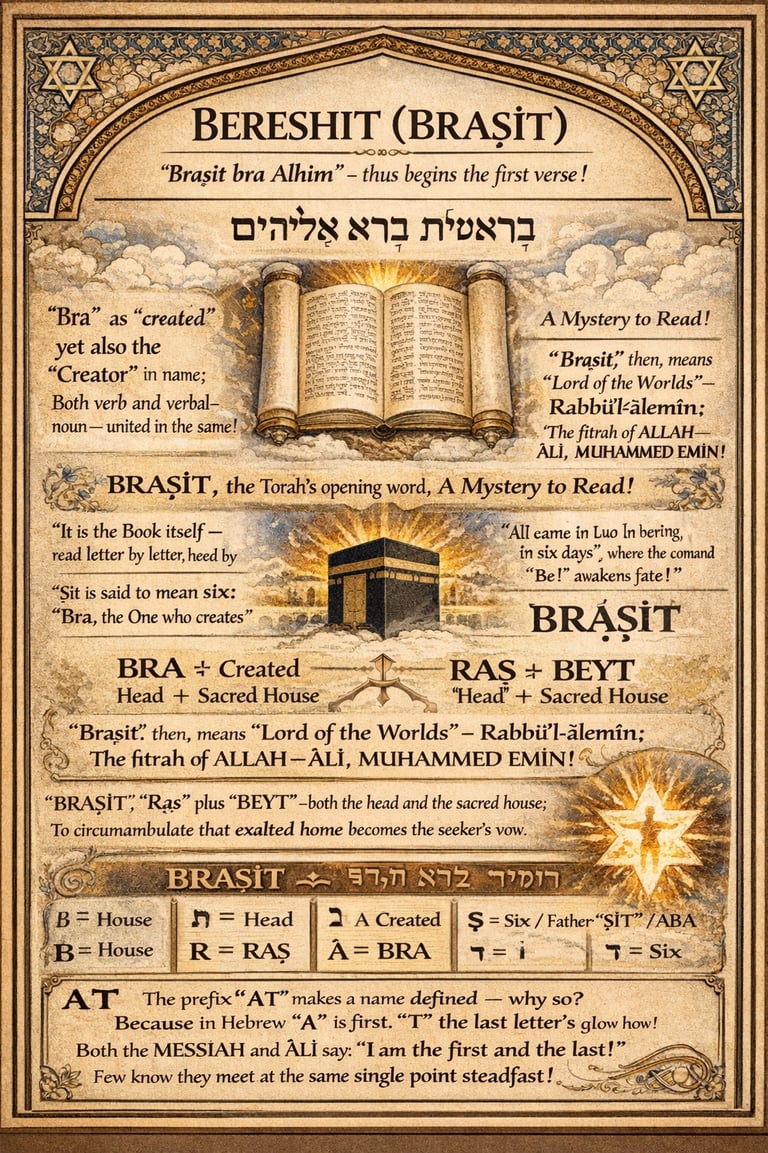
BERESHIT (BRAŞİT). “Bra” means “created,” yet also “the Creator” in name; Both verb and verbal-noun — united in the same! The Torah’s opening word, “BRAŞİT,” a riddle to read; “It is the Book itself — read letter by letter, heed by heed!” “Şit” is said to mean six; “Bra,” the One who creates;
APOCALYPSE BOOK
BERESHIT (BRAŞİT)
“Braşit bra Alhim” — thus begins the first verse!
Its secret you will solve, if you translate it true and diverse!
“Bra” means “created,” yet also “the Creator” in name;
Both verb and verbal-noun — united in the same!
The Torah’s opening word, “BRAŞİT,” a riddle to read;
“It is the Book itself — read letter by letter, heed by heed!”
“Şit” is said to mean six; “Bra,” the One who creates;
“All came into being in six days,” when the command “Be!” awakens fate!
“Braşit,” then, means “Lord of the worlds” — Rabbü’l-âlemîn;
The fitrah of ALLAH — ÂLÎ, MUHAMMED EMİN!
“Braşit”: “Raş” plus “Beyt” — both the head and the sacred house;
To circumambulate that exalted home becomes the seeker’s vow.
“Braşit” the subject; “Bra” the verb; “Elohim” the object’s role;
To translate the first verse rightly — this is essential to the whole!
When no object-marker stands before, Elohim remains the aim;
A prefix is not always needed for the indefinite name!
But when “the earth and heavens” are made, behold the marker’s sign;
For a definite object the prefix must align!
Rabbü’l-âlemîn — the One who creates the Elohim;
And from the Elohim emerged Âdem, the first to begin!
Thus the Elohim are Lord’s Saints — yet not ALLAH’s own being;
Reflect upon this secret — deeper layers you’ll be seeing!
The prefix “AT” makes a name defined — why so?
Because in Hebrew “A” is first, “T” the last letter’s glow!
Both the Messiah and ÂLÎ say: “I am the first and the last!”
Few know they meet at the same single point steadfast!
The Torah’s secret was given to Şimon by İlyas;
Through “a spirit from Him,” Îsâ reached the mystery of the Messiah’s path!
The Torah’s first two letters: “B R” — reflect and read: RAB!
In Hebrew, “the Exalted” — ÂLÎ, EBUTTURAB!
Braşit holds six letters — “He created in six days,” they claim;
The six dimensions of the body — the six days’ hidden aim!
“The Gospel says: ‘Sound is the first’ — hear it before you die!
That sound is no empty word; it equals the command ‘Be!’ on high!
The center of Braşit is “Aş” — fire’s hidden flame;
What remains is “Brit”: covenant, a debt to reclaim!
“Braşit” — a vow given through fire, a sacred rite;
The baptism of Îsâ with fire — clear in its light!
The spark of Yahya made Îsâ the Messiah’s sign;
Seeing the ÂLÎ within himself, he bowed to Âdem divine!
In that moment Îsâ understood Yahya’s former name:
“He was İlyas before,” — thus the revelation came!
“Îsâ was not killed!” — “He was made to resemble Âdem’s frame!”
Prostrate to the Lord — yet call Him not ALLAH’s son by name!
Do not think prostration is pecking the earth like a bird;
İsmâil placed his forehead down, in ecstasy stirred!
This is Ibrâhîm’s entering fire without burning pain;
Thus one becomes the Friend of the Lord, in the Book’s knowledge domain!
Look at the Mi‘rāj: MUHAMMED was washed with fire’s embrace;
Even Mûsâ at Sînâ could not approach that place!
The spine ignites — the third eye opens in light;
In the first cell awakens the “Fire Human,” essence bright!
Then the first cell is called both “Point” and “Head”;
ALLAH told Mûsâ: “My Name is Beginning,” the wise one said!
For the point is the origin — the start of every sign;
The first spark from the “Green Tree” — the Lord’s hidden vine!
Thus the “Green Tree” becomes the Tree of Flame;
If sap from the root cannot rise, sorrow will remain!
In the word “Braşit,” after B comes “Raş,”
Meaning “Head” — strive to unveil its hidden clash!
“Braşit” means “at the beginning” — but of what, you may ask?
Say not “of time,” lest the sage should laugh at your task!
For a line moves forward and backward in endless tread;
Humans call the past “eternity” and the future “ever ahead.”
Yet both “pre-eternity” and “forever” are bound to time’s decree;
Seek that which stands beyond time — where true being shall be.
Thus within you is the immortal — united with ALLAH’s light;
Filter all things through the heart, not the mind’s mere sight!
“You swear upon timelessness, like the Lord’s own decree!”
A bearer of the Book’s wisdom, contemporary with every prophet to be!
“One who dies after a hundred years says: ‘I lived but a few days,’”
“And even less,” corrects the FATHER in mysterious ways!
BERESHIT means “Point,” at the threshold of timeless birth;
Ever young, like the youth whose first mustache appears on earth!
In every vision stands a red-crowned one — hair white, eyes flame;
“The oldest of the ancient” — write down his name!
The architect of the first house dwells within your head;
Unruined, undying — like a spirit never dead!
In the Torah, behold — ALLAH’s spirit was never made;
“Shin,” equal to fire, is the name by which it’s conveyed!
Three candles burning side by side form the letter “Ş”;
If you are wise, see MUHAMMED and ÂLÎ reflected in this mystery!
For “Ş” means three hundred — drop the zeros, three remain;
“Ş” — Imâm ÂLÎ, son of Abu Talib — truth hard to disdain!
When the letter “Ş” descends upon Yehova, it becomes the “Savior”;
Thus appears “YESHUE” — fail to find it, and sorrow grows greater!
The final verse ends with the words “B HBRAM”;
Meaning “when they were created” — a hidden program!
The letters of “BHBRAM” mirror “BABRHM”;
Meaning “by Ibrâhîm” — decode and move within!
“When they were created by Ibrâhîm,” the last word implies;
So the heart understands what the secret signifies:
The essence that created the first universe is Ibrâhîm;
In the Torah, “BERESHIT” is he — both RAHMÂN and RAHÎM!
“Return to the religion of Ibrâhîm,” the command to AHMED was given;
You too — with father and mother — turn to that path toward heaven!
Looking within, Ibrâhîm discovered himself at last;
Becoming the Friend of the Lord — self-knowledge is the HANÎF DİN steadfast!
“Before Ibrâhîm” and “ABRHM” echo the very same word;
The essence born from him bows in oath — in prostration to the Lord!
In the final verse the first word is “HAK” — but why so placed?
Because when the first oath was given, the Lord stood witness-faced!
The word that follows HAK is the letter “T,” the symbol of the cross;
It is the vow of becoming Messiah — open your eyes to what it costs!
The last secret reads “B ABRHM,” meaning “By Ibrâhîm” made;
Ibrâhîm is ÂLÎ — a mystery the Elohim never weighed!
Master M.H. Ulug Kizilkecili
Türkiye/Ankara - 27 September 2000
IMPORTANT NOTE :The original text is poetic, and the author cannot be held responsible for any errors in the English translation! To read the original Turkish text, click HERE! The following section is not the author's work, and the author cannot be held responsible for any errors made!
(x) In Hebrew: Yehova = YEUE
In Hebrew: Savior = YESHUE
FOOTNOTES
[1] Grammar of “Berēʾšît” (בְּרֵאשִׁית):
Most linguists consider Berēʾšît a construct form; therefore translations vary between “In the beginning…” and “When/At the beginning of…,” depending on the syntax of Genesis 1:1–3.
[2] The Claim “Bra = created / creator”:
The Hebrew bārāʾ (בָּרָא) in Genesis 1:1 is a verb meaning “he created.” The participial form meaning “creator” is built differently; the poem’s reading reflects a poetic interpretation rather than standard grammar.
[3] The Claim “Şit = six” (Linguistic Note):
The standard Hebrew word for “six” is šēš (שֵׁשׁ). Therefore interpretations linking “Bra-šît” with six days of creation belong more to midrashic or gematria-style wordplay than to strict philology.
[4] “Elohim Creating / Adam from the Elohim”:
Although ʾĕlōhîm appears plural in form, it often governs singular verbs when referring to the God of Israel. The plural form does not necessarily imply ontological polytheism; linguistic form and theological interpretation must be distinguished.
[5] The Particle אֵת (ʾēt / AT) in Genesis 1:1:
The poem’s claim that “AT makes a noun definite” differs from academic grammar, where ʾēt is understood as a definite direct-object marker, usually untranslated and purely syntactic in function.
[6] “AT = First and Last” (Aleph–Tav) and Christian Typology:
Some Messianic readings link aleph–tav (את) to Alpha–Omega symbolism. However, linguistically its primary role in Genesis 1:1 remains that of an object marker; theological symbolism should be distinguished from grammatical analysis.
[7] The Title “First and Last” in an Interreligious Context:
In Christian textual tradition, “Alpha and Omega” expresses divine sovereignty. The similarity with the Hebrew aleph–tav may be drawn symbolically at the level of inclusiveness through letters; however, this association remains independent from the grammatical role of ʾēt in Genesis 1:1.
[8] The Analogy “Head + House (raş + beyt) = Circumambulation”:
The connection between “house” and “beginning/head” represents a symbolic interreligious reading (e.g., circumambulation around a sacred center). Academically, this is considered a hermeneutical strategy rather than philological evidence.
[9] “Not Necessarily the Beginning of Time” (Bereshit Debate):
The idea that Bereshit need not mean “the beginning of time” partially aligns with modern discussions of the construct-state reading, yet the final translation depends on the full syntax of Genesis 1:1–3.
[10] Gematria and Letter Symbolism — Academic Limits:
The poem’s emphasis on “letter by letter, syllable by syllable” resembles midrashic and especially kabbalistic practices such as gematria or notariqon. Within academic method, these are treated as interpretive traditions rather than historical-linguistic meanings.
[11] The “Seventy Interpretations of Bereshit” (Tikkunei Zohar):
One of the most prominent examples of multilayered interpretation is the tradition of seventy readings of Bereshit in Tikkunei Zohar. This reflects textual polyphony rather than a single definitive etymology.
[12] “Aş = Fire” and the Distinction from Hebrew ʾēš:
The Hebrew word for “fire” is אֵשׁ (ʾēš). The poem’s equation of “aş” with fire appears to be based on phonetic resemblance rather than strict philology, similar to certain kabbalistic wordplays.
[13] “Brit = Covenant”:
The Hebrew berit (בְּרִית) indeed means covenant or agreement; in this respect the poem’s interpretation aligns with tradition. The transition toward “baptism by fire,” however, moves into Christian theological symbolism.
[14] “Baptism by Fire” (Yahya–Îsâ) and Christian Sources:
Imagery of fire and baptism is strong in the New Testament, particularly in the language attributed to John the Baptist. Here the poem shifts from philology to intertextual theological interpretation.
[15] “Sound as the First / The Command ‘Be’”:
Creation through divine speech is a central theme in Jewish and Christian traditions (“God said…” in Genesis 1). Christianity develops this into Logos theology, while Islam expresses it through the formula kun fa-yakūn (“Be, and it is”).
[16] The Meaning of Prostration (Gesture Semantics):
The poem emphasizes prostration as bodily surrender. Across religious traditions, gestures such as proskynesis or kneeling carry varied theological meanings; here biblical scenes are reinterpreted through Islamic ritual language.
[17] “Îsâ Was Not Killed; It Was Made to Appear So” (Qur’an 4:157):
Academic debate continues regarding whether the verse denies the historical event, rejects specific claims of responsibility, or offers an interpretive correction of perception. Modern scholarship presents multiple models.
[18] Interpretations of “Shubbiha Lahum”:
Some scholars understand the phrase as “it appeared so to them,” focusing on perception rather than substitution. This differs from classical replacement theories and highlights the complexity of interpretation.
[19] The Spine, Fire, and the Third Eye — Kundalini Literature:
The poem’s imagery resembles narratives of kundalini awakening found in South Asian religious traditions and modern yoga discourse. Academic research approaches such experiences phenomenologically rather than as fixed biological mechanisms.
[20] Comparative Perspectives on Energetic Experiences:
Similar bodily-spiritual descriptions appear in Buddhist meditation, Christian mysticism, and contemplative traditions worldwide. Comparative study focuses on experiential typology rather than asserting identical ontologies.
[21] Attributions such as “Elias gave the Torah’s secret to Shimon”:
References to figures like Shimon bar Yoḥai often function within later mystical traditions as strategies of authority construction. Academic study treats these not as historical facts but as internal legitimizing narratives.
[22] Notes on “Yehova = YEUE / Savior = YESHUE”:
Transliteration varies across traditions; evaluating such claims requires attention to Masoretic vocalization, historical pronunciation reconstructions, and Greek/Latin transmission layers.
[23] A Framework for Comparative Study Across Religions:
The poem’s central axis — creation, divine speech, fire/light, messianic salvation, and esoteric wisdom — may be mapped comparatively across Jewish, Christian, Islamic, South Asian, Iranian, and Daoist traditions. The aim is thematic mapping rather than doctrinal equivalence.
[24] Methodological Warning — Multilayered Reading:
Many claims in the text operate simultaneously on three levels:
(i) philology/grammar,
(ii) traditional mystical interpretation, and
(iii) modern esoteric synthesis.
Without distinguishing these layers, poetic interpretation may be mistaken for historical-linguistic proof.