THE DOCTRINE OF SELF-DYNAMICS CHAPTER-3: THE CALL OF THE CENTER
THE DOCTRINE OF SELF-DYNAMICS CHAPTER-3: THE CALL OF THE CENTER. At the center of Blavatsky’s teachings is the concept of the “Mahatma.” “Mahatma” means “great soul” in Sanskrit. Blavatsky especially speaks of masters named “Morya” and “Koot Hoomi.” According to her, these beings were not ordinary..
ÖZ-DEVİNİM KURAMI
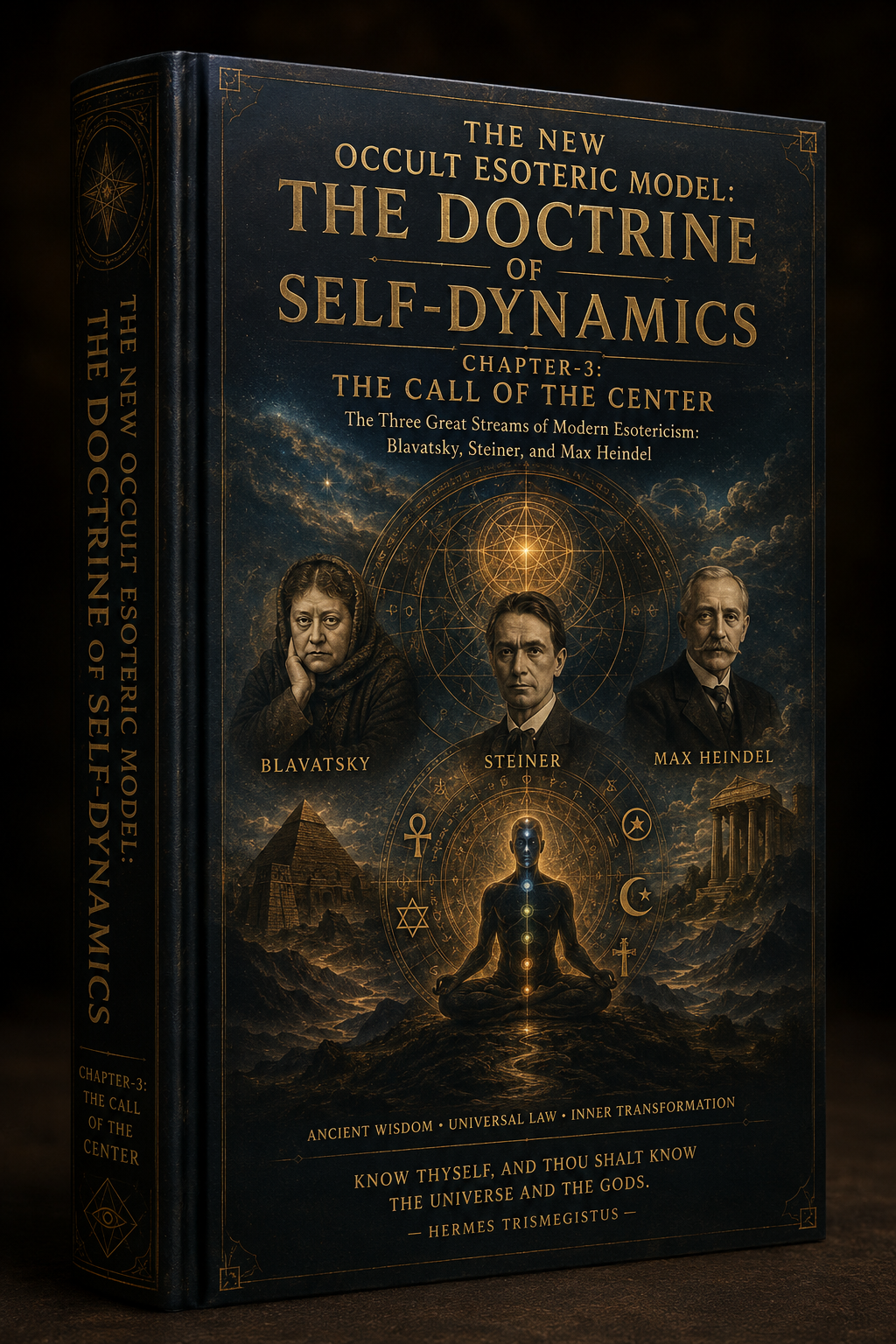
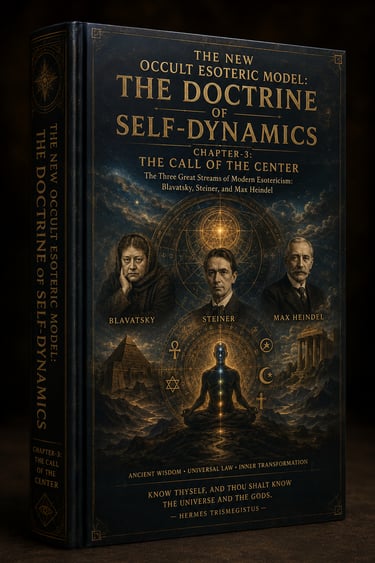
THE NEW OCCULT ESOTERIC MODEL: THE DOCTRINE OF SELF-DYNAMICS
CHAPTER-3: THE CALL OF THE CENTER
The Three Great Streams of Modern Esotericism: Blavatsky, Steiner, and Max Heindel
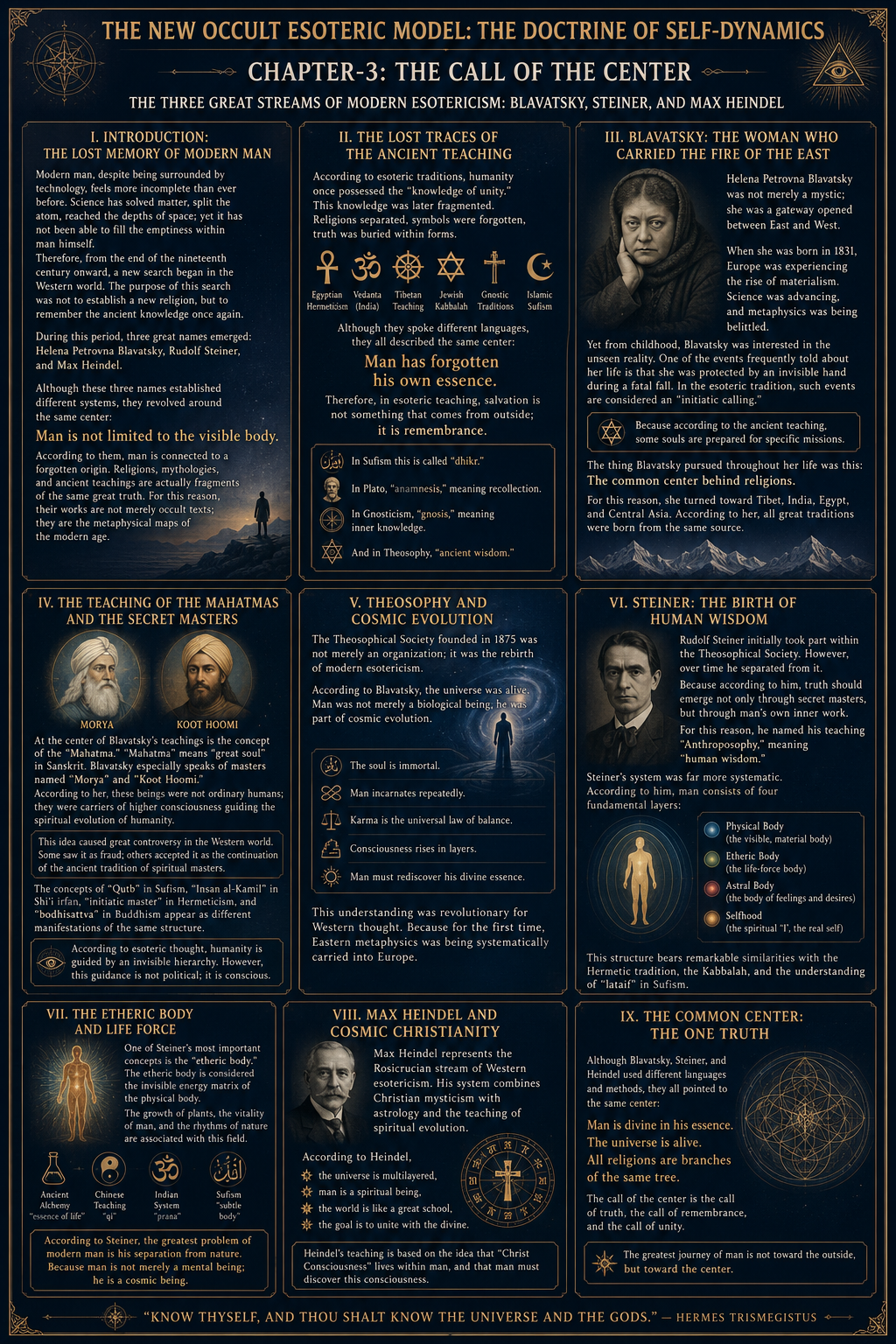
I. INTRODUCTION: THE LOST MEMORY OF MODERN MAN
Modern man, despite being surrounded by technology, feels more incomplete than ever before. Science has solved matter, split the atom, reached the depths of space; yet it has not been able to fill the emptiness within man himself. Therefore, from the end of the nineteenth century onward, a new search began in the Western world. The purpose of this search was not to establish a new religion, but to remember the ancient knowledge once again.
During this period, three great names emerged: Helena Petrovna Blavatsky, Rudolf Steiner, and Max Heindel.
Although these three names established different systems, they revolved around the same center:
Man is not limited to the visible body.
According to them, man is connected to a forgotten origin. Religions, mythologies, and ancient teachings are actually fragments of the same great truth. For this reason, their works are not merely occult texts; they are the metaphysical maps of the modern age.
II. THE LOST TRACES OF THE ANCIENT TEACHING
According to esoteric traditions, humanity once possessed the “knowledge of unity.” This knowledge was later fragmented. Religions separated, symbols were forgotten, truth was buried within forms.
The Hermetic tradition in Ancient Egypt, Vedanta in India, the secret teaching of Tibet, the Jewish Kabbalah, Gnostic traditions, and Islamic Sufism; although they spoke different languages, they all described the same center:
Man has forgotten his own essence.
Therefore, in esoteric teaching, salvation is not something that comes from outside; it is remembrance.
In Sufism this is called “dhikr.”
In Plato, “anamnesis,” meaning recollection.
In Gnosticism, “gnosis,” meaning inner knowledge.
And in Theosophy, “ancient wisdom.”
III. BLAVATSKY: THE WOMAN WHO CARRIED THE FIRE OF THE EAST
Helena Petrovna Blavatsky was not merely a mystic; she was a gateway opened between East and West.
When she was born in 1831, Europe was experiencing the rise of materialism. Science was advancing, and metaphysics was being belittled. Yet from childhood, Blavatsky was interested in the unseen reality. One of the events frequently told about her life is that she was protected by an invisible hand during a fatal fall. In the esoteric tradition, such events are considered an “initiatic calling.”
Because according to the ancient teaching, some souls are prepared for specific missions.
The thing Blavatsky pursued throughout her life was this:
The common center behind religions.
For this reason, she turned toward Tibet, India, Egypt, and Central Asia. According to her, all great traditions were born from the same source.
IV. THE TEACHING OF THE MAHATMAS AND THE SECRET MASTERS
At the center of Blavatsky’s teachings is the concept of the “Mahatma.” “Mahatma” means “great soul” in Sanskrit. Blavatsky especially speaks of masters named “Morya” and “Koot Hoomi.” According to her, these beings were not ordinary humans; they were carriers of higher consciousness guiding the spiritual evolution of humanity. This idea caused great controversy in the Western world. Some saw it as fraud; others accepted it as the continuation of the ancient tradition of spiritual masters. The concepts of “Qutb” in Sufism, “Insan al-Kamil” in Shi‘i irfan, “initiatic master” in Hermeticism, and “bodhisattva” in Buddhism appear as different manifestations of the same structure. According to esoteric thought, humanity is guided by an invisible hierarchy. However, this guidance is not political; it is conscious.
V. THEOSOPHY AND COSMIC EVOLUTION
The Theosophical Society founded in 1875 was not merely an organization; it was the rebirth of modern esotericism. According to Blavatsky, the universe was alive. Man was not merely a biological being; he was part of cosmic evolution. In her system, the soul is immortal, man incarnates repeatedly, karma is the universal law of balance, consciousness rises in layers, and man must rediscover his divine essence. This understanding was revolutionary for Western thought. Because for the first time, Eastern metaphysics was being systematically carried into Europe.
VI. STEINER: THE BIRTH OF HUMAN WISDOM
Rudolf Steiner initially took part within the Theosophical Society. However, over time he separated from it. Because according to him, truth should emerge not only through secret masters, but through man’s own inner work. For this reason, he named his teaching “Anthroposophy,” meaning “human wisdom.” Steiner’s system was far more systematic. According to him, man consists of four fundamental layers: physical body, etheric body, astral body, and selfhood. This structure bears remarkable similarities with the Hermetic tradition, the Kabbalah, and the understanding of “lataif” in Sufism.
VII. THE ETHERIC BODY AND LIFE FORCE
One of Steiner’s most important concepts is the “etheric body.” The etheric body is considered the invisible energy matrix of the physical body. The growth of plants, the vitality of man, and the rhythms of nature are associated with this field. This idea appears in ancient alchemy as the “essence of life,” in Chinese teaching as “qi,” and in the Indian system as “prana.” In Sufism, similar ideas are seen in the understanding of the “subtle body.” According to Steiner, the greatest problem of modern man is his separation from nature. Because man is not merely a mental being; he is a cosmic being.
VIII. MAX HEINDEL AND COSMIC CHRISTIANITY
Max Heindel represents the Rosicrucian stream of Western esotericism. His system combines Christian mysticism with astrology and the teaching of spiritual evolution. According to Heindel, the universe is multilayered, man is a spiritual being, the world is like a great school, suffering is a tool for the development of consciousness, and death is not the end. These ideas overlap remarkably with the Gnostic tradition.
IX. THE IDEA OF THE COSMIC MAN
One of the common centers of Blavatsky, Steiner, and Heindel is the understanding of the “cosmic man.” According to this, man is a small universe, that is, a “microcosm.” The Hermetic principle “As above, so below” describes exactly this. The human body is connected with the stars. Consciousness moves with cosmic rhythms. The soul is the reflection of the universal order. In Sufism this is called “alam al-saghir,” meaning “small world.” According to Ibn Arabi, because man is the summary of all existence, he is “kawn jami.”
X. THE SYMBOLISM OF FIRE
In these three teachings, fire is a very important symbol. Fire represents purification, consciousness, transformation, and divine energy. The stealing of fire by Prometheus, the fire of Moses on Mount Sinai, the sacred fire of Zoroaster, and the understanding of “nur” in Sufism unite at the same center. In esoteric traditions, the “inner fire” is the awakened spiritual center of man.
XI. LIGHT AND THE INVISIBLE HAND
The narrative of the “invisible hand” in Blavatsky’s life is not interpreted merely as a physical event. This symbol represents divine guidance, inner protection, and spiritual direction. In many esoteric traditions, truth is described through the language of “light.” “Or Ein Sof” in Kabbalah, “Nur” in Sufism, the “Light of the Pleroma” in the Gnostic tradition, and the “luminous mind” in Hermeticism are different names of the same metaphysical structure.
XII. INITIATION AND INNER DEATH
True esotericism is not the gathering of information. Initiation means the death of the old self, the dissolution of the ego, and the transformation of consciousness. There is a strong parallel between the saying in Sufism, “Die before you die,” and Hermetic initiation. For this reason, in all great esoteric systems, the symbols of cave, night, death, grave, and darkness are used. Because the person who reaches the truth must lose his old identity.
XIII. THE COLLAPSE OF ESOTERICISM IN THE MODERN AGE
After the twentieth century, esotericism turned into popular culture. The place of true discipline began to be taken by spiritual consumption, false gurus, superficial symbols, and the desire for power. While the systems of Blavatsky, Steiner, and Heindel were deep metaphysical structures, the modern age often sensationalized them. Thus, esotericism transformed from a search for truth into “mystical entertainment.”
XIV. CONCLUSION: RETURN TO THE INVISIBLE CENTER
Blavatsky carried the lost fire of the East to the West. Steiner tried to rebuild the inner center of man. Max Heindel interpreted the cosmic order through spiritual Christianity. Although they appeared different, all three pointed toward the same truth: Man is not merely a body. If modern man is still searching for meaning despite all technological progress, the reason is that the invisible center within him has not fallen silent. Because the common statement of all esoteric traditions is this: Truth is not outside; it is hidden within man’s own essence.
II. THE LOST MAP OF ANCIENT WISDOM
Hermeticism, Theosophy, Anthroposophy, and the Teaching of the Cosmic Human
The history of humanity is not only the history of wars, empires, and technological developments. On the invisible side of history, there is another stream transmitted from generation to generation: the tradition of hidden knowledge. Esoteric schools referred to this knowledge with names such as “ancient wisdom,” “primordial teaching,” “prisca theologia,” or “eternal wisdom.”
According to this understanding, humanity once possessed a holistic knowledge. The connection between existence, consciousness, and the universe had not yet been forgotten. Man did not see himself as separate from nature; he knew that there was a living relationship between the stars, the soul, and the cosmos. But over time, this unity fragmented. Knowledge was buried within symbols, and symbols transformed into rituals. While the essence of truth disappeared, only forms remained.
It was precisely at this point that Helena Petrovna Blavatsky, Rudolf Steiner, and Max Heindel emerged. They did not see themselves as founders of a new religion, but as reinterpretors of the forgotten ancient map.
THE ORIGIN OF THE HERMETIC TRADITION
One of the main streams of modern esotericism is Hermeticism. The Hermetic tradition takes its name from Hermes Trismegistus, regarded as one of the semi-mythological sages of the ancient world. This figure, whose name means “Thrice-Great Hermes,” emerged from the union of Egypt’s Thoth cult and Greek thought.
The central idea of Hermetic teachings is this: The universe is alive.
Matter is not lifeless; it is not separated from consciousness. There is an invisible resonance between man and the cosmos. For this reason, in Hermeticism man is seen as a “microcosm,” that is, a small universe. All the principles found in the great universe are also hidden within man.
The famous statement considered the summary of this understanding is as follows: “As above, so below.”
This sentence is not merely an astrological claim. At the same time, it is a metaphysical principle. The order found within the human soul is the reflection of the deep structure of the universe.
For this reason, in most esoteric traditions, stars are not seen merely as celestial bodies. They are symbols of states of consciousness.
THE HIDING OF KNOWLEDGE
In ancient traditions, truth was not taught openly. Because according to symbolism, true knowledge can become destructive in the hands of the wrong person.
For this reason, the initiation temples in Egypt, the vow of silence in the school of Pythagoras, the closed teachings of Kabbalah, the esoteric interpretation in Sufism, and the secret texts of the Gnostics are all parts of the same understanding.
Truth was seen not merely as intellectual knowledge, but as transformation.
Therefore, true esoteric teaching is not book knowledge. A person cannot understand truth without personally transforming.
Rudolf Steiner places a very important emphasis at this point: according to him, man can grasp truth not merely by learning ideas, but by changing his level of consciousness.
THEOSOPHY: THE COMMON ROOT OF ANCIENT RELIGIONS
The fundamental aim of the Theosophical Society was to reveal the common essence behind religions.
According to Blavatsky, Hinduism, Buddhism, Hermeticism, Gnosticism, Kabbalah, and Sufism were different faces of the same truth.
For this reason, the fundamental teaching of Theosophy is “unity.”
In the esoteric tradition, multiplicity is merely appearance. Truth does not fragment; it is only expressed through different symbols.
The concept of “ancient teaching,” frequently seen in Blavatsky’s works, actually points to humanity’s shared metaphysical memory.
This idea bears a remarkable similarity to the concept of “wisdom” in Islamic thought. In Sufism, truth unites in “wahdat” beyond religions. In the thought of Ibn Arabi, different religions are different mirrors of the same divine truth.
STEINER AND THE INNER ARCHITECTURE OF MAN
Rudolf Steiner made modern esotericism human-centered.
While Blavatsky focused more on cosmic secrets and ancient traditions, Steiner turned toward the inner structure of man.
According to him, man consists of four fundamental layers: physical body, etheric body, astral body, and selfhood.
This structure is not merely a metaphysical model. According to Steiner, thoughts, emotions, and spiritual states directly affect the human body.
Modern psychology would later develop the concept of the subconscious; however, Steiner was addressing the idea of layers of consciousness within a much broader cosmology.
In his system, man is not merely a biological organism. Man is also the intersection point of stellar and spiritual forces.
THE ETHERIC BODY AND THE FIELD OF LIFE
Steiner’s concept of the “etheric body” occupies a very important place in modern esotericism.
The etheric body is considered the carrier of life energy, the source of the force of growth, and the invisible plan of the body.
This idea appears in many traditions under different names: “prana” in Indian teaching, “qi” in China, “vital force” in Hermeticism, and “subtle body” in Sufism.
According to Steiner, the greatest problem of modern man is not only spiritual, but etheric disconnection. As man separates from nature, he loses his inner rhythm.
For this reason, Steiner did not only write mystical texts; he also worked in the fields of education, architecture, agriculture, and medicine. Because according to him, spirituality should encompass the entirety of life.
MAX HEINDEL AND COSMIC CHRISTIANITY
Heindel’s system interprets Christianity not literally, but as a cosmic teaching.
According to him, Jesus is not merely a historical figure; he is the symbol of “cosmic consciousness.”
This understanding bears strong parallels with the Gnostic tradition.
SPIRITUAL EVOLUTION AND REINCARNATION
One of the common points shared by Blavatsky, Steiner, and Heindel is the idea of spiritual evolution.
According to them, man is not limited to a single life.
The soul gains experience, undergoes different incarnations, develops consciousness, and eventually returns to the source.
This understanding was greatly influenced by Eastern religions. However, Western esotericism interpreted this not merely as “rebirth,” but as the unfolding of layers of consciousness.
THE COSMIC HUMAN AND ALAM AL-SAGHIR
One of the most central ideas of esoteric thought is the “cosmic human.”
Man is not merely an individual being. He is regarded as the summary of the universe.
In Sufism this is called “Alam al-saghir,” meaning “small universe.”
According to Ibn Arabi, man is the mirror of all names. In the Hermetic tradition, man is the reflection of the celestial order.
For this reason, a connection is established between the stars and human consciousness.
Astrology is the symbolic language of this connection.
True esoteric astrology is not fatalism, but the art of understanding the rhythms of consciousness.
THE ESOTERIC CRISIS AND THE MODERN AGE
In the modern world, esotericism has largely become superficial.
While the true tradition requires discipline, morality, transformation, and the training of the ego, modern spiritual culture has often been reduced merely to the search for experience and power.
For this reason, the systems of Blavatsky, Steiner, and Heindel have often been misunderstood.
Their purpose was not to enchant man, but to transform man.
Because the ultimate aim of esotericism is not mystery; it is consciousness.
CONCLUSION: IN SEARCH OF THE LOST CENTER
Hermeticism, Theosophy, Anthroposophy, and the Rosicrucian tradition may appear different at first glance. However, when one descends into their depths, it becomes clear that they are parts of the same great map.
This map says the following: Man has forgotten.
But the thing he has forgotten is not outside. Truth is hidden within man’s own essence.
For this reason, the common aim of all great esoteric systems is to return man once again to his own center.
III. ASTRAL GATES AND INITIATION
The Teaching of Hidden Transformation in Blavatsky, Steiner, and Max Heindel
In esoteric traditions, the true journey of man begins not in the outer world, but in the depths of his own consciousness. According to ancient teachings, although the ordinary person believes himself to be “awake,” he actually lives in a half-sleeping state. The world he sees is only a condensed layer of reality. The entirety of truth is hidden within invisible planes.
This is one of the deepest areas where Helena Petrovna Blavatsky, Rudolf Steiner, and Max Heindel converge: the invisible layers of man.
According to them, man does not consist solely of the physical body. Thoughts, desires, fears, and intuitions belong to other planes. The physical body is merely the densest and heaviest part of this greater structure.
WHAT IS THE ASTRAL WORLD?
In esoteric teachings, the “astral world” is accepted as the intermediate dimension where thoughts and emotions become concentrated.
This world is not physical, yet it is not completely abstract either. It can change form and interacts with consciousness.
The idea of the astral plane appears commonly in Hermeticism, Kabbalah, Theosophy, Anthroposophy, and Rosicrucian teaching.
Helena Petrovna Blavatsky interpreted this realm as the collective layer of human thought. According to her, thoughts do not disappear; they leave traces in the astral field.
For this reason, in ancient temples, thought control, silence, meditation, and symbolic rituals were considered extremely important.
Because thought was accepted not merely as psychological, but as an energetic force.
STEINER AND THE ASTRAL BODY
Rudolf Steiner defines the astral body as the carrier of human emotion and consciousness.
According to him, the physical body is connected to the world, but the astral body is of stellar origin.
The expression “stellar” here is not literal astronomy. The word “astral” comes from the Latin “astrum,” meaning star, and represents man’s relationship with cosmic consciousness.
According to Steiner, fear, hatred, jealousy, and anger darken the astral body.
In contrast, love, willpower, inner discipline, and conscious awareness purify the astral field.
There is a remarkable parallel between this understanding and the “purification of the nafs” in Sufism.
Because in both traditions, the inner world of man is accepted as the true battlefield.
MAX HEINDEL AND SPIRITUAL INCARNATION
Max Heindel argues that after death, man continues his existence on the astral plane.
According to him, death is not annihilation, but a transition of consciousness.
Man leaves the physical body behind, but desires, thoughts, and tendencies of consciousness continue to exist on the astral plane.
For this reason, Heindel places great importance on moral development. Because after death, the soul confronts its own inner structure.
This idea bears similarities to traditions such as the “weighing of the heart” in Egypt, the “mizan” in Islam, and the “Chinvat Bridge” in Zoroastrianism.
INITIATION: THE SECOND BIRTH
In esoteric traditions, true knowledge cannot be obtained merely by reading.
Knowledge must be lived, must transform, and must rebirth the individual.
For this reason, all great mystery schools possess “initiation.”
Initiation is not the learning of secrets, but a transformation of consciousness.
In Ancient Egypt, candidates were locked in dark chambers. In shamanic traditions, the individual was subjected to a symbolic death experience. In Sufism, the disciple is asked to “die before dying.”
Because the first condition for reaching truth is the dissolution of the old self.
Helena Petrovna Blavatsky interpreted this as “the silencing of the lower self.”
Steiner expressed it as “the purification of the self.”
According to Heindel, man must approach the “cosmic Christ consciousness.”
Although different expressions are used, the center is the same:
The new man cannot be born until the old man dies.
SYMBOLIC DEATH
In esoteric traditions, death is not a frightening symbol, but a transformative one.
For this reason, the grave, the cave, the night, the underworld, and darkness have always been used as symbols of initiation.
Because man can reach true reality only by passing through his own inner darkness.
In alchemy, the transformation of lead into gold actually describes the transformation of man.
Lead represents the heavy ego, attachment to matter, and the darkness of consciousness.
Gold represents purified consciousness, the spiritual center, and divine balance.
For this reason, alchemy is not merely the art of transforming metals; it is a symbol of consciousness.
THE BODY OF LIGHT AND NUR
In esoteric traditions, it is believed that there exists a “body of light” within man.
This idea appears in different forms in Kabbalah, Hermeticism, Gnosticism, Theosophy, and Sufism.
In Sufism, “nur” is not merely physical light. It means divine consciousness.
Rudolf Steiner argues that as human consciousness develops, the inner light of man increases.
According to Blavatsky, great spiritual masters were therefore described as “luminous beings.”
Max Heindel, on the other hand, says that humanity will eventually evolve toward a body of higher vibration.
This understanding is completely different from modern transhumanism. Here, transformation is not technological, but spiritual.
SECRET MASTERS AND SPIRITUAL HIERARCHY
One of the most controversial aspects of esoteric systems is the teaching of “secret masters.”
The figures “Morya” and “Koot Hoomi,” mentioned by Blavatsky, are among the best-known examples.
According to this teaching, humanity is not completely abandoned. There exists an invisible spiritual hierarchy guiding the development of consciousness.
This structure can be interpreted in parallel with the concepts of “rijal al-ghayb” in Sufism, “qutb” in Shi‘i irfan, and “bodhisattva” in Buddhism.
However, in true esoteric traditions, these figures are not beings to be worshipped, but guides of consciousness.
ASTROLOGY AND SPIRITUAL RHYTHM
Max Heindel interpreted astrology as the language of spiritual development.
Esoteric astrology is not fortune telling, nor is it mechanical fatalism.
The planets are symbols of rhythms of consciousness.
Mars is associated with willpower, war, and energy, while Venus represents the principles of love, harmony, and aesthetics.
In this understanding, celestial bodies do not forcibly determine human destiny; they reflect tendencies of consciousness.
THE AWAKENING OF THE INNER CENTER
Although the teachings of Blavatsky, Steiner, and Heindel use different paths, they move toward the same goal: the awakening of man’s own essential center.
This center is called “qalb” in Sufism, the “inner sun” in Hermeticism, the “divine spark” in Gnosticism, and the “higher self” in Theosophy.
True esotericism is not the search for external power, but for inner balance.
MODERN MAN AND SPIRITUAL FRAGMENTATION
The greatest problem of modern man is not lack of information, but the loss of center.
Man exists under constant stimulation, within mental fragmentation, disconnected from nature, and deprived of inner silence.
For this reason, esoteric traditions place great importance on silence.
Because silence is not merely refraining from speech, but overcoming the scatteredness of the mind.
According to ancient teachings, the voice of truth rises not from outside, but from the inner center of man.
CONCLUSION: THE THRESHOLD OF THE ASTRAL GATE
The teachings of the astral world, the body of light, initiation, and secret masters often appear symbolic or controversial to the modern mind.
However, the common purpose of these teachings is not to produce supernatural stories.
The real purpose is to remind man of his invisible side.
According to Blavatsky, Steiner, and Heindel, man is not merely a biological organism made of flesh and bone.
Man is a being that carries consciousness, possesses cosmic origins, and is capable of transformation.
And the final message of all true esoteric traditions is this:
Man cannot reach the center of truth without opening the gate within himself.
IV. COSMIC MEMORY AND LOST HUMANITY
Akasha, Universal Consciousness, and the Esoteric Interpretation of Ancient Ages
In esoteric traditions, time is not considered linear, but layered. While modern man sees the past as a sequence of events that has “remained behind,” ancient teachings argue that the past is still a living field of consciousness. According to this understanding, no thought, no event, and no vibration disappears completely. Everything is inscribed into the invisible memory of the universe.
One of the deepest concepts on which Helena Petrovna Blavatsky, Rudolf Steiner, and Max Heindel converge emerges precisely here: cosmic memory.
According to them, man does not consist only of individual memories. All of humanity is connected to an invisible field of shared consciousness.
WHAT IS AKASHA?
In the Theosophical tradition, “Akasha” is defined as the invisible field of records of the universe. This Sanskrit-based concept carries meanings such as space, ether, subtle matter, and cosmic field. However, the space mentioned here is not physical. Akasha is a metaphysical field of memory in which all thoughts and events leave traces.
Helena Petrovna Blavatsky defines this field as “the living book of nature.” According to her, the past is not erased, thoughts do not disappear, and humanity carries a collective consciousness. For this reason, some mystics have claimed that they saw visions of past ages. In the esoteric tradition, this is called “reading the Akashic records.”
STEINER AND THE AKASHIC CHRONICLE
Rudolf Steiner developed this idea in a more systematic way. According to him, if human consciousness passes through certain disciplines, it can come into contact with universal memory. Steiner called this the “Akashic Chronicle.”
In this understanding, the universe is not mechanical, but a conscious organism. Every event leaves a vibrational trace. According to Steiner’s claim, the knowledge of ancient civilizations has not completely disappeared; it has only withdrawn beyond humanity’s normal perception. For this reason, according to him, mythologies are not entirely products of imagination. Myths are symbolized remnants of historical consciousness.
LOST CIVILIZATIONS AND THE IDEA OF ATLANTIS
The concept of “Atlantis,” frequently mentioned in esoteric traditions, is not interpreted merely as a sunken continent. According to Blavatsky and Steiner, Atlantis is the symbol of a previous stage of human consciousness. In this teaching, humanity has experienced various root races and periods of consciousness. The concept of “race” here is not biological; it represents stages of consciousness.
The age of Atlantis is described as a period in which intuitive perception was strong, man lived in closer connection with nature, but eventually misused power. According to esoteric traditions, great catastrophes are not only physical; they are also the result of collapses in consciousness.
COLLECTIVE CONSCIOUSNESS AND THE DREAM OF HUMANITY
The concept of the “collective unconscious,” developed in modern psychology by Carl Gustav Jung, bears a remarkable similarity to esoteric traditions. According to Jung, humanity carries shared archetypes. Symbols such as the mother, the hero, the shadow, the wise old man, and the divine child are universal.
Esoteric thought carries this further: humanity carries not only shared psychological images, but also a shared spiritual memory. For this reason, mythologies resemble one another, flood narratives repeat in different cultures, and the symbolism of light appears universal. Because humanity consists of parts of the same deep source.
MAX HEINDEL AND UNIVERSAL EVOLUTION
Max Heindel interpreted the universe as a great school of consciousness. According to him, galaxies, stars, and planets are not merely physical structures. They are all stages of the evolution of consciousness. Humanity passes through the processes of descent into matter, experience, suffering, learning, and re-ascent.
This understanding is parallel to the Hermetic teaching of “descent and return.” In Sufism, there is a similar idea: “Inna lillahi wa inna ilayhi raji‘un,” meaning “we came from Him and to Him we shall return.” In esoteric systems, this return is not only the journey after death, but also conscious ascent.
THE ESOTERIC INTERPRETATION OF TIME
Modern thought sees time as a straight line: past, present, and future. But in esoteric traditions, time is cyclical. The “yuga” system in Indian teaching, the Stoic idea of “eternal return,” the Mayan calendars, and the understanding of “dahr” in Sufism are connected to the same metaphysical root.
According to Steiner, humanity passes through cycles of consciousness. In some ages, intuition becomes stronger; in others, reason predominates. The modern age is interpreted as a period of excessively materialized “dark condensation.”
SPIRITUAL FORGETFULNESS
In esoteric traditions, humanity’s fundamental problem is not sin, but forgetfulness. Man has forgotten his essence, lost his center, and become excessively attached to matter. For this reason, “awakening” is a very important concept in ancient teachings.
“Bodhi” in Buddhism, “yaqaza” in Sufism, “gnosis” in Gnosticism, and “illumination” in Hermeticism describe the same process. Truth is not gaining something new; it is remembering what has been forgotten.
THE COSMIC LANGUAGE OF SYMBOLS
Esoteric systems do not speak directly. Because they argue that truth cannot be fully expressed through plain logic. For this reason, symbols are used.
The mountain represents higher consciousness, the divine center, and the point of revelation. The sea represents the unconscious, chaos, and the field of potential. The cave represents inner transformation, the womb, and rebirth. The sun represents divine consciousness, the center, and spiritual light.
These symbols are seen commonly in Egypt, Kabbalah, Theosophy, Sufism, and alchemy. Because according to esoteric traditions, the language of humanity’s consciousness is shared.
MAN AND THE COSMIC NETWORK
In the systems of Blavatsky, Steiner, and Heindel, man is not an independent individual. Man is a being connected to the universe, part of the network of consciousness, and open to cosmic rhythms. Therefore, thoughts, emotions, fears, hatred, and love produce not only individual but also collective effects. For this reason, in esoteric traditions, morality is not merely a social rule, but a matter of cosmic balance.
THE MODERN AGE AND THE LOSS OF MEMORY
Modern man can access information, but he is losing meaning. According to esoteric traditions, the reason for this is the loss of inner silence, separation from nature, the forgetting of symbols, and the collapse of sacred perception. For this reason, modern man is constantly connected, yet inwardly alone. Ancient teachings argue that man must return once again to his center, his silence, and his inner memory.
THE INVISIBLE BOOK
Blavatsky’s “living book of nature,” Steiner’s “Akashic Chronicle,” and Heindel’s understanding of “cosmic record” are actually different interpretations of the same metaphysical idea. The universe is not blind, it does not forget, and it carries consciousness. And man is not only someone who observes the world, but also a living part of that great cosmic memory.
CONCLUSION: CAN HUMANITY REMEMBER ITSELF?
The most fundamental question of esoteric teachings is this: Can humanity remember again?
According to Blavatsky, the answer lies in ancient knowledge. According to Steiner, it lies in the discipline of consciousness. According to Heindel, it lies in spiritual evolution. But the common message of all three is the same: Man has not been completely severed from his source. Cosmic memory still exists. And if man can return to the silent center within himself, the forgotten gates can open again.
V. THE SECRET LANGUAGE OF NUMBERS
Esoteric Mathematics, Cosmic Geometry, and the Numerical Codes of Consciousness
In ancient esoteric traditions, number is not merely quantity. Numbers are considered alive. Each number represents a certain vibration, state of consciousness, and cosmic principle. While modern mathematics sees numbers as tools of measurement, the Hermetic tradition, Kabbalah, Pythagoreanism, Theosophy, and Rosicrucian teachings interpreted numbers as the metaphysical alphabet of the universe.
In the teachings of Helena Petrovna Blavatsky, Rudolf Steiner, and Max Heindel, the symbolic power of numbers also occupies a central place. Because according to them, the universe is not chaotic; it is founded upon mathematical consciousness.
PYTHAGORAS AND THE SOUL OF NUMBERS
One of the most important sources of esoteric mathematics in the West is Pythagoras. According to Pythagoras, “Everything is number.”
This statement does not carry only an arithmetic meaning. Numbers are seen as principles of existence, patterns of vibration, and forms of consciousness. The Pythagoreans established a relationship between musical notes and planetary movements. Because they believed that the universe operated through a mathematical harmony. This understanding gave birth to the concept of the “music of the spheres.” According to esoteric traditions, the human soul is also part of this cosmic harmony.
THE NUMBER ONE: UNITY AND CENTER
In all esoteric systems, the number “1” is the beginning. One represents the source, absolute unity, and undivided truth. In Hermeticism this is called “The All.” In Sufism, “wahdat.” In Kabbalah, “Ein Sof.” In Theosophy, “the Absolute.”
According to Helena Petrovna Blavatsky, all multiplicity is born from this unity. For this reason, the number one is associated with the symbols of the circle, the point, and the sun. Because the point is the invisible center.
THE NUMBER TWO: SEPARATION AND DUALITY
The number two is the division of unity. Dualities such as light and darkness, male and female, matter and spirit, night and day are connected to this principle. In esoteric traditions, the fall begins precisely at this point. While man is within unity, he passes into fragmented perception.
In Gnostic thought, the material world is accepted as the result of this separation. According to Steiner, human consciousness also develops within duality. The tension between reason and intuition, and between selfhood and universal consciousness, produces transformation.
THE NUMBER THREE: COSMIC COMPLETENESS
The number three is one of the most sacred numbers of esoteric traditions. Because three represents balance, synthesis, and creative movement. The Trinity in Christianity, the Trimurti in Hinduism, the body-soul-mind system in Hermeticism, and the understanding of sharia, tariqa, and haqiqa in Sufism are different reflections of the same structure.
Max Heindel explains the spiritual development of man through triple systems: thought, emotion, and will. Because consciousness is balanced through a threefold movement.
THE NUMBER FOUR AND MATTER
The number four represents directions, elements, and material order. In ancient systems, there are four elements: fire, water, air, and earth.
Steiner interpreted these elements not only as physical substances, but as states of consciousness. Fire represents will. Water represents emotion. Air represents thought. Earth represents condensed consciousness. For this reason, the number four is accepted as the number of “descent into the world.”
THE NUMBER SEVEN AND SPIRITUAL CYCLES
One of the most important numbers in esoteric teachings is “7.” Because seven carries the meaning of a completed cycle, stages of consciousness, and cosmic rhythm. Examples include seven planets, seven notes, seven colors, seven chakras, seven heavens, and seven stages of the nafs.
Helena Petrovna Blavatsky also explains the evolution of humanity through sevenfold systems. Max Heindel interprets the development of the soul through seven cosmic periods. In Sufism, too, it is said that the nafs has seven fundamental layers of transformation. For this reason, seven is the number of journey, maturation, and inner transformation.
THE NUMBER TWELVE AND THE COSMIC WHEEL
The number twelve is associated with celestial order. The twelve zodiac signs, the twelve apostles, the twelve tribes of the Israelites, the twelve imams, and the twelve months of the year are symbols of the same cosmic cycle.
In esoteric traditions, twelve means the wheel of time, universal order, and spiritual organization. According to Steiner, human consciousness is connected with astrological rhythms. However, this connection is not fatalism, but cosmic synchronism.
THE NUMBER TWENTY-EIGHT AND COSMIC LETTERS
In esoteric systems, the number 28 is considered very special. Because the Arabic alphabet has 28 letters, the moon has 28 mansions, and in some Hermetic systems creation is associated with 28 layers of vibration.
In Hurufism, letters are not merely elements of language, but the building blocks of existence. In Kabbalah, letters are accepted as creative powers. In Hermetic traditions, the universe is seen as a “vibrational word.” In Sufism, the command “kun,” meaning “be,” represents the connection between creation and sound. For this reason, letters and numbers are interpreted not merely as symbols, but as codes of consciousness.
THE GOLDEN RATIO AND COSMIC GEOMETRY
In esoteric thought, geometry is sacred. Pythagoras and the Platonic tradition believed that forms carried consciousness. The golden ratio appears in nature, galaxies, the human body, and plants. For this reason, esoteric traditions argue that the universe carries an “intelligent order.”
Gothic cathedrals, Egyptian pyramids, Islamic geometry, and mandalas are all products of this understanding of cosmic geometry.
STEINER AND SACRED GEOMETRY
Rudolf Steiner interpreted architecture as a spiritual field. His building called the Goetheanum was founded upon an architectural understanding that avoided sharp corners, used organic forms, and represented the flow of consciousness. Because according to Steiner, forms affect human consciousness.
The spiritual pressure of modern cities appears precisely here: sharp lines, artificial rhythms, and mechanical order weaken the inner center of man.
SOUND, VIBRATION, AND THE COSMOS
In esoteric traditions, the essence of the universe is vibration. The statement “In the beginning was the Word” is not only religious, but also a cosmological symbol.
According to Blavatsky, creation is a movement of vibration, sound, and frequency. This understanding is seen in practices such as mantras, dhikr, sacred music, and rhythmic prayers. Because it is believed that sound has a transformative effect on consciousness. In Sufism, the purpose of dhikr is not merely repetition, but to change the rhythm of consciousness.
NUMBERS AND GATES OF CONSCIOUSNESS
In esoteric teachings, the purpose of numbers is not fortune telling. True esoteric numerology is a tool for understanding patterns of consciousness, universal rhythms, and spiritual balance.
According to Blavatsky, Steiner, and Heindel, number is the metaphysical alphabet of the universe. For this reason, in ancient temples, mathematics, music, astrology, and geometry were not separated from one another. Because they were all different faces of the same great order.
THE FALL OF NUMBER IN THE MODERN WORLD
The modern age has severed number from sacredness. Number has now become a tool of consumption, statistics, economy, and algorithm. In ancient traditions, however, number meant consciousness, balance, and cosmic rhythm.
According to esoteric teaching, man is not merely a being who uses mathematics; he is a living part of a mathematical order.
CONCLUSION: THE SECRET FORMULA OF THE UNIVERSE
In the teachings of Blavatsky, Steiner, and Max Heindel, number is not merely calculation. Number is consciousness, symbol, and cosmic memory.
Even if the universe appears chaotic on the surface, in its deep structure it carries a harmonic geometry. And man is not only a spectator of this great mathematical symphony, but also one of its living notes.
VI. THE BODY OF LIGHT AND THE MULTILAYERED STRUCTURE OF MAN
Soul, Ether, Astral Field, and Cosmic Self
According to ancient esoteric traditions, man is not as simple a being as he appears from the outside. Modern biology defines man as an advanced organism composed of cells; however, the Hermetic tradition, Theosophy, Anthroposophy, and Rosicrucian teaching argue that man is a multilayered being living simultaneously in many dimensions.
At the center of the teachings of Helena Petrovna Blavatsky, Rudolf Steiner, and Max Heindel lies this understanding: Man is not merely a body. The body is the condensed form of deeper invisible layers.
THE PHYSICAL BODY: CONDENSED CONSCIOUSNESS
In esoteric traditions, the physical body is accepted as the “final layer.” That is, man first exists on the spiritual level; the body forms afterward. For this reason, in ancient systems the body is seen as the temple of the soul, the instrument of consciousness, and the shell of the invisible structure.
According to Rudolf Steiner, the physical body is not alive by itself. What keeps it alive are invisible energy layers. Although modern science explains the biochemical processes of the body, esoteric traditions argue that life is not merely chemistry. Because vitality cannot be explained only by molecular order.
THE ETHERIC BODY: THE MATRIX OF LIFE
In Steiner’s system, the second layer of man is the “etheric body.” The etheric body is interpreted as the carrier of life energy, the source of the power of growth, and the invisible plan of the organism. It is thought that plants possess a strong etheric field. For this reason, nature is accepted as an element that balances the human soul.
In esoteric traditions, forests, mountains, rivers, and sacred spaces are not merely physical places. They are also seen as energy centers.
According to Steiner, modern urban life weakens man’s etheric structure. Because man moves away from his natural vibration under artificial light, mechanical rhythm, and constant mental stimulation.
PRANA, QI, AND THE FLOW OF LIFE
The idea of the etheric body does not belong only to Anthroposophy. In the Indian tradition it is called “prana,” in Chinese teaching “qi,” and in Hermeticism “vital force.” Although there is no directly identical concept in Sufism, the understanding of the “subtle body” bears a remarkable parallel.
For this reason, breath is very important in ancient teachings. Because breath is seen not only as the exchange of oxygen, but as the circulation of life energy. It is no coincidence that rhythmic breathing techniques are found in many mystical traditions.
THE ASTRAL BODY AND THE EMOTIONAL WORLD
Helena Petrovna Blavatsky and Max Heindel interpret the astral body as the emotional and imaginal layer of man. The astral body is the carrier of desires, fears, passions, and dreams.
For this reason, the idea of the astral plane after death occupies a central place in many esoteric systems. According to Heindel, when man leaves the physical body, he continues to live in the astral layer.
Therefore, anger, fear, and hatred make the astral body heavier. In contrast, love, compassion, and inner balance purify the astral field. There is a remarkable similarity between this view and the understanding of “purification of the heart” in Sufism.
THE ENERGY OF THOUGHTS
In esoteric traditions, thought is not accepted as passive. Thoughts produce energy, create vibration, and affect the field of consciousness. According to Blavatsky, thoughts can take form on the astral plane. For this reason, in some esoteric systems there is the concept of “thought-form.”
It is thought that intense fears, collective hatred, or powerful prayers create a field. Certain parallels can be seen between this understanding and the concepts of the collective unconscious, group psychology, and emotional contagion in modern psychology.
THE BODY OF LIGHT
In esoteric traditions, one of the highest layers of man is the “body of light.” This body is interpreted as pure consciousness, the spiritual center, and the divine essence.
“Nûr” in Sufism, the “luminous breath” in Kabbalah, the “solar body” in Hermeticism, and the “spark of light” in Gnosticism are like different names of the same metaphysical idea.
Rudolf Steiner argues that as man develops consciousness, he strengthens his body of light. For this reason, great mystics throughout history have been described as having a “luminous face,” a “shining body,” and being a “radiant human.”
MAN AND THE COSMIC NETWORK
One of the common views of Blavatsky, Steiner, and Heindel is that man is not separate from the universe. Man is constantly connected with the stars, nature, collective consciousness, and invisible fields.
For this reason, not only physical nourishment, but also thoughts, environments, symbols, and sounds affect the human structure. The architecture of ancient temples was important for this reason. Because it was believed that space carried vibration.
CHAKRAS AND CENTERS OF CONSCIOUSNESS
Theosophy and modern esoteric systems carried the concept of chakras from Indian teaching to the West. Chakras are interpreted as centers of consciousness, energy nodes, and spiritual gateways.
Each center is associated with certain states of consciousness. For example, the heart center is seen as connected with love, the throat center with expression, and the forehead center with intuition. Although Steiner did not use this system exactly, he spoke of centers of consciousness in man. There are remarkable parallels between this understanding and the “lataif” system in Sufism.
THE HEART: THE INVISIBLE CENTER
In most esoteric traditions, the true center is not the brain, but the heart. The heart here does not mean the physical organ, but the center of consciousness.
In Sufism, “The heart is the mirror of the Throne.” In the Hermetic tradition, it is the “inner sun.” In Gnostic thought, it is the “divine spark.”
According to Blavatsky, the higher self within man can only be felt when heart-consciousness opens. For this reason, true esoteric work is not gaining power, but awakening the center.
SPIRITUAL FALL AND ATTACHMENT TO MATTER
According to esoteric systems, humanity’s fundamental problem is excessive materialization. Man believes only in the physical body, forgets his spiritual dimension, and loses his inner silence.
Steiner argues that the modern age produces “spiritual drought.” According to Heindel, humanity’s excessive materialism has produced spiritual blindness. Blavatsky says that modern civilization has become disconnected from ancient knowledge.
THE TRANSFORMATION OF THE BODY
In esoteric traditions, the aim is not to reject the body. The aim is to purify the body, bring it into harmony with consciousness, and transform it into an instrument suitable for spiritual energy.
The teaching of transformation in alchemy also describes this. Lead means heavy consciousness, density of the nafs, and material attachment, while gold means purified soul, balanced consciousness, and divine center. The true alchemy is not the laboratory; it is man himself.
THE COSMIC SELF
Blavatsky’s “higher self,” Steiner’s “spiritual ego,” and Heindel’s understanding of the “cosmic human” all move toward the same center. Man is greater than his temporary personality. The true self is accepted as timeless, luminous, and universal.
According to esoteric teachings, the aim of man is not to gain a new identity, but to recognize the essence beyond false identities.
THE FRAGMENTATION OF MODERN MAN
Modern life produces constant speed, distraction, artificial rhythms, and bombardment of information. This weakens man’s etheric balance, astral peace, and inner center.
For this reason, ancient teachings place importance on silence, nature, rhythm, contemplation, and conscious breathing practices. Because true awareness cannot arise unless the inner structure of man is rebalanced.
CONCLUSION: MAN IS MORE THAN WHAT IS SEEN
Although the teachings of Blavatsky, Steiner, and Max Heindel use different paths, they point to the same truth: Man is not merely the physical body. Man is a multilayered being that carries consciousness and possesses cosmic connections.
And true esoteric work is not to conquer the outer world, but for man to awaken the body of light within himself.