ENOCH (HANOK)
ENOCH (HANOK). There is a secret-laden book known as the “Book of Hanok”; The Church called it “crypto” and closed its gate with a lock! “Crypto” means “hidden,” not false or untrue; Hidden from the Church — reflect on this view! Found in Ethiopia, reaching back to ancient days;
APOCALYPSE BOOK
ENOCH (HANOK)
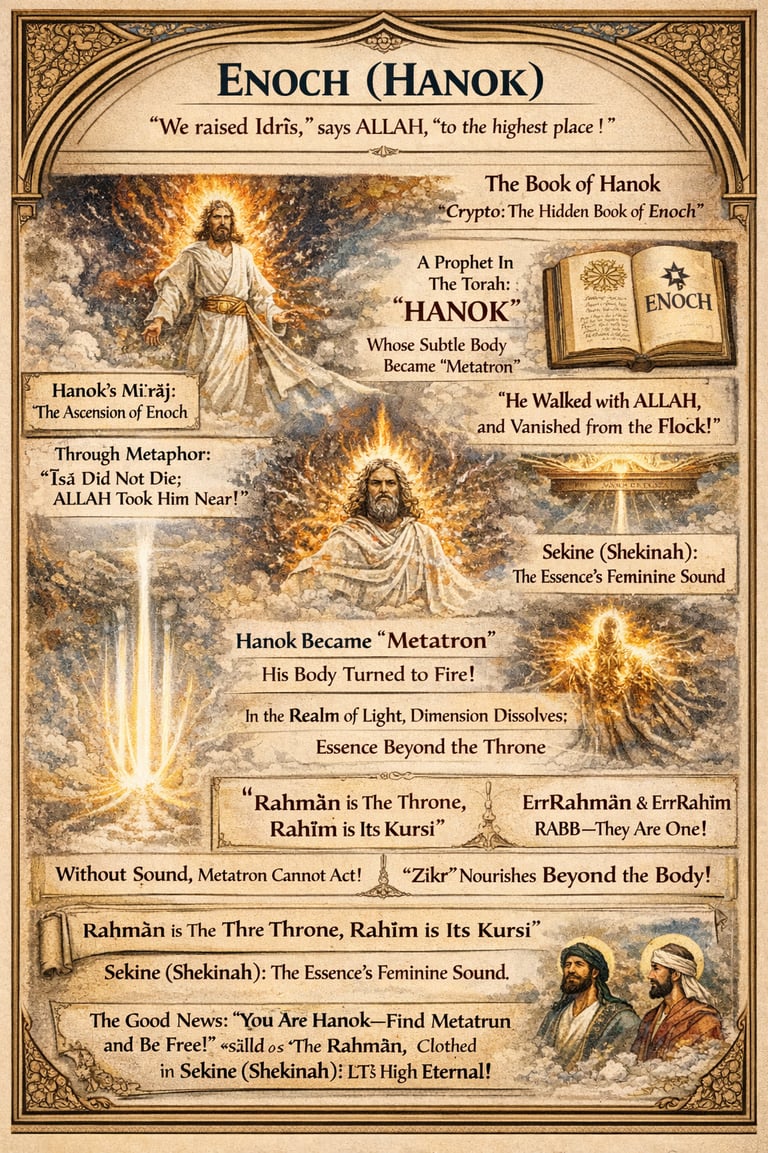
“We raised Idrîs,” says ALLAH, “to the highest place!”
This is the secret of “dying before death” — let the mind embrace!
“Îsâ did not die; ALLAH took him near!”
Many scholars struggled to make that meaning clear!
“Yet the verse speaks through metaphor,” it is said;
It tells of Îsâ’s Mi‘rāj — openly spread!
A similar claim appears about “Uzeyir” too;
Such narratives follow the same symbolic view!
For example, a prophet in the Torah bears the name Hanok;
“He walked with ALLAH, and his body vanished from the flock!”
Clearly, this was Hanok’s Mi‘rāj while still alive;
“ALLAH took him near,” — open your eyes and strive!
While the physical form remained, a subtle body would ascend;
In hidden rites people called this “euthanasia” in the end!
“Euthanasia” is Greek — in Turkish, “a willing death”;
Through trance one departs the physical, breath by breath!
There is a secret-laden book known as the “Book of Hanok”;
The Church called it “crypto” and closed its gate with a lock!
“Crypto” means “hidden,” not false or untrue;
Hidden from the Church — reflect on this view!
Found in Ethiopia, reaching back to ancient days;
Hanok tells how he ascended — whoever solves it awakes!
In the Torah only two verses speak of Hanok’s way;
The difference between subtle and physical bodies is clear as day!
Two Hanoks exist: one the righteous son of Yared’s line;
The other, Cain’s offspring — a murderer’s sign!
The good is the transparent body, the evil the physical frame;
The good lives long, the wicked short — why this claim?
“Hanok lived sixty-five, plus three hundred years,” they say — why so?
“Three hundred years he walked with ALLAH!” — that is the flow!
His first sixty-five years he lived within the physical span;
Three hundred in the subtle realm — the calendar of the cosmos’ plan!
“Hanok, son of Yared!” — behold, the seventh generation’s mark;
Passing seven layers, the servant becomes the Friend of the Lord’s spark!
When Hanok ascended to heaven, his name became “Metatrun”;
His body turned to fire, a cosmic form begun:
Even the subtle grew dense until all stain was gone;
As he rose, more transparent bodies he put on!
Just as a single speck in the eye is cast away,
The ranks ascend until only the Point holds sway!
In the realm of light, dimension itself dissolves;
Time and space fall away — the universe no longer revolves!
Metatrun means “the Essence beyond the Throne,” the name of RAB;
The Throne — twin rays of light — the Wise know RAHMÂN and RAHÎM in that tab!
Beneath the Throne lie seven heavens, seven layered domains;
Its ruler is called “the One who breathed the spirit into Âdem’s veins!”
The Spirit is RAHÎM, RAHMÂN, and RAB — three steps of ascent;
Through vibration the subtle body rises, heaven-sent!
ERRAHMÂN is the Throne, ERRAHÎM its Kursî’s grace;
Without RAHÎM, RAHMÂN would be only the Throne’s adornment in place!
RAB too is dual; the feminine power is sound — Sekine (Shekinah);
Whoever seeks the root of Sekine (Shekinah) descends toward the Essence’s sign!
Know this: without “that sound,” Metatrun cannot act;
Without uttering “that sound,” prayer itself lacks its pact!
By “that sound” the subtle feeds beyond the physical frame;
Its other name is “zikr” — without remembrance there is no claim!
From the pure state it returns at once into the physical form;
Thus the Qur’an and Islâm are remembrance — a sacred norm!
Metatrun nourishes both infant and angel alike;
Who understands may call it “Sekine (Shekinah) within the pure light”!
When physical Hanok becomes subtle, Metatrun is his name;
For İlyas it is Sandalfon — baptism that dissolves the frame!
MUHAMMED becomes MAHMUD, and ÂLÎ EBUTTÜRAB;
Îsâ is El Mesîh, humanity is Âdem — each called RAB!
In Hanok there is a clear glad-tiding for humankind’s plea;
It says: “You are Hanok — find Metatrun and be free!”
For this reason the Gospel is translated as “good news”;
Do not say “the Son descended” and shape it by selfish views!
Metatrun bears “seventy-two” names, each ending in “El”;
Meaning the Lord — and “twenty-eight” letters its secrets tell!
Yet the most important is the “Exalted Name” of ALLAH;
Some understood it as ÂLÎ, others called it ALLAH!
Let there be no confusion — between servant and Essence lies a part;
No wheel can ever turn without the watchmaker’s art!
To Mûsâ He first said, “I am ALLAH,” then, “I am RAB”;
One is behind the veil, the other before it — understand that tab!
ALLAH cannot be seen directly by any human eye;
See Him as “Presence,” “Face,” or “Youth” — that meaning will suffice!
The “Face” is His own sign; the Spirit forever young;
The “Presence” is everywhere ready — without the first point nothing’s begun!
Süleyman says: “The first thing created was Goodness — no less!”
“It is Wisdom itself!” — separating the knowing from ignorance!
The Lord says: “When I created, no unbeliever stood as witness there!”
Thus “those who witness” are those who made the covenant’s prayer!
The declaration of testimony belongs to creation’s sign;
Those who give the covenant are filled with wisdom divine!
RAHÎM is the RAHMÂN who clothed Himself in Sekine (Shekinah);
United with FÂTMA, appearing in the form of ÂLÎ’s light eternal!
Master M.H. Ulug Kizilkecili
Türkiye/ İzmir - 26 August 2001
IMPORTANT NOTE :The original text is poetic, and the author cannot be held responsible for any errors in the English translation! To read the original Turkish text, click HERE! The following section is not the author's work, and the author cannot be held responsible for any errors made!
Sâften = subtle / transparent body
Ahid = giving a covenant to the Lord
FOOTNOTES
[1] Who is Hanok/Enoch (Torah/Tanakh):
In its most basic form, Hanok/Enoch appears in Genesis 5:18–24 as an ancestor who “walked with God” and for whom it is said that “God took him.” The poem’s phrase “he walked with ALLAH and his body disappeared” reflects this core narrative; however, theories of subtle or transparent bodies are not explicit teachings at the peshat level of the Tanakh but belong to later interpretive traditions.
[2] The Distinction of “Two Enochs”:
The Tanakh mentions two individuals named Enoch: one from Cain’s lineage (Genesis 4:17) and another, the son of Yared (Genesis 5:18–24). The poem’s warning about “two Enochs” draws on this textual fact, while transforming it into a moral typology (good vs. evil) represents an interpretive layer.
[3] “God Took Him” — Death or Ascension?:
The expression “God took him” (laqach) in Genesis 5:24 allows for multiple interpretations, including a departure different from ordinary death or a special form of divine proximity. This ambiguity later inspired apocalyptic and mystical narratives of heavenly ascent.
[4] The Academic Status and Origins of 1 Enoch:
What is called 1 Enoch (Ethiopic Enoch) is not a single unified book but a collection composed of several literary layers. It portrays Enoch as a figure who attains heavenly secrets. The discovery of Aramaic fragments at Qumran provides strong evidence for its antiquity.
[5] “The Church Rejected It as Crypto” — Canonical Differences:
The canonical status of 1 Enoch varies across Christian traditions. While it holds a higher status in some communities (especially the Ethiopian tradition), most Western and Eastern churches do not include it in the canon. Labels such as “crypto” usually indicate non-canonical (apocryphal/pseudepigraphal) status rather than falsity.
[6] Enoch within Jewish Apocalyptic Thought:
Enochic literature is considered an early example of Jewish apocalypticism, emphasizing themes such as heavenly ascent, angels, cosmic order, and final judgment.
[7] The Watchers and the Genesis 6 Background:
One of the central narratives of 1 Enoch expands upon Genesis 6:1–4 (“sons of God and daughters of men”) by developing the myth of the Watchers. This tradition influenced later discussions of angelology and demonology.
[8] Enoch in Christianity — The Reference in Jude:
The Epistle of Jude (14–15) appears to echo a prophetic passage from 1 Enoch. While this does not establish the book as canonical, it suggests that Enochic traditions circulated widely in early Christian contexts.
[9] Idris = Enoch in Islamic Tradition (Tradition vs. Proof):
In the Qur’an, Idris is mentioned briefly, notably in 19:56–57, where he is described as being raised to a high station. Classical Islamic exegesis frequently identifies Idris with Enoch; however, modern scholarship generally views this identification as a matter of interpretive tradition rather than definitive historical proof.
[10] The Parallel Between Qur’an 19:57 and Genesis 5:24:
The poem’s comparison of Idris being raised “to the highest place” with the statement that “God took Enoch” represents a common interreligious motif: the righteous figure granted extraordinary ascent. The similarity lies at the thematic level; each tradition develops its own theological explanation of how such ascent occurs.
[11] The Line “Îsâ did not die… resemblance” (Qur’an 4:157 Context):
The phrase shubbiha lahum in Qur’an 4:157 (“it was made to appear so to them” or “they supposed so”) has been interpreted in various ways throughout history. Connecting it to a “Mi‘rāj/body theory,” as in the poem, may overlap with certain classical interpretations; however, modern scholarship presents diverse explanations, so it should not be framed as a single definitive view.
[12] Metatron = Enoch? (3 Enoch / Hekhalot Literature):
The idea that “when Enoch ascended he became Metatrun” is associated mainly with later Jewish mystical texts such as 3 Enoch (Sefer Hekhalot). This does not belong to the plain narrative of the Tanakh but reflects developments within merkavah/hekhalot mysticism.
[13] The Etymology of “Metatron”:
Claims such as “Metatrun means the Essence beyond the Throne” remain academically disputed. Various Greek, Latin, and Hebrew derivations have been proposed, and no scholarly consensus exists.
[14] The Debate on “Lesser YHWH” and Divine Proximity:
In some Hekhalot traditions, Metatron receives exalted titles suggesting closeness to the divine Presence. These formulations have been discussed within theological and angelological debates, often at the boundaries of orthodoxy.
[15] Sandalfon–Elijah Connections (Mystical Tradition):
Associations such as “Sandalfon = Elijah” belong primarily to later mystical or folkloric angelology. They do not appear with the same clarity in canonical texts and should be noted as references to mystical tradition.
[16] The Motif of the “Seven Heavens/Layers”:
A multi-layered heavenly cosmos appears across late antique Near Eastern religious thought. In Islam it is linked to Mi‘rāj narratives; in Jewish apocalyptic literature to heavenly hierarchies; and in some Christian sources to stratified heavens — an example of a shared cultural motif.
[17] “Transparent Body / Subtle Body” Language:
The poem’s terminology resembles “subtle body” typologies known from comparative religious studies. In academic readings of Enoch literature, such imagery is usually interpreted symbolically within visionary ascent narratives rather than as a literal biophysical theory.
[18] The Use of the Word “Euthanasia” and Historical Anachronism:
Applying the modern term “euthanasia” to ancient ecstatic or ascension narratives risks anachronism. In scholarly annotation, this should be understood as a poetic analogy rather than a historically accurate concept.
[19] The Typology of the “Exalted Figure” Across Traditions (Comparative Overview):
· Judaism: Enoch’s being “taken” and later apocalyptic expansions involving heavenly knowledge.
· Christianity: Interpretations emphasizing Enoch’s escape from ordinary death and the early reception of Enochic traditions.
· Islam: Idris being “raised to a high station,” often associated with Enoch in exegetical tradition.
· South Asian Religions: Transformation themes appear through liberation or yogic ascent rather than heavenly translation; similarities remain thematic rather than doctrinal.
[20] Methodological Note for Annotating the Text:
The poem operates simultaneously on three levels:
(i) canonical references (Genesis/Qur’an),
(ii) apocryphal or mystical traditions (1 Enoch, Hekhalot/Metatron), and
(iii) modern esoteric “energy/body” frameworks.
Clarifying which layer each claim belongs to helps prevent confusion between historical-philological analysis and mystical interpretation.