Essence, Aether, Akasha and the Architecture of the Collapse of Reality
Essence, Aether, Akasha and the Architecture of the Collapse of Reality. Essence represents the deepest and most fragile point of the entire system. It is the absolute ground where the distinction between existence and non-existence has not yet arisen. For this reason, Essence neither “exists” nor “
METİNLER
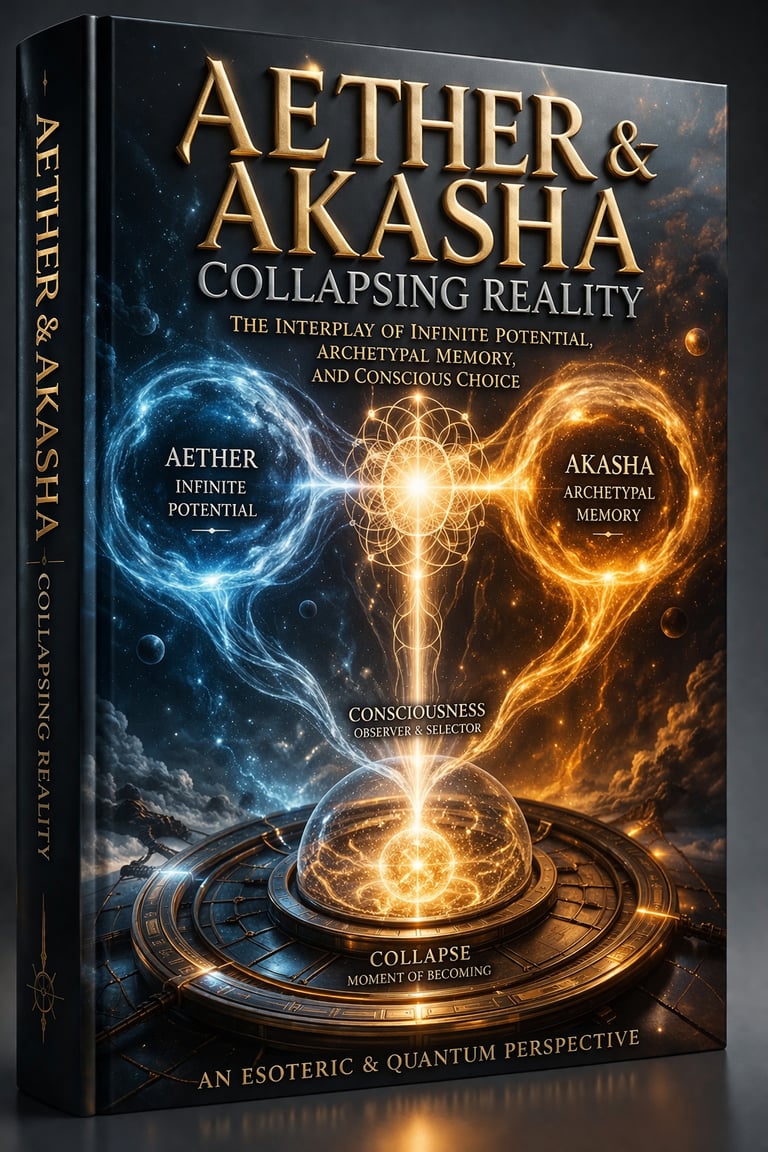
Essence, Aether, Akasha and the Architecture of the Collapse of Reality
ESSENCE
Essence represents the deepest and most fragile point of the entire system. It is the absolute ground where the distinction between existence and non-existence has not yet arisen. For this reason, Essence neither “exists” nor “does not exist”; it is neither consciousness nor energy. Because all of these concepts are categories that emerge later. Essence, however, precedes all categories. It cannot be defined; because to define is to impose a boundary, and Essence admits no boundary.
On the esoteric level, Essence cannot be known, cannot be comprehended, and cannot even be “become.” Because “to become” is a process, and Essence is prior to process. For this reason, speaking about Essence is always incomplete, always indirect. It can only be pointed to, but never encompassed.
The entire metaphysical model — Ether, pattern, consciousness, choice, and reality — does not occur within Essence and does not come after Essence. A more accurate statement is this: none of these layers encompasses Essence, yet all of them rest upon Essence. Essence is not a part of this system; it is the condition for the possibility of the system.
The concepts of existence and non-existence lose their meaning at this point. Existence is manifestation, while non-existence is abstraction. Essence lies outside this duality. It is neither visible nor invisible; because the distinction between visibility and invisibility has not yet arisen. Essence precedes all oppositions.
At this level, no mechanism can be spoken of. Because mechanism requires change, and change implies difference. In Essence, there is no difference. There is no time, no movement, no process. For this reason, Essence cannot be explained; because explanation produces distinction.
The paradox that emerges here is this: Essence is both the fullest and the emptiest. It is the source of everything, therefore it is the fullest. But it contains no determination, therefore it is the emptiest. This emptiness is not non-existence; it is the contentless state of infinite potential.
At this point, the distinction between Ether and Essence becomes critical. The most subtle and the most absolute are not the same. Ether is the first threshold of existence; Essence comes even before this threshold. Essence is undefined absoluteness. It is not existence, not non-existence, not even nothingness.
The mind, by its nature, defines, limits, and separates. However, Essence allows none of these. Therefore, the great esoteric traditions describe Essence through indirect expressions. Statements such as “it is neither this nor that” are ways of expressing this impossibility. Because even “to be” is a determination, and Essence is prior to determination.
Ether, however, is the first “thingification” that comes after this absoluteness. It is not yet physical, not yet energy; but the concepts of potential, probability, and field have now emerged. Ether can be thought of as the first ground of existence, the generative matrix. It is not a separation from Essence; it is the threshold of visibility.
For this reason, all esoteric systems fall silent at a certain point. Because Essence is where language and thought cannot reach. Every expression that attempts to describe it narrows it.
The relationship between Essence and Ether is not a cause-and-effect relationship. Essence does not create itself, does not express itself, nor does it externalize through a conscious act. Such explanations are metaphors of the mind. A more accurate expression is an “overflow.” However, this overflow is neither voluntary nor necessary. It is not a causal process.
The first perceptible threshold of this overflow is Ether. Ether is not the result of Essence; it is its first observable boundary. Therefore, there is a subtle paradox between them. Ether is not separate from Essence; yet Essence is not Ether. There is no separation, but they are not identical.
This situation is expressed esoterically as follows: Ether is the threshold at which Essence begins to appear. Essence, however, is beyond even appearance. Ether is the beginning of existence; Essence is prior even to beginning. Ether is the potential of what has not yet become; Essence is the absoluteness in which the concept of “becoming” has never arisen.
And for this reason, at the final point, language withdraws. Because Essence cannot be understood, only indicated. The mind that attempts to grasp it is forced into silence.
AETHER
Aether is misunderstood the moment it is thought of as an entity. Because it is not a “thing”; it is the threshold of thingification. When you call it existence, you impose a boundary; when you call it non-existence, you again reduce it to a category. Whereas the matter here is an openness where categories have not yet arisen.
For this reason, Aether neither exists nor does not exist. This is not a contradiction; it is a plane where even contradiction is not yet possible. Because existence and non-existence gain meaning only relative to each other. In Aether, this opposition has not yet been established.
Likewise, Aether is neither energy nor matter. Because energy and matter require measurement, interaction, and relation. Here, however, there is no measurement yet, no relation, no interaction. But this does not mean “there is nothing.” A more accurate expression is this: there is not yet a “thing.”
For this reason, thinking of Aether as emptiness is misleading. Even emptiness is a definition, a lack, and requires a reference. Aether, however, is not a lack. On the contrary, it is a threshold where all determinations can arise but have not yet arisen.
Here there is no distinction, no definition, no boundary. But this state of non-being is not a deprivation. This is the unfragmented state of boundlessness. For this reason, Aether appears like a carrier field of the indefinable, but even the expression “carrier” is a metaphor. Because carrying requires two things. Here, however, there are not yet two.
With a more accurate intuition, Aether is the openness from which the definable can arise. There is no definition, but there is the possibility of definition. There is no boundary, but there is a ground upon which a boundary can emerge. There is no distinction, but there is the potential from which distinction can arise.
For this reason, Aether is beyond classical ontology. The distinction between existence and non-existence has not yet collapsed here; it waits in a state of tension. This tension is not static. But this movement is not movement in the sense we know. It is more like an unopened tendency, an uncondensed possibility.
Aether has neither become nor not become. Because the concept of becoming requires time. Time, however, gains meaning only when distinction arises. For this reason, Aether is not existence, but it is the threshold at which existence becomes possible. It is not non-existence, but it is the openness in which even the idea of non-existence loses its meaning.
At this point, expression becomes impossible. Because every sentence formed about Aether limits it. Yet, if it must be indicated, Aether is an undefined openness that contains all infinite possibilities while not yet having become any of them.
From an esoteric perspective, this field is the vibrational plane of possibility prior to form. Nothing has yet been determined, but everything is possible. This field is neither full nor empty; it is a state of tension in which the distinction between fullness and emptiness has not yet arisen.
Here, “vibration” is not a physical motion. It should be understood as a tendency toward becoming, an inclination toward emergence, and a possibility of condensation. Aether is silent but not completely still. It is motionless yet full of potential movement. It is formless yet has the capacity to generate form.
At this level, there is no identity, no event, no time, and no space. But there is a threshold from which all of these can emerge. Therefore, an inverse perspective becomes possible: the hero does not appear later; heroism exists as a potential from the beginning. Matter does not emerge later; materialization is a condensation that is possible from the beginning.
That is, existence does not arise from non-existence. It passes from indeterminacy into determination. This transition unfolds from Aether to archetype, and from archetype to form. However, in Aether, nothing has been selected. Everything is in a state of being selectable.
For this reason, there is not yet a “you,” but there is the possibility of you. There is not yet a world, but there is the possibility of a world. There is not yet form, but there is a tendency from which form can arise.
Aether is neither existence nor non-existence. But it is the undefined threshold from which both can arise.
Reading Aether as a “cosmic superposition field” reveals a subtle point where the language of modern physics intersects with esoteric intuition. However, what is being done here is not a direct equivalence; it is a projection. Because quantum superposition belongs to the physical plane, whereas Aether represents a pre-physical openness.
At the quantum level, a particle is not in a single state. It carries multiple possibilities simultaneously and is not determined until measurement occurs. This is a situation beyond classical logic. Because classical thinking assumes that something is either here or there, either exists or does not exist. In superposition, however, certainty is suspended, determination is deferred, and probability dominates.
In Aether, there is not yet a specific reality. Form has not been selected, distinctions have not been established, and nothing has been fixed. Yet this is not emptiness. On the contrary, it is an openness where all possibilities exist simultaneously.
For this reason, Aether can be thought of as a cosmic superposition field. That is, all possible realities exist as a wave that has not yet collapsed. The “wave” here is not a physical vibration, but a distribution. Reality has not condensed into a single point; it is spread out as possibilities.
This distribution has not yet been selected, fixed, or become “real.” What measurement is at the quantum level, consciousness is its counterpart at the esoteric level. Measurement collapses the wave function and makes a single state real. Similarly, consciousness determines a direction among possibilities and fixes the flow into a particular experience.
For this reason, the equation can be read as follows: Aether is superposition, consciousness is collapse, and reality is the determined state. However, the critical difference must not be forgotten. Quantum superposition belongs to physical systems and can be experimentally measured. Aether, however, is not physical, cannot be measured, and cannot be experimentally captured. Therefore, superposition can be considered as a shadow of Aether at the physical level.
From a deeper perspective, in Aether all forms are still intertwined. All identities have not yet differentiated, and all outcomes have not yet occurred. But all of them exist as potentials. This situation produces a powerful paradox: everything is possible, but nothing has occurred.
This boundlessness alone does not produce experience. Determination is required for experience. At this point, other layers come into play. Consciousness approaches, the potential for selection arises, collapse occurs, and reality is born. The soul carries this flow, the archetype organizes this flow, and ultimately a specific world emerges.
This process operates as follows: within Aether, infinite possibilities vibrate together. When consciousness turns toward this field, a field of selection emerges. This selection narrows the potential and collapse occurs. With collapse, a single reality is fixed and experience begins.
This mechanism clearly shows that reality is not a fixed structure. Reality is not a ready-made object. It is a collapsed possibility. It is determined anew at every moment, formed anew at every moment.
Aether is the purest state of possibility of existence. Quantum superposition is the observable projection of this principle at the physical level. And for this reason, the clearest statement is this: Reality is not something fixed; it is a selected and collapsed possibility.
Aether is not only a cosmic principle; it is also a threshold that can be directly contacted within consciousness. This threshold is revealed not by going somewhere outside, but by the temporary dissolution of internal structures. When habitual references — identity, meaning, direction — withdraw, consciousness briefly comes into contact with the field of indeterminacy.
This experience, in its purest form, emerges in deep meditation. When techniques fall silent, focus relaxes, and intention dissolves, what remains is an openness. In this openness, there is not yet a direction; but there is a sense that all directions are possible. This is a state unfamiliar to the mind. Because the mind always wants to cling to an object, a goal, or a meaning.
In the dissolution of identity, this threshold opens in a more destabilizing way. The structure you call “I” is constructed through name, story, role, and a sense of continuity. When these elements withdraw, the ground that carries them becomes visible. This ground is not familiar. Because everything familiar is already a pattern. Aether, however, is prior to pattern.
In daily life, this threshold is most clearly felt in the gap before a decision. There is a very brief moment just before making a choice: nothing has yet been selected, but all options are open. This moment is usually unnoticed; because the mind quickly jumps to a choice. However, if attended to, a directionless sense of freedom emerges in this gap.
Similarly, in moments of intense uncertainty — when plans collapse, foresight disappears, and the sense of control dissolves — a person involuntarily comes into contact with this field. The inner feeling of this contact is contradictory: along with the sense that everything is possible, there arises directionlessness, a slight fear, and at the same time a feeling of limitless freedom.
The source of this contradiction is not the unknown; it is indeterminacy. Because in indeterminacy, it is not known who you will be, what you will do, or what will happen. The mind wants certainty, direction, and boundaries. In Aether, none of these exist. Therefore, freedom is perceived as a threat at the same time.
The human mind wants to close this openness quickly. It makes a decision, returns to an identity, or produces a meaning. Thus Aether closes, the archetype comes into play, and the flow gains direction. But that brief moment of contact shows something very important: freedom is not the ability to choose; it is the openness before choice.
For this reason, the deepest insight is this: the human being desires freedom but cannot endure unlimited freedom. Because in unlimited freedom, there is nothing to hold onto, nothing to define, and no structure to control. There is only pure possibility that has not yet become anything.
This statement is not a contradiction, but the simultaneous perception of two different planes. When the mind tries to read these two planes with a single logic, a paradox arises. However, when a distinction of layers is made, the situation becomes clear.
At the level of potential, everything exists. But this existence is not actualized. This is not concrete existence; it is existence as possibility. All forms, all identities, and all outcomes are possible; but none of them has yet been selected.
At the level of the actual, nothing exists. Because nothing has yet taken form. There is no object, no event, no identity, and no distinction. This non-existence is not emptiness; it is indeterminacy.
These two states are valid simultaneously. This resolves the tension in classical philosophy. Parmenides emphasizes the stability of being; Heraclitus emphasizes constant flux. These two approaches appear opposite on the surface, but they unite at the level of Aether.
Because Aether is both unchanged — therefore it appears like “being” — and indeterminate — therefore it is the potential of flow. What Parmenides calls “being” is unmanifest potential. What Heraclitus calls “flux” is the unfolding of this potential.
Aether is the intersection of these two. Here everything exists because all flows are possible. At the same time, nothing exists because no flow has yet begun.
For this reason, Aether is neither static nor in motion. But it is the threshold where both stability and motion are possible. Being and becoming have not yet separated. Stability and change have not yet split into two.
“Everything exists but nothing exists” is not a contradiction; it is an ontological simultaneity.
Aether is the vibrational field of undefined infinite possibility awaiting the touch of consciousness.
AKASHA
Akasha is not a leftover memory of what has happened. It is a field of traces that is still operating, still influencing, and still reproducing. For this reason, limiting it to the “past” is misleading. Because what we call the past is a result of the perception of time. Akasha, however, is a continuity that operates beyond time.
Aether was pure possibility. Nothing had yet been determined. Everything was possible, but nothing had occurred. Akasha, however, is its opposite pole: the indelible trace of what has occurred. Yet this trace is not a frozen record. It is alive, active, and continuous.
When something “happens,” it does not disappear. On the surface, a form emerges, exists for a while, and dissolves. However, this dissolution is not annihilation. The form disappears, but the pattern, vibration, and tendency that made it possible remain as a trace in Akasha. This trace can be reproduced, reenacted, and expressed again in different forms.
For this reason, Akasha is not an archive. It is the active field of continuity. An experience is not only lived; it also produces a tendency. This tendency affects future flows, attracts similar situations, and moves toward similar outcomes. Akasha carries not only “what happened,” but also “how it can happen again.”
Memory is held in consciousness and can be forgotten. Akasha, however, is held in existence and cannot be erased. Therefore, even if a person does not remember an experience, the trace of that experience continues to live in their behaviors, choices, and reactions.
Akasha, in this sense, is not an unconscious memory. It is a pre-conscious field of traces. From the perspective of time, Akasha is not the past. It is the still-active form of the past. An event may have ended, but its trace does not end.
These traces guide new experiences, attract similar situations, and reproduce the same patterns. For this reason, Akasha is not a static record; it is a dynamic echo. The concept of “echo” is very important here. Because an echo continues even after the original event has ended and continues to affect the environment.
Akasha works in the same way. An experience ends, but its trace mixes into the texture of new experiences. Nothing completely disappears; it only changes form. For this reason, you are not only what you are experiencing now. You are also the sum of the still-active traces of what has been experienced.
However, this is not fate. Because even if the traces are fixed, how they are expressed can change. Akasha does not produce necessity; it produces tendency.
The fact that Akasha is expressed with different names in different traditions is the description of the same structure in different languages. Helena Blavatsky calls this the “Akashic records” and says that everything in the universe is recorded vibrationally. Rudolf Steiner defines this as “universal memory,” where the emphasis is on continuity.
Ibn al-Arabi expresses this structure with the concept of “Levh-i Mahfuz”; here, the record is seen not as static, but as a continuously unfolding order. Carl Jung explains this as the “collective unconscious”; as shared patterns that are not individual but affect everyone.
No experience is lost, everything leaves a trace, and these traces can be reproduced.
Akasha is not a passive archive. It is an active reproduction mechanism. An experience is not only recorded; it also creates a tendency. This tendency attracts similar experiences, produces similar reactions, and moves toward similar outcomes.
Akasha is not bound to time. Because in Akasha, records are not arranged chronologically. All of them exist simultaneously. Nothing is past, nothing is future. All of them are a field of traces that exist at the same time.
However, consciousness cannot perceive this field in that way. Consciousness divides, orders, and makes sense. This act of ordering produces what we call time.
For this reason, time does not exist in Akasha. Time is the way Akasha unfolds within consciousness. Akasha is the simultaneous existence of all records; time is the sequential reading of these records.
In Akasha, the traces of all experiences exist simultaneously. However, consciousness cannot see this network all at once. It takes a slice, experiences it as “now,” and separates other slices as past and future.
For this reason, time does not flow; it is read. The past does not go away; it only becomes a slice that is no longer read. The future does not come; it is a slice that has not yet been read. “Now” is the point being read.
Within Akasha, the process works as follows: experience occurs, leaves a trace, the trace becomes a pattern, the pattern attracts new experience, and the cycle continues.
This cycle combines with archetype and karma to form a self-repeating structure. Experience produces a trace, the trace forms a pattern, the pattern reproduces. As long as this cycle is not broken, the past does not end; it only changes form.
For this reason, Akasha is not the past. It is the currently active state of the past.
Aether is the potential of what has not yet happened.
Akasha is the still-living trace of what has happened.
And between these two poles:
The soul flows,
The archetype organizes,
Consciousness chooses.
But nothing is lost.
Everything:
Arises from possibility,
Takes form,
Leaves a trace,
And that trace continues to live within existence.
KARMA
Karma, as it is often misunderstood, is not a system of reward and punishment. At a deeper level, karma is an operating mechanism in which Akasha and archetype work together. Akasha can be thought of here like a “database”; however, this data is not static. It is a continuously updating, relational, and effective field.
Every experience leaves a trace. This trace is recorded in Akasha. But this record is not only stored; it also becomes active data that affects subsequent processes. However, this data alone has no function. What runs it is the pattern.
Akasha carries what is recorded, while the pattern determines how this record will operate. That is, Akasha is the database, and the pattern is the running code.
The process works as follows: an experience occurs and is recorded as a trace in Akasha. This trace is organized by a certain pattern. The same pattern is activated again under similar conditions and produces similar results. Thus, a continuous cycle forms between experience, trace, pattern, and repetition.
Data alone does nothing. There may be countless traces in Akasha. However, what determines which traces become active is the structure of the pattern. Therefore, the same data does not produce different results; as long as the same code runs, the same results repeat.
This situation is very clearly seen in human experience. A person thinks they are living different lives, but most of the time they run the same pattern. The stage changes, people change, conditions change; but the results remain similar. Because the operating structure is the same.
This mechanism feeds itself. The more a pattern runs, the stronger it becomes. It is triggered more quickly and becomes more automatic. Thus repetition deepens, and the person begins to perceive this as “fate.”
Freedom is not completely absent. It is simply not on the surface. Freedom is not in producing new data, but in recognizing the code that is running.
Because when the pattern is invisible, it runs automatically. When it is seen, it becomes open to intervention. The records in Akasha may not be erased; but when the pattern is changed, the same data begins to produce different results.
The data may remain the same, but if the code changes, destiny changes. Karma is not the past forcing you; it is past data running again with the same code.
Akasha is not only a theoretical structure. It is sometimes directly experienced. This experience usually appears in brief moments of rupture.
Déjà vu is one of the clearest examples of this experience. While living a moment, a person feels that this moment has been lived before. This is not a conscious recollection. It is more like the overlap between a trace in Akasha and the present experience.
In these moments, the person feels this: this scene is familiar, this feeling has been experienced before. But where and when it happened is unknown. Because this is not remembering; it is the reactivation of an active pattern.
Similarly, the feeling of familiarity without cause is also related to Akasha. A person or environment never encountered before can evoke a deep sense of familiarity. This does not come from conscious memory; it comes from similar patterns in Akasha.
Repeating life cycles are the strongest expression of this mechanism. The same types of relationships, the same conflicts, and the same emotional themes repeat in different scenes. A person often attributes this to external conditions. However, what is happening at a deeper level is the reactivation of the same archetype and the same Akashic record.
The process works as follows: a situation arises, an old trace is triggered, the same pattern comes into play, and the person gives a similar response. Thus, the cycle continues.
The common point of these experiences is this: they are not random, but they are not consciously chosen either. They are the activation of the records in Akasha.
For this reason, déjà vu is not just a mental error. It is the momentary visibility of a repeating pattern. However, this awareness usually lasts only a very short time. The mind quickly returns to its old order, and the pattern begins to operate automatically again.
If these moments can be extended — that is, if a person observes the sense of familiarity, recognizes the repeating structure, and stops the automatic reaction — the system begins to change.
Because for the first time, the pattern becomes visible.
It is understood that Akasha is not a passive record. What is seen is not only the past; it is a trace that is active right now.
With this awareness, the cycle can be broken. Because the source of repetition has become visible.
Akasha records everything.
But what determines destiny is not the record;
it is how that record is operated.
And therefore:
When the pattern changes,
even the same data
can produce a different reality.
AKASHA AND QUANTUM SIMILARITY
Reading Akasha as a “universal information conservation field” establishes a strong parallel with the principle in modern physics that “information is not lost.” However, this is not an equivalence; it is a projection of two different planes onto each other.
In the quantum information approach, the fundamental principle is this: information is not lost. The system may change, particles may transform, the structure may disintegrate; but the information it contains is not completely erased. It only changes form. This is the basis of continuity in the physical universe.
What is said about Akasha on the esoteric plane is the same, but broader: no experience is lost; it only changes form. An event occurs, its form dissolves, the scene closes; but its trace remains. This trace can reappear in another experience, find expression in a different form, but it is never completely erased.
For this reason, the same principle is expressed differently in two languages: in physics, information is conserved; in esotericism, the trace is conserved. However, there is a critical difference here. Quantum information belongs to measurable systems, can be expressed mathematically, and is limited to physical processes. Akasha, however, is immeasurable, cannot be digitized, and transcends the physical plane.
For this reason, Akasha is not merely a “storage of information.” It is the existential continuity of information. Because here, information is not only data; experience, meaning, tendency, and organization are also part of this field.
Akasha is not only the conservation of information; it is the interaction of information. An experience does not disappear; it leaves a trace, and this trace continues its effect. That is, conservation, recording, and interaction occur simultaneously.
PARADOX
“The past does not exist, but its effect does”
This statement reveals the distinction between event and trace. At the ontological level, the past does not exist. Because the event has ended, the form has dissolved, and the scene has closed. That moment is no longer present.
But at the level of effect, the situation is completely different. Because the trace left by the event is still active. This trace turns into behavioral patterns, creates emotional tendencies, filters perception, and directs choices.
For this reason, the past does not exist as a “thing,” but it still operates as an “effect.” The most critical shift appears here: the past is not a remembered moment. The past is a structure operating in the present.
Remembering occurs in consciousness. But the effect can continue independently of consciousness. Therefore, a person may not remember an event but may continue to react in the same way. Because what is operating is not memory, but a coded pattern.
At this point, the past ceases to be a record and becomes an active software. It is not fixed data; it is a continuously running program. This program recognizes similar situations, produces automatic responses, and tends to repeat the same results.
A person is usually unaware of this. Because this program runs in the background. Therefore, the past does not follow you; you run the code of the past.
The stage may change, people may change, conditions may change. But the reaction may remain the same, relationship dynamics may repeat, and outcomes may be similar. Because the event has changed, but the software has not.
This two-level reality is clear: at the ontological level, the past does not exist; at the level of effect, the past is still operating. Time does not leave the past behind; it only changes its form.
The past is not an event, because the event has ended.
The past is a software, because its effect is still running.
And this software:
In every thought,
In every reaction,
In every choice
Continues to reproduce itself.
Freedom is not erasing the past.
It is seeing how the past operates.
CONSCIOUSNESS
Consciousness is one of the most misunderstood concepts in existence. Because it is often thought of as a “thing”: something possessed, something one is inside of, or a central essence. However, when looked at more deeply, consciousness is not a being; it is a process.
Consciousness is the dynamic threshold operating between Aether and Akasha. Aether presents limitless possibility, Akasha carries accumulated traces. Consciousness, however, is the movement of direction that occurs at the intersection of these two. For this reason, consciousness is neither merely an observer nor merely a producer. It is the transformative gateway.
Consciousness is the moment when potential passes into form. That is, the transition of something from a state of “possibility” to a state of “reality” occurs in what we call consciousness.
Consciousness Is Not an Object, but an Operation
Aether is the openness of what is not yet determined. Akasha is the trace of what has been determined. These two fields are always open. Consciousness is the process that operates between these two fields.
Consciousness “reads” Aether; that is, it perceives possibilities. It “references” Akasha; that is, it carries the tendencies of past traces. And at the intersection of these two, it determines a direction. This determination of direction is the feeling of “choice” that we experience.
Consciousness is not a thing. It is not a fixed essence, not a center located inside, and not something possessed. Consciousness is the operation at the moment reality forms.
Consciousness is the movement of perceiving possibility, evaluating trace, and determining direction. For this reason, consciousness is neither completely free nor completely determined.
Aether offers limitless possibilities. Akasha brings limiting tendencies. Consciousness operates at the intersection of these two. Therefore, choice is neither completely free nor completely necessary.
The following paradox emerges: a choice is made, but the field of choice has already been shaped.
At the quantum level, the system is indeterminate before observation. Multiple possibilities exist simultaneously. When measurement occurs, these possibilities collapse into a single result.
On the esoteric plane, this is read as follows: Aether is the field of possibility, consciousness is the selective effect, and reality is the collapsed result.
However, an important correction is necessary here. Consciousness is not an external force that initiates collapse. Consciousness is the operation of collapse itself.
That is, the observer and the observed are not separate. Collapse occurs at the intersection of these two. Reality does not “come into being” at this point; it becomes visible.
For this reason, indeterminacy does not disappear. It only narrows into a particular form.
When making a choice, consciousness uses three fundamental layers:
Attention determines which possibility comes to the forefront. What you look at, what you notice, forms the direction.
Emotion provides the energy. It determines which traces will be activated.
Belief draws the boundaries. It determines which options appear possible.
These three work together. Attention determines direction, emotion provides force, and belief draws the limits.
“You are choosing, but what determines the choice is you”
On the surface, a person experiences the feeling “I decided.” This experience is real. However, in the deeper structure, the field of choice has already been prepared.
The records in Akasha, belief systems, and archetypal patterns shape the ground of choice in advance. Therefore, choice is not an instant creation; it is the result of an accumulated process.
For this reason, there are two layers: the visible “I” and the invisible structure.
You are choosing, but what you will choose has been determined in a tendency-based way. This does not completely eliminate freedom; it redefines it.
Freedom is not choosing what you want. It is being able to see why you choose it.
The real question is this: are you free?
If there is no awareness, no. Because patterns run automatically.
If there is awareness, yes. Because the field of choice expands.
Until the unconscious becomes conscious, it is lived as fate.
BETWEEN AETHER AND AKASHA
Consciousness operates in two directions. Akasha brings the weight of the past: habits, patterns, and repetitions. Aether brings openness: new possibilities and the capacity for creation.
Choice is formed at the intersection of these two fields. The past pushes, the future calls. Consciousness produces reality at this point of collision.
In automatic mode, Akasha is dominant. Old patterns run and repetition occurs.
In awareness mode, a gap forms in between. This gap is the entry point of Aether.
At this point, a new choice becomes possible.
You Are Not the One Who Chooses, You Are the Point Where Choice Happens
You are not making the choice; the choice passes through you.
Because choice is not the action of a fixed subject. It is the result of a process. And even deeper: consciousness is not you.
You are a temporary focus that arises within consciousness. This focus sometimes identifies with patterns, sometimes observes them. But it is never fixed.
For this reason, what you call “I” is a constantly changing center. Consciousness is the process through which this center forms and dissolves.
Aether opens possibility.
Akasha limits direction.
Consciousness processes these two and produces choice.
Reality is the collapsed state of this choice.
You are not a fixed chooser.
You are the living threshold where choice occurs.
COLLAPSE
Collapse is the most critical nodal point of the model of existence. Because here, possibility becomes “real” for the first time. Aether carries limitless possibilities, Akasha brings tendencies and records, and consciousness determines direction. Collapse is the moment of reality that occurs at the point where these three intersect.
This moment is temporally “now,” and ontologically “becoming.” That is, reality is not a result; it is a moment of determination.
On the esoteric level, collapse is the moment of creation. This is the manifestation of the command “be”; the birth of form. The invisible becomes visible.
Ibn al-Arabi expresses this moment as “tajalli”: the unveiling of the divine.
Helena Blavatsky explains this as condensation: the descent of the subtle plane into matter.
Rudolf Steiner sees it as the crystallization of the spiritual in the physical.
Different languages describe a single process: invisible potential descends into a definite form.
At the scientific level, this process is known as the collapse of the wave function. The probability wave descends into a single particle state.
What we call the observer effect completes this as well: observation affects the result.
When consciousness turns toward something, reality appears. However, consciousness here is not an external observer. It is the operation of collapse itself.
Reality does not come into being; it becomes visible.
The Anatomy of Collapse
The process works at every moment as follows:
Aether → infinite possibilities open
Akasha → past patterns give direction
Consciousness → focuses
Choice → forms
Collapse → occurs
Reality → becomes fixed
This is not a one-time event. It happens continuously.
Why Does Reality Appear Stable?
Collapse occurs continuously. In every perception, every thought, every decision.
For this reason, reality is not stable; it is the sum of momentary collapses.
The mind perceives this as a continuous world. Because collapses occur so rapidly that the gap between them is not noticed.
But what lies underneath is not continuous being; it is constant re-formation.
PARADOX
“Reality forms but is not stable”
The moment of collapse produces a short-lived stability. One possibility is selected and becomes “real.” At that moment, everything appears definite.
But this definiteness is not permanent. Because in the next moment a new field of possibility opens and a new collapse occurs.
For this reason, reality is not a frozen structure; it is the flow of successive moments of stability.
At every moment:
• Possibility narrows
• Choice appears
• Reality forms
And immediately afterward it dissolves.
Stability is an illusion. Continuity is an interpretation. What truly exists is a sequence of momentary collapses.
How Is Collapse Felt?
Collapse is not felt directly. But its results are felt:
• The feeling that “it has now happened”
• The clarification of a decision
• The closing of uncertainty
• The occurrence of the event
This moment is the closing of potential.
In automatic collapse, Akasha is dominant. Past patterns come into play and the same reality repeats.
In conscious collapse, awareness is active. Patterns are seen and a new possibility can be selected.
This difference is the distinction between fate and freedom.
Reality is not happening to you.
It is happening through you.
You are not living reality, you are continuously collapsing reality.
But this “you” is not a fixed subject. It is the process of consciousness itself.
Complete Model
AETHER → limitless possibility
AKASHA → trace and tendency
CONSCIOUSNESS → process of choice
COLLAPSE → moment of determination
REALITY → temporary stability
And this process:
At every moment,
In every perception,
In every thought
Occurs again.
Reality is not something completed.
It is a process continuously being written.
REALITY
The Flow of Continuous Collapses and the Field of Shared Experience
Reality is often perceived as a stable and external structure. However, when looked at more deeply, reality is not a single “thing.” It is not a fixed object. Reality is a stable flow of experience formed by continuous collapses.
That is, reality is the successive sequence of momentary choices. It forms again at every moment, but this formation is so uninterrupted that it gives the feeling of continuity.
On the esoteric level, reality is a stage. A projection. A field of reflection.
Ibn al-Arabi expresses this as “alam”: the visible manifestation of the divine imagination.
Carl Jung sees reality as the field of experience of psychological structures.
Rudolf Steiner says that the perceived world is related to consciousness.
Reality is the interaction of perception + consciousness + structure.
Reality = (Consciousness + Akasha + Aether) × Continuity
This formula expresses the following: possibility (Aether), record (Akasha), and choice (consciousness) unite. When this union is continuously repeated, the experience we call “world” emerges.
How Does Reality Form?
At every moment the following process operates:
• Consciousness focuses
• Patterns rise from Akasha
• Possibilities emerge from Aether
• Choice forms
• Collapse occurs
• Reality becomes fixed
This process repeats countless times per second.
For this reason, the feeling of a stable world is actually an illusion produced by very rapidly occurring collapses.
Why Do We See the Same World?
The answer to this question is three-layered.
The first is collective Akasha. Humanity shares a common field of traces. There are common patterns and common tendencies.
The second is synchronized consciousness. Human beings have similar biological structures and mechanisms of perception. This leads similar choices to be made.
The third is the shared field of collapse. Reality is not only individual. It is stabilized collectively.
For this reason, the world is a collectively collapsed reality.
Time is the sequencing of collapses.
Space is the arrangement of collapses.
That is, time and space are not reality itself, but the way it is organized.
How Is Reality Felt?
Reality is experienced in the following ways:
• The feeling that “this is real”
• Continuity
• Causality
• Physical solidity
But this feeling is misleading. Because underneath there is constant change.
“Reality exists but continuously disappears”
At every moment a determination occurs. A possibility narrows and becomes visible. This is the moment when we say “reality exists.”
But at the same time, this determination begins to dissolve. It gives way to a new determination.
For this reason, reality does not remain; it is continuously renewed.
This disappearance is not non-existence. It is one form withdrawing from the stage and leaving its place to another form.
Reality:
• Forms
• Appears
• Dissolves
• Forms again
This cycle is uninterrupted.
The mind perceives this as a single whole. But what truly exists is a sequence of momentary births.
Collective reality is more stable, shared, and changes slowly.
Individual reality is more flexible, changes quickly, and depends on perception.
You are not seeing the world.
You are creating the world.
But not alone. Together with collective consciousness.
Reality is not something given to you.
It is a process in which you participate.
Complete Map
AETHER → possibility
AKASHA → record
CONSCIOUSNESS → choice
COLLAPSE → becoming
REALITY → experience
This process happens again at every moment.
Reality is not stable.
It is not definite.
It is not external.
Reality is a relational formation.
The universe is the flow of experience of possibilities continuously selected by consciousness.
You are not living in a world.
You exist within the flow of realities that are continuously being born and dissolved.
Footnotes
Essence (Zat)
Refers to the absolute, pre-categorical ground of being in metaphysical and Sufi thought. It precedes all distinctions such as existence/non-existence, subject/object, and form/emptiness. Comparable to apophatic (negative) theology traditions where the ultimate cannot be defined.Aether (Ether)
Used here not in the historical scientific sense, but as a metaphysical threshold between absolute undifferentiated reality (Essence) and structured existence. It represents pure potential prior to manifestation.Akasha
A concept found in multiple esoteric traditions referring to a subtle field in which all events, patterns, and impressions are retained. Not a passive archive, but an active field of continuity and influence.Archetype
A structuring principle that organizes experience into recurring patterns. In this text, archetypes function as operational templates through which Akashic traces become expressed.Collapse (Wave Function Collapse)
Borrowed metaphorically from quantum physics, where a system transitions from multiple potential states into a single observed state. In this framework, it refers to the moment when possibility becomes experienced reality.Superposition
A quantum concept describing a system existing in multiple states simultaneously until measurement occurs. Used here analogically to describe Aether as a field of uncollapsed possibilities.Observer Effect
In physics, the act of measurement affects the system being observed. In this model, consciousness plays a similar role—not as an external observer, but as part of the collapse process itself.“Be” Command (Creative Act)
Refers to the metaphysical idea of creation through command (e.g., “Kun” in Islamic thought), symbolizing the transition from potential to manifestation.Tajalli (Theophany)
A term used by Ibn al-Arabi describing the self-disclosure or manifestation of the divine in forms.Akashic Records
A term popularized by Helena Blavatsky referring to the idea that all events are recorded in a subtle, non-physical plane.Universal Memory
A concept articulated by Rudolf Steiner emphasizing a continuous, living record of existence beyond individual memory.Collective Unconscious
Introduced by Carl Jung, referring to shared, inherited structures of the psyche common to all humans.Parmenides vs. Heraclitus
Two pre-Socratic philosophers representing opposing views: Parmenides argued for the unchanging nature of being, while Heraclitus emphasized constant flux. This text integrates both through the concept of Aether.Indeterminacy
A state in which no fixed outcome has yet emerged. Distinct from randomness; it implies structured potential rather than chaos.Pattern (Code Analogy)
The comparison of archetypal structures to “code” is metaphorical, indicating repeatable operational logic rather than literal computation.Echo (Akashic Resonance)
Used to describe how past experiences continue to influence present conditions, not as static memory but as ongoing resonance.Collapse vs. Reality Distinction
Reality is not treated as a fixed entity, but as the temporary stabilization resulting from repeated collapse events.Continuity Illusion
The perception of a stable world arises from rapid successive collapses, similar to how continuous motion is perceived in film frames.Freedom (Redefined)
Freedom is not absolute choice, but awareness of the mechanisms shaping choice (patterns, tendencies, and conditioning).Two-Level Ontology
The distinction between:
Ontological level (what exists in principle)
Effective level (what operates and produces effects)
Time as Interpretation
Time is not fundamental but emerges from the sequential processing of Akashic traces by consciousness.Space as Organization
Space is understood not as an independent container, but as the structured arrangement of collapsed states.Identity (Self-Structure)
The “self” is described as a temporary stabilization of patterns rather than a fixed entity.Awareness vs. Automaticity
Two operational modes:
Automatic: driven by Akashic patterns
Aware: allowing Aether-based novelty to enter
Reality as Relational Process
Reality is defined as an interaction between possibility (Aether), memory (Akasha), and selection (consciousness), rather than an independent external object.