GHAYB (UNSEEN)-2
GHAYB (UNSEEN)-2. The universe is Gayb! For reflections have veiled it tight! Thus the name of this unseen mirror is Gayb outright! When reflection ceases, the reflecting body appears! It takes a name like ‘Mirror’ or ‘Khidr’ through the years!
APOCALYPSE BOOK
GHAYB-2
It is the attribute of the Lord (Hakk), every Name within Him!
When His within and without are ALLAH! Remove the body from between!
Ādam is the mirror to every Name of ALLAH!
“Prostrate!” is to the Name! The mirror is already unseen at that moment!
What is in the mirror is not the very same as the one who looks!
This is the difference between ALLAH and the servant! Bow to this great secret!
The reflection says: “I was not born!” and “Nor did I give birth!”
At that moment, the one speaking is not the child, but the reflected FATHER!
You say, “ALLAH hears the one who praises Him,” while performing prayer;
The one who speaks! And the one who hears! At that moment it is you! Few know!
Reflection is a shadow! In a shadow there is never true existence!
What is reflected does not prostrate! It only bears “witness”! Never otherwise!
The Name—the owner of the Name knows it! For the one reflected is He!
What makes glass a mirror is the paint behind it!
The verse says: “Be dyed in the dye of ALLAH!”
Reflection is not possible if there is no Light!
That which is reflected—that Light—is one Name of ALLAH: “Nūr!” (287)
The son of ʿAbdullāh, MUHAMMED—He is that! What honor! (287)
Reflection! Neither within! The mirror! Nor outside it!
The Name! Again carried to Itself within that ray!
“The Light of the heavens and the earth!”—a Name of that ray!
The true Ghayb is He! For there is no body of the “heavens and the earth”!
Without being seen He makes visible! Nūr! Just like ALLAH!
What He shows is Himself! The owner of the Ghayb is the Ghayb!
The universe is Ghayb! For reflections have veiled it!
Thus the name of this invisible mirror became Ghayb!
When the reflection ceases! The reflecting body appears!
It then takes a name such as “MIRROR” or “KHIDR”!
The reflected and the reflector cannot be seen at the same moment!
They are the “We”s! Reflected from inner space to outer space!
“The Lord says: ‘The inner and the outer are Mine!’” There is no mirror in between!!!
He reflects Himself to Himself! We are in a dream here!
“None knows the Ghayb,” ALLAH says for this reason!
The “created” is the same as the “Creator”!
Since solving this secret is impossible by intellect,
Seek help from ALLAH, who is Himself the Ghayb!
That is, do not remain a stranger to yourself any longer!
He bears the name “Friend of the Lord”! Take heed—every Prophet!
The sun is pure light! It conceals itself by its light!
To find the “Ghayb” hidden within its “Ghayb”—this is the “Religion of Fitrah”!
Master M.H. Ulug Kizilkecili
Türkiye/Ankara - 09 February 2001
IMPORTANT NOTE :The original text is poetic, and the author cannot be held responsible for any errors in the English translation! To read the original Turkish text, click HERE! The following section is not the author's work, and the author cannot be held responsible for any errors made!
Comparative Footnotes
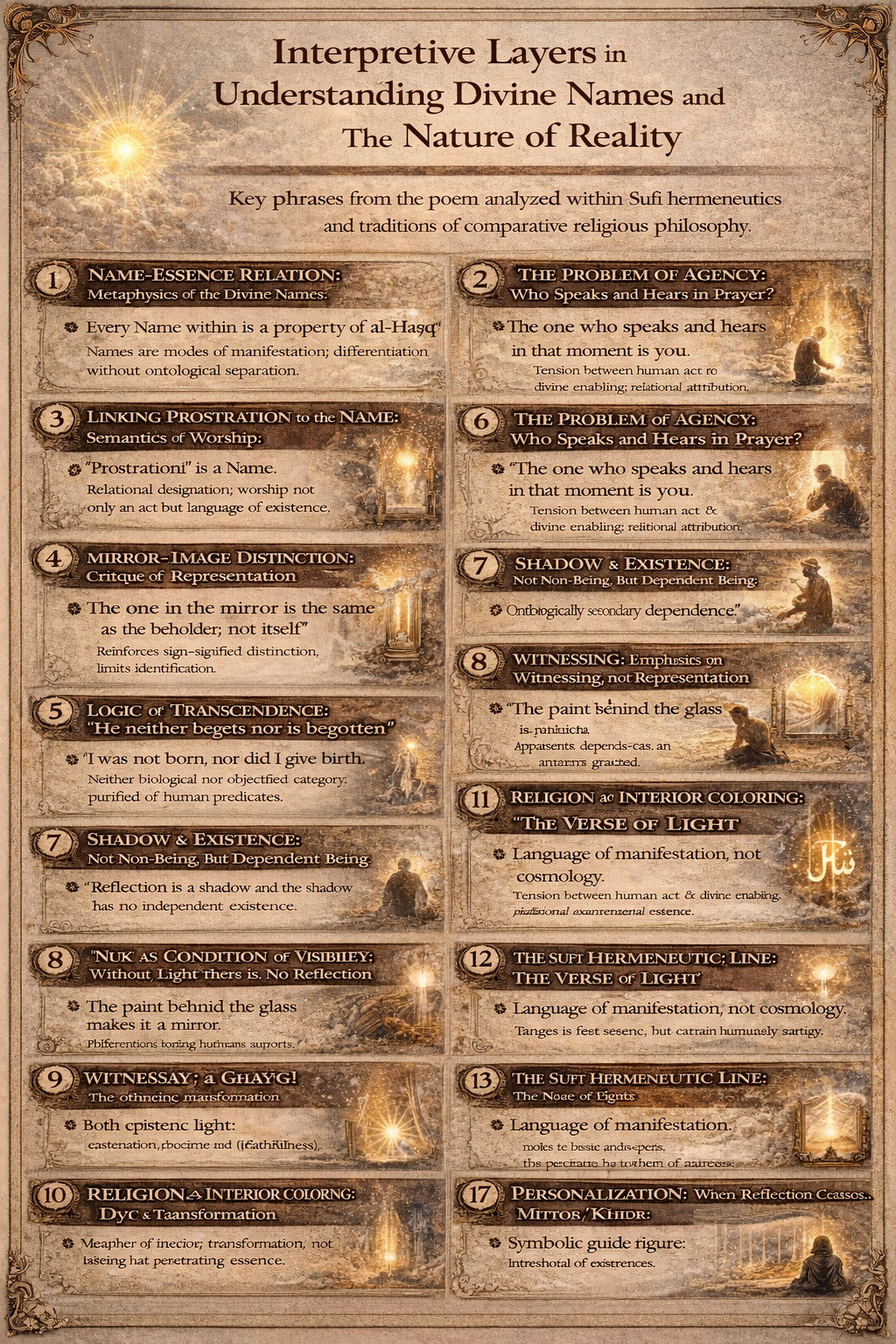
[1] The “Name–Essence” Relation: The Metaphysics of the Divine Names and the Debate on Reality
The statement “Every Name within is a property of al-Haqq” establishes an ontology of Divine Names in which existence is read on the plane of names/manifestations. A Name here is not mere designation but a mode of manifestation. The distinction between “essence” (dhāt) and “name” (attributes/acts of manifestation) structurally parallels the “transcendent essence–immanent appearance” distinction found in various traditions.
[2] Adam as “Mirror”: Human-Centered Manifestation and the Anthropological Axis
The idea that “Adam is the mirror of every Divine Name” positions the human being as the most comprehensive reflector of the Names. Similar anthropological centralities appear in other traditions; however, here mirroring does not imply ontological identity but a status of manifestation and witnessing.
[3] Linking Prostration to the Name: The Ontological Semantics of Worship
The emphasis that “‘Prostration!’ is a Name” reads worship not merely as an act but as a relational designation (nisbah). Prostration signifies the orientation of being toward its source. Thus worship becomes not only an ethical duty but part of the language of existence itself.
[4] Mirror–Image Distinction: Reflection, Not Representation
“The one in the mirror is the same as the beholder; not itself!” critiques representation. Appearance does not replace the original. This reinforces the distinction between sign and signified and warns against identifying the visible with what it indicates.
[5] “He neither begets nor is begotten”: The Logic of Transcendence (Tanzīh)
The insistence “I was not born, nor did I give birth” excludes conceptions that reduce the Divine to biological or objectified categories. It intensifies the principle of transcendence: the Divine is purified of human predicates.
[6] Who Speaks and Hears in Prayer? The Problem of Agency and Attribution
The phrase “The one who speaks and hears in that moment is you” problematizes agency in worship: Is the doer “I,” or “He”? The tension between human act and divine enabling is poeticized through the language of relational attribution.
[7] Shadow and Existence: Not Non-Being but Dependent Being
“Reflection is a shadow; the shadow has no independent existence” situates the shadow not as pure nothingness but as derivative being dependent upon its source. Appearance is thus ontologically secondary, not self-subsisting.
[8] The Emphasis on Witnessing: An Ontological Ethics that Breaks Representation Claims
“The reflected is not prostration; it ‘bears witness’.” The human is not one who replaces God but one who points to God. Witnessing here is both epistemic (knowing) and ethical (faithfulness/trust).
[9] The Paint Behind the Mirror: Background Metaphysics
“The paint behind the glass makes it a mirror” suggests that behind appearance lies an unseen ground. What appears does so because of an enabling background; the visible is not the ultimate explanation.
[10] Dye and Transformation: Religion as Interior Coloring
“Be dyed in the dye of God” reads religious belonging not as external labeling but as interior transformation. Dye penetrates fabric; identity is not surface-level. Religion permeates essence, not merely appearance.
[11] Without Light There Is No Reflection: Nūr as Condition of Visibility
“If there is no light, reflection is impossible.” Nūr is not an object among objects but the condition of appearing. It is not one visible thing but the possibility of visibility itself.
[12] The Verse of Light and the Sufi Hermeneutic Line
The text’s emphasis on Nūr aligns with Sufi interpretive traditions that articulate light in graded degrees. Here light is not sensory brightness but the principle of disclosure within heart–consciousness–sign structures.
[13] “Light of the Heavens and the Earth”: Not Cosmology but Language of Manifestation
“Light of the heavens and the earth” is not a cosmological description of a substance but a horizon of manifestation. “Heaven–earth” is the stage; Nūr is the principle of visibility upon that stage.
[14] “Showing Without Appearing”: The Logic of Theophany
“Light shows without being seen.” This reflects the logic of theophany: the transcendent essence remains unseen; the sign appears. In many traditions, divine contact is narrated through symbolic manifestations rather than direct essence-vision.
[15] Fire/Light Manifestations in Christianity: Transformation and Witness
The text’s structure of “light–manifestation–witness” can be compared with Christian symbolism of sacred experience expressed through light and fire. Light is not the essence itself but the mode of divine effect that generates testimony and transformation.
[16] “The Universe Is Ghayb”: The Visible as Veil
“The universe is Ghayb! For reflections have covered it!” reads the world not as pure disclosure but as veil. Multiplicity both reveals and conceals its source. The cosmos becomes simultaneously sign and curtain.
[17] “When Reflection Ceases… Mirror/Khidr”: Personalization and the Guide Motif
“When reflection ceases… it takes a name like ‘Mirror’ or ‘Khidr.’” The ontological principle merges with a symbolic guide-figure. The guide is less a historical person than the name of a threshold of awareness—the mode that enables passage.
[18] “The Reflected and the Reflector Cannot Be Seen Together”: Essence–Phenomenon Tension
One cannot simultaneously objectify the condition of seeing and the seen object. The condition withdraws as it enables. The mutual invisibility of reflection and reflector poetically expresses the structural limit of cognition.
[19] “Inside and Outside Are Mine… We Are in a Dream”: Ontology of Consciousness and Idealist Reading
“Kendi kendine yansır! Rüyâdayız burada!” approaches an idealist reading in which multiplicity is framed as dream or representation. The external world becomes not ultimate but an order of appearance within consciousness—while preserving theological distinctions.
[20] “No One Knows the Unseen”: Epistemic Humility and Method
By stating “impossible through reason alone,” the text marks the limits of rational explanation and calls for method: humility, spiritual purification, prayer, contemplation. Knowledge is linked not only to intellect but to transformation.
The Verse of Light and Sufi Hermeneutics: In the Context of Mishkāt al-Anwār
The Metaphysical Core of the Verse of Light
The Qur’anic statement “Allah is the Light of the heavens and the earth” (24:35) has been interpreted not as a literal attribution of physical light in a theological sense, but as an ontological and epistemological metaphor.
The representations mentioned in this verse are:
• Mishkāt (niche / lamp recess)
• Miṣbāḥ (lamp)
• Zujājah (glass)
• Olive oil
• Nūr ‘alā nūr (light upon light)
In Sufi hermeneutics, these elements represent not cosmological entities but layers of consciousness and metaphysical reality.
al-Ghazālī and Mishkāt al-Anwār
Abū Ḥāmid al-Ghazālī’s work Mishkāt al-Anwār (The Niche of Lights) interprets the Verse of Light not literally but within a framework of graded ontology.
According to al-Ghazālī, “light” is understood on three levels:
Sensory light (physical light)
The light of intellect (the principle that makes cognition possible)
The True Light (absolute being)
Within this hierarchy, physical light is only metaphor; the real Light is the power of making things manifest. Thus Light is:
Not an object, but the condition of visibility.
This approach directly parallels the poem’s logic: “Reflection is not possible if there is no light.”
The Method of Sufi Hermeneutics
Sufi interpretation (ta’wīl) rests on the following principles:
• The distinction between ẓāhir (outer meaning) and bāṭin (inner meaning)
The outward meaning of the verse is preserved, yet its inner meaning is deepened.
• The logic of representation (tamthīl)
The niche represents the heart; the glass represents purified consciousness; the oil represents innate disposition (fiṭrah).
• A graded understanding of being
Light is not singular; its reflection occurs in degrees.
In Sufi interpretation, the niche symbolizes the heart. The heart is the inner locus where divine manifestation settles and truth is realized.
The lamp is understood as faith or divine knowledge. This light shining within the heart expresses the human orientation toward truth and illumination within consciousness.
The glass symbolizes purified awareness. Just as clean glass transmits light more clearly, a purified consciousness reflects divine knowledge more transparently and without obstruction.
The oil represents primordial disposition (fiṭrah). This refers to the pure potential and innate inclination toward truth with which the human being is created. The oil, almost ready to shine even without fire touching it, expresses a state of readiness.
The phrase “light upon light” signifies divine confirmation of consciousness. It describes the strengthening of the inner light of the human being through divine illumination. It is the layered radiance formed when innate disposition joins with faith and divine guidance.
Negative Ontology and Light
al-Ghazālī does not equate Light directly with God’s essence, yet he maintains that the fullest and truest meaning of Light belongs only to God.
Thus:
• Physical light → metaphor
• Intellect → second-degree light
• Divine Light → the primary principle of manifestation
Here God is not a visible object but the source of visibility itself.
The Motif of Light in Interreligious Perspective
When compared with other traditions:
• Christianity speaks of the “uncreated light” (the Tabor light)
• Jewish mysticism refers to the divine radiance (Shekhinah)
• Neoplatonism describes light emanating from the One
• Vedānta speaks of the light of consciousness (cit)
However, in Sufi interpretation, Light is understood as:
Both transcendent and immanent,
Both cosmic and centered in the heart.
The Ontological Interpretation of “Light upon Light”
The phrase “light upon light” does not mean the addition of one light to another, but rather consciousness becoming aware of its own source.
Phenomenologically, this may be read as:
• The seen → phenomenon
• That which makes seeing possible → horizon
• Awareness of the horizon → “light upon light”
Connection with the Poem
In the GAYB-2 text:
“That light reflected is a Name of Allah: ‘Light!’”
“Light shows without being seen…”
These expressions parallel al-Ghazālī’s interpretation:
• Light is not an object.
• Reflection is not an object.
• Truth is the source of visibility.
Conclusion
The Verse of Light is, at the theological level, a simile;
In Sufi hermeneutics, it becomes an ontological map.
The fundamental thesis of Mishkāt al-Anwār is:
God is not a visible being;
God is the reality that makes visibility possible.
Therefore Light is:
• Not physical illumination,
• Not merely epistemic enlightenment,
• But the ontological principle of disclosure.
Pentecost and the Light of Tabor: The Theology of Divine Light in Christianity
In the Christian tradition, the theme of “divine light” is concentrated around two major theophanic (divine manifestation) events: Pentecost and the Light of Tabor (the Transfiguration). Both are interpreted not as the visible manifestation of God’s essence, but as the manifestation of God’s “energy” or “activity.”
Pentecost: Tongues of Fire of the Spirit
Pentecost
Pentecost (Acts 2) describes the descent of the Holy Spirit upon the apostles in the form of “tongues of fire” after Jesus’ ascension.
Key Elements
• Fire: a symbol of purification and power
• Wind: the movement of the Spirit (Pneuma)
• The miracle of tongues: universal proclamation
Theological Interpretation
In Pentecost, light/fire:
• Is not God’s essence.
• Is the activity of the divine Spirit.
• Produces consciousness and courage.
• Grants the power of witness (testimony).
In this sense, it is a metaphysical fire that burns yet does not destroy. Ego-centered fear dissolves; divine courage takes its place.
The Light of Tabor: The Transfiguration
The Transfiguration
On Mount Tabor (Matthew 17; Mark 9; Luke 9), Jesus’ face shines like the sun and his garments become radiant like light.
In the Eastern Orthodox tradition, this event is interpreted as the “Uncreated Light.”
Palamas and the Essence–Energy Distinction
Gregory Palamas
According to Gregory Palamas:
• God’s essence (ousia) is unknowable.
• God’s energies (energeiai) are experientially accessible.
The Light of Tabor is not God’s essence but God’s energy.
This distinction is structurally similar to the “Essence–Names/Attributes” distinction in Islamic thought.
Comparative Ontological Reading
The element of light and fire appears in Pentecost as the descent of the Spirit; in Tabor as divine radiance; and in Sufism as the concept of Nūr (Light). In all three traditions, light is the mode of manifestation of the transcendent.
In terms of experience, Pentecost is a collective event within a community. At Tabor, the divine radiance is experienced by selected apostles. In Sufism, the encounter occurs in the heart; the locus of experience is not an external place but an inner center of consciousness.
Regarding essence and energy, Pentecost is understood as the activity of the Spirit; Tabor as the manifestation of divine energy; and in Sufism as the manifestation (tajallī) of divine Names. In each case, the essence does not appear directly; it becomes visible through energy, name, or manifestation.
In terms of purpose, Pentecost aims at witness and proclamation; Tabor aims at the revelation of divinity; in Sufism, the ultimate aim is realization—truth unfolding within consciousness and inner awareness becoming actualized.
The Logic of Theophany
In both events, the shared structure is:
God’s essence does not appear directly.
It manifests in the form of light/fire.
The experience is transformative.
It produces witness and realization.
This structure parallels the metaphysics of Nūr:
• God = not a visible object
• Light = principle of visibility
• Experience = transformation of consciousness
Phenomenological Perspective
Pentecost → collective expansion of consciousness
Tabor → ontological moment of disclosure
Both events represent:
• A temporary unveiling of the hidden dimension of Being.
• Light not as merely epistemic but as an ontological event.
Connection with Sinai
At Sinai:
• There is fire, but God is not seen.
At Tabor:
• There is light, but God’s essence is not seen.
At Pentecost:
• There is fire, but the Spirit’s essence is not seen.
This triadic structure forms a universal model of theophanic experience:
Transcendent essence → invisible
Energy/light → visible
Human being → witness
Conclusion
Pentecost and the Light of Tabor:
• Are not identical with God’s essence.
• Are the manifestation of divine energy.
• Are transformative, purifying, and illuminating.
• Are experiential yet limited.
Within this framework, divine light in Christianity is understood not merely as metaphor, but as ontological manifestation.
Gregory Palamas and al-Ghazālī’s Understanding of “Light” in Conjunction with the Jungian Archetypal Model
The concept of divine “light” is a central metaphysical symbol in both Eastern Christian mysticism and Islamic thought. It is not merely a cosmological image, but possesses ontological, epistemological, and even psychological depth. When the understandings of light in Gregory Palamas and al-Ghazālī are compared, a strong common structure emerges that can be read together with the Jungian archetypal model.
Light in al-Ghazālī: The Ontological Principle of Visibility
According to al-Ghazālī, “nūr” is not physical light. Physical light is only metaphor. The true Light is the principle that makes seeing possible. Light:
• At the sensory level: makes objects visible.
• At the intellectual level: makes cognition possible.
• At the ontological level: enables Being to become manifest.
Thus God is not a visible entity but the reality that makes visibility possible. Nūr is not an object but the condition of manifestation. In this approach, God’s essence cannot be directly grasped, yet His “light” is manifested.
Light in Gregory Palamas: The Essence–Energy Distinction
Gregory Palamas distinguishes between God’s essence (ousia) and God’s energies (energeiai):
• God’s essence is unknowable and inaccessible.
• God’s energies can be experienced.
The “Uncreated Light” of Tabor is not God’s essence but God’s energy. It is not the divine essence itself but the mode by which the essence becomes manifest. In this way, divine transcendence is preserved, yet human beings may participate in God’s activity.
Shared Ontological Ground
The structural similarity between al-Ghazālī and Palamas is this:
• God’s essence cannot be directly known.
• Divine manifestation/energy/light can be experienced.
• Light is not an object but the principle of visibility.
In both thinkers, light is not God Himself but the way God discloses Himself. This is the logic of theophany: invisible essence → visible energy.
Jungian Archetypal Reading
In Carl Jung’s analytical psychology, light carries archetypal meanings within the collective unconscious:
• Awakening
• Illumination
• Transformation
• Contact with the Self
Jung’s concept of the Self represents the unity of consciousness and the unconscious. The Self is broader than the ego. The archetype of light symbolizes the transition from ego-centered consciousness to Self-centered awareness.
In theological language, what is expressed as “Divine Light” corresponds, in Jungian psychology, to the illumination of consciousness. It is the process by which unconscious contents are brought into awareness and the inner world gains light.
The concept of “divine energy” may be interpreted in Jungian terms as transformative psychic force. This force unsettles ego-centered structure, reorders inner balance, and moves the personality toward greater wholeness.
The idea of the unknowability of the essence parallels Jung’s notion of the deep center of the unconscious—an inaccessible yet guiding depth beyond conscious grasp.
The concept of manifestation (tajallī) corresponds to Jung’s process of individuation. In individuation, a person transcends the narrow limits of the ego, integrates conscious and unconscious elements, and attains a more comprehensive and balanced sense of self.
Light and Individuation
For Jung, the aim of human life is individuation. In this process:
The ego ceases to be the center.
Consciousness expands.
The Self becomes central.
Palamas’ idea of participation in divine energy and al-Ghazālī’s doctrine of degrees of light may be read, in Jungian terms, as expansion of consciousness. However, an important distinction must be maintained:
• Jung presents a psychological model.
• al-Ghazālī and Palamas construct ontological models.
In Jung, light is inner psychic energy.
In al-Ghazālī and Palamas, light is rooted in a divine source.
Essence–Energy and Ego–Self Parallels
There is a formal similarity between Palamas’ essence–energy distinction and Jung’s ego–Self distinction:
• Essence (ousia) → unknowable center
• Energy → experiential manifestation
• Self → center of wholeness
• Ego → limited focal consciousness
However, in Palamas the essence is ontologically transcendent; in Jung the Self is a psychological totality.
Metaphysical Light and Archetypal Light
In al-Ghazālī and Palamas, light:
• Is the ontological principle of disclosure.
• Is the self-disclosure of the divine.
In Jung, light:
• Is a symbol of psychic transformation.
• Represents a leap in consciousness.
Read together, these approaches reveal both the metaphysical and psychological depth of the symbol of light.
Conclusion: A Threefold Integration
The symbol of light may be understood at three levels:
Ontological level: Divine manifestation (al-Ghazālī, Palamas)
Epistemological level: Condition of visibility
Psychological level: Transformation of consciousness (Jung)
Thus light:
• Is not God’s essence.
• Is God’s energy.
• Is expansion of consciousness.
• Is the transcendence of the ego.
This multilayered reading shows that the metaphysics of light forms a shared symbolic center across religious, philosophical, and psychological domains.