GHAYB (UNSEEN) TRIANGLE
GHAYB (UNSEEN) TRIANGLE. The Lord is Idea! — Becoming sound, He first presents Himself! While within the mold He made — everyone calls it “Life”!Spirit and matter — the two opposite poles of Life (body)! Call spirit the purest matter — matter, frozen spirit!
APOCALYPSE BOOK
GHAYB TRIANGLE
Time is the Name of Allah! The Unseen (Ghayb) is He! — Neither spirit nor matter!
A definition of space! — To Himself, also “self”!
The spirit is matter! — The existence in which matter is spirit! Lord!
“Rahim who is Rahman!” — He! Muhammad Ebuttürab!
While spirit and matter are separate from one another,
Call this “two” Errahman — and you Errahim!
Errahman is the first and highest “I”-conscious Power!
Âlî too means first and highest — this coincidence is profound!
“Muhammad is mercy to the worlds!” — the attribute “Rahim”!
For He Himself is the worlds — His Name “Errahim”!
The Lord is Idea! — Becoming sound, He first presents Himself!
While within the mold He made — everyone calls it “Life”!
Point becomes letter! — Letter becomes word! Word becomes spirit!
Its origin is sound! — Every breath is He, breathing in you as “Hû”!
Spirit and matter — the two opposite poles of Life (body)!
Call spirit the purest matter — matter, frozen spirit!
Thus Life (body) is the thread — binding spirit to matter!
Both become one on the “Last Day” — clothing themselves in space!
Master M.H. Ulug Kizilkecili
Türkiye/Ankara - 13 October 2001
IMPORTANT NOTE :The original text is poetic, and the author cannot be held responsible for any errors in the English translation! To read the original Turkish text, click HERE! The following section is not the author's work, and the author cannot be held responsible for any errors made!
Footnotes
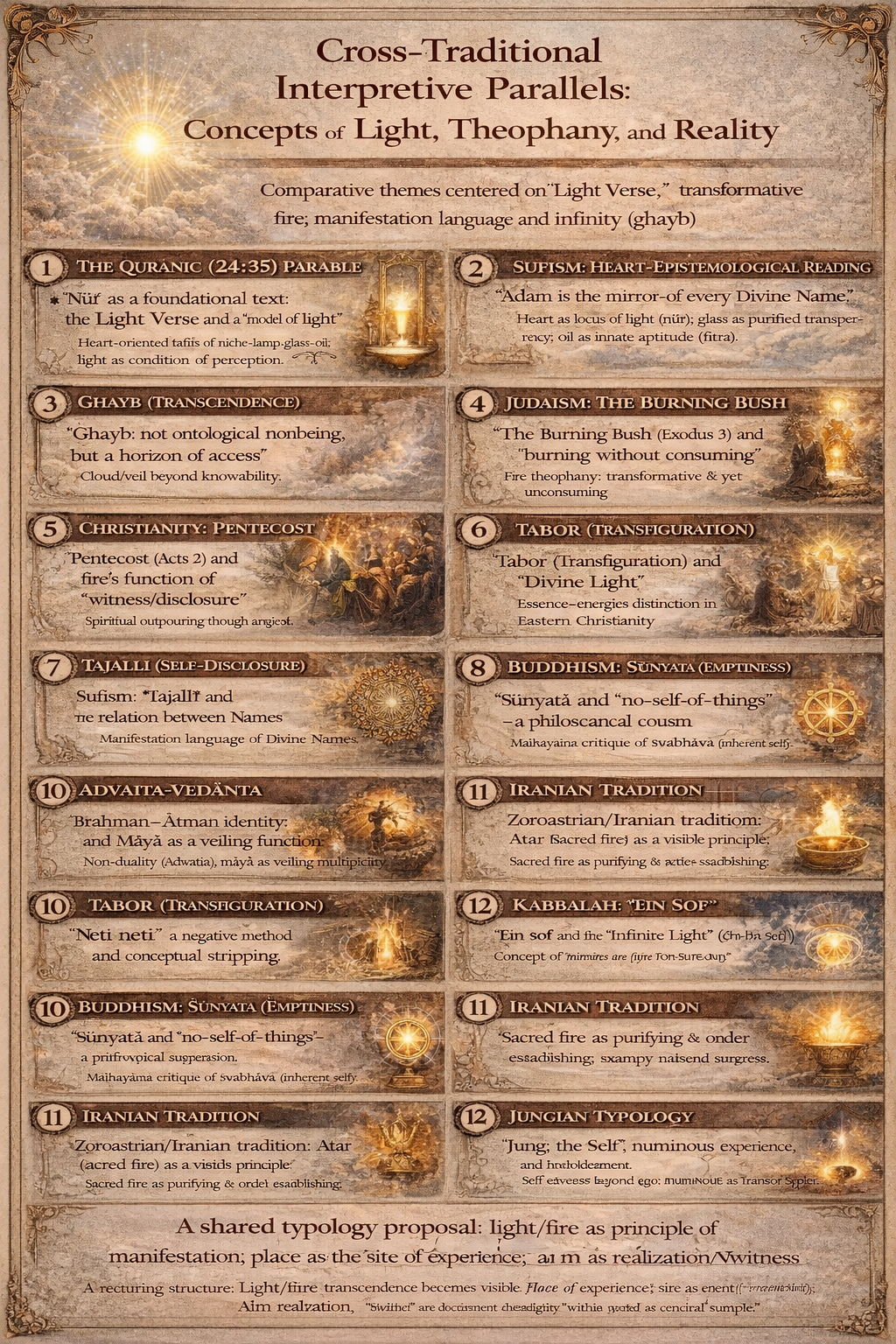
[1] “Nūr” as a Foundational Text: The Light Verse (24:35) and a “Model of Light”
The text’s line of thought about “nūr” and “showing without being seen” is grounded in the Qur’an’s famous Verse of Light (Sūrat al-Nūr 24:35) and its parabolic schema (niche–lamp–glass–oil–“light upon light”). In classical tafsīr, this parable is most often unfolded along the axis of “heart/chest–faith–the heart’s purification–fiṭra/innate aptitude”; that is, light is read not as physical light but as a condition of cognition and perception.
[2] The Sufi Reading of “Niche–Lamp–Glass–Oil”: A Heart-Epistemology
In Sufi tradition, the light symbols relocate the “site of knowledge” from the external world to the heart: the heart is the locus where nūr manifests; glass signifies purified awareness/transparency; oil signifies an aptitude (fiṭra) ready to shine even before fire touches it. This reading turns the verse’s emphasis—“its oil would almost glow even if no fire touched it”—into a theory of preparation/created receptivity.
[3] “Ghayb”: Not Ontological Nonbeing, but a Horizon of Access
The text’s line “Ghayb is He—neither spirit nor matter!” frames ghayb not as absence of being but as a horizon closed to phenomenal access: the source of truth, yet a “higher level” that cannot be objectified. This is a frame where theological transcendence (tanzīh) and epistemic “limits of knowability” converge. (Qur’anic parabolic language works precisely here: not essence, but exemplification.)
[4] Judaism: The Theophany of the “Burning Bush” (Exodus 3) and the Paradox of “Burning without Being Consumed”
The text’s idea of fire/light as “transforming without consuming” closely parallels the Jewish theophany of the burning bush: divine presence becomes visible through fire, yet does not consume the object. This is read less as a narrative that defies “natural law” and more as a symbolic language of transcendent presence.
[5] Christianity: Pentecost (Acts 2) and Fire’s Function of “Witness/Disclosure”
In the Pentecost narrative, “tongues of fire” operate in the context of the Spirit’s descent and public witness/communication (languages/speech). This line is close to your text’s idea that light “sets consciousness in motion”: light is not only “inner illumination” but a power that generates discourse and testimony.
[6] Tabor (Transfiguration) and “Divine Light”: The Essence–Energies Distinction in Eastern Christianity
The divine radiance at Tabor is, in Eastern Orthodox theology (especially the Palamite line), thought through the distinction between God’s essence (inaccessible) and God’s energies (participable manifestations). Thus “light” is conceptualized as a real theophany (energy) not reducible to God’s essence, yet something humans may “share in.” This falls into the same problem-field as the text’s logic: “the essence is unknowable—manifestation is possible.”
[7] Sufism: “Tajallī” and the Relation between Names and the Cosmos
The text’s emphasis on “truth as idea/sound” and “tajallī” connects to Sufi literature—especially tajallī (self-disclosure) and the notion that the divine Names appear in the world as modes of manifestation. Appearance here is not a “copy of the essence” but an unfolding at the level of Names. Modern academic literature also discusses tajallī in both its metaphysical and ethical/experiential dimensions.
[8] Advaita Vedānta: Brahman–Ātman Identity and Māyā as a Veiling Function
The text’s ultimate dissolution of the matter–spirit duality can be compared with Advaita non-dualism: ultimate reality is Brahman; multiplicity is lived as “as-if real” on the level of experience through māyā, but is not absolute. This philosophically supports the theme “the visible produces duality / unity remains at the level of essence.”
[9] “Neti neti”: A Negative Method and Conceptual Stripping
In Advaita, “neti neti” (“not this, not that”) is a negative purificatory method against the impossibility of enclosing truth within positive predicates. The text’s tendency to suspend categories such as “essence, spirit, matter” at the ultimate level is one of the clearest matches for cross-traditional comparison.
[10] Buddhism: Śūnyatā (Emptiness) and “No-Self-of-Things”—A Philosophical Cousin of the “World as Construct” Idea
The text’s language near “world/space/definition” and “construct” corresponds to Mahāyāna Buddhism’s critique of svabhāva (inherent self-nature): things do not possess an independent essence, but are understood through dependent arising. This is not “nihilism,” but an ontology–epistemology critique that dissolves categorical essence-attributions.
[11] Zoroastrian/Iranian Tradition: Ātar (Sacred Fire) as a Visible Principle
Fire as a symbol of “divine presence/purification” is not unique to Abrahamic traditions. In Iranian religious tradition, Ātar/Atar functions as a “visible holiness”: in fire temples and ritual purity contexts, fire becomes a purifying and order-establishing center. This strengthens a comparative reading of the text’s “transformative fire that does not annihilate.”
[12] Kabbalah: Ein Sof and the “Infinite Light” (Ohr Ein Sof)—A Parallel to the Language of Ghayb/Infinity
In Kabbalah, Ein Sof (the Infinite) is a negative-theological concept of God’s incomprehensibility; “infinite light” (Ohr Ein Sof) belongs to the language of manifestation. The text’s phrases about “ghayb/space/time-definition” can be placed alongside this distinction—between an ungraspable source and its unfolding—within a cross-traditional sample.
[13] Sikh Tradition: “Jyot/Jot” (the Divine Spark of Light) and the Critique of Ego (Haumai)
In Sikh thought, Jyot (divine light/spark) points to a divine share within the human being; the critique of haumai (ego/self-centeredness) treats ego as a veil before enlightenment. This can serve as a comparative footnote for your text’s line of “ego-consciousness / dissolution / realization.”
[14] Jung: the “Self,” Numinous Experience, and Individuation
The text’s sequence “unknowability of essence—veil—illumination—transformation” can be compared with Jung’s archetype of the Self (a center of wholeness beyond consciousness) and numinous experience (a shaking, transcendent encounter). Reading “tajallī” psychologically as individuation (integration of opposites; the ego ceases to be the sole owner of the center) links the text’s “transformative power” motif to academic psychology.
[15] A Shared Typology Proposal: Light/Fire as a Principle of Manifestation; Place as the Site of Experience; Aim as Realization/Witness
Across traditions, a recurring structure appears:
Light/Fire: the language of the transcendent becoming visible (theophany/manifestation)
Site of experience: Sinai as event; Pentecost as community; Sufism as heart; Advaita as inward realization
Aim: witness (Pentecost), disclosure of divinity (Tabor), realization/purification (Sufism), liberation through knowledge (Advaita)
This typology shows how different traditions address the “essence–energy–manifestation” problem with different vocabularies.
✨ Transfiguration (The Tabor Event)
1️⃣ Textual Sources
The Transfiguration appears in three Gospels:
Matthew 17:1–8
Mark 9:2–8
Luke 9:28–36
It is also alluded to indirectly in 2 Peter 1:16–18.
2️⃣ Summary of the Event
Jesus takes Peter, James, and John up a high mountain. There:
His face shines like the sun.
His clothes become dazzling white.
Moses and Elijah appear.
A voice is heard from the cloud:
“This is my beloved Son; listen to him.”
This event is traditionally identified with Mount Tabor.
3️⃣ Theological Meaning
a) Disclosure of Divinity
The Transfiguration is interpreted as a temporary visibility of Jesus’ divine identity.
b) Essence–Energies Distinction (Eastern Orthodox Reading)
God’s essence is inaccessible, but God’s energies (manifest light) are participable.
The light at Tabor is understood as the “uncreated light.”
c) Witness and Revelation
Where Pentecost is community-centered, Tabor is an inward disclosure directed to chosen witnesses.
4️⃣ Comparative Perspective
In Judaism, the symbolism of light and fire appears in the burning bush narrative. The experience occurs at Sinai and aims at communicating divine speech; God addresses the human being through fire rather than direct self-visibility.
In Christianity, especially in the Tabor event, light appears as divine radiance. The experience occurs on a mountain and aims at disclosing Jesus’ divinity; selected witnesses observe a brief unveiling of divine identity.
In Islam, light is expressed through the concept of Nūr. The locus of experience is less an external geography than the heart (or the symbol of Ṭūr). The aim is truth opening within consciousness and the realization of insight.
In Advaita, light is understood as the illumination of awareness. The locus is not the external world but inward realization. The final aim is recognizing the identity of the individual self with ultimate reality—self-realization.
5️⃣ Phenomenological Reading
Light → condition of visibility
Mountain → threshold of consciousness
Cloud → the dialectic of concealment and disclosure
Voice → the call of meaning
Tabor can be read not only as a historical miracle, but as an epiphany: a brief opening of what is hidden.
🔥 Ātar (Sacred Fire)
1️⃣ Conceptual Definition
Ātar (Ātar) in Zoroastrian tradition denotes sacred fire. It is not merely physical fire but the visible symbol of:
divine order (Aša/Asha)
purity
truth
divine presence
Ātar is not God’s essence; it is the visible sign of divine truth in the world.
2️⃣ Textual Origin
The concept of Ātar appears in the Avesta, Zoroastrian sacred texts. Especially in the Yasna sections, fire plays a central role in worship and purification.
The highest God in Zoroastrian theology is Ahura Mazda; Ātar is the sign of Ahura Mazda’s truth in the visible world.
3️⃣ Ontological Status
Ātar:
is not God’s essence,
is not an independent power apart from God,
is the phenomenal manifestation of divine order.
4️⃣ Purification and Ethics
Ātar symbolizes moral purity.
It represents the distinction between falsehood (Druj) and truth (Aša).
It is the outward symbol of inner purification.
In Zoroastrian places of worship (fire temples), the continuously burning fire represents the continuity of truth.
5️⃣ Interreligious Comparison
In Judaism, fire gains meaning through the burning bush narrative. Its ontological function is divine speech; God communicates not directly, but via fire. The fire is not destructive but a mode of declaring sacred space.
In Christianity, fire appears especially at Pentecost as the Spirit’s descent. Tongues of fire signify the divine activity descending upon the community and the Spirit’s transformative power. Ontologically, fire is the dynamic unfolding of divine energy toward the world.
In Islam, fire symbolism is more often linked to the concept of Nūr. Nūr expresses divine visibility and the opening of truth within consciousness. Its ontological function is the transcendent gaining visibility—truth breaking into the field of understanding.
In Zoroastrianism, fire holds a sacred status as Ātar. Ātar symbolizes truth and purity. Its ontological function is to be the visible representation of cosmic order and moral rectitude; fire is a purifying and ordering center.
In Advaita, fire is understood as the fire of awareness. It is not physical but cognitive. Its ontological function is dissolving māyā and recognizing the absolute reality behind experienced multiplicity. Fire here is the illumination that melts illusion.
6️⃣ Phenomenological Reading
Ātar is:
a sensory phenomenon,
yet a metaphysical reference,
material, yet bearing transcendent meaning.
Burning → purification
Light → knowledge
Continuity → truth
7️⃣ Jungian Archetypal Reading
Here the archetype of fire can be read as:
transformative energy
a power that brings the shadow to visibility
a process that purifies the ego
8️⃣ Conclusion
Ātar is:
not God,
a visible sign of divine order,
a symbol of purity and truth,
the center of an ethical cosmology.
🔥 A Universal Archetypal Map of the Fire Symbol
I. Archetypal Core Meaning
Fire is one of the strongest and oldest symbols in humanity’s collective unconscious. Its basic archetypal core can be gathered into four axes:
Transformation — passage from one state to another
Purification — cleansing what is impure
Illumination — consciousness gaining light
Danger/Power — an uncontrollable force
These four aspects hold both creative and destructive potential at once.
II. Ontological Layers
1️⃣ Physical layer
heat
light
energy
consumption
2️⃣ Psychological layer
passion
inspiration
anger
spiritual awakening
3️⃣ Metaphysical layer
divine manifestation
visibility of truth
dissolution of ego
transformation of being
III. Interreligious Archetypal Map
🔥 Iranian tradition — Ātar
symbol of truth (Aša)
purification and order
sign of divine presence
🔥 Jewish tradition — the Burning Bush
burning without being consumed
divine speech
declaration of sacred space
🔥 Christianity
Pentecost
descent of the Spirit
witness and language
community-centered manifestation
Transfiguration of Jesusdivine light
essence–energies distinction
chosen witness
🔥 Islam
metaphysics of Nūr
manifestation in the heart
the burning of the ego (fanāʾ)
the endurance of the essence (baqāʾ)
🔥 Hindu tradition — Agni
mediator between gods and humans
sacrificial fire
bearer of cosmic order
🔥 Buddhist tradition
the fire of craving (tṛṣṇā)
burning of desire
nirvāṇa as the metaphor of the fire going out
🔥 Shamanic traditions
fire of purification
rites of passage
a gateway of spiritual transformation
IV. Jungian Archetypal Analysis
For Jung, fire is:
libidinal energy
a force that expands consciousness
a catalyst of individuation
The archetype unfolds in three stages:
Encounter — the ego feels threatened
Burning — the persona dissolves
Purification — the Self becomes central
The paradox “burning without consuming” appears here:
the ego burns, the essence does not.
V. Phenomenological Model
The experience of fire operates in three phases:
Phenomenon — the visible light
Shattering — natural explanation fails
Unconcealment — truth becomes visible
This is truth opening as an “event.”
VI. Unity of Opposites
The fire archetype is a paradoxical symbol that carries opposites simultaneously. It holds both destruction and creation; as it ends one thing, it prepares the ground for a new becoming. Thus fire is not only the symbol of death, but also of rebirth.
Fire is light that breaks darkness, yet when uncontrolled it can become a source of danger. This double nature makes it both feared and regarded as sacred.
Psychologically, fire can represent the dissolution of the ego while enabling the strengthening of what is deeper and more authentic. The surface self burns, and what is truer emerges. Fire is therefore not a destructive end, but a transformative threshold.
VII. Universal Schema
Fire
↓
Shattering
↓
Purification
↓
Transformation
↓
New Consciousness
VIII. Conclusion
The symbol of fire generates a universal archetype as:
cosmic energy
moral purification
divine manifestation
psychological transformation
a leap in consciousness
Mythological Origins Analysis of the Fire Symbol
Fire is one of humanity’s oldest and most universal mythological symbols. Archaeological evidence suggests that controlled use of fire goes back hundreds of thousands of years; yet on the mythic level, fire is not narrated merely as a technical discovery but as a cosmic event. The analysis below examines the archetype of fire’s mythological origins within a cross-cultural framework.
I. The Primordial Myth: The Theft of Fire
🔥 Prometheus (Greek Mythology)
Prometheus steals fire from the gods and gives it to humanity. In this narrative, fire is associated with:
knowledge and technological progress
sharing in divine power
transgression of a prohibition
the price paid (punishment)
Mythic structure:
Divine power → shared with humanity → violation of cosmic order → founding pain
This establishes fire as the archetype that “initiates civilization.”
II. Iranian Cosmic Fire
🔥 Ātar
In Zoroastrian tradition, fire is not stolen; it is from the beginning an element of cosmic order (Aša). Here, fire is identified with:
truth
moral purity
divine order
In Prometheus, fire is rebellious knowledge.
In Ātar, fire is ordering truth.
III. Vedic Cosmogony
🔥 Agni
In the Vedic tradition, Agni is:
a mediator between gods and humans
the carrier of sacrifice
a living component of cosmic order
Agni is both heavenly and earthly fire. Fire here:
descends from the sky
lives on the earth
rises through sacrifice
This generates the model “fire = vertical axis (axis mundi).”
IV. Fire in Semitic Traditions
🔥 The Burning Bush
The bush burns yet is not consumed:
divine presence
declaration of sacred space
transcendence of ordinary law
Here fire is not stolen; it manifests (as theophany).
🔥 Pentecost
Fire appears as:
the descent of the Spirit
language and witness
communal consciousness
V. Shamanic Roots
In many shamanic cultures, fire is:
a medium for communication with spirits
the center of transition rites
a threshold of purification and transformation
The shaman enters trance around fire; fire becomes the catalyst of altered consciousness.
VI. The Anthropological Layer
Anthropology reads fire through three functions:
survival
community formation (the fire-circle as the earliest social center)
symbol-production
In the night’s darkness, fire generates an early metaphysics of “light vs. darkness” in human consciousness.
VII. An Archetypal Structural Model
Myths of fire commonly carry a structure like:
Heavenly source
↓
Descent to humans
↓
Transformation
↓
Cost / purification
↓
A new order
This pattern appears in Prometheus, Agni, and theophanic fire narratives alike.
VIII. The Origin of the Paradox
A recurring feature of fire myths is fire’s capacity to hold opposites at once. Fire both creates and destroys: it prepares the beginning of a new order while also erasing what exists. It warms and sustains life, yet it can burn and reduce to ash. It illuminates and disperses darkness, yet its excess can blind. It purifies and refines, yet it contains the power of devastation.
This double and paradoxical nature lifts fire beyond a mere physical element. Fire becomes a cosmic carrier of meaning—symbolizing the tension between creation and destruction, life and death, illumination and danger.
IX. Cosmogonic Function
In some cultures, fire is imagined as:
a primordial element of the universe
a symbol of an initial eruption
divine creative energy
Fire = energy
Energy = the first movement of existence
X. Conclusion: The Mythic Core
Mythologically, fire stands at the intersection of:
divine power
knowledge
transformation
purification
the beginning of civilization
a leap in consciousness
In primordial myths, fire is:
either stolen (the risk of knowledge),
or it descends (theophany),
or it rises through sacrifice (communication).
In every case: fire is a crossing of boundaries.
Cosmology–Energy Metaphysics Link
A Cosmic Reading of the Fire Archetype
On the mythic plane, fire is not merely an element; it is the symbolic language of cosmic energy. For this reason, the symbol of fire forms a bridge between cosmology (the structure of the universe) and metaphysics (the principle of being).
I. Primordial Energy and Cosmogony
1️⃣ Fire in Ancient Cosmologies
In Heraclitus, fire is the fundamental principle of the cosmos: the symbol of constant change and becoming.
In Stoicism, cosmic fire (pyr technikon) is linked to universal reason (logos).
In Iranian tradition, sacred fire is the visible form of cosmic order (Aša).
Here: cosmic motion = energy = the dynamism of being.
II. Modern Cosmology and the “First Light”
In modern science:
the universe’s beginning is described as an extreme energy-density state
the early post–Big Bang period is an era of light and plasma
the cosmic microwave background radiation is a remnant of the universe’s “first light”
The mythic motif of primordial fire carries a symbolic parallel to the scientific concept of primordial energy. Myth often speaks of a cosmic beginning through flame; science speaks of a beginning through extraordinarily high energy density. Mythic accounts of cosmic light can be placed alongside the emergence of the first photons in scientific language. The “creative flame” image evokes—symbolically—the universe’s early state of intense energy.
In this sense, fire is less a physical act of burning than a metaphor for energy’s cosmic, creative dynamism. Myth and science speak different languages, yet both point toward an origin marked by intense energy and light.
III. “Energy” in Metaphysics
In metaphysical traditions, energy is conceived as:
divine manifestation
the unfolding of being
a power overflowing from the source
In Eastern Christianity, “energies” are not God’s essence, but modes by which the essence opens to the world.
In Sufism, the corresponding terms include:
tajallī (self-disclosure)
nūr
the appearing of the divine Names
In Advaita:Brahman is unchanged
māyā functions like an energetic level of appearance
IV. Energy and Consciousness
On the psychological level, energy is:
for Jung, libidinal force
a transformative psychic current
the motor of individuation
Fire archetype:
Energy → shattering of consciousness → new structure
V. Cosmic–Inner Parallel
Many traditions contain a “macrocosm–microcosm” principle: the force described as primordial energy on the cosmic level finds a counterpart as consciousness-energy in the human. What the dynamic movement of origin is for the universe, the flow of awareness is for the individual.
If the cosmos begins through energy, consciousness also transforms through energy.
VI. Entropy and the Purification Paradox
In science, energy:
changes form
is conserved
trends toward entropy
In myth, fire:
burns
purifies
initiates rebirth
What both share: energy = the necessity of change.
VII. A Metaphysics of Light
Light:
is both particle and wave (dual nature)
carries both energy and information
In metaphysics, light becomes:
visibility
consciousness
truth
Thus “Nūr” and “Fire” function as an intersection of: energy + information + being.
VIII. A Symbolic Cosmological Model
Primordial energy
↓
Cosmic expansion
↓
Materialization
↓
Consciousness
↓
Self-realization
Myths of fire represent this chain symbolically.
IX. Conclusion
The fire archetype unifies within a single symbol:
cosmogonic origin
energy’s transformation
the expansion of consciousness
the dynamic structure of being
Therefore:
Fire = the metaphysics of energy.
Energy = the movement of being.
Movement = the continuity of the cosmos.
⚡ Energy–Consciousness Ontology
A Metaphysical Inquiry into the Dynamic Ground of Being
Energy–consciousness ontology begins from the assumption that the ground of being is not static matter but dynamic process. In this approach, “energy” is not merely a physical quantity; it is the principle by which existence unfolds, while consciousness is the mode through which this unfolding becomes aware of itself.
I. Framing the Ontological Problem
Classical ontology asks:
What is the essence of being?
Energy–consciousness ontology transforms the question:
How does being operate, and how does it experience itself?
Two main poles appear:
Energy → dynamism, movement, unfolding
Consciousness → awareness, meaning-production, inner illumination
These are not separate categories but two aspects of a single process.
II. Ancient Philosophical Roots
🔥 Heraclitus
For Heraclitus, the cosmos is continuous flux (panta rhei). Fire symbolizes change.
Here: fire = energy = becoming.
🌀 Plotinus
In Plotinus, reality proceeds by emanation from the One. Being is not inert; it is a dynamic outflow from the source.
III. Energy–Consciousness in Eastern Metaphysics
🕉 Brahman–Ātman
In Advaita, the ultimate reality is Brahman; consciousness is essential. Energy functions on the level of appearance (māyā). Consciousness is the unchanging ground behind energetic manifestation.
☯ Chinese Thought
Qi (Chi) is:
cosmic life-energy
both material and spiritual
a continuity linking cosmos and human being
IV. Dynamic Ontology in Abrahamic Traditions
✨ The Metaphysics of Nūr (Light)
Light is the visibility of being and the illumination of consciousness. Nūr:
unfolds like energy
becomes intelligible within consciousness
🔥 The Holy Spirit
Spirit is divine activity: not a static essence but a transformative power.
V. Connections to Modern Science
1️⃣ Energy in Physics
matter as condensed energy (E = mc²)
field theories: reality as vibrational process
2️⃣ Consciousness in Neuroscience
consciousness as the organization of neural energy-flows
yet consciousness cannot be fully explained by physical reduction alone
VI. A Jungian Perspective
🧠 Carl Jung
For Jung, psychic energy (libido) is:
a transformative power
a means by which consciousness expands
the motor of individuation
Energy here is not only biological but also symbolic in its intensity and direction.
VII. The Energy–Consciousness Dialectic
Is energy unconscious?
Is consciousness energy-less?
Energy–consciousness ontology proposes this model:
Energy → Organization → Complexity → Consciousness
Consciousness → Orientation → Meaning → New Energy-Structures
Consciousness, then, is energy folding back upon itself.
VIII. A Metaphysical Model
1️⃣ Primordial Energy
Being as movement.
2️⃣ Structuration
Energy acquiring order.
3️⃣ Life
Organized energy.
4️⃣ Consciousness
Energy experiencing itself.
IX. Ontological Implications
According to energy–consciousness ontology:
being is process prior to matter
energy is the dynamism of being
consciousness is the inner face of that dynamism
the symbol of fire is the archetypal narration of this dynamic ontology
X. Summary Sentence
Energy is the movement of being.
Consciousness is movement knowing itself.