THE SECRET OF KAABA
THE SECRET OF KAABA. “It is Spirit!” — the central point within the cross’s frame! Exalted is that consciousness — both presence and no-name! That is the Black Stone of Kaaba — Ahmed in embodied trace! Touch it, take a hand from it — a graft belonging to the Rabb’s grace!
APOCALYPSE BOOK
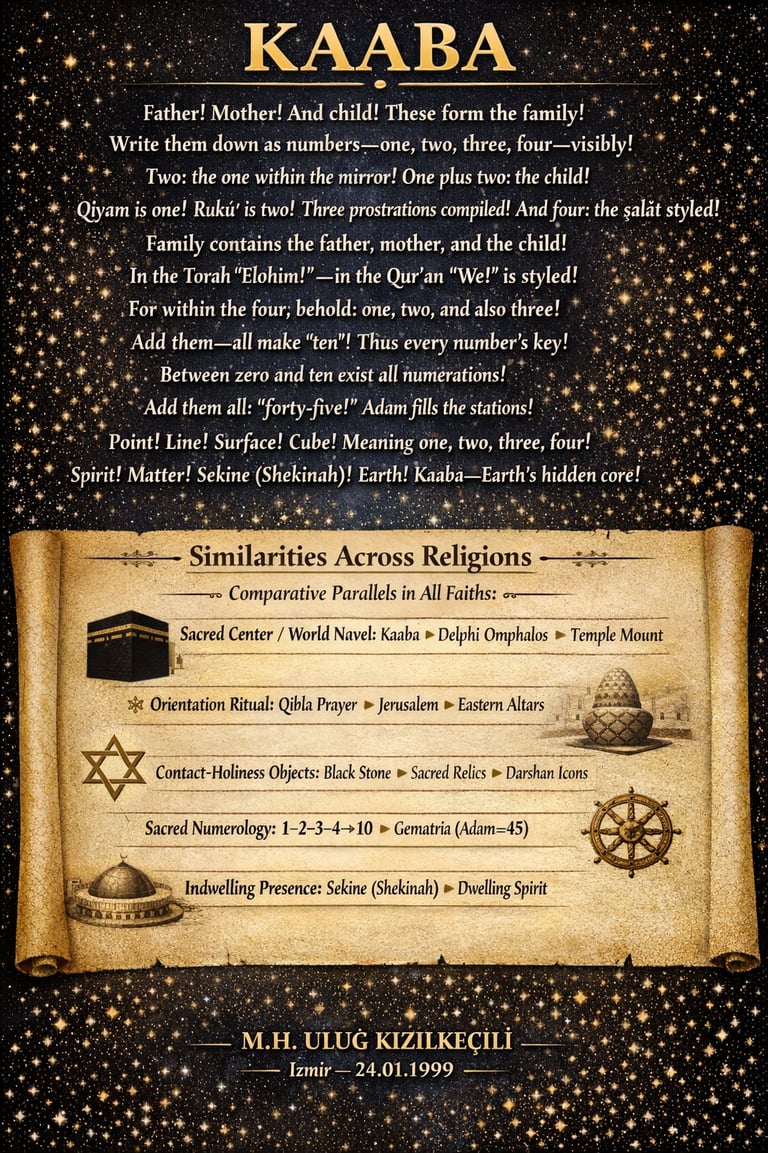
KAABA
Father! Mother! And child! These form the family!
Write them down as numbers — one, two, three, four — visibly!
Two: the one within the mirror! One plus two: the child!
Qiyam is one! Rukū is two! Three prostrations compiled! And four: the ṣalāt styled!
Family contains the father, mother, and the child!
In the Torah “Elohim!” — in the Qur’an “We” is styled!
For within the four, behold: one, two, and also three!
Add them — all make “ten”! Thus every number’s key!
Between zero and ten exist all numerations!
Add them all: “forty-five!” Adam fills the stations!
Point! Line! Surface! Cube! Meaning one, two, three, four!
Spirit! Matter! Sekine (Shekinah)! Earth! Kaaba — Earth’s hidden core!
Its shape a matchbox form! Open every side!
You see a human standing — arms stretched open wide — a cross implied!
Animal symbol: arms spread sideways in display!
Twenty-eight rashidian nerves — the Moon holds sway!
The spirit guides it from outside; instinct comes to birth!
It lives as if in dreaming — half-aware upon the earth!
Upper arm of the cross: the human! Guard your honor!
Thirty-three vertebrae rise, taking the Sun’s bright power!
Now it stands upright — awakened from its sleep!
Owning its own freedom — its self-reliance deep!
“Self-consciousness!” belongs to humankind alone — why so?
Because the spirit guides it inwardly below!
Only the human holds the state of being awake!
Thus worthy to be called “Exalted Essence” for its sake!
Lower arm of the cross: an upside-down human form!
Mouth within the soil, womb lifted — a reversed norm!
Receiving light inverted — a “sleeping mind” inside!
Fertilized above — no joy, no pleasure to confide!
Breathing beauty, fragrant — both the plant and tree!
Claiming sex as filth — an ascetic decree!
The cross fixed into earth — the ground supports them all!
“Deep trance awareness!” lives in minerals’ silent call!
“It is Spirit!” — the central point within the cross’s frame!
Exalted is that consciousness — both presence and no-name!
That is the Black Stone of Kaaba — Ahmed in embodied trace!
Touch it, take a hand from it — a graft belonging to the Rabb’s grace!
Then you shall remember what the Kaaba signifies!
You’ll know why Hazrat-i Ali there did arise!
Hajj begins with the Black Stone — and with the Black Stone ends!
Adam is like a single point — the one who first and last transcends!
“Mother of the Cities — Mecca!” An antenna of the earth!
In Mecca was born the Messenger — Kaaba’s soil became his birth!
Kaaba is secure, for he is Muhammad al-Amīn!
It is the oath we pledged when entering the womb unseen!
Outside the Kaaba there exists only one alternative:
That is Hell itself — so purify your soul, be sensitive!
Kaaba — the symbol of Adam! Its face the “Black Stone” shown!
Its door close to the ground — “Prostrate! Cross the threshold alone!”
Like Adam — fallen from Paradise, its face grew dark with stain!
Forgiven, it turned bright again — the stone’s inner core regained!
While you touch it, it gazes toward your face and says:
“Stand on the right side like me — walk the righteous ways!”
The religion of Ibrahim is called the “Hanīf Dīn” by Rahim!
Kaaba is “Hanīf Dīn!” — for Ibrahim established it for Him!
All the mysteries of the “Hanīf Dīn” lie hidden in the Kaaba’s frame!
Turning toward it is the insistence of the Lord’s claim!
Kaaba is the structure of knowledge — ʿAlī the “Gate of Knowledge” stands!
The title deed of this sanctuary rests in Ahl al-Bayt’s hands!
Directly across the Stone flows the well called “Zamzam”!
To wash within Fāṭima’s radiation — a sacred program!
Look — the roof of Kaaba rests upon four pillars bright!
“These are the four angels who bear the Throne!” — blessed in light!
These four exalted angels — be not unaware of their call:
“Mikāʾil! Jibrāʾil! ʿAzrāʾil! And Isrāfīl!” — guardians all!
“When angels descend to Earth, they appear as human form!”
Like Ibrahim, Ahmed, ʿĪsā, and Adam — beyond the norm!
Kaaba is the Throne! Its mortar: earth, water, fire, air!
Kaaba is Paradise — containing four streams there!
Kaaba is eight-cornered — equal to the “Eight Paradises” told!
For the hand raised against it, the Lord declares: “Let that hand be broken bold!”
There are twenty-four angles within the eightfold side!
As day and night — twelve hours each — in balance abide!
At every hour twice watches the Twelve Imams’ gaze!
Between twelve pairs of ribs the heart completes its ways!
“From Adam’s rib emerged the feminine!” — so the saying goes!
The self is a feminine word — brought forth by the masculine who knows!
From the essence of the Imams all humanity began!
Eve came from Adam — thus the understanding spans!
The Earth too emerged from Ahmed’s essence; the Imams, it is said,
Are the spouses of the Messenger — a mystical thread!
The Imam’s essence is the Messenger! Rise — read the verse aloud:
“From their own selves were spouses made for the crowd!”
Within us lies our partner — the spouse of Muhammad within!
Upon the mystery of “Fāṭir” stands the “Fiṭra Dīn”!
Know this: the essence of the “Supreme Assembly” is Fāṭima’s light!
From her emerges the Imam — the counterpart in sight!
Thus Fāṭima above as spouse — below as the wedded sign!
She is the feminine within the masculine — “Fāṭir” divine!
The four exalted angels receive revelation from the “Lawḥ al-Maḥfūẓ”!
And “Lawḥ al-Maḥfūẓ” is Fāṭima — leaving the witness in awe and muse!
Muhammad himself bore witness to this reality’s flame!
When Fāṭima entered, Jibrāʾil would rise in her name!
Fāṭima was given to ʿAlī by Jibrāʾil’s decree!
The Messenger loved Fāṭima saying, “She is my very identity!”
This love stirred envy against her eternally!
Bakr gave no inheritance — and ʿĀʾisha refused her burial publicly!
Those who betray Ahl al-Bayt shall witness tomorrow’s warning!
Admonish such traitors — let truth be their dawning!
Master M.H. Ulug Kizilkecili
Türkiye/İzmir - 24 January 1999
IMPORTANT NOTE :The original text is poetic, and the author cannot be held responsible for any errors in the English translation! To read the original Turkish text, click HERE! The following section is not the author's work, and the author cannot be held responsible for any errors made!
Expanded Academic Footnotes (English)
[1] “Hajj begins with the Black Stone … and ends with the Black Stone.”
In the rites of ṭawāf, pilgrims circumambulate the Kaaba; many attempt to touch or kiss the Black Stone (al-Ḥajar al-Aswad), and the Stone marks the corner associated with the start/end reference point of circumambulation in common practice. The Stone is widely described as an object of veneration set into the Kaaba’s eastern corner.
[2] Black Stone “whiter than milk” → “blackened by sins”: genre and status.
The motif that the Black Stone “descended from Paradise… whiter than milk… then blackened by the sins of the children of Adam” appears in hadith transmission (e.g., Jāmiʿ al-Tirmidhī 877). This should be read as tradition literature used for moral-symbolic framing, not as a historical-physical claim.
[3] Kaaba as the “first House” and a universal “guide”: Qur’anic basis.
The poem’s language of primordiality coheres with Qur’an 3:96, describing the sanctuary at Bakkah as the first House “established for humanity,” “blessed,” and “a guidance.”
[4] Qibla as identity-formation, not only geography.
The shift/command of qibla (2:144) is a classic case in ritual studies where orientation becomes a community-forming practice (a “directional unity” that disciplines time and body).
[5] “Mother of the Cities — Mecca”: textual anchor.
“Umm al-Qurā” (“Mother of Cities/Towns”) occurs in Qur’an 42:7 in standard translations and is widely glossed as a designation for Mecca in exegetical tradition.
[6] Kaaba as “secure/emin” and the epithet al-Amīn.
“Muhammad al-Amīn” is a well-known honorific in Islamic memory; the poem ties Kaaba’s “security” to moral trustworthiness. Encyclopedic overviews of Mecca/Kaaba emphasize Mecca’s sacred status and the Kaaba’s centrality to ritual life.
[7] Axis mundi / sacred center: comparative frame.
The poem’s “earth antenna / earth’s hidden core” aligns with the comparative-religion concept of axis mundi: a sacred point imagined to connect heaven/earth and anchor meaning. Contemporary reference entries explicitly define axis mundi in these terms.
[8] Direct parallel: Delphi’s omphalos (“navel of the world”).
A close non-Abrahamic analogue is Delphi’s omphalos, the “navel of the world,” a pan-Hellenic sacred center described in heritage literature. This helps contextualize “Mother of Cities” / “earth center” imagery as a widespread religious grammar.
[9] “Elohim” and Qur’anic “We”: plural forms and “majestic plural.”
The poem juxtaposes Torah “Elohim” and Qur’anic “We.” Linguistically, both traditions have long discussions about plural forms used in divine reference (plural morphology with singular reference; “plural of majesty” as rhetorical grandeur). (Note: these are philological/theological debates, not a proof of doctrinal identity.)
[10] Sekine (Shekinah) as comparative bridge.
Your required rendering “Sekine (Shekinah)” is a legitimate comparative move: sakīnah in the Qur’an is associated with tranquility/assurance sent into believers’ hearts (often translated “tranquility/peace”), while “Shekhinah” in Judaism denotes indwelling divine presence in rabbinic and kabbalistic discourse. Modern reference treatments explicitly discuss Shekhinah as “dwelling/presence.”
[11] Tetraktys (1+2+3+4 = 10): arithmology, not mathematics.
The poem’s 1–2–3–4→10 corresponds to sacred number symbolism found in Pythagorean arithmology (“tetraktys”) and later esoteric numerology. This is best read as symbolic cosmology, not “scientific numeracy.” (This note frames method rather than proving influence.)
[12] “45 = Adam”: gematria cross-reading.
The claim “forty-five = Adam” matches a well-known Hebrew gematria result (אדם = 45). In academic terms this is a case of cross-tradition arithmological equivalence, where one symbolic system (gematria) is used to scaffold another (Islamic mystical reading). (Again: interpretive, not historical proof.)
[13] Kaaba geometry: symbolic vs architectural accuracy.
The poem uses “cube / eight-cornered / angles.” Architecturally, the Kaaba is commonly described as a cubic / cuboid shrine at the mosque’s center; “eight-cornered” is therefore better categorized as symbolic geometry (a numerological overlay) rather than a literal description.
[14] “Hanīf Dīn” (Abrahamic primordial monotheism) and fitra.
The poem’s “Hanīf Dīn” gestures toward Qur’anic themes where hanīf is linked to Abraham and upright monotheism; modern summaries of fiṭra also connect it to an innate orientation toward true religion (often citing Qur’an 30:30 in mainstream discussions).
[15] “ʿAlī is the Gate of Knowledge”: authenticity is disputed.
The hadith “I am the city of knowledge and ʿAlī is its gate” is widely circulated, especially in Shiʿi-leaning devotional contexts, but scholars differ in grading (variously: fair/hasan, weak, contested). A careful academic apparatus should mark it as disputed rather than simply “established.”
[16] Four angels / bearing the Throne: conflation risks.
The poem speaks of “four angels who bear the Throne” and lists Jibrāʾīl/Mīkāʾīl/Isrāfīl/ʿAzrāʾīl. In normative Islamic texts, “bearing the Throne” has its own scriptural imagery, while “four archangels” is a common devotional taxonomy; poems often merge these registers. For academic presentation, it’s best to treat this as poetic synthesis (tradition layers combined).
[17] “Kaaba as Paradise containing four streams”: broader mythic pattern.
The “four streams” motif strongly resembles widespread sacred geography patterns (four rivers from Eden; fourfold cosmic flows), appearing across cultures as a way to imagine the world’s life-giving order. The Kaaba link here is mystical typology rather than standard doctrine. (Comparative note; not a single-text claim.)
[18] Sacred relics and “contact holiness”: cross-religion parallels.
Touching/kissing a sacred object to participate in blessing has parallels in:
Christian relic veneration (contact with saints’ shrines),
Hindu darśan and sacred stones/icons,
Buddhist reliquaries (stupa contact),
Jewish traditions around holy sites/objects.
The Black Stone is often presented in reference works as an object of veneration connected to the Kaaba’s ritual cycle.
[19] “Hell as the only alternative”: rhetorical dualism.
This line expresses a strong “either/or” soteriological rhetoric (salvation vs perdition). Comparative religion notes that sacred-center traditions commonly produce spatial moral dualisms (center/periphery; pure/impure; salvation/ruin), a known rhetorical structure in ritual texts.
[20] Sectarian-historical claims about inheritance/burial: contested tradition.
Later parts of the longer poem (not in your first excerpt but present in the full version you shared earlier) include claims about inheritance/burial disputes around Fāṭima and early caliphal history. Academic footnoting should explicitly label these as sectarianly contested narratives rather than neutral history, and present them as part of memory traditions and authority formation. (For one canonical Sunni framing of inheritance doctrine, see standard hadith repositories.)
Cross-Religious “Similarities Map” (All-Religions Comparison, concise)
Sacred Center / World Navel: Kaaba ↔ Delphi omphalos ↔ Jerusalem/Temple ideation ↔ Mount Meru (Hindu) ↔ mandala/stupa centers (Buddhist).
Orientation Ritual: qibla-facing prayer ↔ Jewish prayer toward Jerusalem ↔ Christian ad orientem traditions ↔ Hindu/Buddhist directional mandalas (ritualized space).
Contact-Holiness Objects: Black Stone touch/kiss ↔ relic touch ↔ darśan icons ↔ stupa circumambulation.
Sacred Numerology: 1–2–3–4→10 (tetraktys) ↔ gematria (Adam=45) ↔ broader arithmology across late antique and medieval esoteric traditions.
Indwelling Peace/Presence: Sekine (Shekinah) bridges “tranquility sent down” and “dwelling presence” idioms across Islam/Judaism.