LETTER MAN
LETTER MAN. These are “the names the angels did not know!” “They are the Names,” in truth — all visible bodies! The origin of Names is letters! The origin of letters is the dot! The dot is zero! The inside and outside of everything — in nothingness!
APOCALYPSE BOOK
LETTER MAN
Face — ÂLÎ! Ribs — inscribed HASAN! HÜSEYİN!
Right and left arm — MUHAMMED! “Legs” — say FATMA!
The signature of EHL-İ BEYT became the form of Adam!
Whoever reads it prostrates — certain of what it is!
These are “the names the angels did not know!”
“They are the Names,” in truth — all visible bodies!
The origin of Names is letters! The origin of letters is the dot!
The dot is zero! The inside and outside of everything — in nothingness!
Allah says: “The inside and outside of all things are Mine!”
Allah defines everything — that is, the nothing!
The code of the Incomparable: zero! Infinity! And the first one!
Neither computer nor algebra can solve this code!
Transform the Letter-Man into the Man of number!
Find to whom you swore your oath — before you die!
Since the knowledge of Allah neither increases nor decreases:
Everything is always in that knowledge! Yet first — the primordial Adam!
He is it! Allah’s knowledge of His own identity!
Creation has no connection to Him at all!
Behold this primordial Adam — named MUHAMMED ÂLÎ!
Formed of letters! That is the true fiṭrah — no body!
Primordial Adam! “Rahim who is Rahman!” Twin — in a sense!
“LÂ ILÂHE ILLÂ HÛ!” One hundred ten — equal to ÂLÎ!
“Fiṭrah!” means “unleavened”! Can there be leaven for the Lord?
Leave Allah aside — strive to understand fiṭrah!
Fiṭrah from the root “Fâtır”! Identical with FÂTIMA!
A channel to HASAN and HÜSEYİN! EHL-İ BEYT — the LETTER FAMILY!
Allah — the Knower! Primordial Adam — the known! That is the only difference!
What He knows is again Himself! Take many lessons from this!
“Fiṭrah” does not change! It is ثابت — fixed! It cannot be separated from Allah!
It only reflects! Prayer is to unite with Him!
Sperm — the “Pen”! Ovule — the paper upon which the name is written!
Both are laments to the reflected “Fiṭrah”!
As primordial Adam reflects, he receives existence from Allah!
The seventh copy — the densest being!
Letter by letter resembling himself, drawing our image,
He makes the final copy — our body in the womb!
The community of humankind is also called “World”! Why?
Because each human is a sign of his “Fiṭrah”!
The body is the living Qur’an! Written verse by verse!
Its secret hidden from the unbeliever — clear to the believer!
To the “Spirit” or to the “Soul” — know that the eye is a window!
The eye and the letter “ʿAyn” are the same! In the Qur’an, the beholder is essence!
Since human tissue is formed of letters:
“Allah’s first command to MUHAMMED was: Read!”
“He obeyed and read in the name of his Lord!”
Not “in the name of Allah”! Pay attention!
“The Knower” and “the Unknowing” — separated at that moment!
“The Knower” made covenant by taking himself as witness!
The one he took as witness was his own LETTER MAN!
Soul, angel! Covenant, prostration! This is the inner face of every religion!
“Read your book!” The first command — also in the Hereafter!
Read before you die, so that the LETTER MAN may accompany you!
“The noble companion”! Look — his name is in the Qur’an!
Like you, he is LETTER MAN — pure light! No body!
“ALIF LÂM MÎM (ALM)!” The name Allah gave to the “Book”!
“It guides to the path of Lord!” Fiṭrah must be the aim!
The other letters at the beginnings of surahs — verses!
In origin “two sevens” of letters — if you do not repeat them!
“The first twin seven classes!” Reflect primordial Adam!
“Spirit” — the rank of prophet! “Lord” — the moment of ascension!
The body is a book written at every instant by the sound called “letter”!
We are addressed by the command: both “Read!” and “Listen!”
Vocal dhikr fulfills both commands!
Lord calls the Qur’an “Book” and “Remembrance”! Reflect!
“Listen to the reed,” Mevlâna did not say in vain!
The reed — seven chakras! Tones — “nineteen”! Let the mind perceive!
“The one who reads his Book” remembers his identity!
“The Qur’an had been taught to him before he was created!”
He utters the sound “Be!” When he hears the sound “Be!”
He lies down with the “seven sleepers” when he falls asleep with that sound!
The name of the religion of Islam — pay attention — is “the religion of Fiṭrah”!
Read the LETTER MAN — and now learn yourself:
However many couplets LETTER MAN has — sum them to that number:
Six hundred sixty-six! LETTER MAN — MELK-İ SEDEK!
Master M.H. Ulug Kizilkecili
Türkiye/Ankara - 09 September 2001
IMPORTANT NOTE :The original text is poetic, and the author cannot be held responsible for any errors in the English translation! To read the original Turkish text, click HERE! The following section is not the author's work, and the author cannot be held responsible for any errors made!
Academic Footnotes (English, Comparative)
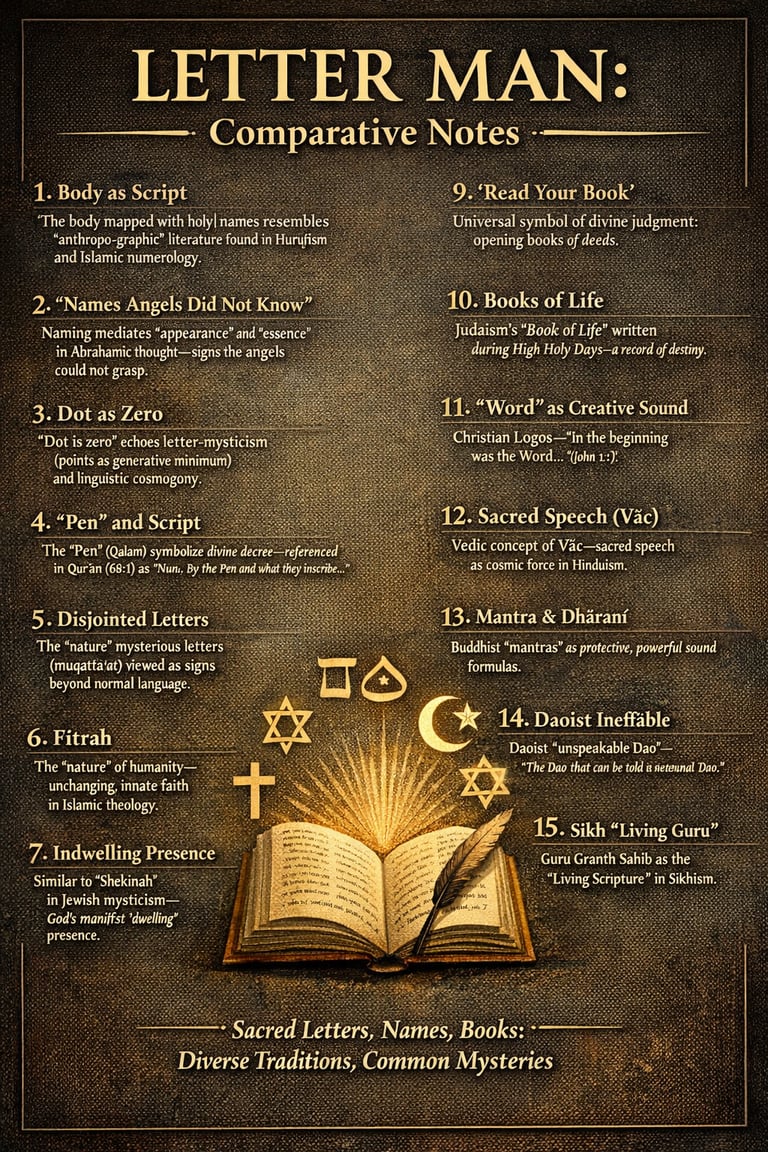
[1] Letter–body correspondences and “human form as script.” The poem’s mapping of holy names onto Adam’s bodily form belongs to a wider family of “anthropo-graphic” symbolism, where the human body is read as a legible microcosm. A close Islamic near-neighbor is Ḥurūfism, whose hallmark is numerological interpretation of letters and explicit attempts to correlate the Perso-Arabic alphabet (letters/points) with the human form and cosmic structure.
[2] “Names the angels did not know”: knowledge, naming, ontology. The line evokes a classic Abrahamic theme: naming as epistemic privilege and as a mode of grasping reality. In comparative terms, “names” often mediate between appearance (bodies) and meaning (essence)—a move seen across exegetical traditions that treat the world as a readable sign-system (scriptural hermeneutics, mystical semiotics). As a methodological note, modern scholarship often treats such claims less as empirical propositions and more as religious language about meaning, authority, and the limits of angelic/created knowledge within revelation.
[3] Dot → zero: the “point” as generative minimum. The poem’s “letters originate in the dot; the dot is zero” aligns with a broad mystical semiotics in which minimal marks generate maximal worlds (point/seed → extension/form). Ḥurūfī materials explicitly treat letters and points as foundational sign-units with cosmological reach.
[4] The “Pen” (Qalam) and what is inscribed: scriptural anchor and exegetical range. The poem’s “Pen” imagery resonates strongly with Qur’anic oath-language (“Nūn. By the Pen and what they inscribe…”) and the vast interpretive tradition around writing, decree, and record. Mainstream tafsīr often emphasizes the mysterious disjointed letters and the Pen as a symbol of divine governance/communication; many commentaries explicitly state that the ultimate meaning of the isolated letters is known to Allah (or disclosed to the Prophet).
[5] Disjointed letters (muqaṭṭaʿāt) as “signs”: secrecy, function, and literary theory. When the poem calls the opening letters “āyāt,” it aligns with readings that treat them as textual signs rather than ordinary lexemes—markers of revelation’s otherness, sonic force, or encoded structure. Contemporary scholarship generally recognizes the lack of consensus about their meaning and often frames them as part of Qur’anic rhetoric (sound/attention/authority) as much as semantics.
[6] Fiṭrah as primordial human nature (theological anthropology). The poem’s refrain that “Fiṭrah does not change” matches a well-attested Islamic concept: fiṭrah as an inbuilt human disposition tied to ethical monotheism and devotion, anchored in Qur’an and ḥadīth reception. Modern reference treatments present fiṭrah as a central category in Islamic theological anthropology—often described as a primordial orientation that can be obscured but not structurally replaced.
[7] Immanence / indwelling presence and Sekine (Shekinah). Although your poem text here doesn’t include “Sekine,” the conceptual neighborhood (“reflection,” “presence,” “dwelling”) compares well with Jewish discourse on Shekhinah—a term used in rabbinic and later mystical traditions for the manifest, “dwelling” divine presence in communal/liturgical/revelatory contexts. This is best treated as functional parallel (how presence is spoken about) rather than a doctrinal identity-claim.
[8] “World created through letters”: Sefer Yetzirah and linguistic cosmogony. The poem’s letter-ontology (“all bodies are names; names are letters”) is strikingly comparable to a classic Jewish mystical cosmogony: Sefer Yetzirah, which presents creation through “ways of wisdom” including the letters (and enumerations). Scholars routinely discuss it as a formative text for later Jewish letter-mysticism and cosmological semiotics.
[9] “Living Book” / “read your book”: record-of-deeds across traditions. The poem’s “Read your book” motif participates in a near-universal religious image: moral life as recorded inscription and judgment as opening books. A particularly clear comparative anchor is Zoroastrian eschatology: encyclopedic reference summaries describe judgment by records kept in two books (good and evil deeds), a theme that also appears in later Abrahamic apocalyptic imagery.
[10] Books of Life and inscription (Judaism; High Holy Days). Rabbinic Judaism has a well-known liturgical/theological idiom of being inscribed in the “Book of Life,” especially around Rosh Hashanah/Yom Kippur, grounded in rabbinic sources and later prayer practice. In comparative reading, this supports the poem’s sense that destiny/identity is “written,” and that spiritual practice is bound up with inscription/reading metaphors.
[11] Logos (“Word”) and creation: Christian and Hellenistic bridges. The poem’s “sound/command” (“Be!”) and “world-as-text” sensibility can be compared to Christian discourse on the Logos (especially the Johannine prologue) and its philosophical receptions: the “Word” as creative principle and mediating intelligibility. Stanford Encyclopedia discussions (via Augustine and related traditions) note how Christian theology connects the Logos of John’s prologue with philosophical accounts of intelligibility and inner word.
[12] Vāc (sacred Speech) and South Asian “speech-as-cosmos.” The poem’s strong “sound/voice” axis has a robust parallel in Vedic/Hindu traditions where speech is sacralized and cosmologically potent (Vāc as goddess of speech; mantric speech as formative). Encyclopedic reference treatments identify Vāc as central to Hindu conceptions of speech and knowledge.
[13] Mantra/Dhāraṇī: condensed doctrine as protective sound (Buddhism). The poem’s emphasis on vocal recitation (“Listen,” “Remembrance,” voiced devotion) compares, structurally, with Buddhist practices where dhāraṇīs and mantras function as condensed doctrinal utterances believed to have efficacy when chanted—often as protection, blessing, or mnemonic encapsulation. This is a cross-tradition example of sound as soteriological technology, not merely semantic content.
[14] The ineffable source beyond naming: Daoist critique of speakable Dao. The poem’s paradox “inside and outside are in nothingness,” plus its suspicion toward total capture by calculation, resonates with Daoist reflections on the limits of language: “The Dao that can be spoken of is not the constant Dao.” Comparative philosophy uses this to mark the tension between ultimate source and named forms—a tension that also appears (with different metaphysics) in apophatic theologies.
[15] “Scripture embodied” and the Word internalized (Sikh tradition). The poem’s “living book” motif also finds a distinctive analogue in Sikhism’s doctrine/practice around scripture and divine Name (nāmsimran), including the belief that the Gurus’ authority culminates in the Guru Granth Sahib as a uniquely central embodiment of guidance for the community. Encyclopedic summaries emphasize scripture’s normative role and the tradition’s stress on disciplined meditation on the divine Name.
[16] Comparative-historical caution: “shared motifs” are not “same doctrine.” When the poem’s motifs (letters, numbers, books, speech) are aligned cross-religiously, the academically responsible move is to treat them as family resemblances: similar symbolic technologies answering shared human questions (meaning, authority, judgment, presence), while maintaining doctrinal non-identity and distinct histories. Recent scholarship on Abrahamic interdependence, for example, argues that Judaism, Christianity, and Islam continually form and re-form in interaction—useful for interpreting convergences without collapsing differences.