LOVE (The Secret of Divine Love)
LOVE (The Secret of Divine Love).“The angel descends to earth in human form,” says RAHMAN! Your form is also human—this is the angel’s descent! “To every angel was given the command to prostrate to Adam!” “Who refuses becomes Iblis!” Submit—this is faith!
APOCALYPSE BOOK
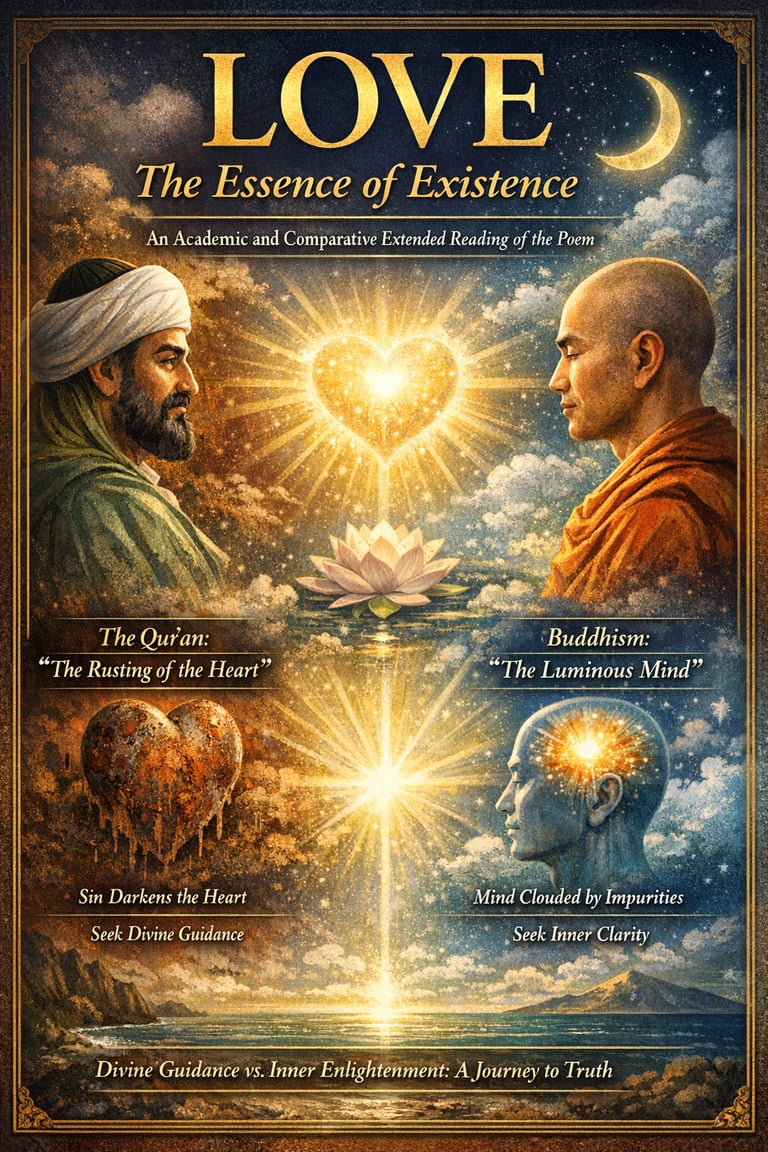
LOVE
The fish at the bottom of the ocean has no eyes! Why?
The eye created light so that it may see it!
“Lord is also light!” So that He may be loved and love,
He made His own soul a gift to every human!
While drinking, you choose the most intoxicating one!
When marrying, you surely choose the most beautiful!
Behind the veil of the body, to the beloved’s soul,
Even when touching—look! You lose yourself!
You tremble! Even when there is a veil in between!
In union, flesh to flesh with the one you love!
So the greatest pleasure must be to create!
Then desire direct contact with your soul!
Iblis means “garment”, and the unbeliever means “covered”!
One cannot unite with the bride while her veil remains!
ALLAH shows His beauty to the nearest!
What makes every nightingale sing is the rose, not the thorn!
Prayer is meeting the Lord! “Friday” means becoming one!
If not done in secrecy, effort becomes exposed!
A child is the father’s secret! This secret is not a seed!
So sow not what is yours, but your very self!
Even Cibril could not be present in the Mi‘raj!
Thus the Messenger was called “Habibullah”!
Out of love for the Lord, Iblis said “No” to Adam!
Out of jealousy, he accused him of being “clay”!
RAHMAN means one who loves greatly; not one who merely pities!
A beautiful face needs a mirror; incline toward this mystery!
“Houri” and “boy” are the rewards of the Lord’s paradise!
Thus Cibril gave ZEHRA to ALI!
ZEHRA, from the root “Zühre”: dazzling beauty!
ALI, “ELION!” The Sun! Eternity placed him at the summit!
When Mary saw the spirit as a “magnificent youth,”
She forgot her virginity and held his hand!
In the Mi‘raj, a “boy” like a “houri” appeared!
He took on the most beautiful form to be seen!
This most beautiful form is our soul called ADAM!
Who does not unite with it wanders in a lowly state!
“The angel descends to earth in human form,” says RAHMAN!
Your form is also human—this is the angel’s descent!
“To every angel was given the command to prostrate to Adam!”
“Who refuses becomes Iblis!” Submit—this is faith!
“Esselamu aleykum!” then the Lord says to you!
For now He Himself is a guest within the human!
Host this honored guest within your heart!
Know its worth! You have reached that moment called “Kadir”!
Master M.H. Ulug Kizilkecili
Türkiye/Ankara - 03 December 1996
IMPORTANT NOTE :The original text is poetic, and the author cannot be held responsible for any errors in the English translation! To read the original Turkish text, click HERE! The following section is not the author's work, and the author cannot be held responsible for any errors made!
Academic and Comparative Extended Reading of the Poem
The central proposition of the poem is the idea that the essence of existence is love. The motifs in the first stanza—“light,” “eye,” “seeing,” and “the gifting of the soul to the human”—are closely related to the concepts of nūr (light) and rūḥ (spirit) in Islamic thought. In the Qur’an, the expression that ALLAH is the light of the heavens and the earth is interpreted not as physical light, but as divine manifestation, guidance, and the source that renders existence meaningful. Likewise, the motif of the divine breath in the creation of the human attributes to humanity an ontological nobility beyond mere biological life. The phrase “so that He may be loved and love” aligns with a strong current in classical Sufism, where creation is explained through love and manifestation. Modern academic studies also demonstrate that divine love in Islamic thought is not merely an ethical principle but a cosmological one.
This theme has strong parallels in Judaism and Christianity. In the Christian tradition, the statement “God is love” does not merely indicate that God loves, but that love itself pertains to the divine essence. In the Johannine tradition, light emerges as a symbol of divine truth and revelation. In Jewish tradition, especially in the Psalms and esoteric interpretations, divine light is treated as the source of life and understanding; moreover, the concept of Sekine (Shekinah) expresses the idea of divine presence dwelling within the human world. Therefore, the poem’s line “the Lord is also light” and the notion of the soul being gifted to humanity, while rooted in Islam, also connect to the shared symbolic vocabulary of the Abrahamic traditions.
The tension established in the poem between bodily desire and spiritual contact is also noteworthy. Expressions such as “touching the beloved’s soul behind the veil of the body” and “seek direct contact with your soul” resemble the Sufi idea that human love serves as a bridge to divine love. The erotic language here does not primarily denote biological sexuality; rather, through concepts such as “veil,” “proximity,” “ecstasy,” “self-loss,” and “direct contact,” it expresses an ontological longing. A similar model of elevation is found in the Hindu bhakti tradition, where love is not merely an emotion but a transformative path that binds the human to the divine. In Jewish mysticism, devekut (clinging to God) and in Christian mysticism, “union,” are likewise understood as intensifications that begin with the sensory and move toward the transcendent.
The poem’s implication that “creation is the greatest pleasure” must be approached carefully from the perspective of modern theology. In mainstream Islam, divine creation is not explained through human categories of pleasure; however, in mystical poetry, divine action is expressed through the language of beauty, love, manifestation, and appearance. Such usage is symbolic rather than doctrinal. Similarly, in Hindu thought, the Brahman–Ātman relationship and certain bhakti interpretations use divine play or love to explain the cosmos. In contrast, Buddhism, lacking a central creator God, does not develop a love-based cosmology; instead, it emphasizes the overcoming of ignorance, the dissolution of the illusion of self, and the purification of the mind. Thus, the ontology of the poem resonates not with Buddhism but with Abrahamic mysticism and the bhakti current of Indian thought.
The images of Iblis, “covering,” “garment,” and the “accusation of clay” reinforce the idea that what veils human truth is not merely sin but an erroneous ontological perspective. In the Qur’anic narrative of prostration to Adam, the human is honored through the divine breath; the poem rearticulates this through metaphors of “veil” versus “beauty” and “rose.” The implied equation of unbelief with “coveredness” should be understood as both an etymological and Sufi play, since the root k-f-r carries the sense of covering or concealing, though in the poem it is expanded into a metaphysical blindness. Similar metaphors exist in Judaism and Christianity in the forms of “hardness of heart,” “veil,” and “spiritual blindness.” In Buddhism, this function is fulfilled by avidyā (ignorance), and in Hinduism by māyā and false identification.
The interpretation of prayer, Friday, and communal gathering as “meeting,” “union,” “intimacy,” and “secret” transforms ritual from a merely juridical act into an existential encounter. In Islam, worship is already not only outward action but also intention and presence; mystical interpretations deepen this further by reading worship as an experience of being in the divine presence. The phenomenology of religion likewise emphasizes that ritual unites visible practice with invisible meaning. In Judaism, the Sabbath and communal prayer; in Christianity, liturgy and Eucharist; in Hinduism, darśan and pūjā; and in Buddhism, the sangha and meditative discipline—all, despite theological differences, remove the human from ordinary time and introduce a form of “intensified sacred time.”
The axis of Mi‘raj, Cibril, and “Habibullah” constitutes the most explicitly Islamic section of the poem. Academically, two levels can be distinguished: first, in the classical narrative, the Mi‘raj expresses the ascent of the Prophet to the divine presence; second, in Sufi interpretation, it becomes a symbol of the ultimate horizon of proximity available to the human soul. The line “even Cibril could not be present” echoes a traditional motif emphasizing the transcendence of prophetic proximity beyond the angelic limit. However, this should be read not as theological dogma but as the symbolic language of Mi‘raj literature.
The verse stating that “out of love for the Lord, Iblis said ‘No’ to Adam” enters a highly sensitive interpretive domain. In mainstream Islam, Iblis’ refusal is understood as arrogance and rebellion; however, in some Sufi and marginal interpretations, the figure of Iblis has been treated as a tragic-theological paradox, generating alternative readings based on the idea of exclusive devotion. It must be noted with academic rigor that this line does not represent standard Sunni orthodoxy but reflects a symbolic and contested mystical interpretation. Thus, the poem here dramatizes love through jealousy and absoluteness rather than presenting doctrine.
The expression “RAHMAN means one who loves greatly, not one who merely pities” exemplifies the poem’s interpretive boldness. Philologically, this is not a standard lexical definition; RAHMAN is classically understood in terms of mercy, compassion, and all-encompassing benevolence. However, the poem reinterprets mercy not as passive pity but as overflowing love and encompassing intimacy. Such semantic expansion is legitimate in poetry but must be identified academically as a mystical reinterpretation rather than a dictionary meaning. Parallels can be drawn with agape in Christianity, hesed in Judaism, and the relational love of bhakti in Hinduism, all of which transcend mere pity and express a binding, transformative, and faithful mode of love.
One of the most controversial aspects of the poem is the symbolic network constructed around paradise, houris, the “boy,” ZEHRA, and ALI. This section should not be read through the lens of normative theology but through symbolic gender language, the metaphysics of beauty, and luminous anthropology. The poem treats beauty not merely as an aesthetic object but as a carrier of divine manifestation. In the Judeo-Christian tradition, divine beauty and the erotic language of sacred love are powerfully expressed, especially in the Song of Songs. In Hindu bhakti, the Krishna–Radha symbolism and certain tantric-poetic traditions likewise construct beauty as divine attraction rather than mere sensuality. Buddhism, however, typically approaches this domain through the recognition of impermanence and the binding nature of desire, making the poem’s language most distant from Buddhist sensibility.
“The angel descends to earth in human form” and “your form is also human” propose a powerful anthropology that affirms the cosmic centrality of the human being. In the Qur’an, the command for prostration to Adam indicates that the human is not a merely material entity; Sufism develops this line further by describing the human as the microcosm and sometimes as the mirror of divine names. In Christianity, the doctrine of imago Dei—that the human is created in the image of God; in Hinduism, the relationship between Ātman and ultimate reality; and in Jewish mysticism, the attribution of cosmic-spiritual significance to the human—all, despite their differing metaphysical grounds, place the human beyond the level of a simple biological organism. Buddhism, however, offers a fundamental contrast here: rather than a permanent, essential self, it emphasizes a self-illusion that must be dissolved. This comparison shows that the metaphysics of the poem is “essentialist” and “personal-relational” in nature.
The expressions in the final stanza—“at that moment the Lord says ‘Esselamu aleykum’ to you” and “He Himself is now a guest within the human”—constitute the climax of the poem. Here, God no longer appears as a distant sovereign but as an honored guest hosted in the heart. This reflects a mystical-poetic internalization of the Qur’anic idea that ALLAH is closer to the human than the jugular vein; however, classical exegesis emphasizes that this closeness is not physical, but pertains to knowledge and power. The poem goes beyond this theological explanation and establishes a phenomenological language of proximity: the human becomes the recipient of divine address within inner experience. Similarly, in Jewish mysticism, divine presence; in Christianity, the indwelling of God; in Hinduism, the divine essence within; and in Buddhism, the clarity of the purified mind—all represent different versions of an “inner depth” experience, though their metaphysical contents are not identical.
From an academic perspective, this poem operates on three levels. The first level is explicitly Islamic: the language of nūr, spirit, Adam, prostration, Mi‘raj, Cibril, the Lord, RAHMAN, prayer, and communal unity originates here. The second level is Sufi: the tension between body and soul, veil and beauty, love and ecstasy, immanent proximity, and the human as the locus of divine manifestation is intensified at this level. The third level is broader from the perspective of comparative religion: divine presence and light in Judaism, love and indwelling in Christianity, Ātman and bhakti in Hinduism, and in Buddhism the axis of purified consciousness and non-self instead of a creator-centered love ontology—revealing both parallels and sharp differences. Therefore, while the poem does not claim that all religions are identical, it can be read as a powerful text demonstrating that the human quest for love, light, proximity, and inner transformation has been articulated in different languages throughout the history of religions.
Pabhassara Sutta (Pabhassara Sutta – “The Luminous Mind Teaching”)
The Pabhassara Sutta is a short but significant text found in the Pali Canon of Buddhism. It appears in the Anguttara Nikaya and expresses the concept of the “intrinsically luminous mind,” a foundational idea in Buddhist psychology.
The key sentence in the Pali text is as follows:
“Pabhassaram idaṃ bhikkhave cittaṃ; tañca kho āgantukehi upakkilesehi upakkiliṭṭhaṃ.”
Its meaning:
“Monks, this mind is luminous by nature; but it is defiled by adventitious impurities.”
The text continues with the idea that:
The mind is originally luminous, but the untrained person does not perceive this truth.
The trained person, however, recognizes this luminous nature.
Core Meaning of the Teaching
This sutta emphasizes three key points regarding the nature of the mind in Buddhism:
The fundamental nature of the mind is clear
In Buddhist thought, the essence of the mind is not impure. Defilement arises later.
These defilements include:
desire (rāga)
aversion (dosa)
ignorance (moha)
Defilements are temporary
These impurities do not belong to the essence of the mind; they are later additions (āgantuka).
Therefore, the aim of Buddhist practice is not to create a new mind, but to remove the coverings.
Meditation removes the veil
The purpose of Buddhist meditation is not to produce a new state of mind, but to reveal the inherent clarity of the existing one.
Thus, a common expression in Buddhist literature states:
“The mind becomes defiled, but its essence is not defiled.”
Its Place in Buddhist Psychology
The Pabhassara Sutta is considered important particularly in:
Theravāda meditation tradition
Abhidhamma psychology
debates on the pure nature of the mind
In later Buddhist traditions, this idea has been interpreted in various ways:
In Mahayana: the concept of Buddha-nature
In Tibetan Buddhism: the teaching of the “luminous mind”
Comparative Interpretation with Other Religions
This concept can be compared with similar metaphors in other traditions:
Islamic Sufism: the rusting of the heart and its purification through remembrance
Christian mysticism: the obscuring of the divine image by sin
Hinduism: the covering of Ātman by ignorance
Buddhism: the defilement of the mind while its essence remains luminous
However, there is a crucial difference:
In Buddhism, the luminous mind is not God or a soul.
It is simply the experiential clarity of the mind.
Academic References
Key academic references on the Pabhassara Sutta include:
Bhikkhu Bodhi – The Numerical Discourses of the Buddha
Rupert Gethin – The Foundations of Buddhism
Peter Harvey – An Introduction to Buddhism
Analayo – Satipatthana: The Direct Path to Realization
Comparison of the Qur’anic “Rusting of the Heart” and the Buddhist “Luminous Mind” Teaching
This comparison is important for understanding the metaphors developed by two different religious traditions regarding human consciousness / heart / mind. On one side stands the Pabhassara Sutta in Buddhism, and on the other, the concept of the rusting of the heart (ran) in the Qur’an.
1. Buddhism: The Nature of the Mind is Luminous (Pabhassara)
The Pabhassara Sutta begins with the following statement:
“Monks, this mind is luminous by nature; but it is defiled by adventitious impurities.”
Pali text:
Pabhassaram idaṃ bhikkhave cittaṃ; tañca kho āgantukehi upakkilesehi upakkiliṭṭhaṃ.
Here, three fundamental ideas are present:
1. The essence of the mind is considered pure
The mind is originally clean.
2. Defilement is secondary
Defilement arises through the following mental states:
desire (rāga)
aversion (dosa)
ignorance (moha)
3. Meditation removes the veil
The aim of Buddhist practice is not to change the mind, but to remove the covering.
2. The Qur’an: The Rusting of the Heart (Ran)
In the Qur’an, this idea appears in Qur'an 83:14:
“No! Rather, what they have earned has rusted their hearts.”
Arabic text:
كَلَّا بَلْ رَانَ عَلَى قُلُوبِهِم مَّا كَانُوا يَكْسِبُونَ
The key concept here is:
رَانَ (ran)
= to become rusted
= to be covered
= to darken
In classical exegesis, this concept is explained as follows:
sin leaves a trace on the heart
as it is repeated, the heart begins to darken
eventually, it can no longer perceive truth
3. Similarities
There are striking parallels between these two teachings.
1. The metaphor of defilement
defilement of the mind
rusting of the heart
mental impurities
sin
Both describe a covering that prevents the perception of truth.
2. The concept of a veil
In Buddhism:
the defiling elements are considered temporary
In Islam:
the darkening of the heart is seen as the result of sin
In both traditions, the human being can fall into a state of being unable to perceive truth.
3. The idea of purification
In Buddhism:
meditation
mindfulness
mental discipline
In Islam:
repentance (tawbah)
remembrance (dhikr)
worship
The aim is the same:
the clarification of the heart / mind.
4. Fundamental Differences
The most important difference is ontological.
1. Concept of God
In Buddhism:
there is no creator God
purification is an individual process of awareness
In Islam:
the illumination of the heart occurs through the guidance of ALLAH
2. Concept of the soul
In Buddhism:
there is no permanent soul (anatta)
In Islam:
the soul is considered a divine breath
3. Ultimate goal
In Buddhism:
nirvana
(the cessation of ignorance)
In Islam:
closeness to ALLAH and salvation in the hereafter
5. An Interesting Parallel Between Sufism and Buddhism
In Sufi literature, the following hadith is often transmitted:
“When a servant commits a sin, a black spot appears on his heart.”
This idea resembles the Buddhist notion that:
defiling elements of the mind prevent the perception of truth.
Sufism explains this condition as follows:
the heart is a mirror
sin creates rust
remembrance polishes the mirror
In Buddhism, this metaphor appears as:
the mind is the sky
impurities are clouds
Although Islam and Buddhism differ fundamentally in their metaphysical frameworks, both traditions converge on a profound psychological insight: the human capacity to perceive truth can become obscured, yet this obscuration is not necessarily absolute. Through different methods—divine guidance and remembrance in Islam, disciplined awareness and meditation in Buddhism—the coverings over the heart or mind can be removed, allowing a clearer encounter with reality.