MELCHIZEDEK
MELCHIZEDEK.Only one person repeated the word of Ali! “The only leader is science!” he said; his name is Atatürk! He surpassed even statesmanship every time! For he received a share from Melchizedek!
APOCALYPSE BOOK
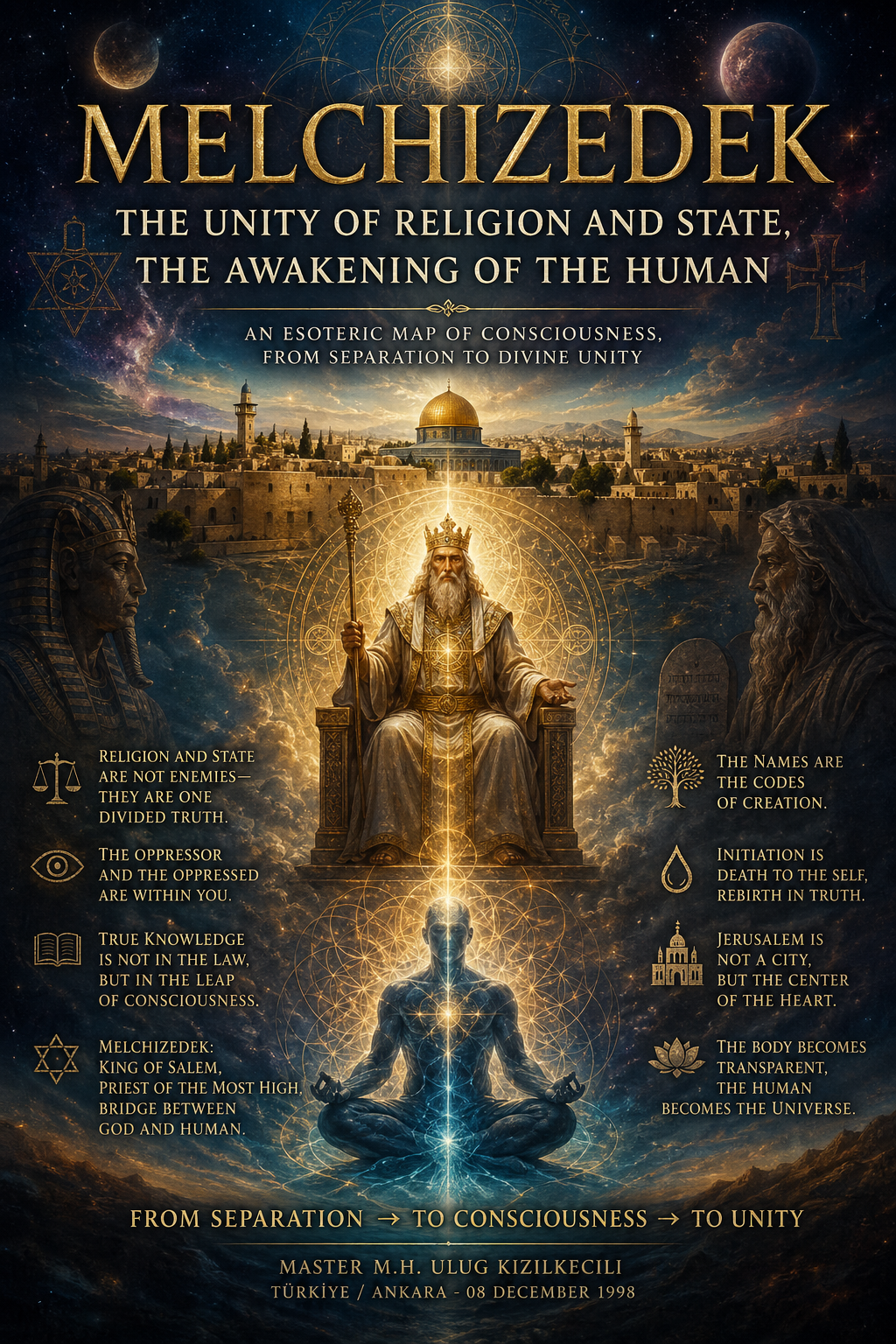
MELCHIZEDEK
Religion is the Lord; the state is the property of those who deceive the people!
Some say it should be separated! Some say it should not!
This is not the division of Allah but of Satan!
This is the cause of every war! The death of every society!
Do not say: “The right of Caesar must be given to Caesar!”
Every right is the right of the human! Seek your own right!
“Both the oppressor and the oppressed go together into the fire!”
Allah says: “Why did you not crush the oppressor?”
Even an unconscious cell rebels against its own head!
First with a headache! And finally with cancer!
In Pharaoh there is no trace from the gene of Musa!
Calling it “order,” he slaughters the infant for the throne!
Khidr even tested Musa in religion!
Then he said: “You govern the people with the Ten Commandments!”
And Harun became a priest! Prophet Musa a king!
This is the true secular order! Take heed!
Only Muhammad became both a statesman and a man of religion!
For He is “mercy” both to the world and the hereafter!
When Bekir, Ömer and Osman were chosen as “caliphs,”
Ali gave a noble message to every universal consciousness:
“You are only heads of state,” he said, “you all!
Only one like Muhammad can follow Muhammad!”
They made him the first consultant of the Qur’an,
They said: “We do not want you to interfere with the state!”
Thus the Living Qur’an was excluded from his state!
Those who said “You are our Lord” had forgotten their oath!
In the end, neither religion nor state remained on earth!
Ignorant bigots bought religion, schemers bought the state!
Do not ever be deceived by those who say “I am the caliph!” or “I am the Qutb!”
Beware of the imitations of Muhammad and Ali!
Only one person repeated the word of Ali!
“The only leader is science!” he said; his name is Atatürk!
He surpassed even statesmanship every time!
For he received a share from Melchizedek!
Like him, he defended universal peace!
“In serving humanity,” he said, “make it a competition!”
A king who is a priest is called Melchizedek!
His identity, like the Mahdi, is hidden until the Resurrection!
The Torah says: “His state and religion never change!”
Understand! Both state and religion are knowing oneself!
Melchizedek blessed Prophet Ibrahim!
He became “the friend of Allah”! Only then his name!
To transmit Sekine (Shekinah) is called baptism!
“Salat rises!” The self dies! The debt is paid!
The name given at birth changes!
Allah gives the name! The whole body is renewed!
Adam gained the caliphate through “names”!
“Not losing the Name” is humanity’s oath to the Lord!
The name Allah gave to Muhammad—look: “Sin”!
Among the “twenty-eight” letters, know that you are one!
The vibration of that letter is given in the first cell!
In the name of Allah, you use it at every moment!
The Gospel says: “The Messiah was always bound to Melchizedek”!
The Father made him the forerunner of the world state!
In the world state, “religion and world” cannot be separated!
One becomes the qibla of the other and prayer is performed!
Melchizedek means “king of Salem”!
Salem and “salam” are the same! Now the matter is illuminated!
Look, the Hebrew name of Jerusalem: “Jerusalem”!
It means “there will be peace”! This realm will change!
The common sacred center of all three religions is Jerusalem!
The Messenger ascended from Jerusalem! Take lesson!
The verse says: “In Paradise, there is always greeting among them!”
The earth and the body become transparent and turn into Paradise!
Everyone becomes subtle like the Lord! Can penetrate everything!
Now one can be a caliph with a transparent body!
This is the new earth! The temple of Solomon!
“Belkıs does not worship the sun!” The vision dazzles eternally!
On his Throne, Melchizedek now unveils his face!
Whoever looks falls into wonder, seeing his own essence in him!
When he speaks his name, everyone’s mind stops!
“I am from the earth,” he says; “my secret is hidden in the Ulu!”
Now every soul is a cell! The body is the “king of the earth”!
Every breath prostrates to the Sultan of salvation!
Melchizedek means “king of loyalty”!
Remain faithful to the word you gave to the Shah! Until death!
Master M.H. Ulug Kizilkecili
Türkiye/Ankara - 08 December 1998
IMPORTANT NOTE :The original text is poetic, and the author cannot be held responsible for any errors in the English translation! To read the original Turkish text, click HERE! The following section is not the author's work, and the author cannot be held responsible for any errors made!
Footnotes
[1] The name “Melk-i Sedek / Melchizedek” appears in the Hebrew tradition as Malkī-Ṣedeq and is generally interpreted as “king of righteousness” or “king of justice.” In the Torah, his appearance both as “king of Salem” and as “priest of the Most High God” transforms him into an archetypal figure who unites kingship and priesthood in a single center, rather than a mere ruler. Therefore, the discussion of “religion and state” in the text is connected, through Melchizedek, to the primordial unity of “material authority” and “spiritual authority” before their separation.
[2] Salem is associated, in most interpretations within the Biblical tradition, with Jerusalem. Melchizedek’s identity as “king of Salem” turns him not only into a historical figure but also into a symbol of the “ruler of the city of peace.” The Hebrew shalom, Arabic salām, and Syriac/Aramaic roots for peace converge within the same Semitic semantic field. Thus, the statement in the text that “Salem and Salam are the same” points not to a strict philological identity, but to an esoteric convergence toward the same sacred idea of peace.
[3] Melchizedek’s blessing of Ibrahim gives rise to the idea that the patriarchal religions are connected, prior to institutionalization, to a more ancient source of “universal priesthood.” In the Torah, Ibrahim’s offering of the tithe indicates that Melchizedek holds a spiritual authority superior to, or at least acknowledged by, Ibrahim. In Christian interpretation, this is understood as the Messiah representing a higher priesthood not from the Aaronic line, but from the “order of Melchizedek.”
[4] In Christianity, Melchizedek is interpreted, especially in Hebrews Chapter 7, as a prefiguration of the Messiah. There, he is described as “without father, without mother, without genealogy, having neither beginning of days nor end of life.” This description refers not to a historical biography but to a timeless archetype of priesthood. The phrase in the text, “his identity, like the Mahdi, remains hidden until the Resurrection,” aligns with this timeless, genealogy-less, and eschatological understanding.
[5] In Islamic terms, Melchizedek does not appear directly in the Qur’an; however, he may be interpreted comparatively through concepts such as Khidr, Qutb, Ghawth, the Perfect Human (Insān al-Kāmil), the Mahdi, and sainthood (walāyah). Khidr’s role as a teacher to Musa represents the tension between exoteric law and esoteric wisdom. Thus, the verse “Khidr even tested Musa in religion” treats the relationship between state and religion not merely as a matter of legal authority, but of inner qualification.
[6] The teaching of the names to Adam is a fundamental form of cosmic knowledge in the Qur’an, associated with humanity’s role as vicegerent. The verse “Allah taught Adam all the names” expresses the human capacity to name, know, and comprehend the realities of existence. The line “Adam gained the caliphate through names” in the text is an esoteric interpretation: true vicegerency arises not from political authority, but from knowledge of the realities of names.
[7] The doctrine of “name” and “letter” in Islamic mysticism is related to Hurufism, the metaphysics of Ibn ‘Arabi, and the theory of divine names (asmā’ al-ilāhiyya). In Hindu tradition, its counterpart is nāma-rūpa (“name and form”); in Vedantic thought, existence manifests at the level of name and form. In Jewish mysticism, Hebrew letters are considered the building blocks of creation. Therefore, the phrase “the vibration of that letter is given in the first cell” symbolically merges modern biological language with ancient cosmologies of letters.
[8] Sekine in Islam refers to divine tranquility, security, and inner peace. In Jewish tradition, Shekhinah represents the indwelling presence of God in the world. The statement “to transmit Sekine (Shekinah) is called baptism” establishes a parallel between Islamic Sekine, Jewish Shekhinah, and Christian baptism as processes of inner purification and the descent of divine presence into the body/soul.
[9] Baptism in Christianity symbolizes the death of the old self and rebirth in the Messiah. The expression “the self dies, the debt is paid” combines the Sufi teaching of “dying before death” with Christian baptismal symbolism. In this sense, baptism is not merely a water ritual, but a metaphysical renaming of the self.
[10] Jerusalem is one of the shared sacred centers of Judaism, Christianity, and Islam. In Judaism, it is the city of the Temple; in Christianity, it is associated with the suffering and resurrection of the Messiah; in Islam, it is the center of the Isra and Mi‘raj event. The Qur’an states that the Prophet was taken from Masjid al-Haram to Masjid al-Aqsa, whose surroundings were blessed. The line “The Messenger ascended from Jerusalem” is based on this shared sacred center.
[11] The idea of a “world state” in esoteric traditions is not merely a political empire, but the visible manifestation of cosmic order on earth. In Zoroastrianism, asha represents cosmic truth; in Hinduism, dharma is universal order; in Chinese thought, Tianming (Mandate of Heaven); in Islam, mīzān and ‘adl; and in Christianity, the “Kingdom of God” all express this idea in different forms.
[12] The phrase “the only leader is science,” associated with Atatürk in the text, is presented as a threshold suggesting that modern reason need not conflict with sacred order. Here, science is understood not in a narrow positivist sense, but as the disciplined search for truth, comparable to ‘ilm in Islam, vidyā in Hinduism, prajñā in Buddhism, gnosis in Greek tradition, and sophia (wisdom) in the Judeo-Christian tradition.
[13] The Pharaoh–Musa opposition represents not only a historical event, but esoterically a conflict between the “tyrannical ego” and “liberating consciousness.” Pharaoh symbolizes power frozen in self-deification, while Musa represents revelation, law, and liberation. This polarity structurally resembles Kansa–Krishna in Hinduism, Mara–Buddha in Buddhism, Herod–Messiah in Christianity, and Angra Mainyu–Spenta Mainyu in Zoroastrianism.
[14] The portrayal of Harun as priest and Musa as king/leader represents not a separation but a harmonious dual structure of religious and political functions. This is paralleled in the Brahmin–Kshatriya distinction in India, Plato’s philosopher-king ideal, the prophet–king–priest triad in Judaism, and debates on prophethood–imamate–caliphate in Islam.
[15] The expression “Living Qur’an” evokes interpretations within Islamic tradition, especially those centered on the Prophet and Ahl al-Bayt, where revelation is not merely a text but is embodied in the Perfect Human. This parallels the “incarnation of the Logos” in Christianity, the living Torah in Judaism, the doctrine of avatars in Hinduism, and the manifestation of Dharma in the Buddha.
[16] The phrase “the earth and the body become transparent and turn into Paradise” describes the purification of body and world into a more subtle level of existence. The Qur’an mentions the softening of skins and hearts before the remembrance of Allah, indicating that even the body is open to spiritual transformation. Esoterically, the body is not merely material mass, but a transformable temple.
[17] The Temple of Solomon is, in Judaism, the earthly center of divine presence; in Masonic and hermetic traditions, it symbolizes the inner temple of the human being. The union of the “new earth” with “Solomon’s temple” in the text signifies the reconstruction of sacred architecture within human consciousness.
[18] The transformation of Belkıs (Queen of Sheba) away from sun-worship opens to an esoteric interpretation of the Qur’anic narrative. The sun represents external light, while Solomon represents inner light governed by divine wisdom. Thus, her transformation signifies a shift from cosmic-object worship to monotheistic consciousness centered on the divine.
[19] The phrase “every soul is a cell, the body is the king of the earth” reflects the microcosm–macrocosm doctrine. In Hermeticism, “as above, so below”; in Sufism, the human is the small universe and the universe the great human; in Hinduism, puruṣa; in Chinese thought, the human–heaven–earth triad; and in Kabbalah, Adam Kadmon all express this holistic relation between human and cosmos.
[20] The “loyalty” in the final line unites with Melchizedek’s meaning as “king of righteousness/justice.” Here, loyalty is not merely moral fidelity but ontological alignment: remaining faithful to one’s primordial covenant, divine name, and purpose of creation. This idea parallels the alast covenant in Islam, covenant (berit) in Judaism, covenant in Christianity, dharma in Hinduism, asha in Zoroastrianism, and the “right path” in Buddhism.
DEEP ESOTERIC EXEGESIS
[1] “Religion–State” = Not Two Poles, but a Divided Unity
The fundamental claim in the text is this:
Religion and state are not separate things; they are an artificial division of two poles of a single truth.
On the esoteric plane:
• Religion = Divine consciousness (vertical axis / descent from above)
• State = Earthly order (horizontal axis / lateral expansion)
When these two axes unite, there emerges:
👉 Cross / Plus (+) symbol = Cosmic center (axis mundi)
This is the same in the following traditions:
• ☥ Ankh in Ancient Egypt
• ✝ Cross in Christianity
• ☸ Dharma wheel in Buddhism (center + expansion)
• 🕉 Om vibration in Hinduism (descent + manifestation)
Therefore, the text says:
When religion and state are separated, the center is lost → chaos emerges.
[2] “Oppressor–Oppressed” = Inner Duality
The expression in the text “the oppressor and the oppressed go together into the fire”:
This is not social, but a psychic law.
Within the human:
• Oppressor = Ego / Pharaoh consciousness
• Oppressed = Soul / Musa consciousness
If a person:
• Does not suppress the ego → fire (inner collapse)
• Does not defend the soul → annihilation
This is the same as in these systems:
• Shadow (psychology) → unintegrated darkness grows
• Nafs → if not purified, it dominates
• Mara → obstructs enlightenment
👉 Conclusion:
The tyrant is not outside, but within.
[3] “Khidr–Musa” = Layers of Knowledge
The most critical esoteric gateway in the text:
Khidr tests Musa.
This structure:
• In Kabbalah: Tiferet ↔ Keter
• In Vedanta: Vidya ↔ Para-Vidya
• In the Gnostic tradition: Pistis ↔ Gnosis
👉 Deep meaning:
Truth is understood not through intellect, but through a leap of consciousness.
[4] “Melchizedek” = Cosmic Archetype (Perfect Human)
Melchizedek here is not a person:
👉 It is a frequency of consciousness / an ontological station.
The characteristics of this station:
• Timeless
• Without lineage
• Unites two powers:
o King (matter)
o Priest (spirit)
Its equivalents:
• Insan al-Kamil
• Christ Logos
• Bodhisattva
• Krishna
👉 Common essence:
A bridge between God and human.
[5] “Names” = Cosmic Codes
The expression “Adam learned the names”:
Not literal.
Its esoteric meaning:
👉 Name = vibrational code of existence
This means:
• Everything is a frequency
• Name = the key to accessing that frequency
Correspondences:
• Hinduism: Mantra
• Kabbalah: Shem (Divine Names)
• Islam: Asma al-Husna
• Hermeticism: Doctrine of Vibration
👉 The claim of the text:
The human carries the code of creation within.
[6] “Letter / Sīn” = Cosmic Frequency
The “Sīn” letter:
In esotericism:
• Letter = energy wave
• Sound = creation
In the Qur’an:
• “Kun (Be)” → creation through vibration
Modern parallel:
• Universe = vibrational field (quantum field)
👉 Therefore:
When a human speaks, he creates.
[7] “Sekine (Shekinah) / Baptism” = Descent of Consciousness
The union of these concepts:
• Sekine (Shekinah) → descent of divine presence
• Baptism → death of the old self
Esoteric equivalent:
👉 Initiation
Stages:
Dissolution of the old self
Loss of identity
Bestowal of a new name
Elevation of consciousness
This process:
• Sufism: Fanā → Baqā
• Christianity: Born again
• Buddhism: Enlightenment (Nirvana)
• Shamanism: Spiritual death/rebirth
[8] “Jerusalem / Salem” = Inner Center
The text uses Jerusalem not as geography but as:
👉 Inner center (heart-point)
Jerusalem = Salem = Salam = Peace
This corresponds to:
• Sufism: Qalb
• Yoga: Anahata chakra
• Kabbalah: Middle pillar
👉 Deep meaning:
Ascension (Mi‘raj) is not going up to the sky, but descending into the center.
[9] “Transparent Body” = New Human
The most advanced concept in the text:
👉 Subtle body / light body
Correspondences:
• Subtle body
• Merkaba
• Rainbow body
What does this mean?
• Density of matter decreases
• Consciousness expands
• The boundary of “self” dissolves
👉 Result:
Human becomes the universe itself.
[10] FINAL LAYER: “KING OF THE EARTH = BODY”
This is the most critical sentence.
Esoteric interpretation:
• Earth = body
• King = consciousness
• Body = miniature of the universe
👉 This means:
You are not a small being.
You were a cosmos unaware of itself.
This text essentially conveys:
Religion and state = divided single truth
Human = microcosm
Melchizedek = the ultimate consciousness the human will reach
Names = codes of creation
Jerusalem = inner center
Paradise = transformed state of consciousness
Salvation is not outside.
The system does not change.
You change.
And when you change…
the system is you.
ESOTERIC EXEGESIS OF THE MELCHIZEDEK TEXT
Abstract
This study examines the poetic text titled “Melk-i Sedek” through the method of esoteric hermeneutics and analyzes how the text constructs humanity’s inner transformation, its bond with cosmic order, and the understanding of the Perfect Human through the relationship between religion and state. The text is addressed comparatively with Islam, Christianity, Judaism, and other ancient traditions; the figure of Melchizedek is interpreted as a universal archetype.
1. Introduction
The relationship between religion and state has stood at the center of theological, political, and philosophical debates throughout history. Yet some texts treat this relationship not merely at the institutional level, but as an ontological and anthropological problem. The text “Melk-i Sedek” displays such a structure, presenting the religion–state distinction as a reflection of humanity’s inner division.
This study aims to examine the text beyond the literal level, through esoteric and symbolic layers of meaning.
2. Method: Esoteric Hermeneutics and Comparative Religions
The method used in this study is esoteric hermeneutics, which evaluates the text within a multilayered structure of meaning. This approach:
• reads the text on a symbolic plane
• evaluates historical figures as archetypes
• reveals interreligious parallels
In this context, the study offers a comparative analysis with Islamic Sufism, Jewish mysticism (Kabbalah), Christian theology, and Hindu and Buddhist metaphysical systems.
3. Melchizedek: An Archetypal Figure
The figure of Melchizedek is described in the Torah as both king and priest (Genesis 14:18). This dual structure represents the union of worldly and divine authority.
In Christianity, this figure is associated with Jesus Christ and interpreted as the symbol of the “eternal order of priesthood” (Hebrews 7). Although he does not appear directly in Islam, this figure overlaps with the concept of the Perfect Human.
In this context, Melchizedek may be evaluated as:
• not a historical person
• a timeless level of consciousness
• a bridge between the human and God
4. The Religion–State Division: An Ontological Fracture
The critique of religion and state at the beginning of the text is treated, unlike modern political theories, on an ontological plane.
Religion:
• divine truth
• vertical/transcendental axis
State:
• worldly order
• horizontal/immanent axis
The separation of these two axes parallels the human being’s loss of inner wholeness. This condition may be explained through the “nafs–spirit conflict” in Islam, the “shadow archetype” in Jungian psychology, and the concept of “maya” in Hinduism.
5. The Musa–Khidr Dialectic: Two Layers of Knowledge
The Musa–Khidr relationship in the text represents two layers of knowledge:
• Musa → outward knowledge / sharia
• Khidr → inward knowledge / truth
In the Qur’an, this relationship is narrated in Surah al-Kahf (18:60–82). This narrative represents the epistemological tension between reason and intuition.
Similar structures include:
• Gnosticism → gnosis vs. dogma
• Buddhism → prajna vs. knowledge
• Vedanta → para-vidya vs. apara-vidya
6. The Doctrine of “Names”: Cosmic Language and Creation
In the Qur’an, the “teaching of the names” to Adam (al-Baqarah 2:31) represents humanity’s access to the knowledge of existence.
In esoteric interpretation:
• Name = essence of being
• Letter = vibration
• Language = instrument of creation
This understanding parallels:
• divine names in Kabbalah
• mantra in Hinduism
• the law of vibration in Hermeticism
7. Initiation: Sekine (Shekinah) and Rebirth
The concepts of “Sekine” and “baptism” in the text represent the same process in different traditions:
• Islam → Sekine (Shekinah), the descent of divine tranquility
• Christianity → baptism, rebirth
• Sufism → fana and baqa
In this process:
the old self dissolves
identity is transformed
a new consciousness is born
8. Jerusalem: Not Geography, but Center
In the text, Jerusalem is not merely a city, but a cosmic center.
• Judaism → center of the Temple
• Christianity → stage of the Messiah
• Islam → beginning of the Mi‘raj
On the esoteric level:
👉 Jerusalem = the human heart
This understanding overlaps with the heart in Sufism, the anahata chakra in yoga, and the middle pillar in Kabbalah.
9. Light Body and Cosmic Human
The final section of the text describes the transformation of the human being:
• the body becomes subtle
• consciousness expands
• the self dissolves
This overlaps with the concepts of:
• Adam Kadmon
• Purusha
The human is no longer:
👉 a part of the universe
👉 but becomes the universe itself
10. Conclusion
The text “Melk-i Sedek” transcends the debate on religion and state and becomes a multilayered esoteric text dealing with the ontological structure of the human being and its relationship with divine truth.
The main theses of the text are:
the division between religion and state → inner division
the human → microcosm
Melchizedek → cosmic consciousness
names → codes of creation
the final aim → unity
COSMIC MAP OF MELCHIZEDEK
I. LAYER — SEPARATION / FALL
Division of Religion and State
This first layer expresses the splitting of truth into two:
• Religion → divine consciousness / vertical axis
• State → worldly order / horizontal axis
When these two axes unite, truth emerges; when they are separated, chaos is born.
Esoteric correspondences:
• Fall of Man → fall from unity
• Maya → veiling of truth
👉 This stage is the human being’s rupture from its own essence.
II. LAYER — INNER CONFLICT
The Mechanism of Oppressor and Oppressed
The “oppressor and oppressed” in the text are actually two inner forces:
• Oppressor → ego / nafs
• Oppressed → spirit / essential consciousness
Correspondences:
• Nafs
• Shadow psychology
👉 Solution:
If the ego is not restrained, the human becomes the victim of the tyranny within.
III. LAYER — DIVISION OF KNOWLEDGE
The Musa–Khidr Threshold
This stage separates two kinds of knowledge:
• Musa → reason, law, order
• Khidr → intuition, truth, timeless knowledge
Correspondences:
• Gnosis
• Prajna
👉 Here the fracture occurs:
Reason is left behind; consciousness leaps.
IV. LAYER — THE STATION OF MELCHIZEDEK
Union of King and Priest
At this layer, the person:
• governs matter / king
• carries the spirit / priest
This is the highest form of the human:
• Perfect Human
• Logos
👉 This station is the bridge between the human and God.
V. LAYER — KNOWLEDGE OF THE NAMES
Opening of the Cosmic Codes
Here, “names” mean:
• frequency
• vibration
• code of being
Correspondences:
• Mantra
• Shem
👉 The human no longer merely understands creation;
the human becomes part of creation.
VI. LAYER — INITIATION
Sekine (Shekinah) – Baptism – Rebirth
This stage means:
• the old identity dies
• a new consciousness is born
Correspondences:
• Born again
• Fana
👉 This is the irreversible threshold.
VII. LAYER — CENTER
The Inner Temple
Here, Jerusalem is:
• not a physical city
• but the center of the heart
Correspondences:
• Anahata
• Shekhinah
👉 Mi‘raj is not ascending upward, but descending into the center.
VIII. LAYER — LIGHT BODY
Becoming Transparent
At this stage:
• bodily density decreases
• consciousness expands
Correspondences:
• Subtle body
• Rainbow body
👉 The human is no longer limited.
IX. LAYER — COSMIC UNION
King of the Earth = Body
Final stage:
• human = universe
• consciousness = center
Correspondences:
• Adam Kadmon
• Purusha
👉 Ultimate reality:
You are not inside the universe.
The universe unfolds within you.
From separation → to consciousness → to unity.