MIRROR (Divine mirror)
MIRROR (Divine mirror). Kant says: “Time is inner sense, and space is outer sense!” Until you find the Original, come and go; sleep with open eyes! While an image appears in the mirror, the mirror itself disappears from sight! Through this example, it is understood that the mirror is the “UNSEEN!”
APOCALYPSE BOOK
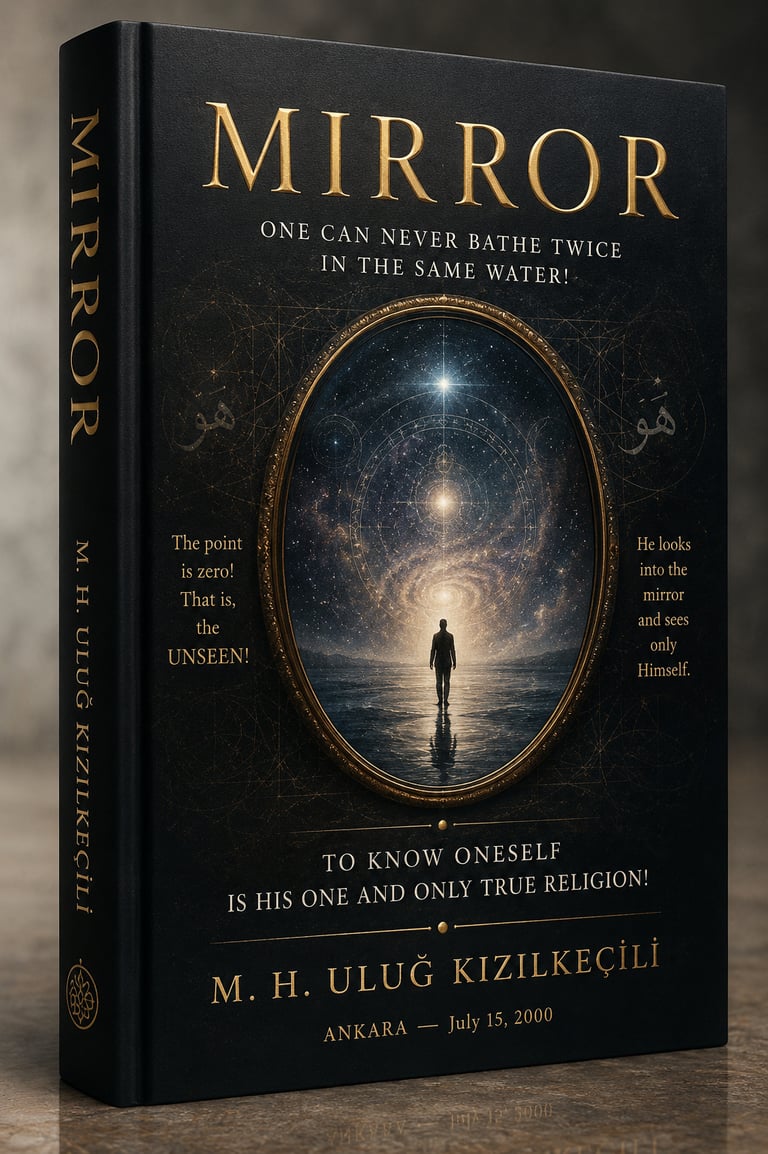
MIRROR
One can never bathe twice in the same water!
Everything exists and does not exist at every moment! Few know this secret!
“The inside of everything is He!” “The outside is He as well!” Where is the thing?
ALLAH is a point of infinite speed! At every moment, everywhere!
“In everything, the inside and the outside are the Lord!” In which jinn is the thing hidden?
The thing! Within the consciousness of a shadow that imagines itself to exist!
The point is zero! That is, the “UNSEEN!” At zero there is no dimension!
Neither macro nor micro! Neither dense nor abstract!
Therefore, He defines Himself by saying “He!”
“To know oneself!” is His one and only true religion!
Do not say, “Then let me know myself as well!” and fall into passion!
You are a line! There is nothing that exists other than the point!
Only “He” knows Himself through Himself!
He can reflect Himself unto Himself!
Thus emerges the mirror called the universe!
The One who looks into the mirror is always “He!” Tell me, who are the images?
The images! Those that exist within ALLAH!
The true universe is in ALLAH! Whoever understands this, understands!
From the cosmos to the quantum, everything you see is a copy!
Birth and death are a dream! There is neither earthquake nor wedding!
Kant says: “Time is inner sense, and space is outer sense!”
Until you find the Original, come and go; sleep with open eyes!
While an image appears in the mirror, the mirror itself disappears from sight!
Through this example, it is understood that the mirror is the “UNSEEN!”
The Lord’s not looking into the mirror for a single instant is the Apocalypse!
The copy vanishes! Salvation belongs to the one who finds the Original!
“Only the true sage can evaluate the Lord!”
Know this, İnan, your interest in the universe astonished me!
“To investigate the cosmos and the quantum is a scientific prayer!”
One cannot become an atheist by reading His work!
M. H. ULUĞ KIZILKEÇİLİ
ANKARA — July 15, 2000
Dedicated to Mr. Yalçın İNAN
(The section written after this point has no relation to the author, and the author cannot be held responsible for any errors that may have been made!)
MIRROR METAPHYSICS
The text beginning with the statement, “One can never bathe twice in the same water,” appears at first glance to refer to Heraclitus’ doctrine of perpetual change. However, when the continuation of the poem is examined, it becomes evident that this is not merely a doctrine of change. Here, change is treated not as the fundamental quality of existence, but as the reflection of absolute truth within the realm of appearances. For Heraclitus, the river changes; in this text, both the river and the person entering the river change. At a deeper level, neither the river nor the person actually exists; there is only the Absolute Consciousness contemplating Itself through different images.
This understanding bears a strong resemblance to the idea found in the Hindu Vedanta tradition that Brahman contemplates Itself through Maya. Brahman, the ultimate reality described in the Upanishads, is the single truth behind all phenomena. Multiplicity is merely appearance. The expression in the poem, “Everything exists and does not exist at every moment,” articulates precisely this paradox. For on the absolute level, nothing is born and nothing dies; yet on the level of appearances, everything continuously emerges and disappears.
This may also be compared with the doctrine of “Śūnyatā” (Emptiness) taught in the Madhyamaka school of Buddhism. According to Nāgārjuna, neither existence nor nonexistence is absolutely real. Everything arises through dependent origination. The poem’s statement, “Everything exists and does not exist at every moment,” expresses precisely the transcendence of this duality. Here, existence and nonexistence become simultaneously true and simultaneously false.
The central concept of the text is the “Point.” The poet establishes a direct identity between the Point and the Unseen (Ghayb). Throughout the history of Sufism, the symbol of the point has held immense importance. Particularly within the traditions of Hurufism and Nuqtavism, the point was regarded as the source of all letters. It was believed that all forms within the Arabic alphabet originate from the point. Thus, the point is the invisible essence, while the letters constitute the visible world.
A similar approach is found in the metaphysics of Ibn al-ʿArabī. According to him, all Names and Attributes are unfoldings of the Absolute Essence. The poet’s expression, “The Point is zero, that is, the Unseen,” recalls this perspective. The Unseen is the absolute potentiality in which no determination has yet emerged. Although it is not directly identical to the concept of the vacuum field in modern physics, it bears a symbolic resemblance. In quantum field theory, seemingly empty space is actually filled with infinite potential energy. Likewise, the point described as zero by the poet is apparently nothing, yet is the absolute potential from which everything emerges.
The concept of the “Zero Point” may also be compared to the Kabbalistic understanding of Ayn Sof. According to Kabbalah, before creation there exists only the Infinite, Ayn Sof. No definition, no boundary, and no attribute can be applied to It. The expressions in the poem, “Neither macro nor micro; neither dense nor abstract,” describe precisely this state of transcendence. For the Unseen is the level at which opposites have not yet emerged.
One of the most striking passages of the poem is the statement, “To know oneself is His one and only true religion.” This sentence directly touches the common center of the world’s esoteric traditions. The maxim “Gnothi Seauton” (“Know Thyself”) inscribed at the entrance of the Delphic Temple in ancient Greece, the Sufi saying “Man ʿarafa nafsahu faqad ʿarafa rabbahu” (“Whoever knows himself knows his Lord”), the identity of Atman and Brahman in Hinduism, and the doctrine of inner knowledge within the Gnostic tradition all converge upon the same center.
The self-knowledge intended here is not psychological self-awareness. Rather, it is the realization of the Divine Essence that lies behind the individual self. According to the poem, personal identity is nothing more than a shadow. The expression, “The thing exists within the consciousness of a shadow that imagines itself to exist,” is therefore of great significance. The symbol of the shadow here recalls Plato’s Allegory of the Cave. Human beings mistake shadows for reality. Truth, however, is the light that produces the shadows.
At this point, the text almost completely coincides with Ibn al-ʿArabī’s doctrine of Wahdat al-Wujūd (Unity of Being). According to Ibn al-ʿArabī, true existence belongs only to Allah. The world is but a shadow existence. The poet’s statement, “The true universe is within Allah,” directly reflects this ontology. Here, Allah is not outside the universe, nor is the universe outside Allah. Yet the universe is not Allah Himself. Rather, the universe is a continuously changing mirror composed of the manifestations of the Divine Names.
The symbol of the mirror occupies a special place in Sufism. Ibn al-ʿArabī describes the human being as “the mirror in which Allah contemplates Himself.” In the poem, however, this symbol is expanded even further. Not only the human being, but the entire universe is a mirror. Thus, a metaphysics of manifestation is established on a cosmic scale.
The mirror metaphor also evokes the Hermetic principle, “As above, so below.” For there is no separation between the image in the mirror and its original; only the appearance differs. All phenomena are reflections of absolute truth.
The expression, “From the cosmos to the quantum, everything you see is a copy,” represents the point where modern science and mysticism intersect. Here, the concept of the quantum is used more symbolically than physically. The poet is asserting that all visible levels are repetitions of the same fundamental reality on different scales. This idea may also be related to fractal geometry. In fractals, structures observed on small scales repeat themselves on larger scales. In the Hermetic tradition, this is called the macrocosm-microcosm principle.
The poem’s reference to Kant is also significant. According to Kant, time and space are categories of perception belonging to the mind. Human beings experience objects within time and space, yet they cannot know things-in-themselves directly. The poet carries this idea to a mystical conclusion. If time and space are forms of perception, then absolute reality must exist beyond them.
This interpretation also resembles the Buddhist understanding of Nirvana. Nirvana is defined as a state of absolute consciousness in which time and space disappear. In Sufism, this condition is expressed through the concepts of Fanā and Baqā. The self disappears; only the Lord remains.
One of the most remarkable statements in the final sections of the poem is: “The Lord’s not looking into the mirror for a single instant is the Apocalypse.” This contains an extraordinarily profound metaphysical proposition. Here, the Apocalypse is defined not as a physical destruction but as the cessation of Divine manifestation. If Absolute Consciousness ceases to contemplate Its own image, all phenomena will disappear.
This idea resembles the metaphor of Brahma’s breath in Hindu cosmology. The universe emerges during the inhalations and exhalations of Brahma and then vanishes once again. Similarly, in Kabbalah, creation is possible only through the continual flow of Divine Light. When the flow ceases, the created order can no longer sustain its existence.
In conclusion, although the poem appears outwardly to be a short mystical text, it is in fact addressing the common metaphysical question at the center of the world’s religions and esoteric traditions: “What truly exists?” The poet’s answer is clear. The only reality is Absolute Consciousness. The universe is the image of that consciousness reflected in a mirror. Humanity is the image that has forgotten it is an image. The journey of gnosis is the realization that the image itself is the eye that is gazing. This is why the poem’s fundamental message becomes the common call of all esoteric traditions: Know thyself; for the one who knows himself begins to see not the mirror, but the One who is looking into it.
THE SYMBOL OF THE MIRROR IN THE HISTORY OF RELIGIONS
MIRROR METAPHYSICS IN IBN AL-ʿARABĪ, AYN SOF AND REFLECTIONS IN KABBALAH, MAYA AND BRAHMAN IN VEDANTA, THE DOCTRINE OF CHANGE FROM HERACLITUS TO QUANTUM THEORY
Among all the esoteric symbols employed by humanity, few are as universal as the mirror. Alongside archetypes such as fire, water, light, mountains, and trees, the mirror has been one of the most powerful metaphors used to explain the relationship between appearance and reality. The reason lies in the physical nature of the mirror itself:
A mirror produces nothing.
It possesses nothing.
It changes nothing.
Yet it makes everything visible.
For this reason, throughout the history of religions, the mirror has been used not merely as an object, but as a model of ontology.
The mirror is the visible manifestation of the invisible.
It is truth revealing itself without losing itself.
It is unity appearing within multiplicity.
Therefore, whether in Sufism, Kabbalah, Vedanta, or Hermeticism, all eventually arrive at the metaphor of the mirror.
For the mirror is the most natural language through which the relationship between appearance and essence can be expressed.
I. THE ORIGIN OF THE MIRROR IN THE HISTORY OF RELIGIONS
Before polished metal mirrors existed, human beings gazed upon the surface of water.
The face reflected upon a still lake may have been one of humanity’s earliest metaphysical experiences.
For here a strange realization occurs:
The image exists.
Yet it cannot be touched.
It is real.
Yet it possesses no substance.
It belongs to oneself.
Yet it is not oneself.
This paradox would later become central to all mystical systems.
In Ancient Egypt, the mirror was regarded as a carrier of solar light.
In Mesopotamia, shining surfaces were interpreted as symbols of celestial realms.
In Ancient Greece, the mirror became a symbol of self-knowledge.
Together with the Delphic teaching “Gnothi Seauton” (“Know Thyself”), the mirror became not merely a means of examining outward appearance, but also an instrument for investigating inner truth.
From this point onward, the mirror ceased to be merely a physical object.
It became a metaphysical principle.
II. MIRROR METAPHYSICS IN IBN AL-ʿARABĪ
One of the thinkers who employed the symbol of the mirror most systematically was Ibn al-ʿArabī.
According to Ibn al-ʿArabī, absolute existence belongs only to the Lord.
The universe is not an independent reality in itself.
It is the appearance of the Lord.
Here the mirror metaphor becomes central.
When we look into a mirror, an image appears.
The image is real.
Yet it is not independent.
If the object standing before the mirror disappears, the image also disappears.
Therefore, the existence of the image is a borrowed existence.
Ibn al-ʿArabī’s theory of contingent existence explains precisely this.
The universe exists.
But not by itself.
It is visible through manifestation.
Therefore, the cosmos is:
The mirror of the Divine Names.
Rahman is manifested in mercy.
The Wise is manifested in wisdom.
The Beautiful is manifested in beauty.
The Just is manifested in balance.
The entire realm of existence becomes a reflective surface for the Divine Names.
Among these mirrors, the human being occupies a unique position.
For the human being is not merely the reflected image.
The human being is also the mirror that sees.
This is why the doctrine of the Perfect Human (al-Insān al-Kāmil) emerges.
The human being is interpreted as the most comprehensive mirror through which the Lord contemplates Himself.
III. AYN SOF AND REFLECTIONS IN KABBALAH
In Jewish mysticism, the same problem is approached through different terminology.
The central concept of Kabbalah is:
Ayn Sof.
Ayn Sof means:
Infinite.
Indefinable.
Boundless.
Absolute Transcendence.
Ayn Sof cannot be known directly.
For every definition imposes a limitation upon It.
Therefore, the visible universe is not Ayn Sof itself.
It is Its reflection.
At this point, the system of the Sefirot comes into play.
The Sefirot are interpreted as the aspects through which Ayn Sof becomes visible.
Just as white light passes through a prism and separates into colors,
Ayn Sof becomes manifest through the Sefirot.
Therefore, in Kabbalah, the universe is:
The field of reflection of Absolute Infinity.
This idea displays remarkable parallels with Ibn al-ʿArabī’s theory of manifestation.
In both systems:
The Source is transcendent.
Appearance is reflection.
IV. MAYA AND BRAHMAN IN VEDANTA
In Indian metaphysics, the same question is asked in another form:
If Brahman is Absolute Reality, then what is the world?
Vedanta’s answer is:
Maya.
However, Maya is often misunderstood.
Maya is not “nonexistence.”
Nor is it simply false appearance.
More accurately, it is:
The realm of relative appearance.
Like an image in a mirror.
The image exists.
Yet it is not independent.
The world is the same.
According to Vedanta, only Brahman is Absolute Reality.
Multiplicity is the manifestation of Brahman on the level of appearance.
Therefore, the famous teaching of Vedanta is expressed as:
Atman = Brahman
Individual consciousness and Absolute Consciousness are not essentially separate.
Separation arises from the different images appearing in the mirror.
The Source is One.
V. HERACLITUS AND CHANGE
Mirror metaphysics leads us to another question:
If everything is a reflection, why is everything constantly changing?
One of the first great philosophers to address this question was Heraclitus.
Heraclitus’ famous statement is:
“One cannot step into the same river twice.”
For the river has changed.
And you have changed as well.
According to this view, change is not the exception but the rule.
Everything is in flux.
No form is permanent.
This idea would later reveal striking parallels with Buddhist teachings.
In Buddhism:
There is no permanent object.
There is no permanent self.
There is no permanent structure.
There is process.
There is flow.
There is dependent origination.
Therefore, change is not merely a physical principle but an ontological one.
VI. FROM HERACLITUS TO QUANTUM THEORY
When quantum theory emerged in the modern era, the classical worldview was once again shaken.
Matter was no longer understood as solid and immutable.
Particles became processes.
Relationships gained importance.
Certainty gave way to probability.
At this point, caution is necessary.
Quantum theory does not validate Sufism, Kabbalah, or Vedanta.
Yet on a symbolic level, certain parallels are noteworthy.
For example:
Heraclitus → Continuous flux
Buddhism → Continuous becoming
Sufism → Continuous Renewal of Creation (Tajaddud al-Khalq)
Vedanta → Manifestations of Maya
Quantum Theory → Dynamic processes
Although these systems belong to different domains, they share a common tendency to challenge the idea of permanence.
VII. THE PARADOX OF THE MIRROR AND CHANGE
The most fascinating aspect of mirror metaphysics appears here.
Reflections change.
The mirror does not.
Waves change.
The ocean remains.
Forms change.
Truth remains.
Therefore, Sufism says:
Manifestation changes.
The Lord does not.
Vedanta says:
Maya changes.
Brahman does not.
Kabbalah says:
The Sefirot become visible.
Ayn Sof remains transcendent.
Therefore, the relationship between change and the changeless is the common problem of all metaphysical systems.
The mirror has become one of the most powerful symbols used to resolve this problem.
VIII. THE COSMIC MIRROR
When all of these traditions are brought together, a common model emerges:
Absolute Source
↓
Reflection
↓
Appearance
↓
Consciousness
↓
Awareness
↓
Return to the Source
In this model, the universe becomes a great mirror.
The human being becomes the consciousness that looks into the mirror.
Truth becomes the infinite light made visible within the mirror.
Therefore, the mystical journey is not the discovery of something new.
It is the realization of what the mirror is.
Then it is the realization of the mirror’s source.
Finally, it is the realization that both the mirror and the source point toward the same truth.
CONCLUSION: THE MIRROR AND TRUTH
Throughout the history of religions, the symbol of the mirror has appeared under different names:
Manifestation in Sufism.
The Sefirot in Kabbalah.
Maya in Vedanta.
Reflection in Hermeticism.
Flux in Heraclitus.
Process in modern science.
Yet at the center of all these traditions lies the same question:
What is the relationship between appearance and reality?
Mirror metaphysics offers the following answer:
What appears is not Reality itself.
Yet neither is it separate from Reality.
Just as the image in a mirror cannot exist without its source,
the universe cannot exist without its Source.
Therefore, the common secret of all mystical traditions may be summarized in a single sentence:
The universe is the manifestation of Absolute Reality without that Reality ever being diminished or lost.
And the human being is the only being capable of looking into this mirror and thereby coming to know the universe, oneself, and the Source.
Academic Notes
The symbol of the mirror carried sacred and metaphysical meanings in Ancient Egyptian, Mesopotamian, Greek, and Indian traditions.
For Ibn al-ʿArabī’s mirror metaphysics, see the works of Ibn al-ʿArabī.
The theory of contingent existence is based upon the idea that the universe is not independent but appears through manifestation.
The doctrine of the Perfect Human (al-Insān al-Kāmil) was later developed in greater detail by Abd al-Karim al-Jili.
Ayn Sof is the infinite and indefinable Absolute Reality in Kabbalah.
The system of the Sefirot is interpreted as the visible manifestations of Ayn Sof.
One of the foundational texts of Kabbalah is the Sefer Yetzirah.
Maya in Vedanta refers to the realm of relative appearance.
Brahman is the Absolute Reality in Vedantic metaphysics.
The identity of Atman and Brahman was particularly systematized by Adi Shankara.
Heraclitus is one of the most important representatives of the philosophy of change.
The statement “One cannot step into the same river twice” is generally regarded as the summary of the doctrine of perpetual change.
The Buddhist doctrine of anicca emphasizes the impermanence of all things.
The doctrine of Tajaddud al-Khalq (Continuous Renewal of Creation) expresses the idea of perpetual creation in Sufism.
Parallels between quantum theory and mystical traditions should be evaluated on a symbolic rather than a scientific level.
The distinction between the unchanging Source and changing appearance is a common theme in many metaphysical systems.
The mirror metaphor is one of the universal symbols used to explain the relationship between appearance and essence.
Throughout the history of religions, the metaphor of reflection has played an important role in theology, cosmology, and theories of consciousness.
The interpretation of the universe as a field of reflection appears in different forms within Sufism, Kabbalah, and Vedanta.
In esoteric traditions, the search for truth is often described as a journey of consciousness moving from reflection back toward the Source.