NINETEEN-1
NINETEEN-1. The Gospel begins with “En arche” — “In the beginning.” First comes the point; then prostration to B begins.Adam is earth; his father is Abu Turab (The Earthly Father of the Believers). Two thousand twenty reduces to zero; what remains is Lord.
APOCALYPSE BOOK
NINETEEN-1
The eternal cry of “KUN!” creates the cosmos every hour;
Thus the Qur’an is called “Ancient Word” in timeless power.
The Qur’an is the inner Adam — touched by sacred tone;
Each note a letter formed — by saints in depth well known.
Learn the cipher while alive from one near to the Lord;
Knowledge of the Hereafter changes not when lifted is the veil’s cord.
The Name ALLAH in Qur’an appears as “LILLÂH, LEHÛ, HÛ”;
Hû is the vowel “û” — the “H” is ALLAH’s Spirit true.
“H” is the sound of breath — its number AHL AL-BAYT;
At five times recall those five and blessings dedicate.
When man says “Hû,” behold, as he exhales his breath;
“Hû” is “Ha” and “Vav” — the sound of NINETEEN set.
When drawing breath he utters “Hi!” in hidden plea;
Read in Arabic “Hûhi” — in truth “Yeheve.”
In Hebrew four letters stand: YOD, HA, VAV, HA;
Witness of YEHOVA says “Bear witness to Adam,” ha!
Eleven totals ALLAH; eleven also HÛ;
ÂLÎ is Hû plus zero — Hû is ÂLÎ’s Spirit too.
“Hi” is fifteen — our primal mother named Havvâ;
The “ummi” suffix of AHMAD points to this law.
Ummi means motherly — the VELÎ cannot be blind;
The syllable “B” is “Eb” — Father is ÂLÎ defined.
ALLAH is “Light of the heavens” — positive and negative ray;
The lover worships primal Father and Mother from first day.
All praise is due to MUHAMMED and ÂLÎ in accord;
The first twin channels from ALLAH — their name is the Lord.
Remove the “B” from Basmala — deny not ÂLÎ’s part;
From “ALLAH, the Compassionate, the Merciful” “B” starts.
Qur’an begins “Bismillah,” Torah “Bereshit” begins;
Surah Bara’ah lacks Basmala — reflect on what that means.
The first letter of Bara’ah is “B” — equal to “Bismillah”;
“B” is your first father — be his child and wear his color’s shawl.
The Gospel begins “In the beginning” — “En arche” first;
First was the point — bow to B — let pride be reversed.
Behold with ALLAH co-eternal the primal word “KUN!”;
The root of “kawn” is “kun” — the universe is “Be” done.
In Hebrew and Arabic “B” stems from BEYT’s root;
Hieroglyph “B” draws a house — a dwelling absolute.
Only ÂLÎ was born within the Kaaba — the Lord’s House;
To ÂLÎ belongs not ALLAH’s Name but ERRAHMÂN’s spouse.
Against the Name “B” stood Iblis — not against ALLAH’s Light;
The Lord’s Assembly parted knower from unknowing sight.
ALLAH is behind the veil — His veil is Adam’s face;
He is ALLAH’s countenance — “El-Vecîh” forty-five in place.
Adam is earth — his father “Hazrat Abu Turâb”;
Two thousand twenty — remove the zero — remains the Lord.
“Zul-Jalâli wal-Ikrâm” — drop a zero — becomes ÂLÎ;
Without zeros entirely — it is Hû — proclaim this inwardly.
“Rabb al-‘Âlamîn” is five hundred — ALLAH’s fivefold grace;
The manifestation of the Name RAB is MUHAMMED ÂLÎ in place.
The Lord praises MUHAMMED as RAHÎM — and why this theme?
Because the Name ERRAHÎM in him appears complete, supreme.
B, ISM, ALLAH, RAHMÂN, RAHÎM — five words in line;
Like AHL AL-BAYT — same vibration, same essence divine.
MUHAMMED, ÂLÎ, FÂTMA, HASAN and HÜSEYİN —
Basmala is NINETEEN — wear these noble ones within.
Fourteen joints and five nails — one body they compose;
Hands to face with “Amin” ends the prostration’s close.
EYÜB, sign of endless patience, makes NINETEEN in sum;
ESSABIR and ERRAHMÂN — same Name from the Lord come.
Through patience under trial each Friend of the Lord ascends;
For the tormentor he says: “O Lord, forgive him,” he extends.
“His face! One! Guide!” — again NINETEEN they be;
Each reveals the hidden self in man’s interior sea.
After nineteen years the moon returns same day as crescent sign;
Crescent shares the letter ALLAH — the Name of Majesty divine.
“Hazrat MUHAMMED” and Arabic “Nineteen” are one;
“Beloved — word and essence” — the loftiest one — proclaim the takbîr begun.
To the verse “Over it are nineteen” equal numbers cling;
Two phrases give the Friend of the Lord a coloring:
“The Day of Descent” its number — of “Hazrat Mahdî”;
“Hazrat MUHAMMED and ÂLΔ — the secret of every creed to be.”
Master M.H. Ulug Kizilkecili
Türkiye/Ankara - 1996
IMPORTANT NOTE :The original text is poetic, and the author cannot be held responsible for any errors in the English translation! To read the original Turkish text, click HERE! The following section is not the author's work, and the author cannot be held responsible for any errors made!
1) Prose Rendering of the Poem “Nineteen–1”
Being is created at every moment through the primordial command “Be!” (Kun); for this reason the Qur’an is called the “Eternal Word” (Kalām al-Qadīm). The Qur’an is likened to Adam within the human being; it is as though it were a divine composition woven from musical notes. Each note corresponds to a letter, and these letters are read through the language of the saints (awliyāʾ). Before the veil is lifted—while still alive—a person must learn this code from one who is near to the Truth (Ḥaqq), because knowledge of the realities of the Hereafter does not change.
The poem points to the resonances of the name of God in the Qur’an through expressions such as Lillāh, Lahū, and Hū. It suggests that the “ū” in the invocation “Hū” may be thought of as an added extension, while in essence the letter “H” is interpreted as God’s breath/spirit. “H” is the sound of breath; this letter, associated with breath itself, is linked in the poem to the Ahl al-Bayt: it is emphasized that five exalted figures should be remembered and blessings invoked upon them in the five daily prayers.
When a human being exhales, it is as if one says “Hū.” According to the poem, saying “Hū” is the sounding of “Hā” and “Wāw” (ه + و), and this is connected to the “secret of nineteen.” When inhaling, a person seems to say “Hi!”; in Arabic pronunciation a composite like “Hūhi” emerges, from which the Hebrew four-letter divine name YOD–HA–VAV–HA (YHWH) is recalled. Thus, the poem establishes a theme of “witnessing” (shahāda) addressed to Adam through the testimony of “Yehova/Yahweh.”
The poem then constructs numerical correspondences: saying “Eleven in total makes Allah; eleven makes Hū,” it alludes to the abjad value of Hū. By stating “ʿAlī is Hū plus zero,” it suggests that the reality of ʿAlī is linked to Hū. It notes that “Hi” equals fifteen; this number is connected to the symbolism of Eve (the primordial mother). The term ummī is read like a maternal attribute; it is stressed that a saint cannot be ignorant. The syllable “B” is joined to the idea of “Ab” (father), and it is said that the meaning “Father” alludes to ʿAlī.
God is “the Light of the heavens”; the poem unites primordial father and mother symbolism through a language of light and darkness (positive/negative). Praise is said to belong to Muhammad and ʿAlī; the “first dual channel” emanating from God is called Ḥaqq (Truth). When the letter “B” is separated from the basmala, it is argued that this letter carries a secret, in connection with the names al-Raḥmān and al-Raḥīm.
The Qur’an begins with “Bismillāh”; the Torah begins with “Bereshit.” Attention is drawn to the absence of the basmala in Sūrat al-Barāʾa; this is symbolically explained through the letter “B”: since Barāʾa begins with “B,” it is as though it replaces the basmala. The Gospel’s opening “En archē” (“In the beginning”) is likewise tied to the same theme of “beginning.” Through expressions such as “first the dot” and “prostration to the B,” a metaphysics of letters and points is foregrounded.
The poem reconstructs the command “Kun” as the root of creation: kawn (being) derives from kun; the entire cosmos is the word “Be.” It recalls the connection of “B” in Hebrew and Arabic with the root bayt (house), and says that in hieroglyphs the letter “B” is drawn like a house. The birth of ʿAlī in the Kaʿba strengthens the theme of the “House of God.” It is suggested that Iblīs opposed not God directly but the name “B,” and that the distinction between “the one who knows” and “the one who does not know” appears here.
God is behind the veil; His veil is Adam. He is His Face; the expression al-Wajīh is mentioned in this context. Adam’s being from earth is reinforced by the name Abū Turāb; through numerical correspondences the text moves to the word “Rabb.” By subtracting zeros from the phrase Dhū’l-Jalāli wa’l-Ikrām, it is said one reaches ʿAlī, and by removing more zeros, one reaches Hū. “Rabb al-ʿālamīn” is read as if it were “the five beauties of Allah,” and the manifestation of the name Rabb is linked to “Muhammad–ʿAlī,” forming the backbone of the poem.
Muhammad being praised as “Raḥīm” is explained by the full manifestation of the name al-Raḥīm in him. The basmala (B, Name, Allah, Raḥmān, Raḥīm) consists of five words; these are brought into resonance with the five names of the Ahl al-Bayt. Thus it is said that the basmala opens onto “nineteen,” and that a person must “wear” these figures: like fourteen joints and five nails, conceived as parts of a body, completed through supplication and prostration.
The poem connects the themes of patience and affliction to “nineteen” through the figure of Job (Ayyūb); it notes that al-Ṣabūr and al-Raḥmān share the same value. It narrates that the friend of God rises in rank through patience in affliction and can even say of the oppressor, “O Lord, forgive him.” It then reiterates that phrases such as “His face, One, Guide” are linked to “nineteen,” implying that the hidden ego within the human being becomes visible through these signs.
In the final section, a symbolic link is established between the crescent and the divine name; it is proposed that “Hazrat Muhammad” and the “Arabic nineteen” are one. Expressions such as “the Beloved, whose word is essence” and “the most exalted man” are tied to a call of takbīr. It is said that two words corresponding to the verse “Over it are nineteen” give color to the heart of the friend of Truth: one is the number of “the day of the descent of Hazrat Mahdī,” and the other is the secret of “Hazrat Muhammad and ʿAlī.”
2) The “Comparative Examination” Section Recast in Academic Prose
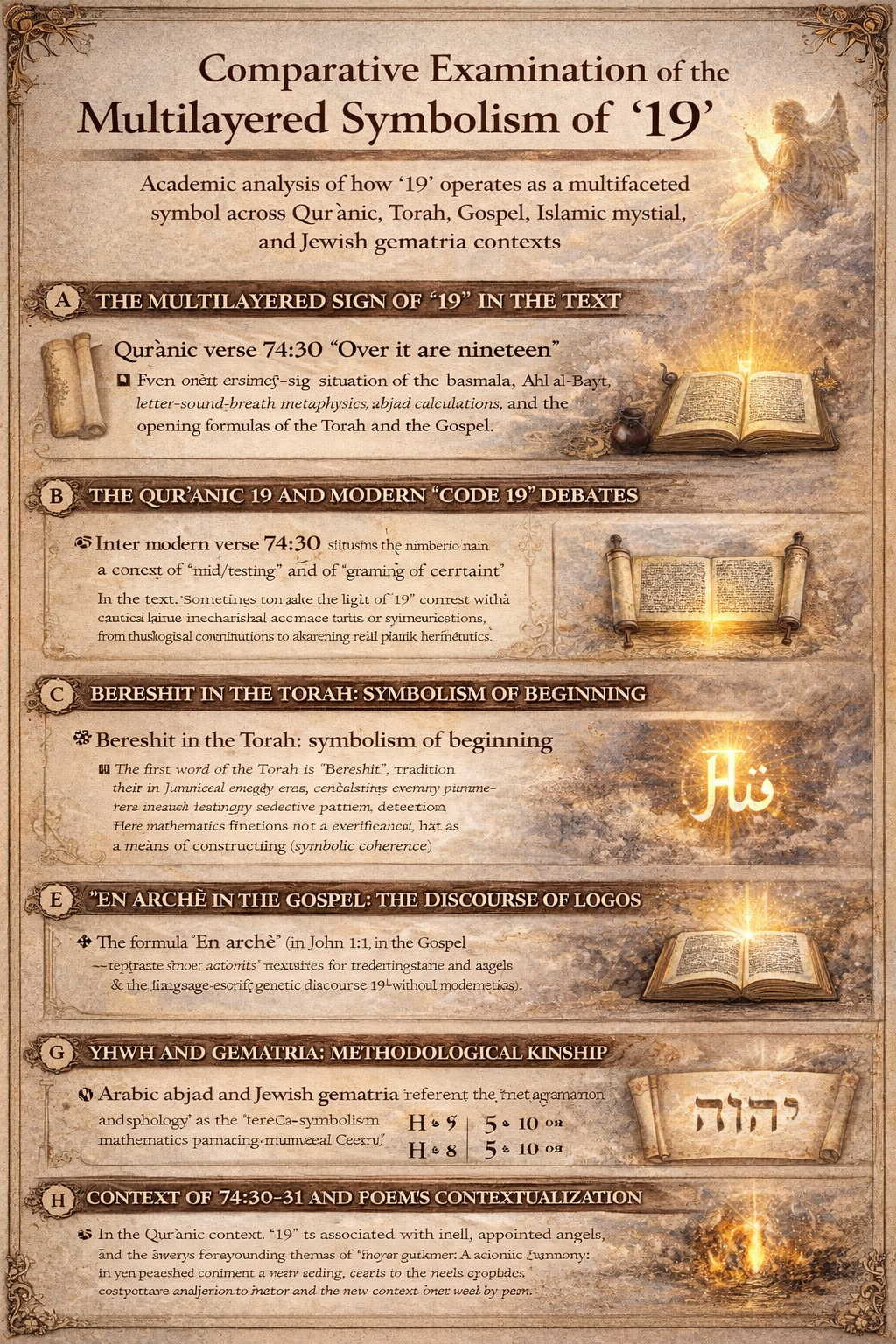
A) The Main Axis of the Text: The Multilayered Sign of “19”
In this text, “nineteen” functions as a sign that cannot be reduced to a single meaning. On the one hand, it draws upon the Qur’anic statement “Over it are nineteen” (74:30); on the other, it expands through parallels established among the components of the basmala, the emphasis on the Ahl al-Bayt, the metaphysics of letter-sound-breath (“H,” “Hū,” “Hi”), abjad calculations, and the opening formulas of the Torah and the Gospel. Thus, 19 ceases to be merely a number and becomes an “engine of meaning production” within the text.
The continuation of 74:30 in 74:31 situates the number within a context of trial/testing and of granting certainty to the People of the Book. This indicates that the role of 19 within the Qur’anic text may not be solely a “mathematical code,” but also a rhetorical and theological sign.
B) The Intersection Between the Qur’anic 19 and Modern “19 Code” Debates
The poem’s approach touches upon modern claims that read 19 as a numerical code. Within that line, criticisms frequently arise concerning counting parameters, textual variants, selective pattern detection, and statistical coincidence. From the perspective of comparative religion, a more productive path is to approach such claims not through the logic of “absolute proof,” but as a form of “symbolic hermeneutics”—a technique of meaning production.
C) The Torah’s “Bereshit” Opening and the Symbolism of Beginning
The first word of the Torah is “Bereshit,” and in tradition this word also functions as the book’s title. The poem reads “beginning” as a mystical gateway of letters: beginning, letter, and creation are brought together on the same line of meaning.
D) “En archē” in the Gospel and the Discourse of Logos
The formula “En archē” (“In the beginning”) in John 1:1 links the Word/Logos with the order of creation. In the poem, this becomes a bridge of “beginning and word” parallel to the Torah’s Bereshit opening; here the intertextual resonance rests on a philological basis.
E) “Hū/Breath” and Letter Mysticism: The Line of ʿIlm al-Ḥurūf
The identification of the letter “H” with breath and the interpretation of the invocation “Hū” in rhythm with breathing aligns with letter symbolism in Islamic thought, especially with circles associated with ʿilm al-ḥurūf. Such interpretations belong not to mainstream kalām, but to a more esoteric/gnostic discourse.
F) Abjad and Gematria: Methodological Kinship and Meaning Production
Arabic abjad and Jewish gematria are based on the equivalence “letter = number.” Although such correspondences in the poem are sometimes presented as “proof,” within an academic framework it is more consistent to see them not as methods proving a single meaning of the text, but as devices of interpretation. Here mathematics functions not as verification, but as a means of constructing symbolic coherence (internal consistency).
G) YHWH and the Question of Pronunciation: Philology vs. Symbolism
Since the historical pronunciation of the Tetragrammaton (YHWH) is not definitively known, and since forms such as “Yahweh” and “Jehovah” have distinct historical trajectories, the poem’s bridge between sound–breath–letter should be read at the level of symbolic association rather than philological certainty.
H) The Context of 74:30–31 and the Poem’s Recontextualization
In the Qur’anic context, “19” is associated with Hell, appointed angels, and the language of testing. The poem, however, relocates this number into the basmala–Ahl al-Bayt line, foregrounding themes of mercy, guidance, and cosmic harmony. In comparative analysis, it is necessary to distinguish between the text’s original context and the new context constructed by the poem.
Comparative Study: “Nineteen,” Letter-Mystical Interpretation, and Intertextual Parallels
1) The poem’s main axis: constructing “19” as a textual sign
The poem constructs “nineteen” not on a single level but as a multilayered sign: (i) the Qur’anic phrase “over it are nineteen” (74:30), (ii) the five components of the basmala and their linkage to the Ahl al-Bayt, (iii) the metaphysics of letters as sound/breath (“H,” “Hū,” “Hi”), (iv) assigning values to names through abjad counts, (v) parallels with the opening formulas of the Torah and the Gospel. Such a construction can be considered a typical example, in the history of religions, of practices that produce sacred meaning through letters and numbers (abjad/ʿilm al-ḥurūf circles in Islam; gematria in Judaism; certain isopsephy examples in Christianity, etc.).[1][2]
The immediate continuation of Qur’an 74:30 (74:31) states that the “number” functions as a trial/test and includes a context such as “that those who were given the Book may gain certainty.” This indicates that 19 can be read not merely as a “mathematical miracle,” but also as an element with intra-textual rhetoric.[3]
2) “19” in the Qur’an (74:30–31) and modern “19 code” debates
The line implied by the poem intersects with modern approaches that read “19” as a numerical cipher. The best-known example in this literature is the “Quran code / 19 miracle” debate that formed around Rashad Khalifa in the 20th century. Evaluations—academic and semi-academic—addressing these claims indicate that the method has been criticized under headings such as textual variants, counting parameters, selective pattern-spotting, and the statistical problem of “accidental patterns in large datasets.”[4][5]
From a comparative-religions standpoint, the critical point is this: numerical-miracle claims are akin not only within Islam but also to tendencies in Jewish and Christian traditions to extract a numerical “design” from the text. For this reason, it is more productive to treat the poem’s approach within the framework of symbolic hermeneutics (the science of interpretation), rather than forcing it into a simple true/false binary.
3) The Torah’s opening: “Bereshit” and the poem’s “Braşit/Beraşit” allusion
The poem links the Torah’s beginning with “Beraşit/Bereshit” (the first word of Genesis 1:1) to the symbolism of “beginning” and “letter.” Philologically, the Hebrew text begins with “בְּרֵאשִׁית” (Bereshit), which in tradition also becomes the book’s name.[6] What the poem does is emphasize, through the “word of beginning,” the “gate-opening” role of letters.
In the Jewish interpretive tradition, it is also known that the Torah’s relationship to creation is expressed in midrashic forms such as “God created the world by looking into the Torah”; this, too, constructs a symbolic universe close to the poem’s “Word/creation” line.[7]
4) The Gospel’s opening: “En archē” (John 1:1) and the discourse of “logos”
The poem’s statement “The Gospel begins with ‘first before,’ that is ‘En archē’” is directly tied to the formula “Ἐν ἀρχῇ” (“in the beginning”) in John 1:1. This prologue establishes the relationship between creation, the Word (Logos), and the divine order by saying, “In the beginning was the Word (Logos).”[8] This “beginning” discourse also deliberately echoes the Torah’s “Bereshit” opening; the poem’s move to build an intertextual parallel rests, in this respect, on a philological ground.
5) “Hū/breath” and letter mysticism: connection to Islamic ʿilm al-ḥurūf
In the poem, the letter “H” is associated with breath and the invocation “Hū”; the granting of a metaphysical centrality to “H” as “the sound of breath” aligns with letter symbolism in the history of Islamic thought, especially with certain Sufi/esoteric interpretive lines. Studies of “letter mysticism” show that interpretations attributing cosmic meanings to letters continued even in late Ottoman contexts and in 20th-century Anatolia.[9]
It is also known that in movements such as Hurufism, the world, the human being, and revelation are read through the “secrets of letters,” and that abjad and letter calculations are used to generate interpretation.[10][11] Even if the poem’s language does not directly build a Hurufi doctrine, it uses the triangle “letter–number–cosmos” through a similar symbolic logic.
6) Abjad/ebced and gematria: methodological kinship and limits
In the poem, abjad values (e.g., ʿAlī = 110, Muḥammad = 92, etc.) and totals (e.g., Rabb = 202) function both as “proof” and as “symbolic hint.” This directly relates to the tradition of abjad numerals in which Arabic letters are used with numerical values.[12] There are academic studies on the historical origins and uses of the abjad system (such as eastern/western abjad orders); these show that abjad was not only “mystical” but also functioned in practices such as chronograms (dating by phrase), historical dating, and notation.[13][14]
Gematria in Judaism is a similar “letter = number” equivalence and is widespread especially in kabbalistic interpretive practices.[15] What is important comparatively is that modern scholarship generally treats these systems not as methods that “prove the single valid meaning of a text,” but as interpretive techniques (exegetical devices). Accordingly, reading the poem’s abjad tables as a strategy of “building symbolic coherence” rather than as “logical proof” is more compatible with an academic frame.
7) YHWH (Tetragrammaton), “Yehova/Yeheve,” and the issue of pronunciation
The poem’s “Hūhi/Yeheve” line and its emphasis on “YOD, HA, VAV, HA” touches the issue of the Tetragrammaton (YHWH) in the Hebrew tradition. In academic literature it is explained that the historical pronunciation of YHWH is not known with certainty; that “Yahweh” is a scholarly reconstruction; and that the “Jehovah/Yehova” form has a history linked to Masoretic pointing and medieval reading practices.[16] This point matters: because of the philological caution surrounding pronunciation reconstructions, the bridge the poem builds through “sound–breath–letter” should be read not as a claim to certainty but largely at the level of symbolic association.[17]
8) The meaning of “over it are nineteen” in interreligious comparison: number–angels–trial
In the context of Qur’an 74:30–31, “19” is associated with Hell (Saqar), appointed angels, and the language of trial.[3] The poem, however, relocates this “charged number” into an axis of “mercy/guidance” via the basmala and the Ahl al-Bayt. This strengthens the theological direction of the interpretation; but in academic comparison, the text’s own context and the poem’s recontextualization must be shown separately: the intra-Qur’anic context is “warning/trial,” while the poem foregrounds “sign/guidance and cosmic harmony.”
Turkish Footnotes (with sources)
For the general framework of “letter-number” systems such as abjad (ebced) and gematria, see the entry on Abjad numerals.
An academic study on the secrets of letters and the centrality of letter doctrine in Hurufism: Guliyeva, “The Principles of the Letter System of Hurufism …” (PDF).
For the textual context of Qur’an 74:30–31 and its reading in the tafsīr tradition (verse text and tafsīr page): Quran.com, 74:30–31 (links to the Maarif-ul-Quran tafsīr).
An example of an academic journal article critically evaluating “19 code” claims: Moradi (2023), “Evaluating Rashad Khalifa’s 52 Claims …”
A compiled overview summarizing the “Quran code” topic’s criticisms section:
For the Hebrew text of Genesis 1:1 and the “Bereshit” form:
A classic example of the “Torah and creation” relation in the midrashic tradition (Bereshit Rabbah 1):
For the Greek text of John 1:1 and the “En archē” formula:
A recent academic study on letter mysticism in Anatolia and interpreting the Qur’an through letters:
A DergiPark PDF publication on the use of abjad calculation in Hurufism (direct treatise/study):
A classic compiled text (PDF) for the historical description of Hurufi doctrine and literature:
A general definition stating that abjad/ebced is a system operating with the numerical values of letters:
An academic article (SCIAMVS, PDF) on the origins of abjad numerals and their use in the history of science:
An academic study (PDF) giving examples of practical uses of abjad numerals such as chronograms/dating:
An explanatory source on gematria as an interpretive method in Jewish mysticism:
A general compilation on the Tetragrammaton (YHWH) and pronunciation reconstructions (Yahweh/Yahô, etc.):
A classic academic publication on the origin/pronunciation of YHWH (JSTOR record):
Metaphysics of Breath (H): Parallels in Sufism and Kabbalah
Below I compare a metaphysics centered on “H” (the sound of breath) through key concepts in two traditions (Islamic Sufism and Jewish mysticism/Kabbalah).
I) “H” and Breath in Sufism
1️⃣ The Dhikr of “Hū” and Breath
• “Hū” (هو) is used as a pronoun meaning “He” (the Divine Essence).
• The “h” sound that comes out while exhaling is interpreted as a natural/innate form of dhikr.
• In some Sufi practices, inhalation and exhalation are paired with the dhikr “Hū.”
Metaphysical ground:
In Ibn al-ʿArabī, “Nafas al-Raḥmānī” (the Merciful/Divine Breath) is the first principle of the manifestation of the cosmos: being “determines itself” (taʿayyun) through the divine breath. This is related to the cosmic unfolding of the command “Kun (Be).”
2️⃣ Letter Metaphysics
• ه (Hāʾ/He): Breath/spiritual openness.
• و (Wāw/Vav): Connection/mediator; a linkage between degrees of being.
• The abjad value of “Hū” is 11 (5+6); in some mystical readings, 11 is symbolized as “the union of two fives (outer–inner)” (this is not canonical).
Note: These interpretations belong not to mainstream kalām, but to Sufi/letter-mystical discourses.
II) Breath and the Letter “He” in Kabbalah
1️⃣ “Ruach” and the Divine Name
In Kabbalah, the divine name is יהוה (YHWH).
Letters: י (10) – ה (5) – ו (6) – ה (5) → 26
• ה (He) appears twice.
• In Kabbalah, He is interpreted as “openness/window” (the graphic openness of heh) and as a “breathy sound.”
• The idea that creation occurs “through letters” (Sefer Yetzirah) strengthens the breath–letter link.
2️⃣ “Nefesh – Ruach – Neshamah”
Three layers of the human soul:
• Nefesh (life-force)
• Ruach (spirit/breath)
• Neshamah (higher consciousness)
The word “Ruach” means both “wind” and “spirit.”
God’s “spirit/breath” initiates creation (in Genesis 1:2: “the Spirit of God was moving over the waters”).
III) Parallels
Some conceptual parallels between Sufism and Kabbalah are noteworthy. While Sufism places “Nafas al-Raḥmānī” at the foundation of divine creation, Kabbalah similarly contains the notion of “Ruach Elohim,” the Spirit of God. In both traditions, creation is linked to a divine breath or spiritual overflow.
From the standpoint of letter metaphysics, Sufism foregrounds the command “Kun” and the symbolic meanings of letters for being. In Kabbalah—especially in the Sefer Yetzirah teaching—the universe is accepted as created through letters. In this view, letters are not merely linguistic units but carriers of cosmic powers.
The letter “He” also holds a special place in both traditions. In Sufism, “he” is associated with the sound of breath and symbolizes the divine breath. In Kabbalah, the letter “He,” which appears twice inside the divine name (the structure of the Tetragrammaton), symbolizes the manifestation of creative energy.
In dhikr practice, “Hū” in Sufism expresses orientation toward the essence of the divine being. In Kabbalah, divine names are contemplated in meditation; this practice aims at spiritual deepening through reflecting on divine names.
In this way, both traditions express their understanding of creation and divine manifestation through a symbolic language via the notions of breath, letter, and name.
IV) Numerical Parallel (Symbolic Level)
• هوهي (Hūhi) = 26 (abjad)
• יהוה (YHWH) = 26 (gematria)
In both traditions:
God → Sound → Breath → Letter → Being
forms an ontological chain.
The metaphysics of “H” (breath):
• In both traditions it is conceived as the “silent vibration” of creation.
• An ontological link is established between letter and breath.
• Numerical correspondences (such as 26) produce a symbolic parallel.
ABJAD–GEMATRIA EXAMPLES
HŪHI–YEHEVE = YOD, HA, VAV, HA = 26
1️⃣ “Hūhi” (هوهي) — Abjad Expansion
If the word is written as:
هوهي
Letters:
• ه (He) = 5
• و (Vav/Wāw) = 6
• ه (He) = 5
• ي (Yā) = 10
Total:
5 + 6 + 5 + 10 = 26
2️⃣ “Yeheve” (יהוה / YHWH) — Gematria
The Hebrew Tetragrammaton:
יהוה
Letters:
• י (Yod) = 10
• ה (He) = 5
• ו (Vav) = 6
• ה (He) = 5
Total:
10 + 5 + 6 + 5 = 26
Mathematically:
هوهي = יהוה = 26
The expression “YOD, HA, VAV, HA” indicates the four-letter divine name in Hebrew:
יהוה
These letters in order:
• י (Yod) = 10
• ה (He / Ha) = 5
• ו (Vav) = 6
• ה (He / Ha) = 5
Total (gematria):
10 + 5 + 6 + 5 = 26
EVE (HAVVĀ) = HI = AL-WAJH = 15
2️⃣ Arabic (Abjad)
“Havvâ” in Arabic Abjad
Arabic spelling: حواء
Letters:
• ح (Ḥā) = 8
• و (Vav/Wāw) = 6
• ا (Alif) = 1
• ء (Hamza) = 1 (in many abjad calculations it is taken as 1)
Total:
8 + 6 + 1 + 1 = 16
If hamza is not counted:
8 + 6 + 1 = 15
✔ Thus in Arabic abjad: Havvâ = 15
The Abjad Value of “Hi” (هي)
Arabic spelling: هي
Letters and values (classical abjad):
• ه (He) = 5
• ي (Yā) = 10
Total:
5 + 10 = 15
✔ Result: هي (Hi) = 15
AL-WAJH = ADAM = 45
The word “al-Wajh” in Arabic:
الوجه
Letters and Abjad Values:
ا = 1
ل = 30
و = 6
ج = 3
ه = 5
Total:
1 + 30 + 6 + 3 + 5 = 45
✔ الوجه = 45
The word “Adam” in Arabic:
آدم
Letters and Abjad Values:
ا = 1
د = 4
م = 40
Total:
1 + 4 + 40 = 45
✔ آدم (Adam) = 45
Interestingly:
• الوجه = 45
• آدم = 45
“HAZRAT ABŪ TURĀB” = 2020 → 202 = RABB
1️⃣ حضرت (Hazrat)
ح = 8
ض = 800
ر = 200
ت = 400
Total:
8 + 800 + 200 + 400 = 1408
2️⃣ ابو (Abū)
ا = 1
ب = 2
و = 6
Total:
1 + 2 + 6 = 9
3️⃣ تراب (Turāb)
ت = 400
ر = 200
ا = 1
ب = 2
Total:
400 + 200 + 1 + 2 = 603
🔢 Grand Total:
حضرت = 1408
ابو = 9
تراب = 603
1408 + 9 + 603 = 2020
✔ حضرت ابو تراب = 2020
Checking the poem’s claim:
“It makes two thousand and twenty; remove the zero, what remains is RABB!”
RABB (رب):
ر = 200
ب = 2
Total: 202
2020 → if the final zero is removed → 202 = RABB
DHŪ’L-JALĀL WA’L-IKRĀM = 1100 → 110 = ʿALĪ → 11 = HŪ
1️⃣ ذو (Dhū)
ذ = 700
و = 6
Total: 706
2️⃣ الجلال (al-Jalāl)
ا = 1
ل = 30
ج = 3
ل = 30
ا = 1
ل = 30
Total:
1 + 30 + 3 + 30 + 1 + 30 = 95
3️⃣ و (wa / “and”)
و = 6
4️⃣ الاكرام (al-Ikrām)
ا = 1
ل = 30
ا = 1
ك = 20
ر = 200
ا = 1
م = 40
Total:
1 + 30 + 1 + 20 + 200 + 1 + 40 = 293
🔢 Grand Total:
ذو = 706
الجلال = 95
و = 6
الاكرام = 293
706 + 95 + 6 + 293 = 1100
✔ ذو الجلال و الاكرام = 1100
Checking the poem’s claim:
“Remove one zero, it is ʿALĪ!”
1100 → remove one zero → 110
ʿALĪ (علي):
ع = 70
ل = 30
ي = 10
Total: 110
✔ This is mathematically correct.
“Without any zeros, it is ‘Hū!’”
1100 → remove two zeros → 11
Hū (هو):
ه = 5
و = 6
Total: 11
AL-ṢABŪR = AL-RAḤMĀN = 329
2️⃣ AL-ṢABŪR (الصبور)
Arabic spelling:
الصبور
Letters:
ا = 1
ل = 30
ص = 90
ب = 2
و = 6
ر = 200
Total:
1 + 30 + 90 + 2 + 6 + 200 = 329
✔ الصبور = 329
3️⃣ AL-RAḤMĀN (الرحمن)
Arabic spelling:
الرحمن
Letters:
ا = 1
ل = 30
ر = 200
ح = 8
م = 40
ن = 50
Total:
1 + 30 + 200 + 8 + 40 + 50 = 329
✔ الرحمن = 329
🔎 Conclusion
• أيوب = 19
• الصبور = 329
• الرحمن = 329
So the poem’s statement is mathematically correct:
“The name of the Truth, AL-ṢABŪR, and AL-RAḤMĀN are the same.”
Indeed, both equal 329.
“The Descent Day of Hazrat al-Mahdī” = “Hazrat Muhammad and ʿAlī” = 1616
1️⃣ “Hazrat al-Mahdī’s descent day”
Arabic spelling:
حضرت مهدي يوم نزول
حضرت (Hazrat)
ح = 8
ض = 800
ر = 200
ت = 400
→ 1408
مهدي (Mahdī)
م = 40
ه = 5
د = 4
ي = 10
→ 59
يوم (day)
ي = 10
و = 6
م = 40
→ 56
نزول (descent)
ن = 50
ز = 7
و = 6
ل = 30
→ 93
Total
1408 + 59 + 56 + 93 = 1616
2️⃣ “Hazrat Muhammad and ʿAlī”
Arabic spelling:
حضرت محمد و علي
حضرت = 1408
محمد = 92
و = 6
علي = 110
Total
1408 + 92 + 6 + 110 = 1616
✔ Result
حضرت مهدي يوم نزول = 1616
حضرت محمد و علي = 1616
In abjad terms, the two expressions are equal.
“The beloved’s word, its essence” = “Nineteen”
2️⃣ Arabic “nineteen”
Spelling:
تسعة عشر
تسعة
ت = 400
س = 60
ع = 70
ة = 5
→ 535
عشر
ع = 70
ش = 300
ر = 200
→ 570
Total
535 + 570 = 1105
❗ تسعة عشر = 1105, not 1500.
3️⃣ “The beloved’s word, its essence”
In the poem, this expression is usually based on the following spelling:
حكمة لفظ حبيب
حكمة
ح = 8
ك = 20
م = 40
ة = 5
→ 73
لفظ
ل = 30
ف = 80
ظ = 900
→ 1010
حبيب
ح = 8
ب = 2
ي = 10
ب = 2
→ 22
Total
73 + 1010 + 22 = 1105
✔ حكمة لفظ حبيب = 1105
The number 19 in Abjad
1️⃣ أيوب (Ayyūb / Job)
ا = 1
ي = 10
و = 6
ب = 2
Total:
1 + 10 + 6 + 2 = 19
✔ It appears in the Qur’an.
✔ It equals 19.
2️⃣ وجهه (His face)
و = 6
ج = 3
ه = 5
ه = 5
Total:
6 + 3 + 5 + 5 = 19
✔ It appears in the Qur’an (e.g., al-Baqara 115).
✔ It equals 19.
3️⃣ واحد (One)
و = 6
ا = 1
ح = 8
د = 4
Total:
6 + 1 + 8 + 4 = 19
✔ It occurs frequently in the Qur’an.
✔ It equals 19.
4️⃣ هدى (Hudā / guidance, the right way)
ه = 5
د = 4
ى = 10
Total:
5 + 4 + 10 = 19
✔ It occurs very often in the Qur’an.
✔ It equals 19.
5️⃣ يده (His hand)
ي = 10
د = 4
ه = 5
Total:
10 + 4 + 5 = 19
✔ It appears in the Qur’an (e.g., al-Fatḥ 10).
✔ It equals 19.
Hebrew (Gematria) — HAVVA (Eve)
Spelling: חוה
Letters:
• ח (Chet) = 8
• ו (Vav) = 6
• ה (He) = 5
Total:
8 + 6 + 5 = 19
✔ In Hebrew gematria, Havvâ = 19
ABJAD VALUES AND THEIR CORRESPONDENCES
Introduction
This study systematically brings together the abjad values found in the given text by sorting them from smallest to largest, and assembling—under each number—the corresponding expressions, concepts, and expansions. Expressions that share the same value are presented together, and repetitions are collected under a single heading.
I. Low Numerical Values (0–500)
19
Vechehu – Vâhid – Hâdî
45
Al-Wajh
92
MUHAMMED
108
ḤAQQ – Himself – His army – The scale – We – CUNDENĀ – MĪZĀN – NAḤNU
110
ʿALĪ
132
Revelation of ḤAQQ – Heart – Friday (Day of Jumuʿa)
133
The single cry – The metaphor of the first Adam
138
LOVE OF ḤUSAYN
141
The inner face of ALLAH – His supreme name
145
Love of FĀṬIMA
184
Known term (appointed death) – Being questioned – Oath – The clear Imam – A means to prostration –
The manifest Imam – The means of prostration – The day of questioning – The appointed term
185
Knowledge of Adam
188
Mahdī of the age
195
AB IMĀM ʿALĪ
202
RABB
262
The One who knows the reckoning of everything – al-Ḥasīb – the name ʿAlī metaphorically
287
MUHAMMED son of ʿAbdullāh – Kızılkocalı – The Light
328
The name “HŪ”: ʿALĪ IBN ABĪ ṬĀLIB
329
al-RAḤMĀN – Zakariyyā’s child Yaḥyā
332
“Assalāmu ʿalaykum” – Hū as the signified of the name ʿAlī
343
The Face of al-RAḤMĀN – The rising of Imam ʿAlī –
The name “Master of the Day of Judgment” – Son of Mary –
The name of the Stone – The referent of Imam ʿAlī
361
One whose name is IMAM ḤUSAYN – That martyr – The black point of the heart
438
MUHAMMED = Light = Betûl – Blessings upon you, O FĀṬIMA
469
MUHAMMED = Raʾūf – Absolute Creator: FĀṬIMA – al-Betûl
II. Middle Values (500–1000)
548
The beardless youth – The honored face: Imam ʿAlī
583
Worship the Kaʿba – Attach yourself to his name – Swear an oath –
Prostrate to the House of God – The name of allegiance –
MUHAMMED ʿALĪ FĀṬIMA ḤASAN ḤUSAYN
619
She is FĀṬIMA al-BETÛL – TRUE RELIGION –
LĀ ILĀHA ILLALLĀH MUHAMMED RASŪLULLĀH
728
The Virgin Mary – RAḤMĀN RAḤĪM: ʿALĪ is He
779
The name of the trumpet: Isrāfīl – The interpretation of “assalāmu ʿalaykum”
790
The interpretation of “the name of the Stone”
791
Hacı Bektaş-ı Velî
920
Mercy to the worlds – Dhikr – The figure taken pride in – The double title
934
The moment of being called to account – ʿAlī’s primordial nature
III. High Values (1000–2000)
1100
Dhū’l-Jalāl wa’l-Ikrām
1101
ESSENCE (ZĀT) – Tafsīr of the Qur’an – MĞMKA (initial letters)
1191
Fixed archetypes (aʿyān al-thābita) – Realms of the Unseen – Manifestation of the Face of God
1211
Manifestation of God (Mazharullāh) – The Essence of ʿAlī – Hū: Commander of the Faithful ʿAlī Abū Turāb
1252
FĀṬIMAT AL-ZAHRĀʾ al-BETÛL – Realm of the Essence –
An interpretation of the Night of Power
1337
Hijrī “Samsun landing” date
1338
Ghāzī Mustafa Kemal –
The motif of “prostrate to Adam” –
“Aqīmū al-dīn” inner face
1348
The formula “wa ʿalaykum al-salām” – The referent of the Vicegerent of God
1349
Hū: Ghāzī Mustafa Kemal –
The day of the manifestation of Muḥammad al-Mahdī
1364
The special name of your RABB: Mustafa Kemal –
Hū: the locus of manifestation of MUHAMMED ʿALĪ
1439
Hū: the name of the manifestation of RABB – The Beast of the Earth
1493
The expression “alek asek” –
An interpretation of “And We raised him to a high station” (al-ʿAliyyā)
1500
Hazrat MUHAMMED – Master of humankind –
Tisʿat ʿAshar (nineteen) – The wisdom of the phrase “Ḥabīb”
1511
The phrase “al-Rafīq al-Aʿlā” – Hū: Hazrat MUHAMMED
1557
Ṣibghatullāh – missing alif
1558
Hazrat ʿĪsā – Ṣibghatullāh – The phrase “beardless youth”
1600
Hazrat Imam ʿALĪ – Khiḍr
1616
The descent day of Hazrat al-Mahdī –
Hazrat MUHAMMED and ʿALĪ
1765
“Am I not your Lord?” –
The saying of FĀṬIMA al-BETÛL –
The essence that is a lock upon earth and heavens
1850
The motif of renewing allegiance –
The special RABB: Mustafa Kemal ATATÜRK
1881
The time of the manifestation of “the man” – The referent of the “great sacrifice”
1886
An interpretation of the Beast of the Earth –
Commander of the Faithful (ʿALĪ)
1919
The phrase “raḥmatan lil-ʿālamīn” (a mercy to the worlds)
2020
Hazrat Abū Turāb
Conclusion
This compilation:
• Sorted the abjad values in the text in a systematic way,
• Provided coherence by grouping concepts that correspond to the same number,
• Gathered numerical–symbolic correspondences into a single reference text.
If you want, in the next stage we can:
• Add an academic analysis section
• Add a methodology explanation for abjad (letter–number system)
• Do a thematic analysis (axis of RABB, ESSENCE, MUHAMMED, ʿALĪ)
• Convert it into a PDF book format
Below is a thematic analysis of the abjad data across four main axes:
THEMATIC ANALYSIS
(Axis of RABB – ESSENCE (ZĀT) – MUHAMMED – ʿALĪ)
I. THE RABB AXIS
🔢 202 → RABB
The central number is 202. This number corresponds directly to the term “RABB” and forms the fundamental ontological center of the system.
🔢 1439
• Hū: the name of the manifestation of RABB
• The Beast of the Earth
Here, the concept of “RABB” is linked to ẓuhūr (manifestation/appearance). RABB is constructed not only as a name, but as a manifested truth.
🔢 1364
• The special name of your RABB: Mustafa Kemal
🔢 1850
• The special RABB: Mustafa Kemal
In these values, the concept of “RABB” shifts toward the idea of an individual manifestation (a personal lord).
🔢 1765
• “Am I not your Lord?”
Here, the emphasis on the primordial covenant (the alast pledge) is visible.
🔢 1100
• Dhū’l-Jalāl wa’l-Ikrām
The attributes of Majesty and Generosity represent, on the RABB axis, a balance of power and grace.
📌 Conclusion (RABB Axis)
On this axis, RABB is structured as:
• The ontological center,
• The manifested truth,
• The addressee of the covenant,
• The name that discloses itself in manifestation.
II. THE ESSENCE (ZĀT) AXIS
🔢 1101
• ESSENCE (ZĀT)
• Tafsīr of the Qur’an
Here, ESSENCE is positioned directly as the core of truth.
🔢 1211
• Mazharullāh (Manifestation of God)
• The Essence of ʿAlī
ESSENCE becomes visible through the mazhar (locus of manifestation).
🔢 1252
• The realm of the Essence
Here, ESSENCE becomes a cosmological layer.
🔢 1191
• Fixed archetypes (aʿyān al-thābita)
• Realms of the Unseen
• Manifestation of the Face of God
These numbers represent the metaphysical plane. A chain forms: ESSENCE → Unseen → Manifestation.
📌 Conclusion (ESSENCE Axis)
ESSENCE (ZĀT) constitutes the system’s metaphysical layer as:
• The absolute core,
• The unseen truth,
• The principle that becomes visible through a locus of manifestation.
III. MUHAMMAD AXIS (English Translation)
🔢 92 → MUHAMMAD
The core name-value.
🔢 1500
• Hazrat MUHAMMAD
• Sayyid al-Bashar (Master/Chief of humankind)
• Tisʿat ʿAshar (Nineteen)
Here the emphasis is on perfection and completeness.
🔢 1511
• Hū Hazrat MUHAMMAD
🔢 469
• MUHAMMAD = Ra’ūf (Most Kind/Compassionate)
🔢 438
• MUHAMMAD = Nūr (Light)
🔢 920
• Mercy to the worlds
🔢 1919
• Raḥmatan lil-ʿālamīn (a mercy to the worlds)
Main themes on the Muhammad axis:
• Mercy (raḥma)
• Light (nūr)
• Compassion (shafaqa/kindness)
• Human perfection (basharī kamāl)
📌 Conclusion (MUHAMMAD Axis)
On this axis, MUHAMMAD is structured as:
• the source of mercy,
• the metaphor of light,
• the summit of human perfection.
IV. ʿALĪ AXIS (English Translation)
🔢 110 → ʿALĪ
The core name-value.
🔢 343
• Qiyām of Imam ʿALĪ
• The referent/name-reality (musammā) of Imam ʿALĪ
🔢 1600
• Hazrat Imam ʿALĪ
• Khiḍr
Here ʿALĪ is linked to continuity and living truth.
🔢 1886
• Amīr al-Muʾminīn (Commander of the Faithful)
🔢 934
• ʿALĪ’s fiṭra (primordial nature)
🔢 1211
• Hū: Amīr al-Muʾminīn ʿALĪ Abū Turāb
🔢 548
• Shabb al-amrad (the beardless youth)
• The honored Face of ḤAQQ: Imam ʿALĪ
On the ʿALĪ axis, these come to the fore:
• Imamate
• Walāya (spiritual authority/guardianship)
• Mazhariyya (being a locus of manifestation)
• Tajallī (theophany/manifestation)
📌 Conclusion (ʿALĪ Axis)
ʿALĪ is positioned as:
• the axis of walāya,
• the carrier of tajallī,
• a symbol of fiṭra and imamate.
GENERAL SYSTEMIC STRUCTURE (English Translation)
When the four axes are evaluated together, the structure appears as follows:
ZĀT (absolute essence)
↓
RABB (name and manifestation)
↓
MUHAMMAD (mercy and light)
↓
ʿALĪ (walāya and mazhar / locus of manifestation)
This constructs a hierarchical symbolic system descending from metaphysics to the historical/theophanic level.
1) Core Constants: “Backbone Numbers”
In the text, some numbers behave like a “spine,” because they recur with multiple expansions rather than a single equivalent.
343 (the densest node)
Under the same number, many headings are gathered:
• Wajh al-Raḥmān (the Face of the Merciful)
• Qiyām of Imam ʿALĪ
• The name of Mālik Yawm al-Dīn (Master of the Day of Judgment)
• Ibn Maryam (Son of Mary)
• Ism al-Ḥajar (the Name of the Stone)
• The referent/name-reality of Imam ʿALĪ
This shows that 343 is used as a symbolic center in the text (multiple themes are tied to the same node).
184 (an “equation node”)
The text uses 184 for functional/semantic equation:
• “Clear Imam” = “means to prostration”
• “Being questioned” = “known term (appointed death),” etc.
Here numerology links concepts like an equation through “the same value.”
108 (a multi-synonym cluster)
• ḤAQQ / Himself / His army / Scale / We / Cundenā / Mīzān / Naḥnu
108 works like “one truth with many headings.”
1500–1511 band (densification on the Muhammad axis)
• 1500 (Hazrat Muhammad / Sayyid al-Bashar / Tisʿat ʿAshar / “wisdom of the word Ḥabīb”)
• 1511 (Rafīq al-Aʿlā / Hū Hazrat Muhammad)
This band concentrates the emphasis on “high identity/rank.”
2) The “19” Symmetry: Micro-core and Echoes
The text explicitly gives 19 as a triple package:
• Wajhuhu = 19
• Wāḥid = 19
• Hādī = 19
This fixes 19 as a triad of unity–guidance–face/manifestation, then prepares ground for the logic of “one center, many appearances” in later clusters (108, 184, 343).
Also, by repeating Tisʿat ʿAshar (“nineteen”) within 1500, the idea of 19 is carried into the upper band:
• Tisʿat ʿAshar = 1500
So 19 is made to function both as a base micro-core (19) and as an upper-rank label (1500).
3) Mirror/Twin-Value Symmetries (near pairs)
The text includes a note of proximity: “since +1/−1 is close, it is accepted” (e.g., 328–329).
This shows that symmetry is built not only through strict equality but also through nearness.
328 ↔ 329
• 328: “HŪ: the name ʿALĪ ibn Abī Ṭālib”
• 329: “al-RAḤMĀN” and “Zakariyyā’s child Yaḥyā”
In the same region, the themes “Hū/ʿAlī” and “Raḥmān” are twinned.
438 ↔ 469
Both sit around the Muhammad/Fāṭima/Betūl cluster:
• 438: MUHAMMAD = Nūr = Betūl; “Blessings upon you, O Fāṭima” = Betūl
• 469: MUHAMMAD = Ra’ūf; FĀṬIMA = al-Betūl
“Nūr” and “Ra’ūf” appear like two poles in adjacent numbers.
790 ↔ 791
• 790: Interpretation of “Ism al-Ḥajar”
• 791: Hacı Bektaş-ı Velî
The adjacency functions like a bridge between taʾwīl (interpretation) and a named figure/personality.
4) “Threshold zones”: the 1000-crossing and 1800–1900 density
The 1000 threshold (1100–1252)
• 1100: Dhū’l-Jalāl wa’l-Ikrām
• 1101: ZĀT / Tafsīr of Qur’an
• 1191: aʿyān al-thābita / unseen realms / manifestation of wajhullāh
• 1211: Mazharullāh / Amīr al-Muʾminīn ʿAlī Abū Turāb
• 1252: realm of ZĀT / Fāṭimat al-Zahrāʾ al-Betūl
Common theme: a metaphysical layer (Essence–Unseen–Manifestation–Locus).
The 1800–1919 band (manifestation/event/time)
• 1850: renewal of allegiance / special RABB
• 1881: time of manifestation of “the man” / great sacrifice
• 1886: interpretation of the Beast of the Earth
• 1919: Raḥmatan lil-ʿālamīn
Here the language of time, manifestation, interpretation, binding/allegiance intensifies.
5) Structural symmetry: the rule “one number = many concepts”
The text’s mathematics works like this:
• 19 → 3 concepts
• 108 → 8 concepts
• 184 → multiple equations
• 343 → multiple identities/names/interpretations
This is not “one concept = one number,” but “one number = a concept-cluster.”
6) Summary: the text’s numerological symmetry map
• Cores: 19, 108, 184, 343
• Near pairs: 328–329, 438–469, 790–791
• Thresholds: 1100–1252 (metaphysical layer), 1850–1919 (event/manifestation layer)
• Main technique: “binding by equal value” + “twinning by near value”
Pattern Modules (English Translation)
I) The 19 Pattern — “Unity/Oneness Micro-core”
🔢 19
• Wajhuhu (His face)
• Wāḥid (One)
• Hādī (Guide)
Mathematical features
• 19 is a prime number.
• 1 and 9 → 1+9 = 10 → 1+0 = 1 (digital root: emphasis on oneness).
• 19 × 19 = 361 (361 appears as another node in the text).
Structural function
19 gathers the triad:
• “Oneness” (Wāḥid),
• “Face/manifestation” (Wajhuhu),
• “Guidance” (Hādī).
This makes 19 the system’s micro-core.
Also, by repeating “Tisʿat ʿAshar” (nineteen) within 1500, the 19 theme is carried into the upper band.
II) The 108 Pattern — “Unity within Multiplicity”
🔢 108
• ḤAQQ
• Himself
• His army
• The scale
• We
• Cundenā
• Mīzān
• Naḥnu
Mathematical features
• 108 = 12 × 9
• 1+0+8 = 9 (symbol of completion/perfection)
• 1080 = 108 (equation by dropping a zero is explicitly noted)
Structural function
108 functions as an “equation platform”: multiple concepts are tied to a single value → one number = many names.
III) The 343 Pattern — “Central Cluster Number”
🔢 343
• Wajh al-Raḥmān
• Qiyām of Imam ʿAlī
• Name of Mālik Yawm al-Dīn
• Ibn Maryam
• Ism al-Ḥajar
• The referent of Imam ʿAlī
Mathematical features
• 343 = 7³
• 3+4+3 = 10 → 1 (digital root again: oneness)
• A cubic number (three-dimensional symmetry)
Structural function
At 343, themes such as:
• Name,
• Rising/standing (qiyām),
• Day (yawm),
• Maryam,
• Hajar,
• Imam
converge into a single number, making 343 the densest conceptual node.
IV) Band Analysis (Numerical Densification)
1100–1252 band: metaphysical domain (ZĀT – unseen – manifestation – locus).
1500–1616 band: rank + descent/manifestation language (MUHAMMAD – Mahdī – Rafīq al-Aʿlā).
1850–1919 band: manifestation/time/event layer (ẓuhūr, dating, taʾwīl, allegiance).
V) General Mathematical Pattern (English Translation)
First of all, 19 is the system’s core point. The fact that it is a prime number and that the sum of its digits reduces to 1 (1+9=10 → 1) makes it a mathematical symbol of the idea of unity. For this reason, 19 functions within the structure as a fundamental, indivisible center: it is the source and starting point of meanings.
108, on the other hand, serves the function of gathering multiplicity into a single value. Its reduction to 9 (1+0+8=9) points to the idea of completion and wholeness. In the text, multiple concepts are equated under the same value, which turns 108 into a “concept-equation platform.” This number brings different names and expressions together on a shared mathematical ground.
184 stands out as a number used for direct multiple equations. The same value being used for different expressions elevates it to a kind of “equation number.” Here, mathematical equality is transformed into conceptual equality.
343 is the cube of 7 (7³). Its cubic structure creates a sense of three-dimensional symmetry. The sum of its digits also reduces to 1 (3+4+3=10 → 1). This number functions in the text as a central node where the greatest number of concepts are gathered. For that reason, 343 is the system’s “central cluster” number.
Values 1500 and above form a separate band. This range is where themes of rank, manifestation (ẓuhūr), descent, theophany (tajallī), and elevated identity become concentrated. Here numerical magnitude symbolically carries the meaning of “ascent” and “upper layer.”
In sum, the system begins with a small prime core of unity (19), expands through concept-equation numbers (108, 184), condenses around a cubic center (343), and is completed in the high band (1500+) with themes of rank and manifestation. This structure produces a layered and hierarchical numerological order.
The system in the text:
Small prime core (19)
Equation clusters (108, 184)
Cubic center (343)
High-rank bands (1500+, 1800+)
builds a hierarchical and layered numerological structure.
“The Nineteen High Council” – Cosmic Spiral Model (Prose) (English Translation)
The cosmic diagram of the “Nineteen High Council” is not a straight line; it is a spiral flow. Because truth does not advance linearly—it manifests cyclically.
At the beginning there is a point. This point is called the Point of the Unseen (Nokta-i Gayb): the Essence (ZĀT). Here there is no number, no sound, no definition. There is only pure potential. ZĀT is the essence that has not yet taken on a name; it cannot be confined by any calculation.
In this silent center there is still no movement. But when potential begins to vibrate, the first ring is formed. This first vibration is represented by 19. Here 19 is not merely an arithmetic value; it is the essence beginning to vibrate. Its primeness symbolizes indivisibility, and its digital root returning to 1 symbolizes that unity is never lost. Thus, the silence of ZĀT turns into a pulse.
After vibration, order is born. The second ring is RABB. RABB is the essence in a state of relationship. Now a structure is built, direction is determined, responsibility begins. This level, represented by 202, implies stability and order. ZĀT is consciousness; RABB is relation. Vibration takes on form.
When order is established, expansion begins. The third ring is RAḤMĀN. Mercy becomes a universal field. Represented by 329, the spiral widens at this stage. RAḤMĀN does not form merely a circle; it forms a field. The vibration emerging from the center spreads as an all-encompassing atmosphere of mercy—not a narrow direction, but a surrounding domain of being.
Within this expanding field, condensation occurs. The fourth ring is RAḤĪM. The cosmic field of Raḥmān becomes focused in the heart. At this stage a second center forms within the spiral. If Raḥmān is the macro-field, Raḥīm is the micro-center. Cosmic mercy becomes personal compassion.
The final ring is ADAM. Adam is reflection, face, manifestation. Represented by 45, this level is the mirror in which the essence becomes visible. Adam may appear as the outer ring, but in fact it is the reflection of the center. The face is the aspect of the essence that looks toward the world. Thus the spiral opens onto the visible world.
This model is not a linear descent but a continuously turning flow. The process that begins from ZĀT reaches RABB through the vibration of 19, then RAḤMĀN, then RAḤĪM, and finally ADAM. In Adam, consciousness is born, and that consciousness turns back toward the center. The spiral does not close; it expands and returns. Each return is a deeper level of consciousness.
This spiral structure is fractal, because each Adam carries the same model within himself. Within every human being there is a point of ZĀT, a vibration of 19, an order of RABB, a field of Raḥmān, and a condensation of Raḥīm. Therefore the model is both cosmic and personal.
The spiral mathematics of 19 also supports this fractal structure. 19 is the central prime. The square of 19 is 361, representing expansion. The digital root of 361 returns again to 1. So no matter how much the spiral expands, it does not lose its center. Expansion is not the loss of unity—it is the multiplication of unity.
In the end, the system can be summarized as follows: The center is ZĀT. The first wave is 19. The structure is established by RABB. The field expands with RAḤMĀN. The density forms with RAḤĪM. The reflection becomes visible with ADAM. The spiral does not close; it expands with consciousness and turns back toward the center.
19 is the pulse of this flow.
“19: The Constitution of Tawḥīd” (Systematic Metaphysical Framework) (English Translation)
This text is not a proof through numbers;
it is a text that builds a system through the consciousness of unity.
INTRODUCTORY PRINCIPLE
The central frequency is 19.
19 is the prime core that reminds one of unity.
Everything exists in order to preserve tawḥīd-consciousness.
FIRST SECTION
ZĀT — ABSOLUTE CENTER
Article 1 — Principle of Tawḥīd
ZĀT is the absolute essence. It cannot be limited by numbers.
19 is not ZĀT itself; it is the sign of the first vibration arising from ZĀT.
Article 2 — Principle of the Silent Center
Every being rests on stillness before motion.
Tawḥīd is the awareness of returning to the center.
Article 3 — Root of Unity
The digital root of 19 is 1.
Every increase returns to unity.
SECOND SECTION
RABB — ORDER AND RESPONSIBILITY
Article 4 — Principle of Nurturing/Formation (tarbiya)
RABB is ZĀT in a state of relationship.
Every consciousness is responsible for establishing order.
Article 5 — The Order of 202
RABB (202) is the coefficient of order.
Tawḥīd is not disorderly mysticism; it is responsible consciousness.
Article 6 — Principle of Justice
RABB establishes order.
Justice is the social manifestation of tawḥīd.
THIRD SECTION
RAḤMĀN — ALL-ENCOMPASSING MERCY
Article 7 — Principle of the Field
RAḤMĀN is the universal field of mercy.
Tawḥīd is not narrow; it is encompassing.
Article 8 — The Equality of 329
RAḤMĀN and AL-ṢABŪR carry the same value.
Patience is the form of mercy in time.
Article 9 — Law of Expansion
Unity does not constrict; it expands.
This is not moving away from the center, but spreading from the center.
FOURTH SECTION
RAḤĪM — INNER DENSITY
Article 10 — Principle of Focus
RAḤMĀN is the field; RAḤĪM is the focus.
Tawḥīd is not external; it is of the heart.
Article 11 — Practice of Compassion
Raḥīm is the personal manifestation of mercy.
Tawḥīd cannot be without ethics.
Article 12 — Inner Center
Every human being carries a second center within.
That center is mercy.
FIFTH SECTION
ADAM — FACE AND REPRESENTATION
Article 13 — Principle of the Mirror
Adam (45) is the face.
The face is the visible side of the essence.
Article 14 — Responsibility of Representation
The human does not represent ZĀT;
he reflects the mercy of ZĀT.
Article 15 — Law of Direction
Purity of face = purity of intention.
Tawḥīd is the consciousness of correcting one’s orientation.
SIXTH SECTION
19 — CENTRAL FREQUENCY
Article 16 — Prime Core
19 is indivisible.
Tawḥīd cannot be fragmented.
Article 17 — Spiral Expansion
19² = 361
Unity expands but does not lose its center.
Article 18 — Law of Cycles
ZĀT → RABB → RAḤMĀN → RAḤĪM → ADAM
This flow is not linear; it is a spiraling cycle.
SEVENTH SECTION
ETHICAL RESULT
Article 19 — Ethics of Tawḥīd
Tawḥīd has three measures:
Justice (RABB)
Mercy (RAḤMĀN–RAḤĪM)
Right orientation (ADAM)
The true meaning of 19
is to transform unity into ethics.
SUMMARY DIAGRAM OF THE CONSTITUTION
ZĀT (essence)
↓
19 (first vibration)
↓
RABB (order)
↓
RAḤMĀN (field)
↓
RAḤĪM (density)
↓
ADAM (reflection)
↓
Consciousness
↓
Return to the center
FINAL RULING
Numbers are not sacred.
Unity is sacred.
19 is a sign that reminds one of unity.
Tawḥīd is not mathematics; it is consciousness.