SALĀM 1-2 (Peace 1-2)
SALĀM 1-2 (Peace 1-2). John’s mother was Elizabeth by name! “House of Elijah” is the meaning the scriptures proclaim! JESUS said concerning JOHN: “He was Elijah!” And calling “Elijah,” JESUS departed the frame!
APOCALYPSE BOOK
SALĀM–1
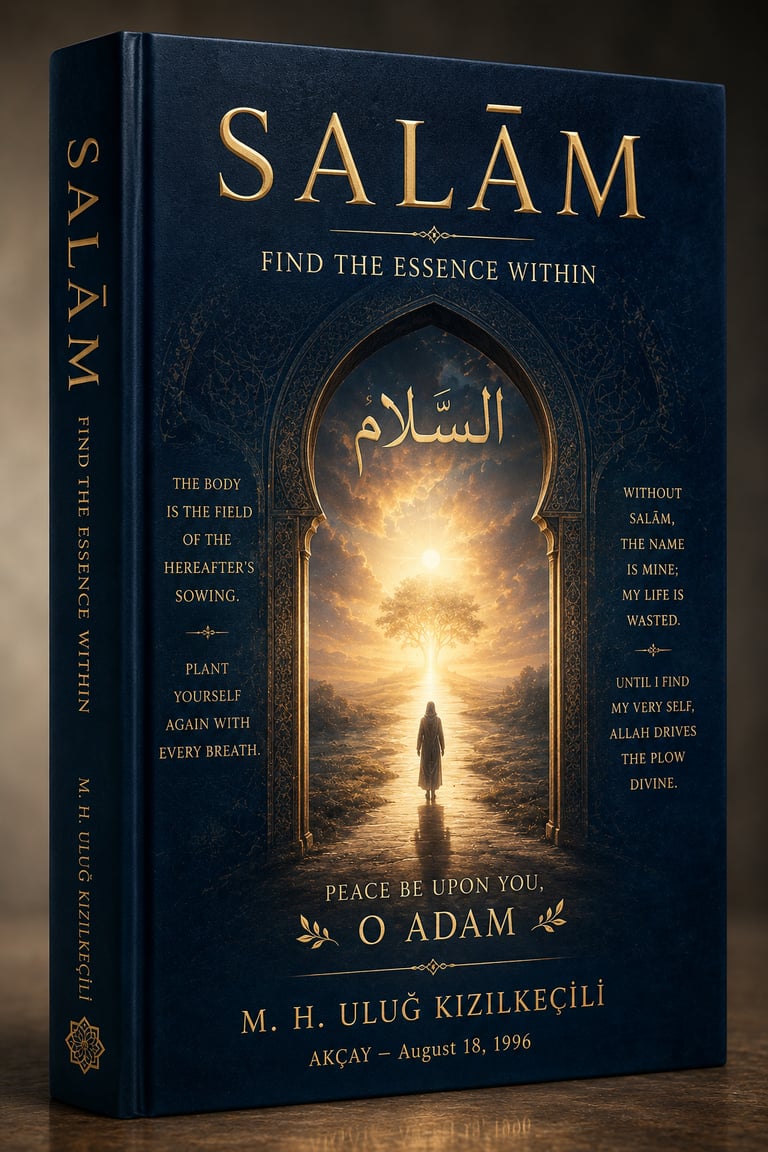
SALĀM means: “Find the Essence within!”
Otherwise, every effort is vain and thin!
The body is the field of the Hereafter’s sowing;
With every breath, plant yourself again!
When my clay veil rises and falls away,
And I behold myself on that Day,
May it be said unto me at last:
“Peace be upon you, O ADAM,” they say!
Otherwise, I cannot truly bow!
Though ecstasy visit me here and now!
No longer merely myself shall I be,
But the One drawn forth from my brow!
Without SALĀM, that name is mine!
My life is wasted along the line!
Until I find my very self,
Allah drives the plow divine!
Ulugh! Let the Essence be your sign!
Be sacrificed like Ishmael divine!
From the ledger of the slaughterhouse,
Erase your name with life as thine!
With the One whose Name is SALĀM,
While body and soul together are one,
My daughter, I have spoken to you;
And my daughter-in-law, understand what is done!
M. H. ULUĞ KIZILKEÇİLİ
AKÇAY – August 18, 1996
SALĀM–2
If I do not write, there is guilt to bear!
If I do write, none will truly care!
And though some read the words I leave,
Few understand what is hidden there!
As though alive, they fear their death!
Inside their graves they pray with breath!
For prayer means leaving the body behind,
And rising beyond the mortal sheath!
Paradise in Turkish means “to fly” indeed!
Make your Miʿrāj and rise with speed!
John emerged from Zechariah’s line,
Through the fast of silence and inward heed!
“He spoke through signs,” through glance and eye!
“Between two bows!” The Third Eye high!
This Essence always commands: “In Allah’s Name!”
For empty words cannot reach the sky!
This “Word of the Lord” is called SALĀM!
The Qur’an itself is Sacred Kalām!
Salāt is supplication, yet ends in Peace;
Who reaches SALĀM becomes Islam!
The Lord grants SALĀT and SALĀM to the MESSENGER above!
“Wherever you are born, become My command through love!”
Escape the state of a speaking beast!
Lest you perish in the form of Barzakh thereof!
John’s mother was Elizabeth by name!
“House of Elijah” is the meaning the scriptures proclaim!
JESUS said concerning JOHN: “He was Elijah!”
And calling “Elijah,” JESUS departed the frame!
The Lord says of JOHN: “A unique name is his!”
Meaning one Spirit exists, though many bodies are!
“Neither angel nor devil knew this Name!”
ADAM breathed the Spirit, and the body became alive!
The Lord says: “Call JESUS Spirit and Word!”
“He resembles ADAM!” Thus is the mystery heard!
Adam is earth; ʿALĪ is the “Father of Earth!”
In Hebrew, Elijah and ʿALĪ are one word!
The mother of earth is the MESSENGER, the Primordial Womb!
The universe is but a ball of earth in its room!
And if the “Father of Earth” is the soul of the cosmos,
Then ADAM is the universe—approach with reverence and bloom!
Ulugh has opened the veil for you completely today!
The universe is the Qur’an, and atoms are verses on display!
But beware! Never tear the veil apart,
If you wish not to perish from wonder on the way!
M. H. ULUĞ KIZILKEÇİLİ
ANKARA – January 19, 1998
(The section written after this point has no relation to the author, and the author cannot be held responsible for any errors that may have been made.)
SALĀM
An Esoteric Commentary on the Cosmic Human, the Divine Word, and the Living Universe
CHAPTER I
SALĀM AND THE REMEMBRANCE OF THE ESSENCE
An Esoteric Inquiry into the Birth of the Cosmic Human
When the great mystical traditions of humanity are examined, it becomes apparent that, despite having arisen thousands of miles apart, they have all sought to answer the same fundamental question: Who is the human being, and why is he here?
This question stands at the center of religions, philosophies, and esoteric schools alike.
The statement appearing in the opening lines of M. H. Uluğ Kızılkeçili’s text Salām—“Salām means: find the Essence”—is, in reality, a mystical answer to this ancient question. Here, salām ceases to be a social form of greeting and becomes a call for the human being to return to his own Source.
In everyday language, salām is a means of communication between people. Yet in esoteric traditions, words possess deeper layers beyond their visible meanings. For this reason, salām may be interpreted not merely as a greeting, but as a symbol of humanity’s renewed encounter with its own essence.
Etymologically, the Arabic word salām carries meanings such as wholeness, completeness, perfection, and peace. These meanings refer not only to social harmony but also to the return of the human being from fragmentation to primordial unity.
In the Sufi tradition, al-Salām is one of the Names of Allah and signifies Absolute Wholeness, free from every deficiency. In this respect, salām is not merely a spoken word but also the ontological condition toward which the human being strives.
Human beings live within fragmented consciousness. They are divided among desires, fears, expectations, and the burdens of the past. Salām represents the point at which this fragmentation comes to an end and the essence is remembered once again.
Most esoteric teachings define humanity’s fundamental problem not as ignorance but as forgetfulness. Humanity does not know Truth because it has forgotten it.
This idea is not unique to Sufism.
In Ancient Greece, Plato’s doctrine of anamnesis is founded upon the same principle. According to Plato, learning is actually the recollection of truths already known by the soul. Before birth, the soul beheld Reality. Earthly existence begins with the forgetting of that knowledge. The journey of wisdom is therefore not the acquisition of something new, but the remembrance of what has been forgotten.
The Sufi concept of maʿrifah points toward the same reality.
Maʿrifah is not ordinary knowledge. It is the direct experience of one’s own truth. For this reason, the Sufis described maʿrifah not as information learned from books, but as an awakening born within the heart.
To the degree that the human being knows his own essence, he begins to know his Lord.
For there exists an inseparable bond between essence and Divine Source.
In Gnostic traditions, this reality is expressed through the concept of gnosis.
Although the Greek word gnosis means knowledge, the knowledge intended here is not theoretical. Gnosis is the realization of one’s own Divine origin.
In Gnostic texts, the human being is portrayed as a spark of light fallen into the world. That spark has forgotten its own essence amidst the layers of material existence. Salvation consists in the ending of this forgetfulness and the recognition of the Light’s true Source.
The Buddhist concept of Bodhi carries a similar meaning.
Bodhi means awakening.
Human beings live within a dream, and the name of that dream is the illusion of selfhood.
As long as one identifies exclusively with body and mind, Reality cannot be perceived. When awakening occurs, Reality is seen as it truly is.
For this reason, Bodhi is not the acquisition of new knowledge but the disappearance of false perception.
In the Kabbalistic tradition, the same process is expressed through the concept of Daʿat.
Daʿat is not ordinary knowledge. It is the direct realization of Divine Reality.
According to Kabbalistic thought, the human being is a fragmented reflection of Divine Light. The purpose of the soul is to transcend fragmentation and reunite with its Source.
Thus, Daʿat means not merely knowing but becoming one with Truth.
When these concepts from different traditions are examined together, a common structure emerges.
Maʿrifah, Gnosis, Bodhi, and Daʿat may have arisen in different cultures, yet all describe the same experience:
The remembrance of one’s own essence.
As long as the human being identifies exclusively with physical existence, he remains in exile.
The moment essence is remembered, the return home begins.
At this point, one of the most important metaphysical concepts in Islamic Sufism enters the discussion: the doctrine of Alast.
The Covenant of Alast described in the Qur’an has been interpreted by esoteric commentators as the source of humanity’s cosmic memory.
The Divine question, “Am I not your Lord?” and the response, “Yes,” symbolize the soul’s first encounter with Divine Reality.
Earthly existence begins with the forgetting of this primordial witnessing.
According to Sufi interpretations, the feeling of longing within the human being originates from this very event.
Human beings constantly feel that something is missing.
They acquire wealth.
They attain status.
They gather knowledge.
Yet deep within, an unexplainable absence remains.
For what is longed for is not an object lost in the world.
What is longed for is the experience of Unity once known in Alast.
Human beings are ultimately searching for their lost essence.
The Kabbalistic doctrine of exile, the Gnostic teaching of the fallen spark of light, and the Vedantic concept of the apparent separation between Atman and Brahman all share the same metaphysical structure.
Their common theme is that humanity has forgotten its own essence.
Worldly life is a field of forgetfulness.
The spiritual path is the process of remembrance.
In Vedanta, the true nature of the human being is taught to be Atman.
Yet because one identifies with body, emotions, and thoughts, this truth remains hidden.
The veil called Maya conceals the true essence.
However, this concealment is not absolute.
As the search for Truth begins, the veil gradually becomes transparent, and essence begins to reveal itself.
A similar understanding may be found within the Mystery Traditions of Ancient Egypt.
The initiate symbolically dies and is reborn.
This rebirth does not mean acquiring a new identity.
It means remembering the real identity.
For throughout all esoteric traditions, Truth is not something acquired later.
It is an essence that has always been present.
For this reason, the concept of salām is not merely an introductory word.
Salām is an invitation to return to one’s own Source.
It is a call to remember one’s essence.
It is also the common voice of all great mystical traditions.
For maʿrifah in Sufism, gnosis in Gnosticism, bodhi in Buddhism, daʿat in Kabbalah, and the knowledge of Atman in Vedanta all point toward the same center.
The human being has forgotten his essence.
The purpose of life is to remember that essence once again.
Salām is the first word of that remembrance.
It is the first step of the inward journey.
It is the reopening of cosmic memory.
It is the hearing once more of the answer given at Alast.
And, in the shared language of all esoteric traditions, it is the awakening of the human being to his own Truth.
Academic Notes
Note 1. The Arabic word salām derives from the root S-L-M and carries meanings such as wholeness, security, completeness, and peace.
Note 2. In Sufism, maʿrifah refers to knowledge of Truth based upon direct experience rather than theoretical understanding.
Note 3. The Greek term gnosis was used particularly in Gnostic traditions to signify the direct realization of one’s Divine origin.
Note 4. The Sanskrit term Bodhi (“awakening”) signifies the direct realization of Reality in Buddhism.
Note 5. The Hebrew concept Daʿat is interpreted in Kabbalah as the hidden sefirah representing conscious union with Divine Reality.
Note 6. According to Plato’s doctrine of anamnesis, learning is the recollection of truths known by the soul before birth.
Note 7. The Covenant of Alast has been interpreted in esoteric readings of Qur’an 7:172 as the pre-temporal witnessing of souls before creation.
Note 8. In Vedanta, Atman represents the individual essence, while Brahman represents Absolute Reality; liberation occurs through the realization of their essential unity.
Note 9. In Gnostic literature, the descent of the Divine spark into the material world constitutes one of the central myths of salvation.
Note 10. Mircea Eliade interpreted the theme of remembrance, found at the center of many mystical traditions, as the rediscovery of humanity’s sacred origin.
CHAPTER II
THE ADAM ARCHETYPE AND THE COSMIC HUMAN
The Esoteric Unity of the Doctrines of the Perfect Human, Adam Kadmon, Anthropos, and Purusha
One of the oldest metaphysical mysteries in human history is the doctrine of the Cosmic Human. Although it appears in cultures that seem entirely independent from one another, it is described through remarkably similar symbols. From Mesopotamia to Egypt, from India to Iran, from Jewish mysticism to Islamic Sufism, the same fundamental idea appears under different names.
According to this doctrine, the human being is not merely a creature living within the universe. The human being is the summary of the universe and even the primordial model through which creation itself unfolds.
The symbol of Adam appearing in M. H. Uluğ Kızılkeçili’s Salām belongs to the center of this ancient teaching. Here, Adam is not merely the first human being in a historical sense. He is the archetype of humanity, the first reflection of the Divine Form, and the symbol of the Cosmic Human.
In esoteric traditions, the importance of Adam does not arise from his role as a biological beginning. His significance derives from being regarded as the first prototype of creation.
For this reason, mystics view Adam less as a person than as a principle.
Less as an individual than as a cosmological reality.
This figure, regarded as the origin of humanity, has simultaneously been understood as the symbol of the Divine potential present within every human being.
Within the Sufi tradition, this idea reaches its most developed form through the concept of the Perfect Human (al-Insān al-Kāmil).
Particularly within the metaphysical system of Ibn al-ʿArabī, the Perfect Human represents the very purpose of creation.
Allah desired to behold His Names and Attributes.
The universe emerged as the field of that manifestation.
Yet the only mirror capable of reflecting all Divine Names completely is the human being.
For this reason, the Perfect Human is not merely a perfected person.
He is the most comprehensive mirror of Divine Reality itself.
In Ibn al-ʿArabī’s thought, the universe is the Great Human, while the human being is the Small Universe.
Therefore, to know oneself is to know the universe.
The universe is a book spread outwardly.
The human being is its condensed edition.
This idea, which stands at the center of the doctrine of the Perfect Human, is in fact a reinterpretation within Islamic wisdom of far older teachings concerning the Cosmic Human.
Within Jewish mysticism, the same archetype appears under the name Adam Kadmon.
The Hebrew word Kadmon carries the meanings primordial, original, and eternal.
Adam Kadmon is not the historical Adam.
He is the first cosmic form that appears at the beginning of creation.
According to Kabbalah, the Infinite Divine Reality known as Ayn Sof first manifests itself in the form of Adam Kadmon in order to become visible.
Thus Adam Kadmon becomes the primordial template of the entire universe.
According to Kabbalistic teaching, the Divine centers of power known as the Sefirot are represented within the body of Adam Kadmon.
The head, chest, arms, and feet are not merely anatomical regions.
They are symbols of cosmic forces.
Thus a direct parallel is established between the human body and the universe.
For this reason, to understand the human being in Kabbalah is to understand the cosmos itself.
The human carries within his own existence the hidden map of creation.
Within Gnostic traditions, this figure appears under the names Anthropos or Protanthropos.
In Gnostic texts, Anthropos is the primordial human existing within the Divine realms.
He has not yet fallen into the material world.
He exists as pure light and consciousness.
When material creation appears, this primordial human becomes fragmented, and his sparks of light become countless human souls.
For this reason, the goal of Gnostic salvation is not the acquisition of something new.
It is the reunification of the fragmented Light of Anthropos.
When the human being remembers his Divine origin, the lost wholeness of the Primordial Human begins to emerge once again.
Salvation therefore becomes not an individual achievement but a cosmic act of remembrance.
A similar structure appears within the Hermetic tradition.
In the Poimandres section of the Corpus Hermeticum, Anthropos is described as the Cosmic Human born from the Divine Mind.
This being simultaneously contains both heavenly and earthly realities.
He encompasses both spirit and matter.
For this reason, the human being becomes the most important symbol within the universe.
The human is the living bridge standing between two worlds.
The Hermetic principle, “As above, so below,” is one of the fundamental foundations of the Cosmic Human doctrine.
The human being is not merely a creature living within the cosmos.
The human being is a miniature copy of the cosmos itself.
The order of the sun, the stars, and the planets exists within the human being as well.
Therefore, turning inward is simultaneously a turning toward cosmic order.
Within the Indian tradition, this archetype appears under the name Purusha.
In the famous hymn known as the Purusha Sukta in the Rig Veda, Purusha is described as having a thousand heads, a thousand eyes, and a thousand feet.
The number one thousand is not mathematical.
It is symbolic of infinity.
Purusha is the universe itself.
His body is the cosmos.
According to the Vedic narrative, the gods sacrifice Purusha, and from his body the entire creation emerges.
The moon is born from his mind.
The sun is born from his eyes.
The heavens arise from his head.
The earth emerges from his feet.
The parallels between this narrative and the doctrine of Adam Kadmon are extraordinarily striking.
In both systems, the universe is portrayed as the unfolding of a Cosmic Human.
These similarities are too powerful to be explained merely as coincidence.
Historians of religion and scholars of comparative mythology have suggested that the Cosmic Human archetype belongs to the shared inheritance of human consciousness.
The appearance of the same symbol across different continents and historical periods indicates that it corresponds to a universal metaphysical pattern.
Within ancient Iranian tradition, the figure of Gayomart possesses similar characteristics.
According to Zoroastrian cosmology, Gayomart is the primordial human, and from his death life emerges upon the earth.
This narrative shares the same archetypal structure found in the myths of Purusha and Adam Kadmon.
Within Chinese tradition, the figure of Pangu fulfills a similar role.
When the universe is formed, the body of Pangu becomes mountains, rivers, stars, and winds.a<
Thus the motif of the Cosmic Human appears even within East Asian cultures.
In the Egyptian Mysteries, Osiris symbolizes fragmented cosmic wholeness.
His restoration represents the restoration of universal order itself.
Seen from this perspective, the myth of Osiris may also be interpreted as another version of the Cosmic Human theme.
All of these traditions point toward a common truth.
The human being is not merely a biological organism.
The human being is the summary of the universe, the mirror of the Divine Form, and the central symbol of creation.
For this reason, the ancient traditions of wisdom did not diminish humanity.
They regarded humanity as the bearer of cosmic meaning.
The symbol of Adam appearing in the text of M. H. Uluğ Kızılkeçili stands within the continuation of this great esoteric heritage.
Here Adam ceases to be a historical figure who lived in the distant past.
He becomes the common metaphysical origin of all humanity.
When the human being remembers his essence, he becomes Adam once again.
He no longer sees himself merely as a body.
He begins to perceive himself as a reflection of the Cosmic Human.
The Perfect Human, Adam Kadmon, Anthropos, Purusha, and all other figures of the Cosmic Human are ultimately different cultural expressions of the same Reality.
Each teaches that the human being is not an ordinary creature.
Each teaches that the meaning of the universe is carried within the human being.
Each teaches that the path toward Truth leads not outward but inward, toward one’s own essence.
For this reason, the doctrine of the Cosmic Human is not merely a myth belonging to the past.
It is a universal metaphysical map designed for the rediscovery of human identity.
At the center of this map stands the common call of all mystical traditions:
Know thyself.
For the one who knows himself remembers the Primordial Human.
And the one who remembers the Primordial Human rediscovers his own Divine origin.
Academic Notes
Note 11. The concept of the Perfect Human (al-Insān al-Kāmil) was developed systematically especially by Ibn al-ʿArabī and ʿAbd al-Karīm al-Jīlī.
Note 12. Adam Kadmon, in Kabbalah, is understood as the first manifestation of Infinite Divine Light and is distinct from the historical Adam.
Note 13. In Gnostic texts, Anthropos or Protanthropos refers to the primordial archetypal human existing within the Divine realm.
Note 14. In the Poimandres section of the Corpus Hermeticum, Anthropos is described as the Cosmic Human born from Divine Mind.
Note 15. The Purusha Sukta (Rig Veda 10.90) is regarded as the foundational text of the Cosmic Human doctrine within Indian cosmology.
Note 16. Comparative studies of religion frequently emphasize parallels between the universe emerging from Purusha’s body and the cosmic body doctrine of Adam Kadmon.
Note 17. Gayomart in Zoroastrian cosmology represents the primordial human and cosmic ancestor of Iranian tradition.
Note 18. The Chinese mythological figure Pangu embodies the Cosmic Human motif through the transformation of his body into the universe.
Note 19. Mircea Eliade regarded the Cosmic Human archetype as one of the recurring universal symbols found throughout the religions of the world.
Note 20. According to Carl Gustav Jung, the Cosmic Human motif is one of the fundamental archetypes of the collective unconscious and symbolizes the process through which the individual attains wholeness.
CHAPTER III
ADAM’S CREATION FROM EARTH
An Esoteric Commentary on Earth Symbolism, the Condensation of Light, and the Doctrine of the Cosmic Body
The narrative of Adam’s creation from earth is one of the most widespread and ancient symbols of creation in human history. This narrative appears in various forms in many traditions, especially Islam, Judaism, and Christianity; yet it has never been read by esoteric traditions merely as a physical event.
For mystical commentators, earth is not merely the substance beneath our feet. Earth is the symbol of invisible Truth becoming visible form. Therefore, Adam’s creation from earth does not so much explain the physical origin of the human body as reveal the cosmic mystery of the relationship between spirit and matter.
In the exoteric reading, earth is the beginning of matter.
In the esoteric reading, however, earth is the final stage in the condensation of Divine Light.
In the great metaphysical systems of Sufism, creation is described as a movement of manifestation descending from above to below. Absolute Truth exists as an invisible field of unity. This unity unfolds through various levels and ultimately becomes the visible universe.
Earth is the densest link in this long chain of manifestation.
For this reason, the Sufis did not regard earth as a degrading element, but as the final station of the Divine Mystery. The human being’s creation from earth does not signify his worthlessness. On the contrary, it represents the level of existence in which Divine Truth becomes most intensely visible.
For what becomes condensed is not ordinary matter, but Divine Light.
The concepts of density (kathāfah) and subtlety (laṭāfah), frequently used in Sufi metaphysics, become important at this point.
Subtlety means refinement and spirituality.
Density means concentration and visibility.
Yet these two concepts are not absolute opposites. They are different levels of appearance of the same Truth.
Light, in its most subtle state, is invisible.
As it condenses, it becomes visible.
Eventually, it becomes matter.
For this reason, in the deeper layers of Sufism, there is no absolute separation between matter and spirit.
Matter is the condensed form of spirit.
Spirit is the refined form of matter.
The two are different points on the same chain of Being.
In Ibn al-ʿArabī’s cosmology, creation arises from the manifestations of the Divine Names in different degrees of density. Every being is the appearance of a Divine Name. Stone, tree, star, and human being all emerge from the same Source. Therefore, the whole universe is regarded as the visible forms of the Divine Names.
Earth is one of the densest forms of this appearance.
A similar understanding appears in the Kabbalistic tradition through the concept of Malkhut. Malkhut, the final sefirah of the Tree of Life, is the most dense and concrete field of appearance of Divine energy. The Light descending from the higher Sefirot finally becomes the visible world in Malkhut. Thus, a bridge is established between invisible Divine Reality and the material universe.
In Kabbalistic thought, the world is not a realm distant from Divine Light. On the contrary, it is the final stage in which that Light becomes visible. Therefore, the sacredness of earth does not arise from its separation from the Divine Source, but precisely from its being the final point of manifestation of that Source.
In the Hermetic tradition, the same idea is expressed through the concept of Prima Materia. Frequently used by alchemists, this concept represents the primordial substance from which all creation emerges. Yet Prima Materia is not ordinary physical matter. It is the sacred essence that carries within itself the potential for all transformation.
In the alchemical tradition, the symbol of lead transforming into gold actually describes the human being’s unveiling of the hidden Light within himself.
Lead represents condensed and forgotten Light.
Gold represents the essence that has been remembered and purified.
Thus, matter is not the enemy of transformation, but its starting point.
A similar understanding exists in the Vedanta tradition. Maya is often translated merely as illusion. Yet in Vedantic interpretation, Maya is the manifestation of Absolute Reality as the visible world. The world is not entirely unreal; it is the final layer of appearance of Absolute Reality. Therefore, there is no unbridgeable separation between the visible universe and Brahman.
In Indian metaphysics, it is said that the universe emerges from the body of Purusha. The moon arises from his mind, the sun from his eyes, the sky from his head, and the earth from his feet. This narrative demonstrates the profound relationship established between the human body and the universe. The human body is not merely a biological structure; it is the earthly reflection of cosmic order.
In esoteric traditions, the body has often been described as the small universe.
In Ancient Greece, this was called the microcosm.
The universe is the macrocosm; the human being is its reflection on a smaller scale.
The centers within the human body were interpreted as symbolic counterparts of the powers present in the cosmic order.
According to this understanding, the human being is not merely a creature living within the universe.
The human being carries the universe within himself.
The order of the stars, the rhythm of the planets, the laws of nature, and the geometry of creation are also present within the human body.
For this reason, many mystical traditions have described the human being as the “small world” and the universe as the “Great Human.”
Hurufism carried this idea even further.
According to the Hurufis, the human face is the visible page of the Divine Book. Eyebrows, eyes, lips, and facial lines were associated with letters. Thus the human body ceased to be merely a biological structure and became the living form of the Sacred Text.
At the foundation of this approach lies the idea that the body is not worthless but sacred.
For the body is the bearer of the Divine Mystery.
The human being is not a spirit imprisoned within earth.
The human being is Light made visible within earth.
For this reason, earth symbolism has also been associated with death. When the human being returns to earth, he is in fact returning to the point from which he began. Yet according to esoteric interpretations, this return is not annihilation.
Just as earth is the first point of the condensation of Light, it is also the starting point of dissolution.
With death, the human being begins once more to become subtle and turn toward his Source.
In the Mysteries of Ancient Egypt, the body was regarded as the earthly reflection of Divine order. The mummification of the pharaohs was not merely intended for physical preservation; it aimed to preserve the body’s connection with cosmic order. This too shows that the body was regarded as sacred.
In Gnostic traditions, although matter is sometimes described as a realm of exile, it is also accepted that the Divine Spark within the human being is hidden in matter. Thus matter is not entirely rejected; rather, the Truth concealed within it is sought.
When all these teachings are considered together, it becomes clear that the narrative of Adam’s creation from earth is not merely a biological origin story.
This narrative is a great metaphysical symbol that explains the transformation of invisible Light into visible form, the manifestation of Divine Truth in matter, and the human body’s becoming the bearer of universal order.
Earth here is not ordinary matter.
Earth is condensed Light.
Earth is the visible manifestation of the invisible.
Earth is the final veil of the Divine Mystery.
And the human being is the living form of the cosmic Truth hidden within this veil.
For this reason, Adam’s creation from earth does not describe the human being’s ascent from below to above.
Rather, it describes the appearance below of the Truth that is above.
The human being is not the child of earth.
The human being is Light written into earth.
Academic Notes
Note 21. The Arabic concepts ṭīn (“clay”) and turāb (“earth”) are used in different contexts in the Qur’an to describe the creation of the human being.
Note 22. In Sufism, kathāfah refers to the condensation of Divine Light into visibility, while laṭāfah refers to the more subtle and spiritual levels of the same Light.
Note 23. In Ibn al-ʿArabī’s cosmology, creation is explained through the manifestation of the Divine Names across different levels.
Note 24. In Kabbalah, Malkhut is the final sefirah of the Tree of Life and represents the manifestation of Divine energy in the visible world.
Note 25. The Latin term Prima Materia refers in Hermetic alchemy to the metaphysical first substance from which all transformations arise.
Note 26. Alchemical gold has been interpreted less as a physical metal than as a symbol of spiritual perfection.
Note 27. In Vedanta, Maya is a complex metaphysical concept expressing the appearance of Absolute Reality within the field of manifestation.
Note 28. The Purusha Sukta is regarded as one of the oldest texts linking the human body with cosmic order.
Note 29. The microcosm-macrocosm principle is one of the foundational doctrines of many esoteric systems, especially the Hermetic tradition.
Note 30. In Hurufism, the human face was regarded as the visible book of letters and Divine mysteries.
CHAPTER IV
ʿALĪ AND THE FATHER OF EARTH
ʿAlī in the Hurufi Tradition, the Mystery of the Cosmic Human, and the Manifestation of the Divine Form in Matter
In most esoteric traditions, certain figures are not regarded merely as historical persons. They also become symbols of metaphysical principles, cosmic powers, and universal truths.
The statement in M. H. Uluğ Kızılkeçili’s text, “Adam is earth! ʿAlī is the Father of Earth!” is the product of precisely this kind of symbolic language.
What is at stake here is not merely a historical personality. Through the figure of ʿAlī, the poet expresses one of the oldest esoteric mysteries in human history: the doctrine of the manifestation of Divine Truth in matter.
To understand this expression, one must first understand what the concept of “earth” represents in esoteric traditions.
As seen in the previous chapter, earth is not ordinary matter.
Earth is the transformation of invisible Truth into visible form.
It is the condensation of Light.
It is the embodiment of Spirit.
It is the descent of the Divine Mystery into the visible world.
Therefore, the phrase “Father of Earth” does not refer to the source of the physical element that forms earth, but to the metaphysical principle made visible within earth.
It is no coincidence that ʿAlī occupies a special position in the Hurufi tradition.
According to Hurufi thought, the universe is composed of letters. Letters are not merely linguistic signs; they are the fundamental building blocks of creation. Just as modern physics proposes that energy and information lie at the foundation of the universe, the Hurufis held that Divine letters lie at the foundation of existence.
The human face, the body, and even all creation are nothing but the visible forms of these letters.
Within this system, ʿAlī becomes not merely a historical person but the symbol of the Divine mysteries carried by the human being.
For according to Hurufi thought, the mysteries hidden in the human face and body are the visible form of Divine Speech.
The human being is a book.
The letters are written upon his face.
The cosmic order is hidden within his body.
For this reason, ʿAlī was regarded as the key figure through whom these mysteries are unveiled.
The importance given to the human face in Hurufi sources is in fact the continuation of a much older doctrine of the Cosmic Human. Here, the human face is not an ordinary anatomical structure. It is the earthly map of the invisible Divine order.
Eyebrows, eyes, lips, and facial lines were associated with certain letters.
Thus the human being became a living Sacred Text.
The roots of this understanding are found not only in Hurufism, but also in many ancient traditions.
In Kabbalah, Adam Kadmon is the primordial form of all creation.
In Hermeticism, Anthropos fulfills the same function.
In the Vedic tradition, Purusha is the body of the entire universe.
In Sufism, the Perfect Human is the complete mirror of the Divine Names.
All of these teachings may be understood as different languages expressing the same Truth.
At this point, the doctrine of the Cosmic Human is seen to possess central importance.
The Cosmic Human is not a historical individual.
He is the first model of creation and the metaphysical plan of the universe.
The human being has been created according to this plan.
For this reason, when the human being comes to know himself, he begins to discover not only his individual identity, but also the fundamental structure of the universe.
In Ibn al-ʿArabī’s thought, the Perfect Human is the complete field of manifestation of the Divine Names.
The Names of Allah—such as Rahman, the Wise, the Light, the Living, and the Knowing—appear in the universe in scattered form, but in the human being they are gathered as a whole.
For this reason, the Perfect Human has been regarded as the summary of creation.
The mystery to which the poet points through the figure of ʿAlī is precisely this doctrine of wholeness.
The Kabbalistic concept of Malkhut gains a new meaning in this context.
Malkhut is the final field of manifestation of Divine energy in the visible world.
The Light descending from the higher Sefirot becomes matter here.
Yet this transformation is not a fall.
On the contrary, it is the visible manifestation of invisible Truth.
For this reason, Malkhut has sometimes been interpreted as the earthly mirror of the Divine Kingdom.
The poet’s phrase “Father of Earth” strikingly corresponds to this function of Malkhut.
For here, earth is the final station of Divine energy.
It is the transformation of invisible Light into visible form.
Thus ʿAlī becomes not the source of earth, but the symbol of the Divine meaning made visible within earth.
The same idea appears in the Hermetic tradition through the concept of Prima Materia.
The first matter sought by the alchemists is not an ordinary physical element.
It is the metaphysical essence that is the source of all transformations.
Expressed in the language of alchemy, all forms of the universe arise from the same fundamental essence.
This essence may appear outwardly as lead, stone, or body; yet inwardly it carries the same Divine substance.
Therefore, the goal of alchemy is not to produce something new.
The goal is to reveal what is hidden.
Gold is already hidden within lead.
The Divine essence of the human being is already hidden within the body.
Just as the alchemist seeks to reveal the gold hidden within lead, the mystic seeks to unveil the Divine Form hidden within the human being.
Here, the concept of the Divine Form has central importance.
In Jewish, Christian, and Islamic traditions, there are teachings that the human being was created in the Divine Image.
Esoteric commentators have interpreted this statement not as a physical resemblance, but as a metaphysical reflection.
The human being is not the image of God in a material sense.
The human being is the mirror of Divine Truth.
For this reason, to look upon the human body is not merely to look upon a biological organism.
The human body carries the hidden geometry of creation.
Organs, proportions, and structures of consciousness are reflections of cosmic order on a smaller scale.
That is why, in many mystical traditions, self-knowledge has been regarded as the highest form of knowledge.
In Ancient Egypt, the pharaoh was regarded as the earthly representative of Divine order.
In Iranian tradition, Gayomart is the symbol of the Cosmic Human.
In Chinese mythology, the universe is born from the body of Pangu.
All of these examples are different cultural forms of the same archetype.
The Divine has not remained invisible.
It has become visible in human form.
The figure of ʿAlī in M. H. Uluğ Kızılkeçili’s text also belongs within this great metaphysical tradition.
Here, ʿAlī is not merely a historical person.
He is the symbol of the Divine Mystery carried by the human being.
He is the Cosmic Human made visible in matter.
He is Light written into earth.
He is the unveiling of invisible Truth within the visible body.
For this reason, the expression “Father of Earth” is not a biological account of origin, but a metaphysical explanation.
Earth is not ordinary matter.
Earth is condensed Light.
Earth is Malkhut.
Earth is Prima Materia.
Earth is the mirror in which the Divine Form becomes visible.
And ʿAlī represents the mystery of the Cosmic Human appearing in this mirror.
The mystery is this:
The human being was not merely created from earth.
The human being is a Divine Text written into earth.
He is the earthly reflection of the Cosmic Human.
He is the visible form of invisible Truth.
Therefore, to read the human being is to read the universe.
And to read the universe is to follow the traces of the Divine Form.
According to the common doctrine of all esoteric traditions, these traces are most clearly hidden within the human being’s own existence.
Academic Notes
Note 31. Hurufism is an esoteric system of thought that interprets letters as the fundamental metaphysical elements of creation.
Note 32. In the teachings of Fazlullah Astarabadi, the human face was regarded as the visible manifestation of Divine mysteries and letters.
Note 33. In Kabbalah, Malkhut is regarded as the final sefirah through which Divine energy is reflected into the visible world.
Note 34. Prima Materia in Hermetic alchemy refers to the first metaphysical substance from which all forms arise.
Note 35. In the alchemical tradition, the transformation of lead into gold was interpreted as a symbol of the human being’s inner transformation.
Note 36. The doctrine that the human being was created in the Divine Image appears in different forms within Jewish, Christian, and Islamic traditions.
Note 37. According to the doctrine of the Perfect Human, the human being is the most comprehensive field of manifestation of the Divine Names.
Note 38. The doctrine of Adam Kadmon interprets the human body as the metaphysical plan of cosmic order.
Note 39. According to Mircea Eliade, the Cosmic Human archetype is one of the most widespread symbols in the history of religions.
Note 40. The microcosm-macrocosm principle is an ancient esoteric doctrine asserting a structural and symbolic parallel between the human being and the universe.
THE HUMAN BEING’S SOWING OF HIMSELF
CHAPTER V
THE BODY IS THE FIELD OF THE HEREAFTER
The Esoteric Metaphysics of Consciousness, Destiny, and Cosmic Harvest
All great mystical traditions in human history have taught that the human being is not merely a living creature, but also a being who constantly constructs himself. M. H. Uluğ Kızılkeçili’s expression, “The body is the field of the Hereafter; with every breath, sow yourself,” is like a concise formula of this ancient teaching.
Here, the body is not merely a biological organism. It is seen as a cosmic field in which destiny is woven. At every moment of life, the human being leaves seeds in this field. Thoughts, emotions, intentions, fears, loves, and choices are sown into the soil of consciousness as invisible seeds.
Traditional religious understandings have often portrayed the Hereafter as a place to be reached after death. Esoteric traditions, however, have interpreted the Hereafter primarily as a state of consciousness. For what one encounters after death is thought to be, to a great extent, the continuation of the structure of consciousness formed during life.
Thus, after death, the human being does not create an entirely new reality; he harvests the reality he has sown while living.
In the Sufi tradition, action does not mean only outward behavior. The intentions of the heart, the orientations of the mind, and the states developed in one’s inner world are also included within the meaning of action. For according to the Sufis, what transforms the human being is not only what he does, but the consciousness with which he does it.
Thus destiny ceases to be a fate imposed from outside and becomes a web continuously woven by the human being through his own consciousness.
In Indian metaphysics, the doctrine of karma is another expression of the same principle. The Sanskrit word karma means action. Yet what is meant here is not merely physical behavior. Every thought, every emotion, and every intention also produces karma.
Thus the human being shapes not only the external world, but also his own future state of consciousness.
Buddhism deepened the psychological dimension of this teaching even further. According to Buddhist thought, a person’s present personality is the result of past tendencies. Future experiences are the product of today’s structure of consciousness.
Life therefore becomes a continuous process of sowing and harvest.
For this reason, in the teaching of the Buddha, liberation occurs not through the change of external conditions, but through the transformation of the seeds of consciousness.
A similar understanding exists in Kabbalah. Every choice made during the development of the soul either strengthens or veils the manifestation of Divine Light within the human being.
Whatever seed a person nourishes in his inner world begins to grow over time.
If mercy is sown, mercy multiplies.
If arrogance is sown, arrogance grows.
If love is sown, love deepens.
Thus the future state of the soul is shaped by the invisible choices of today.
In the Hermetic tradition, this principle is expressed as the law of cause and effect. No movement in the universe is without consequence. Every vibration gives birth to other vibrations. The human being is not outside this universal law.
Thoughts are not merely mental events; they are energies that produce ontological consequences.
For this reason, Hermetic wisdom calls the human being to become a conscious participant in his own destiny.
The poet’s description of the body as a field expresses this universal metaphysical law in poetic form.
The human being does not merely live.
The human being constantly sows himself.
And every sowing one day becomes a harvest.
CHAPTER VI
THE METAPHYSICS OF BREATH
The Cosmic Principle of Life Between Rūḥ, Ruah, Pneuma, and Prana
In most esoteric traditions, breath has not been regarded merely as a biological function. Breath has been understood as the visible sign of life and the first manifestation of Divine Being within the human being. For this reason, in many languages, the words for spirit and breath derive from the same root.
When the human being breathes, he does not merely take in oxygen; he participates in life itself.
The Arabic word Rūḥ is associated with meanings such as blowing and giving life. In the Qur’an, the theme of Divine Spirit being breathed into the human being appears in the account of creation. For esoteric commentators, this narrative is not a biological event, but a metaphysical symbol showing that the human being is connected to the Divine Source.
The human being is not composed only of earth.
He also carries spirit.
The Hebrew concept Ruah possesses the same multi-layered structure. Ruah means wind, breath, and spirit. According to Jewish mysticism, the life-force moving through the universe becomes visible through Ruah.
Thus breathing is not merely a bodily activity, but the continual renewal of Divine energy.
The Greek word Pneuma similarly carries the meanings of both breath and spirit. Stoic and Hermetic thinkers regarded Pneuma as the invisible life-force that holds the universe together.
The human breath is a small-scale reflection of the cosmic breath.
Thus a direct bond is established between individual life and universal life.
In the Indian tradition, the concept of Prana is one of the most developed examples of this idea. Prana is not merely respiration. It is accepted as the universal energy that nourishes all vitality. For this reason, breath practices hold great importance in yogic systems. Regulating the breath also means regulating the mind and consciousness.
Breath also occupies a central position in Sufism. Especially in the Naqshbandi tradition, there is the principle of “hūsh dar dam,” meaning wakefulness in every breath. The human being must be aware of each breath.
For every breath is a new creation.
Every breath is an invisible beginning that reshapes one’s destiny.
For this reason, in esoteric traditions, breath is not an ordinary biological movement.
Breath is the sign that creation is continuously ongoing.
As long as the human being breathes, he participates in the Divine process of creation.
Every breath is a new beginning, a new choice, and a new line of destiny.
CHAPTER VII
DESTINY FROM THE ATOM TO THE GALAXY
Fractal Consciousness and the Esoteric Unity of Microcosm and Macrocosm
One of the oldest metaphysical principles in human history is the idea that the same order repeats itself at every level of the universe. In the Hermetic tradition, this thought is expressed through a famous formula: “As above, so below.”
This sentence is not merely a poetic analogy. It is an esoteric law expressing the profound parallel between cosmic order and human consciousness.
In modern science, the concept of the fractal refers to a structure that repeats itself within its smaller parts. Esoteric traditions expressed a similar understanding thousands of years earlier through symbolic language.
The human being is the small universe.
The universe is the Great Human.
The order found in the atom and the order found in galaxies operate according to the same fundamental principles.
In Sufism, this has been called the small world and the great world.
The human being is the small world.
The universe is the great world.
Whoever understands one begins to understand the other.
For both are appearances of the same Truth at different scales.
In Kabbalah, the Tree of Sefirot explains not only the cosmic structure, but also the inner structure of the human soul. A parallel is established between the centers of human consciousness and universal order. Thus a relationship of reflection emerges between the outer world and the inner world.
In the Hermetic tradition, this relationship is even more explicit. The human body has been associated with planets, elements, and cosmic forces. For the human being is not an observer standing outside the universe, but a conscious part of the universe itself.
The relationship between Atman and Brahman in the Vedanta tradition may also be considered in this context. Individual consciousness and universal consciousness are appearances of the same Reality at different scales.
Just as there is no essential difference between a drop in the ocean and the ocean itself, there is no essential separation between the human being and universal consciousness.
Modern cosmology and quantum theories do not directly confirm these esoteric teachings. Nevertheless, they show that the universe possesses an astonishingly ordered and mathematical structure. From the behavior of atoms to the movement of galaxies, certain patterns are observed at every level.
This has led many thinkers toward the idea that the universe is a readable and meaningful structure.
When the poet’s expressions “the body is the field of the Hereafter” and “the atom is a verse” are considered together, it becomes clear that a profound connection is established between the destiny of the human being and the destiny of the universe.
The human being does not merely live in the universe.
The human being carries the destiny of the universe within himself.
For microcosm and macrocosm are two different appearances of the same Truth.
Therefore, when the human being begins to know himself, he does not merely make a psychological discovery.
He also begins to discover the fundamental order of the universe.
He realizes that there is an invisible bond between atom and galaxy, breath and star, the human heart and cosmic order.
And according to the shared teaching of all esoteric traditions, the name of this bond is not merely destiny.
The name of this bond is unity.
It is the secret that the human being and the universe were born from the same Truth.
Academic Notes
Note 41. The doctrine of karma is explained in Hinduism, Buddhism, and Jainism as the universal law of cause and effect determining the future consequences of actions.
Note 42. The Arabic concept Rūḥ is one of the fundamental metaphysical terms in the Qur’an expressing the human being’s relation to the Divine Source.
Note 43. The Hebrew word Ruah carries the meanings of breath, wind, and spirit.
Note 44. The Greek term Pneuma expresses the life principle that animates the universe in Stoic and Hermetic thought.
Note 45. The Sanskrit term Prana is defined in Yoga and Vedanta systems as universal life energy.
Note 46. In Naqshbandi Sufism, “hūsh dar dam” refers to the state of conscious awareness in every breath.
Note 47. The microcosm-macrocosm principle is one of the foundational principles of Hermetic philosophy.
Note 48. The concept of the fractal was systematically developed in modern mathematics by Benoit Mandelbrot.
Note 49. Ibn al-ʿArabī’s doctrine of the small world and the great world explains the structural parallel between the human being and the universe.
Note 50. In Vedanta, the identity of Atman and Brahman expresses the unity between individual and universal consciousness.
THE SECRET OF SACRIFICE
CHAPTER VIII
BEING SACRIFICED LIKE ISHMAEL
The Esoteric Interpretation of the Sacrifice Narrative and the Dissolution of the False Self
One of the most powerful symbols in human history is the symbol of sacrifice. This symbol has held a central place not only in the Abrahamic traditions, but in almost every ancient civilization of the world.
Yet esoteric traditions have never interpreted narratives of sacrifice merely as external rituals.
For this reason, the expression “Be sacrificed like Ishmael” in M. H. Uluğ Kızılkeçili’s text does not point to a physical act, but to the great transformation that takes place within the inner world of the human being.
Outwardly, it is Ishmael who is sacrificed.
Inwardly, it is the self that is sacrificed.
For this reason, the great masters of Sufism read the story of Abraham not merely as a historical event, but as an inner map of the human soul.
Here, Abraham represents the intellect turned toward Divine Truth.
Ishmael represents the identity the human being has constructed about himself: his personality, desires, fears, habits, and the structure of selfhood he believes he possesses.
The knife is Divine Knowledge.
For without the knife of Truth, the false self cannot be cut.
The human being thinks he is the body.
The human being thinks he is the name.
The human being thinks he is the profession.
The human being thinks he is his thoughts.
Yet all mystical traditions teach that these are temporary.
Sufism has called this temporary structure the nafs.
Nafs does not simply mean evil.
Nafs is the structure that causes the human being to perceive himself as a limited individual.
The esoteric interpretation of the sacrifice narrative describes the surrender of this limited self before Divine Truth.
In Vedanta, this structure is called ahamkara.
Ahamkara is the “I-making” mechanism.
The human being forgets his true essence and mistakes his mental identity for himself.
Liberation is the dissolution of this illusion.
In Buddhism, the same process is expressed through the doctrine of anatta.
According to the Buddha, the human being has no permanent and independent self. He suffers because he clings to the things he imagines to be self.
Therefore, awakening begins with the dissolution of the false center.
In Gnostic traditions, too, it is said that the Divine Spark within the human being is veiled by material identities.
Salvation is the removal of these veils.
Thus, to be sacrificed like Ishmael is not to die.
On the contrary, it is to be truly born for the first time.
For what is cut is not the Essence.
What is cut is the veil covering the Essence.
CHAPTER IX
ABRAHAM AND DIVINE INTELLECT
The Cosmic Logic of Surrender and the Symbolism of Intellect
The second great symbol at the center of the sacrifice narrative is Abraham. In esoteric traditions, Abraham is not merely a historical prophet, but an archetypal figure representing a particular stage of human consciousness. He is the symbol of the intellect that seeks Truth.
In the Qur’an, Abraham is described as searching for Truth by looking at the stars, the moon, and the sun. This narrative is not merely about astronomical observations. It is a symbol of the human intellect searching for Absolute Reality behind the visible world.
Abraham first sees the star.
Then he realizes that it sets.
Then he sees the moon.
Then he realizes that it too disappears.
Then he sees the sun.
Then he understands that it too is temporary.
This process is a metaphor for human consciousness abandoning the relative and turning toward the Absolute.
In the Sufi tradition, Abraham represents the highest degree of intellect. Yet what is meant here is not the calculating intellect, but the intellect that seeks Truth. For in esoteric traditions, true intellect does not merely produce logic; it seeks to recognize Reality.
In the Neoplatonic tradition, the principle called Nous performs a similar function. Nous is the universal intellect. When the human being comes into harmony with this intellect, he begins to comprehend the deep order of the universe.
In Kabbalah, the concepts of Hokhmah and Binah also represent this structure of cosmic intellect. As the human soul comes into contact with Divine Wisdom, it rises to a higher level of understanding.
Abraham’s surrender gains its meaning precisely at this point.
Surrender is not blind obedience.
Surrender is alignment with the Will of Truth.
For according to mystical traditions, a greater order operates within the universe.
The human being may struggle against this order.
Or he may enter into harmony with it.
Abraham chooses the second path.
For this reason, his surrender is not defeat, but union with the Cosmic Will.
In Vedanta, this is called harmony with Dharma.
In Taoism, it is called flowing with the Tao.
In Sufism, it is expressed as trust and surrender.
Although different names are used, the Reality indicated is the same:
the alignment of individual will with Universal Will.
CHAPTER X
FANĀ AND BAQĀ
The Metaphysics of Ego-Death in Hallāj, Bāyazīd, and Ibn al-ʿArabī
One of the deepest concepts in Sufism is fanā.
Fanā has often been misunderstood as annihilation. Yet fanā is not the disappearance of the human essence; it is the disappearance of what is not the essence.
Fanā is the dissolution of the false center.
It is the dethroning of the nafs.
It is the dispersal of the illusion of selfhood.
For this reason, fanā is not death, but liberation.
The saying of Hallāj al-Manṣūr, “Anā al-Ḥaqq,” must be understood in this context. Hallāj is not deifying his individual ego here. On the contrary, he is expressing that the individual ego has disappeared. The one speaking is no longer the limited self, but Truth itself.
Bāyazīd al-Bisṭāmī’s statement, “Subḥānī, mā aʿẓama shānī,” has been interpreted in a similar way. From an outward perspective, such words may appear as arrogance. Yet in Sufi interpretation, they are not expressions of selfhood, but expressions of the disappearance of selfhood.
Ibn al-ʿArabī explained this process in a more systematic manner. According to him, Being is in truth One. Because the human being forgets this Unity, he imagines himself to be a separate being. Fanā is the end of this forgetfulness.
However, fanā is not the final stage.
After fanā comes baqā.
Baqā is the human being’s rebirth within Truth.
The person no longer lives through the old self.
He begins to live from a new level of consciousness.
The relationship between Nirvana and the Bodhisattva ideal in Buddhism resembles this.
The Vedantic understanding of life after Moksha carries the same structure.
First dissolution.
Then rebirth.
First death.
Then abiding in Truth.
Fanā and baqā are the two faces of this great transformation.
CHAPTER XI
DYING BEFORE DEATH
The Great Doctrine of Transformation in Sufism, Buddhism, Vedanta, and Gnosticism
“Die before you die.”
This statement, one of the most famous teachings of Sufism, is not unique to Islamic wisdom alone. The same teaching appears in different forms in nearly every major mystical system in human history.
This death is not biological death.
This death is a psychological and ontological transformation.
The human being cannot pass into a new level of consciousness without letting go of the old identity.
For this reason, mystical traditions have regarded symbolic death as a necessary stage.
In Sufism, this is what is meant by the death of the nafs.
The person ceases to perceive himself as a limited self.
He opens himself to Truth.
In Buddhism, the same process is described as Nirvana.
The word Nirvana means “extinguishing.”
What is extinguished is not life.
What is extinguished is illusion.
What is extinguished is self-centered perception.
In Vedanta, the dissolution of ahamkara expresses the same transformation.
Before Atman can reveal itself, the false self must withdraw.6523mıo3
For this reason, Vedantic teachers often ask the question:
“Who are you?”
This question does not seek biographical information.
It aims at the dissolution of false identity.
In Gnostic traditions, the Divine Spark within the human being is asleep among the layers of the material world.
Salvation is awakening from this sleep.
For this reason, Gnostic texts frequently contain the calls: “Awaken,” “Remember,” and “Know yourself.”
In the Mysteries of Ancient Egypt, candidates for initiation were symbolically laid in the tomb.
For the new consciousness cannot be born before the old self dies.
Similar processes are also found in shamanic traditions.
The shaman is first dismembered.
Then he is reconstructed.
The old person dies.
The new person is born.
This archetype is universal.
In Sufism, the nafs dies.
In Buddhism, the illusion of selfhood dissolves.
In Vedanta, ahamkara melts away.
In Gnosticism, the sleeping Light awakens.
Yet the process described is the same.
The human being exits the limited story he has constructed about himself.
For this reason, “dying before death” is not a pessimistic doctrine.
On the contrary, it is the beginning of true life.
For according to the shared view of esoteric traditions, death, which is humanity’s greatest fear, is in fact the symbol of a transformation that must be lived at every moment.
The old dies.
The Real emerges.
The temporary dissolves.
The Eternal becomes visible.
And the human being begins, for the first time, to know his own Essence.
Academic Notes
Note 51. Esoteric interpretations of sacrifice narratives emphasize that the sacrificed element is not an external object, but the limited self of the human being.
Note 52. The Sanskrit term ahamkara refers to the individual ego and the mechanism of self-making in Vedantic thought.
Note 53. In Buddhism, anatta or non-self is the fundamental doctrine that there is no permanent and independent self.
Note 54. In the Neoplatonic tradition, Nous is regarded as the universal intellect and the source of cosmic order.
Note 55. Hallāj al-Manṣūr’s saying “Anā al-Ḥaqq” is one of the most debated expressions of the doctrine of fanā in Sufi history.
Note 56. The ecstatic utterances of Bāyazīd al-Bisṭāmī have been interpreted as paradoxical expressions spoken in states of mystical ecstasy.
Note 57. In Ibn al-ʿArabī’s doctrine of the Unity of Being, fanā means the dissolution of the perception of multiplicity and the realization of Unity.
Note 58. Nirvana is one of the central concepts of Buddhism, expressing the cessation of illusion and ignorance.
Note 59. In Gnostic texts, the fundamental condition of salvation is the remembrance of one’s Divine origin and the experience of cosmic awakening.
Note 60. Mircea Eliade regarded the theme of symbolic death and rebirth as one of the most widespread initiation archetypes in world mysticism.
THE GATES OF SILENCE
CHAPTER XII
THE THREE-DAY FAST
The Silence of Zechariah, the Initiation Process, and the Archetype of Three-Day Transformation
In most mystical traditions, silence does not merely mean the absence of speech. Silence is the withdrawal of mental noise so that Truth may be heard.
The expression in M. H. Uluğ Kızılkeçili’s text, “the three-day fast he kept through silence,” therefore points not to an ordinary state of muteness, but to one of the oldest initiation symbols in human history.
Here, the fast is not from food, but from words.
The human being fasts not against the outer world, but against the constantly speaking mind within himself.
In the Qur’an, Zechariah’s inability to speak with people for a certain period and Mary’s fast of silence have not been interpreted by esoteric commentators merely as historical events. These narratives have been read as symbols of the inner preparation that precedes the birth of Truth.
For before the Divine Word appears, there is silence.
Before the Word is born, there is stillness.
Before the human being enters a new level of consciousness, old mental structures must dissolve.
In the Sufi tradition, this process appears in the practices of khalwah and retreat. The human being withdraws from crowds, reduces speech, and turns attention toward the inner world.
Yet the true aim is not outward silence, but inward silence.
For the greatest noise of the human being does not come from the outer world, but from his own mind.
Constantly speaking thoughts, desires, fears, and memories prevent Truth from being heard.
The period of three days is also highly significant from an esoteric perspective.
In the history of religions, the number three has been regarded as the number of transformation, transition, and rebirth.
The threefold structure of birth, death, and rebirth recurs in many mystical systems.
For this reason, three days are not so much a biological measure of time as the symbolic duration of the transformation of consciousness.
In Christian mysticism, Jesus’ three days in the tomb represent the transitional field between death and resurrection.
In Ancient Egypt, the dismemberment and resurrection of Osiris reflect the same archetype.
In shamanic traditions, the symbolic death and rebirth of the candidate are likewise described as a three-stage process.
In alchemy, the stages of nigredo, albedo, and rubedo repeat the same structure of transformation.
For this reason, Zechariah’s silence is not merely silence.
It is the dissolution of the old identity and the cosmic waiting period necessary for the birth of a new consciousness.
When the human being remains silent, he does not merely stop speaking.
He also opens a space in which Truth can speak.
CHAPTER XIII
ZEN AND ABSOLUTE SILENCE
The Stillness of the Mind, Koans, and Truth Beyond Words
Zen Buddhism developed one of the most radical teachings of silence in human history. For according to Zen, the fundamental problem of the human being is not ignorance, but mental excess.
The human being is constantly thinking, interpreting, and creating categories.
Thus he cannot come into direct contact with Reality.
Zen masters often emphasize the following principle:
Truth is not the object of thought.
Truth exists before thought.
For this reason, the aim in Zen is not to learn new information. The aim is to pass beyond the conceptual noise continuously produced by the mind.
Silence here is not a passive state.
It is an intensely alive and awake awareness.
Koans serve this purpose.
A koan is a paradoxical question that cannot be solved logically.
Questions such as “What is the sound of one hand?” may be given as examples.
The aim is not to find an answer.
The aim is to break the mind’s habitual mode of thinking.
For logic can advance only up to a certain point; beyond that, it must surrender to silence.
This approach of Zen displays striking parallels with certain aspects of Sufism.
Sufis too have stated that Truth cannot be grasped by intellect alone.
Intellect is a necessary instrument, but it is not the final gate.
The final gate is direct experience.
Zen masters sometimes give no answer at all to their students.
They simply sit in silence.
This silence is part of the teaching.
For certain truths cannot be explained.
They can only be lived.
A similar understanding exists in the mystical layers of Kabbalah.
It is accepted that the highest dimensions of Divine Reality cannot be expressed in words.
For language expresses multiplicity, whereas Absolute Truth represents Unity.
For this reason, the silence of Zen is not emptiness.
It is meaning in its most intense form.
When words fall silent, Truth begins to appear.
The human being begins to discover the awareness that exists beyond thought.
CHAPTER XIV
KHALWAH AND THE INNER CAVE
Sufi Retreat, the Hermetic Cave, and the Soul’s Return to the Womb
In the history of Sufism, khalwah does not merely mean being alone. Khalwah is a sacred inner space created so that the human being may confront his own essence. For mystics, the greatest escape of the human being is not flight from the outer world, but flight from himself. For this reason, khalwah is the courage to encounter one’s own inner reality.
In the Sufi tradition, many Sufis withdrew into retreat for certain periods, reduced speech, and turned toward inner contemplation. Yet the aim here is not hatred of the world. The aim is to distance oneself from the noise of the world in order to hear the voice of the essence.
The symbol of the cave is therefore one of the most universal symbols of world mysticism. The cave of Hira of Prophet Muhammad, Moses’ experience at Sinai, Elijah’s withdrawal into the cave, and the periods of retreat of many saints all carry the same archetypal structure.
In the Hermetic tradition, the cave represents the inner center of consciousness. In alchemical texts, the enclosed space in which transformation occurs is often symbolized as a cave, furnace, or hidden chamber. For true transformation does not take place outside, but within.
Plato’s Allegory of the Cave also carries the same symbolism from another perspective. The human being lives in the cave of appearances. In order to see Truth, he must go outside. Yet esoteric commentators have also read this process in reverse. When the human being withdraws from the images of the outer world and enters his own inner cave, he too may reach Truth.
The symbol of the womb has special importance here. For the cave has often been regarded as the cosmic womb. When the human being enters the cave, he symbolically leaves behind his old identity. There he dissolves, is purified, and is born again.
The practice in shamanic traditions of keeping the initiate in a dark space is a continuation of the same archetype. In alchemy, the stage of blackening known as nigredo likewise represents the dissolution of the old forms of the soul.
For this reason, khalwah is not loneliness.
Khalwah is the preparation for rebirth.
The cave is not darkness.
The cave is the womb in which the new Light will be born.
CHAPTER XV
FROM SILENCE TO THE WORD
Uncreated Silence, Created Speech, and Cosmic Vibration
All mystical analyses of silence ultimately arrive at a single point: silence is not the end. Silence is the beginning. For all ancient traditions teach that creation is born from silence.
According to esoteric metaphysics, the first uncreated state is Absolute Silence. This silence is not nothingness. On the contrary, it is limitless Being containing all potentials within itself. It is infinite possibility that has not yet taken form.
The Qur’anic command “Kun” is the symbol of this silence turning into the first vibration. The word here is not speech in the human sense. It is the manifestation of Creative Will.
In Christian mysticism, the same idea is expressed through the concept of Logos. The statement “In the beginning was the Word” explains that creation emerged through Divine Speech. Here Logos is at once intellect, meaning, and creative vibration.
In Kabbalah, the concept of Dabar fulfills a similar function. There is no separation between the Word of God and creation. What is spoken happens at once. For this reason, the Word is regarded as creative power.
In Vedanta, the symbol Om represents the same metaphysical structure. Om is not merely a sound. It is the symbol of the first vibration of the universe. It represents the cosmic resonance from which all creation spreads forth.
In the Hermetic tradition as well, the universe is composed of vibrations. Alchemical and esoteric schools that emerged in later centuries developed this idea further. Every being possesses a particular level of vibration. Matter, energy, and consciousness are not entirely separate from one another, but different densities of the same Reality.
In the deeper layers of Sufism, there is also the doctrine of the Breath of Rahman. According to this teaching, the universe is continuously created through the Breath of Rahman. Creation is not an event that happened and ended in the past. It takes place anew at every moment.
Therefore, silence and speech are not opposites.
Silence is the Source.
Speech is manifestation.
Silence is essence.
Speech is appearance.
Silence is the invisible sea.
Speech is the waves forming upon the surface of that sea.
In M. H. Uluğ Kızılkeçili’s text, the journey beginning with the silence of Zechariah ultimately reaches the Word of Jesus. This is not an ordinary narrative. It is the esoteric map of creation.
First there is silence.
Then vibration is born.
Then the Word appears.
Then the universe takes form.
And the human being, as a small reflection of this vast cosmic process, relives the same creation within himself every day.
He descends into silence.
He encounters his essence.
And from there, he gives birth to a new word.
Academic Notes
Note 61. The motif of silence in the narratives of Zechariah and Mary has been interpreted by many esoteric commentators as a symbol of inner preparation and initiation.
Note 62. The number three is one of the universal archetypes in world mythologies representing the cycle of birth, death, and rebirth.
Note 63. In Zen Buddhism, koans are paradoxical teaching tools used to transcend the limits of logical thought.
Note 64. In Sufism, khalwah is a spiritual training method that signifies inner concentration more than external solitude.
Note 65. Mircea Eliade regarded the cave symbol as a place of rebirth and initiation in many traditions.
Note 66. Plato’s Allegory of the Cave is one of the most influential philosophical symbols explaining the relationship between appearance and Truth.
Note 67. The concept of Logos has been used in Christian mysticism and Hermetic thought as the name of the creative principle.
Note 68. The concept of Dabar in Kabbalah expresses the inseparability of Divine Speech and creative action.
Note 69. Om is accepted in the Vedic tradition as the symbol of the first vibration of the universe and of Absolute Reality.
Note 70. According to Ibn al-ʿArabī’s doctrine of the Breath of Rahman, creation is a continuous process of manifestation renewed at every moment.
ASCENSION AND RISING
CHAPTER XVI
PRAYER AND DEPARTURE FROM THE BODY
The Esoteric Meaning of Prayer, the Miʿrāj Model, and the Cosmic Map of Spiritual Ascent
The expression in M. H. Uluğ Kızılkeçili’s text, “For the meaning of prayer is departure from the body,” opens one of the work’s most important esoteric gates. At first glance, this statement may seem distant from the traditional understanding of worship; yet it points to a deep metaphysical understanding found in some of the oldest interpretations of Islamic wisdom.
For in the Sufi tradition, prayer has never been seen merely as a ritual composed of bodily movements. Prayer has been interpreted as the ascent of the human being from horizontal consciousness to vertical consciousness, from multiplicity toward unity, and from the temporary self back to the true essence.
The saying frequently repeated in Sufi sources, “Prayer is the Miʿrāj of the believer,” explains this inner dimension of prayer. The Miʿrāj here is not so much a physical journey taking place in the sky as a spiritual ascent through the layers of consciousness.
When the human being reaches prostration, he does not merely place his head upon the ground. He also leaves the center of ego upon the ground. For prostration is the dethroning of the ego.
Esoteric commentators have interpreted every movement of prayer as a symbol of the transformation of consciousness.
Standing is the human being’s upright presence at the center of existence.
Bowing is the bending of the individual self before universal order.
Prostration is the complete surrender of selfhood.
Salām represents the return to the world after this transformation.
For this reason, prayer is not a circular movement but a spiral one. The human being seems to return to where he began, yet he is no longer the same person.
Every true prayer creates an inner transformation.
This understanding is not unique to Sufism. In the Ancient Egyptian Mysteries, the initiate passed through certain symbolic movements and experienced spiritual ascent. In shamanic traditions, rituals performed with the drum were interpreted as journeys through layers of consciousness. In Tibetan Buddhism, processes of meditation describe the same model of ascent through different symbols.
Thus departure from the body does not mean abandoning the body. It means transcending identification with the body. The human being does not reject the body, but ceases to see himself as nothing but the body.
In this way, prayer becomes, beyond physical movements, the living symbol of cosmic ascent.
CHAPTER XVII
MERKABAH AND THE HEAVENLY JOURNEY
The Seven Heavens and the Ascent to the Divine Throne in Jewish Mysticism
One of the oldest and deepest traditions of Jewish mysticism is the doctrine of Merkabah. The Hebrew word Merkabah means “chariot” or “throne-chariot.” This concept is based upon the symbol of the Divine Throne seen in the visions of Ezekiel.
Yet for esoteric commentators, the Merkabah is not a physical vehicle. It is a metaphysical map describing the ascent of consciousness toward the Divine Center.
Merkabah mystics taught that the soul could pass through the heavenly layers and reach the Divine Presence. During this journey, the person passes through seven heavens. Each heaven represents a different level of consciousness. For this reason, the doctrine of the seven heavens is more psychological and ontological than astronomical.
A similar structure exists in the Islamic narrative of the Miʿrāj. The Prophet’s passing through the seven heavens has been interpreted by many Sufis as the ascent of the soul through the levels of consciousness. The encounter with different prophets in each heaven also represents different levels of maturity within the human soul.
In the later development of Kabbalah, the doctrine of the Tree of Life systematized this model of ascent in a new form. The Sefirot are not merely cosmic centers of power. They are also inner gates through which human consciousness must pass. The ascent from Malkhut to Keter represents the human being’s movement from the world of multiplicity toward the realm of unity.
The symbol of the Divine Throne stands at the center of all these systems. The throne is not a symbol of authority alone, but of the Center. It represents the human being’s reaching the Divine Center within himself. For according to mystical traditions, God is not located in a distant corner of the sky, but in the deepest center of consciousness.
Therefore, the Merkabah journey is not a physical ascent, but an inward deepening.
While the human being ascends upward, he is in fact descending inward.
While he rises through the heavens, he approaches his own essence.
This paradox is a common feature of all mystical traditions.
CHAPTER XVIII
THE HERMETIC SEVEN SPHERES
Planetary Layers, the Ascent of the Soul, and the Cosmic Ladder
In Hermetic traditions, the doctrine of the seven spheres through which the human soul passes after death or during mystical experience occupies an important place. In this system, the universe consists of seven layers of consciousness associated with the planets.
The Moon, Mercury, Venus, the Sun, Mars, Jupiter, and Saturn are not merely celestial bodies, but symbols of spiritual stations.
In the Corpus Hermeticum and later Hermetic texts, the ascent of the soul is described as a process of purification.
At each sphere, the human being leaves behind a particular burden.
He leaves behind his fears.
He leaves behind his desires.
He leaves behind the illusions he possesses.
Thus he gradually becomes lighter and draws nearer to the Divine Source.
This model bears a striking resemblance to the Sufi stations of the nafs. The human being begins with the coarse self and then rises toward subtler layers of consciousness. At every stage, an old identity dissolves and a new awareness is born.
In the Neoplatonic tradition, too, a similar understanding of the cosmic ladder exists. In Plotinus’ system, the soul has emerged from the One and returns again to the One. Throughout this return, it passes through various levels of consciousness.
The Hermetic doctrine of the seven spheres describes the human being’s inner transformation through cosmic symbols. For in esoteric traditions, the sky is not merely a map of the outer world. It is also the map of the human soul.
For this reason, the planets are within as much as they are without.
Saturn is the human being’s fears.
Mars is his passions.
Venus is his love.
Mercury is his mind.
The Sun is his essence.
Through these symbols, the human being begins to read his own inner universe.
And as he climbs the steps of the cosmic ladder, he is in fact approaching his own essence.
CHAPTER XIX
SAMADHI AND NIRVANA
The Final Experience of Consciousness in Vedanta, Buddhism, and Sufism
Although most mystical traditions use different methods, they speak of a similar final experience. In Sufism, this is called fanā and baqā. In Vedanta, it is called samadhi and moksha. In Buddhism, it is called nirvana and bodhi. The names differ; yet the transformation described is remarkably similar.
In the Vedanta tradition, samadhi is the state of consciousness in which the individual mind becomes silent and Atman is directly realized. In this state, the human being no longer experiences himself as body, emotion, or thought. He begins to know himself as Absolute Consciousness.
In Shankara’s Advaita teaching, this experience is the direct realization of the identity of Atman and Brahman. The human being does not acquire something new. He remembers the Truth that has always already been present.
In Buddhism, the concept of Nirvana uses a different terminology. Here, the aim is not union with an essence. The aim is the cessation of ignorance and the illusion of selfhood. Yet the result is strikingly similar. The feeling of separation dissolves. The source of suffering disappears. The human being begins to see Reality directly.
Zen Buddhism expresses this point as “seeing things as they are.” Reality is already as it is. The problem is not in Reality, but in the way we perceive it.
The Sufi doctrine of fanā has the same structure. When the nafs disappears, the human being begins to live Truth directly. In the stage of baqā, this consciousness returns to the world and continues to live within daily life.
For this reason, there are striking similarities between the Sufi gnostics, the Vedantic figure of the jivanmukta, and the Buddhist ideal of the bodhisattva. All represent those who have seen Truth, yet have not fled from the world.
According to the common teaching of mystical traditions, ascent is not escape into the sky.
Ascent is awakening to a higher level of consciousness.
The Miʿrāj does not take place in the sky.
The Miʿrāj takes place in consciousness.
The heavenly journey is not made among the stars.
It is made along the depths of one’s own essence.
The seven heavens, seven spheres, and seven layers of consciousness are different symbols of the same Reality.
And at the end of all these journeys, what the human being encounters is not a new world.
It is his own forgotten Truth.
Academic Notes
Note 71. In the Sufi tradition, the saying “Prayer is the Miʿrāj of the believer” is one of the fundamental interpretations expressing the inner ascensional dimension of worship.
Note 72. Merkabah mysticism is one of the earliest forms of Jewish esotericism, developing between the final centuries BCE and the first centuries CE.
Note 73. Ezekiel’s vision of the Divine Throne is regarded as one of the primary symbolic sources of the Merkabah tradition.
Note 74. In Kabbalah, ascent through the Sefirot represents the movement of human consciousness toward the field of Divine Unity.
Note 75. In the Corpus Hermeticum, the doctrine of the soul’s passage through the seven spheres and return to its Source is described in detail.
Note 76. The Neoplatonic system of Plotinus is founded upon the soul’s procession from the One and return to the One.
Note 77. Samadhi in the Yoga and Vedanta traditions refers to a state of consciousness in which the mind reaches absolute stillness.
Note 78. Nirvana in Buddhism means the cessation of ignorance and the illusion of selfhood.
Note 79. According to Advaita Vedanta, Atman and Brahman are essentially one, and liberation occurs through the realization of this unity.
Note 80. The concepts of fanā and baqā constitute one of the most developed models of transformation of consciousness in Sufism.
THE THIRD EYE AND QĀBA QAWSAYN
CHAPTER XX
BETWEEN THE TWO BOWS
Qāba Qawsayn, the Point of Fanā, and the Esoteric Metaphysics of Unity Consciousness
The expression in M. H. Uluğ Kızılkeçili’s text, “Between the two bows! With the Third Eye!” opens a gate toward one of the deepest symbols of Islamic wisdom: the concept of Qāba Qawsayn.
The Qur’anic expression “Qāba Qawsayn aw adnā,” which appears at the summit of the Miʿrāj narrative, literally means “at the distance of two bows, or even nearer.” Yet for esoteric commentators, this does not refer to a physical distance. For there is no spatial distance between Divine Truth and the human being. Separation is not in space; it is in consciousness.
For this reason, Qāba Qawsayn is the symbol of the final distance between the human being and the Lord. This distance cannot be crossed by walking. Nor can it be crossed by thinking. It can be crossed only through transformation.
The symbol of the two bows is extremely striking. One bow represents the human being. The other represents Divine Truth. These two poles, which appear separate, actually arise from the same center. The point at which the bows meet is the level of consciousness at which separation comes to an end.
The “center between the two bows” indicated by the poet is precisely this point.
In the Sufi tradition, this center has been interpreted as the point of fanā. Fanā is the dissolution of the individual self. The human being does not disappear here. What disappears is only the illusion that imagines itself to be separate and independent.
For this reason, the Sufis have regarded fanā not as death, but as true birth.
In Ibn al-ʿArabī’s system, the greatest illusion of the human being is to imagine himself separate from the Lord. Yet separation is in appearance. Unity is in essence. Qāba Qawsayn represents the state of consciousness in which this essence is directly realized.
In Kabbalah, a similar process may be seen in the doctrine of Ayn Sof. The soul, which appears to have separated from Infinite Divine Reality, has in fact never been cut off from its Source. The spiritual journey is not the act of going somewhere new, but the realization of the Truth in which one already abides.
The Advaita teaching of Vedanta reaches the same point. The identity of Atman and Brahman is another expression of the fact that the two bows actually emerge from one and the same center. The human being experiences himself as a separate individual; yet when awakening occurs, it is understood that this separation is merely appearance.
For this reason, Qāba Qawsayn is not merely a symbol of the Miʿrāj. It is a universal metaphysical map describing the passage of human consciousness from multiplicity into unity.
CHAPTER XXI
THE EYE OF THE HEART
Basīrah, ʿAyn al-Qalb, and the Esoteric Meaning of Inner Vision
The human being can see in two different ways.
The first is seeing with the eyes.
The second is seeing Truth.
Mystical traditions have distinguished between these two modes of seeing. For while the physical eye sees objects, the eye of the heart sees meanings.
In Sufi literature, this capacity is called basīrah. Basīrah is not merely seeing events. It is perceiving the Truth behind events. Different people may look at the same scene, yet not everyone sees the same thing. For what is seen depends not on the eye alone, but on the capacity of consciousness.
The Qur’anic statement, “The eyes do not become blind, but the hearts within the breasts become blind,” has been interpreted by many Sufis as one of the foundations of the doctrine of basīrah.
Here, blindness is not physical.
It is the inability to perceive Truth.
The concept of ʿAyn al-Qalb, meaning the Eye of the Heart, belongs to the same teaching. The heart here does not mean a piece of flesh. The heart is regarded as the spiritual center of the human being.
When this center opens, the human being begins to see not only forms, but also the meaning behind forms.
In Kabbalah, one corresponding concept may be understood as the experience of Hokhmah, interpreted as inner wisdom. Knowledge comes from the mind; wisdom arises directly from intuition. When the Eye of the Heart opens, the human being no longer merely gathers information; he begins to perceive Truth directly.
Zen Buddhism also reaches a similar point. What Zen masters call “direct seeing” is an awareness that occurs beyond concepts. Here, Reality is not interpreted; it is seen as it is.
In Vedanta, the discriminative power called viveka may also be related to the Eye of the Heart. When the human being begins to distinguish the temporary from the permanent, inner vision develops. Thus the essence behind the visible world begins to be perceived.
The great masters of Sufism regarded basīrah as one of the most important fruits of the spiritual journey. For the human being cannot learn Truth merely by reading. At a certain point, he must see.
Therefore, the essence of the doctrine of the Third Eye is not to see something new.
It is to notice what has always been there.
CHAPTER XXII
THE PINEAL GLAND AND ESOTERIC TRADITIONS
The Doctrine of the Third Eye, Ancient Civilizations, and Centers of Consciousness
The symbol of the Third Eye appears in many mystical traditions throughout the world. Across a wide cultural field extending from India to Egypt, from Tibet to Hermetic traditions, it has been believed that the human being possesses a capacity of perception beyond the physical senses.
In the Indian tradition, this center is known as the Ajna Chakra. Located in the region of the forehead, this center is associated with intuition, inner vision, and higher awareness. In yogic systems, the opening of the Third Eye signifies the human being’s transcendence of ordinary perceptual limits.
In Ancient Egypt, the symbol of the Eye of Horus has often been associated with the doctrine of the Third Eye. The Eye of Horus is not merely a symbol of protection. It has also been interpreted as a sign of consciousness and awareness.
In Western esotericism, René Descartes’ interpretation of the pineal gland as the point of connection between soul and body led to new interpretations of the Third Eye symbol. Later occult and Theosophical movements interpreted the pineal gland as the biological counterpart of inner perception.
Scientifically, the pineal gland is defined as an endocrine organ that secretes melatonin. Yet the Third Eye symbol of esoteric traditions goes far beyond biological explanation. For what is being described here is not so much an anatomical structure as a capacity of consciousness.
In Tibetan Buddhism, experiences of inner vision arising during advanced meditative states have been associated with Third Eye symbolism. Similar experiences of perceiving invisible realms also appear in shamanic traditions.
Although the term Third Eye is not used directly in Sufism, the concepts of basīrah, unveiling, and witnessing fulfill the same function. The human being begins to perceive Truth not through the outer eye, but through inner vision.
Thus the essence of the doctrine of the Third Eye is not a physical organ.
It is the opening of consciousness to a deeper level of perception.
CHAPTER XXIII
THE EXPERIENCE OF UNITY
The Shared Horizon of Waḥdat al-Wujūd, Advaita, and Gnosis
Although the ultimate goals of mystical traditions are expressed through different concepts, the field of experience they reach is remarkably similar. In Sufism, this is called Waḥdat al-Wujūd. In Vedanta, it is called Advaita. In Gnostic traditions, it is expressed as the experience of unity reached through Gnosis.
According to Ibn al-ʿArabī’s doctrine of Waḥdat al-Wujūd, true Being is One. Multiplicity consists of the appearances of this Unity. The human being imagines himself to be an independent being; yet in reality, he is one of the manifestations of Divine Being.
This thought bears striking parallels with the Advaita doctrine of Vedanta. According to Shankara, Brahman is the only Reality. The perception of multiplicity arises through Maya. When awakening occurs, the human being directly realizes that Atman and Brahman are one.
In Gnostic traditions as well, the goal is the return of the Divine Spark within the human being to its Source. This return does not occur through information alone. Gnosis is the transformation of knowledge into lived Truth.
Zen Buddhism expresses this experience in simpler language.
Separation disappears.
The boundary between the seer and the seen dissolves.
The human being ceases to experience himself as a being separate from life.
Therefore, the experience of Unity is not a philosophical theory.
It is a state of consciousness.
In Sufism, this is called shuhūd.
In Vedanta, it is called samadhi.
In Buddhism, it is called satori.
In Gnosticism, it is called gnosis.
The names differ, but the direction indicated is the same:
the human being ceasing to perceive himself as a separate center.
The mystery of Qāba Qawsayn is unveiled precisely here.
The two bows have in truth never been separate.
Separation exists only in perception.
Unity has always been present.
The opening of the Third Eye, the awakening of the Eye of the Heart, and the birth of inner vision are therefore parts of the same process.
The human being does not create a new Truth.
He begins to see the Truth that already exists.
And, in the shared expression of all mystical traditions, what he sees is not a God standing outside the universe, but the Unity shining at the essence of Being.
Academic Notes
Note 81. The expression “Qāba Qawsayn aw adnā” appears in Sūrat al-Najm 53:9 and has been interpreted in Sufi thought as a symbol of Divine nearness.
Note 82. Fanā is one of the fundamental concepts of Sufism, expressing the dissolution of the perception of individual selfhood.
Note 83. Basīrah is defined in Islamic wisdom as the ability to perceive the inner dimension of Truth.
Note 84. ʿAyn al-Qalb means the Eye of the Heart and signifies direct intuitive perception in Sufi literature.
Note 85. The Ajna Chakra is regarded in Indian yogic systems as the center of inner vision and intuition.
Note 86. The Eye of Horus was interpreted in Ancient Egypt as one of the symbols of consciousness, protection, and wholeness.
Note 87. René Descartes regarded the pineal gland as the point of connection between soul and body.
Note 88. The doctrine of Waḥdat al-Wujūd was developed most systematically by Muḥyiddīn Ibn al-ʿArabī.
Note 89. Advaita Vedanta, especially in Shankara’s interpretation, is a non-dualist metaphysical system defending the unity of Absolute Reality.
Note 90. The concept of Gnosis is used to mean the direct experiential knowledge of the human being’s Divine origin.
THE ONENESS OF THE SPIRIT
CHAPTER XXIV
THERE IS ONLY ONE SPIRIT
The Metaphysics of Spirit, the Doctrine of Unity, and the Mystery of Cosmic Consciousness
The statement in M. H. Uluğ Kızılkeçili’s text, “There is only one Spirit; what is many is the body,” is one of the most metaphysically dense expressions in the work. For this sentence does not merely present a view concerning the human soul; it also summarizes the doctrine of unity that stands at the center of all esoteric traditions.
Although the great mystical systems of human history have used different symbols and concepts, they have often pointed toward the same fundamental truth:
What appears is many, but Truth is One.
At the level of everyday consciousness, the human being experiences himself as a separate individual. He believes that he possesses a body, a name, a past, and a personal story. While this experience is functional in daily life, mystical traditions have argued that it is not Absolute Reality.
For individuality exists at the level of appearance; at the level of essence, there is a deeper field of unity.
The great masters of Sufism regarded Spirit as an indivisible Reality. The multiplicity of spirits exists in appearance. Yet their Source is One. For this reason, when the human being turns toward his own essence, he begins to discover not only his individual self, but also his bond with all Being.
In Ibn al-ʿArabī’s system, all beings are different manifestations of Divine Truth. Separation arises from the limited perception of consciousness.
In Vedanta, the same idea is expressed through another terminology. Atman appears as the individual soul; yet in reality, it is not separate from Brahman. Although waves in the ocean appear different from one another, they are nothing but movements of the same water. Human beings, too, appear different from one another; yet in essence, they are waves of the same ocean of consciousness.
In Kabbalah, the source of souls is connected to a single primordial structure. Human souls may possess different appearances, yet in origin they are parts of the same Divine Light. Therefore, salvation is not an individual achievement, but the renewed awareness of a lost wholeness.
In the Hermetic tradition, the concept of universal intellect fulfills the same function. The human mind is a local manifestation of the cosmic intellect. Just as sunlight appears differently through different windows, universal consciousness manifests differently in individual minds.
Although Buddhism approaches this subject differently, the result is again striking. Buddhism does not accept the idea of a permanent individual soul; yet it teaches that all beings are interconnected and that no independent self exists. Thus, although it uses a different terminology, it reaches the idea of overcoming separation.
Therefore, the expression “there is only one Spirit” is not merely a theological proposition. It is a metaphysical perspective that radically changes the way the human being perceives himself and the universe.
For as long as the human being sees himself merely as an individual being, he lives in fear, competition, and separation.
When Unity is realized, however, all existence begins to acquire a new meaning.
CHAPTER XXV
THE MYSTERY OF JOHN AND ELIJAH
Spiritual Continuity, Prophetic Archetypes, and the Esoteric Interpretation of Immortal Consciousness
The joint mention of John and Elijah in M. H. Uluğ Kızılkeçili’s text is highly striking. For these two names have stood throughout history at the center of esoteric interpretations concerning spiritual continuity and prophetic archetypes.
In Jewish and Christian traditions, there are strong expectations concerning the return of Elijah. In certain parts of the Gospel, it is stated that John came in the spirit and power of Elijah. Esoteric commentators have interpreted this statement not as biological identity transfer, but as spiritual continuity.
What matters here is not the name.
What matters is consciousness.
What matters is function.
What matters is the spiritual principle.
For this reason, in mystical traditions, certain figures have been regarded not so much as historical individuals, but as carriers of archetypal powers. Elijah is more than a person. John is more than a person. They are visible forms of specific spiritual principles within history.
In Sufism, the figure of Khidr fulfills a similar function. Khidr does not belong to a single historical moment. He is the symbol of the ever-living principle of spiritual guidance. For this reason, many Sufis have emphasized the spiritual meaning of Khidr more than his historical personality.
In Kabbalah, too, there are interpretations according to which particular souls may manifest in different forms at different times. What is meant here is not reincarnation in a simple sense, but the continuity of spiritual energy.
In Gnostic traditions, prophets and sages have also been regarded as manifestations of Divine Wisdom in different ages. Although Truth appears through different names in time, its essence does not change.
Therefore, the bond between John and Elijah carries a meaning far deeper than similarity between two individuals. That bond is the symbol of spiritual continuity.
In most mystical traditions, death has not been regarded as the complete annihilation of consciousness.
The body may change.
Identity may change.
History may change.
Yet the principle of consciousness continues.
Thus the mystery of Elijah is not immortality in a crude sense.
It is the continuity of consciousness.
And the mystery of John is not rebirth in a crude sense.
It is the appearance of the same Light in a new lamp.
CHAPTER XXVI
ADAM KADMON AND THE UNIVERSAL SPIRIT
The Collective Soul Model and the Esoteric Structure of the Cosmic Organism
The doctrine of Adam Kadmon, one of the greatest mysteries of Kabbalah, is one of the most developed models of the Cosmic Human in human history. Yet this doctrine is not unique to Jewish mysticism. Similar ideas have appeared in many parts of the world.
Adam Kadmon is not the historical Adam.
He is the Cosmic Human before creation.
He is the first form of Divine Light.
He is the Source of all souls.
According to Kabbalah, this cosmic structure that appears at the beginning of creation later becomes the common origin of all souls. Human beings appear to be separate individuals; yet in depth, they are like cells within the same cosmic organism.
This thought shows striking parallels with the Sufi doctrine of the Perfect Human. The Perfect Human is not merely individual perfection. He is the complete appearance of the Divine potential carried by all humanity.
In the Vedic tradition, Purusha performs the same function. The universe is born from the body of Purusha. The moon becomes his mind, the sun his eyes, the sky his head, and the earth his feet. Thus the cosmos is portrayed as a vast organism.
Modern systems theory and ecological thought likewise regard life as an interconnected whole. Esoteric traditions expressed this idea thousands of years earlier through symbolic language.
According to the idea of the cosmic organism, the human being is not an independent entity.
He is a cell.
He is an organ.
He is part of a network.
Just as the cells of the human body cannot live independently of the whole, individual consciousness is not entirely separate from universal consciousness.
Therefore, the doctrine of Adam Kadmon does not merely describe the beginning of creation. It also offers a vision concerning humanity’s future. When human beings cease to see themselves as separate entities, they begin to approach the consciousness of the cosmic organism.
CHAPTER XXVII
WAḤDAT AL-WUJŪD AND ADVAITA
Comparative Metaphysics Between Ibn al-ʿArabī and Shankara
Two of the most powerful doctrines of unity in human history are the Sufi doctrine of Waḥdat al-Wujūd and the Vedantic doctrine of Advaita. Although they emerged within different cultures, there are striking parallels between these two systems.
According to Ibn al-ʿArabī, true Being is One.
According to Shankara, true Reality is One.
Ibn al-ʿArabī calls this Unity Wujūd.
Shankara calls it Brahman.
The names are different, yet the metaphysical orientation is similar.
In Ibn al-ʿArabī’s system, the universe consists of manifestations of Divine Truth. Multiplicity is real, but it is not independent. Everything is a different appearance of the same Truth.
In Shankara’s Advaita doctrine as well, Brahman is the only Absolute Reality. The experience of multiplicity arises through Maya. When the human being knows his own essence, he realizes that Atman and Brahman are one.
In both systems, liberation is connected with knowledge.
Yet this knowledge is not theoretical.
It is direct experience.
In Sufism, this is called maʿrifah.
In Vedanta, it is called jñāna.
In the Gnostic tradition, it is called gnosis.
All three point toward the same Reality:
the knowing of Truth through living experience.
Nevertheless, there are also important differences between the two systems. Ibn al-ʿArabī places the doctrine of Divine Names and manifestations at the center, while Shankara emphasizes Absolute Unity more strongly. Sufism uses the language of love and longing intensely, while Advaita speaks more through the language of knowledge and awareness.
Yet the horizon ultimately reached is similar.
The human being is not separate.
The universe is not separate.
Truth is not divided.
Multiplicity is in appearance.
Unity is in essence.
For this reason, Waḥdat al-Wujūd and Advaita are not merely two philosophical systems. They are two great metaphysical maps that seek to explain the highest experiences of unity within human consciousness.
And both end with the same ancient call:
Know thyself.
For the one who knows himself knows the Universal Spirit.
And the one who knows the Universal Spirit sees the Unity beyond separation.
Academic Notes
Note 91. Ibn al-ʿArabī’s understanding of Being is based on the view that true Being is One and that multiplicity consists of the manifestations of this Unity.
Note 92. Advaita Vedanta is the non-dualist metaphysical doctrine systematized by Shankara.
Note 93. The identity of Atman and Brahman is one of the central teachings of the Upanishads.
Note 94. Adam Kadmon is accepted in Kabbalah as the first manifestation of Divine Light and the cosmic model of all souls.
Note 95. In the Purusha Sukta, the universe is portrayed as an organism born from the body of the Cosmic Human.
Note 96. The figure of Khidr has been interpreted in Sufism as the symbol of the continuously present principle of Divine guidance.
Note 97. Gnosis is the Gnostic concept expressing the direct experience of Divine Truth.
Note 98. The idea of a collective soul is related in many mystical traditions to the belief that individual consciousnesses are connected to a shared Source.
Note 99. Carl Gustav Jung regarded the themes of the Cosmic Human and universal consciousness as archetypal structures of the collective unconscious.
Note 100. Mircea Eliade studied the experience of unity as one of the shared phenomena of world mysticism.
JESUS AND THE COSMIC WORD
CHAPTER XXVIII
SPIRIT AND WORD
The Esoteric Interpretation of Jesus and the Principle of Cosmic Mediation
The expression in M. H. Uluğ Kızılkeçili’s text, “The Lord says: call Jesus Spirit and Word,” invites us to read the figure of Jesus not merely as a historical prophet, but as one of the oldest metaphysical symbols in human history.
In esoteric traditions, great prophets, sages, and savior figures are not merely persons who lived in a specific period. They are also visible forms of universal principles. In this context, Jesus becomes a cosmic symbol in which the concepts of “Spirit” and “Word” converge.
The expressions used for Jesus in the Qur’an—“Rūḥun minhu” (“a Spirit from Him”) and “Kalimatullah” (“the Word of Allah”)—have long been discussed within Islamic thought. While exoteric interpretations have related these concepts to the prophetic station, the wisdom tradition has attributed to them deeper metaphysical meanings. For Spirit and Word are not merely individual qualities; they are two fundamental principles of creation.
Spirit is the invisible principle of life.
Word is the visible manifestation of invisible meaning.
For this reason, the association of Jesus with Spirit and Word shows that he represents the bridge between life and meaning.
In the Sufi tradition, all prophets have been regarded as representatives of particular Divine Names and Truths. The mystery represented by Jesus has often been associated with life, breath, spirit, and Divine Speech. Thus, in many Sufi texts, Jesus is interpreted not merely as a historical figure who raised the dead, but as a principle of cosmic consciousness that awakens souls.
In Kabbalah, a similar understanding appears in the idea that Divine Wisdom becomes visible within humanity. In the Hermetic tradition, he is interpreted as the manifestation of Divine Mind and Logos in the world. In Gnostic texts, the Savior figure is described as the cosmic guide who awakens the forgotten Divine knowledge within the human being.
For this reason, the esoteric interpretation of Jesus transcends his historical personality.
He is the symbol of the awakened Spirit within the human being.
He is the manifestation of the invisible Word.
He is the ability of Divine Meaning to be read in human form.
Therefore, the doctrine of “Spirit and Word” concerns not only a prophet, but the cosmic potential carried by the human being.
CHAPTER XXIX
THE DOCTRINE OF LOGOS
The Gospel of John, the Hermetic Logos, and the Stoic Principle of Intellect
One of the most influential metaphysical concepts in human history is Logos. The Greek word Logos does not have a single meaning. It carries many layers of meaning, such as word, intellect, order, principle, meaning, and creative law. For this reason, the concept of Logos is not merely a linguistic expression, but a metaphysical model concerning the structure of the universe.
The opening sentence of the Gospel of John is the most famous expression of this doctrine:
“In the beginning was the Word. The Word was with God, and the Word was God.”
This sentence stands at the center of Christian mysticism. Here, the Word is not ordinary speech. It is the organizing principle behind creation. It expresses the meaning-bearing structure of the universe.
However, the doctrine of Logos did not begin with Christianity. Centuries earlier, the Stoic philosophers had defined Logos as the cosmic intellect that orders the universe. According to the Stoics, the universe is not chaotic. Everything is ordered by an invisible intellect. Human reason is also a part of this universal Logos.
Therefore, wisdom is the act of bringing one’s own intellect into harmony with the cosmic intellect.
The Hermetic tradition carried this thought into a more mystical dimension. In the Corpus Hermeticum, Logos is the creative principle used by the Divine Mind in creation. All forms in the universe arise through Logos. Thus, Logos becomes not only an ordering principle but also a creative power.
Neoplatonic thinkers also interpreted Logos as the mediating principle between the One and the universe. Absolute Unity does not become visible directly; it becomes visible through Logos.
In this context, the identification of Jesus with Logos carries a much deeper metaphysical meaning than the divinization of a historical personality. Here, Jesus becomes the symbol of the principle by which Divine Meaning becomes visible within humanity.
Thus, Logos is not merely spoken word.
Logos is the logic of the universe.
Logos is the language and order of creation.
Logos is the transformation of invisible meaning into the visible universe.
CHAPTER XXX
KUN AND DABAR
The Qur’an, Kabbalah, and the Metaphysics of the Creative Word
In most esoteric traditions, creation has been associated with a kind of Divine Word. In the Qur’an, this principle is expressed through the phrase “Kun fa-yakūn,” meaning “He says, ‘Be,’ and it is.” The Word here is not speech composed of sounds in human language. For Divine creation is not bound by time or language.
“Kun” is the symbol of Creative Will.
It is the manifestation of Truth.
It is the transformation of potential into actuality.
Sufi commentators have interpreted the command Kun as the continuously unfolding dimension of creation. The universe was not created once and then abandoned. It is recreated at every moment. Every breath is a new Kun.
In Kabbalah, a similar concept is Dabar. The Hebrew word Dabar means both word and event. This is extremely important. For in Kabbalistic thought, there is no separation between the Divine Word and the event that occurs. What God speaks takes place at once.
For this reason, Dabar is not merely a means of communication.
It is creative power.
It is the principle that brings into being.
The letter mysticism of Kabbalah takes shape at this point. Hebrew letters are not merely written signs. Each represents specific powers of creation. The universe is seen as a living text composed of the combinations of Divine letters.
A similar approach exists in the Hurufi tradition. Letters are cosmic powers. The traces of these letters are found in the human face and body. Thus the human being becomes a living Word.
There are striking parallels between the Qur’anic Kun and the Kabbalistic Dabar. In both systems, creation is explained as a command, a word, and a movement of meaning.
Therefore, the Creative Word is not merely sound.
It is the visible manifestation of the invisible.
It is the ever-continuing breath of creation.
CHAPTER XXXI
OM AND COSMIC VIBRATION
Sound, Consciousness, and Creation in Vedic Metaphysics
In Indian metaphysics, the origin of creation has often been explained through the symbolism of sound. At the center of this symbolism stands Om. Om is not merely a syllable. It is a sacred symbol representing the fundamental vibration of the entire universe.
In the Upanishads, Om is described as the cosmic sound that encompasses past, present, and future. More importantly, it also represents the Reality beyond time. Thus Om signifies both creation and the Absolute Truth beyond creation.
According to Vedanta, the universe is born from consciousness. Yet this consciousness transforms into the visible world through vibration. Om is the symbolic expression of this first vibration. For this reason, concentration upon Om during meditation has been interpreted as the human being’s attunement to the fundamental rhythm of the universe.
In Tantra and Yoga traditions as well, the universe is seen as a web composed of vibrations. Sound here is not merely a physical wave. It is the movement of consciousness. It is energy becoming visible.
This understanding bears a striking resemblance to the principle of vibration in the Hermetic tradition. One of the foundational principles of Hermetic philosophy is:
“Everything vibrates.”
Although modern physics does not directly confirm these teachings, it has revealed that motion and energy exist within the deep structure of matter. Esoteric traditions have interpreted this motion not only as a physical reality, but also as a metaphysical one.
The Sufi doctrine of the Breath of Rahman also offers a similar framework. The universe is continuously brought into being through the Divine Breath. Thus creation is not a one-time event, but an ongoing process of vibration.
When Om, Logos, Kun, and Dabar are considered together, a common structure emerges.
All represent the creative principle.
All describe the visible manifestation of the invisible.
All explain the transformation of meaning into matter.
Different languages have been used.
Different symbols have been preferred.
Yet the Truth indicated is the same.
First there is silence.
Then vibration is born.
Then the Word appears.
Then the universe takes form.
And the human being takes his place upon the stage of existence as a living letter capable of reading this great Cosmic Word.
Academic Notes
Note 101. The expressions “Kalimatullah” and “Rūḥun minhu” used for Jesus in the Qur’an have been the subject of extensive metaphysical interpretations in the history of Islamic thought.
Note 102. The concept of Logos stood at the center of the doctrine of cosmic order that began with Heraclitus in Ancient Greece and was later developed by the Stoics.
Note 103. The prologue of the Gospel of John contains the classical Christian formulation of the doctrine of Logos.
Note 104. In the Corpus Hermeticum, Logos is described as the creative manifestation of Divine Mind.
Note 105. In Neoplatonic thought, Logos is the mediating principle between Absolute Unity and the visible universe.
Note 106. The expression “Kun fa-yakūn” appears in various Qur’anic verses as a symbol of the Creative Divine Will.
Note 107. The Hebrew word Dabar carries the meanings of both word and event and has been interpreted in Kabbalah as creative power.
Note 108. Letter mysticism led to interpretations of the universe as letter-structured in traditions such as Kabbalah and Hurufism.
Note 109. The Mandukya Upanishad is one of the foundational Vedic texts explaining the metaphysical meanings of the symbol Om.
Note 110. The principle “Everything vibrates” was formulated in its modern form in The Kybalion, although it is attributed to older Hermetic traditions.
THE UNIVERSE IS A LIVING BOOK
CHAPTER XXXII
THE UNIVERSE IS THE QUR’AN
Created Revelation and the Doctrine of the Cosmic Text
The sentence in M. H. Uluğ Kızılkeçili’s text, “The universe is the Qur’an, and the atom is a verse,” is a cosmic formula that summarizes the entire metaphysical structure of the work in a single expression. Here, the Qur’an is interpreted not only as the sacred text in the form of the muṣḥaf, but as creation itself. This understanding is related in Islamic wisdom to the doctrine of the Kitāb al-Takwīn, the Book of Creation.
According to the great masters of Sufism, there are two Qur’ans.
The first is the written Qur’an.
The second is the created Qur’an.
The written Qur’an consists of letters.
The created Qur’an consists of stars, galaxies, human beings, trees, and atoms.
For this reason, Ibn al-ʿArabī regarded the universe as a Divine text that must be continually read. According to him, every being is a word. Every event is a sentence. Every life is a sūrah. Thus the cosmos ceases to be a silent mechanism and becomes a living book that carries meaning.
A similar understanding exists in Kabbalah. According to Kabbalistic thought, creation is the unfolding of Divine letters. The universe is not a material system formed by chance, but a readable network of meaning. Everything can be interpreted like a text.
In Christian mysticism, the doctrine of the Book of Nature is another form of the same understanding. Medieval mystics said that alongside the Holy Scripture there is also a “Book of Creation.” Mountains, rivers, stars, and living beings are the lines of this book.
In the Hermetic tradition, the universe has been seen as a great inscription. The human being approaches Truth to the degree that he can read this writing.
Therefore, the statement “The universe is the Qur’an” declares that creation is not meaningless.
The universe can be read.
The universe can be interpreted.
The universe is the visible form of Divine meaning.
And the human being is the only being capable of reading this book.
CHAPTER XXXIII
THE ATOM IS A VERSE
Quantum Symbolism and the Letters of Being
If the universe is a book, what are the smallest lines of this book?
The poet gives a single answer:
“The atom is a verse.”
This expression stands at the intersection of modern science and esoteric symbolism. For the atom, which in classical ages was seen as the indivisible unit of matter, is today understood as an extremely complex structure. Within the atom are protons, neutrons, electrons, and, at a deeper level, quarks.
From an esoteric perspective, what matters is not the physical detail, but the symbolic meaning.
Just as a book is composed of letters, the universe is composed of atoms.
Just as letters carry meaning, atoms carry Being.
For this reason, the atom may be read not merely as a physical particle, but as a letter of cosmic writing.
From the Sufi perspective, every atom carries a particular manifestation of the Divine Names. In Ibn al-ʿArabī’s terminology, every particle is a point of appearance of the Divine Names.
In Kabbalah, every letter is accepted as a creative power.
In Hurufism, every letter is alive.
Expressed through a modern metaphor, atoms become the letters of the universe.
Galaxies are sentences.
Living beings are paragraphs.
The human being is the consciousness capable of reading meaning.
Therefore, the discovery of the atom is not merely a physical achievement.
It is also a new gate showing how deep a text Being truly is.
CHAPTER XXXIV
DNA AND DIVINE WRITING
The Codes of Life and Genetic Symbolism
One of the most astonishing discoveries in human history is the discovery of DNA. For the first time, it was seen that life operates through a specific code system.
DNA consists of four fundamental letters:
A, T, G, and C.
These four letters create countless combinations and give rise to the entire diversity of living beings.
From an esoteric perspective, this reveals a striking symbolism.
Ancient traditions explained creation through letters.
Modern biology explains life through codes.
Of course, scientific DNA and mystical letter metaphysics are not the same thing. Yet on a symbolic level, a powerful parallel exists between them.
In Sefer Yetzirah, the universe is created through letters.
In the Qur’an, creation begins with the command “Kun.”
In Hurufism, the human body is the visible form of letters.
In modern biology, the body is formed through the reading of a genetic text.
For this reason, from an esoteric perspective, DNA may be read as the writing of the Book of Life.
Every cell is a line.
Every gene is a word.
Every organism is a paragraph.
And all life appears as the unfolding of a vast cosmic text.
CHAPTER XXXV
LIBER MUNDI
The Book of the World and Hermetic Cosmology
In the medieval Hermetic tradition and Western mysticism, there is a very important concept:
Liber Mundi.
That is, “the Book of the World.”
According to this doctrine, the universe is a sacred text that must be read. The human being must read not only sacred scriptures, but nature itself.
The growth of a tree.
The flow of a river.
The birth of a star.
The life of a human being.
All of these are different pages of the same book.
According to Hermetic thinkers, Truth is found in two places:
Within.
And without.
The human being may reach Truth by reading his own soul.
Likewise, he may approach Truth by reading the universe.
For this reason, in the Hermetic tradition, astronomy, alchemy, and the study of nature were regarded not merely as scientific activities, but also as spiritual practices.
For the universe is the visible writing of Divine Intellect.
And every star can be read like a letter.
CHAPTER XXXVI
THE LIVING LETTERS OF GOD
Sefer Yetzirah and the Mystery of Letter Metaphysics
Sefer Yetzirah, one of the oldest works of Kabbalah, explains that creation takes place through letters. According to this text, the Hebrew letters are not merely tools of communication. They are creative powers.
The universe was established through the combinations of letters.
This understanding later spread throughout the whole system of Kabbalah.
Every letter carries an energy.
Every number expresses a vibration.
Every word is the symbol of a particular cosmic order.
A similar approach appears in Hurufism. The human face is the mirror of Divine letters. The universe is the visible form of invisible writing.
For this reason, in letter metaphysics, creation is not a process of construction, but a process of writing.
God does not work like a carpenter.
He writes like an Author.
The universe is a text before it is a structure.
And the human being is both the reader of this text and one of its lines.
M. H. Uluğ Kızılkeçili’s sentence, “The universe is the Qur’an, and the atom is a verse,” is like a summary of this great esoteric tradition.
The universe is the book.
The atom is the letter.
DNA is the writing.
The human being is the reader.
And Truth is the invisible meaning scattered across all the pages of this book.
Academic Notes
Note 111. The concept of Kitāb al-Takwīn has been used in Sufi and theological traditions in which creation is interpreted as the second book of Divine revelation.
Note 112. Ibn al-ʿArabī regarded the universe as a living text in which the Divine Names are manifested.
Note 113. The doctrine of the “Book of Nature” held an important place in medieval Christian mysticism.
Note 114. Quantum physics has shown that the atom is not indivisible; however, the interpretation made here is symbolic and metaphorical.
Note 115. Sefer Yetzirah is one of the oldest texts of Kabbalah and explains creation through letters and numbers.
Note 116. The Hurufi tradition interpreted letters as visible symbols of cosmic powers.
Note 117. The fact that DNA operates through four fundamental nucleotides is one of the foundational discoveries of modern biology.
Note 118. The doctrine of Liber Mundi is based on the idea that the universe is a readable book in Hermetic and Christian esoteric traditions.
Note 119. The microcosm-macrocosm principle argues that there is a textual and structural parallel between the human being and the universe.
Note 120. Letter mysticism led to interpretations of creation through linguistic structures in Kabbalah, Hurufism, and various esoteric systems.
VEILS AND TRUTH
CHAPTER XXXVII
DO NOT TEAR THE VEIL
Esoteric Warning and the Gradual Unveiling of Truth
The expression near the end of M. H. Uluğ Kızılkeçili’s text, “But beware! Do not tear the veil!” appears surprising at first glance. For throughout the entire text, the human being is advised to find his essence, know the Truth, and open the gates of consciousness. Why, then, is he told not to tear the veil instead of removing it?
This question leads us to a principle shared by all esoteric traditions.
Truth opens.
But it is not opened by force.
Truth is born.
But it does not appear by being torn apart.
Truth illuminates.
But for unprepared consciousness, it may also burn.
For this reason, nearly all ancient mystical schools established an inseparable relationship between knowledge and preparation. Before the human being becomes capable of bearing Truth, he is not exposed to it in its fullness. For intense experiences encountered before consciousness reaches a certain maturity may be destructive rather than illuminating.
In Sufism, this condition is regulated by the system of sayr wa sulūk. The traveler approaches Truth not all at once, but stage by stage. At every stage, a new veil opens. The human being gains a new realization. Then he passes to the next veil.
A similar gradualness exists in Kabbalah. In traditional teaching, it is no accident that mystical texts were not taught to everyone in the same way. For certain symbols acquire meaning only after a specific inner preparation.
Buddhism uses the same principle. The idea of gradual enlightenment occupies a central place in the teachings of the Buddha. The mind cannot grasp all Reality at once. First it is purified, then deepened, and only then awakened.
For this reason, tearing the veil means forcing the natural process of development. Yet according to esoteric traditions, Truth is an organic process of growth. If a flower bud is forced open, it dies. But when it opens in its own time, it reveals its beauty.
The poet’s warning is therefore highly significant.
The veil exists.
Because consciousness must be prepared.
The veil opens.
Because Truth must become visible.
But the veil is not torn.
Because Truth is not an object to be conquered, but an awareness to be born.
CHAPTER XXXVIII
THE DOCTRINE OF THE FORTY VEILS
The Layered Model of Truth in Sufism, Kabbalah, and Buddhism
In many mystical systems throughout human history, Truth does not consist of a single layer. As consciousness deepens, new dimensions open. For this reason, the doctrine of the veil occupies an important place in traditions such as Sufism, Kabbalah, and Buddhism.
In the Sufi tradition, the number forty possesses a special symbolism. Concepts such as forty days of retreat, forty stations, the Forty Saints, and forty veils frequently appear. Here, the number forty is less a mathematical figure than a symbol of completed transformation.
According to the Sufis, there are many veils between the human being and Truth.
These veils do not come from outside.
The human being carries them within himself.
Arrogance is a veil.
Fear is a veil.
Anger is a veil.
Attachment is a veil.
Ignorance is a veil.
Considering oneself absolute is a veil.
As each veil is lifted, the human being realizes that Truth becomes somewhat more visible.
In Kabbalah, a similar structure is expressed through the system of the Sefirot. Divine Light becomes visible by passing through different layers. The human being also rises through those same layers and reaches higher levels of consciousness.
In Buddhism, the veils are often explained as mental illusions. The human being cannot see Reality as it is because desires, fears, and habits distort perception. Meditation and mindfulness practices allow these veils to become thinner.
In Tibetan Buddhism, there is also the doctrine of the forty-nine-day intermediate state. Here, consciousness passes through various layers of awareness after death. Esoteric commentators have noted that this doctrine is also related to transformations of consciousness experienced during life.
Thus, the doctrine of the forty veils is not merely a mystical symbol.
It is a map of human psychology.
As consciousness develops, the veils diminish.
As the veils diminish, the Light increases.
And in the end, the human being realizes that Truth has always already been there.
CHAPTER XXXIX
THE PSYCHOLOGY OF INITIATION
Expansion of Consciousness and the Meaning of Spiritual Crises
In esoteric traditions, initiation is often described as a sacred ceremony. Yet at a deeper level, initiation is a psychological and spiritual process of transformation. The human being leaves behind an old identity and enters a new level of consciousness.
This transition is often not easy.
For the human being does not merely acquire new information.
He also loses old ideas about himself.
For this reason, many experiences in mystical traditions show characteristics that modern psychology might interpret as transformational crises.
Carl Gustav Jung’s concept of the individuation process offers an important parallel here. According to Jung, for the human being to reach the true Self, he must confront the contents of the unconscious. This process is often painful. For the human being must see not only the Light, but also his shadow.
In Sufism, this has been called muḥāsabah and mujāhadah. When the human being begins to observe his own inner world, he encounters aspects of himself that he had not previously noticed. This encounter may sometimes be unsettling rather than peaceful.
The mental resistances that arise during meditation in Buddhism are interpreted in a similar way. The human mind does not want to abandon its old habits. Therefore, as awareness increases, certain inner conflicts become visible.
The trials encountered during mystical ascent in Kabbalah are also symbolic expressions of the same psychological truth.
For this reason, spiritual crisis is not always a negative event.
Sometimes it is a sign of growth.
The seed experiences crisis as it breaks the soil.
The butterfly experiences crisis as it leaves the cocoon.
The human being may pass through similar processes as consciousness expands.
This is the essence of initiation:
The dissolution of the old structure.
The birth of the new structure.
And the conscious experience of this transformation.
CHAPTER XL
TRUTH AS FIRE
The Burning Light of Nūr, Logos, and Gnosis
In ancient traditions, Truth has often been associated with Light. Yet this Light is not only illuminating. It is also transforming. For this reason, in many mystical texts, Truth has been described through the symbol of fire.
Fire illuminates.
Fire burns.
Fire transforms.
Fire purifies.
In Sufism, the concept of Nūr does not mean only physical light. Nūr is the manifestation of Truth. When the human being encounters Nūr, he begins to see things he had not previously noticed. Yet this process of seeing is not always comfortable. For Light reveals not only beauties, but also hidden things.
The fire encountered by Moses on Mount Sinai is highly meaningful in this respect. That fire is not an ordinary physical event. It is the symbol of Divine awareness. Moses’ life changed after that encounter.
In Christian mysticism, Logos fulfills a similar function. Logos does not merely provide information. It transforms human consciousness. Therefore, encountering the Divine Word means not merely learning something new, but entering a new mode of being.
In Gnostic traditions, Gnosis has also been described as fire. For true knowledge does not leave the human being as he was. It burns away the old identity and gives birth to a new consciousness.
In the alchemical tradition, fire has central importance as well. When the alchemist works on metals, he is in fact describing the transformation of the human soul. As lead turns into gold, consciousness rises from its ordinary state to a higher condition.
Therefore, Truth is not always pleasant.
Sometimes it shakes.
Sometimes it burns.
Sometimes it shatters all old beliefs.
Yet precisely for this reason, it transforms.
The final meaning of the poet’s warning, “Do not tear the veil,” appears here.
For Truth is fire.
The unprepared one who approaches may burn.
The prepared consciousness is illuminated.
The Light is the same Light.
The fire is the same fire.
The difference lies in the maturity of the consciousness that approaches it.
And according to the shared teaching of all esoteric traditions, Truth is not simply given to the human being.
The human being is prepared for Truth.
And Truth reveals itself in the proper time.
APPENDICES
APPENDIX A
THE COSMIC HUMAN IN HURUFISM
Hurufism is one of the most original esoteric systems in the history of Islamic thought. According to this doctrine, systematized by Fazlullah Astarabadi, the essence of creation is hidden within letters. Letters are not merely elements of language; they are the fundamental building blocks of Being. The universe consists of the visible forms of invisible Divine letters.
In Hurufi thought, the human being occupies a special position. For the human face and body are regarded as a living book that carries the mysteries of creation. Eyebrows, eyes, ears, lips, and facial lines are associated with specific letters. Thus the human body becomes the visible form of Divine Speech.
Within this system, the idea of the Cosmic Human holds a central place. The human being is not merely a biological entity. He is the summary of creation and the bearer of Divine mysteries. Therefore, in Hurufism, to look upon the human face means to look upon the metaphysical plan of the universe.
For Hurufi commentators, ʿAlī is one of the most powerful symbols of this mystery of the Cosmic Human. For the Divine Truth carried by the human being becomes readable in his person. Thus the human being becomes not a small copy of the universe, but the central being who carries the meaning of the universe.
APPENDIX B
KABBALAH AND ADAM KADMON
One of the deepest concepts of Kabbalah is Adam Kadmon. The Hebrew word Kadmon carries the meanings ancient, primordial, and first. Adam Kadmon is not the historical Adam. He is the Cosmic Human model that appears at the beginning of creation.
According to Kabbalistic cosmology, Ayn Sof, the Infinite Divine Reality, first manifested in the form of Adam Kadmon before creating the visible universe. All the Sefirot are contained within his cosmic body.
For this reason, Adam Kadmon is not merely a being, but the metaphysical plan of all creation. Human souls are regarded as parts of him. Although they appear as separate individuals, they are all organs of the same cosmic organism.
This doctrine is one of the most developed collective soul models in human history. It seeks to explain the invisible bond between human beings and the universe.
APPENDIX C
THE HERMETIC ANTHROPOS
In the Hermetic tradition, Anthropos refers to the Primordial Human born from Divine Intellect. In the Poimandres section of the Corpus Hermeticum, Anthropos is described as a cosmic being who unites the heavenly and earthly worlds.
The importance of Anthropos arises from his carrying both worlds within himself. He is both Divine and material. For this reason, the human being has been regarded as the mediating being at the center of the universe.
According to Hermetic thought, when the human being knows his own essence, he begins to rediscover the lost wholeness of Anthropos. Salvation is not flight from the outer world, but the awakening of the Cosmic Human within.
For this reason, in the Hermetic tradition, wisdom begins with the human being’s knowledge of his own inner universe.
APPENDIX D
PURUSHA AND VEDIC COSMOLOGY
In the famous Purusha Sukta hymn of the Rig Veda, Purusha is described as the Cosmic Human with a thousand heads, a thousand eyes, and a thousand feet. The number “thousand” here is not mathematical; it is a symbolic expression of infinity.
Purusha is not merely a being within the universe.
Purusha is the universe itself.
According to the Vedic narrative, the gods sacrificed Purusha, and from his body the whole of creation emerged. The moon was born from his mind, the sun from his eyes, the heavens from his head, and the earth from his feet.
This narrative reveals the idea that the universe is a living organism. The human being is not a small part of this organism, but its conscious reflection.
The doctrine of Purusha later became one of the foundations of Vedantic metaphysics and contributed to the development of the Atman-Brahman teaching.
APPENDIX E
A COMPARISON BETWEEN WAḤDAT AL-WUJŪD AND ADVAITA
The Sufi doctrine of Waḥdat al-Wujūd and the Vedantic system of Advaita are among the most important doctrines of unity in the history of world metaphysics.
According to Ibn al-ʿArabī, true Being is One. Multiplicity consists of the different manifestations of this Unity.
According to Shankara, Absolute Reality is Brahman. Multiplicity is the world of appearance that arises through Maya.
In both systems, the fundamental problem of the human being is the illusion of separation.
In both systems, liberation occurs through the realization of true Unity.
Yet there are differences in method.
Sufism uses the language of love, maʿrifah, and manifestation.
Advaita uses the language of knowledge, awareness, and identity.
While Sufism preserves the relationship between Allah and the servant, Advaita emphasizes more explicitly the identity between the individual essence and Absolute Reality.
Nevertheless, both systems turn toward the same metaphysical horizon:
Multiplicity is in appearance.
Unity is in essence.
When the human being knows his own Truth, this Unity becomes manifest.
APPENDIX F
THE COMPLETE ESOTERIC MAP OF THE TEXT SALĀM
M. H. Uluğ Kızılkeçili’s text Salām, although it appears short and simple on the surface, contains a multilayered esoteric map in its deeper structure.
At the center of this map lies “the remembrance of the Essence.”
Salām = Remembrance
Adam = Cosmic Human
Earth = Condensed Light
ʿAlī = The Mystery of the Cosmic Human
Body = The Field of the Hereafter
Breath = The Continuity of Divine Creation
Ishmael = The Sacrificed False Self
Abraham = Divine Intellect
Fanā = Dissolution of Ego
Baqā = Abiding in Truth
Zechariah = Silence
Three Days = Transformation
Khalwah = Inner Womb
Between the Two Bows = Point of Unity
Third Eye = Basīrah
John = Awakened Consciousness
Elijah = Continuing Spirit
Jesus = Word and Spirit
Logos = Cosmic Intellect
Kun = Creative Command
Om = Cosmic Vibration
Universe = Living Qur’an
Atom = Verse
DNA = Divine Writing
Veils = Layers of Consciousness
Truth = Fire
When these symbols are examined individually, they may appear to carry different meanings.
Yet when the entire text is read as a whole, one great narrative emerges.
The human being has forgotten his essence.
He has come into the world.
He lives within the body.
He sows himself through breath.
He sacrifices his false self.
He descends into silence.
He enters the inner cave.
He ascends.
He reaches the point of Unity.
He discovers the oneness of the Spirit.
He understands the mystery of the Word.
He reads the Book of the Universe.
He passes beyond the veils.
And at last, he hears the first call once again:
“Salām.”
This salām is not a greeting.
It is remembrance.
It is the call for the human being to return to his own Divine Essence.
And the entire esoteric journey described from the beginning to the end of the book is nothing but the unfolding of this single word.
Final Evaluation
All the symbols examined throughout this work—Adam, ʿAlī, Ishmael, Abraham, John, Elijah, Jesus, Logos, Kun, Om, Atom, DNA, and the Veil—unite around a single metaphysical axis:
The human being was created to know himself.
For the one who knows himself knows the universe.
The one who knows the universe knows Truth.
And the one who knows Truth reaches the shared secret of all mystical traditions:
In reality, there is no separation between the Essence and the Lord.
Salām is the remembrance of this Truth.
BIBLIOGRAPHY
Islamic Sufism and the Tradition of Wisdom
• Ibn al-ʿArabī, Fuṣūṣ al-Ḥikam.
• Ibn al-ʿArabī, al-Futūḥāt al-Makkiyyah.
• ʿAbd al-Karīm al-Jīlī, al-Insān al-Kāmil.
• al-Qushayrī, al-Risālah.
• Hujwīrī, Kashf al-Maḥjūb.
• al-Ghazālī, Mishkāt al-Anwār.
• Mawlānā Jalāl al-Dīn Rūmī, Mathnawī.
• Farīd al-Dīn ʿAṭṭār, Manṭiq al-Ṭayr.
• Hallāj al-Manṣūr, Kitāb al-Ṭawāsīn.
• Sayings and ecstatic utterances attributed to Bāyazīd al-Bisṭāmī.
• Imām Rabbānī, Maktūbāt.
The Qur’an and Islamic Sources
• The Qur’an.
• al-Ṭabarī, Jāmiʿ al-Bayān.
• Fakhr al-Dīn al-Rāzī, Mafātīḥ al-Ghayb.
• Elmalılı Hamdi Yazır, Hak Dini Kur’an Dili.
• al-Sulamī, Ḥaqāʾiq al-Tafsīr.
Hurufism
• Fazlullah Astarabadi, Jāvidānnāmah.
• Gölpınarlı, Abdülbaki, Hurûfîlik Metinleri Kataloğu.
• Ritter, Hellmut, studies on Hurufism.
• Bashir, Shahzad, Fazlallah Astarabadi and the Hurufis.
Kabbalah and Jewish Mysticism
• Sefer Yetzirah.
• Zohar.
• Moses Cordovero, Pardes Rimonim.
• Teachings of Isaac Luria.
• Gershom Scholem, Major Trends in Jewish Mysticism.
• Gershom Scholem, Kabbalah.
• Moshe Idel, Kabbalah: New Perspectives.
Hermeticism and Western Esotericism
• Corpus Hermeticum.
• Asclepius.
• Marsilio Ficino, Hermetic translations.
• Works of Giordano Bruno.
• Manly P. Hall, The Secret Teachings of All Ages.
• Frances Yates, Giordano Bruno and the Hermetic Tradition.
• Antoine Faivre, Access to Western Esotericism.
Gnostic Sources
• The Nag Hammadi Library.
• Gospel of Thomas.
• Gospel of Truth.
• Hans Jonas, The Gnostic Religion.
• Elaine Pagels, The Gnostic Gospels.
Christian Mysticism
• The Gospel of John.
• Sermons of Meister Eckhart.
• Dionysius the Areopagite, Mystical Theology.
• John of the Cross, Dark Night of the Soul.
• Thomas Merton, works on mystical theology.
Vedanta and Hindu Metaphysics
• Rig Veda.
• The Upanishads.
• Bhagavad Gītā.
• Māṇḍūkya Upanishad.
• Shankara, Vivekachudamani.
• Shankara’s commentaries on the Brahma Sūtras.
• Radhakrishnan, The Principal Upanishads.
Buddhism
• Dhammapada.
• The Pali Canon.
• Mahayana Sutras.
• Lankāvatāra Sūtra.
• Heart Sutra.
• D. T. Suzuki, Essays in Zen Buddhism.
• Thich Nhat Hanh, works on Buddhist mindfulness.
Taoism
• Lao Tzu, Tao Te Ching.
• Chuang Tzu (Zhuangzi).
• Translations and commentaries by Thomas Cleary.
Ancient Greece and Neoplatonism
• Plato, Republic.
• Plato, Phaedrus.
• Plato, Timaeus.
• Plotinus, Enneads.
• Proclus, Elements of Theology.
History of Religions and Comparative Mythology
• Mircea Eliade, The Sacred and the Profane.
• Mircea Eliade, Patterns in Comparative Religion.
• Joseph Campbell, The Hero with a Thousand Faces.
• Carl Gustav Jung, Archetypes and the Collective Unconscious.
• Erich Neumann, The Origins and History of Consciousness.
Modern Science and Symbolism
• David Bohm, Wholeness and the Implicate Order.
• Fritjof Capra, The Tao of Physics.
• Rupert Sheldrake, The Presence of the Past.
• Carl Sagan, Cosmos.
• Brian Swimme, The Universe Story.
INDEX OF SYMBOLS
Symbol
Esoteric Meaning
Salam
Remembrance of the Essence
Adam
Cosmic Human
Earth
Condensed Light
Ali
Secret of the Cosmic Human
Body
Field of the Hereafter
Breath
Continuous Creation
Seed
Seed of Consciousness
Field
Field of Destiny
Ishmael
The Sacrificed Ego
Abraham
Divine Intellect
Knife
Knowledge of Truth
Sacrifice
Transformation of the Self
Three Days
Initiatory Process
Silence
Primordial State
Khalwa (Retreat)
Inner Womb
Cave
Center of Consciousness
Mi'raj
Spiritual Ascent
Seven Heavens
Levels of Consciousness
Merkabah
Celestial Journey
Qāba Qawsayn
Point of Unity
Third Eye
Inner Vision
Eye of the Heart
Spiritual Insight
John (Yahya)
Awakened Consciousness
Elijah (Ilyas)
Spiritual Continuity
Jesus (Isa)
Spirit and Word
Logos
Cosmic Intellect
Kun
Creative Command
Dabar
Divine Word
Om
Cosmic Vibration
Cosmos
Living Book
Atom
Verse (Āyah)
DNA
Divine Script
Letter
Cosmic Building Block
Liber Mundi
Book of the World
Veil
Limitation of Consciousness
Forty Veils
Stages of Spiritual Development
Fire
Transformative Truth
Nūr
Divine Manifestation
Gnosis
Direct Knowledge
Fanā
Dissolution of Ego
Baqā
Abiding in Truth
Human Being
The Reading Letter
Universe
Written Word
Truth
Consciousness of Unity
FINAL WORD
Throughout this work, all concepts, symbols, and teachings converge around a single center:
The human being is a book.
The universe is a book.
Truth is a book waiting to be read.
From Adam to Jesus, from Abraham to John, from the Mi'raj to Qāba Qawsayn, from the Atom to DNA, from the Letter to the Logos, every symbol represents a different expression of the same reality.
Human beings were not created merely to live.
They were created to read themselves.
For when a person reads the self, the universe begins to be understood.
When the universe is understood, the language of creation begins to reveal itself.
And when the language of creation is understood, one discovers the common secret toward which all mystical traditions point:
Multiplicity is appearance.
Unity is essence.
Separation belongs to perception.
Oneness belongs to reality.
For this reason, the ultimate purpose of every esoteric path is not to acquire something new, but to remember what has been forgotten.
Sufism calls it Ma'rifah.
Kabbalah calls it Wisdom.
Vedanta calls it Knowledge.
The Gnostics call it Gnosis.
Yet all point toward the same direction:
The awakening of the human being to its own essence.
Every journey described in this book, every ascent, every cave, every silence, every veil, and every mystery ultimately leads to a single gate.
Upon that gate is written one word:
SALAM
For Salam is not merely a greeting.
It is remembrance.
It is the rediscovery of the Divine Essence within the human being.
The first word of this book is Salam.
And its last word is also Salam.
The Beginning is from That.
The Return is to That.
And the entire journey consists of remembering the Truth hidden within oneself.