SALĀT AND SALĀM
SALĀT AND SALĀM.To say of the Prophet: “He was merely a messenger delivering mail!” What a tremendous slander that is—and how bitter such a tale! The messenger was Gabriel; MUHAMMAD was not the courier there! Bow before the mystery of the SPIRIT that brings revelation to the heart with care!
APOCALYPSE BOOK
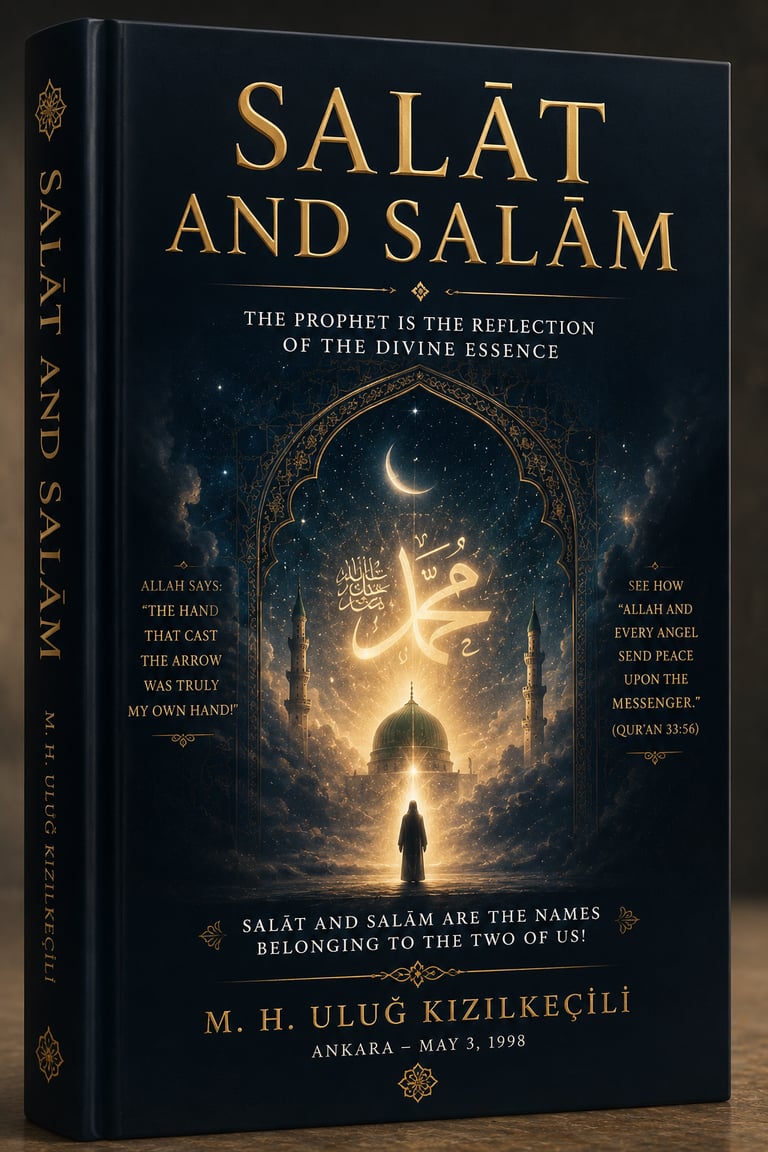
SALĀT AND SALĀM
To say of the Prophet: “He was merely a messenger delivering mail!”
What a tremendous slander that is—and how bitter such a tale!
The messenger was Gabriel; MUHAMMAD was not the courier there!
Bow before the mystery of the SPIRIT that brings revelation to the heart with care!
For in the Qur’an, the SPIRIT is another name for GABRIEL indeed!
The MESSENGER says: “Before me, no spirit was ever created in deed!”
That SPIRIT descending into the heart of the MESSENGER OF Allah,
Was but the reflection of his Essence—unknown to the heedless throng in awe!
One does not become Muslim through LĀ ILĀHA ILLĀ ALLAH alone!
One must also say MUHAMMAD RASŪL ALLAH—though this truth is little known!
“For above his hand was the Hand of Allah!” the sacred words declare!
By grasping that hand, we said “Yes!” unto our Lord from pre-eternal care!
“Allah says: The hand that cast the arrow was truly My own Hand!”
Like a seed, the father keeps within himself the hidden secret planned!
There is no gain in merely accepting Allah by Himself alone!
Whoever denies ADAM becomes IBLĪS upon a darkened throne!
“Iblīs said yes to Allah, yet said no to Rahman!” they proclaim!
Meaning Rahman clothed Himself in Adam—thus unfolds the meaning's flame!
Since Allah says, “Rahman established Himself upon the Throne above,”
Then Adam must be the Throne where Rahman sits in sovereign love!
Thus “eight angels bear the Throne,” or else “the waters bear it too!”
“And Paradise rests upon the waters!”—the Lord Himself is carried through!
The Throne and Paradise are Adam; to carry means to bow and bend!
Unless you circle this Kaaba, all labor in the world is vain in the end!
“Eight angels” therefore signify “the eight gates of Paradise!”
Only the one who bows before Adam receives its deed and prize!
The “eight angels” are “four pairs”; the rivers of Paradise are four!
Equal in number to the AHL AL-BAYT—the mystery hides at its core!
“The wind bears Solomon’s throne upon its head and through the sky!”
“The waters carry Noah’s Ark!” and thus its destiny draws nigh!
The fire embraces ABRAHAM, greeting him with peace serene!
And clay within JESUS’ hand becomes a bird with wings unseen!
Fire, air, water, and earth bow down before ADAM in delight!
Though once four jinn, they become the Four Angels of the Throne in light!
The soul called Zulaykha transformed Satan and made him Muslim at last!
She lies with the JOSEPH SPIRIT, untouched by base passions of the past!
The being born from this union bears the sacred name SALĀM!
From earth to heaven, his body itself becomes a Paradise calm!
This is the date of birth—the primal beginning and true era!
Cast all other chronologies into history’s forgotten terra!
That “Black Stone” grows white—the Night of Power then begins its reign!
Through ʿALĪ the riddle of destiny is opened and made plain!
The Lord unveils His curtain and the greatest longing finds release!
First the AHL AL-BAYT descend, then every saint into the heart in peace!
To this Paradise-Being, the Qur’an gives the name “SALĀT”!
For this reason, prostration before him is repaid with Paradise as one’s lot!
The right of the one who reaches the Lord is granted through rightful due!
The family called “We” grows greater as the ranks draw closer and true!
SALĀM is the boundary standing between the angel and Iblīs!
Hell is heated only by hearts that have hardened into stone and cease!
The Caliph bears the name “DHU'L-QARNAYN!” or perhaps “DHU'L-FIQĀR” in lore!
A double-edged sword—its spirit in the Unseen, its body in the worldly shore!
When the spirit departs the body, its breadth becomes without end!
Then it is KHIDR and ELIJAH—or the “Saint of the Unseen” men commend!
Present and witnessing everywhere, “a mercy unto all the worlds” is he!
Send blessings upon him, and perhaps your own forgiveness you shall see!
Repent because you buried your Essence; seek pardon and confess your plight!
One does not enter that Presence while carrying a coffin upon one’s back in sight!
He does not show Himself to you in that condition—do you know why?
Because His love has overcome His wrath and stands forever high!
For this reason He draws a veil between Himself and you instead!
Behind your body, your spirit waits upon the rampart spread!
He is “a soldier of Allah,” while you are “the human satan” within!
Without becoming a demon-jinn, come now and know your Lord from sin!
Wage your jihād as well, O Ulugh! Become a Caliph unto yourself!
No other religion is your duty—it is your own self upon the shelf!
See how “Allah and every angel send peace upon the MESSENGER” above!
And we are told: “Send upon him salāt and salām with love!”
With salāt and salām offered to the MESSENGER, the prayer finds its end!
Otherwise, know that no act of worship shall acceptance ever transcend!
MUHAMMAD is the “Undying Face”! He is HANĪF and ISLĀM as one!
His other names are SALĀT and SALĀM! Thus the matter is done!
M. H. ULUĞ KIZILKEÇİLİ
ANKARA – May 3, 1998
(The section written after this point has no relation to the author, and the author cannot be held responsible for any errors that may have been made.)
ESOTERIC COMMENTARY
CHAPTER I: THE POINT, UNITY, AND THE COSMIC BEGINNING
The vast majority of esoteric traditions explain the beginning of creation not through a physical event, but through a metaphysical principle. This principle has sometimes been symbolized as a light, sometimes as a sound, sometimes as a word, and sometimes as a point. In geometry, a point is dimensionless; yet in esoteric symbolism it contains within itself the potential of all dimensions. For this reason, the point is not merely a mathematical concept but a metaphysical archetype.
In Kabbalah, this condition is expressed through the concept of Ayn Sof. Ayn Sof represents the infinite and indefinable Divine Reality. Before It, there is no distinction whatsoever. There is neither light nor darkness; neither above nor below. Similarly, in Vedanta, Brahman is the Absolute Reality beyond all names and forms. In Taoism, the Tao is the unnamed primordial source. In Sufism, the Unseen (Ghayb) is the unknowable Reality preceding the visible world.
The common element among all these concepts is that, at the deepest level of existence, there is not multiplicity but unity. In esoteric thought, multiplicity appears later; unity is primordial and eternal. Thus, the point is not only the beginning but also the ultimate goal of existence.
The idea expressed in the text that “the beginning was the point, and the end is also the point” reflects the circular cosmology found in many mystical traditions. Here, creation is not linear but cyclical. Existence emerges from the Source, unfolds into multiplicity, and ultimately returns to the Source once again. The Sufi understanding expressed by the phrase “Indeed we belong to Allah, and indeed unto Him we return” likewise conveys this metaphysical doctrine of return.
CHAPTER II: LETTER, WORD, AND CREATION
In esoteric traditions, creation has often been conceived not as an architectural construction but as an act of speaking or writing.
According to Sefer Yetzirah, one of the foundational texts of Jewish mysticism, the universe was established through letters. Letters are not merely elements of language; they are cosmic powers. A similar understanding appears in Islamic Hurufism. Letters are interpreted as the building blocks of the visible world.
Viewed from this perspective, the Qur’anic command “Kun” (“Be”) is not merely a command. It is understood as the first vibration of existence. A symbolic parallel may be drawn between modern physics, which explains the universe through models of energy and vibration, and esoteric traditions, which explain the universe through Word and Sound. Both approaches accept that visible form arises from an invisible foundation.
For this reason, in the doctrine of the Letter-Man (Harf Adam), the human being is viewed not as a biological organism but as a written text. Organs become letters, thoughts become sentences, and life itself becomes a book in the process of being read. This approach is a continuation of the ancient understanding that regards the human being as a microcosm—a small model of the universe.
CHAPTER III: ADAM KADMON AND THE MUHAMMADAN REALITY
One of the most striking comparisons in the text is the parallel between Adam Kadmon and the Muhammadan Reality (Ḥaqīqat al-Muḥammadiyyah).
Adam Kadmon, in Kabbalah, is not a historical human being. He is the first manifestation of Divine Light. He is the source of all the Sefirot. He is called the Cosmic Human because all existence is contained within him in potential form.
In the doctrine of the Muhammadan Reality, the Muhammadan Truth is interpreted as a cosmic Light that precedes the historical Prophet. Particularly in the works of Ibn al-ʿArabī and ʿAbd al-Karīm al-Jīlī, this Light is described as the first mirror of creation.
In both systems, the following common structure appears:
• First, there is Absolute Unity.
• Then the First Manifestation emerges.
• This First Manifestation is symbolized in the form of the Cosmic Human.
• Thereafter, all worlds unfold from this primordial manifestation.
For this reason, Adam Kadmon and the Muhammadan Reality may be read as two different symbols employed by different traditions to express the same archetypal structure.
CHAPTER IV: MIRROR METAPHYSICS
The symbol of the mirror is one of the most universal symbols in esoteric thought.
According to Ibn al-ʿArabī, the universe is the mirror of the Names of Allah. The human being is the point of consciousness located at the center of that mirror. The Perfect Human (al-Insān al-Kāmil) is described as the brightest surface of the mirror.
Likewise, in Kabbalah, the visible world is understood as a reflection of Divine Light. In Vedanta, the world is regarded as a reflection of Brahman. In Buddhism, the mind is often explained through the metaphor of a mirror; enlightenment is likened to removing the dust covering its surface.
The statement in the text, “Allah gazes into the mirror, and the image appearing in the mirror becomes the universe,” is a concentrated expression of this shared symbolism.
The essential principle of mirror metaphysics is this: the image is not independent. The reflection in a mirror possesses no reality separate from the mirror itself. Therefore, existence is not absolute in itself but a manifestation dependent upon its Source.
CHAPTER V: THE FORTY-NINE VEILS AND THE LAYERS OF CONSCIOUSNESS
The doctrine of the forty-nine veils may be interpreted as a symbolic map of the transformation of consciousness.
The number seven is the number of cosmic order in many traditions. Forty-nine signifies the deepening of seven through seven successive levels.
This symbolism appears in various traditions as follows:
• Tibetan Buddhism: The forty-nine-day Bardo process.
• Kabbalah: The forty-nine Gates of Understanding.
• Jewish Mysticism: Forty-nine stages of purification.
• Sufism: The gradual transformation of the self (nafs).
• Hermeticism: The ascent of consciousness through successive layers.
From this perspective, the forty-nine veils may be read as the symbolic map of humanity’s journey from identity toward essence.
CHAPTER VI: MELCHIZEDEK AND THE ARCHETYPE OF TIMELESS CONSCIOUSNESS
The figure of Melchizedek (Melk-i Sedek) appearing in the text is one of the most mysterious symbols found within esoteric traditions. He has become less a historical personality than a metaphysical principle. He appears briefly in the Torah and then disappears. His birth is not described. His death is not described. His lineage is not specified. For this reason, Jewish mysticism has interpreted him as a model of consciousness standing outside historical time.
From the Kabbalistic perspective, Melchizedek is the intermediary being standing between the visible and invisible worlds. He is the principle that forms a bridge between the lower and upper realms. Christian mysticism describes him as the Eternal Priest. Here, however, priest does not merely mean a religious official; it symbolizes the connection between Heaven and Earth.
One of the closest concepts to this in Sufism is the Perfect Human (al-Insān al-Kāmil). The Perfect Human is the cosmic model of humanity standing beyond historical identity. He lives within time, yet is not limited by time. He appears within space, yet his essence does not belong to space.
For this reason, the Melchizedek figure in the text represents one of the final stages of individual transformation. At the stage of the Letter-Man, the human being is still a written text. At the stage of Melchizedek, the text has begun to be read. The human being is no longer merely a symbol but becomes the very reality toward which the symbol points.
In esoteric literature, this is sometimes called “the completion of the second birth.”
The first birth is biological.
The second birth is conscious.
The third birth is ontological.
That is, it is the union of the human being with his own essential reality.
CHAPTER VII: THE COSMIC RHYTHM OF THE NUMBER 108
The number 108 is not treated in the text as an ordinary number. It is one of the most widespread sacred numbers in the world. In Hinduism, there are 108 Upanishads. In Buddhism, there are 108 chains of desire. In Buddhist temples, bells are struck 108 times at the end of the year. Hindu prayer beads consist of 108 beads. Yogic systems speak of 108 energy channels said to radiate from the heart center. The repeated appearance of the same number across so many different cultures has attracted the attention of esoteric researchers.
In the interpretation presented within the text, 108 is associated with the concepts of Nahnu (“We”), Hakk (Lord), and Cundena (“Our Army”). The symbolic interpretation expressed here may be summarized as: We = Lord = Army. The union of these three concepts is highly significant. As long as the individual perceives himself as separate, he remains within fragmented consciousness. From the perspective of Truth, however, the individual is not an independent entity standing outside Reality. He is a cell within the Whole.
The similarity between the Sufi doctrine of Unity and the Vedantic doctrine that Atman equals Brahman appears precisely at this point. The distinction between microcosm and macrocosm gradually dissolves. Therefore, 108 becomes not merely a number but a symbol expressing the rhythm of the Whole itself.
CHAPTER VIII: 333 AND THE WRITTEN HUMAN BEING
One of the most original concepts in the text is the interpretation of the number 333 as the “Written Human Being.”
The number three is the number of the creative principle. When Unity seeks to manifest itself, a threefold structure emerges. Subject, object, and relation; father, mother, and child; source, flow, and result are all different manifestations of this triadic structure.
The three highest Sefirot in Kabbalah, the Trinity in Christianity, the Trimurti in Hinduism, and the triad of Spirit–Sekine (Shekinah)–Lord in Sufism are examples of this cosmic model of organization.
The number 333 represents the repetition of this model three times. In other words, it signifies the penetration of the creative principle through all levels of existence.
According to the interpretation presented in the text, 333 does not represent the completed human being; it represents the written human being. In other words, it is the human being who carries his potential within himself. He is the seed, but not yet the fruit.
The process of the forty-nine veils represents the beginning of the reading of this written human being. As each veil is lifted, the text becomes more visible. Every realization reveals a new letter. Every transformation renders a new line readable. Eventually, the human being begins to read his own book.
CHAPTER IX: 666 AND COMPLETE REFLECTION
In modern culture, the number 666 has often become a symbol of fear. Yet in most esoteric traditions, numbers are not evaluated merely as good or evil. They are symbols of cosmic principles.
The interpretation found in the text regards 666 as the symbol of complete reflection.
There are six directions: front, back, right, left, above, and below. Together these six directions constitute the totality of visible space.
For the same reason, the cube possesses six faces.
Thus the cube becomes the geometric symbol of the visible universe.
In this context, 666 does not represent evil but the completion of visibility. When matter becomes fully manifested, the sixfold structure appears.
Therefore, while 333 represents the side of consciousness, 666 represents the side of manifestation.
One is the writing.
The other is the visible book.
One is the seed.
The other is the tree.
CHAPTER X: THE ESOTERIC GEOMETRY OF THE KAABA
One of the central symbols of the text is the Kaaba.
In esoteric interpretation, the Kaaba is not merely a historical structure. It is understood as the geometric summary of the visible universe.
Its cubic form is not accidental.
The cube symbolizes the stability of space.
The circle symbolizes the flow of time.
For this reason, circumambulation (ṭawāf) is not merely an ordinary act of walking. While performing ṭawāf, the human being symbolically reenacts the movement of time around space.
A profoundly important metaphysical principle is present here:
The center does not move.
The circumference moves.
In Sufism, this principle is associated with the idea of the Immutable Truth.
In Kabbalah, Keter is the unchanging center.
In Vedanta, Brahman is the unchanging center.
In Taoism, Tao is the unchanging center.
In Buddhism, Śūnyatā is the unchanging center.
The names differ, but the concept of the center remains the same.
Throughout life, human beings move around the circumference.
Ideas change.
Identities change.
Beliefs change.
Emotions change.
Yet the center remains unchanged.
The esoteric journey is the art of returning to the center.
CHAPTER XI: ALIF-LĀM-MĪM AND THE COSMIC FORMULA
One of the most important symbols in the text is the sequence Alif-Lām-Mīm.
In esoteric interpretation, Alif signifies Unity, Lām signifies Manifestation, and Mīm signifies Return.
Creation may therefore be understood as a movement from Unity to unfolding, from unfolding to multiplicity, and from multiplicity back to Unity.
This model is not found only within Islamic thought.
In Neoplatonism, there is the movement from the One to Intellect and Soul.
In Kabbalah, there is the movement from Ayn Sof to the Sefirot and then the return.
In Vedanta, there is the movement from Brahman to Maya and then to Moksha.
In Buddhism, there is the movement from Emptiness to Form and back to Emptiness.
The triad of Source, Manifestation, and Return is the common pattern underlying all of these systems.
The Point–Cube–Point formula presented in the text expresses the same structure.
CHAPTER XII: THE DISAPPEARANCE OF THE MIRROR
The final destination of all esoteric systems is the disappearance of the mirror.
At first, the human being believes himself to be the body.
Then he believes himself to be the mind.
Then he believes himself to be the personality.
Then he believes himself to be the spirit.
Yet as the journey deepens, all definitions begin to fall away.
Kabbalah calls this Bitul.
Sufism calls it Fanā.
Vedanta calls it Nirvikalpa.
Buddhism calls it Nirvana.
Hermeticism describes it as union with the One.
At this stage, the mirror is no longer needed
For the mirror requires two things:
The observer and the observed.
Yet at the final level of realization, duality dissolves.
The distinction between the one who sees and the one who is seen disappears.
Ibn al-ʿArabī’s statement that “Existence is One” expresses precisely this realization.
Likewise, Hallāj’s declaration “Ana al-Haqq” (“I am the Truth”) serves as a symbolic expression of the same experience.
At this point, there is no longer an image.
There is no longer a mirror.
There is no longer a reflection.
Only consciousness remains.
The final sentence of the text therefore summarizes the entire system.
While the human being attempts to understand the universe, he is in reality searching for his own essence.
The one who discovers his essence discovers the center of the universe.
The one who discovers the center of the universe realizes that all symbols point toward the same Source.
In the end, the mirror disappears.
The image disappears.
The observer remains.
The Point remains.
The Lord remains.
At this stage, the text transforms into a comprehensive esoteric cosmology that unites Hurufi symbolism, the Kabbalistic doctrine of Adam Kadmon, the Sufi concept of the Perfect Human, the Vedantic doctrine of Brahman, the Buddhist idea of enlightenment, and the Hermetic doctrine of the One upon a single metaphysical axis.