SALĀT (Invocation of blessings)
SALĀT (Invocation of blessings).Ulug! Reveal not the secret of Salāt beyond this measure! For whoever calls it nonsense wounds “us” and loses hidden treasure! The one who wounds “us” shall never prosper again! Say to him: “Do not flee from the lion as a donkey flees in fear!”
APOCALYPSE BOOK
SALĀT
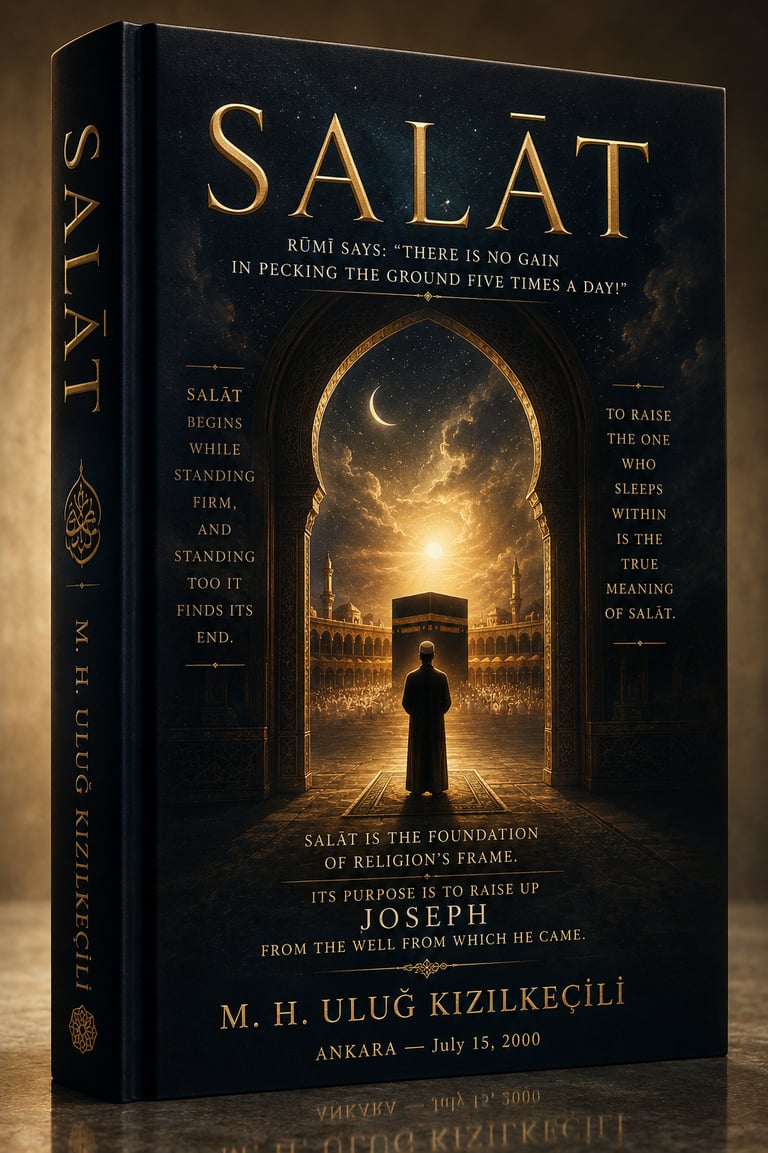
Rūmī says: “There is no gain in pecking the ground five times a day!”
Warm the egg within your heart, and let the hidden chick find its way!
Never brood without the fire of the Lord to light your inward art,
Even the blind deny the light, yet cannot deny the heat’s display!
Allah says: “Establish your prayer aright!” For one lies sleeping deep inside!
To fail to wake the cave’s saint within is shame that cannot be denied!
Else all your salāt becomes mere noise, a restless clatter far and wide;
Know your Adam, or from the Presence of the Lord you shall be cast aside!
Salāt begins while standing firm, and standing too it finds its end;
For you are called to raise the one who sleeps within and not pretend.
You say “Peace,” turning right and left, your face to either side you bend;
The outer face is but reflection, for the Peace to which all signs ascend.
Look not beside the Imām's place; there one must never choose to stay!
Behind the Imām stands the one who seeks to walk the proper way.
For all must gaze, through the Imām’s eye, toward the Qiblah where truths lay;
Yet few indeed have ever known the secret hidden in that ray.
Know that all things, at every moment, bow before the Lord in prayer!
Whatever turns toward the Sun keeps all its face directed there.
Birds praise the light at dawn and dusk as solar splendors fill the air;
And everything, through the Lord’s own tongue, cries: “Write me as Islam and care!”
“May Allah bestow salāt on Muhammad and upon his line!” they say;
And every prophet, rising living, offers peace upon the way.
For “Peace” itself demands: “Establish salāt! Raise what sleeping shadows sway!”
Unveil your primordial face, conquer, and like Alexander hold your day!
Thus truly SALĀT becomes the very foundation of religion’s frame;
Its purpose is to raise up JOSEPH from the well from which he came.
If salāt were merely ritual prayer, then the Lord would do the same—
When He says “Salāt be upon the MESSENGER,” reflect upon that claim!
Salāt is not mere supplication—does Allah offer prayers above?
Is He a priest within a church who kneels in pious acts of love?
Nor is salāt remembrance only—the Lord forgets not what He’s of;
Would He say “Salāt be upon him” if empty words He would approve?
The moment that the MESSENGER beheld his Lord, salāt became a must;
To MUHAMMAD was revealed the Praised Station, noble, true, and just.
At Kaaba’s gate stands ABRAHAM’S Station, rising-place from earthly dust;
A station where one stands upright—Resurrection fashioned out of trust!
While Abraham was yet a prophet, he cried: “Lord of the Worlds, let me see
Resurrection in my heart itself, that certainty may dwell in me!”
From the black point emerged that rosy-white Stone for eternity;
Bearing witness against himself, he swore before his Lord solemnly.
The MESSENGER says: “Salāt is the light of my heart’s eye!”
Salāt is a feminine word; it is the honor of the Houri on high!
“This is the woman whom the Lord most dearly made beloved to the MESSENGER!”
Kiss her hands and feet, then rise and stand upright beneath the sky!
Now the meaning of bowing, prostration, and standing has become clear to see!
The Qiblah is both JOSEPH and Zulaykha, slender in beauty!
Just like the “Night of Power,” her eyes are dark and mystery-filled!
She has twenty-two “I”s; her body is letters, her spirit fifty!
“No hand may touch her save the hand that has been purified indeed!”
If you wish to draw near, come with ablution in your heart and heed!
Since you have not been defiled, no full ritual bath is required!
“The Lord completed the Light!” Your lower self was the false barrier to exceed!
“On that Day, faces shall shine!” For they shall gaze upon Rahman!
The purified soul becomes a mirror to the spirit—thus the meaning lives on!
Now understand why Allah is called “The Light of the heavens!”
Reach the blessed moment known as the “Wedding Night” before it is gone!
One who is joined with Light remains forever fresh and living still!
“The MESSENGER’S eye never swerved to the right nor left by will!”
On the Night Journey he beheld such a youth before his sight,
Exactly himself he was—thus they became a single family fulfilled!
Therefore he said: “ʿAlī and I are but a single Light!”
Our bodies are veils; yet everywhere we are present in sight!
For we are mercy not to one world, but unto all the worlds!
We are SALĀT and SALĀM; within hearts we are preserved in light!
SALĀT and SALĀM are the names belonging to the two of us!
They are the image of the soul departing in sleep and death thus!
For every soul is a ray from Rahman and Rahim above!
The universe is the frozen body of those rays dispersed among us!
A mosque means that which gathers; you have gathered everything as one!
Therefore your name became Adam, worthy of prostration beneath the sun!
Look into your palm while saying “Āmīn”; read and gather what is there!
With the Ninety-Nine Names, you have encompassed Allah and what He has done!
By the command of the MESSENGER, Bilāl became the first caller to prayer!
Like the Black Stone he is dark—take heed and wisdom from there!
For the command of the MESSENGER is precisely the command of the Lord!
Look—he defines salāt itself: a crescent assuming three forms in the air!
“The Lord strips away the day and from it brings forth the night!”
Meaning that day itself is but a shell, while its interior is Light!
Thus day is also night—you have been sleeping all along!
Open your eyes and awaken! At last solve the riddle aright!
“If only you knew, you would not sleep—you would know why you were created!”
Because of this heedlessness, how many times into the womb were you translated!
Among all the sleepwalkers, you are the most pitiable one!
“Raise up the salāt and rise!” Alas, how greatly you have been devastated!
“Those who do not awaken remain in darkness on the Gathering Day!”
Those who find their Light are the ones whom fire cannot consume away!
“When the blind ask those within the Light for illumination,
They are told: Seek your Light behind you!” The understanding know what this means to say!
This verse means: “Turn back!” It means: “Find your Light once more!”
The breathed spirit is essential; repayment belongs to the One who breathed before!
The one who becomes an angel willingly submits himself unto his Lord!
But Satan struggles in the wombs—through hardship and labor evermore!
“While Allah exists, there can be no worship of Adam!” says Iblīs aloud.
“Many people believe while associating partners with the Lord,” declares the crowd.
The one who prostrates must unite with the one before whom he bows!
The child is hidden in the father—one is the secret, one the guardian proud!
“For man, the greatest good is Wisdom!” For it is the Essence indeed!
And “Wisdom,” like “Salāt,” is once again a feminine word in creed!
“This is the bounty of Allah!” “He grants it to whomsoever He wills!”
Yet He wills only through Wisdom—the fairest eye that sees every need!
Rūmī says: “The men at the center of the circle have spoken thus:
They stitched my mouth shut and declared, ‘To reveal the secret is forbidden to us!’”
That is, permission is granted not from the circumference itself,
But only to one descending from within their midst and trust.
The Qur’an calls this circle: “The Exalted Assembly” above!
There the “Flowing Spirit” bears witness unto itself in love!
“We stand in ordered ranks before Rahman’s Presence!”
And your case is judged according to the Salāt you have made thereof!
“A symbolic verse known only to the Lord and to those brought near!”
If explained without permission from a higher station, hear:
It becomes a sin against the Holy Spirit, beyond forgiveness!
The friends of the Lord observe this rule with reverence sincere!
Ulug! Reveal not the secret of Salāt beyond this measure!
For whoever calls it nonsense wounds “us” and loses hidden treasure!
The one who wounds “us” shall never prosper again!
Say to him: “Do not flee from the lion as a donkey flees in fear!”
M. H. ULUĞ KIZILKEÇİLİ
ANKARA – February 2, 1997
In the science of Abjad:
The numerical value of the Name “HAKK” equals 108.
(The section written after this point has no relation to the author, and the author cannot be held responsible for any errors that may have been made.)
THE COSMOLOGY OF SALĀT AND THE UNIVERSAL MAP OF THE PERFECT HUMAN
One of the most important themes in the esoteric interpretation of Salāt is the idea that the human being is not merely a biological entity. All ancient traditions have regarded the human being as a multi-layered being. Modern humanity tends to define itself solely through the physical body. Yet in esoteric traditions, the physical body is only the outermost shell.
In Sufism there are the stations of the nafs, the heart, the secret, the hidden, and the most hidden. In Kabbalah there are the layers of Nefesh, Ruah, Neshamah, Hayyah, and Yehidah. In Vedanta there are the kośa systems of Annamaya, Pranamaya, Manomaya, Vijnanamaya, and Anandamaya. Tibetan Buddhism speaks of five bodies. Hermeticism embraces a seven-layered understanding of the human being. Although all these systems employ different languages, their common view is the same: the human being is not limited to the visible body.
The doctrine of Salāt found at the center of the poem may likewise be read as a process of awakening these layers of the human being. At this point, the doctrine of the seven energy bodies comes into play.
The first body is the physical body.
This body belongs to the earth.
It is born.
It grows.
It ages.
It dies.
The second body is the life body.
In Sufism it may be called the breath of life.
In the Indian system it is expressed as prāṇa, in the Chinese tradition as chi, and in the Japanese tradition as ki.
The third body is the emotional body.
Love, fear, anger, longing, and compassion emerge here.
The fourth body is the mental body.
Thoughts arise here.
The fifth body is the spirit body.
The sixth body is the Sekine (Shekinah) body.
The seventh body is the Lord body.
The human being is the point of intersection of these seven layers.
For this reason, the human being is not merely a small universe.
Rather, the human being is regarded as the summary of the universe.
The Qur’anic statement, “We offered the Trust to the heavens, the earth, and the mountains,” is interpreted esoterically as an indication of humanity’s cosmic wholeness.
In Kabbalah, Adam Kadmon represents the same idea.
Adam Kadmon is not a historical human being.
He is the Cosmic Human.
He is the sum of all worlds.
The Sufi concept of the Perfect Human (al-Insān al-Kāmil) is another language for the same truth.
The Perfect Human is not a particular individual.
It is the principle of the Cosmic Human.
It is the center in which all Names are gathered.
Therefore, the expression in the poem, “A mosque means that which gathers,” does not merely describe a mosque building.
It describes the human being.
For the human being gathers all worlds within himself.
Earth exists within the human being.
Water exists within the human being.
Fire exists within the human being.
Air exists within the human being.
Angelic qualities exist within the human being.
Animal qualities exist within the human being.
Divine qualities exist within the human being.
Therefore, the human being is not a small universe.
The human being is the knot-point of the universe.
The number twelve, frequently encountered in esoteric traditions, also gains significance here.
The twelve-edged system associated with the cubic form of the Kaaba is likewise a symbol of cosmic order.
The twelve zodiac signs.
The twelve months.
The twelve apostles.
The twelve imams.
The twelve solar cycles.
The twelve fundamental archetypes.
These are not independent of one another.
For esoteric traditions have generally maintained that there exists a reciprocal relationship between the heavens and the human soul.
In the Hermetic tradition, this principle is known as the relationship between the macrocosm and the microcosm.
The emphasis in the poem that one should stand behind the Imām is, in reality, describing orientation toward this cosmic center. Here, the Imām is not merely a human being. He is the Center. The Pole. The Axis. The Logos. Adam Kadmon. The Muhammadan Reality (Ḥaqīqat al-Muḥammadiyyah). The same figure appears throughout all traditions under different names.
The doctrine of the Muhammadan Reality is of particular importance at this point. According to Ibn al-ʿArabī, the first manifestation of creation is the Muhammadan Light. This is not Muhammad in the historical sense. It is Cosmic Consciousness. It is the Logos of the Gospel of John. It is the Adam Kadmon of Kabbalah. It is the Hiranyagarbha of Vedanta. It is the Dharmakaya of Buddhism. It is the Nameless Source of the Tao. All creation consists of the appearance of this primordial Light in different degrees of density. For this reason, the people of Sufism regarded the Muhammadan Reality as the nucleus of creation.
For this reason, the expression in the poem, “May salāt be upon Muhammad and his lineage,” cannot be read merely as a historical prayer. From an esoteric perspective, it is the turning of the human being toward his cosmic origin. Like a ray returning to the sun. Like a river returning to the sea. Like a letter returning to the point.
At this point, the doctrine of the Letter-Man (Harf Adam) emerges. The idea that the universe is composed of letters is extremely widespread among ancient traditions. The Kabbalistic text Sefer Yetzirah states that the universe was created through letters. The disconnected letters (Muqaṭṭaʿāt) of the Qur’an point toward the same mystery. Hurufism attempted to read the entire universe through letters. For a letter is the form of sound. Sound is vibration. Vibration is energy. Energy forms structure. Therefore, the entire universe is a visible Word brought into manifestation.
For this reason, the command “Kun” (“Be”) is not merely a word. It is a creative vibration. Humanity, likewise, is viewed as a living letter within this Divine Text. The doctrine of the Letter-Man emerges precisely here. The human being is a written book. The body is its lines. The organs are its letters. Consciousness is its meaning. The spirit represents its Author. This understanding is found not only in Islamic Sufism but also in Jewish mysticism and the Christian doctrine of the Logos.
Now we may descend even deeper. The number forty-nine occupies an extraordinarily important place in ancient traditions. Seven times seven. The seven heavens deepened sevenfold. The seven bodies passing through seven stages of transformation. The Tibetan Book of the Dead describes a forty-nine-day transitional process. Buddhist traditions speak of a forty-nine-day intermediate state after death. In Sufism, the concept of forty-nine veils represents layers of consciousness within certain esoteric schools. Each veil removed brings the individual into contact with a greater reality. Yet when the final veil is lifted, the one encountered is not another being. It is oneself.
For this reason, the ultimate experience described by all mystical traditions is remarkably similar. The Sufi calls it Fanā. Vedanta calls it Moksha. Buddhism calls it Nirvana. Kabbalah calls it Devekut. Hermeticism calls it union with the One. The Gnostics call it return to the Pleroma. The names differ. The experience is the same.
At this point, the symbol of 666 also acquires a new meaning. Often transformed into a symbol of fear within popular religious interpretations, this number has frequently been read within esoteric systems as a symbol of complete manifestation. Six directions. Six faces. Six dimensions. Cubic geometry. The full manifestation of matter. The cubic form of the Kaaba. The completion of space. Thus, 666 is not merely a negative symbol. It may also signify the complete visibility of manifestation within the material realm.
Opposite this stands the Point.
The Point is dimensionless.
The Cube is the sum of dimensions.
The Point is the Unseen (Ghayb).
The Cube is the World of Witnessing (ʿĀlam al-Shahādah).
The Point represents the unknowable aspect of Allah.
The Cube represents the realm of the Divine Names and Attributes.
Salāt is the bridge between these two poles.
The human being is the living axis standing between the Point and the Cube.
For this reason, the same call is heard at the esoteric center of all religions:
Know thyself.
For the one who knows himself sees that the letter emerged from the Point.
The one who sees the Point sees the Center.
The one who sees the Center begins to understand why all religions revolve around the same Truth.
And in the end, he realizes that Salāt is not merely a ritual, but the movement by which the universe remembers its own essence.
This is the Great Secret.
While the human being seeks Allah, he is in reality seeking the manifestation of Allah within himself.
That is the journey.
That is Salāt.
That is Resurrection.
That is the Apocalypse.
And that is the common heart of all the ancient traditions.