SECRET OF BAPTISM
SECRET OF BAPTISM When every essence received its first abstract form from the Lord, It prostrated to Allah — this is the pre-eternal covenant. Thus it became clear: “Everything is in constant prostration to Him,” Accepting the laws of nature without condition.
APOCALYPSE BOOK
BAPTISM
A · BAPTISM IN PRE-ETERNITY
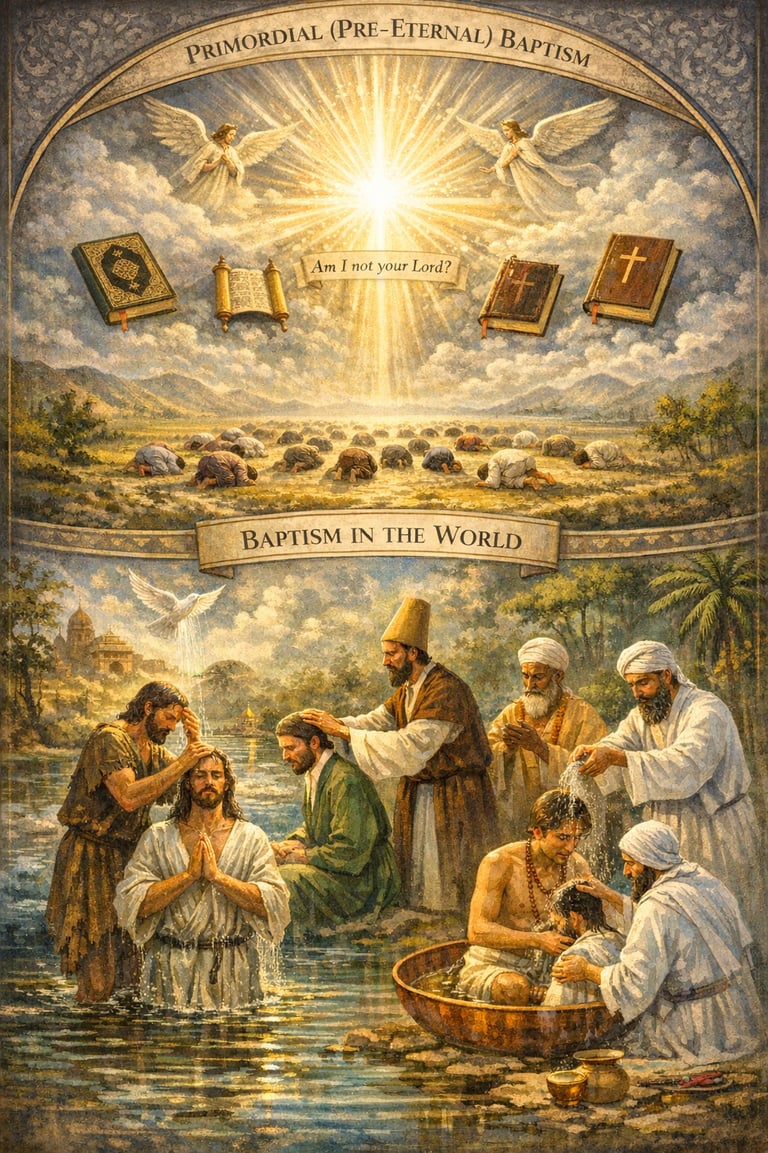
When every essence received its first abstract form from the Lord,
It prostrated to Allah — this is the pre-eternal covenant.
Thus it became clear:
“Everything is in constant prostration to Him,”
Accepting the laws of nature without condition.
In this way, every Name within Allah was revealed;
The Name transformed into Spirit
And emerged as a body of Light (Nur).
First, a twin Name wore this garment of Light.
“The Lord created the Light first,”
“And called it good before all else.”
The “first darkness” — that is, the Lord —
Descended to a lower veil.
This vibration, the sages named MUHAMMED ALI.
The Prophet’s name appears already in the Gospel as AHMED;
MUHAMMED is his identity beyond time and universe.
“The immortal Face of Allah” — count it: the name MUHAMMED (193).
His body was touched by the fitrah of the Lord.
Allah Himself named the First Five Beings;
A father, after all, knows his true child by name.
The five names of the Ahl al-Bayt equal nineteen letters.
The letters of the Basmala as well — no coincidence remains.
A Name is like the command “Be!” —
A sound of the Lord, never an empty word.
“In Paradise there is no idle speech”;
Reflect on the mystery of Salām.
In the Qur’an, the word “name” appears exactly nineteen times.
One feels compelled to call each a demon (Zebani).
For the Zebânî are also nineteen in number —
Those who form and dissolve all patterns: Vibration itself.
The Prophet emerged from AHMED
And fell at his feet.
As soon as he rose, he drank the First Oath.
Indeed, Qiyāmah means to rise.
Spend effort to experience it before death.
“The Lord presented him by name to every prophet,
So they might open his path and assist him.”
Thus he was baptized before Allah at that moment,
For Baptism and First Adam share the same number (113).
“Baptism is proof of the Lord’s descent” (223).
He bound to Himself all who prostrated.
After the Prophet came the Walī, from the Light of ALI.
MUHAMMED ALI is a Light —
With neither beginning nor end.
According to their vibration, every Spirit awakened.
“Light cannot be gazed upon,”
And they drank the Second Oath.
They promised:
When descending into the body as life,
They would remain faithful to the One who manifested them.
B · BAPTISM IN THE WORLD
“The sin of Adam in Paradise exists within the genes.”
Only through Baptism can the body be freed from it.
In the name of Jesus, son of Allah,
The holy father calls the people to baptism for this reason.
The body of Jesus, treated as sacred bread, melts in the mouth.
Instead of the guilty name, the priest grants a new name.
In the name of Jesus, son of Allah,
The holy father calls the people to baptism for this reason.
Jesus, nailed to the cross,
With his pure flowing blood,
Is said to have cleansed the blood —
Even if Satan had seized it.
For you have become his repentant child;
He has saved you from Hell —
This is called the baptismal name.
Sacred water is dripped between the two eyebrows.
A “grant of Paradise” is placed —
A well-designed ritual indeed.
“Though you change the name of the rose,
Its scent does not change,” says Shakespeare,
Mocking baptism with great mastery.
Let me explain what baptism truly is in this world:
Without hearing it with your ears,
A piercing trumpet blast!
Baptism is the union of life with its Spirit.
Interpret it as finding the lost Paradise — truly!
Fire, Air, Water, Soil —
Life has been nailed to the cross.
Though sinless, innocent blood was spilled.
The wise call this “the crucifixion of Jesus.”
Life pays for choosing matter
With its own essence.
Until the four nails are removed,
Life remains crucified.
This torment ends only upon realization.
With water poured between the eyebrows,
The third eye does not open —
Even the crows would laugh.
“Jesus raised the dead” — when his name became Messiah.
The one he revived was himself;
John washed his body.
“And Adam named every animal.”
At that moment,
The path of liberation from animality was opened.
When the hand of a Lord’s Saint touches you,
Your name is no longer
“Bipedal mammal.”
Do not think any vision is a UFO encounter;
Interpret it as the baptism of a Lord’s Saint.
Our true name is the name of our identity in the Lord.
If we fail to find it,
We become mere registry offspring.
The names of all three Holy Books mean: “The Oldest Word.”
“The First Word.”
The most ancient essence —
Found within the Lord’s Saints.
Master M.H. Ulug Kizilkecili
Türkiye/Ankara - March 31, 2002
IMPORTANT NOTE :The original text is poetic, and the author cannot be held responsible for any errors in the English translation! To read the original Turkish text, click HERE! The following section is not the author's work, and the author cannot be held responsible for any errors made!
Annotated Commentary with Footnotes
Title: “Baptism” as a cross-tradition motif
Your poem uses “baptism” in two layered senses:
a primordial/ontological “initiation” (pre-temporal covenant, light, naming, descent), and
the historical ritual best known in Christianity (water rite, forgiveness, rebirth, new identity).
This two-level structure resembles how many traditions hold both a cosmic archetype and a ritual enactment (e.g., “heavenly temple” vs. earthly liturgy; “primordial word” vs. spoken prayer).¹
A · “Baptism in Pre-Eternity”
1) “When every essence… prostrated… the pre-eternal covenant”
This strongly parallels the Qur’anic motif of the primordial covenant (often called mīthāq / “alastu”), where humanity testifies to God’s lordship: “Am I not your Lord?”—“Yes, we testify.”² The gesture of universal prostration also matches Qur’anic passages describing all creation submitting (willingly or unwillingly): e.g., Q 13:15 and Q 22:18, and the imagery of shadows prostrating in Q 16:48.³
Cross-religious counterparts
Judaism / Christianity: A direct “pre-eternal covenant” scene is not identical, but there are adjacent ideas: divine foreknowledge/choosing (e.g., prophetic calling “before birth”) and covenantal identity.⁴
Platonism / Late Antique religiosity: strong parallels exist in traditions of pre-existence of souls and “anamnesis” (recollection), which later mystical writers sometimes blend with Abrahamic language.⁵
Hindu traditions: ideas of ātman and cyclical embodiment often frame “forgetting/remembering” of ultimate identity; ritual initiation can be read as a recovery of that.⁶
Buddhist traditions: less about a creator-covenant; more about ignorance and awakening, with refuge vows/initiations serving as “rebirth into the Dharma.”⁷
2) “Everything is in constant prostration… laws of nature”
Your line reads nature’s regularity as cosmic worship: the world obeys divine “law” as an unbroken act of submission. This is closely aligned with Qur’anic rhetoric that creation “bows” to God and that all beings are under divine ordinance.³
Comparative note: In Stoicism and some Hellenistic Jewish thought, nature’s order can be read as participation in divine reason (logos). This becomes especially relevant once your poem turns to “Name,” “Word,” and “Light.”⁸
3) “The Name transformed into Spirit… body of Light (Nur)”
This evokes a classic mystical chain: Name → Spirit → Light → manifestation. In Islam, “Light” imagery is centrally anchored by the “Light Verse” (Q 24:35): “Allah is the Light of the heavens and the earth…”⁹ Your poem is also very close to Sufi “nūr” metaphysics, where divine self-disclosure (tajallī) can be narrated as degrees of light.
Cross-religious counterparts
Christianity: strong resonance with Logos theology (“In the beginning was the Word…”), where “Word/Light/Life” are intertwined.¹⁰
Judaism: creation begins with light—“Let there be light”—and light is called “good.”¹¹
Zoroastrianism: light symbolism is foundational (cosmic struggle framed around truth/light vs. deceit/darkness), though its metaphysical grammar differs from Qur’anic nūr.¹²
4) “The Lord created the Light first… called it good”
This aligns most directly with Genesis 1:3–4, where light is created and declared “good.”¹¹ If you intend “first created thing = light” as a metaphysical axiom, note that it becomes a major theme in later mystical commentary across traditions, but the scriptural base differs in what “first” precisely means (light is first in Genesis’ sequence; the Qur’an emphasizes guidance/light but does not narrate creation with the same sequence).⁹ ¹¹
5) “This vibration… named MUHAMMED ALI” / “AHMED in the Gospel”
Here your poem blends (a) a mystical “primordial vibration/light” idea with (b) the Islamic identification of Aḥmad with Muhammad.
The Qur’an explicitly places Aḥmad on Jesus’ lips: Jesus announces “a messenger after me whose name will be Aḥmad.”¹³
The claim “the Prophet’s name appears already in the Gospel as Aḥmad” is not present in the canonical New Testament wording. Rather, some Muslim polemical and interpretive traditions connect Johannine “Paraclete” language to the Qur’anic Aḥmad—an idea that has a documented interpretive history and scholarly debate.¹⁴
Cross-religious counterparts
Christianity: “baptism,” “Spirit,” and “Paraclete” belong to a distinct theological field (Holy Spirit, advocacy, guidance), and historical-critical scholarship typically reads “Paraclete” within Johannine community theology rather than as an explicit Arabic-name prophecy.¹⁴
Islam (mystical currents): “pre-existent light of Muhammad” (nūr Muḥammadī) is a widespread mystical motif, but the status of particular “first-created light” reports can vary in hadith evaluation and is often carried more by Sufi metaphysics than by universally accepted canonical proof-texting.¹⁵
6) “The immortal Face of Allah” / numerology (MUHAMMED = 193)
Your poem connects “Face of Allah” to the permanence of divine reality. Qur’anic phrasing: “Only your Lord… will remain” (Q 55:26–27) and “Everything will perish except His Face” (Q 28:88).¹⁶
The step “count it: MUHAMMED (193)” signals abjad numerology (assigning numeric values to Arabic letters). That method has analogues in:
Jewish gematria,
Greek isopsephy,
later Christian mystical numerology.¹⁷
Academically, these methods are best treated as interpretive technologies used in certain devotional/mystical environments rather than as universally binding proofs.
7) “First Five Beings… Ahl al-Bayt… nineteen letters… Basmala nineteen”
Two separate numerological claims appear:
Basmala = 19 letters is widely circulated and depends on a particular orthographic counting tradition; it is often discussed in connection with “19” themes around Q 74:30–31.¹⁸ ¹⁹
“The five names of the Ahl al-Bayt equal nineteen letters” is a sectarian/mystical numerological claim found in some devotional literature; it is not a mainstream doctrinal axiom across all Islamic schools, so in academic apparatus it should be presented as a tradition within traditions rather than a universal.²⁰
Your text also ties “19” to the Qur’anic “nineteen” of hell’s guardians: “Over it are nineteen” (Q 74:30), and the very next verse warns that their full reality is known only to God (Q 74:31).¹⁹
8) “In the Qur’an, the word ‘name’ appears exactly nineteen times”
This is a quantitative claim that requires a defined counting protocol (Arabic lemma vs. surface form; whether “ism” compounds count; which orthography/edition; whether “His Names” phrases count as “name,” etc.). I have not verified this count here; in academic presentation it should be flagged as “reported” unless you run a reproducible concordance count.²¹
9) “Zebani are nineteen… vibration itself”
The Qur’an explicitly states “Over it are nineteen” regarding Hell (Q 74:30–31).¹⁹ The identification of these with zabāniya (punitive/guarding angels) appears in later Islamic tradition and exegesis; the term zabāniya itself is classically associated with “wardens/angels of punishment.”²²
Your poem’s move—angels as “vibration itself” and “forming/dissolving patterns”—is a metaphysical reinterpretation. In comparative terms, it resembles:
Neoplatonic “intelligences” mediating order,
Kabbalistic structures of emanation,
Hindu sound/manifestation metaphysics (e.g., “sound” as creative principle in some schools),
but those are analogies, not simple equivalences.¹⁷
10) “Baptized before Allah… Baptism and First Adam share the same number (113)” / “Baptism… (223)”
These are numerological identifications (likely abjad/letter-number equivalences). Academically, you would footnote:
the exact Arabic/Greek word used,
the numeric system (abjad/isopsephy),
the spelling used (orthography changes the sum),
and present it as an esoteric reading practice rather than a historical statement.¹⁷
B · “Baptism in the World”
1) “Only through Baptism can the body be freed…”
This fits core Christian sacramental interpretations: baptism is linked to forgiveness, new birth, and incorporation into Christ. Key New Testament anchors include:
“born of water and Spirit” (John 3:5),
participation in Christ’s death and resurrection (Romans 6:3–4),
the baptismal commission (Matthew 28:19–20),
repentance and baptism for forgiveness (Acts 2:38),
baptism as a salvific pledge/appeal (1 Peter 3:21).²³
Cross-religious counterparts
Judaism: the mikveh (ritual immersion) functions as purification and transition in specific contexts; conversion involves immersion in many traditions.²⁴
Islam: not “baptism,” but fitrah (primordial disposition), repentance (tawbah), and purification rites (wudu/ghusl) serve cleansing and reorientation functions—though they are not identical in theology to Christian baptism.²⁵
Mandaeism: an especially close analogue: repeated ritual immersion is central.²⁶
Hinduism: pilgrim bathing (tīrtha-snāna) and initiation rites (dīkṣā) can function as purification/identity transformation.²⁷
Zoroastrianism: initiation (e.g., navjote) marks entry into religious identity with ritual elements of purification and investiture.²⁸
Buddhism: “rebirth” language is metaphorical/ethical; refuge vows and initiations mark identity change rather than removal of inherited “original sin.”⁷
2) “New name… baptismal name”
Naming rites are widely attested as identity reconfiguration:
Christianity: baptismal names and confirmation/monastic names mark new belonging.²⁹
Judaism: naming (and in some traditions, renaming) can signify covenant life.³⁰
Islam: emphasis falls more on meaningful names and spiritual “states,” while Sufi orders may emphasize initiatory bonds (bayʿa) and remembrance (dhikr) as transformative.³¹
Hindu/Buddhist monastic traditions: receiving a new name at initiation/ordination is common.³²
3) “Water between the eyebrows… third eye…”
Here your poem critiques a purely external ritualism: water on the body does not automatically yield inner awakening. That critique has clear analogues:
In Christianity: debates over sacrament ex opere operato vs. inner faith/repentance.³³
In Islam: critiques of empty formalism—ritual without sincerity.³⁴
In Buddhism/Hinduism: external rites without insight are treated as incomplete.⁷ ²⁷
4) “Jesus raised the dead… the one he revived was himself; John washed his body”
This is a mystical rereading rather than a straightforward canonical claim. In the New Testament, Jesus raises individuals (e.g., Lazarus) and is himself raised; John the Baptist administers baptism as repentance preparation.²³ Your line reads “resurrection” as a symbol of self-awakening, a move common in mystical literature across traditions.
5) “Adam named every animal… liberation from animality”
Genesis describes Adam naming the creatures (Gen 2:19–20).³⁵ Your poem interprets naming as a spiritual step: language/meaning lifts human consciousness beyond instinctual “animality.” Comparable ideas appear in:
Jewish and Christian readings of “dominion” as moral responsibility,
Islamic themes of Adam taught “the names” (Q 2:31; not quoted in your poem, but highly relevant),
Indian philosophies where correct “naming/knowing” participates in liberation.³⁶
6) “Do not think any vision is a UFO encounter… interpret it as baptism of a Lord’s Saint”
This is a pastoral hermeneutic: reframe anomalous experience as spiritual initiation rather than exotic external phenomenon. Cross-traditionally, mystics often caution against sensational interpretations of visions and emphasize discernment, humility, and ethical fruit.³⁷
7) “The names of all three Holy Books mean… ‘The Oldest Word’ / ‘The First Word’”
As a literal linguistic claim, this is not straightforward: “Torah,” “Gospel,” and “Qur’an” do not literally translate as “oldest/first word.” Academically, it’s best handled as symbolic theology: “scripture as primordial speech/Word.” A closer intertextual bridge would be:
Christian Logos (“Word” in John 1),¹⁰
Qur’anic emphasis on divine speech/revelation, and
Jewish reverence for Torah as foundational instruction.³⁸
Footnotes (academic apparatus)
Comparative ritual theory often distinguishes archetypal/cosmic models from enacted rites; your structure fits this pattern.
Qur’an 7:172; see Qur’an text and tafsir discussion of the “covenant of alastu”.
Qur’an 13:15; 16:48; 22:18 (universal prostration/submission imagery).
Examples of foreknowledge/vocation traditions exist in biblical literature, though not identical to Qur’an 7:172 as a staged covenant scene.
For pre-existence concepts, see classical Platonist/Neoplatonist discourse; parallels are analogical, not direct identity.
Hindu traditions vary widely; “remembering ultimate identity” is a broad comparative frame, not a single doctrine.
In Buddhism, vows/initiations relate to refuge, ethics, and awakening rather than a creator-covenant schema.
“Logos” as ordering principle becomes especially relevant once “Word/Name/Light” imagery is invoked.
Qur’an 24:35 (“Light Verse”).
John 1:1–5 (Word/Light/Life complex).
Genesis 1:3–4 (light created and called good).
Zoroastrian light symbolism is central but doctrinally distinct from Qur’anic nūr metaphysics.
Qur’an 61:6 (Jesus announces a messenger named Aḥmad).
On the interpretive history linking “Aḥmad” and the Johannine Paraclete, see scholarly treatments of the idea’s development and textual issues.
“Primordial light of Muhammad” (nūr Muḥammadī) is a major Sufi motif; its textual grounding varies by author and hadith evaluation (often discussed in Sufi metaphysics more than as a single decisive proof-text).
Qur’an 55:26–27 and 28:88 (“everything perishes except His Face / only your Lord remains”).
Numerological hermeneutics: abjad/gematria/isopsephy methods are comparative interpretive techniques across traditions; academically treated as symbolic/interpretive rather than strictly demonstrative.
Discussion of the Basmala’s letter-count and “19” culture appears widely in contemporary discourse; see overview note on the Basmala and letter-count claims.
Qur’an 74:30–31 (“Over it are nineteen… none knows the forces of your Lord except He”).
Claims linking Ahl al-Bayt names to 19 letters occur in devotional/numerological literature; present as tradition-specific, not universal proof.
Corpus-count claims (“word X occurs exactly N times”) require explicit methodology; without a reproducible concordance method, label as “reported” rather than asserted.
Zabāniya as wardens/angels of punishment are commonly identified with the “nineteen” in interpretive traditions; see overview discussion.
Key NT baptism texts: Matthew 28:19–20; John 3:5; Romans 6:3–4; Acts 2:38; 1 Peter 3:21.
Judaism: mikveh/immersion practices (broadly attested); details vary by halakhic tradition.
Islam: fitrah and purification rites (wudu/ghusl) are closer functional analogues than direct equivalents; theologies differ.
Mandaeism: ritual immersion is central (comparative note).
Hinduism: purification bathing and initiation rites function as transformation markers; doctrinal framing differs by school.
Zoroastrian initiation (navjote) functions as entry into religious identity; exact ritual forms vary by community.
Christian naming customs around baptism/confirmation vary by denomination and region.
Jewish naming/renaming practices exist in multiple contexts (life-cycle, healing, conversion), varying by community.
Islamic mysticism: bayʿa (allegiance/initiation) and dhikr (remembrance) are common initiatory/transformative frames in Sufi orders.
Monastic traditions in Buddhism/Hinduism commonly confer new names at ordination/initiations.
Sacramental theology debates about efficacy vs. disposition are longstanding in Christian history.
Islamic critiques of mere formalism appear in ethical/spiritual literature across schools.
Genesis 2:19–20 (Adam names living creatures).
Qur’an 2:31 (“He taught Adam the names”) is a key intertext for your naming motif (not in your poem but highly relevant).
Discernment of visions is a shared theme in mystical literatures; “meaning over spectacle” is a classic spiritual counsel.
“Scripture as primordial Word” is a theological motif; “Torah/Gospel/Qur’an” do not literally mean “oldest/first word” as a strict lexical translation.