SOUL AND MIND
SOUL AND MIND. DNA molecule — a Pandora’s chest; ATLANTIS burned and sank — leaving nothing at rest! Do not destroy spirituality saying “Reason is all!” Reason is ego — making life savage and small!
APOCALYPSE BOOK
SOUL AND MIND
In life, the truest guide is not reason — but SOUL!
Only the materialist crowd makes reason their goal!
Up to his throat he is drowned in the body’s domain;
Calls every living religion “superstition” and “vain”!
As a rationalist he denies the Soul’s light,
Says: “ALLAH is a fantasy born from the human mind’s sight!”
Reason is a fragile unit — a merely comparative sign,
A demagog politician of the world of matter and time!
Ask the fiercest murderer — he believes he is right!
Human reason serves sherbet to every pulse in sight!
The fathers of revolutions — born from rationalist claim;
Has a bee ever changed the honeycomb’s shape by a flame?
For the instinct they call a “revelation” within,
Whispers: “Each cell must be hexagonal” under the skin!
The only shape that fits flawless is the hexagon’s art!
Neither brain nor gene has taught this to its heart!
From nature itself it has learned the ideal design;
Knowing not oppressor nor oppressed in its line!
Honey belongs to every bee — not to a bee-brain’s reign;
The center of revelation is SOUL, the center of reason is brain!
Look again — the crystal of earth stands cubic and still;
Just like the Kaaba — with a lofty secret to fill!
Six-faced cosmos was created in six days’ decree;
On the seventh, the Soul entered — filled with light to be!
The civilization of ants astonishes humankind’s plan;
Its only explanation: Allah’s gift called revelation!
Look! The ant’s brain is no bigger than a dot;
Yet its radar works with the least noise it has got!
The brain adds interference to the message from within;
When your essence speaks — command your brain to be still!
“The constitution of Lord is perfect,” says the verse;
To alter the natural order is a cosmic curse!
If genes are changed — monsters may rise to the land;
The world fills with robots — all balance unmanned!
DNA molecule — a Pandora’s chest;
ATLANTIS burned and sank — leaving nothing at rest!
Do not destroy spirituality saying “Reason is all!”
Reason is ego — making life savage and small!
It turns man into a wolf devouring his own;
Calls the law of the jungle “natural law” alone!
Reason is the rope binding the camel’s front feet;
Reflect in Arabic — so it will not flee the street!
The Latin root of reason is “ratio,” a measuring rod;
A compass imprisoned between two ends — not God!
Beyond two opposites no reason can pass;
Even if it crosses — it cannot choose what it has!
“Neither right nor left did AHMED’s gaze sway!”
The soul looks to the axis — the natural way!
Thus the one who finds the axis is called the POLE;
Turning the universe while remaining whole!
The voice of the vibrating axis spins every domain;
That voice is Sekine (Shekinah) — the pen of Lord’s reign!
“Betül” is Maryam, FÂTMA — in light no stain appears!
Thus the zodiac of Sekine (Shekinah) became “Virgo” through the years!
The universe is AHMED; the axis — center point ÂLÎ;
The star of “KUTUB” is its symbol in the sky we see!
Master M.H. Ulug Kizilkecili
Türkiye/Ankara - 1996
IMPORTANT NOTE :The original text is poetic, and the author cannot be held responsible for any errors in the English translation! To read the original Turkish text, click HERE! The following section is not the author's work, and the author cannot be held responsible for any errors made!
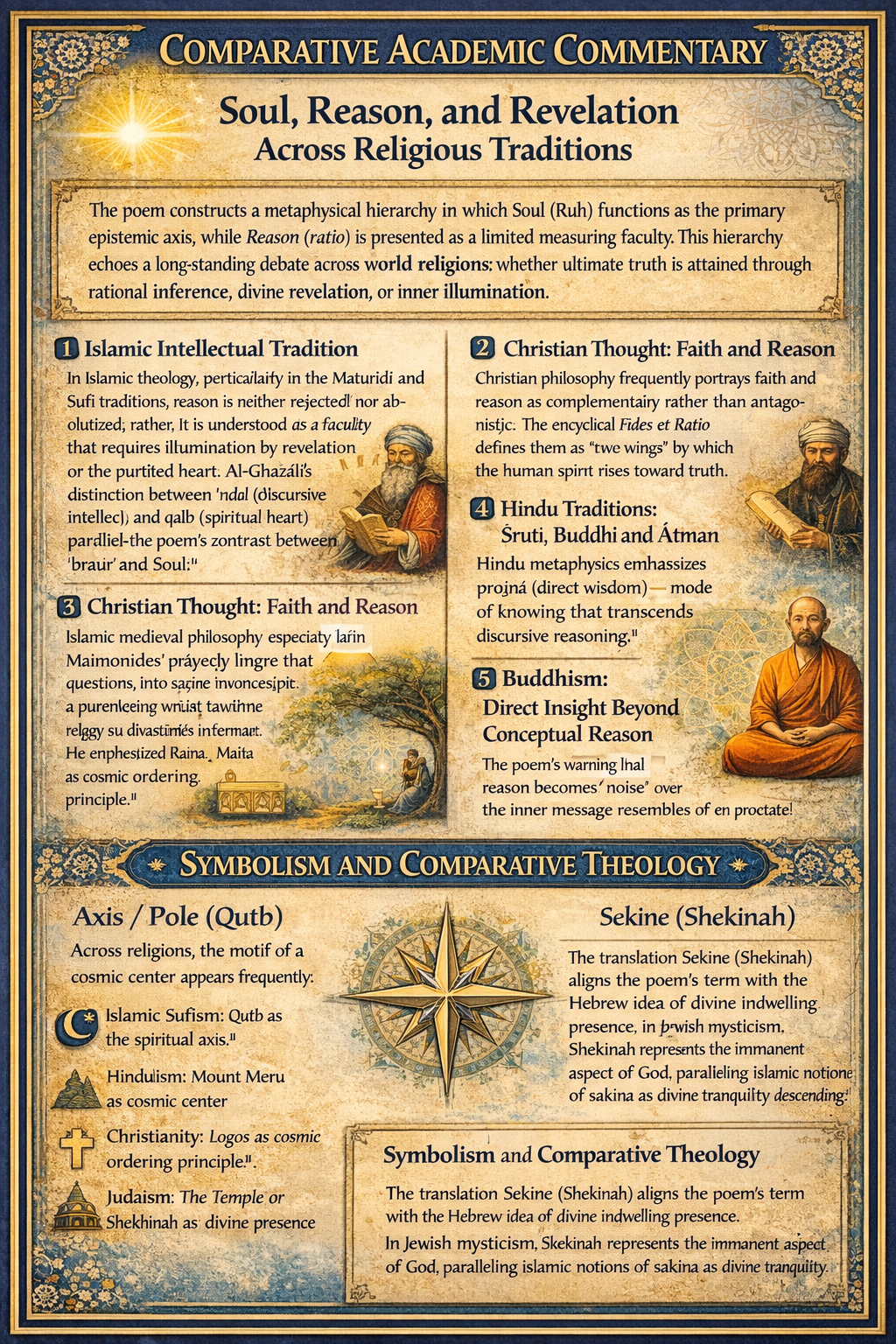
Comparative Academic Commentary
Soul, Reason, and Revelation Across Religious Traditions
The poem constructs a metaphysical hierarchy in which Soul (Rûh) functions as the primary epistemic axis, while Reason (ratio) is presented as a limited measuring faculty. This hierarchy echoes a long-standing debate across world religions: whether ultimate truth is attained through rational inference, divine revelation, or inner illumination.
1. Islamic Intellectual Tradition
In Islamic theology, particularly in the Māturīdī and Sufi traditions, reason is neither rejected nor absolutized; rather, it is understood as a faculty that requires illumination by revelation or the purified heart. Al-Ghazālī’s distinction between ʿaql (discursive intellect) and qalb (spiritual heart) parallels the poem’s contrast between “brain” and “Soul.”¹
Similarly, Ibn ʿArabī describes the Qutb (Pole) as a metaphysical axis around which cosmic order turns — a concept strongly resonant with the poem’s imagery of the “axis” and the “center.”²
2. Christian Thought: Faith and Reason
Christian philosophy frequently portrays faith and reason as complementary rather than antagonistic. The encyclical Fides et Ratio defines them as “two wings” by which the human spirit rises toward truth.³
The poem’s critique of pure rationalism resembles medieval Christian concerns that reason without divine grace may justify moral relativism or power structures — themes visible in Augustine’s distinction between earthly reason and divine illumination.
3. Jewish Philosophy and Prophetic Knowledge
In Jewish medieval philosophy, especially in Maimonides, prophecy is understood as an intellectual illumination beyond ordinary reasoning.⁴
While Maimonides valued rational philosophy, he also argued that revelation communicates truths inaccessible to purely speculative thought. This dual epistemology mirrors the poem’s claim that instinct or revelation guides natural order beyond calculation.
4. Hindu Traditions: Śruti, Buddhi, and Ātman
Hindu metaphysics distinguishes between buddhi (intellect) and ātman (inner Self). The Vedic concept of śruti (“that which is heard”) resembles the poem’s language of an inner “voice” guiding cosmic harmony.⁵
The hexagonal bee metaphor can be read analogously to Hindu cosmology, where sacred geometry reflects divine order (ṛta).
5. Buddhism: Direct Insight Beyond Conceptual Reason
Although Buddhism lacks a creator-God framework, it emphasizes prajñā (direct wisdom) — a mode of knowing that transcends discursive reasoning.⁶
The poem’s warning that reason becomes “noise” over the inner message resembles Zen critiques of conceptual thought, though the theological foundations differ.
6. Modern Secular Philosophy: Instrumental Reason
The poem’s portrayal of reason as a “measuring rod” parallels critiques by modern philosophers such as Max Horkheimer and Martin Heidegger, who argued that instrumental rationality can reduce reality to calculation.⁷
Thus, the text participates in a broader global discourse that questions the absolutization of rationalism in modernity.
Symbolism and Comparative Theology
Axis / Pole (Qutb)
Across religions, the motif of a cosmic center appears frequently:
Islamic Sufism: Qutb as the spiritual axis.²
Hinduism: Mount Meru as cosmic center.
Christianity: Logos as cosmic ordering principle.³
Judaism: The Temple or Shekhinah as divine presence.
Sekine (Shekinah)
The translation Sekine (Shekinah) aligns the poem’s term with the Hebrew idea of divine indwelling presence. In Jewish mysticism, Shekhinah represents the immanent aspect of God, paralleling Islamic notions of sakīna as divine tranquility descending into the heart.⁸
English Academic Footnotes
Al-Ghazālī, Iḥyāʾ ʿUlūm al-Dīn, discussions on heart (qalb) and intellect (ʿaql); see also Frank Griffel, Al-Ghazali’s Philosophical Theology (Oxford University Press, 2009).
Ibn ʿArabī, Fuṣūṣ al-Ḥikam; William Chittick, The Sufi Path of Knowledge (SUNY Press, 1989), esp. chapters on the Qutb and cosmic hierarchy.
John Paul II, Fides et Ratio (1998), §§1–5; also Augustine, Confessions, Book VII on illumination.
Moses Maimonides, The Guide for the Perplexed, trans. Shlomo Pines (University of Chicago Press, 1963).
Sarvepalli Radhakrishnan, Indian Philosophy, Vol. I (Oxford University Press, 1923), chapters on Śruti and Vedānta epistemology.
Edward Conze, Buddhist Wisdom Books (George Allen & Unwin, 1958), introduction to Prajñāpāramitā literature.
Max Horkheimer, Eclipse of Reason (Continuum, 1947); Martin Heidegger, “The Question Concerning Technology,” in Basic Writings (HarperCollins, 1977).
Gershom Scholem, Major Trends in Jewish Mysticism (Schocken Books, 1941), sections on Shekhinah; comparison with Islamic sakīna in Annemarie Schimmel, Mystical Dimensions of Islam (University of North Carolina Press, 1975).