SPIRIT AND LIFE (BODY)
SPIRIT AND LIFE (BODY). The spirit always says “peace”; it does not speak idle words like life (body); Whatever it commands becomes reality — paradise defies description. It has no need to think like the life (body); How sorrowful that we still speak with the voice of animals.
APOCALYPSE BOOK
SPIRIT AND LIFE (BODY)
Our essence stands firm beside the Lord; it cannot descend to us,
For within it no trace belonging to matter can ever be found.
This essence is neither identical with Allah nor separate from Him;
It belongs to the unseen — a secret beyond all speech.
When this essence reflects upon the heart, it becomes a dark point;
This subtle center is what is called RÛH, or the mystery of FUAD.
Life (body) is the ego-awareness belonging to the brain;
Spirit is the consciousness of the Lord — the pearl known as “We.”
Both kinds of awareness cannot operate at once,
For prayer cannot be offered toward two qiblas.
A person placed into deep hypnosis
May perform deeds unknown to the waking self.
Nothing is remembered when awakening comes,
Because the time of the spirit differs from the time of the brain.
Thus the life (body) forgets the covenant it gave to the spirit;
Who cannot bear witness remains veiled in loss.
Until the vow is remembered, rebirth unfolds;
After each death comes a decision belonging to the spirit.
The part of the life (body) that clings to the spirit enters paradise;
The part befriending jinn becomes the cause of madness.
Its right side attains every aim of the Lord;
Its left side falls into the hands of the Zabani.
Until its form dissolves, it burns inevitably;
To mediums, a jinn plays the role of spirit like a phantom.
It assumes the shape of the summoned dead,
Appearing from the medium’s left side before the crowd.
Drawing its substance from the spleen on the left,
The jinn molds it into forms that astonish observers.
Scanning minds for answers,
It delivers responses expected by the questioner.
If the phantom ever revealed its true face,
All who saw it would lose their sanity in terror.
In hypnosis, the protective circle of the spirit dissolves;
The invaded life (body) becomes a pulpit for Iblis.
The spirit departs; the eye of the heart is torn;
The pupil neither widens nor contracts again.
True mediums tremble at night in seizure,
Howling like wolves beneath the full moon.
Be neither medium nor hypnotist — refuse it!
It leads toward black magic; it is never acceptable.
“Three angels appeared to Ibrahim at noon”;
If it cannot be seen in daylight, call it a phantom.
After “two thousand years” the spirit sends forth a new life (body),
Seeking renewed awareness upon the earth.
Life (body) is but a mask worn by the actor;
The actor remains unchanged — the same spirit weaving destiny.
The Hamlet upon the stage is not truly Hamlet;
When the curtain falls, the mask dissolves.
Thus life (body) remembers not former existence;
The rider changes horses at every journey.
The one who remembers is not the horse but the rider;
Choosing the horse belongs to the rider’s will.
Whoever fully unites with the spirit receives reward;
Within the spirit’s album every incomplete life (body) is seen.
For this purpose, lives (bodies) revolve like the earth itself;
If fulfillment fails, the heart beats once more at resurrection.
While the brain sleeps, the consciousness of the Lord awakens;
The spirit rises outward until it reaches the Throne.
Before the One seated there it says: “You are my Mother and Father,”
Prostrating to Rahman who caused it to emerge.
Traveling through the inner universe, it beholds every truth,
For its creation resembles Rahman in essence.
The Lord says: “Each night We cause you to die,”
In deep sleep neither ego nor attribute remains.
“For in that moment we exist only in the identity of the Lord;
We are fully surrendered — within the religion called Islam.”
The spirit does not dream; whatever it speaks becomes real;
Whoever reaches this mystery never wishes to awaken.
The spirit always says “peace”; it does not speak idle words like life (body);
Whatever it commands becomes reality — paradise defies description.
It has no need to think like the life (body);
How sorrowful that we still speak with the voice of animals.
The throat has nine joints — the number of Âdem;
Names become creative sound once the spirit is breathed.
When within the identity of the Lord we rule the universe;
We say to the brain: “Awaken now from heedlessness.”
When the spirit returns, we awaken within the body;
We are colored by the illusion called dream.
The poor brain cannot grasp this state at dawn;
Dream becomes merely the interpretation of foolish impressions.
Reason cannot interpret the work of the spirit;
How can an infant understand its arrival into the world?
The caterpillar knows nothing of the butterfly within the cocoon,
Like Robinson unaware of the deserted island he has reached.
Half-unconscious in sleep, the intellect watches the spirit,
Remembering emptiness and calling it dream.
When the spirit enters the Fuad, we believe we awaken;
Yet in truth we see an open-eyed dream.
For the spirit’s vision alone is reality;
“To remember the vision is attainment,” says the path of the Lord.
The verse commands: “Remember your Lord within yourself”;
To remember is to recall — obey this command.
If remembrance were only counting beads,
Would the Lord say “every particle remembers”? Reflect!
The Lord also says: “Even every shadow prostrates before Me”;
Prayer without spirit is not accepted, even with a thousand “amen.”
Electrons circle their nucleus like pilgrims,
Yet their hajj is not accepted — unconscious and mechanical.
Even while resting in the heart, the spirit awakens the brain;
The lowest tone of Gabriel’s voice is called conscience.
The voice of conscience is silent and calm — pay attention!
“No one else hears it,” it says; therefore obey.
This is the single rope extended to us by the Lord,
Like sunlight sharing the nature of the sun.
Hold that rope and ascend — the “jugular” is not distant;
Every other rope is a snare cast by the devil.
Otherwise life (body) cannot be saved, for it is transparent fire;
A denser fire becomes equal to Iblis.
If united with Iblis, its form is destroyed;
The Torah says: “Dust you are, and to dust you shall return.”
Dust divides into particles called atoms;
The life (body) holding the rope is favored for paradise.
Spirit is the first ray from the primal sun — a command from the Lord;
Whoever rejects it becomes cold iron like Iblis.
Saints sleep at night with intellect fully stilled;
What they see is true vision, not dream.
“The one sleeping with open eyes is the cave dweller;
The guardian dog is Sekine (Shekinah)!” — understand this now.
Between spirit and life (body), you are the judge — the choice is yours;
Beyond this explanation, Uluğ has no permission to speak.
Master M.H. Ulug Kizilkecili
Türkiye/İzmir - 5 October 1996
IMPORTANT NOTE :The original text is poetic, and the author cannot be held responsible for any errors in the English translation! To read the original Turkish text, click HERE! The following section is not the author's work, and the author cannot be held responsible for any errors made!
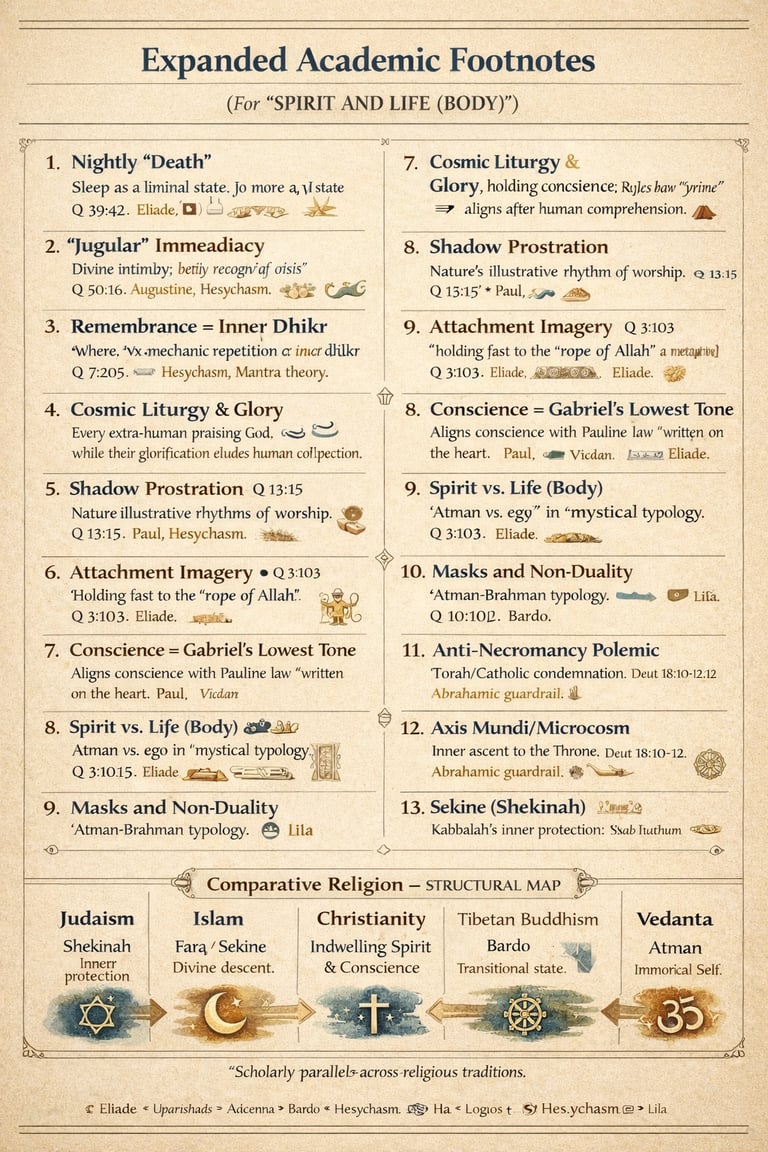
Expanded Comparative Academic Footnotes
1. Spirit, Divine Presence, and Sekine (Shekinah)
The poem’s notion of spirit as a descending or indwelling consciousness parallels the Jewish mystical concept of Sekine (Shekinah) — the manifest presence of the Divine dwelling among creation. In rabbinic and kabbalistic literature, Shekinah expresses the immanent dimension of God experienced within history, community, or inner awareness rather than an ontologically separate entity.
Comparatively:
Islamic Sekine refers to divine tranquility or stabilizing presence sent into believers’ hearts during moments of crisis, often interpreted as a functional analogue to Shekinah.
Christian theology frames a similar dynamic through the indwelling Holy Spirit or “God-with-us” motif (Immanuel), emphasizing divine presence within human history.
Thus, the poem’s imagery of spirit descending into the heart aligns with a broad Abrahamic archetype of immanent sacred presence.
2. Spirit vs. Life (Body) and the Atman Paradigm
The distinction between spirit and life (body) resembles classical Vedantic metaphysics:
Ātman denotes the immutable inner self beyond ego, body, or mental processes.
In Advaita Vedanta, Ātman is ultimately identical with Brahman, whereas the empirical personality belongs to the realm of change.
This parallels the poem’s separation between:
Spirit → transcendent consciousness
Life (body) → temporal ego-awareness
However, unlike Vedanta’s non-dual ontology, Islamic metaphysical frameworks maintain a relational distinction between human spirit and divine source.
3. Hypnosis, Mediumship, and the Necromancy Prohibition
The poem’s strong warnings against mediumship resonate with prohibitions found across multiple religious traditions:
Judaism: Deuteronomy 18 condemns necromancy and spirit consultation as violations of prophetic revelation.
Christianity: Traditional theology rejects occult divination as undermining trust in divine providence.
Islam: Practices involving jinn-based knowledge or magical mediation are frequently criticized within Qur’anic and Sufi ethical discourse.
From a comparative religion perspective, these prohibitions reflect a shared concern for preserving epistemological authority — authentic knowledge must originate from divine revelation rather than intermediary spirits.
4. The Actor and Mask Motif — Mystical Anthropology
The poem’s metaphor of the actor wearing different masks echoes several mystical traditions:
Sufi thought: the concept of tajalli (manifestation), where the divine reality appears through changing forms.
Christian mysticism: the “old self / new self” transformation language.
Vedantic philosophy: the world as līlā (divine play), where individual identity functions as a temporary role.
This indicates a universal archetype of performative selfhood within mystical anthropology.
5. Cosmic Microcosm — Human as Axis Mundi
The internal journey described in the poem aligns with the widespread idea of the human being as a microcosm reflecting cosmic structure.
In comparative symbolism:
Shekinah represents the meeting point of heaven and earth.
Axis mundi traditions portray the heart or inner center as a vertical bridge between realms.
Similar motifs appear in:
Hindu yogic subtle-body systems
Christian hesychasm (prayer of the heart)
Islamic Sufi cosmology
6. Sleep, Death, and the Intermediate State (Bardo)
The poem equates deep sleep with temporary death — an idea mirrored in Tibetan Buddhist teachings on bardo, the transitional state between death and rebirth.
Bardo emphasizes:
altered states of consciousness,
visionary experiences shaped by perception,
the possibility of liberation through awareness.
Scholars note that Tibetan traditions frame bardo not as a fixed place but as a process of consciousness transition, offering a structural parallel to the poem’s description of nightly spiritual ascent.
Islamic theology similarly uses metaphors of sleep as a temporary withdrawal of the soul.
7. Voice of Conscience and Inner Law
The poem identifies conscience as the lowest tone of Gabriel’s voice.
In comparative theology:
Christian Pauline texts describe conscience as a law “written on the heart.”
Jewish ethics associates divine presence with moral awareness.
Islamic spirituality links conscience (vicdan) with inner remembrance.
These parallels suggest a shared archetype of internal revelation across traditions.
8. Sacred Sound, Names, and Creative Speech
The poem’s emphasis on creative sound aligns with several traditions:
Jewish mysticism views divine speech as sustaining creation (Logos-like concepts).
Hindu mantra theory treats sacred sound as ontologically transformative.
Islamic cosmology connects the creative command “Be!” with divine speech.
This cross-cultural motif portrays language not merely as communication but as a metaphysical force.
9. Sekine (Shekinah) and the Feminine Divine Principle
In Kabbalistic symbolism, Shekinah is often associated with the feminine aspect of divine presence, mediating between transcendence and immanence.
Comparative parallels include:
Christian Sophia traditions
Sufi metaphors of divine mercy
Shakti concepts in Hindu thought
The poem’s imagery of protection and guidance through Sekine (Shekinah) fits within this broader symbolic pattern.
Islamic Mysticism: Spirit as divine trust; Sekine as stabilizing descent.
Judaism: Shekinah as indwelling presence bridging heaven and earth.
Christianity: Indwelling Spirit and conscience theology.
Vedanta: Ātman as immutable self beyond egoic identity.
Tibetan Buddhism: Bardo as transitional consciousness field.
Universal Symbolism: Human being as microcosmic axis.
Expanded Comparative Academic Footnotes
1) “Nightly death”: sleep as a liminal withdrawal of consciousness
The poem’s claim that Allah “causes death each night” aligns closely with Qur’anic language that describes sleep as a mode of “taking” the souls, with return except for those whose death is decreed (Q 39:42).
Comparatively, many traditions treat sleep as a liminal state: in late antique and medieval Christian thought, sleep often functions as a figure for mortality and resurrection; in Indic traditions, deep sleep (suṣupti) can become a privileged site for analyzing consciousness and selfhood (though the metaphysics differs). (For the Upaniṣadic self-discourse, see notes 8–9.)
2) “Closer than the jugular”: divine immediacy and interiority
The line that reworks “the jugular is not distant” resonates with Qur’anic interiority discourse (Q 50:16), typically read as divine knowledge/presence “closer” than the most intimate bodily marker.
In comparative theology, this maps onto a broad “interiority” motif: Augustine’s famous inward turn, Orthodox hesychastic “prayer of the heart,” and Sufi interior remembrance each articulate immediacy without collapsing Creator–creature distinction (in Abrahamic systems).
3) “Remember your Lord within yourself”: remembrance as inward recollection, not mere vocal counting
The poem’s insistence that “dhikr = remembering” parallels Qur’anic instruction to remember inwardly and quietly (Q 7:205).
This also situates the poem within a wider cross-tradition distinction between mechanical repetition and interior recollection—a contrast that appears in Christian monastic treatments of the Jesus Prayer and in Hindu mantra theory (where “sound” is not mere noise but disciplined recollection/attention).
4) “Everything glorifies”: cosmic liturgy beyond human comprehension
The poem’s “every particle remembers” motif coheres with Qur’anic cosmic praise language (Q 17:44), where creation’s glorification is affirmed while human comprehension is denied.
In the history of religions, scholars often discuss this as “cosmic liturgy”: cosmos as sign-bearing, meaningful, and quasi-devotional (cf. Eliade’s analyses of a “speaking” cosmos in religious consciousness).
5) “Even the shadow prostrates”: symbolic submission and the semiotics of nature
The poem’s “shadow prostration” aligns with Q 13:15, which includes shadows among those who “bow” morning and evening.
This supports a comparative reading in which nature’s rhythms become a symbolic grammar of submission/order (whether interpreted metaphysically, ethically, or phenomenologically).
6) “The rope”: a soteriological image of attachment/union
The “single rope” extended by the Lord resonates with Q 3:103 (“hold fast… to the rope of Allah”), though the poem internalizes the image toward conscience/inner guidance rather than primarily communal unity.
Comparatively, “rope/line/cord” functions widely as a metaphor of ascent and rescue (e.g., ladders/ropes in axis-mundi symbolism; see note 12).
7) Conscience as “the lowest tone of Gabriel”: internal law and moral audition
The poem’s mapping of conscience to an angelic “tone” aligns structurally with Pauline conscience theology (Rom 2:15: law written on the heart; conscience testifies).
In comparative ethics, this supports reading conscience as a site of interior normativity—not identical across religions, but functionally parallel to moral “interiority” models.
8) Spirit vs. life (body): cross-tradition “higher consciousness / empirical self” typology
Your poem’s distinction (spirit = Lord-consciousness; life (body) = brain/ego-awareness) has strong structural parallels to Indian philosophy’s Ātman discourse (the self as enduring/unchanging and distinct from psycho-physical states).
The metaphysical commitments differ (especially regarding Creator–creature distinction in Islam), but the phenomenological contrast—stable witness vs. shifting mental identity—recurs.
9) Non-duality horizon: Ātman–Brahman and the “one truth, many masks” problem
Advaita Vedānta’s radical claim that the essential self (ātman) is brahman provides a high-theory analogue to the poem’s “actor/mask” motif, though your poem remains within a theistic grammar.
For comparative scholarship, the productive method is to treat these as functional analogies, not identity claims.
10) “Two thousand years later”: reincarnation language vs. typology vs. intermediate-state models
The poem’s cyclic “sending down a new life (body)” evokes rebirth idioms, but in comparative analysis it can be triangulated across:
rebirth frameworks (Indic traditions),
typological/functional recurrence (some Christian readings emphasize “spirit and power” rather than literal return),
intermediate-state models (e.g., bardo/berzah/purgatory families, each with distinct ontology).
For “bardo as intermediate state,” see scholarship and teaching summaries noting bardo as the in-between process between death and rebirth.
11) Anti-necromancy polemic: a shared Abrahamic boundary
The poem’s rejection of mediumship/necromancy closely matches Torah prohibitions against mediums/necromancers (Deut 18:10–12).
In Catholic moral theology, divination and “conjuring up the dead” are likewise explicitly rejected (CCC 2116).
Methodologically, comparative religion reads this boundary as protecting epistemic authority (revelation vs. illicit knowledge) and anthropological boundaries (living/dead/divine).
12) Axis mundi and microcosm: inner ascent as cosmic geography
Your poem’s “spirit rising to the Throne” reads coherently within the cross-cultural axis-mundi pattern, where an inner center becomes a vertical bridge between realms. Eliade’s comparative frame on cosmos-as-meaning and sacred center supports this reading as a classic religious structure (microcosm mirroring macrocosm).
13) Sekine (Shekinah) as immanent divine presence: Jewish theology and comparative mapping
If your wider corpus uses Sekine (Shekinah) as a protective/indwelling presence, this maps to Jewish theological usage of Shekhinah as the “Dwelling/Presence” of God in the world, developed in post-biblical literature (Targums, Talmud, Midrash).
Comparatively, Islamic “sakīna” (tranquility sent down) can be treated as a functional analogue (calm/presence/support), without claiming doctrinal identity.
14) “Baptism” as reconciliation of opposites: Christian water/fire pairing
Where your earlier poem-work invokes “baptism” and “fire,” the New Testament explicitly juxtaposes water-baptism with “Holy Spirit and fire” (Matt 3:11).
Comparatively, the ritual logic is: purification → transformation → communal/ethical reorientation—found in many religious systems, though sacramental theology is specific to Christianity.
15) Materialization (“densification”) as fall: Platonic-Gnostic patterning (method note)
Your broader “lightness → heaviness” imagery is methodologically comparable to late antique patterns where spirit “thickens” into matter. In academic framing, this is best described as conceptual parallel rather than historical dependence unless textual transmission is demonstrated.
16) “Creative sound / Names”: language as ontological force
The poem’s emphasis on names/sound as generative supports a cross-tradition theme: sacred speech acts as world-sustaining or world-disclosing (Jewish dabar/“word” theologies; Islamic creative command discourse; mantra ontologies in Hindu traditions). This is a well-known comparative motif: speech as metaphysics, not only communication.
17) “Right side / left side”: eschatological sorting as moral topology
The poem’s “people of the right side” coheres with Abrahamic symbolic geography where “right” signifies favor/salvation and “left” signifies loss/judgment (details vary by tradition). In academic terms, this is moral topology—mapping ethical states onto spatial directions.
18) Methodological caution: allegory vs. literal ontology
Given the poem’s strong imagistic register (jinn/phantom/hypnosis; ascent; “rope”; “Throne”), the academically responsible approach is to:
(1) read primary claims as symbolic anthropology and moral psychology,
(2) avoid turning metaphors into biological or empiric assertions,
(3) mark where the poem explicitly polemicizes (necromancy) vs. where it mythopoetically speculates (rebirth-like phrasing).