THE CLOCK (Death's Hour)
THE CLOCK (Death's Hour).The eagle that from the sky beholds every corner of the world! Passing over many abysses, wandering and forlorn, it says: While passing above a grave, trembling, it declares: “This indeed is the most dreadful, the deepest of pits!” — Translation from Viktor Hugo
APOCALYPSE BOOK
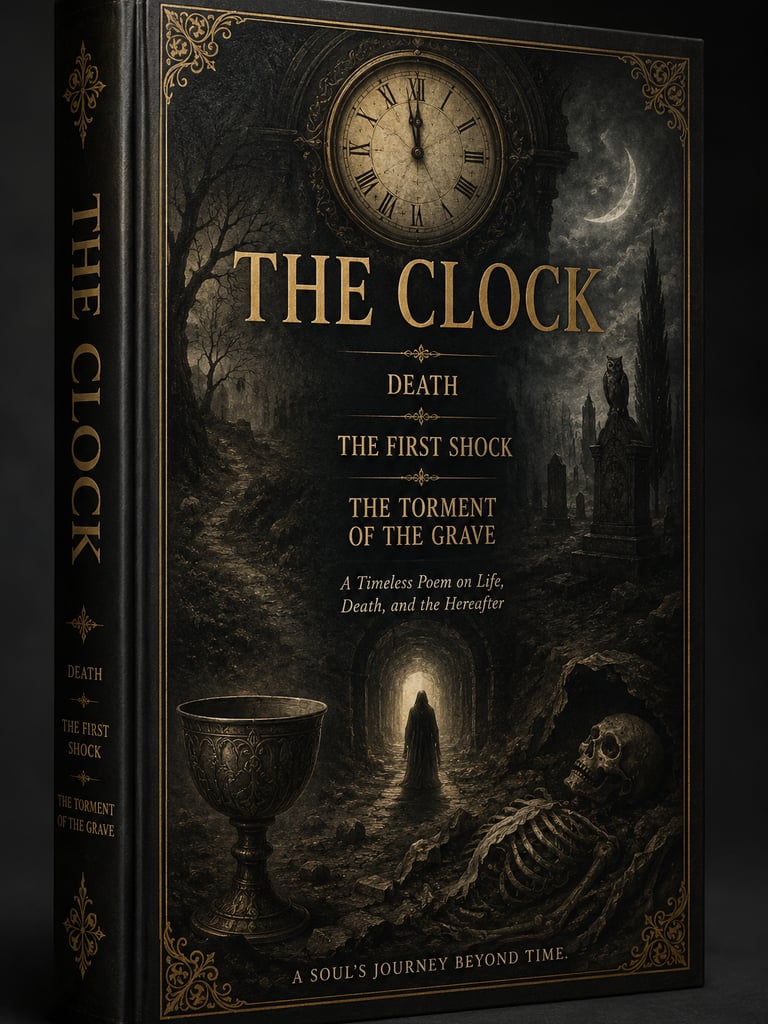
THE CLOCK
“DEATH”
When the sexton of the clock rings its bell,
The soul comes to the mouth of the living being!
The mainspring no longer turns the wheel!
That pulse no longer beats: tick, tick, tick!
The Sun called the Heart is eclipsed, the face grows pale!
Blood no longer reaches the brain, the Moon grows dark!
Great earthquakes are lived within the body!
Tumults are heard arising from the cells!
Like stars in the sky, each faculty,
Falls extinguished from a heaven!
At first a sound is heard saying: “Vu, Vu,”
At last one obeys the sound saying: “Hû, Hû!”
Someone blows into the form called the “Trumpet”!
A dead one revives, tearing through soot!
One dies though there was no wish to die!
The soul recalls one by one whatever it has done!
Then a voice growls: “Some faces shine,
Some faces darken!”
Moaning, it says to itself: “Your end has come!”
“His sight is sharp! His tongue is captive!”
A pitch-black hand extends the final goblet!
Laughing at the one who weeps: “Hi hi hi!”
Such a hand that every part is claw!
It smells of blood! Its tips are always wet!
Each nail has grown through thousands of ages,
Turned into hooks! Their roots are bruised and calloused!
It tears flesh away every moment like grass, this witch!
Its face and name are different for everyone!
Whoever upon the Earth was pregnant with the Hereafter,
Such a midwife calls to the bedside!
That goblet is not crystal, but earth!
Its earth never dries! It is always wet!
That goblet is washed by our tears!
That goblet is carved from the stone of our soul!
Its inside is filled with our separations!
Its bottom is dim! It is the road to eternity!
On every rim are traces of lips!
On every wall are the sweats of death!
Even while being lifted to the mouth, it touches!
What prayers are recited while it is drunk!
This blessed cupbearer is not refused!
While drinking, it is said: “Allah remains eternal!”
At its first sip the soul draws one deep breath!
At its final sip the body becomes nothing!
It is the only moment when repentance no longer passes!
They take but a simple bribe! It is the soul!
Out of fear, it prostrates a thousand times!
The dead rises! The bodily grave is split apart!
“THE FIRST SHOCK”
The Earth is folded up and turns into a plain!
Behold, the body has turned into a waterless bucket!
Those seas and mountains were but an illusion!
The soul sits utterly naked and weeps!
It awakens from a dream in terror!
Attacking its corpse-body with savagery!
Within frozen flesh it searches for itself!
With severed hands it embraces itself!
It wanders about the body in bewilderment!
It cries out wildly to everyone!
What is this! No one answers at all!
What mystery is this! Its mind cannot grasp it!
One washes something with a ewer!
One stuffs something into several places!
One ties it shut from the jaw!
Meanwhile spouse and friends weep without ceasing!
As though bathing one prepared for union,
They cleanse the body with water!
That body resembles itself! Yet,
It is itself that screams! The body remains still!
The corpse lies stretched upon the wooden board!
The soul stands upright, asking around:
“Outside I see another me! Where am I?
It is as though I have gone cross-eyed in the grave!
Am I the real one? Or is this body false?
Is this thing cast off my sheath? Am I the serpent?
If I am a serpent, why do I have a thousand legs?
I am like a spider! Yet I have no web!
I have a hand! Yet it cannot grasp my collar!
That hand is a shadow! Is my body a jest?
I am like mist or soot in this form, alas!
If I am smoke, then why does my inside burn?”
“THE TORMENT OF THE GRAVE”
Everyone departed, he remained alone!
Look upon his state and take lesson:
Every side frozen stiff, winter has descended!
Only the owl upon the cypress draws its breath!
A pitch-black night! The stones gleam!
Only tears water this land!
Here all leaves are always pale yellow!
The soils cry out particle by particle!
Everyone’s cloth is of the same pattern!
The minute hand asks the scorpion-hand its age!
One lies in a bridal gown! Without a collar!
And the bride’s chest is the coffin she enters!
Such a lying-down that wounds the hearts!
Such a silence that shreds the ears!
Outside, the grave is a garden of wreaths!
Inside, a display of flesh! A market of souls!
The eyes gouged out! Turned into omen-stones!
Alone they teach a lesson for warning!
From every hollow worms pour forth!
Those chests and backs torn piece by piece!
While the skin in places leaks its grease,
Vermin suck its foul intestines!
Where is that rose-like neck kissed every day?
Where is that upright bosom sighed over always?
Where are those strands of hair fallen to the waist?
Where are the golden earrings, the diamond crowns?
No earrings remain! Only drops of pus!
Each ear a honeycomb of worms! The bee weeps!
Its bracelet is either serpent or scorpion!
It bites! Each arm bruised purple and crushed!
Those dear pink-white thighs,
Have become blackened, dried branches!
That nose once raised to the skies,
Has fallen to the earth, a scorpion gnaws it!
Each lip within the mouth of an insect!
Each cheek within the throat of a worm!
Those parted jaws grin forever!
Ticks forever race about inside them!
To this he had given that lofty rank!
Now none is more wretched than it!
That filthy wreck returned to its origin,
Says to the soul: “Find your origin! Final warning!”
The soul, that heedless-stricken one, still bewildered!
Its love for the body overflowing within!
With sobs it circles its Ka‘bah!
Mistaking its prison of bones for the Ka‘bah!
It pleads: “My cells, hold together!
It is sorcery, this box has become a coffin!
A mighty hand has cast a spell upon us!
Unless the spell is broken, my passion shall not fade!
Even if you are chewed and become gum in the soil,
Come embrace me again, O sieve-waisted girl!
Let the Creator be ashamed of such a pair!
Let the Creator awaken from my lament!
Once I was a king, now I am wholly a sigh!
Neither mine, nor yours! I am Barzakh!”
The body says: “O Soul! What is this longing for your mate!
You have fallen like a hyena pursuing a corpse!
Those beauties of mine, alas, were but a moment!
All were loans, and they bore your seal!
I both pity and laugh at your mourning!
The living do not worship the mummy of the dead!
Do not think your prayer-rug is but a few spans!
This is the final prostration of the Throne upon the earth!
The moment you rise to your feet, your coquetry ends!
Look, your final prayer is performed standing!
Know! Resurrection is to stand upright!
It is to flow forth, severed from your body!
Let me say it in a comprehensible manner:
They now call you “dead” upon the Earth!
This corpse is flesh belonging to the soil!
Within you remains the form belonging to your Rabb!
By defiling that divine honor of yours,
With greed you pierced that veil of virginity!
While that bridal veil is bloody, heaven will not receive you!
Unless you deliver its bastard, the earth will not release you!
Suffer the pains and now give birth to it!
Come, strip off this final bloody garment!”
“THE BRIDGE OF SIRAT”
A chasm stretching from the Moon to the Earth!
It swallows the soul! The condition changes!
One cannot ascend to the Supreme Throne while sick!
Whoever dies does not die if in sincerity!
Fire is the offering of its final remedy!
It is antidote, no matter how painful it comes!
A limb that has become gangrenous,
Is cut away, though it causes torment!
This Hell too is a law of the Hereafter!
The final operating table of God!
An ice-cold basement! Candle-sooted!
They lay the soul down like an animal!
They bind it to the chain of its own nature!
They oil it so that it may feel more keenly!
An injection struck, the soul remains awake!
Both witness to itself and defendant!
Holding a knife to each of its limbs,
They say: “Begging and weeping are past their time!”
More alive than before, the soul sweats continually!
Those knives become scalpels upon the soul
Such that its cry is heard from outer space!
Yet its memory is never heeded!
No other heart now bleeds for it!
The instant its makeup ends, trembling,
That devilish puller rises from the table!
As though its inside has come outside!
Crawling and moaning through the void,
Searching for a light within dimness!
Seeing the luminous face of the Moon turned toward the Earth,
It somewhat disperses its sorrow!
When with a thousand hardships it nears the Moon,
Then the soul cries out in madness!
What it sees is no longer the Moon, but a mirror!
Its forehead strikes that Frankenstein!
Aman Allah! What monstrous growth is this!
The soul has grown a thousandfold like a giant!
The skin of its anus stitched onto its face!
Its eyes gouged and flowing outward!
Every strand of its hair become a scorpion!
Its brain stung line by line, filled with blood!
That mouth ripped open up to the hairline!
The dangling tongue shredded into a giant caterpillar!
Its breath hotter than a flame!
The insides of its nose a channel of tar!
While coughing, it spits out its throat!
Forever swallowing back its own intestines!
That body turned into a sewer-pipe!
It reeks like a corpse! Everything is there!
The monster, upon gazing at the Sirat,
Spits at this disgusting face in the mirror!
It says: “O Adam! What a form! What a condition!
Do not look at me, depart at once!
I do not open my gate to a vagabond traveler!
I do not hand my title deed to an unlicensed hand!
One who while alive turned his back upon the Lord,
Can never knock upon my gate-ring!
How many times from the heavens did I wink at you!
I called out and clapped ‘twenty-eight hands’!
By hunting the blind eye of your soul,
I gave you the copy! Discover your essence yourself!
Each night I danced in another form!
I reflected into the womb, the hand, and the face!
Within my mouth it is Saturn that speaks!
My name ‘Hilâl’ is a sign unto exalted Allah!
Mûsâ called me ‘Sinai,’ upon the ‘Tûr’!
Know that your souls are first divided here!
Your filthy side remains beneath me as jinn!
And the angelic side crosses over and journeys on!”
“HELL”
Pharaoh’s bundle is now opened!
And monsters scatter forth from within!
Not souls, but jinn each monster becomes!
Whatever was inside comes always outside!
Every evil clothed in its own garment,
Stands upright before itself! Exactly the Gathering!
Every sin now a dungeon unto itself!
Now conscience has become Munkar and Nakir!
It questions itself account by account!
Turning page by page the final book!
Greed and lust have become fire, burning!
Îsâ has crucified it upon the cross, nailing it!
Seven times louder than its voice on Earth:
“To become soil! At every instant content with this!”
When matter is absent, pain has no equal!
For it grasps the fire without tongs!
From agony it faints, then awakens again!
Here one moment is counted as eternity!
No hope! No intercession! No mercy!
Can time even function in such a realm!
The soul cries out: “What kind of torture is this!
I think I have plunged into an endless nightmare!
Can such a dream exist! Only my eye remains!
Why does my essence here assume a thousand forms!
Whichever trait rises forth from me,
The beast of that trait rises from the body!
My one soul divided into a thousand souls!
In each one an image of me appears!
I am both millstone and grain,
Crushing while being crushed myself!
I chew my flesh! Yet I have no mouth!
My cry shakes the heavens! Yet I have no throat!
Seeing a darkness, I grow exhausted!
If I am a night, where then is my moonlight!
Is this fire in the soul or in the body?
Am I in the fire? Or is the fire within me?
I burn to ash, I die, yet I do not vanish!
I am torn piece by piece! Yet I do not multiply!
Am I not light but fire, a tulip opposed to the rose?
Am I a torch scattering darkness?
Where am I? What am I? Where is the Rabb?
Enough torment! I have become exhausted!”
“REPENTANCE”
“No! I am worthy of this torment!
This destruction shall rebuild me!
This Hell too is Your manifestation!
Still far better than annihilation!
The joy of Your wrath shines within the fire!
Even reproach is sweet when from the Beloved!
My reel wound up like a filmstrip!
I saw my ‘Lawh al-Mahfûz,’ and melted!
I had thought I possessed that world!
I had thought resurrection a lie!
I had become arrogant through learning!
Wealth and fame alone were my aim!
What fame now! What wealth! Alas remains!
Only forbidden gain remains in the hand! Alas!
Every instant passes with this remorse!
Now my whole conscience bleeds!
Turning an entire life into pitch-black soot,
At last I became this coal of Hell!
The Existing One was the Lord! That Iblîs, but shadow!
My delusion within the body gave him territory!
Every life was a draught from the ‘Bezm-i Elest’!
The one who loses not that draught is the true Adam!
While every breath cried out “Hû Hû!”
I searched outside and lost the Spirit!
God cannot oppress us even by an atom!
Let us come to our knees only through prostration!
Let us become the clay of His ripened body!
And at the end, the wire of His antenna!
Let us cut off the head and become chiefs at His Throne!
Let us become ‘Five Standards’ upon that great helmet!
Mercy is written doubly in the Basmalah!
Let the servant offer gratitude and devotion unto You!
This punishment belongs to the crime of a single lifetime,
Torment cannot justly endure forever!
Suffering is a means! Not the end!
Eternity is not its exclusive rank!
Is there a wine that I might drink for one lifetime!
May the ecstasy of its drunkenness never cease!
Every fire is condemned to extinction! Water a mirage!
O Rabb, is the fire of the heavens Your flame or Your light?
I understood what prostration is! What the Qiblah is!
Behold! The unripe fruit ripened and became nourishment!
Even if my mi‘râj reaches unto Your Throne,
At every instant I remain in need of Your mercy!
Your mercy surpasses Your wrath, mercy!
Do not burden me any longer, I beg You!
Forgive me for the sake of that Muhammad!
For the sake of the whole Ummah عاشق with him!”
Mercy, the one hidden weakness within Allah!
At last forgiveness reaches this sinner!
“Come now, enter Paradise and behold your Rabb!” He says!
And seeing His Spirit, the soul prostrates!
The secret of the Clock is hidden within Yusuf!
The secret of Yusuf is the wisdom of the Walî!
M. H. Uluğ Kızılkeçili
Ankara – 1956
The eagle that from the sky beholds every corner of the world!
Passing over many abysses, wandering and forlorn, it says:
While passing above a grave, trembling, it declares:
“This indeed is the most dreadful, the deepest of pits!”
— Translation from Viktor Hugo
“‘The soul cannot endure the earthquake of the Clock!’”
— Qur’ân al-Karîm
“The resurrection of the dying soul erupts!”
— Hz. Muhammad
(What is written after this point bears no relation to the author, and because of any errors made, the author cannot be held responsible!)
THE CLOCK=SAAT (In Turkish)
PART ONE
THE ESOTERIC COSMOLOGY OF THE “CLOCK” TEXT
M. H. Uluğ Kızılkeçili’s text entitled “Clock” (“Saat”), although outwardly appearing to be a poetic work depicting death and the Hereafter, is in its deeper structure a highly esoteric text describing the ontological dissolution of the human being, the separation of the layers of consciousness, and the cosmic reckoning of the nafs. This work is not merely a poetic narration of the Islamic understanding of death; at the same time, it possesses the character of an “initiatory transition text” carrying the shared symbolism of the Hermetic tradition, Tasavvuf, Gnosticism, Kabbalah, and the ancient mysteries of death.
Already in the opening lines of the text:
“When the sexton of the Clock rings its bell,
The soul comes to the mouth of the living being!”
The expressions represent not ordinary physical death, but the “cosmic call.” The “sexton” here is not merely a church official; within Western esotericism, he is the Turkish-Islamic projection of the being called the “threshold guardian.” For death, in all ancient traditions, is a gate. In order for this gate to open, a “call-sound” is required.
In Tasavvuf this has been called the “invitation of the Lord,” in Tibetan teaching the “Bardo call,” and in Ancient Egypt the “voice of Anubis.”
The first great symbol demanding attention here is the concept of the “CLOCK” (“SAAT”).
I. The Esoteric Meaning of the Concept of “Clock”
In the Qur’ân, “Clock” (“Es-Sâ‘a”) is not merely a time-indicator. “Es-Sâ‘a” is also another name for the Resurrection. Yet the concept of resurrection has most often been misunderstood. In esoteric traditions, resurrection is not merely the end of the world; it is the collapse of one’s own ontological order.
When the poet says:
“That pulse no longer beats: tick, tick, tick!”
this is not merely biological death. It is the ending of linear time.
For the human being experiences time through the heart.
When the heart stops:
• mechanical time ends,
• spiritual time begins.
In Tasavvuf this is called “dehr consciousness.” According to Ibn al-‘Arabî, the human being lives within “sequential time” in the physical world; after death, however, he passes into “single-instant time.” For this reason, in Hell “one moment is counted as eternity.”
The verse:
“Here one moment is counted as eternity!”
directly points toward this metaphysics.
At this point, an interesting parallel emerges between Einsteinian physics and the mystical understanding of time. In the theory of relativity, time depends upon the condition of the observer. In Tasavvuf, however, it depends upon the level of consciousness.
Post-mortem time becomes:
• not chronological,
• but psycho-metaphysical time.
This understanding exists not only in Islam, but is represented also by:
• “Kalpa” in Hinduism,
• the “Bardo duration” in Buddhism,
• the “Aeon” in Hermeticism,
• and the concept of “Olam” in Kabbalah.
Therefore, the “Clock” is not a wristwatch; it is the threshold of cosmic consciousness.
II. The Mechanical Clock and the Human Body
One of the most important symbols of the poem is the depiction of the human body as a clockwork mechanism.
“The mainspring no longer turns the wheel!”
Though this line appears ordinary, it carries a profoundly Hermetic symbol.
In ancient Hermetic teaching, the human being is regarded as:
• a “microcosm.”
Just as the universe is a mechanism operating through stars, the human body too is considered the miniature model of that same mechanism.
Thus:
• the heart = the sun,
• the brain = the moon,
• the veins = star-paths,
• the breath = cosmic wind,
• the pulse = rhythm of time.
The poet’s expressions:
“The Sun called the Heart is eclipsed, the face grows pale!
Blood no longer reaches the brain, the Moon darkens!”
contain an exact astro-human correspondence.
Here:
• Heart = Shams (Sun)
• Brain = Qamar (Moon)
are presented.
In Tasavvuf the heart is accepted as the “center of divine light,” while the intellect is considered the “reflective moon.”
When the sun is eclipsed:
• consciousness darkens,
• the moon is extinguished,
• the nafs becomes directionless.
This understanding is also encountered in Ancient Egypt. In the Pharaohs’ death texts, the heart is described as “the sun of Ra.” When the light of the heart is withdrawn, the human being’s “Ba” (soul) falls into darkness.
The symbolism here explains that the human body is not merely flesh, but a cosmic device.
III. The Frequency of “HÛ” and the Cosmic Breath
One of the most striking sections of the poem is this:
“At first a sound is heard saying: ‘Vu, Vu,’
At last one obeys the sound saying: ‘Hû, Hû!’”
These verses open directly into breath-centered Sufi esotericism.
“Hû” in Tasavvuf represents the essential breath of Allah.
According to many Sufis:
• the human breath is actually a vibration entrusted by God,
• within every breath “Hû” is concealed.
This understanding shares the same root as:
• the “OM” mantra of India,
• Tibet’s “AUM” sound,
• the unpronounced sacred name in Jewish mysticism,
• and Christianity’s doctrine of the “Logos.”
For in all esoteric traditions:
“The universe was created through sound.”
The Qur’ânic expression:
“He said ‘Be,’ and it became.”
is likewise a metaphysics of sound-based creation.
From the perspective of modern science, too, the fundamental structure of the universe is interpreted vibrationally. The central approach of string theory asserts that vibration lies at the essence of matter.
Tasavvuf interpreted this centuries ago as:
“Breath.”
Thus, the “Hû” heard at the moment of death is:
• not the sound of the brain shutting down,
• but the return of existence to its original frequency.
IV. Is Death Annihilation or Separation?
One of the central theses of the poem is this: death is not annihilation. Death is the breaking of identification with the body.
When the poet says:
“He awakens from a dream in terror!”
he reveals an extremely important metaphysical secret.
In Tasavvuf, worldly life is regarded as “sleep.” The saying attributed to Hz. Muhammad — “People are asleep; when they die, they awaken.” — finds its exact correspondence here.
A similar understanding exists in Plato’s allegory of the cave, in the Hindu doctrine of Maya, in the Buddhist understanding of samsara, and in the Gnostic teaching of the “world of forgetfulness.”
The question within the text:
“Am I the real one? Or is this body false?”
is the fundamental question of all esoteric traditions.
For the greatest illusion of the human being is imagining the body to be himself.
According to Tasavvuf, the body is regarded as:
• garment,
• mold,
• shadow,
• trust.
The true human being is “the secret within the form.”
For this reason, the statement in the poem:
“Within you remains the form belonging to your Rabb!”
rests directly upon the metaphysics of the hadith:
“The human being was created upon the form of Allah.”
V. Is the Grave Merely a Pit in the Earth?
The grave-description in the poem is not merely physical decay. What is truly described is consciousness confronting its own darkness.
For this reason, worms, scorpions, centipedes, pus, and darkness are all psycho-spiritual symbols.
According to Carl Jung’s theory of the “shadow archetype,” all the dark aspects that a human suppresses are already carried within the subconscious, not merely after death.
The grave described by the poet is not beneath the earth, but within the suppressed self.
Thus the line:
“Every sin now a dungeon unto itself!”
is extraordinarily important.
For here Hell is not a punishment arriving from outside. The human being produces his own Hell.
This understanding stands in complete parallel with Ibn al-‘Arabî, Mawlânâ, Hallâj, Dante, Swedenborg, and the Tibetan Bardo teaching.
VI. Conclusion: “Clock” Is Not a Poem of Death
The text “CLOCK” is not a death-poem, but a map of the dissolution of consciousness.
The text narrates the fragmentation of the nafs, astral confrontation, the soul’s encounter with its own truth, and its gaze into the cosmic mirror.
In this respect, the work may be regarded as one of the densest esoteric death-texts ever written in Turkish.
PART TWO
THE GRAVE, BARZAKH, AND ASTRAL DISSOLUTION
The Layers of Post-Mortem Consciousness
The most powerful aspect of the “CLOCK” text is that it treats the post-death process not merely as a narrative of religious fear, but as the dissolution of consciousness, the separation of the nafs, and the unveiling of spiritual anatomy. Especially the sections entitled “THE FIRST SHOCK,” “THE TORMENT OF THE GRAVE,” and “THE BRIDGE OF SIRAT” contain an extraordinarily sophisticated esoteric structure far beyond classical folk religiosity.
The death experience within the text advances through three stages:
1. Separation from the body
2. Dissolution of identity
3. Confrontation with the essential being
This structure displays remarkable parallels with:
• “fanâ” in Tasavvuf,
• the “Bardo” in Tibetan Buddhism,
• Hermetic initiation,
• and the death mysteries of Ancient Egypt.
I. “THE FIRST SHOCK” and Post-Mortem Consciousness
The poet says:
“He awakens from a dream in terror!
Attacking his corpse-body with savagery!”
Here death is not an ending, but an awakening. Yet this awakening is not peaceful. For in worldly life, the human being identified himself with his body.
At the moment of death, the soul realizes that it exists outside the body, yet still remains attached to it.
For this reason, the line:
“Within frozen flesh it searches for itself!”
is of immense importance.
This scene also bears great resemblance to modern Near Death Experience narratives. Many people who returned from death have claimed that they saw their own bodies from outside, watched the doctors, and heard what was being spoken.
In Tasavvuf this is called:
“the dissolution of the subtle body.”
In the Hermetic tradition it is termed:
“astral separation.”
The poet’s question:
“Outside I see another me! Where am I?”
is, in the fullest sense, an ontological crisis.
For the human being is, for the first time, confronting the question:
“Who am I?”
II. The Soul’s Dependence on the Body
In esoteric traditions, it is believed that after death the soul is not immediately liberated. On the contrary, the soul wanders around the body for a while. The expression in the text, “It wanders upon the flesh in bewilderment!” describes this. This situation is similar to the “barzakh” in Islam, the “intermediate state” in Tibet, and the “passage through Hades” in Ancient Greece. Because consciousness cannot immediately abandon its habits. Man is dependent upon his body. Therefore the poet says, “The love of its body overflows from within!” This line points to the continuation of the “nafs al-ammāra” after death in Sufism. Death kills only the flesh; not the habits. Thus lust, pride, ambition, addiction, and attachment to the body continue to live within consciousness for a while longer. This is the esoteric meaning of the “torment of the grave.”
III. The Real Interpretation of the Torment of the Grave
In popular narratives, the torment of the grave is often imagined as physical torture. Yet the text says something much deeper. When the poet says, “Now Munkar and Nakir have become conscience!” he reveals an extraordinary metaphysical secret. Here Munkar and Nakir are not external beings, but fragmented faces of conscience itself. After death, a person cannot escape from himself. Everything he suppressed, forgot, or tried to conceal in the world comes forth. This understanding overlaps with Jung’s concept of the “shadow,” the karmic records in Buddhism, and the “purification of nefesh” in Kabbalah. Therefore hell is not God’s sadistic torture, but consciousness experiencing its own deformation. The poet openly states this by saying, “Every sin is now a dungeon unto itself!” This is a very important point. Because here the “punishment” is not given from outside. Man falls into the structure of his own being.
IV. What Do the Worms, Scorpions, and Centipedes Mean?
The “TORMENT OF THE GRAVE” section of the text is filled with grotesque images: worms, centipedes, scorpions, pus, decay, gnawing. These are not literal; they are symbolic. In Sufism it is said: “Every evil trait has a form.” That is, anger, lust, jealousy, pride, and hatred take shape on the astral plane. Therefore the poet says, “Whichever trait rises forth from me, The beast of that trait resurrects from the flesh!” This idea also exists in Ancient Egypt. In the Book of the Dead, a person’s sins appear as creatures, serpents, and monsters. In the Tibetan Bardo teaching as well, it is said that the terrifying beings encountered after death are actually reflections of one’s own mind. Thus the creatures seen in the grave are the shaped form of one’s own lower self.
V. The Transformation of the “Moon” into a Mirror
One of the deepest symbols in the text is the “Moon.” The poet says, “What he sees is no longer the Moon! It is a mirror!” This is an immense esoteric key. In Sufism the Moon = reflected consciousness. While the Sun represents divine truth, the Moon is the reflective face of the human self. In the world, man cannot see truth directly. He only sees its reflections. Therefore the Moon is also imagination, illusion, consciousness, and the mirror of the nafs. Here the poet describes man confronting his own truth after death. But the terrifying thing is this: man sees not God in the mirror, but himself. And that face is distorted. Grotesque expressions such as “The skin of your anus stitched upon your face!” actually represent the inversion of the nafs. In Sufism this is known as “ṣūrat al-maskh.” That is, the soul taking a form appropriate to its morality. In Islamic tradition, the transformation of some people into monkeys, pigs, or monstrous forms is not merely metaphorical, but an esoteric spiritual deformation.
VI. The Esoteric Interpretation of the Ṣirāṭ Bridge
The poet’s line, “A chasm stretching from the Moon to the Earth!” is very different from the classical understanding of the ṣirāṭ. Here the ṣirāṭ is not a physical bridge. It is a vibrational passage line. In Sufism the essence of man is light. But as the nafs becomes denser, it grows heavier. The ṣirāṭ is a separation of frequencies where the light may pass and the dense may fall. This understanding resembles the “Chinvat Bridge” in Zoroastrianism, the “Bifrost” in Norse mythology, Tibet’s tunnel of light, and Hermetic paths of ascent. The poet’s statement, “The dead one does not die, if he dies in sincerity!” is very important here. Because biological death alone is not sufficient to cross the ṣirāṭ. The “death of the nafs” is necessary. In Sufism this is called “dying before death.”
VII. Is Hell a Center of Purification?
One of the most striking metaphysical theses in the text is this: Hell is not an eternal field of vengeance. The poet says: “This hell too is a law of the hereafter! God’s final operating table!” This is an extraordinary metaphor. Here hell is seen as surgery, scalpel, the cleansing of gangrene. In Sufism hell is the fire of purification. According to Ibn al-ʿArabī, even hell ultimately transforms into mercy. Because the essence of God is mercy. The verse in the text, “Mercy, victorious over wrath, mercy!” is precisely this doctrine. This approach shows astonishing parallels with Origen’s doctrine of universal salvation, Mahayana Buddhism, and certain Kabbalistic interpretations.
VIII. Barzakh: The Region Between Two Worlds
“Barzakh” in Islam is often thought of merely as life in the grave. Yet its esoteric meaning is the veil between two dimensions. In fact, the entire text of the poet unfolds within the consciousness of barzakh. Here matter does not completely end, the soul does not fully become free, time does not function linearly, and identity begins to dissolve. This realm functions like dream, astral plane, subconscious, or metaphysical intermediate region. According to Ibn al-ʿArabī, after death man enters the “world of imagination.” There, thoughts transform into forms. Therefore both hell and heaven are ontological projections of one’s inner world.
IX. Conclusion
The text “SAAT” presents:
• not a folk-type fear of death,
• but a multilayered metaphysics of consciousness.
The poet explains that death is:
• not so much physical decay,
• but the stripping away of the self,
• the visible manifestation of the nafs,
• the fragmentation within the mirror of truth.
THIRD SECTION
HELL, REPENTANCE, AND THE MUHAMMADAN TRUTH
The Esoteric Metaphysics of Fire
One of the most remarkable aspects of the text “SAAT” is that it removes hell from the classical fear-centered understanding of religion and interprets it as a “mechanism of purification.” This approach goes beyond ordinary theological narratives and reaches a Sufi, Hermetic, and metaphysical cosmology.
The poet’s expressions:
“This hell too is a law of the hereafter!
God’s final operating table!”
are among the keys to the entire work.
Here hell is:
• not punishment,
• but an operating field.
This understanding shows major parallels especially with:
• Ibn al-ʿArabī,
• Mawlānā,
• Hallāj,
• the Illuminationist tradition,
• and certain Bāṭinī interpretations.
Because in esoteric doctrine:
fire exists not to destroy, but to purify.
I. The Symbolism of Fire
In ancient traditions, fire is not merely destructive, but transformative. Iron is purified in fire. Gold is cleansed in fire. Man too dissolves in fire. Therefore the fire of hell is the final stage of ontological alchemy. In the Hermetic tradition this is called “calcination.” In alchemy, the first operation is the burning of matter. Because truth cannot emerge until the ego dissolves. The poet’s statement, “A limb that has become gangrenous, Is cut away, though it may cause pain!” is precisely this alchemical transformation. Here the gangrene is the nafs. What is cut away is the ego. Fire is not God’s destructive wrath, but the painful form of His mercy.
II. The Secret Between “Nār” and “Nūr”
In the final sections, the poet asks a very important question:
“Is the fire of the heavens, or its light, the Lord?”
This question is not ordinary. In Sufism “Nār” (fire) and “Nūr” (light) are regarded as different manifestations of the same source. If man is not prepared for truth, the light appears to him as fire. If he is prepared, the same reality becomes mercy. Therefore in the Qurʾān fire, light, lightning, sun, and thunderbolt appear as different faces of the same divine energy. The experience of Mūsā on Mount Ṭūr is also like this. Mūsā thought he saw fire. But what he saw was divine manifestation. The poet’s line, “Mūsā called me ‘Sīnā,’ upon Ṭūr!” opens directly onto this secret. The Moon here is no longer a celestial body. The Moon is the mirror of manifestation.
III. Why Is Hell Not Eternal?
One of the most striking theological aspects of the text is this: The poet implies that hell cannot be eternal torture.
“A punishment belonging to a life-long crime,
Cannot justly continue as eternal torment!”
This approach differs from the classical literalist understanding. In the Sufi tradition many thinkers have argued that hell is ultimately a realm of transformation. According to Ibn al-ʿArabī, mercy encompasses wrath. Therefore even hell is eventually included within divine mercy. This idea bears astonishing similarities to the Christian mystic Origen, certain Jewish mystics, and Mahayana Buddhism. Because in all high esoteric traditions, the essence of God is not absolute evil, but absolute unity.
IV. The Ontological Interpretation of Sin
In the text, sin is described not so much as a moral crime, but as an existential deviation. The poet says, “What exists is the Truth! That Iblīs is but a shadow!” This is a very deep metaphysical thesis. Here Satan is not an independent absolute power. He is the shadow of truth. In Sufism evil is the incomplete perception of truth. Therefore even the essence of Satan cannot be conceived independently of God. This understanding parallels Plotinus’ theory of evil, Illuminationist metaphysics, and the doctrine of Waḥdat al-Wujūd. The further man moves from truth, the more he falls into shadow. Hell is precisely this fragmentation experienced within shadow.
V. “Bezm-i Elest” and the Forgotten Covenant
The poet says:
“Every life has been breathed forth from the ‘Bezm-i Elest’!”
This expression is one of the most important concepts in Sufism. “Bezm-i Elest” is the covenant made by souls with truth before creation. The answer “Balī!” given to the Qurʾānic address “Am I not your Lord?” is regarded in esoteric tradition as man’s forgotten essence. Worldly life is the forgetting of this covenant. The aim of Sufism, however, is remembrance. Therefore the Sufis say, “Maʿrifa is not learning, but remembering.” The poet’s statement, “While every breath cried ‘Hū Hū!’ I searched outside and lost the Spirit!” is precisely this tragedy of forgetting. Man seeks God outside. Yet He is within the breath itself.
VI. The Muhammadan Truth
At the end of the text, the phrase:
“Forgive me for the sake of Muhammad!”
carries a deeper meaning than the ordinary understanding of intercession. In Sufism “Muhammad” is not merely a historical person. He is regarded as the primordial light, the cosmic intellect, the seed of creation, the model of the Perfect Man. This is called “al-Ḥaqīqa al-Muḥammadiyya.” According to Ibn al-ʿArabī, the universe is the unfolding of the Muhammadan Light. Therefore “intercession” is not judicial pardon, but man’s reconnection to the divine center. The poet’s phrase, “In the name of the whole community in love with him!” is based upon the doctrine of mystical love. The love here is not personal emotion, but cosmic attraction.
VII. “Mercy, the Only Hidden Weakness in God”
When the poet says, “Mercy, the only hidden weakness in God!” he uses a very daring metaphysical expression. Of course, there is no literal meaning here. “Weakness” is a metaphor describing God’s inclination toward mercy. In Sufism the essence of God is seen as love. The sacred ḥadīth stating, “My mercy surpasses My wrath,” is one of the foundational pillars of the text. Therefore the finale of the work ends not with fear, but with mercy. Because the final face of truth is not terror, but compassion.
VIII. The Secret of Yūsuf
One of the most mysterious lines of the poem is:
“The secret of the SAAT is hidden in Yūsuf!”
This is an immense esoteric key. In Sufism Yūsuf is the symbol of beauty, dream, consciousness, the well, death, and resurrection. Yūsuf descends into the well, does not die, and rises again. This is the metaphysical journey of the soul. The same motif appears in the narratives of Jesus, Osiris, Dionysos, Inanna, and Simurgh. In esoteric traditions there can be no “ascent” without “descent.” Therefore death is the well. Yet at the same time it is the gateway opening onto truth.
IX. “The Intellect of the Walī”
Finally the poet says:
“The secret of Yūsuf is the intellect of the Walī!”
The “intellect of the walī” here is not ordinary intellect. In Sufism there are two kinds of intellect:
1. Worldly intellect
2. Luminous intellect.
The first calculates. The second sees truth. The intellect of the walī is the consciousness capable of reading symbols, seeing beyond appearances, and perceiving the life hidden within death. Therefore “SAAT” is not merely poetry, but an initiatic text. It carries the reader beyond fear of death, body-centered consciousness, and literal religion, toward the idea of the cosmic human.
X. Conclusion
This work may be regarded as one of the densest examples of esoteric poetry in Turkish. The text stands at the point of convergence between many ancient teachings such as Sufism, Hermeticism, the astrological human model, death mysteries, the metaphysics of consciousness, alchemy, and the psychology of the nafs.
Here death is not annihilation, but the lifting of veils.
The grave is not soil, but the dark face of consciousness.
Hell is not vengeance, but the fire of purification.
The ṣirāṭ is not a bridge, but a vibrational separation.
And mercy is the hidden center of all existence.
FOURTH SECTION
THE COSMIC HUMAN, CRESCENT SYMBOLISM, AND THE “HŪ” FREQUENCY
Is Man the Small Model of the Universe in the Text “Saat”?
One of the deepest layers of the text “SAAT” is the idea that man is not merely an individual living being, but the small model of the universe (microcosm). This understanding is parallel to the teachings of “al-insān al-kāmil” in Sufism, the “microcosm” in Hermeticism, “Adam Kadmon” in Kabbalah, “Gayomart” in Ancient Iran, and the “cosmic human” in Gnosticism. Although the poet’s language is woven with harsh images of death, the deep structure of the text is based on the idea that man is in fact a “cosmic center.” For this reason, cosmological symbols such as the Moon, the Sun, star, sound, breath, ṣirāṭ, fire, and mirror are used throughout the work. Because what is described here is not only human death, but the dissolution of the universal human.
I. Is Man a Universe?
One of the most famous principles of Hermetic doctrine is this: “As above, so below.” According to this principle, the human body is the small model of the universe, and the universe is the great body of man. The poet’s expressions, “Like stars in the sky, every faculty, Fading, falls into a sphere!” point exactly to this. Here “faculty” is not merely a moral capacity. In the Sufi sense, they are the cosmic functional centers of the soul. Each faculty is depicted like a star. At the moment of death, these stars go out. This understanding is completely parallel to the astrological human model, alchemy, Sufism, and Neoplatonism. In ancient traditions, the human body was associated with the seven planets, the seven heavens, and seven energy centers. Therefore death is not merely the death of flesh, but the dissolution of cosmic organization.
II. Heart = Sun, Brain = Moon
The poet’s lines, “The Sun called the Heart is eclipsed! Blood no longer goes to the brain, the Moon darkens!” are not ordinary metaphors. Here the heart = the sun, and the brain = the moon. In Sufism, the heart is the center of divine light. Reason, however, is reflective. Therefore reason is symbolized by the Moon. If the heart goes out, reason darkens. This is not merely a biological process; it is a mystical cosmology. According to Ibn al-ʿArabī, truth rises in the heart, and reason only reflects it. Therefore the crisis of modern man is “reason taking the place of the sun.” The poet’s system, however, places the heart at the center.
III. The Secret of the Crescent
One of the most mysterious sections of the text is the line: “‘Crescent’ is my name, a sign to exalted Allah!” The crescent here is not only a symbol of Islam. The crescent is a symbol of birth, transformation, womb, and becoming anew. In ancient cultures, the crescent represents the feminine cosmic principle. Because the crescent resembles the womb. For this reason, moon goddesses, fertility cults, and nocturnal mysteries are associated with the crescent. In Sufism, however, the crescent means the “incomplete human.” The full moon represents perfection. The crescent is the state of becoming. Before dying, man is an incomplete crescent. When he reaches truth, he turns into the full moon. The poet’s Moon is also a mirror. Therefore the Moon functions as the nafs, consciousness, divine reflection, and inner tribunal all at once.
IV. “Hū” and the Doctrine of Universal Sound
The greatest secret at the center of the text is the sound “HŪ.” “While every breath cried ‘Hū Hū!’” In Sufism, “Hū” is one of the most hidden names of Allah. But this is not merely religious dhikr. In esoteric traditions, the essence of the universe is vibration. In Hindu teaching it appears as “OM,” in Jewish mysticism as the unpronounced sacred name, in Christian mysticism as “Logos,” and in Sufism as “Hū.” The common point of these sounds is that they are connected with breath. Because breath = life. According to many Sufis, when man is born he draws in the first “Hū,” and when he dies he gives out the last “Hū.” Therefore life itself is dhikr. The poet’s statement, “At first a sound like ‘Vu Vu’ is heard, At last the sound is followed as ‘Hū Hū’!” explains that death is in fact a transformation from personal frequency into cosmic frequency.
V. The Doctrine of Creation by Sound
In most ancient traditions, the universe is thought to have been created by sound. The Qurʾānic expression “He said ‘Be,’ and it was” is the metaphysics of vibrational creation. In Hermetic doctrine the universe comes into being through “logos.” In Hindu teaching there is the understanding of “nāda brahma” (the universe is sound). Even modern physics says that matter is essentially vibration. According to string theory, at the foundation of the universe there are vibrating threads of energy. Sufism interpreted this as “breath.” For this reason, the poet’s emphasis on “Hū” is not merely a mystical slogan, but a cosmological principle.
VI. Man and the Mirror
One of the strongest symbols in the text is the mirror. The Moon is a mirror. Hell is a mirror. The grave is a mirror. Conscience is a mirror. In Sufism, the entire universe is regarded as the mirror of God. Man, however, is the point of consciousness within the mirror. Therefore in the process after death, man is in fact watching his own interior. The poet’s grotesque bodily images; scorpions, centipedes, fragmented faces, terrifying creatures, are all the soul looking into its own mirror. Jung calls this “confrontation with the shadow.” Sufism calls it “reckoning with the nafs.” Tibet calls it “Bardo visions.” But they all describe the same thing: After death, man encounters the self from which he fled.
VII. Who Is the “Dead”?
The poet’s line: “‘Dead,’ they now call you upon the Earth!” is very important. Because here the definition of death changes. In Sufism, true death is not the death of the body. It is separation from truth. The Qurʾānic expression “They are alive, but you do not perceive it” is also based on this. Sufis call the person who lives far from truth “dead.” Therefore the death in the text is not a biological, but an ontological problem of death.
VIII. The Cosmic Human and “al-Insān al-Kāmil”
At the foundation of the text lies the teaching of “al-insān al-kāmil.” Man is not an ordinary living being, but the mirror of God. That is why the poet says, “Within you there is a form belonging to your Lord!” This expression is at the center of Sufism. Man is not God. But he is the reflection of the divine names. This understanding resembles the teachings of Adam Kadmon in Kabbalah, the Gnostic Anthropos, the Hermetic cosmic human, and the Logos-Human in Christian mysticism. Man is the small universe. And the universe is the great human.
IX. “Saat” and the Inner Interpretation of the Apocalypse
The “Saat” in the text describes the inner apocalypse rather than the external apocalypse. In Sufism it is said: “Every person’s apocalypse is his own death.” It is no coincidence that the poet places the quotation “The apocalypse of the dying soul breaks forth!” at the end. The apocalypse here is not the collapse of mountains, but the collapse of the system of selfhood. The nafs loses its own center. Man is left alone with truth. For this reason, the post-death process is described as “the compulsory manifestation of truth.”
X. Conclusion
The text “SAAT” is not a work written to produce fear of death. This text is an esoteric initiatic text that describes the cosmic structure of man, the dissolution of the nafs, the journey of consciousness through mirrors, and mercy as the absolute center. Here the grave = the subconscious, hell = purification, ṣirāṭ = frequency passage, the Moon = the mirror of the nafs, Hū = cosmic vibration, and Muhammad = the principle of al-insān al-kāmil.
FIFTH SECTION
LETTERS, NUMBERS, AND CELESTIAL CODES
The Numerological and Esoteric Cipher of the Text “Saat”
The text “SAAT” is not merely a poetic work that describes the metaphysics of death. In the deep structure of the text, letter symbolism, number mysticism, lunar cycles, abjad relations, Qurʾānic signs, and astrological references are hidden. Especially the line: “Throwing words, I clapped ‘twenty-eight hands’!” is one of the secret centers of the work. This expression is not an ordinary poetic ornament. Because the number “28” has a very special place in Islamic esotericism, the Hermetic tradition, lunar cosmology, and the metaphysics of letters.
I. The Secret of the Number “28”
In the Islamic tradition, the Arabic alphabet has 28 letters. In Sufism, letters are accepted not merely as sounds, but as vibrations of existence. Therefore the essence of the universe has been conceived as “letters.” According to Ibn al-ʿArabī, letters are the form taken by God’s breath. The universe is a “writing.” Man is the book that is read. Therefore the expression “I clapped 28 hands” points to the cosmic letter system together with the cycle of the Moon. Because the visible cycle of the Moon is approximately 28 days. Here the Moon = consciousness, 28 = cosmic rhythm, and letters = codes of creation are united.
II. The Moon and Human Consciousness
In ancient traditions, the Moon is not merely a celestial body. The Moon is seen as consciousness, memory, imagination, soul passage, and the gate of death. For this reason, most post-death journeys have been described with the symbol of the Moon. In Ancient Egypt, the path of the dead passes through the lunar gate. In the Hermetic tradition, the sublunar realm is the world of generation and corruption. In Sufism, however, the Moon is the reflective face of truth. The poet’s statement, “What he sees is no longer the Moon! It is a mirror!” explains that the Moon is in fact a “cosmic mirror of consciousness.”
III. “Crescent” and Womb Symbolism
When the poet says, “‘Crescent’ is my name, a sign to exalted Allah!” he does not use the crescent merely as a symbol of Islam. In ancient esotericism, the crescent means: womb, rebirth, the journey from incompleteness to perfection, and spiritual pregnancy. In Islamic Sufism, man is born “raw.” Perfection occurs through inner transformation. That is why Mawlānā says: “I was raw, I was cooked, I was burned.” The crescent represents the soul that has not yet been completed. The full moon is al-insān al-kāmil. Therefore the death process in the text “Saat” is the metaphysics of passing from crescent to full moon.
IV. Abjad and “Saat”
The abjad system is the doctrine of assigning numerical value to letters. In Sufism, letters are accepted not merely as sounds, but as centers of energy. The word “Saat” is related to the Arabic “al-Sāʿa.” In the Qurʾān, “the Hour” often appears with the meaning of apocalypse. But in esoteric interpretations, “Saat” is the moment of man’s inner transformation. That is, the sudden opening of truth. Sufis say, “Every walī has an apocalypse.” Therefore death is in fact one’s own “Hour.”
V. “Sīnā,” “Ṭūr,” and the Symbolism of the Mountain
The poet refers to the experience of Mūsā on Mount Ṭūr by saying: “Mūsā called me ‘Sīnā,’ upon Ṭūr!” In the esoteric tradition, the mountain is the ascent of consciousness. Because the mountain is the axis between earth and sky. Therefore Sīnā, Ṭūr, Olympus, Meru, and Mount Qāf are different names of the same cosmic center. Mūsā seeing fire on Ṭūr is in fact the event of “encountering divine light.” In Sufism, consciousness that approaches truth first mistakes it for “fire.” For this reason, nār and nūr transform into one another.
VI. The Well of Yūsuf and the Subconscious
The expression at the end of the text: “The secret of Saat is hidden in Yūsuf!” is a very deep esoteric gate. In Sufism, Yūsuf is the symbol of beauty, consciousness, dream, secret, and post-death ascent. Especially the “well” is a very important symbol. The well is the subconscious. To reach truth, man must first descend into his own well. This motif is the same as shamanic underworld journeys, the descent of Inanna, the myth of Orpheus, and Dante’s descent into hell. In esoteric traditions, there is no “ascent upward” without “descent downward.” Therefore death is not a collapse, but an initiatic descent.
VII. “The Intellect of the Walī” and Esoteric Consciousness
The poet’s expression: “The secret of Yūsuf is the intellect of the Walī!” opens all the ciphers of the work. Because here the “intellect of the walī” is not the ordinary mind. In Sufism there are two kinds of consciousness:
1. Acquired intellect
2. Ladunnī intellect.
The acquired intellect learns. The ladunnī intellect sees directly. The walī is the person capable of reading the secrets behind symbols. For this reason, “SAAT” cannot be read plainly. The text is multilayered. One reader sees only a poem of death. Another sees Sufism. The one who looks more deeply perceives the doctrine of the cosmic human.
VIII. “Letter” and Creation
According to the Sufi metaphysics of letters, God created the universe with “letters.” The disconnected letters of the Qurʾān such as “Alif Lām Mīm” are associated with this secret. According to some Sufis, the human body too is a letter. For example; alif = the upright posture of man, mīm = the womb, wāw = the state of prostration. Even the poet’s expression, “Come, strip off this last bloody garment!” can be read in letter metaphysics as “emergence from the shell.” Because to reach truth, form must dissolve.
IX. The Spiral Structure of Time
The understanding of “Saat” in the text is not linear time. In ancient traditions, time is cyclical. The Moon is the symbol of this cycle. Birth, death, and rebirth move within the same spiral. For this reason, the poem constantly contains themes of return, repetition, echo, dissolution, and becoming anew. In Sufism, even death is a new birth. For this reason, Sufis called the day of death “Shab-i Arūs” (the wedding night).
X. Conclusion
The text “SAAT” is not merely a poem, but a multilayered esoteric symbolic system. All the symbols in the text, such as the Moon, crescent, 28, Hū, Yūsuf, Ṭūr, fire, mirror, and ṣirāṭ, are parts of one great metaphysical structure. This structure explains that man is not limited to the body, that he is connected to cosmic rhythms, that death is not annihilation but transformation, and that truth is found within.
SIXTH SECTION
JUNG, THE SHADOW ARCHETYPE, AND THE PSYCHOLOGY OF HELL
The Deep Psychological Interpretation of the Text “Saat”
The text “SAAT” is not merely a work carrying Sufi or religious symbols; it is also an extremely powerful map of consciousness descending into the dark regions of human psychology. Especially when the torment of the grave, hell, becoming monstrous, bodily fragmentation, and descriptions of the terrifying face in the mirror are read from the perspective of modern depth psychology, they acquire extraordinary meanings. In this context, the work shows great parallels especially with Carl Gustav Jung’s theories of the shadow archetype, the collective unconscious, persona, and individuation. One of the most striking aspects of the text is this: The poet describes hell not as an external physical place, but as the ontological reflection of man’s own inner world.
I. What Is the Shadow Archetype?
According to Jung, the human mind does not consist only of consciousness. Suppressed fears, desires, anger, lust, jealousy, and hatred accumulate in the dark region called the “shadow.” In daily life, man lives with the social mask called the “persona.” But death shatters this mask. The poet’s line, “Whatever is within comes entirely outward!” describes exactly the Jungian theory of the shadow. Because in the post-death process, everything the person has suppressed becomes visible. Therefore worms, scorpions, centipedes, and fragmented bodies are in fact symbols of psychological deformations.
II. Hell = The Opening of the Unconscious
When the poet says, “Every sin is now a dungeon unto itself!” he removes hell from being an external punishment. Here hell is the uncontrolled opening of the unconscious. From the perspective of modern psychology, when a person does not confront the contents he has suppressed, they return as neurosis, paranoia, violence, and obsession. In Sufism this has been called “the raging of the nafs.” Jung, however, says: “The person who does not confront the shadow takes it for fate.” The text “SAAT” describes exactly this confrontation.
III. The Monster in the Mirror
One of the most shocking scenes in the text is the Moon turning into a mirror and the person seeing his own terrifying form. “What he sees is no longer the Moon! It is a mirror!” This is the moment of “encountering the true self” in depth psychology. But what man sees is not the ideal self. It is a distorted, corrupted, deformed face. The poet’s grotesque images, such as “The skin of your anus stitched upon your face!” describe the soul turning upside down. According to Jung, as man rejects his suppressed aspects, they become monstrous in the unconscious. Sufism explains this as “the deformation of the nafs.” That is, moral structure turns into spiritual form. Therefore the creatures seen in hell are in fact man’s own inner forms.
IV. The Death of the Persona
Jung’s concept of “persona” is the false face shown to society. Man constructs identity through status, money, title, beauty, and power. But death destroys all of these. The poet’s line, “Where is that fame! Where is my money! Ah, it is gone!” is the collapse of the persona. Because death removes all masks. What remains is naked consciousness. In Sufism this state is known as “tajarrud.” That is, stripping away. For this reason, Sufis regarded death not as fear, but as a return to truth.
V. “The Torment of the Grave” and Traumatic Dissolution
The grave descriptions in the text are not merely physical decay. They are also the fragmentation of the ego. In modern psychology, in individuals experiencing the dissolution of identity, bodily perception is disturbed, a sense of fragmentation arises, and experiences of seeing oneself from outside may occur. The poet’s line, “I have one hand! It cannot grasp my collar!” describes precisely this dissolution. Here the soul is losing its bodily coordination. In Sufism, the dissolution of the bond between body and soul is called “infisāl.”
VI. Animals of the Unconscious
The scorpions, worms, ticks, and centipedes in the text are not merely elements of fear. In ancient psychology, animals represent man’s instinctive aspects. For example; wolf = greed, serpent = deceit, scorpion = poisonous hatred, pig = excessive lust, dog = dependency. The poet’s line, “Whichever trait rises forth from me, The beast of that trait resurrects from the flesh!” is like a summary of Sufi psychology. Man cannot kill his morality. Because morality is the form of the soul.
VII. The Crisis of “Who Am I?”
One of the most important questions in the text is: “Am I real? Or is this body of mine a lie?” This is not only a mystical crisis, but a philosophical and psychological one. In modern psychology, the “self” is not regarded as fixed. In Sufism as well, the “nafs” is not considered the true essence. The real human is seen as the “spirit.” Therefore the greatest shock experienced in the post-death process is the crisis of identity. Man realizes that he is not the body. But he has not yet found his true essence either. This interval is experienced as “barzakh.”
VIII. Bardo and “Saat”
There are remarkable parallels between the Tibetan Book of the Dead and “SAAT.” According to Tibetan teaching, after death consciousness sees terrifying images, lights, monsters, and gods. But all of these are the person’s own mind. If the person realizes this, he is liberated. If he cannot realize it, he falls downward again. In the text “SAAT” as well, the creatures of hell emerge from within the person himself. For this reason, the work may be considered not only religious, but also a universal text of the psychology of death.
IX. Jungian “Individuation” and Sufi “Fanā”
One of Jung’s most important concepts is “individuation.” In this process, man confronts his shadow, abandons his masks, and integrates his fragmented aspects. In Sufism, the counterparts of this are the processes of “fanā” and “baqā.” First the ego dies. Then true consciousness is born. The poet’s line, “I understood what prostration is! What the qibla truly was!” is exactly this realization. Because prostration is not merely a physical movement, but the breaking of the ego.
X. Mercy and Psychological Wholeness
It is very important that the end of the text concludes with mercy. Because according to Jung, healing is not destroying the shadow, but consciously transforming it. In Sufism as well, the nafs is not completely annihilated; it is purified. Therefore hell is not a field of eternal hatred, but a process of integration. The poet’s line, “This destruction will build me!” carries extraordinary depth from psychological, Sufi, and esoteric perspectives alike.
XI. Conclusion
The text “SAAT” may be read as a poem of the unconscious, a map of the psychology of death, and a Sufi interpretation of the shadow archetype. Here hell = the suppressed self, the grave = the unconscious, ṣirāṭ = the threshold of transformation, fire = psychospiritual purification, and mercy = the state of integration. For this reason, the work is not only theological, but also a psychological, archetypal, existential, and cosmological text.
SEVENTH SECTION
THE HERMETIC TRADITION, ALCHEMY, AND THE INITIATION OF DEATH
Is the Text “Saat” an Esoteric Book of Initiation?
When the text “SAAT” is examined carefully, it is seen that it carries intense parallels not only with Sufism, but also with the Hermetic tradition, alchemical doctrine, and ancient death mysteries. Especially the themes of the dissolution of the body, looking into the mirror, passing through fire, fragmentation, rebirth, and reaching light largely overlap with the fundamental structure of Ancient Egyptian, Gnostic mysteries, Hermeticism, and alchemical transformation rituals. For this reason, “SAAT” may be read not merely as poetry, but as an initiatic doctrine of death.
I. Death and Initiation
In ancient esoteric schools, death was considered not so much a biological event as an “initiation,” that is, a process of spiritual birth. Because the person who wished to reach truth had to kill his old self. For this reason, shaman candidates, Egyptian priests, Mithraic initiates, Sufi dervishes, and Gnostic students were trained through the symbolism of death. The essence of initiation is this: “Unless the old human dies, the true human is not born.” The poet’s line, “This destruction will build me!” is precisely this understanding. Here destruction = initiatic dissolution, rebuilding = spiritual birth.
II. Alchemy and “Calcination”
In Hermetic alchemy, transformation is described in four fundamental stages: burning, dissolving, purification, and rebirth. The first stage is “calcination,” that is, dissolution by burning. In this process, matter is fragmented in fire. The aim is not to destroy it, but to reveal its essence. The poet’s expression, “This hell too is a law of the hereafter! God’s final operating table!” is alchemical transformation in the full sense. The fire, scalpel, cutting, and pain here are all symbols of “calcination.” In Sufism too, the nafs must burn. Mawlānā’s saying, “I was raw, I was cooked, I was burned,” is the Sufi expression of the alchemical doctrine of death.
III. Phoenix and Rebirth from the Ashes
In ancient traditions, death is not the end, but rebirth. One of the strongest symbols of this understanding is the Phoenix. Its counterpart in the Turkish-Islamic tradition is Simurgh or Anka. The Phoenix burns itself, turns to ash, and is then reborn. The hell in the text “SAAT” is also not annihilation, but a field of rebirth from the ashes. The poet’s line, “I burn to ash, I die, yet I do not disappear!” is directly the metaphysics of the Phoenix. Here ash = dissolution of the ego, rebirth = spiritual resurrection.
IV. Parallel with Ancient Egyptian Books of the Dead
There are extraordinary similarities between the text “SAAT” and the death texts of Ancient Egypt. Especially the motifs of the soul watching the body from outside, encountering terrifying creatures, mirrored confrontation, turning toward light, and the weighing of the heart are striking. In Ancient Egypt, the post-death journey took place in the intermediate region called “Duat.” Here the soul encountered various creatures and confronted its own truth. Similarly, in “SAAT” too, scorpions, worms, dark faces, and terrifying forms represent the person’s inner state. In Egyptian doctrine, the soul that could not reach truth became trapped within its own darkness. This resembles the Sufi idea of “the dungeon of the nafs.”
V. “Mirror” and the Hermetic Self
In Hermetic doctrine, the mirror is one of the most important symbols. Because man cannot see truth directly. He sees it through his own reflection. The poet’s line, “What he sees is no longer the Moon! It is a mirror!” stands at the center of the Hermetic understanding of consciousness. Here the Moon = astral consciousness, the mirror = spiritual confrontation, and the ugly form = deformed ego. In Hermetic texts it is said, “If man knows himself, he knows God.” In Sufism too, the saying “He who knows his nafs knows his Lord” is the expression of the same understanding.
VI. “Dying Before Death”
One of the most fundamental teachings in Sufism is the ḥadīth: “Die before you die.” This saying does not describe biological suicide, but the dissolution of the ego. The poet’s line, “The dead one does not die, if he dies in sincerity!” is precisely this doctrine. Because even if the body dies, if the ego does not die, man cannot reach truth. Therefore hell is the field of resistance of the ego. The ṣirāṭ, however, is the threshold of consciousness crossed without ego.
VII. “Nigredo” and the Grave
In alchemy, the first great stage is “Nigredo,” that is, the process of blackening. This is the phase of decay, disintegration, dissolution, and darkness. The poet’s grave descriptions are precisely the “Nigredo” stage. “Everywhere has frozen over, winter has descended!” “A pitch-black night!” “Worms pour out from every hollow!” These are the poetic forms of alchemical dissolution. Because unless the old form is fragmented, the new form cannot be born. In Sufism too, “fanā” comes first. “Baqā” is born afterward.
VIII. Alchemy and the Human Body
In the Hermetic tradition, the body is the alchemical laboratory. The heart is the furnace. The breath is the wind. Blood is mercury. The spirit is gold. The poet’s intensive use of images such as blood, pulse, breath, wheel, and mainspring shows that he sees the body as a mechanical-alchemical structure. This approach is also compatible with Islamic alchemists. Especially Jābir ibn Ḥayyān and the Illuminationist tradition considered man as a “transformable substance.”
IX. Simurgh and al-Insān al-Kāmil
In Sufism, Simurgh is the symbol of truth. In the work The Conference of the Birds, while the birds search for Simurgh, they are in fact searching for their own truth. In the end, they realize that what they were searching for was themselves. In the text “SAAT” as well, the journey of death is the person’s encounter with his own essence. Therefore paradise is not an external reward, but the realization of truth.
X. “Operating Table” and Surgery of the Soul
The poet’s expression, “God’s final operating table!” is extraordinarily profound from the perspectives of modern psychology and alchemy. Here God is not a punishing ruler, but like a spiritual surgeon. Pain is not punishment, but an operation of purification. This understanding is completely parallel to the Sufi doctrine of ordeal, Zen koans, and shamanic experiences of fragmentation. Shaman candidates too see in dreams that they are fragmented, their bones separated, and then reassembled. This is the universal model of initiatic death.
XI. Conclusion
The text “SAAT” is a multilayered esoteric structure carrying the common language between Sufism, Hermeticism, alchemy, death mysteries, and initiation rituals. Here the grave = nigredo, hell = calcination, mercy = rebirth, ṣirāṭ = threshold of consciousness, death = initiation, and man = transformable substance. Therefore the work may be evaluated not merely as a poem of death, but as “the alchemy of the soul.”
EIGHTH SECTION
QURʾĀNIC ESOTERIC INTERIORITY, THE METAPHYSICS OF THE “SŪR,” AND AL-LAWḤ AL-MAḤFŪẒ
The Qurʾānic Esoteric Structure of the Text “Saat”
When the text “SAAT” is examined carefully, it is seen that it carries not only Sufi symbols, but also a Qurʾān-centered esoteric cosmology. While the poet uses concepts such as apocalypse, ṣūr, nafkha, mercy, prostration, tablet, qibla, Hū, form, and throne, he goes beyond classical literal interpretation and transforms them into a psychometaphysical structure. Therefore the work is not only poetry, but also a poetic interpretation of the Qurʾān’s esoteric anthropology.
I. What Is the “Sūr”?
When the poet says, “Someone blows into the form called ‘Sūr’!” he reveals a very great esoteric secret. In classical interpretation, the “Sūr” is the trumpet into which Isrāfīl will blow at the apocalypse. But in esoteric interpretations, the “Sūr” is not only a physical trumpet. The root of the word is related to “ṣūrat.” That is, form, shape, configuration. In this case, “the blowing into the Sūr” actually means giving life to the spiritual form. In Sufism, God’s breath gives life to forms. Therefore resurrection after death is the formation of a new form of consciousness.
II. “Nafkha” and the Divine Breath
In the Qurʾān, the expression “I breathed into him from My spirit” appears. This is the foundation of the doctrine of nafkha. In Sufism, man is the condensed form of God’s breath. Therefore breath = life, spirit = divine vibration, and “Hū” = the sound of existence. The poet’s lines, “At first a sound like ‘Vu Vu’ is heard, At last the sound is followed as ‘Hū Hū’!” describe the dissolution of nafkha. Man comes into the world through breath, and departs through breath. In ancient traditions, the last breath at the moment of death is the soul’s leaving the gate.
III. “Kun Fayakūn” and the Cosmology of Sound
The Qurʾānic expression “Kun Fayakūn” (He says Be, and it is.) has been interpreted in esoteric traditions as the principle of vibrational creation. Because here creation is not material production, but sound vibration. In Hermetic doctrine, the universe comes into being through logos. In Hindu metaphysics it is said: “nāda brahma” (the universe is sound). In Sufism, Allah’s breath is the fundamental vibration of the universe. Therefore the sounds in the text “SAAT”—Vu, Hū, bell, ṣūr—are all vibrations of creation and dissolution.
IV. The Inner Interpretation of the Apocalypse
The apocalyptic narratives in the Qurʾān are often interpreted as an external cosmic catastrophe. But in the esoteric tradition, the apocalypse first breaks forth within man’s inner world. It is no coincidence that the poet especially places the quotation “The apocalypse of the dying soul breaks forth!” at the end. In Sufism, every person has his own apocalypse. At the moment of death, time dissolves, selfhood disperses, consciousness fragments, and truth is revealed. Therefore the apocalypse is a personal event before it is a universal event.
V. “Al-Lawḥ al-Maḥfūẓ” and Cosmic Memory
The poet says: “I saw my ‘al-Lawḥ al-Maḥfūẓ,’ and I melted!” This line is one of the greatest metaphysical knots of the work. “Al-Lawḥ al-Maḥfūẓ” appears in the Qurʾān as the Preserved Tablet. In literal interpretation, it is God’s book of destiny. In esoteric interpretation, however, it is the cosmic memory of the universe. In Sufism, nothing is lost. Every thought, every feeling, every action leaves a trace in existence. In modern psychology, this may be called unconscious records. In the Hermetic tradition, there is a similar understanding to the “Akashic records.” Therefore the post-death reckoning is not an external court, but the opening of cosmic memory. The poet’s statement, “Turning page by page the final book!” also expresses this.
VI. The “Book” and Human Consciousness
In the Qurʾān, symbols such as the record of deeds, book, tablet, and writing are very important. In Sufism, man too is a book. According to Ibn al-ʿArabī, the universe is like a “recited Qurʾān.” Man is regarded as the “small muṣḥaf.” Therefore after death, man reads his own book. The poet’s line, “The soul remembers one by one whatever it has done!” is exactly this inner reading.
VII. The Esoteric Interpretation of Prostration
One of the most important moments of transformation in the text is the expression “I understood what prostration is! What the qibla truly was!” In Sufism, prostration is not merely a movement of prayer. Prostration is the collapse of the ego. As long as man places himself at the center, he cannot see truth. Prostration is the breaking of selfhood. Therefore the tragedy of Iblīs is also his refusal to prostrate. In esoteric interpretation, the sin of Iblīs is remaining frozen in the frequency of pride. The poet’s entire system is built upon the dissolution of the ego.
VIII. “Qibla” and the Inner Center
When the poet says, “What the qibla truly was!” he explains that the qibla is not merely a geographical direction. In Sufism, the true qibla is the heart. Because the center of God’s manifestation is seen as the heart. Therefore external orientation does not give birth to truth unless it unites with the inner center. Parallel to the poet’s understanding of “the One striking in every breath and every pulse as ‘Ḥaqq! Ḥaqq!’,” truth is sought not outside, but in the inner center.
IX. “ʿArsh” and Cosmic Consciousness
When the poet says, “Let us cut off the head and become commander at His ʿArsh!” he does not use “ʿArsh” merely as a heavenly throne. In Sufism, the ʿArsh is the field of cosmic consciousness. If man transcends his nafs, he approaches the consciousness of the ʿArsh. Therefore “cutting off the head” is not literal, but sacrificing the ego. In Sufism, “giving the head” means surrendering to truth.
X. “Mercy Surpassed Wrath”
The end of the text unites with the Qurʾānic understanding that “My mercy encompasses all things.” When the poet says, “Your mercy, victorious over Your wrath, mercy!” he explains the esoteric center of Islam. Because in Sufism, the essence of God is absolute compassion. Even hell is regarded as the harsh face of mercy. Therefore the end of the text concludes not with fear, but with prostration and mercy.
XI. “Saat” and the Inner Map of the Qurʾān
When the entire work is read carefully, “SAAT” in fact becomes the inner psychometaphysical interpretation of the Qurʾānic concepts of apocalypse, nafkha, ṣūr, prostration, mercy, hell, and paradise. Here apocalypse = the collapse of selfhood, hell = purification, the grave = the unconscious, mercy = divine wholeness, prostration = ego death, and Sūr = re-formation.
XII. Conclusion
The text “SAAT” opens, in poetic form, the Qurʾān’s esoteric doctrine of man rather than its literal narratives of fear. The text transforms the apocalypse into a psychological process, hell into an alchemical process, mercy into an ontological process, prostration into a process of consciousness, and death into an initiatic process. Therefore the work may be regarded not only as poetry, but as one of the densest examples of Qurʾānic esotericism in modern Turkish.
NINTH SECTION
GNOSTIC FALL, THE PRISON OF MATTER, AND THE EXILE OF THE SOUL
The Relationship of the Text “Saat” with Gnostic Esotericism
The text “SAAT” is not only a Sufi or Hermetic poem; in its deep structure it also carries strong parallels with the Gnostic worldview. Especially the themes of the body being presented as a prison, the soul’s feeling of exile, the deceptive nature of the world, mirror-like alienation, the forgetting of truth, and the search for inner light strikingly overlap with classical Gnostic thought. Therefore the work may be read not only as an Islamic poem of death, but also as “the return journey of the fallen soul.”
I. What Is Gnosticism?
“Gnosis” does not mean knowledge, but “knowledge of inner truth.” According to Gnostic traditions, man does not belong to this world. The soul has fallen from the realm of light and has been imprisoned in matter. Therefore man constantly feels deficiency, alienation, and longing. The poet’s line, “He wakes from a dream in terror!” is precisely the Gnostic awakening. Because in Gnostic doctrine, the world is a state of sleep. The person who approaches truth “awakens.” This understanding unites with Sufism, Buddhism, Platonism, and Hermeticism.
II. Is the World a Prison?
In the text, the body is constantly shown as a decaying, dissolving, deceptive, temporary structure. With the question “Is this shell that sheds from me? Am I the serpent?” the poet separates the body from the true self. In Gnostic thought, the body is seen as “the shell of the soul.” In some Gnostic texts, the body is directly called a “grave.” In Sufism too, there is the understanding of the “prison of the nafs.” Therefore death is sometimes seen as liberation for the soul.
III. Demiurge and False Reality
In classical Gnosticism, the material world is organized by a deficient creator. This creator is called the “Demiurge.” The Demiurge does not know absolute truth. He keeps humans within matter. The concept of the Demiurge does not appear directly in the text “SAAT”; yet the world’s being a deceptive stage carries a Gnostic tone. When the poet says, “I had thought I possessed that world!” he confesses worldly illusion. Here money, fame, body, beauty, and status are all temporary masks. Gnostics called this “the game of the archons.” In Sufism, however, it is called “the veil of the world.”
IV. The Soul’s Forgetting
In Gnostic teachings, man has forgotten his essence. In Sufism too, the soul forgets the promise it gave at the “Bezm-i Elest.” The poet’s lines, “While every breath cried ‘Hū Hū!’ I searched outside and lost the Spirit!” are precisely this tragedy of forgetting. Truth is within. But man seeks it outside. Therefore in Sufism the journey is not learning, but remembering. In the Gnostic tradition too, “salvation” is not external worship, but inner realization.
V. The Doctrine of the “Spark of Light”
According to Gnosticism, there is a divine spark of light within man. This spark is trapped within matter. In Sufism this is called “spirit.” The poet’s line, “Within you there is a form belonging to your Lord!” carries the same understanding. Man is not entirely worldly. There is a divine root within him. Therefore the post-death journey is in fact the effort of that light to return to its source.
VI. The Stranger in the Mirror
The symbol of the “mirror” in the text is the center of Gnostic alienation. When man looks at himself, he cannot recognize himself. The poet’s grotesque descriptions of the face, such as “The skin of your anus stitched upon your face!” describe the soul’s confrontation with its own alienated state. In the Gnostic tradition, the soul that becomes too attached to matter loses its own light. In Sufism this is called “the rusting of the heart.” Jung explains it as “the shadow taking over the personality.”
VII. Hell and Inner Division
In Gnostic thought, hell is often not an external place, but the severing of the bond with light. In “SAAT” as well, hell is the person’s being divided within himself. The poet says: “My one soul has been divided into a thousand souls!” This is the fragmentation of selfhood. In modern psychology, traumatic splitting creates fragmented structures of self. In Sufism, however, the nafs fragments when it moves away from unity. Truth is tawḥīd. Hell is dispersion within multiplicity.
VIII. Tawḥīd and Gnostic Unity
Although Gnosticism appears dualistic, in higher Gnostic teachings the ultimate aim is return to unity. In Sufism too, “tawḥīd” is not merely belief, but existential unity. The poet’s line, “What exists is the Truth! That Iblīs is but a shadow!” carries a very important understanding of tawḥīd. Here the only absolute reality is Ḥaqq. Evil is not an independent ontological power. This approach is a point of intersection between high Sufism and certain Gnostic interpretations.
IX. “Fall” and “Return”
In Gnostic cosmology, the fundamental narrative is the story of “fall” and “return.” The soul falls from light. It becomes attached to matter. It suffers. It remembers. Then it returns. The text “SAAT” follows exactly this structure:
1. Worldly intoxication
2. The shock of death
3. Dissolution in the grave
4. Confrontation in hell
5. Repentance
6. Mercy
7. Return to truth.
This structure is the universal model of initiatic death rituals.
X. The Esoteric Interpretation of “Paradise”
At the end of the text it is said: “Come now, enter Paradise, behold your Lord!” But paradise here is not merely a physical place of reward. In Sufism, the true paradise is the vision of truth. Because distance from God = hell, and nearness = paradise. Therefore the poet’s finale ends not with spatial reward, but with “vision.” The greatest blessing is the opening of truth.
XI. “Saat” and Cosmic Exile
In Sufism, man is seen as “strange.” Because the soul has separated from its original homeland. In the Gnostic tradition too, man is a cosmic exile. The deep sorrow of the text “SAAT” arises precisely from this feeling of exile. Even the fear of death is in fact the fear of having been separated from the essence. Therefore mercy is a return home.
XII. Conclusion
The text “SAAT” is an extremely dense esoteric structure carrying the common metaphysical language between Sufism, Gnosticism, Hermeticism, and depth psychology. Here the body = prison, the soul = exiled light, death = awakening, hell = alienation, mercy = return, and paradise = the vision of truth. Therefore the work may be regarded not merely as a narrative of death, but as “the epic of the forgotten essence returning home.”
TENTH SECTION
SUFISM, SHAMANISM, AND THE CELESTIAL JOURNEY OF THE SOUL
The Hidden Traces of Turkish Cosmology in the Text “Saat”
Although the text “SAAT” appears to have been written in the language of Islamic Sufism, it carries much older cosmological layers in its deep structure. Especially themes such as the soul’s separation from the body, ascent to the heavens, fragmentation, encountering terrifying beings, passing through fire, rebirth, and the use of sound and vibration show striking similarities with ancient Turkish Shamanism and Central Asian initiation rituals. For this reason, the work may be read not only as Sufi, but also as the post-Islamic transformed form of Turkish cosmology.
I. What Is Shamanic Death?
In shamanic traditions, in order to become a true shaman, one must experience symbolic death. During this death, the body is fragmented, the bones are separated, the flesh is stripped away, terrifying spirits appear, and a journey is made to the sky or the underworld. Then the shaman is reborn. This process is known as initiatic death. The fragmentation, worms, decay, and dissolution of the body in the text “SAAT” fully fit this structure. The poet’s expressions, “Those chests, backs, torn piece by piece!” overlap in a striking way with shamanic rituals of fragmentation.
II. The Soul’s Separation from the Body
In shamanic teachings, the soul leaves the body and sets out on a journey. In this process, the person may see his own body from the outside. In “SAAT,” the line “I see a self outside! Where am I?” describes astral separation in the full sense. Shamans describe, in a state of trance, that they become birds, rise to the sky, and travel through different realms. In Sufism this has been called “spiritual journeying.” Modern esotericism calls it “astral projection.”
III. Drum, Sound, and Frequency
In Shamanism, sound is the basic instrument of spiritual passage. The drum is not merely a musical instrument. It is seen as the rhythm of the heart, the pulse of the universe, and the gate of trance. The images of bell, Hū, Vu, ṣūr, and echo in the text “SAAT” point to the same metaphysics of vibration. The shaman changes consciousness through the sound of the drum. The Sufi changes consciousness through dhikr. In both traditions, repeated sound serves to dissolve the self. Therefore “Hū” is not merely a word, but a gate of frequency.
IV. The Motif of Ascent to the Sky
In shamanic cosmology, the universe is layered. The shaman rises to the sky and comes into contact with spirits, ancestors, and gods. In Sufism, the “miʿrāj” is the Islamic form of the same structure. The poet’s statement, “Even if my miʿrāj were to Your ʿArsh!” shows this metaphysics of ascent. The miʿrāj here is not merely a historical event, but the ascent of consciousness. In the shamanic tradition, the person who ascends to the sky does not return in his old state. In “SAAT” as well, the transformation after death carries the person to a different level of existence.
V. Mount Qāf and the Cosmic Threshold
In Turkish-Islamic esotericism, “Mount Qāf” is a very important symbol. This mountain is the boundary between the world and the metaphysical realm. It has the same function as the shamanic world tree. Although it does not appear directly in “SAAT,” the images of ṣirāṭ, abyss, ascent to the Moon, and ʿArsh carry the same vertical cosmology. Because here the soul moves between layers.
VI. Spirit Animals and Shamanic Beings
In the shamanic tradition, it is believed that every person has a spirit animal, a shadow being, and a protective spirit. The figures of wolf, scorpion, centipede, and creature in “SAAT” are not merely punishment, but the shaped aspects of the soul. In Shamanism, a person’s fears appear in the form of creatures during trance. This understanding is also the same as the Tibetan Bardo teaching. Therefore the creatures of hell are not external demons, but the symbolized states of consciousness.
VII. Death and Rebirth
Shaman candidates feel during initiation that they die and are reborn. Therefore death is not the final end. The poet’s line, “I burn to ash, I die, yet I do not disappear!” carries the same doctrine of transformation. Here death = the dissolution of the old identity, and rebirth = approaching truth. In Sufism, the concepts of “fanā” and “baqā” correspond to the same structure.
VIII. “The Layers of the Sky” in Turkish Cosmology
In ancient Turkish belief, the sky consists of layers. The shaman travels among these layers. In Sufism too, there are the ideas of seven heavens, seven levels of the nafs, and seven levels of consciousness. The images of ascent, passage, ṣirāṭ, ʿArsh, and Moon in the text “SAAT” describe the same cosmic ladder. For this reason, the work may be read as the form of Turkish cosmology united with Islamic Sufism.
IX. The Concept of “Can”
In the shamanic tradition, the soul is not single-parted. It is believed that man has a life soul, a shadow soul, and a breath soul. In “SAAT” as well, the word “can” is very central. The poet describes the transformation experienced by the “can” rather than the body. In Sufism, can is the essence closest to truth. Therefore death is not the journey of the body, but the journey of the can.
X. Shamanic Symbolism of “Bone”
In shamanic initiations, it is believed that the candidate’s bones are separated. Bone is the undying essence. In “SAAT,” even while decay is described, it is emphasized that the essence is not annihilated. This is the idea of the immortality of the soul. In ancient Turkish culture, the bones of ancestors are sacred. In Sufism too, the essence is independent of the body.
XI. “Saat” and Turkish Esotericism
When the text “SAAT” is read carefully, it appears not only as an Islamic poem, but as a modern echo of Turkish esoteric memory. The motifs of shamanic death, trance, ascent to the sky, fragmentation, and rebirth have been reshaped within Sufi language. For this reason, the work may be considered a multilayered synthesis of the Turkish metaphysical heritage.
XII. Conclusion
The text “SAAT” carries the common field of consciousness between Sufism, Shamanism, death mysteries, the journey of the soul, and the metaphysics of sound. Here death = trance, hell = dissolution of consciousness, Hū = frequency, ṣirāṭ = cosmic passage, ʿArsh = higher consciousness, and mercy = return. Therefore the work may be read not only as a poem of death, but also as “the celestial journey of the soul.”
ELEVENTH SECTION
QUANTUM METAPHORS, THE FIELD OF CONSCIOUSNESS, AND THE DISSOLUTION OF TIME
The Esoteric Interpretation of the Text “Saat” from the Perspective of Modern Physics
The text “SAAT” is essentially a metaphysical poem; yet it also strikingly carries symbols that may be associated with modern physics, consciousness studies, and quantum ontology. Of course, the poet is not directly writing theories of physics. But themes such as the dissolution of time, frequency-based existence, the field of consciousness, the observer problem, vibrational reality, and holographic reflection build astonishing bridges between contemporary theoretical physics and esoteric thought. For this reason, “SAAT” may be read not only as a religious poem, but also as a “frequency ontology.”
I. Does Time Really Exist?
When the poet says, “Here, one moment is counted as eternity!” he presents a very important metaphysical problem: What is time? In modern physics, especially according to the understanding after Albert Einstein, time is not absolute. In the theory of relativity, speed, mass, and gravitational field change the perception of time. In Sufism, however, the level of consciousness changes time. In post-death narratives, the motif of people “seeing their whole life in a single moment” is very widespread. The poet’s line, “The soul remembers one by one whatever it has done!” describes the breaking of linear time. Here past, present, and future unite in a single field of consciousness.
II. The Holographic Universe and “Al-Lawḥ al-Maḥfūẓ”
One of the modern theories is the “holographic universe model.” According to this approach, all the information of the universe may be encoded in every part. The poet’s expression, “I saw my ‘al-Lawḥ al-Maḥfūẓ,’ and I melted!” may be read esoterically as access to the cosmic field of information. In Sufism, nothing is lost. Every action leaves a trace in existence. This also carries an interesting parallel with modern theories of the field of consciousness. Because some neurophysicists think that consciousness may function not only in the brain, but in a field-like structure.
III. Frequency Ontology
One of the most important concepts at the center of the text “SAAT” is vibration. Hū, ṣūr, bell, echo, sound, and breath are all symbols of frequency. Modern physics says that vibration exists at the essence of matter. According to string theory, the fundamental structure of the universe consists of vibrating strings of energy. In Sufism, however, the universe is interpreted as “breath.” Ibn al-ʿArabī explains existence as “al-Nafas al-Raḥmānī.” The poet’s statement, “While every breath cried ‘Hū Hū!’” evokes the sound-based ontology of the universe.
IV. Death and the Continuity of Consciousness
Modern neuroscience does not give a definitive judgment on the continuation of consciousness after death. But near-death experiences, out-of-body perceptions, and experiences of time dissolution are being studied increasingly. In “SAAT,” the soul observes the body from outside. “I see a self outside! Where am I?” This resembles accounts of “out-of-body experience” in modern consciousness studies. In esoteric traditions, consciousness is not reduced to the body. The body is an instrument. The poet’s entire system is also built upon this understanding.
V. The Problem of “I” and the Quantum Observer
In modern physics, the role of the observer has given rise to great debate, especially in quantum mechanics. Because observation appears to affect reality. In Sufism too, reality is connected with consciousness. The poet’s question, “Am I real? Or is this body of mine a lie?” is important both metaphysically and in terms of quantum ontology. Here the problem of the “subject” arises. Is man the observer or the observed? In Sufism, the person who reaches truth transcends duality. The seer, the seen, and the seeing become one.
VI. Is Hell an Energy Field?
The hell in the text is not described as a fixed physical place. On the contrary, it is like a psychodynamic field that changes according to the state of the person. The poet says, “Whichever trait rises forth from me, The beast of that trait resurrects from the flesh!” This resembles a frequency-based understanding of reality. In Sufism, the state of man determines the experience of reality. Modern psychology also says that perception is affected by internal state. Therefore hell may be read as a vibrational field of consciousness.
VII. The Veil Between Matter and Energy
In modern physics, matter is not seen as solid reality. Most of atoms consist of emptiness. In esoteric traditions too, matter has been regarded as condensed energy. The poet’s descriptions of bodily dissolution constantly emphasize the temporariness of matter. “If I am smoke, why does my inside burn?” This is the dissolution of bodily identity. In Sufism, truth is beyond matter.
VIII. “The Mirror Universe” and Consciousness
The symbol of the “mirror” may also be associated with modern theories of consciousness. Man sees the universe outside. But what he perceives is actually his own mental processing. The poet’s statement, “No longer the Moon! It is a mirror!” suggests that the universe may be read as a reflective system of consciousness. In the Hermetic tradition, the universe is accepted as “mental.” In modern cognitive science as well, it is said that man experiences the external world not directly, but through neural representations.
IX. “Field Passage” After Death
In esoteric traditions, death is not spatial movement, but a frequency passage. The poet’s line, “A chasm stretching from the Moon to the Earth!” is like a metaphor of dimensional passage. Here the soul passes from dense matter into subtle vibration. In Sufism, there is the concept of the subtle body. In modern esoteric literature, it appears as the energy body or astral body. The poet’s system is compatible with this multilayered understanding of the body.
X. Consciousness and the Problem of Infinity
One of the most striking elements in the text is the feeling of time as infinite. “Here, one moment is counted as eternity!” In modern consciousness studies, this is examined as “the experience of intensified time.” In traumatic situations, a person may experience seconds like hours. In Sufism, however, post-death consciousness approaches the field of timelessness. Therefore hell appears eternal. Because linear time has dissolved.
XI. Mercy and the Universal Field
The doctrine of mercy at the end of the text may be read esoterically as a universal field of unity. When the poet says, “Your mercy, victorious over Your wrath, mercy!” he says that the ultimate reality is not separation, but unity. This may be read in parallel with Sufi tawḥīd, quantum wholeness, and holographic unity approaches.
XII. Conclusion
The text “SAAT” does not produce modern scientific theories; however, it carries strong symbolic parallels with contemporary concepts such as frequency, consciousness, the dissolution of time, field reality, and vibrational ontology. Here death = passage of consciousness, hell = frequency collapse, mercy = field of unity, Hū = cosmic vibration, and ṣirāṭ = dimensional threshold. Therefore the work may be regarded not merely as a metaphysical poem, but as “the poetic model of the universe of consciousness.”
TWELFTH SECTION
FINAL SYNTHESIS: A HOLISTIC ESOTERIC READING OF THE TEXT “SAAT”
The Journey of the Cosmic Human from Death to Mercy
When the text “SAAT” is examined with all its layers, it is clearly seen that it is not merely a poetic narrative of death. The work is an extremely dense esoteric structure carrying the common metaphysical language of very different traditions such as Sufism, Hermeticism, Gnosticism, shamanic death rituals, alchemy, Jungian psychology, Qurʾānic esotericism, and the doctrine of the cosmic human. For this reason, the work may be considered not only a poem to be read, but an “inner doctrine of death.”
I. What Is “Saat”?
The word “SAAT” in the title of the text carries the key to the entire work. The hour here is not chronological time, but the fracture of consciousness. It is directly related to the Qurʾānic concept of “al-Sāʿa” (the apocalypse). But the poet interprets the apocalypse not as an external catastrophe, but as the collapse of man’s inner system. Therefore “the hour” is this: the emergence of truth in a way that cannot be postponed. For this reason, death is not only the end of the body, but the compulsory appearance of truth.
II. The Great Structure of the Text
When the work is examined carefully, it is seen to possess the order of an initiatic journey:
1. Worldly intoxication
2. The shock of death
3. Separation from the body
4. Dissolution in the grave
5. Confrontation with the shadow
6. The fire of hell
7. Repentance
8. Mercy
9. Return to truth.
This structure carries great parallels with shamanic death rituals, Dante’s journey through hell, the Tibetan Bardo teaching, alchemical transformation, and the Sufi system of fanā-baqā. Therefore “SAAT” is one of the densest expressions in Turkish of the universal archetype of death.
III. The True Meaning of Death
Throughout the text, death is never presented as annihilation. On the contrary, death is the dissolution of false identity. The poet’s question, “Am I real? Or is this body of mine a lie?” is the center of the work. Because the basic problem of all esoteric traditions is this: Man seeks himself in the wrong place. The body is an instrument. The nafs is a temporary center. The persona is a mask. The true human, however, is the “form belonging to his Lord.”
IV. The Grave: The Opening of the Unconscious
The deep structure of the “torment of the grave” section is extraordinarily important from psychological and metaphysical perspectives. Here the grave is not a pit in the soil, but the dark layer of consciousness. Worms, scorpions, centipedes, and decaying bodies are symbols of the person’s suppressed aspects. Therefore hell is not external torture, but inner dissolution. In Sufism this has been called “reckoning with the nafs,” and in Jungian psychology “confrontation with the shadow.”
V. The Moon, the Mirror, and Consciousness
The symbol of the Moon in the text is one of the greatest keys of the work. “What he sees is no longer the Moon! It is a mirror!” The Moon is consciousness, imagination, reflection, and the mirror of the nafs. In the post-death process, man is in fact watching his own interior. Therefore the creatures he sees are his own shaped traits. Thus hell is not God’s sadistic wrath, but consciousness confronting its own deformation.
VI. “Hū” and Cosmic Vibration
At the center of the text stands “Hū.” This is not merely Sufi dhikr, but the symbol of cosmic vibration. The poet’s line, “While every breath cried ‘Hū Hū!’” explains that the universe is based on breath, sound, and vibration. This understanding unites with the doctrines of Logos, OM, Nāda Brahma, and Kun Fayakūn. Here creation = vibration, and death = change of frequency.
VII. Is Hell a Punishment?
One of the greatest metaphysical revolutions of the text is its reinterpretation of hell. By saying, “This hell too is a law of the hereafter! God’s final operating table!” the poet presents hell not as a field of vengeance, but as a field of spiritual surgery. This is the common doctrine of Sufism, alchemy, and higher esotericism. Fire is not for destroying, but for purifying. Therefore hell = calcination, and mercy = rebirth.
VIII. Repentance and Ontological Transformation
The “Repentance” section of the text is something much deeper than moral regret. Here repentance is an ontological change of direction. Man realizes truth for the first time. “I understood what prostration is! What the qibla truly was!” This line is the moment of illumination in the work. Prostration is not a bodily movement, but the breaking of the ego. The qibla is not a geographical direction, but the center of truth.
IX. The Final Victory of Mercy
At the end of the work, not fear but mercy prevails. This is very important. Because the poet’s system is ultimately centered on compassion. “Your mercy, victorious over Your wrath, mercy!” This understanding is the same as Ibn al-ʿArabī’s teaching that “Mercy has encompassed wrath.” Here the essence of God is not absolute anger, but absolute unity and mercy. Therefore even hell is ultimately the harsh face of mercy.
X. The Doctrine of al-Insān al-Kāmil
At the deep center of the text lies the idea of “al-insān al-kāmil.” Man is not merely flesh. He is the microcosm, the cosmic mirror, the reflection of the divine names. Therefore the process of death is in fact the process of the raw human being cooked. The poet’s system approaches Mawlānā’s line: “I was raw, I was cooked, I was burned.”
XI. The Place of “Saat” in Modern Turkish Thought
“SAAT” differs from ordinary metaphysical poems written in Turkish. Because the work does not merely give religious advice, does not merely produce fear of death, and does not merely speak of morality. On the contrary, it presents a multilayered map of consciousness. In this respect, the work stands in a special place among Necip Fazıl’s metaphysical tension, Asaf Hâlet’s mystical symbolism, Sezai Karakoç’s metaphysics of resurrection, Sufi wisdom, and ancient death mysteries.
XII. Final Interpretation
All the symbols of the text “SAAT” ultimately unite in a single center: death = awakening, the grave = the unconscious, hell = purification, ṣirāṭ = frequency passage, Hū = cosmic breath, the Moon = mirror of consciousness, mercy = return, paradise = vision of truth. Therefore the work is not a poem of death, but “the epic of compulsory return to truth.” Man in the world thinks himself to be the body. Death shatters this illusion. The grave dissolves the masks. Hell burns the shadow. Repentance changes the direction. Mercy gathers man back into the center. And in the end, man returns to the truth he forgot at the beginning. That is why “SAAT” is in fact not the poem of death, but the poem of truth.