THE COVENANT CHEST
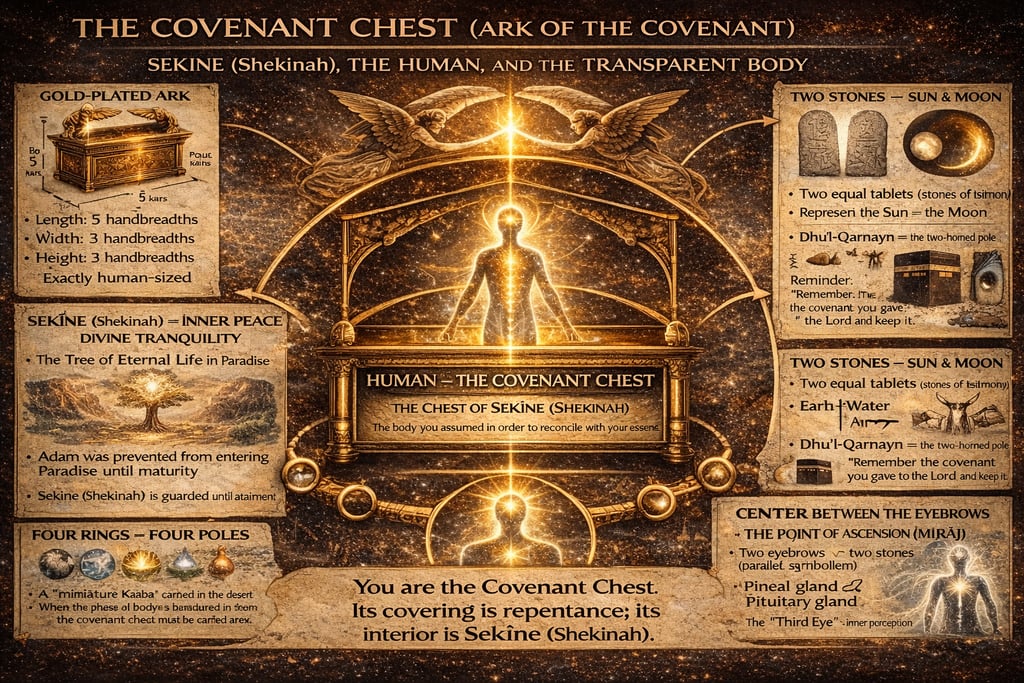
THE COVENANT CHEST. You know the one— what they call “Moses’ Holy Ark of the Covenant.” It is not that at all— not the chest the people imagine. The Lord described it, “On the mountain, in the finest detail.” And Moses fashioned it immediately after descending from the mountain.
APOCALYPSE BOOK
THE COVENANT CHEST
You know the one—
what they call “Moses’ Holy Ark of the Covenant.”
It is not that at all—
not the chest the people imagine.
The Lord described it,
“On the mountain, in the finest detail.”
And Moses fashioned it
immediately after descending from the mountain.
When Moses came down from the mountain,
he covered his face—why?
So that his gaze would not overwhelm,
so that the people could look upon him.
The Chest was made of wood overlaid with gold,
five handbreadths long,
three wide, three high—
its function was inner peace.
This is why it is called
“the Chest of Sekine (Shekinah).”
You donned the body
so that you might reconcile with your essence.
Nothing but Sekine (Shekinah)
can establish inner peace.
One who has faith in the heart
does not weep in the cave.
It was human-sized,
its body like a coffin.
Its lid was overlaid with gold—
its name was Repentance.
Above it lay two winged angels,
face down, facing one another,
resting upon it
to bear the Throne.
So close to the Chest,
they were seen in prostration—
for they knew the Lord was within,
and thus they were seized by ecstasy.
The Torah calls these angels Cherubim;
in Hebrew, this means
“like the Lord.”
Blessed is the one who awakens to this secret.
They awaken the seed of Sekine (Shekinah)
within the heart.
They are also known as
the Exalted Saints of Cancer.
They were the first
to bestow Sekine (Shekinah) upon our spirit.
Through this, humanity
attained the transparent body.
But by following Satan,
humankind descended from Paradise to Earth—
falling from the transparent realm
into the physical body.
So that Adam might not enter Paradise
before maturity,
the guardians always protect
Sekine (Shekinah) from him.
In Paradise, Sekine (Shekinah)
is the Tree of Eternal Life.
If you do not find it before death,
you will die again and again—alas.
The Cherubim guard the rivers of Paradise.
From their chiefs was transmitted
the revelation called the Torah.
With a body of earth and a pair of angels,
they became guides to Moses.
With them, Moses received news
from the Lord in the desert.
Every part of the Chest
was overlaid with gold.
For Sekine (Shekinah),
the Deity declared gold
to be the sole conductor.
The Lord carved two tablets of stone,
and inscribed two Names upon them,
so that the people might be bound together.
He placed the two equal tablets
vertically within the Chest—
they reflected two poles,
the primordial Sun and Moon.
The Kaaba also has two stones:
the Black Stone and the Esat Stone.
Esat means “the most blessed”—
keep your word and cross the path.
These two stones are Dhu’l-Qarnayn,
the two-horned pole.
“Remember the covenant you gave to the Lord—
and keep it.”
The heart transforms
when one returns from the Kaaba,
for the physical body
has received a share of Sekine (Shekinah).
The stones within the Chest
are called stones of testimony.
The Testimony of Faith is fulfilled
by seeing the Lord.
The chamber where the Chest stood—
none but Moses and Aaron could enter;
to enter otherwise
was tantamount to death.
It was a place of sacred etiquette,
a space of intimacy.
Only one could enter—
thus the Kaaba is called Bayt al-Haram.
Fixing his gaze
between the two stones,
Moses remembered
the primordial covenant.
Between the two stones,
a state would form,
and suddenly
he would transform
into a transparent body.
Between the two angels,
a Single Essence was being heard—
walking before the people
in the desert itself.
Like Moses,
his face was always veiled;
no one could lift
the veil of light
before death.
Imam means “the one in front,”
Mubīn means “manifest.”
The Mubīn Imam
is this transparent guide—
do not deny it.
Through this caliph,
the Lord proved Himself
and explained to the community
what the Hanif religion truly is.
For the first time,
he saw the Adam within
before dying—
and realized Adam is
the center between the eyebrows.
Between two stones and two brows
lies the Mi‘raj.
Vibrate these two points—
open your third eye.
Pituitary and pineal
are the names of these points.
No one has ever seen
the third eye from the outside.
You see even the outer world
within your brain—
the universe is within us,
with all its stars.
Even in ancient Russia,
there existed a copied ritual of this secret—
call it superstition or truth.
On the night of January ninth, at midnight,
a girl would pray to the Lord:
“Show me my spouse.”
She would place two mirrors
facing one another,
with two identical candles
burning between them.
She would stare between the candles,
her body drenched in sweat from excitement,
until a vision appeared
between the mirrors.
The vision would approach
and take the form of a man.
But before he kissed the girl,
the candles had to be extinguished—
otherwise, the hand that grasped hers
would be the hand of a jinn.
Leaving the girl here,
let us return again
to the Chest of Sekine (Shekinah).
The sacred Chest had
four rings and four poles—
the body-Chest
of earth, water, air, and fire.
This miniature Kaaba
was carried in the desert
by four poles,
which were removed when resting.
That is, when the physical body
is abandoned by death,
the people were told:
“Carry your Chest anew.”
Only upon reaching
the Promised Land,
the Lord said:
“The four carrying poles shall be removed.”
That land is called Peace (Salām)
and the Temple of Solomon—
built without hammers,
that is, transparent and eternal.
Thus the coffin of Sekine (Shekinah)
is also called
the true child of Adam,
possessor of the body of light.
The Kaaba is a fixed Chest,
for it has no four poles.
It does not go to the grave like a coffin—
reflect on this distinction.
You are the Chest of the Covenant.
Its covering is repentance.
Repent—from the Lord’s Point
to the B above it.
Otherwise,
you will remain a carrier of chests
throughout the ages.
The chosen child
must find the true mother and father.
Repent—
between the coffin and the two angels:
“One who does not prostrate to the Face
is condemned to disgrace.”
The land where the Kaaba stands
is called Amin.
Upon the Stone,
the Lord of the Worlds inscribed:
MUHAMMAD ALI.
When Adam gave his covenant
to the Lord, saying “You are my Lord,”
these two stones
became witnesses to his word.
For this reason,
the Chest is called
the Ark of the Covenant—
invoked with every breath:
“Hū… Hū…”
Carry the Throne upon your head
like the exalted angels,
lest you become, like Iblis,
one who stands against Rahman.
Master M.H. Ulug Kizilkecili
Türkiye/Ankara - 19 June 1999
IMPORTANT NOTE :The original text is poetic, and the author cannot be held responsible for any errors in the English translation! To read the original Turkish text, click HERE! The following section is not the author's work, and the author cannot be held responsible for any errors made!
Academic Footnotes on the Qur’anic, Biblical, and Intertestamental References
1. The Non-Crucifixion and Ascension of JESUS
The text explicitly grounds its claim that Îsâ was not killed, that his death was a likeness or resemblance, and that he was raised alive, in the Qur’an.
Qur’an: An-Nisāʾ 4:157–158
(“They did not kill him, nor did they crucify him, but it was made to appear so… rather, Allah raised him to Himself.”)
2. “Dying Before Death” (Ethical–Mystical Principle)
The phrase “to die before dying” is not a direct scriptural quotation but a mystical–ethical maxim, especially prominent in Islamic spirituality. In the text, it is interpreted as the death of the ego (nafs) and the rising of the Spirit (Rûh).
This motif is conceptually aligned with Qur’anic teachings on self-purification and inner transformation, though the expression itself functions symbolically rather than as a direct verse citation.
3. The Ascension of the Spirit in “Fifty Thousand Years”
The statement that the Spirit ascends to Rahman in fifty thousand years directly corresponds to a Qur’anic verse describing the ascent of the angels and the Spirit.
Qur’an: Al-Maʿārij 70:4
(“The angels and the Spirit ascend to Him in a day whose measure is fifty thousand years.”)
4. “The First and the Last” (Inner–Outer Unity)
The text’s formulation—“The First and the Last are the same; only the veil differs”—is grounded in the Qur’anic articulation of divine totality.
Qur’an: Al-Ḥadīd 57:3
(“He is the First and the Last, the Manifest and the Hidden…”)
5. The Night of Power and Peace Until Dawn
The phrase “peace until dawn” is a direct reference to the closing verse of Sūrat al-Qadr.
Qur’an: Al-Qadr 97:5
(“Peace it is until the rising of dawn.”)
6. Signs in the Horizons and Within the Human Being
The text’s emphasis on divine signs appearing both in the cosmos and within the human being reflects a central Qur’anic epistemology.
Qur’an: Fuṣṣilat 41:53
(“We shall show them Our signs on the horizons and within themselves…”)
7. The Parallel Between JESUS and Adam
The statement “Îsâ is exactly like Adam” is a direct Qur’anic comparison.
Qur’an: Āl ʿImrān 3:59
(“Indeed, the likeness of Îsâ before Allah is as that of Adam…”)
Parallels in the Torah / Hebrew Bible (Tanakh)
8. Moses Covering His Face (The Veil Motif)
The text refers to Moses covering his face after descending from the mountain, symbolizing the veil between divine light and the people.
Torah (Tanakh): Exodus 34:33–35
(Moses places a veil over his face after speaking with the people.)
9. The Fifth Day and the Creation of Great Sea Creatures
The reference to “great fish created on the fifth day” corresponds to the Genesis creation narrative.
Torah: Genesis 1:21–23
10. The Jubilee (The Fiftieth Year)
The notion that the fiftieth year represents liberation and equality corresponds to the Jubilee law.
Torah: Leviticus 25:10–11
11. The Counting of Fifty Days
The symbolic structure of counting seven weeks plus one day underlies the text’s numerological emphasis on fifty.
Torah: Leviticus 23:15–16
Parallels in the New Testament
12. Pentecost: The Descent of the Spirit
The text’s reference to the Spirit descending fifty days after Passover corresponds to the Pentecost narrative.
New Testament: Acts 2:1–4
13. The Sign of Jonah (Three Days)
The “fish’s belly for three days” motif appears in both Hebrew scripture and the teachings of Jesus.
Tanakh: Jonah 1:17
New Testament: Matthew 12:40
14. The Paraclete (Paraklētos)
The statement “After me, another Paraclete will come” aligns with the Johannine promise of another advocate.
New Testament: John 14:16
Shared Interreligious Themes (Analytical Summary)
Ascension and Spiritual Elevation:
Seen in the Qur’anic raising of Îsâ, Moses’ veiling after divine encounter, and the descent of the Spirit at Pentecost.Numerical Symbolism (50 and 3):
Jubilee (50th year), the counting of fifty days, Pentecost, and the three-day Jonah typology form a shared symbolic language across traditions.Inner Signs and Anthropological Revelation:
The Qur’anic principle of signs within the self (41:53) supports the text’s portrayal of the human being as a spiritual microcosm.