THE COVENANT (The Ark of Shekinah)
THE COVENANT (The Ark of Shekinah). “I was a prophet,” said the Messenger, “while Adam still was clay!” After ALLAH, the RESÛL and AHL AL-BAYT hold eldest sway! Without the covenant, no soul can angel, man, or prophet be! ÂLÎ examines every pledge; for believers this is prayer truly!
APOCALYPSE BOOK
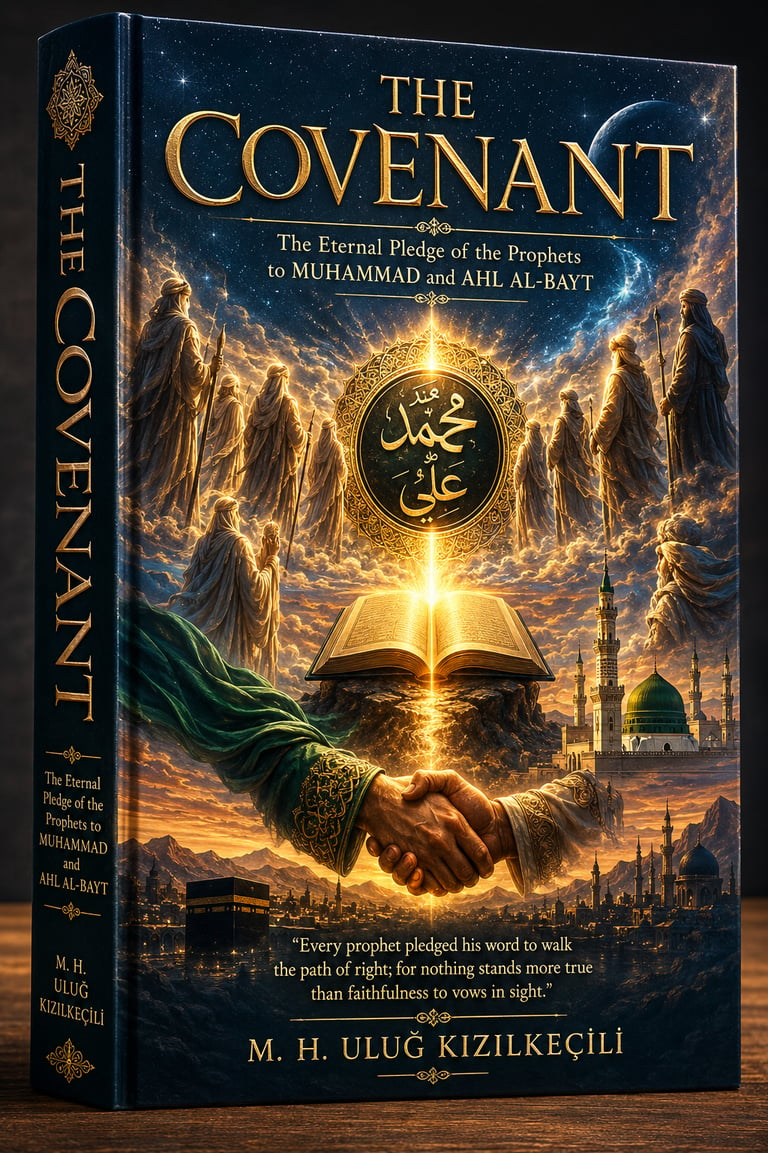
THE COVENANT
Every prophet pledged his word to walk the path of right!
For nothing stands more true than faithfulness to vows in sight!
“His own fitrah and the Prophet’s nature stood as witness clear!”
“Lord took from every prophet, for AHL AL-BAYT, a solemn swear!”
“Every prophet gave his word to MUHAMMAD and AHL AL-BAYT!”
For the light of MUHAMMAD-ÂLÎ in all became their state!
“I was a prophet,” said the Messenger, “while Adam still was clay!”
After ALLAH, the RESÛL and AHL AL-BAYT hold eldest sway!
Without the covenant, no soul can angel, man, or prophet be!
ÂLÎ examines every pledge; for believers this is prayer truly!
“He alone suffices witness unto Lord!” “He knows the Book’s deep lore!”
For “the pleasure of ALLAH,” MURTEZÂ becomes the only cord!
“Will he hold fast unto that rope?” thus every man is born;
To grasp the hand of Lord’s beloved while alive is greatest form!
The one who takes that hand receives reward tenfold in grace;
“You became dust to ABÛTTURÂB! Pass now unto the right-side place!”
For taking hands alone there is no compulsion on believer’s soul;
Whatever its reward may be, that measure shall become his role!
But enemies of AHL AL-BAYT are “betrayed by their very face!”
ÂLÎ casts the Marsık visage straight into the fire’s embrace!
“To speak, from RAHMÂN only He received permission and decree!”
He cries aloud: “This is your right!” proclaiming: “MU’EZZIN!” openly!
M. H. ULUĞ KIZILKEÇİLİ
ANKARA – November 22, 2000
Ahit = Covenant / Promise
(The section written after this point has no relation to the author, and the author cannot be held responsible for errors made thereafter!)
FOOTNOTES
[1] “Every prophet pledged his word to walk in truth”
On the outward level, this verse refers to the truthfulness of the prophets; inwardly, however, it speaks of the cosmic fidelity rooted in existence itself. In Islamic esoteric interpretation, “truthfulness” is not merely moral honesty, but ontological conformity to reality — that is, existence bearing witness unto the Lord exactly as it truly is. In Judaism, this theme appears through the concept of berit/covenant, the bond between God and the people; in Jeremiah 31, the covenant is no longer written upon external tablets, but upon the heart itself. In Zoroastrianism, a similar axis exists in asha — truth, cosmic order, and divine harmony. In Taoism, to live in harmony with the “Unnamed Origin” is likewise considered fidelity to the essence of existence. Thus, the “truthfulness” of the poem should not be read merely as an ethical command, but as loyalty to the cosmic order itself.
[2] “Faithfulness to the covenant”
Here, “faithfulness to the covenant” evokes, in the Sufi sense, man’s loyalty to the primordial promise made before entering the world. In Qur’an 7:172, the descendants of humanity testify “Yes” to the divine question: “Am I not your Lord?” Classical Islamic tradition interprets this passage as the Covenant of Alast — the primordial pact. The poem expands this motif onto the level of the prophets and constructs human existence itself as an ethic of remembrance. In Jewish and Christian traditions, covenant is generally established with a historical community; here, however, the covenant deepens further into a pre-existent spiritual agreement.
[3] “Lord took from every prophet a covenant for AHL AL-BAYT!”
Read through a Shi‘i-irfanî perspective, this expression approaches the idea that at the center of all prophethood lies the Muhammadan Reality and its familial-theophanic manifestation. The term AHL AL-BAYT appears explicitly in Qur’an 33:33, yet the poem extends it beyond a merely historical family designation into a luminous lineage, an axis of walâyah, and the carrier of divine trust. Comparatively speaking, Judaism contains similar structures through priestly lineage, the Davidic line, and the chosen covenantal chain; Christianity through apostolic succession and the salvific line centered upon Christ; Sikh tradition through the concept of the light and authority transmitted through the Guru. Thus, the poem interprets AHL AL-BAYT not merely as kinship, but as the historical carrier-line of divine wisdom.
[4] “Every prophet gave his word to MUHAMMAD and AHL AL-BAYT”
This verse rests upon the notion of a primordial light existing prior to historical prophets themselves. The strongest parallel here emerges with the Christian concept of Logos: in John 1, “In the beginning was the Word… and all things were made through Him.” The two traditions are not identical; yet from the perspective of comparative theology, both present a figure who appears historically later, but is metaphysically linked to a divine principle existing from the beginning of creation. In Hindu traditions, the doctrine of avatāra — especially Bhagavad Gītā 4:7–8 — teaches that divine descent recurs whenever dharma declines. Thus, the poem’s idea of “the light that is the essence of all prophets” may be interpreted as the manifestation of one truth across different times and forms.
[5] “I was a prophet, said the Messenger, while Adam was still clay”
This line transcends historical chronology and asserts a metaphysical priority. Academically speaking, what stands at the center here is not the biographical individual, but the eternal principle of truth itself. Within Islamic irfan, this motif relates to interpretations surrounding the Muhammadan Reality (Haqîqat al-Muhammadiyya). Comparatively, similar conceptual spaces emerge in the Logos of John, the nameless eternal Tao of the Tao Te Ching, and the timeless Absolute of the Upanishads. Yet the poem differs from these traditions by constructing this primordiality within a personal and love-centered light of walâyah.
[6] “Without the covenant, no prophet, angel, or human can exist!”
This line portrays even humanity and the angels as beings responding to a primordial call. Within the Islamic framework, this is the covenantal dimension of ontological servanthood. In Judaism and Christianity, the human being is likewise defined through relationship with God; in Sikh tradition, it is emphasized that without the grace of the Divine Name and the Guru, truth cannot be attained. Buddhism lacks a theistic covenant, yet conscious commitment to awakening — refuge and disciplined practice — functions similarly as an existential vow. Thus, although the poem’s covenant has no exact equivalent across all religions, it may broadly be read as an oath of fidelity to ultimate truth.
[7] “ÂLÎ examines the covenant — for the believer, this is prayer!”
Here, “ÂLΔ functions not merely as a historical name, but as the scale that discerns the exalted — the balance of truth itself. Prayer, in this context, becomes not only ritual worship but the living practice through which fidelity is tested. This resonates strongly with the Sufi understanding that “the essence of worship is presence.” Comparatively, the constant recitation of the Shema in Judaism, the covenant written upon the heart in Christianity, nām-simran in Sikhism, and continuous mindfulness in Buddhist discipline all transform fidelity to truth into daily practice. Thus, the poem transforms prayer from ritual form into the moment in which covenant-consciousness is measured.
[8] “Possessor of the knowledge of the Book”
This expression evokes the Qur’anic themes of witnessing and gnosis: the true witness is not merely the one who knows the text, but the one who lives its inner reality. Christianity’s idea of “the Word made flesh,” Judaism’s notion of the law written upon the heart, and Sikh understanding of the Guru’s Word as inward truth all approach this same idea. In Taoism, truth diminishes the moment it is spoken, yet still points toward the Way. Thus, the “knowledge of the Book” in the poem should not be understood as dry literary knowledge, but as wisdom penetrating the secret of existence itself.
[9] “MURTEZÂ is the only rope!” / “Every human is born to see whether he will hold that rope”
The symbol of the rope is extraordinarily powerful throughout religious history. In Islam, clinging to the Rope of Allah is a famous metaphor; the poem links this directly to the axis of walâyah. Esoterically, the rope symbolizes the connection between heaven and earth, the Absolute and humanity, the inner and the outer. In Hindu and yogic traditions, the Guru or teaching guides liberation from samsāra; in Buddhism, Dharma is the raft carrying one to the farther shore; in Christianity, Christ is “the Way” and “the Door”; in Sikh tradition, the Guru’s grace mediates access to truth. By personifying the rope, the poem transforms an abstract principle into a historical and embodied station of guidance.
[10] “To grasp the hand of the friend of Lord”
“Taking the hand” symbolizes initiation, allegiance, discipleship, and spiritual transmission on the esoteric level. Throughout the history of religions, many traditions hold that truth is transmitted not only through text, but through a living representative. Rabbinic transmission in Judaism, apostolic continuity in Christianity, Sufi initiation, and Guru-centered authority in Sikhism all reflect this structure in different forms. The poem thus constructs truth not merely as an abstract proposition to be believed, but as a tangible relationship of fidelity embodied through the “friend of Lord.” Consequently, salvation arises not from abstract concepts, but from a living bond.
[11] “The reward of the one who takes the hand is repaid tenfold”
Outwardly, this line refers to reward; inwardly, it expresses the principle that turning toward truth returns multiplied blessings. Comparatively, the Abrahamic traditions associate fidelity with divine blessing; Hindu traditions teach karmic consequence; Buddhism speaks of the fruit of wholesome action (kusala); Sikhism emphasizes the transformative power of nām and seva. The originality of the poem lies in its connection of this multiplication not merely to ethics, but to an economy of walâyah: an act touching the true bond expands not quantitatively, but qualitatively.
[12] “The enemy of AHL AL-BAYT… he casts into the Fire!”
Although this harsh statement may outwardly appear as hostility toward opponents, esoterically “fire” often symbolizes the burning away of the self opposed to truth. In Zoroastrianism, fire represents not only punishment but purity and truth itself; in Christian mysticism, divine fire purifies; in Islamic irfan, fire may signify the burning away of veils. Thus, the fire in the poem can be interpreted not merely as external punishment, but as the dissolution of the false form within its own contradiction. This reading does not soften the polemical tone of the text, but instead relocates it into symbolic interpretation.
[13] “Only He received permission from RAHMÂN to speak”
This line evokes the idea of eschatological mediation and final witnessing. Esoterically, “permission” here means not merely authorization to speak, but authority to unveil truth itself. Christian discussions of intercession and the Paraclete, Jewish concepts of final testimony, Islamic ideas of shafâ‘ah and witnessing, and Sikh portrayals of the Guru proclaiming truth all fulfill similar functions. The poem concentrates this authority within a particular center of walâyah; thus, truth becomes not scattered information equally voiced by all, but a secret unveiled through permission.
[14] “MU’EZZIN”
The final word is deeply significant. Outwardly, the mu’ezzin is the one who calls to prayer; inwardly, he represents the moment when truth becomes audible — when the call itself receives a voice. Christianity’s proclamation of the Word, Judaism’s “Hear O Israel,” Sikhism’s śabad, Taoism’s pointing toward the unspeakable Way, and Buddhism’s proclamation of Dharma all approach the same archetype: truth does not merely exist; it calls. In the poem, this call is constructed as the final proclamation of walâyah itself. Thus, the mu’ezzin here is not merely the reciter of the adhān, but the cosmic herald of truth.
THE WORD: A DEEP COMMENTARY ON THE COSMIC COVENANT, WALÂYAH, AND ESOTERIC TRUTH
An Academic Study from the Perspectives of the History of Religions, Irfan, and Comparative Metaphysics
Introduction: The Ontology of the “Word”
M.H. Uluğ Kızılkeçili’s poem “THE WORD” appears outwardly as a praise of walâyah; yet within its deeper structure, it constitutes an intense esoteric manifesto concerning humanity’s metaphysical origin, the cosmic covenant, the light of truth, and the inward fidelity of existence itself. The text is not merely poetry; it is simultaneously a poetic theology of Islamic irfan, Shi‘i walâyah thought, Sufi ontology, and the doctrine of the primordial covenant. What is particularly striking, however, is that the conceptual structure of the poem resonates not only within the Islamic tradition, but also with the esoteric cores of Judaism, Christianity, Zoroastrianism, Hinduism, Buddhism, Taoism, and Sikhism.
For this reason, to read the poem merely as a sectarian eulogy would be insufficient. In truth, the text approaches a metaphysical doctrine of unity suggesting that “truth has manifested throughout history in different forms while preserving the same essential reality.”
Thus, the fundamental questions become:
What is the human being?
What is the essence of existence?
What does fidelity to truth truly mean?
And why do all prophets gather around “one Word”?
The entire poem revolves around an esoteric doctrine of mîsâk — the primordial covenant.
I. THE COSMIC COVENANT AND PRE-EXISTENTIAL FIDELITY
“Every prophet pledged his word to walk in truth!”
This line does not merely speak of the honesty of the prophets. Here, “truthfulness” does not signify ethical honesty in the modern sense, but ontological alignment — becoming a vibration fully harmonized with the essence of truth itself.
In Sufi interpretation, sidq (truthfulness) means complete correspondence with reality. The falsehood of existence lies in imagining itself independent from the Lord. Truthfulness, by contrast, is the consciousness that says: “I am from Him.”
This idea is not unique to Islam.
The Covenant in Judaism
The Hebrew term Berit signifies the sacred bond between God and humanity. Yet in esoteric Kabbalistic readings, this covenant is not merely historical but cosmic. The human soul itself is understood as a spark overflowing from God. Thus, fidelity is ontological belonging before it becomes outward obedience.
The Logos in Christianity
The statement in the Gospel of John:
“In the beginning was the Word”
carries an extraordinary parallel to the poem’s concept of “Word.” Here, the Word is not sound alone; it is creative vibration.
The Logos is not merely speech. It is cosmic intellect.
Thus, “giving one’s word” in the poem resembles an oath of fidelity to the Logos itself.
Asha in Zoroastrianism
Asha signifies truth, order, and cosmic harmony. To live in accordance with the divine order of the universe means to stand on the side of truth.
The poem’s emphasis on “truthfulness” strongly approaches this idea.
The Way in Taoism
In the Tao Te Ching, to live according to the Tao means to harmonize oneself with the primordial rhythm of existence.
Thus, the “Word” in the poem may ultimately be understood as humanity’s ancient frequency agreement with the cosmos itself.
II. THE COVENANT OF ALAST AND THE SOUL’S FIRST MEMORY
“Because nothing is truer than fidelity to the covenant!”
The address “Alastu bi Rabbikum?” (“Am I not your Lord?”) in Qur’an 7:172 represents, within Islamic esotericism, the primordial promise given by the human soul before entering the world.
This event is not historical, but metaphysical.
It is the soul’s first memory.
In Sufism, all human suffering arises from forgetting this primordial unity.
For this reason, the world becomes exile.
Thus, “faithfulness to the covenant” in the poem means not merely keeping one’s promise, but remembering one’s forgotten origin.
Platonic Anamnesis
For Plato, knowledge is not learning but recollection.
The soul already knows truth.
The covenant in the poem functions similarly:
Truth is not taught from outside.
It is remembered from within.
Hinduism and Atman
In the Upanishads, the essence of the human being is Brahman itself, yet through maya this truth becomes forgotten.
What Sufism calls ghaflah (heedlessness), Hindu thought calls maya.
The poem is therefore a call to awaken this forgotten primordial fidelity.
III. THE MUHAMMADAN LIGHT AND THE ETERNAL HUMAN
“Every prophet gave his word to MUHAMMAD and AHL AL-BAYT!”
From the standpoint of historical Islam, this statement may appear controversial; yet esoterically, the poem is not constructing a chronology, but a metaphysical center.
Muhammad here ceases to be merely a biographical figure.
He becomes the Cosmic Human.
In Sufism, this is known as the Muhammadan Reality (Haqîqat al-Muhammadiyya):
the primordial light-consciousness existing before creation itself.
The Parallel with Logos
A strong parallel emerges here with the Logos in John.
In both doctrines, the figure appearing within history already exists from eternity.
The difference, however, is significant:
• In Christianity, the Logos is interpreted as the Son of God.
• In Sufi metaphysics, the Muhammadan Light is understood as the first manifestation of divine truth.
Hindu Avatars
The doctrine of Vishnu appearing in different forms throughout cosmic ages reflects a similar structure.
Truth is one.
Manifestations are many.
The poem clearly points toward this metaphysical principle.
IV. AHL AL-BAYT: LINEAGE OR LIGHT?
Within the poem, AHL AL-BAYT is not merely a historical family.
It is a lineage of light.
On the esoteric plane, AHL AL-BAYT becomes:
• The carrier of divine wisdom,
• The guardian of inner knowledge,
• The manifestation-line of cosmic walâyah.
The Parallel with the Sefirot in Kabbalah
In Kabbalah, divine energy unfolds through emanational channels.
Similarly, the doctrine of AHL AL-BAYT becomes the historical transmission-line of divine light itself.
The Guru Lineage in Sikhism
In Sikh tradition, truth is transmitted through the chain of Gurus.
The light passes from person to person.
This bears a remarkable resemblance to the poem’s doctrine of walâyah.
V. “I WAS A PROPHET WHILE ADAM WAS STILL CLAY!”
This line represents the metaphysical summit of the poem.
Here, time itself breaks apart.
For in esoteric thought, truth is not temporal.
The Perspective of Ibn ‘Arabî
According to Ibn ‘Arabî, truth first exists as light, and only afterward assumes historical forms.
Thus, “Muhammad” precedes the historical individual as a cosmic principle.
The Parallel with Tao
The Tao:
• Is nameless,
• Eternal,
• Prior to all forms.
The poem’s doctrine of primordial light approaches this same metaphysical horizon.
The Buddhist Dharmakaya
In Mahayana Buddhism, Dharmakaya signifies the body of truth beyond all forms.
Functionally, it bears strong resemblance to the Muhammadan Light.
VI. “ÂLÎ EXAMINES THE COVENANT”
This statement is not merely sectarian glorification.
Here, ÂLÎ becomes:
• The cosmic balance,
• The consciousness distinguishing truth,
• The measure of existence itself.
In Sufism, Ali is regarded as:
• The Gate of Knowledge,
• The center of walâyah,
• The pole of esoteric wisdom.
Thus, Ali transcends historical individuality and becomes the principle of irfan itself.
The Principle of Ma’at in Ancient Egypt
In Ancient Egypt, the soul’s heart was weighed against the feather of Ma’at.
The line “ÂLÎ examines the covenant” evokes a strikingly similar metaphysical judgment:
the scale of truth itself.
VII. THE ESOTERIC INTERPRETATION OF PRAYER
“For the believer, this is prayer!”
Prayer here is not ritual alone.
It is the continuous alignment of consciousness.
True prayer means:
• The constant orientation of existence toward the Lord.
The Parallel with Zen
In Zen, meditation is not merely sitting.
It is remaining centered within existence itself.
Huşû in Sufism,
zazen in Zen,
yoga in Hinduism,
all approach the same ontological axis:
the gathering of the scattered self back toward its center.
VIII. THE SYMBOL OF THE ROPE AND THE COSMIC BOND
“MURTEZÂ is the only rope!”
The symbol of the rope possesses extraordinary depth throughout religious history.
In Islam:
“Hold firmly unto the Rope of Allah…”
In Hinduism:
The Guru is the bond carrying one across the ocean of samsāra.
In Buddhism:
Dharma is the raft carrying one to the farther shore.
In Christianity:
Christ is “the Way.”
Thus, within the poem, the rope becomes:
• The energetic line between heaven and earth.
When humanity binds itself to that line, it returns to its center.
IX. “TAKING THE HAND”: THE SECRET OF INITIATION
In Sufism, taking the hand signifies:
• Allegiance,
• Spiritual affiliation,
• Spiritual rebirth.
This same structure appears within:
• Masonic initiations,
• Hermetic traditions,
• Shamanic transmissions,
• Zen teacher lineages.
Truth is not transmitted through books alone.
A living transmission is required.
For this reason, the poem employs the metaphor of the hand.
Because truth is transmitted through contact.
X. THE ESOTERIC MEANING OF FIRE
“He casts him into the Fire!”
The fire here is deeper than the literal fire of hell.
On the esoteric level, fire signifies:
• Purification,
• Dissolution,
• The burning away of the ego.
Nigredo in Alchemy
In alchemy, the first stage is burning.
Transformation cannot begin until the old self dies.
The Fire of Zoroastrianism
Here, fire symbolizes truth itself.
Falsehood cannot endure within it.
Thus, hostility toward AHL AL-BAYT in the poem symbolizes, on the deepest level:
the resistance of the ego against truth itself.
What burns is not the essence,
but the veil.
XI. “ONLY HE RECEIVED PERMISSION FROM RAHMAN”
This expression is not merely a discourse of authority.
Here, “permission” signifies:
• The authority to unveil truth,
• The capacity to carry the secret,
• The qualification for cosmic speech.
In Sufism, this is called:
ijāzah — spiritual authorization.
In Gnostic Traditions
Truth is not revealed to everyone.
Because not everyone can bear it.
For this reason, the poem transforms walâyah into the center of sacred secrecy.
XII. MU’EZZIN: THE COSMIC CALL
The final word is extraordinarily significant.
The “Mu’ezzin” here is not merely the one who recites the adhān.
He becomes:
• The voice of the cosmic call,
• The echo of the divine frequency.
Kerygma in Christianity
The proclamation of truth…
The Call of Dharma in Buddhism
The announcement of the Buddha’s teaching…
The Shema in Judaism
“Hear, O Israel!”
In all traditions, truth does not merely exist.
It calls.
At the conclusion of the poem, the Mu’ezzin becomes the metaphysical symbol of this eternal call.
CONCLUSION: THE HIDDEN DOCTRINE OF THE POEM
Fundamentally, this poem is constructed upon four great esoteric axes:
The Cosmic Covenant
The Muhammadan Light
Walâyah and Spiritual Guidance
The Remembrance of Truth
Although the text appears outwardly sectarian, within its deeper structure it touches the shared metaphysical memory of humanity itself.
The poem’s most significant insight is this:
Although truth appears throughout history under different names, its essence remains one.
• Logos,
• Tao,
• Asha,
• Dharma,
• Haqîqat al-Muhammadiyya,
• Śabad,
• The Light of the Guru…
All may be interpreted as expressions of the same central intuition translated into different sacred languages.
For this reason, the poem is not merely a religious poem.
It is a cosmological text.
A manifesto of irfan.
A call to remembrance.
And at its deepest level, it whispers the following sentence:
Humanity does not enter the world in order to learn something new,
but to remember the forgotten covenant.