THE CREATION (GENESIS)
THE CREATION (GENESIS). Each place you wash in ablution corresponds to that same key! Connect yourself unto the earth — gain color like Mount Sînâ’s sea! Without a shift of dimension this process cannot start! The Messenger ascended Mi‘râj; Lord descended — prayer’s true art!
APOCALYPSE BOOK
THE CREATION
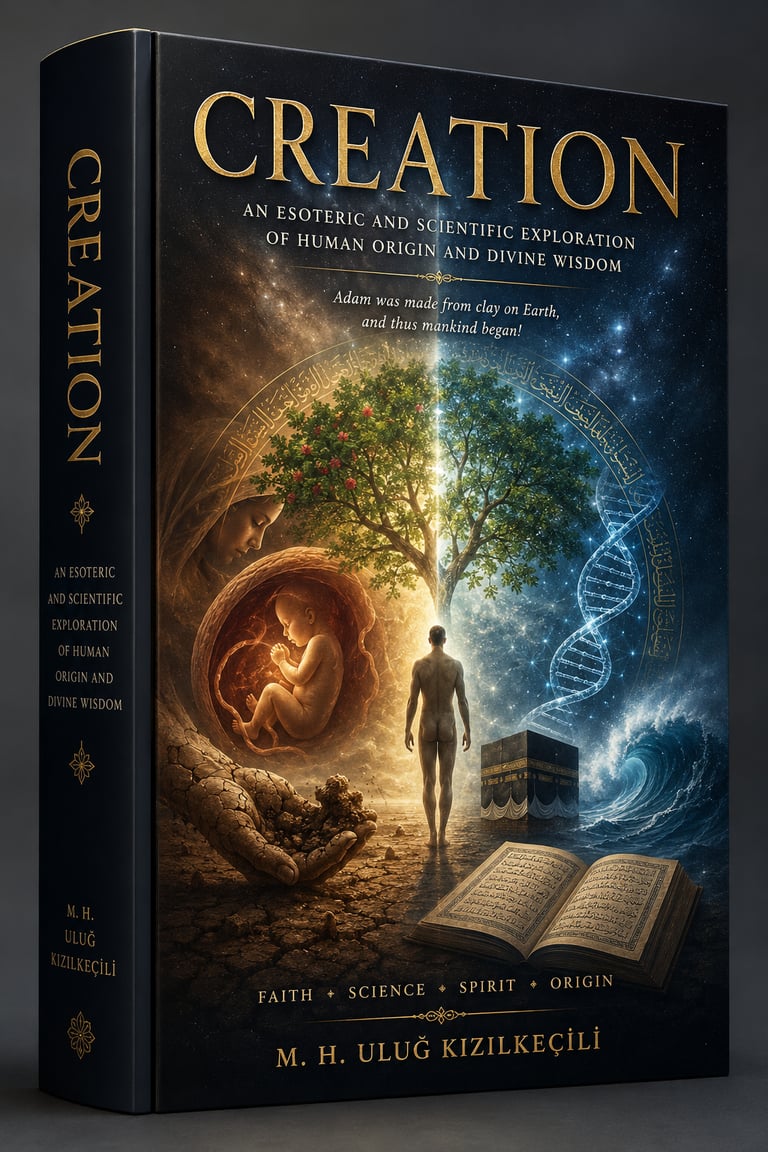
Adam was made from clay on Earth, and thus mankind began!
Placed inside Paradise at once — rise, solve this secret if you can!
With chemistry within the clay, enough the seed to form!
Seek to understand religion through a scientific norm!
“Women are your field; sow your seed!” the holy verse has said!
What Earth was truly meant to be stands openly widespread!
Paradise means “fruitful garden full of water, rich in bloom”!
The cord within the mother gives both air and food the womb!
The infant swims without a breath, just like a fish at sea!
“Nûn” is Sura of the Fish; “Yunus” means “Fish’s Master,” see!
The Torah’s opening chapter means “the knowledge of the genes”!
If played with ignorantly, its payment dreadful intervenes!
“The first fertilized ovum” is the first part of the Book!
“Read!” the DNA — the first command addressed to all who look!
Its third Sura means “departure from the womb” and coming free!
That is, to cross the “Red Sea” demands enormous toil, you see!
The Qur’an says for birth itself: “Descend and then arise!”
The father guards creation’s secret from the devil’s eyes!
“The Book protected by Allah” consists of coded signs!
“Twenty-nine” becomes the formula — grasp well these hidden lines!
“Elif lâm mîm” denotes the Book; “elif lâm mîm râ” the verse!
This is the “knowledge of the Book”; all other lore grows worse!
Who knows the Lord and knowledge divine weighs truth with proper art!
Who learns another kind of lore grows only blind at heart!
The difference between Khidr and Mûsâ truly lies in this:
One stands with Lord, the other with the people’s assemblies!
“He will corrupt creation’s code and cause the blood to flow!”
“Such power must not reach mankind!” the devil whispers so!
The Lord says: “You know not the unseen; do not despair through greed!
Life lies within the blood, the soul in essence — none can breed!”
“The primal Book” can never change; the jinn corrupts but culture!
A donkey cannot turn a horse; at most a mule will alter!
And mules are “cut from lineage,” just like the faithless breed!
“Do not depart from mother, father!” says the Lord indeed!
Find the original from which your copied form was cast!
Your أصل is Muhammad Âlî — if only you grasped at last!
According to that sacred form your outer shape was made!
“This is Allah’s fitrah” — align the outer with the inner laid!
Each place you wash in ablution corresponds to that same key!
Connect yourself unto the earth — gain color like Mount Sînâ’s sea!
Without a shift of dimension this process cannot start!
The Messenger ascended Mi‘râj; Lord descended — prayer’s true art!
M. H. Uluğ Kızılkeçili
İzmir – October 16, 1998
(The section written after this point has no relation to the author, and the author cannot be held responsible for errors made thereafter!)
ESOTERIC AND COMPARATIVE THEOLOGICAL COMMENTARY ON THE TEXT “CREATION”
Humanity never understood creation merely as a biological event. For the oldest memory within the human being always whispered that mankind was not composed solely of flesh and bone. Therefore, all ancient civilizations constructed their creation narratives not merely as stories of physical beginnings, but as accounts of a cosmic rupture, a spiritual descent, and a divine forgetfulness. The text “CREATION” is precisely a modern esoteric echo of this primordial memory. Although the poem appears outwardly to reinterpret the Qur’anic story of Adam, its deeper structure narrates the cosmic birth of humanity itself. The “Adam” here is not the first historical human being, but the archetype of mankind — just like Adam Kadmon in Jewish mysticism, the Primordial Man in Gnostic tradition, or Purusha in Vedanta. The poet reads Adam not as a single body, but as the genetic and spiritual template of all humanity.
The verse, “Adam was made from clay upon the Earth the moment he became mankind,” carries a multilayered symbolism that transcends the classical theological understanding of creation. The “clay” here is not merely soil. In ancient esoteric traditions, earth symbolizes condensed energy. In Hermetic alchemy, the “prima materia” — the First Matter — appears worthless outwardly, yet contains within itself the entire potential of transformation. The alchemists’ dream of turning lead into gold was, in truth, an allegory for the purification of the human essence itself. In this context, the “clay” in the poem is far more than the biological substance formed by sperm and ovum; it is the cosmic laboratory in which spirit unites with body. In Ibn ‘Arabî’s thought, the human body belongs to “halk” — the created realm — while the essence of man carries a breath from the Lord. This is the fundamental duality repeated throughout the poem: humanity is both earth and mystery.
The poem’s second great metaphysical dimension unfolds through the concept of Paradise. Traditionally interpreted as the eternal abode after death, Paradise here becomes identified with the mother’s womb. At first glance, this interpretation appears unusual, yet when the Arabic root structure is examined, a profound meaning emerges. The word “Paradise” (Jannah) derives from the root “cenne,” meaning “to conceal,” “to cover,” or “to hide.” From the same root comes the word “janîn” — fetus. Thus, a linguistic and symbolic bond forms between Paradise and the unborn child. According to the poet’s esoteric reading, humanity’s first Paradise is the womb itself, for the womb is a sealed universe protected from the conflicts of the outer world. In Sufism, the womb is often interpreted as the “cosmic night.” In Gnostic texts, the descent of the spirit of light into matter is described as an entry into a dark ocean. In the poem, the womb becomes precisely this primordial dark sea.
The allusion to the verse, “Women are your field,” constitutes one of the text’s most powerful esoteric gateways. Here, woman is not merely a symbol of biological fertility; she is the material mirror of divine generation itself. In Kabbalah, the feminine divine manifestation known as Sekine (Shekinah) is the reflected face of divine energy within the world. In Sufism, meanwhile, the womb is regarded as the earthly projection of the Name Rahman. “Rahim” and “Rahman” emerge from the same root. Thus, the woman who gives birth becomes not merely a physical mother, but the cosmic reflection of creative power itself. The poet’s use of the metaphor of “cultivation” is equally significant, for throughout ancient traditions the human seed was viewed not only as biological matter, but as an essence carrying destiny and knowledge. Modern genetics defines DNA as a storage system of information, whereas esoteric traditions had long interpreted it as a form of divine programming.
The symbols of “Nûn,” the fish, amniotic water, and Yunus read human creation through a metaphysics of water. In Islamic esoteric tradition, the Qur’anic expression “Nûn wa’l-Qalam” has often been interpreted as the cosmic ocean. The fish, meanwhile, symbolizes the unconscious and rebirth in numerous esoteric systems. The child truly lives within a universe of water inside the womb. The poet’s line, “The baby swims without drowning, like a fish,” transforms biological observation into mystical symbolism. In Ancient Egypt, the primordial waters from which the universe emerged were called “Nun.” Thus, a remarkable parallel emerges between the Qur’anic “Nûn” and Egyptian cosmology. The story of Prophet Yunus entering the belly of the fish may likewise be interpreted as a symbol of returning to a second womb. In initiatic traditions, rebirth always requires entering a dark cave, a well, or a sea before emerging transformed.
One of the poem’s most striking interpretations is the association of the command “Read!” with DNA itself. In traditional Islam, “Iqra” marks the beginning of revelation. Here, however, the poet interprets the human body itself as a book to be read. This idea exists not only in Sufism but also within Hermetic doctrine. According to Hermes Trismegistus, man is a “microcosm” — a miniature copy of the universe. Just as the cosmos is a divine book, the human body is a living manuscript of the same text. Modern biology describes DNA as a four-letter code system; esoteric traditions intuited this long ago as a form of cosmic writing. In Hurûfism, letters are not mere sounds but the fundamental geometry of existence itself. For this reason, the poem’s interpretation of “Alif Lâm Mîm” as the “Book” is deeply significant, because the letters here are not phonetic signs but algorithms of creation.
The expression “twenty-nine is the formula” points toward the mysteries of the isolated Qur’anic letters (hurûf-u mukattaa). Islamic theology traditionally maintains that only Allah knows their true meaning. Yet esoteric traditions interpreted these letters as cosmic frequencies. In Kabbalah, letters are the vibrations through which creation itself emerges. Lord created the universe through sacred letters. Similarly, Hurûfism regards the human face as the mirror of sacred script. When the poet declares, “The protected Book of Allah consists of these codes,” he interprets the sacred scripture not only as a written mushaf, but also as the human genome itself. Thus, a mystical parallel is established between revelation and genetic structure.
One of the greatest tensions within the text lies between “Lord” and “creation,” between the unseen essence and the visible world. This distinction forms the foundation of Sufism. “Halk” is the visible realm; “Lord” is the hidden essence behind appearances. The special emphasis placed upon the story of Khidr and Mûsâ is therefore deliberate. Mûsâ represents the outward law and visible knowledge, whereas Khidr symbolizes esoteric wisdom. According to Sufism, reason can travel only to a certain point; secret knowledge demands another mode of consciousness. When the poet says, “One belongs to Lord, the other to the assembly of creation,” he describes humanity as divided between two modes of knowing: outer knowledge and inner knowledge.
Throughout the poem, the figure of Satan is likewise interpreted beyond the classical notion of moral evil. Satan here represents the consciousness that seeks to corrupt the formula of creation itself. This idea strongly resembles Gnostic thought. According to the Gnostics, the force that causes humanity to forget its divine essence is the false order of material existence. The line “He will corrupt the formula of creation and spill blood” carries frightening implications extending even toward modern genetic manipulation. Humanity is no longer merely created; it has become a being attempting to alter creation itself. In this sense, the poem conceals anxiety regarding biotechnology within mystical language.
The line, “Your origin is Muhammad Âlî,” directly connects the text to the Sufi understanding of the Perfect Human. Muhammad here is not merely the historical prophet, but the Muhammadan Reality (Haqîqat al-Muhammadiyya). In Sufism, all existence is believed to have first emerged from the Muhammadan Light. The Perfect Human is the complete reflection of this primordial light. The poet’s call to “find the original from which you were copied” urges humanity to return to its primordial archetype. This idea also parallels Plato’s theory of Forms, according to which everything in the world is but the shadow of a perfect original.
In the final sections of the poem, the connection established between prayer, Mi‘râj, and bodily transformation is highly significant. The statement, “This process cannot occur without changing dimensions,” describes mystical ascension itself. Mi‘râj here is not merely a historical miracle, but a rise in consciousness. In Sufism, prayer is regarded as the believer’s personal ascension. When man prostrates, he does not merely bend physically; he descends toward the center of existence itself. The poet’s declaration, “Lord descended — this is prayer,” interprets worship as a reciprocal movement of ascent and descent. While humanity rises, the divine descends into the heart.
Ultimately, the poem “CREATION” is not merely a mystical interpretation, but a modern cosmological attempt to synthesize biology, Sufism, genetics, Hermeticism, and sacred symbolism into a unified vision. At times its language is heterodox, at times metaphorical, and at times deliberately provocative. Yet the central idea hidden within its deeper structure is this: humanity seeks the forgotten original from which it came. The body born from the womb is only the beginning of a greater birth. True creation has not yet been completed. The day mankind discovers the divine archetype hidden within itself, it will be born for the second time.