THE DIMENSIONLESS HAND
THE DIMENSIONLESS HAND. The surname of this “holy virgin” was BLAVATSKY! Rabid dogs in the arena tore her apart! Because of the “oath,” she could not reveal the “Secret” very much! The “oathless” were forced to remain content with little!
APOCALYPSE BOOK
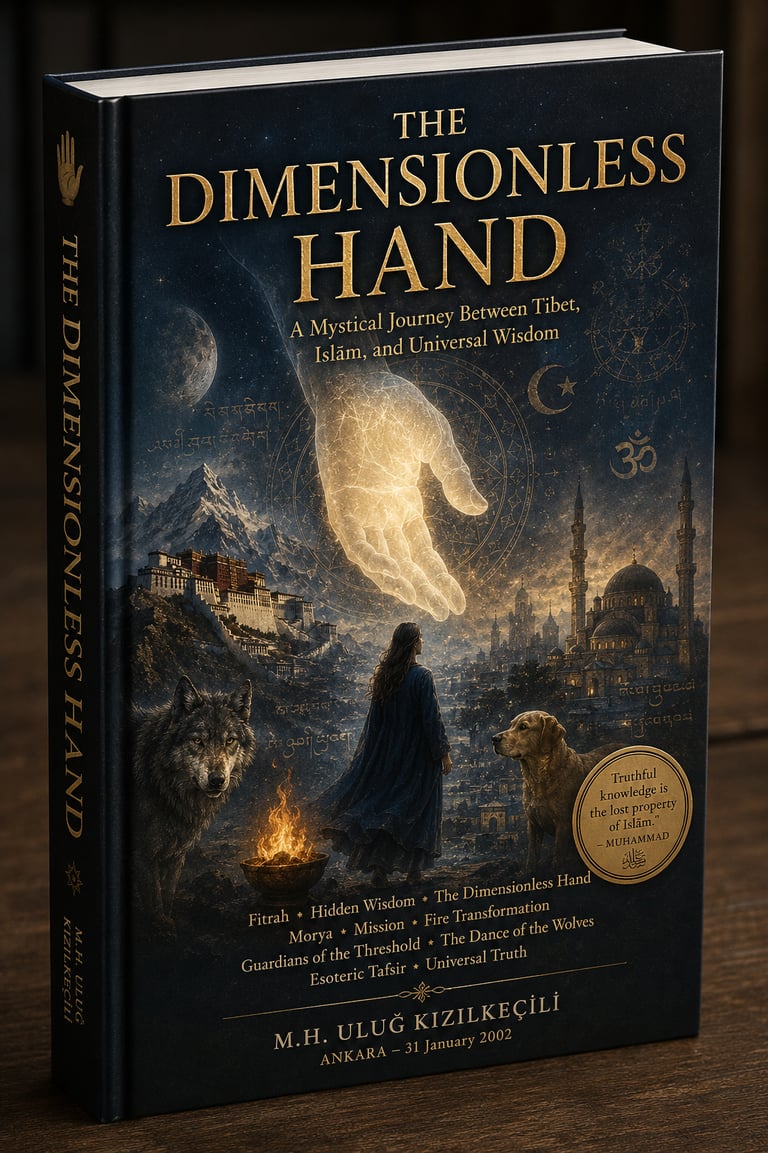
THE DIMENSIONLESS HAND
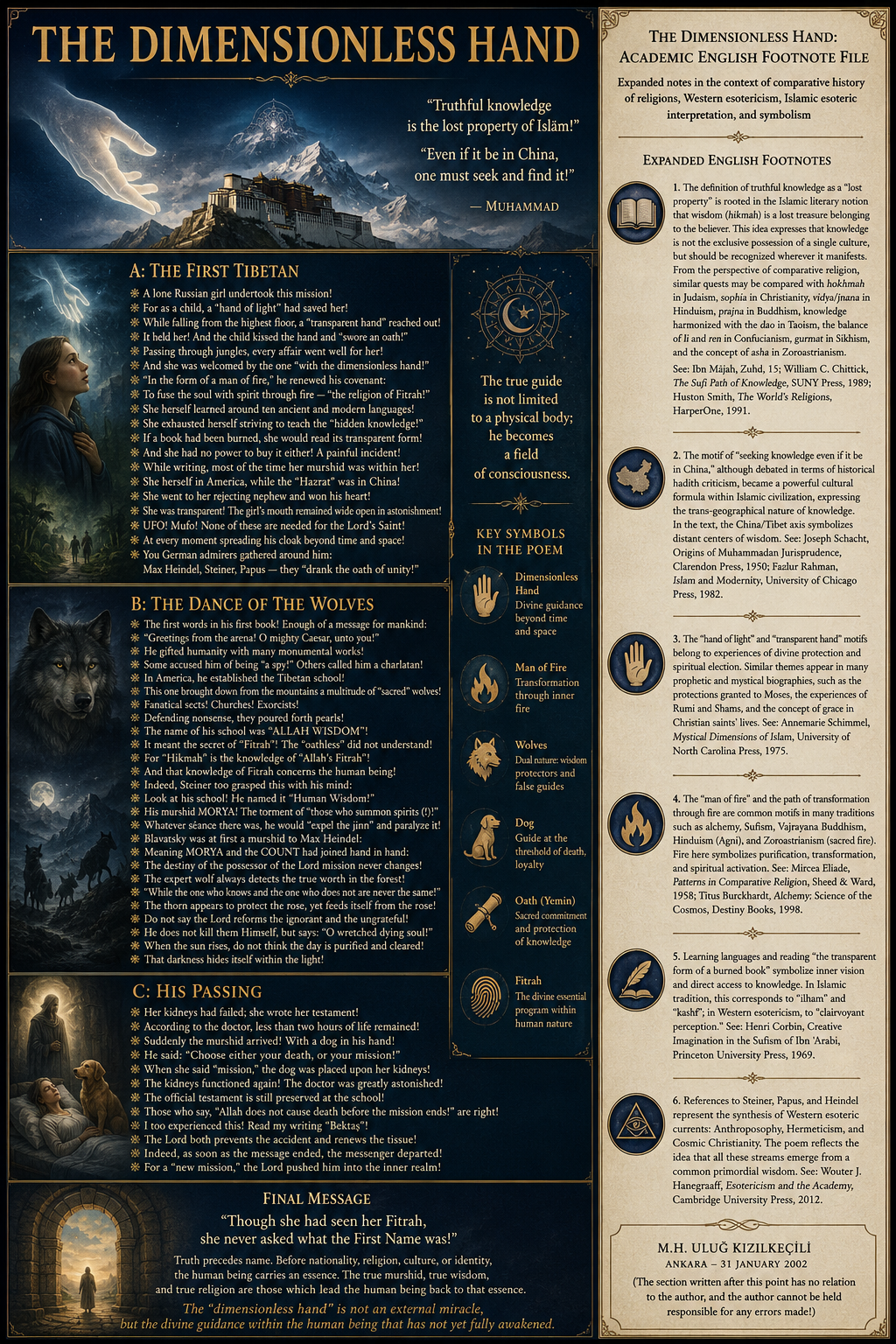
A: THE FIRST TIBETAN
MUHAMMAD says: “Truthful knowledge is the lost property of Islām!”
“Even if it be in China, one must seek and find it!”
A lone Russian girl undertook this mission!
For as a child, a “hand of light” had saved her!
While falling from the highest floor, a “transparent hand” reached out!
It held her! And the child kissed the hand and “swore an oath!”
Passing through jungles, every affair went well for her!
And she was welcomed by the one “with the dimensionless hand!”
“In the form of a man of fire,” he renewed his covenant:
To fuse the soul with spirit through fire — “the religion of Fitrah!”
She herself learned around ten ancient and modern languages!
She exhausted herself striving to teach the “hidden knowledge!”
If a book had been burned, she would read its transparent form!
And she had no power to buy it either! A painful incident!
While writing, most of the time her murshid was within her!
She herself in America, while the “Hazrat” was in China!
She went to her rejecting nephew and won his heart!
She was transparent! The girl’s mouth remained wide open in astonishment!
UFO! Mufo! None of these are needed for the Lord’s Saint!
At every moment spreading his cloak beyond time and space!
You German admirers gathered around him:
Max Heindel, Steiner, Papus — they “drank the oath of unity!”
B: THE DANCE OF THE WOLVES
The first words in his first book! Enough of a message for mankind:
“Greetings from the arena! O mighty Caesar, unto you!”
He gifted humanity with many monumental works!
Some accused him of being “a spy!” Others called him a charlatan!
In America, he established the Tibetan school!
This one brought down from the mountains a multitude of “sacred” wolves!
Fanatical sects! Churches! Exorcists!
Defending nonsense, they poured forth pearls!
The name of his school was “ALLAH WISDOM”!
It meant the secret of “Fitrah”! The “oathless” did not understand!
For “Hikmah” is the knowledge of “Allah’s Fitrah”!
And that knowledge of Fitrah concerns the human being!
Indeed, Steiner too grasped this with his mind:
Look at his school! He named it “Human Wisdom!”
His murshid MORYA! The torment of “those who summon spirits (!)!”
Whatever séance there was, he would “expel the jinn” and paralyze it!
Blavatsky was at first a murshid to Max Heindel:
Meaning MORYA and the COUNT had joined hand in hand:
The destiny of the possessor of the Lord mission never changes!
The expert wolf always detects the true worth in the forest!
“While the one who knows and the one who does not are never the same!”
The thorn appears to protect the rose, yet feeds itself from the rose!
Do not say the Lord reforms the ignorant and the ungrateful!
He does not kill them Himself, but says: “O wretched dying soul!”
When the sun rises, do not think the day is purified and cleared!
That darkness hides itself within the light!
C: HIS PASSING
Her kidneys had failed; she wrote her testament!
According to the doctor, less than two hours of life remained!
Suddenly the murshid arrived! With a dog in his hand!
He said: “Choose either your death, or your mission!”
When she said “mission,” the dog was placed upon her kidneys!
The kidneys functioned again! The doctor was greatly astonished!
The official testament is still preserved at the school!
Those who say, “Allah does not cause death before the mission ends!” are right!
I too experienced this! Read my writing “Bektaş”!
The Lord both prevents the accident and renews the tissue!
Indeed, as soon as the message ended, the messenger departed!
For a “new mission,” the Lord pushed him into the inner realm!
Her works in the world were translated into many languages!
Except Turkish! Apologize to her spirit for that!
A shame to be embarrassed of in the name of Turkish culture!
For in Tibet there still remains: “a loss belonging to Islām!”
My conscience is at ease: I quoted from her here and there!
I interpreted it through the Qur’an! Meaning it is not plagiarism!
The surname of this “holy virgin” was BLAVATSKY!
Rabid dogs in the arena tore her apart!
Because of the “oath,” she could not reveal the “Secret” very much!
The “oathless” were forced to remain content with little!
Though she had seen her “Fitrah,” she never asked what the First Name was!
Neither she nor Morya could ascend to the “Supreme Realm”!
M.H. ULUĞ KIZILKEÇİLİ
ANKARA – 31 JANUARY 2002
(The section written after this point has no relation to the author, and the author cannot be held responsible for any errors made!)
THE DIMENSIONLESS HAND: ACADEMIC ENGLISH FOOTNOTE FILE
Expanded notes in the context of comparative history of religions, Western esotericism, Islamic esoteric interpretation, and symbolism
Expanded English Footnotes
The definition of truthful knowledge as a “lost property” is rooted in the Islamic literary notion that wisdom (hikmah) is a lost treasure belonging to the believer. This idea expresses that knowledge is not the exclusive possession of a single culture, but should be recognized wherever it manifests. From the perspective of comparative religion, similar quests may be compared with hokhmah in Judaism, sophia in Christianity, vidya/jnana in Hinduism, prajna in Buddhism, knowledge harmonized with the dao in Taoism, the balance of li and ren in Confucianism, gurmat in Sikhism, and the concept of asha in Zoroastrianism. See: Ibn Mājah, Zuhd, 15; William C. Chittick, The Sufi Path of Knowledge, SUNY Press, 1989; Huston Smith, The World’s Religions, HarperOne, 1991.
The motif of “seeking knowledge even if it be in China,” although debated in terms of historical hadith criticism, became a powerful cultural formula within Islamic civilization, expressing the trans-geographical nature of knowledge. In the text, the China/Tibet axis symbolizes distant centers of wisdom that appear outside Islām yet are thought to preserve fragments of truth. Comparatively, this theme is also visible in Buddhist monastic networks, Hindu guru-parampara chains, Christian monastic traditions, and Jewish diaspora learning centers. See: Franz Rosenthal, Knowledge Triumphant, Brill, 1970; Jonathan A. C. Brown, Hadith: Muhammad’s Legacy in the Medieval and Modern World, Oneworld, 2009.
The symbol of the “dimensionless hand” signifies invisible intervention on the phenomenological level, divine providence on the theological level, and murshidic/cosmic guidance on the esoteric level. In Islām, the metaphor of yadullah (the Hand of Allah) is interpreted without falling into anthropomorphism; in Judaism, the “Hand of God” signifies power and deliverance; in Christian iconography, manus Dei symbolizes divine intervention; in Hindu and Buddhist traditions, mudras indicate states of consciousness and protective functions; while in Islamic-Jewish-Christian folk religiosity, the hamsa/khamsa evolves into a protective symbol. See: Annemarie Schimmel, Deciphering the Signs of God, SUNY Press, 1994; Eva-Maria von Kemnitz, “The Hand of Fatima: The Khamsa in the Arab-Islamic World”, Brill, 2021.
The “transparent hand” in the poem expresses the notion of a power that transcends material visibility yet still produces effects. In Sufism, this may be explained through the concepts of himmah, providence, or spiritual influence (tasarruf); in Christian mysticism through grace; in Mahayana Buddhism through bodhisattva compassion; in the Hindu bhakti tradition through the grace of the ishta-devata; in Sikhism through nadar/kirpa; and in Taoism through the idea of effective action within non-interference (wu-wei). See: Evelyn Underhill, Mysticism, Methuen, 1911; Bernard McGinn, The Foundations of Mysticism, Crossroad, 1991.
The presentation of Tibet as a “hidden center of wisdom” forms part of the image of “Eastern wisdom” developed in modern Western esotericism from the nineteenth century onward. Academic literature emphasizes that this image both contains real contact with Asian religions and was reconstructed through European Orientalism and modern occult formations. Thus, the Tibet in the text represents not only historical Tibetan Buddhism, but also the Western esoteric imagination of a “secret center.” See: Donald S. Lopez Jr., Prisoners of Shangri-La, University of Chicago Press, 1998; Wouter J. Hanegraaff, New Age Religion and Western Culture, Brill, 1996.
Blavatsky’s central role in the poem is related to Theosophy’s claim of a modern interreligious synthesis. Theosophy sought to combine elements from Hinduism, Buddhism, Neoplatonism, Hermeticism, Kabbalah, Christian mysticism, and spiritualism within a narrative of universal primordial wisdom. In this respect, the text should be read less within the framework of classical history of religions than within the context of modern esoteric syncretism. See: Antoine Faivre, Access to Western Esotericism, SUNY Press, 1994; Wouter J. Hanegraaff, Esotericism and the Academy, Cambridge University Press, 2012.
The figure of “Morya” is connected in Theosophical tradition with the doctrine of the Mahatmas/Masters. Academically, this figure is studied less as a historical individual than as one of the symbolic centers of modern esoteric authority construction. Comparable guidance structures may be found in the Sufi concepts of qutb and ghawth, the esoteric guidance of the Imam in Shi‘i irfan, the intercession of saints in Christianity, the authority of tulkus and lamas in Tibetan Buddhism, and the sadguru figure in Hinduism, though their theological foundations differ significantly. See: K. Paul Johnson, The Masters Revealed, SUNY Press, 1994; Joscelyn Godwin, The Theosophical Enlightenment, SUNY Press, 1994.
8. The expression “religion of Fitrah” may be read as a reference to the Qur’anic concept of fitrah. Fitrah denotes the primordial orientation embedded within human creation, an openness toward God, and the potential for moral awareness. It may be compared with discussions of the yetzer and the image of God in Judaism, imago Dei and the tension of original sin in Christianity, atman in Hinduism, tathagatagarbha (Buddha-nature) in Buddhism, debates on the goodness of human nature in Confucianism, and the idea of awakening through the Divine Name in Sikhism. See: Toshihiko Izutsu, God and Man in the Qur’an, Keio Institute, 1964; Sachiko Murata & William C. Chittick, The Vision of Islam, Paragon House, 1994.
9. The interpretation of wisdom (*hikmah*) as “knowledge of Allah’s Fitrah” recalls that in classical Islām, hikmah signified not merely theoretical knowledge, but also the simultaneous comprehension of the order of being and right action. This meaning may be compared with the Aristotelian distinction between phronesis and sophia, the Jewish hokhmah tradition, Christian sapientia, Hindu jnana-yoga, Buddhist prajna, and Taoist wisdom. See: Seyyed Hossein Nasr, Knowledge and the Sacred, SUNY Press, 1989; Pierre Hadot, Philosophy as a Way of Life, Blackwell, 1995.
10. The themes of the “man of fire” and spiritual transformation are rooted in the use of fire throughout religious history as a symbol of purification, revelation, energy, and trial. In Zoroastrianism, fire is the visible sign of the order of asha; in Judaism, the burning bush is a scene of revelation; in Christianity, the tongues of fire of the Holy Spirit signify Pentecost; in Hinduism, Agni represents sacrifice and transformation; in Buddhism, fire may symbolize both desire and transformation; while in Sufism, the fire of divine love burns away the ego and purifies the heart. See: Mircea Eliade, The Sacred and the Profane, Harcourt, 1959; Kees W. Bolle, The Persistence of Religion, Brill, 1987.
11. The alchemical analogy is particularly suitable for explaining the expression in the poem, “to boil the soul into spirit through fire.” In Islamic alchemy, the Jabirian tradition; in Western Hermeticism, the opus magnum; in Hindu Tantra, the fire of kundalini; and in Buddhist Vajrayana, the practices of inner heat (*tummo*), all express in different symbolic languages the idea of transforming the unrefined human being. These similarities, however, should be understood not as identities, but as symbolic affinities. See: Carl Gustav Jung, Psychology and Alchemy, Princeton University Press, 1968; Mircea Eliade, The Forge and the Crucible, University of Chicago Press, 1978.
12. The names Steiner, Papus, and Max Heindel demonstrate the branching of Western esotericism after Theosophy. Steiner represented Anthroposophy, Papus Martinist-Hermetic occultism, and Heindel Rosicrucian-Christian cosmology. Their collective appearance in the text points to the synthetic character of modern esotericism, which transcends established religious institutions while simultaneously borrowing symbols from them. See: Nicholas Goodrick-Clarke, The Western Esoteric Traditions, Oxford University Press, 2008; Christopher McIntosh, Eliphas Lévi and the French Occult Revival, SUNY Press, 2011.
13. The expression “UFO! Mufo!” may be interpreted as a critique of false extraordinariness reduced to external phenomena. In modern esotericism, narratives of extraterrestrials, advanced beings, ascended masters, or interdimensional guides often function as secularized counterparts to traditional categories such as angels, jinn, devas, bodhisattvas, saints, and spiritual guides. The academic history of religions studies such narratives within the contexts of belief, authority, and the production of religious experience. See: Christopher Partridge, The Re-Enchantment of the West, T&T Clark, 2004; Jeffrey J. Kripal, Authors of the Impossible, University of Chicago Press, 2010.
14. The metaphor of the “wolves” is associated in Turkish and Central Asian traditions with guidance, lineage, protection, and the crossing of boundaries. The she-wolf in Roman mythology, the Grey Wolf in Turkish mythology, animal guides in shamanic traditions, protective animal iconography in Hinduism and Buddhism, the wolf/sheep opposition in Christianity, and the wolf image in the Islamic story of Joseph all generate different layers of meaning. In the text, the wolf bears a double significance: both protective wisdom and predatory exploitation of truth. See: Mircea Eliade, Shamanism: Archaic Techniques of Ecstasy, Princeton University Press, 1964; Jean-Paul Roux, The Religion of the Turks and Mongols, Kabalcı, 1994.
15. The symbol of the dog in the poem is associated with thresholds and the gate of death. In Egypt, Anubis; in Zoroastrian funerary rites, the sagdid function of the dog; in Greek mythology, Cerberus; in Indian traditions, the dogs of Yama; in Islamic culture, the dog of the Companions of the Cave; and in folk beliefs, the image of the protective dog all situate the dog within the axis of death, loyalty, and guardianship of boundaries. See: Jan Assmann, Death and Salvation in Ancient Egypt, Cornell University Press, 2005; Mary Boyce, Zoroastrians: Their Religious Beliefs and Practices, Routledge, 1979.
16. The idea that “Allah does not cause death before the mission is complete” establishes a relationship between destiny, duty, and spiritual vocation. In Islām, this may be compared with the concepts of ajal (appointed term) and destiny; in Christianity with vocation/calling; in Judaism with prophetic mission; in Hinduism with dharma; in Buddhism with the bodhisattva vow; in Sikhism with seva; in Confucianism with the heavenly mandate (*tianming*); and in Zoroastrianism with the idea of moral choice in service of asha. Such parallels demonstrate that religions often situate human life within a field of meaning extending beyond mere biological continuity. See: Max Weber, The Sociology of Religion, Beacon Press, 1963; Robert N. Bellah, Religion in Human Evolution, Harvard University Press, 2011.
17. The themes of “oath” and “secret” are connected with the principle of gradual transmission of knowledge within esoteric traditions. In Sufism, ijazah and the path of sayr wa suluk; in Shi‘i-esoteric traditions, ta‘lim; in Jewish Kabbalah, spiritual eligibility; in Christian monasticism, mystagogy; in Hinduism, guru-*diksha*; in Vajrayana Buddhism, the samaya vow; and in Masonic/occult traditions, initiation all share the notion that knowledge should not be disclosed with equal openness to every level of consciousness. See: Gershom Scholem, Major Trends in Jewish Mysticism, Schocken, 1941; Hugh B. Urban, Tantra: Sex, Secrecy, Politics, and Power in the Study of Religion, University of California Press, 2003.
18. The emphasis that “the one who knows and the one who does not are not equal” accords with the Qur’anic hierarchy of knowledge; however, the text employs this less as a claim of institutional superiority than as a distinction in ontological wakefulness. In this context, knowledge signifies not merely possession of information, but a transformed state of consciousness. Comparative parallels may be found in Buddhism through the distinction between avidya and prajna; in Hinduism through avidya and vidya; in Platonism through doxa and episteme; in Christian mysticism through gnosis; and in Sufism through the distinction between ‘ilm and ma‘rifah. See: Toshihiko Izutsu, Sufism and Taoism, University of California Press, 1983; Henry Corbin, Alone with the Alone, Princeton University Press, 1997.
19. The critique of “false spiritualism” in the text may be connected to the problem of charisma and exploitation in the history of religions. In the Weberian sense, charismatic authority, when not institutionalized or regulated, becomes vulnerable to manipulation. Sufism, Christian mysticism, the Buddhist lama tradition, Hindu guru institutions, and modern occult groups have each attempted to address this risk through different mechanisms of supervision and discipline. See: Max Weber, Economy and Society, University of California Press, 1978; Olav Hammer, Claiming Knowledge, Brill, 2001.
20. The concept of “hidden knowledge” corresponds in Islām to ladunni knowledge, ma‘rifah, and esoteric interpretation (*batini ta’wil*); however, both classical Sunni and Shi‘i traditions emphasize that such knowledge must remain bounded by revelation, sacred law, and moral responsibility. Similarly, in Kabbalah, halakhah; in Christian mysticism, church dogma; in Buddhism, vinaya; in Hinduism, dharma; and in Sikhism, the authority of the Guru Granth Sahib function as frameworks preventing esoteric interpretation from dissolving into limitless arbitrariness. See: Alexander Knysh, Islamic Mysticism: A Short History, Brill, 2000; Moshe Idel, Kabbalah: New Perspectives, Yale University Press, 1988.
21. The notion that “truth is not the monopoly of a single institution” opens into debates concerning perennialism, pluralism, and syncretism in comparative religion. The perennialist approach argues that religions originate from a transcendent common essence, whereas the historical study of religions insists upon preserving differences in historical context, language, ritual, and institutions alongside similarities. Consequently, the text should be interpreted by considering both shared symbolic patterns and doctrinal distinctions together. See: Frithjof Schuon, The Transcendent Unity of Religions, Quest, 1984; Steven Wasserstrom, Religion after Religion, Princeton University Press, 1999.
22. The presentation of Blavatsky as a “misunderstood bearer of truth” reflects a mode of interpretation that produces narratives of heroic mysticism and martyrdom. Academically, Blavatsky is regarded both as one of the founding figures of modern esotericism and as a historically controversial actor situated at the center of disputed claims. This duality requires the text to be positioned carefully between apologetic hagiography and critical history of religions. See: Marion Meade, Madame Blavatsky: The Woman Behind the Myth, Putnam, 1980; Alex Owen, The Place of Enchantment, University of Chicago Press, 2004.
23. The examples of Mansur al-Hallaj, Socrates, and Giordano Bruno may be employed to strengthen the archetype of the “bearer of truth punished by society”; however, their historical contexts differ considerably. Hallāj existed within a political-theological Islamic environment; Socrates within the civic religion and political order of Athens; and Bruno within the tensions of cosmology, theology, and church authority in early modern Europe. Any comparison should therefore remain on the symbolic rather than strictly historical level. See: Louis Massignon, The Passion of al-Hallaj, Princeton University Press, 1982; Ingrid D. Rowland, Giordano Bruno: Philosopher/Heretic, Farrar, Straus and Giroux, 2008.
24. The theme of “essence before name” is among the most widespread motifs of mystical discourse across religions. In Islamic Sufism, it appears through the concept of haqiqat al-insaniyyah (the reality of the human being); in Christianity through the “inner man”; in Hinduism through atman; in Buddhism through awakening via the realization of non-self; in Judaism through neshamah; in Taoism through the ineffable Dao beyond naming; in Sikhism through naam; and in indigenous traditions through notions of cosmic kinship. All of these give rise to the idea that the human being possesses an existential depth prior to social or conceptual identity labels. See: William James, The Varieties of Religious Experience, Longmans, 1902; Ninian Smart, Dimensions of the Sacred, University of California Press, 1996.
25. The overall structure of the text may be evaluated as an example of a modern “esoteric tafsir.” Here, the term tafsir is not employed in the classical sense of Qur’anic exegesis, but rather in the sense of a symbolic/esoteric interpretation of the poem’s imagery. In academic work, this distinction should be explicitly emphasized; otherwise, traditional Qur’anic exegesis and modern symbolic interpretation risk being reduced to the same category. See: Gerhard Böwering, “The Qur’an Commentary of al-Sulami”, Islamic Studies, 1980; Andrew Rippin, The Qur’an and Its Interpretative Tradition, Ashgate, 2001.
Comparative Religion Matrix
The metaphysical structure presented in the poem and its esoteric interpretation is grounded not solely in a specific mystical tradition, but in certain archetypal concepts commonly recognized across world religions and ancient teachings. Symbols such as “fitrah,” the “dimensionless hand,” “hidden wisdom,” “mission,” “fire,” the “murshid,” the “guardian of the threshold,” and “inner awakening” all find metaphysical correspondences within different religions and traditions.
In Islamic thought, this structure is particularly associated with the concepts of fitrah (the primordial orientation within creation), hikmah (the essence of truth), himmah (spiritual support or concentrated spiritual energy), and ladunni knowledge (knowledge directly derived from divine source). The invisible protective hand in the poem and the call toward the human being’s inner essence evoke the Sufi understanding of esoteric guidance.
In Jewish mysticism, a similar structure appears through Hokhmah (divine wisdom), Shekhinah (the manifestation of God in the world), and the hidden interpretive tradition of Kabbalah. In particular, the notion of invisible yet effective divine guidance parallels the symbol of the “dimensionless hand” in the poem.
Within Christian mystical thought, concepts such as Sophia (holy wisdom), grace, manus Dei (the Hand of God), and vocation (calling/mission) establish a metaphysical framework similar to the poem’s themes of chosenness and divine protection.
In Hindu traditions, the poem’s understanding of fitrah approaches the concept of Atman (the essential self), while the mission carried by the individual corresponds to dharma, and direct comprehension of truth corresponds to jnana. The symbol of the “man of fire” and the “purification of the soul through fire” may also be associated with Agni in the Vedic tradition, for Agni signifies not merely physical fire, but transformative sacred energy.
In Buddhist thought, the concepts of Prajna (wisdom of awakening), the bodhisattva (a conscious being who labors to awaken others), mudra (symbolic hand gestures), and tathagatagarbha (the essence of awakening present within all beings) display strong affinities with the poem’s understanding of inner guidance. In particular, the metaphor of the “dimensionless hand” resembles the symbolism of mudra and the bodhisattva, representing not merely external intervention but invisible direction operating on the level of consciousness.
In Jainism, the concepts of ahimsa (non-harm), kevala-jnana (absolute knowledge), and the tirthankara (the guide who opens the path of truth) recall the poem’s themes of purification and the murshid figure who guides toward truth. In Sikhism, the concepts of Naam (the Divine Name), seva (service), and kirpa/nadar (divine grace) support the idea that the human being reaches truth only through inner openness and spiritual assistance.
The symbols of fire and the threshold of death in the poem also display important parallels with Zoroastrianism. While asha represents the cosmic order of truth and sacred fire signifies divine purity, the sagdid ritual symbolizes the transition between death and the invisible world. The appearance of the dog in the poem as a guide at the threshold of death approaches this symbolism in a striking manner.
In the Taoist tradition, the Dao represents the unnameable absolute path, wu-wei signifies effortless action through non-interference, and internal alchemy symbolizes the transformation of the human being within one’s own essence. The poem’s understanding of “dimensionless intervention” stands close to Taoist metaphysics through its notion of an invisible cosmic order operating unseen. In Confucianism, the concepts of Ren (human virtue), Li (cosmic-social order), and Tianming (heavenly mandate) evoke the moral and social dimensions of the poem’s idea of “mission.”
Within the Shinto tradition, the sacred beings known as Kami, purification rituals, and the binding life-force called musubi form a structure analogous to the poem’s theme of invisible protective power. In indigenous and shamanic traditions, the perception of animals such as wolves and dogs as “guardians of the threshold,” “spirit guides,” and “protectors of transition” may be directly associated with the poem’s “Dance of the Wolves” and the dog symbolism appearing at the moment of death.
Above all these, the poem’s fundamental structure converges with the synthetic character of Western esotericism. Traditions such as Theosophy, Hermeticism, Kabbalah, and alchemy advocate the idea that all religions originate from a shared primordial core of wisdom. The connections established in the poem among Tibet, Islām, Western occultism, Sufism, and mystical symbolism reflect precisely this understanding of “universal wisdom.” In this way, the text approaches the notion that different religions are not rivals to one another, but rather distinct symbolic languages expressing the same metaphysical truth.
ESOTERIC TAFSIR
Although the poem “The Dimensionless Hand” appears outwardly as a mystical biographical narrative, its deeper structure contains a multilayered esoteric system founded upon hidden knowledge, chains of spiritual masters, cosmic guidance, invisible protectors, and humanity’s lost heritage of wisdom. In the poem, especially through the central figure of Helena Petrovna Blavatsky, an attempt is made to establish a metaphysical connection between Tibetan teachings, Islamic esoteric understanding, Western occultism, and Sufism.
The most important symbol at the center of the text is the “dimensionless hand.” This hand is not physical; rather, it represents an invisible intervention belonging to no material dimension and operating beyond time and space. At the beginning of the poem, the individual who encounters mortal danger in childhood is described as being rescued by a “hand of light.” What is described here is not merely physical salvation, but the “experience of chosenness” frequently encountered within esoteric traditions. Persons believed to carry a great mission often confront death in childhood and are thought to exist under invisible protection. Thus, the “hand of light” in the poem becomes a symbol of the cosmic calling.
In esoteric traditions, the symbol of the hand signifies will, guidance, and power. The “dimensionless hand,” however, represents the invisible intervention of divine will. The expression “transparent hand” appearing in the poem deepens the same meaning further. Transparency here signifies immateriality; it describes a power that is unseen yet effective. In Sufism, this is sometimes called himmah. Within the Hermetic tradition, it may be interpreted as “the hand of the hidden masters,” while in Theosophy it may be understood as “the influence of the Mahatmas.” The poem unites all of these traditions beneath a single metaphysical framework.
The special place occupied by Tibet within the text is likewise not accidental. Here, Tibet signifies not merely a geographical region, but one of humanity’s hidden centers of wisdom. In ancient traditions, the mountain is consistently associated with elevated consciousness. Symbols such as Mount Sinai, Olympus, Meru, Mount Qaf, and the Himalayas represent the axis between humanity and the heavens. For this reason, Tibet in the poem is presented as a lost metaphysical memory of humankind.
One of the poem’s central theses is the idea that “truthful knowledge is the lost property of Islām.” Here, knowledge is understood not as an alternative to religion, but as its lost essence. According to the poet, truth is not the monopoly of a single culture or civilization. Fragments of truth are scattered across different traditions. Thus, Tibet, Russia, China, Islām, and Western occultism are described as parts of the same chain. In this way, the poem approaches the notion that all primordial teachings emerge from a common source.
The symbol of the “man of fire” stands at the center of the poem’s concept of transformation. Fire here does not signify hell, but purification, energy, spiritual activation, and the divine spark. The line, “To boil the soul into spirit through fire — the religion of Fitrah!” describes the transformation of raw human nature through spiritual fire. Just as metals are purified by fire in alchemy, the human being matures through inner fire.
For this reason, one of the central concepts of the poem is fitrah. Here, fitrah signifies not merely innate character, but humanity’s divine essential program. The poem defines wisdom (hikmah) within this same framework. Wisdom ceases to be merely knowledge of the external world and becomes knowledge of the essential law of existence itself. While science examines the outer world, wisdom seeks to understand the human essence and the inner order of the universe.
The appearance of figures such as Rudolf Steiner, Papus, and Max Heindel is therefore significant. These figures represent different branches of Western esotericism. Steiner symbolizes spiritual anthropology, Papus Hermetic occultism, and Heindel cosmic Christianity. The poem interprets all of these teachings as different paths emerging from the same source. Thus emerges the idea that truth cannot be confined within a single religion or institution.
The poem’s dismissal of the search for external miracles through the phrase “UFO! Mufo!” is equally striking. According to the poet, the truly extraordinary power lies not in spaceships or paranormal spectacles, but in the transformation of consciousness itself. Consequently, the figure of the murshid is not limited to a physical body; it becomes a field of consciousness. Human beings search for the guide externally, yet according to the poem’s deeper structure, true guidance concerns inner awakening.
The section entitled “Dance of the Wolves” constitutes one of the poem’s harshest critical layers. Here, the metaphor of the wolf carries two distinct meanings. On one hand, it is the wild force that protects wisdom; on the other, it symbolizes false spiritual masters who feed upon truth. Through the line, “The thorn appears to protect the rose, yet feeds itself from the rose,” the poem criticizes the exploitative dimension of the esoteric sphere. Blind mysticism, false spiritualism, and spectacle-oriented occultism are strongly rejected. Genuine wisdom, the poem argues, does not render the human being dependent, does not perform displays, but merely awakens consciousness.
The figure of “Morya” within the text is likewise more than simply a Theosophical master. He represents the archetype of the invisible teacher. In esoteric traditions, the true teacher often manifests not physically, but upon the level of consciousness. Although human beings seek him externally, he in fact symbolizes inner awakening itself.
One of the central ideas of the poem is also the concept of “mission.” Through the phrase, “Allah does not cause death before the mission is complete,” human life acquires a meaning greater than biological process alone. According to the poem, the human being is not merely a living organism, but the bearer of a particular task. What determines the span of human life may therefore be not only the strength of the body, but also the purpose of consciousness it carries.
The symbol of the dog appearing in the poem should likewise be interpreted within this framework. The dog here is not an ordinary animal, but a guardian of the threshold and an intuitive guide. It possesses a metaphysical function similar to that of Anubis in Egypt, the wolf in Turkish mythology, and the protective dog symbols of Iranian tradition. The dog is perceived as both the guide at the gate of death and the symbol of loyalty.
In the final section of the text, Blavatsky’s being “torn apart by rabid dogs in the arena” expresses society’s hostility toward those who carry truth. Within esoteric traditions, bearers of truth have often been misunderstood. The execution of Mansur al-Hallaj, the burning of Giordano Bruno, and the poisoning of Socrates all belong to the same archetypal pattern. For new consciousness threatens the old order.
The emphasis on the “oath” in the poem is also significant. Here, the secret is not merely hidden information; rather, it is knowledge that must be protected from consciousness not yet prepared to receive it. In esoteric traditions, knowledge is transmitted gradually, because a person who receives knowledge they cannot bear may fragment rather than transform.
The line at the poem’s conclusion, “Though she had seen her Fitrah, she never asked what the First Name was,” summarizes the entire system. Truth precedes name. Before nationality, religion, culture, or identity, the human being carries an essence. The true murshid, true wisdom, and true religion are those which lead the human being back to that essence.
For this reason, the “dimensionless hand” represents less an external miraculous force than the divine guidance within the human being that has not yet fully awakened. This is the poem’s deepest message: while human beings search for truth outside themselves, they are in fact searching for the invisible hand within.