THE DOCTRINE OF SELF-DYNAMICS CHAPTER-11: THE SEVEN AGES OF THE HUMAN RACE
THE DOCTRINE OF SELF-DYNAMICS CHAPTER-11: THE SEVEN AGES OF THE HUMAN RACE. In esoteric traditions, this period is often called the “Lemurian Age” and is accepted as the first great era in which human consciousness formed a deep bond with matter. While the bodies of previous human forms were...
ÖZ-DEVİNİM KURAMI
THE DOCTRINE OF SELF-DYNAMICS
CHAPTER-11: THE SEVEN AGES OF THE HUMAN RACE
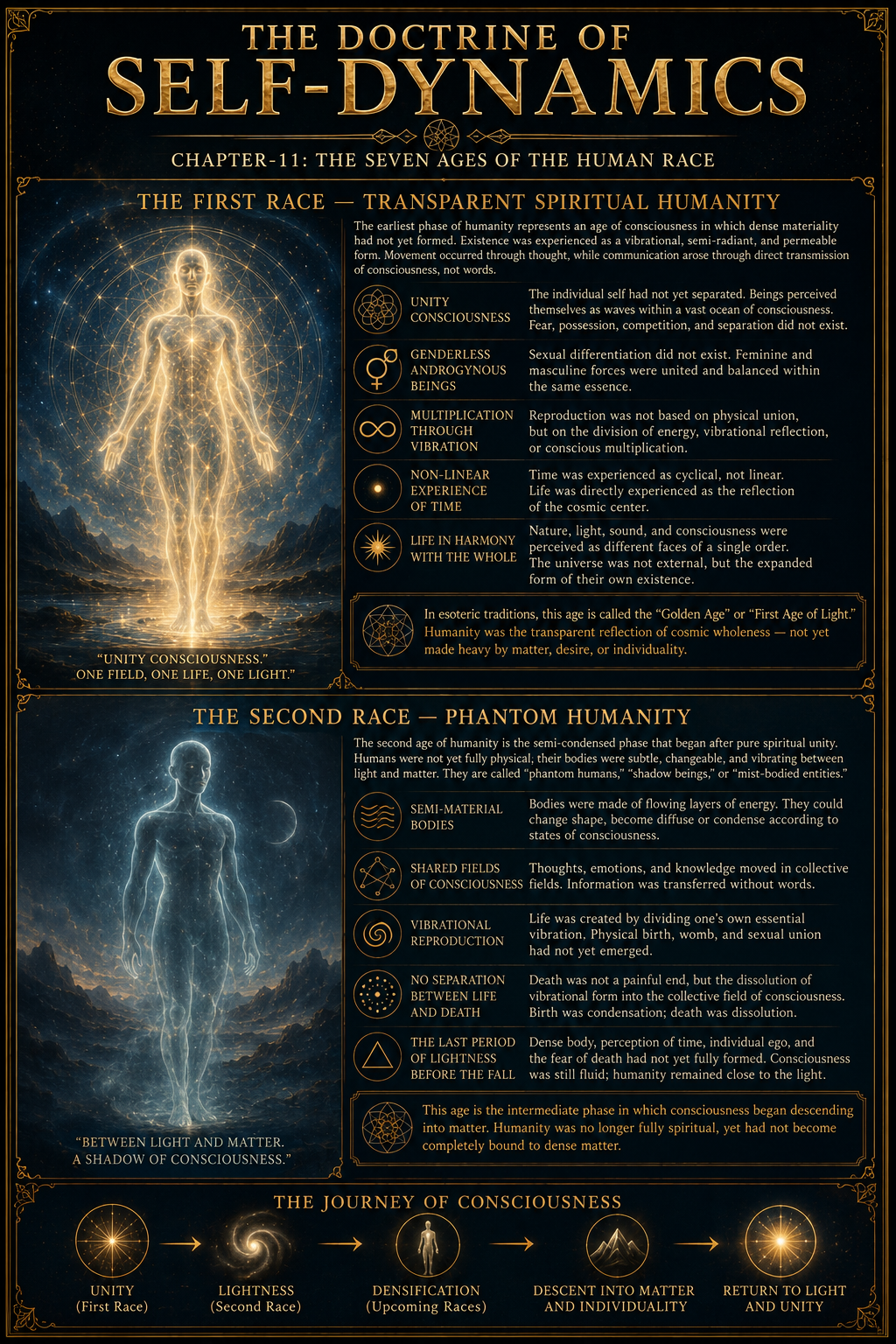
THE FIRST RACE — TRANSPARENT SPIRITUAL HUMANITY
The earliest phase of humanity represents an age of consciousness in which dense materiality had not yet formed. In this first period, existence possessed a structure very different from the physical human form known today. Bodily boundaries were not sharp; existence was experienced more as a vibrational, semi-radiant, and permeable form. For this reason, the first human model is described not as a body made of solid matter, but as a subtle and transparent field of being. Movement occurred through thought, while communication arose not through words, but through direct transmission of consciousness.
In this age, the individual self had not yet fully separated. Instead of the concept of “I,” there existed a shared field of awareness. Every being perceived itself not as separate from the whole, but as a wave within a vast ocean of consciousness. Therefore, fear, possession, competition, and the idea of separation had not yet emerged. Consciousness existed as a collective flow radiating from a single center. The personal ego structure that would emerge in later ages had not yet been born.
Because the body of the first human was not composed of dense biological structures, sexual differentiation also did not exist. Reproduction and multiplication were explained not through physical union, but through the division of energy, vibrational reflection, or conscious multiplication. For this reason, the first human model is regarded as an androgynous or genderless form of unity. Feminine and masculine forces had not yet separated and existed in balanced form within the same essence. Humanity was complete within itself.
The fundamental quality of this period was “unity consciousness.” There was no feeling of boundary between existence and the universe. Nature, light, sound, and consciousness were perceived as different faces of a single order. Time was experienced not as linear, but as cyclical; life was directly experienced as the reflection of the cosmic center. For the human beings of the first age, the universe was not an external space, but the expanded form of their own existence.
In esoteric traditions, this period is often symbolized as the “Golden Age,” the “First Age of Light,” or “Spiritual Humanity.” These narratives describe the pure state of humanity before the fall: a form of consciousness not yet made heavy, not yet fully bound to matter, and still directly connected to its source. Matter, desire, individuality, and the sense of separation, which would intensify in later ages, had not yet emerged. Humanity was the transparent reflection of cosmic wholeness.
THE SECOND RACE — PHANTOM HUMANITY
The second age of humanity is the semi-condensed phase of existence that began after the first period of pure spiritual unity. In this age, humanity was not yet fully physical; yet it had begun taking on a more distinct form compared to its previous transparent spiritual state. The bodily structure of existence existed as a subtle intermediate form vibrating between light and matter. For this reason, the humans of this period are symbolized in many esoteric teachings as “phantom humans,” “shadow beings,” or “mist-bodied entities.”
The body of this age was not composed of dense flesh and bone. Rather, it consisted of a semi-material structure formed from flowing layers of energy. Although the human form had become visible, it still possessed a permeable, changeable, and unstable nature. Bodies reacted to thought, could alter shape according to states of consciousness, and could condense or become diffuse. Matter had not yet frozen into rigidity; clear boundaries between the being and the environment had not yet formed.
During this period, consciousness was not connected to an individual mind as it is today. Thoughts and emotions moved within shared vibrational fields. The experience of one being could easily flow into another; knowledge could be transferred without the need for words. Therefore, for the humans of the second age, learning did not mean gathering information externally, but attuning oneself to the collective field of consciousness. Memory was collective rather than individual. Humanity experienced itself not as a separate self, but as a temporary condensation within a vast and constantly undulating ocean of life.
The mode of reproduction was also not based on physical biology. In esoteric teachings, this process is described as “vibrational reproduction.” A being could create a new life form by dividing its own essential vibration. This formation was imagined as the echoing of energy or light reproducing itself. Biological birth, the womb, and sexual union had not yet emerged. Life continued through vibration reproducing itself.
In this age, the concept of death also did not exist in its modern meaning. Because the body was not bound to dense physical matter, the process of dissolution was not experienced as a painful rupture. When a being “died,” it merely dispersed its vibrational form and merged once more into the collective field of consciousness. Therefore, for the humanity of the second age, there were no sharp boundaries between life and death. States of being were parts of a constantly changing flow. Birth was regarded as condensation, and death as dissolution.
Esoteric traditions interpret this period as the intermediate phase in which consciousness gradually began descending into matter. Humanity was no longer completely spiritual; yet it had not become fully bound to dense matter. Therefore, the second age is accepted as the “last period of lightness before the fall.” The dense body, the perception of time, the individual ego, and the fear of death that would emerge in later ages had not yet fully formed. Consciousness was still fluid; humanity resembled the breathing shadow of the universe.
THE THIRD RACE — THE LEMURIAN AGE
The third age of humanity is the great phase of transformation in which, after the spiritual and semi-material periods of existence, humanity began for the first time to root itself deeply within the dense physical world. In esoteric traditions, this period is often called the “Lemurian Age” and is accepted as the first great era in which human consciousness formed a deep bond with matter. While the bodies of previous human forms were fluid and permeable, during this age existence gradually became heavier, and the foundations of skeletal structures and distinct physical form began to emerge. Humanity was no longer merely a vibrational being; it had become a living entity bound to earth, water, heat, and biological life.
The most remarkable feature of this age is that humanity was initially regarded as a dual-polar being. Feminine and masculine energies existed together within the same body. This condition represented not merely a biological unity, but a conscious wholeness. Humanity was regarded as complete within itself; polarity had not yet fully emerged. The separation between male and female that would appear in later ages gradually began to become distinct during the later phases of this period. In esoteric narratives, this differentiation is interpreted as the symbol of humanity’s transition from unity into polarity.
Lemurian humanity possessed a structure of consciousness that functioned more through intuition than intellect. Thought had not yet begun operating through abstract logical systems. Knowledge was acquired through direct perception, inner feeling, and vibrational sensing. Humanity could consciously feel the voice of nature, the memory of stones, the vibration of water, and celestial cycles. For this reason, Lemurian civilization is described not as a technological civilization, but as an intuitive civilization. Their power came not from external tools, but from harmony between consciousness and nature.
In this age, there was no sharp separation between humanity and nature. Mountains, seas, plants, and animals were perceived not merely as material entities, but as living fields of consciousness. Humanity did not attempt to dominate nature, but vibrated together with it. Rituals aimed at achieving harmony with celestial movements and natural energies. Sound, rhythm, and vibration possessed great importance; some teachings even describe the Lemurians as capable of moving stones through thought and establishing conscious bonds with the forces of nature.
This period is also the age in which humanity’s physical densification accelerated. The lighter bodies of previous ages gradually became heavier; the perception of time became more distinct; hunger, fatigue, and biological needs began to emerge. Consciousness was no longer entirely within the collective flow, but began condensing around individual centers. This process marked the beginning of humanity moving away from its spiritual origin and becoming more deeply bound to material experience.
In esoteric teachings, the Lemurian Age is often regarded as a great transitional era. Humanity still possessed high intuitive abilities; yet at the same time, the descent into dense matter had begun. As the bond between spirit and body strengthened, unity consciousness slowly transformed into individuality. For this reason, the third age is the threshold period carrying both humanity’s most ancient intuitive wisdom and the first traces of the fall together.
THE FALL OF LEMURIA
The final periods of Lemuria are regarded as one of the greatest fractures of consciousness in human history. Humanity, which initially lived in harmony with nature, moved through intuition, and felt itself as part of the cosmic whole, gradually became more deeply bound to dense matter. This process was not merely a physical transformation; it was a redirection of consciousness itself. Humanity ceased being a vibration dissolved within the universe and began feeling itself as a separate center. This is the essence of what esoteric teachings describe as the “fall.”
In previous ages, consciousness existed as a shared flow. The thought of one being could naturally reach another, and life could be experienced as a vast field of unity. Yet during the final phases of Lemuria, this common field began to fragment. Humanity felt for the first time the difference between “self” and “other.” When the feeling of separation was born, fear, possessiveness, and the instinct for protection also emerged. Consciousness was no longer merely experiencing the universe; it was beginning to perceive itself as a being separate from the universe.
With this transformation, matter became heavier. The human body became denser, more limited, and more fragile. The perception of time hardened; the boundary between birth and death became distinct. The cycle of life, previously felt as vibrational transformation, now began to be perceived through the ideas of loss and finitude. Humanity confronted for the first time the feeling of mortality. Thus the free flow of the soul began closing itself within the limits of the biological body.
In esoteric traditions, this period is described as the “descent into matter.” This descent is not an evil or demonic event; it is the deepening of consciousness so that it may gain intense experience. The soul enters dense layers of matter in order to experience itself as a limited being. Yet the price of this condensation is the forgetting of the source. Humanity begins losing memory of the cosmic wholeness from which it came.
The spark of selfhood is born precisely at this point. Individual will develops for the first time. Humanity begins feeling its own desires, fears, and choices independently from others. On one hand, this marks the beginning of free will; on the other hand, it forms the basis for separation from unity consciousness. In esoteric teachings, symbols such as the “forbidden fruit,” the “fall from paradise,” or the “fragmentation of light” often describe this transformation of consciousness.
The collapse of Lemuria is interpreted not as a physical catastrophe, but as a conscious rupture. Humanity lost its direct connection with the universe and began perceiving the outer world as separate from itself. Thus cosmic forgetfulness was born. The soul forgets its own essence and begins regarding matter as the only reality. Yet according to esoteric traditions, the deep essence within humanity is never completely destroyed. Beneath forgetfulness, the echoes of the ancient ages of unity still remain concealed.
For this reason, the fall of Lemuria is also the beginning of humanity’s great search. Humanity will create religions, mystery schools, initiations, and spiritual paths throughout history in order to rediscover the wholeness it has lost. Cosmic memory has not been entirely erased; it has merely been buried within deep layers of consciousness.
THE FOURTH RACE — THE ATLANTEAN AGE
The fourth age of humanity is the phase in which the great civilization of power known in esoteric traditions as Atlantis emerged. The intuitive and nature-aligned consciousness of Lemuria gave way to a human model centered upon will and direction. Humanity was no longer merely a being listening to nature; it had become a consciousness seeking to decipher, control, and shape it. The fundamental quality of this age is the discovery of power by consciousness and the learning of how to direct energy.
Atlantean humanity still carried the intuitive inheritance of previous ages; however, intuition was no longer used to harmonize with nature, but to direct the forces of nature. For this reason, Atlantean civilization is described in many esoteric teachings as the “rise of will.” Humanity discovered that thought was not merely an inner process, but something capable of affecting matter. Mind could become energy, and energy could become form.
The psychic technologies said to have been developed during this age were based not upon mechanical devices, but upon consciousness-centered systems. Atlantean sages were believed to have developed methods capable of directing energy flows through sound frequencies, geometric vibrations, magnetic fields, and mental focus. Temples were not merely places of worship; they were also centers for raising consciousness, concentrating energy, and balancing cosmic forces. It was believed that a direct connection existed between the human mind and networks of energy.
One of the most remarkable elements of Atlantis in esoteric narratives is the crystal centers. These crystals were not ordinary stones, but structures described as storing vibration, concentrating energy, and interacting with consciousness. According to some traditions, giant crystals were used as energy sources for cities, producing light, communication, and power through attunement with thought frequencies. Crystal structures were also believed to be connected to the energy lines of the planet. Thus the cities of Atlantis were thought to have been built upon the invisible energy networks of Earth.
The Atlantean era is also described as the age in which humanity’s psychic abilities reached their peak. Telepathy, thought transmission, symbolic vision, and the sensing of energy had become natural parts of society. Consciousness was no longer seen merely as a tool of individual experience, but as an active force transforming external reality. Yet this great power also brought with it a great danger.
During the later periods of Atlantis, the desire for power began separating itself from wisdom. Humanity turned toward using energy not for balance, but for superiority, control, and domination. Thus the bond between consciousness and ethics weakened. In esoteric traditions, the collapse of Atlantis is interpreted as the result of technological arrogance and spiritual imbalance. Humanity had understood the laws of nature, yet had forgotten how to use them harmoniously.
During the final periods of this age, it is said that energy networks became corrupted, crystal centers destabilized, and the natural vibrational order of the planet was shaken. The disappearance of Atlantis is therefore regarded not merely as a physical catastrophe, but as a symbol of consciousness becoming corrupted in the face of power. Humanity attained great knowledge, yet lost wisdom.
According to esoteric teachings, Atlantis was never completely destroyed. Its knowledge was fragmented and transmitted into later civilizations; through mystery schools, symbolic teachings, and hidden traditions, it continued living within humanity’s collective memory. Because Atlantis represents both humanity’s greatest ascent and its greatest inner trial.
THE FALL OF ATLANTIS
The final periods of Atlantis are described as the age in which human consciousness reached its most brilliant power while simultaneously experiencing its deepest corruption. At first, knowledge of energy was used in order to understand cosmic balance and sustain life harmoniously. Yet as time passed, the connection between knowledge and wisdom began to break apart. Humanity had solved the secrets of nature and learned to direct energy, yet it had failed to preserve inner balance. Thus a great conflict emerged within Atlantean civilization: the conflict between power and ethics.
During this period, human will reached extraordinary levels. Mind no longer merely produced thoughts; it became an active force shaping reality. Yet consciousness no longer sought transcendence from matter; instead, it turned toward domination over matter. Humanity was no longer a being seeking harmony with cosmic laws, but a center of power placing its own will above all else. In esoteric teachings, this condition is described as the “rise of the ego.”
With the rise of the ego, the feeling of separation deepened. Humanity no longer saw itself as part of the universal order, but as an independent being destined to rule over it. Power began being used not for service, but for control. Centers of consciousness, energy temples, and psychic systems were no longer operated for spiritual development, but for superiority. Thus two different directions emerged within Atlantean society: those seeking to preserve balance and those desiring limitless power.
The concept of “dark knowledge” appears precisely at this point within esoteric traditions. Dark knowledge is the use of the laws of nature by consciousness without ethical principles. Knowledge itself is not evil; yet when separated from wisdom, it becomes destructive. During the final ages of Atlantis, some groups are said to have developed mental control, energy manipulation, and vibrational weapons. Human consciousness began for the first time to be overshadowed by the very power it had created.
The unbalanced use of crystal centers is also regarded as one of the symbols of this collapse. Systems once functioning in harmony with the planet’s energy lines began deteriorating because of excessive power overload. As the balance between energy fields broke down, nature itself reacted. Earthquakes, magnetic shifts, volcanic movements, and great oceanic floods are described in esoteric narratives as the outward reflections of this imbalance.
The collapse of Atlantis is described in many traditions through the symbol of the “Great Flood.” This flood is not merely a physical catastrophe; it also represents consciousness confronting its own shadow. Water here symbolizes the subconscious, suppressed power, and cosmic purification. The submergence of Atlantis beneath the waters signifies the collapse of humanity under the weight of its uncontrolled use of power. Humanity lost its inner balance while attempting to surpass the laws of nature.
Yet according to esoteric teachings, the destruction of Atlantis is not entirely an end. This great collapse is regarded as necessary for humanity to pass into a new stage of consciousness. Because power cannot endure without ethics; knowledge, when separated from wisdom, consumes its own bearer. For this reason, the fall of Atlantis is not merely the story of a lost continent, but the symbolic narrative of human consciousness confronting darkness.
It is believed that after the Flood, surviving sages carried ancient knowledge into different lands. Mystery traditions, temple schools, and hidden teachings are therefore regarded as fragmented memories of Atlantis. As humanity passed into later ages, it preserved the memory of great power, yet at the same time buried the danger of that power deep within the subconscious.
THE FIFTH RACE — MODERN HUMANITY
The fifth age of humanity is the period in which human consciousness becomes completely individualized and intellect becomes the central force. In esoteric traditions, this age is associated with the emergence of modern humanity. After the fall of Atlantis, humanity moved away from intuitive and psychic centers and turned toward denser physical reality. Consciousness no longer relies on the direct experience of cosmic unity, but on mental processes that attempt to analyze, separate, and interpret. Thus humanity entered the “age of intellect.”
The fundamental characteristic of this age is the full formation of the individual self. In previous periods, the human being felt itself as part of the greater whole, whereas the human being of the modern age experiences its own identity as a separate and independent center. The thought of “I” has grown stronger; personal will, individual goals, and subjective experience have come to the forefront. While this condition has opened the way for free thought, creativity, and personal development, it has also deepened the feeling of separation.
In this age, the ego becomes not merely a psychological structure, but the fundamental axis of all civilization. The human being now begins interpreting the world through his own interests, fears, and desires. Competition, the desire to possess, and the desire for control settle at the center of social order. As individuality strengthens, common consciousness weakens. The human being begins seeing himself as separate from nature, from other human beings, and even from his own inner essence.
The rise of scientific thought is one of the greatest transformations of this age. Humanity began seeing nature not as a mystical wholeness, but as a mechanism to be examined, measured, and solved. As the matter-centered point of view grew stronger, the universe came to be perceived as a giant machine. The cosmos was no longer interpreted as a sacred field of consciousness, but as an objective system operating through physical laws. This approach produced great technological advances, but at the same time pushed the inner world of the human being into the background.
The mechanical perception of the world produced a mode of thought that examines life in fragments. Instead of seeing nature as a living organism, humanity divided it into resources, data, and functions. Thus modern civilization achieved extraordinary success in controlling the external world, yet was drawn into an inner crisis of meaning. Esoteric traditions define this condition as the “age of alienation.”
This alienation is not only toward nature. The human being has also become alienated from his own spiritual origin. Inner silence has been replaced by constant mental noise; intuition has been pushed into the background. As consciousness turned toward the outer world, the inner center was forgotten. While the modern human being lives among great cities, machines, and digital networks, he has begun feeling increasingly lonely. Because when individuality reaches its peak, the feeling of unity weakens.
From the esoteric perspective, the fifth age is not a fall, but a necessary stage of experience. In this period, humanity has deepened free will by developing individual intellect. Yet the same process has distanced the human being from his spiritual origin. Therefore, the modern age is at once the period of great progress and great inner emptiness.
According to many esoteric teachings, as the fifth age approaches its end, humanity will begin searching again for wholeness. A new synthesis will be born between science and intuition, technology and consciousness, individuality and unity. Because the crisis of modern humanity is, in truth, the call of forgotten cosmic memory to awaken once again.
THE CRISIS OF THE FIFTH RACE
In the later periods of the fifth age of humanity, humanity has begun experiencing a great inner fracture. A civilization built upon intellect and technology has achieved extraordinary success in transforming the external world, yet to the same degree it has created a deep emptiness within the inner world of the human being. Knowledge has increased, speed has multiplied, communication has become global, yet consciousness has moved away from its own center. From the esoteric perspective, the true crisis of the modern age is not technical insufficiency, but the disruption of balance between consciousness and technology.
For the first time, humanity has begun producing its own mental extension. Artificial intelligence, automation, and digital systems have ceased being merely tools and have become partners in processes of thought. Thus human intellect has been externalized, memory has begun to be stored in machines, and decision mechanisms have been transferred to algorithms. In esoteric interpretations, this process is seen as the human mind encountering its own reflection. For the first time, humanity is observing its own mental structure as an external force.
Yet a great paradox emerges here. While technology expands human capacity, it also begins dulling inner intuition. Constant information flow, fragmentation of attention, and digital dependency weaken the central wholeness of consciousness. The human being appears more connected, yet becomes lonelier; he acquires more data, yet loses the feeling of meaning. Esoteric traditions define this as “spiritual emptiness.”
This emptiness arises because humanity develops only the outer world while neglecting inner development. The modern human being possesses great powers, yet experiences a profound loss of direction concerning the purpose for which these powers should be used. As material progress accelerates, existential questions also grow: Who is the human being? What is the source of consciousness? Is the purpose of life only to produce and consume? When these questions remain unanswered, the human being is drawn into an invisible feeling of meaninglessness.
Mass consciousness becomes one of the most important characteristics of this age. In previous ages, collective consciousness was a more natural and spiritual field of unity, whereas in the modern age this structure is shaped by media, propaganda, digital networks, and mechanisms of mass direction. While the human being believes his thoughts are free, he begins to be directed by vast flows of information. Thus, paradoxically, a new herd psychology is born within the age of individuality.
From the esoteric perspective, mass consciousness is the state in which the human being becomes open to external vibrations after losing his inner center. Living under a constant bombardment of images, sounds, and information, the human being becomes unable to hear his own silence. When inner intuition is suppressed, the individual begins mistaking the thought patterns produced by external systems for his true self. Therefore, the greatest danger of the modern age is not lack of information, but loss of consciousness within excessive information.
Artificial intelligence is also seen as one of the symbols of this crisis. Because for the first time, humanity is creating thinking systems that resemble itself, yet at the same time it cannot fully explain what its own essential consciousness is. While the machine learns, the human being forgets himself. According to esoteric interpretation, the true question is not whether machines will gain consciousness, but whether humanity will lose its own consciousness.
For this reason, the crisis of the fifth age is not so much a collapse as a threshold period. Humanity will either transform into a completely mechanical civilization or develop a new understanding that rebalances technology and consciousness. Because intellect alone is not enough; without intuition, knowledge becomes blind. When technology is not united with spiritual awareness, the human being may become lost within the systems he has created.
According to esoteric teachings, this crisis is also the herald of a new awakening. When humanity reaches the limit of excessive materiality, it will return once again to the question of consciousness. Thus a new search will be born from within the darkness of the modern age, and the human being will begin rediscovering the inner center he had forgotten.
THE SIXTH RACE — CONSCIOUS UNITY
The sixth age of humanity is regarded as the phase of transformation in which consciousness begins turning once again toward wholeness after long periods of separation. In this age, humanity recognizes the insufficiency of a life centered solely on intellect and moves toward a higher synthesis of consciousness. The individuality of the modern age does not completely disappear; however, it begins to be balanced within a greater common awareness. For the first time, the human being begins learning both to be an individual and to live in harmony with the whole at the same time.
The most important characteristic of this period is the return of intuition. Yet this intuition is not in the form of primitive instinct or blind mysticism. The intuition of the sixth age is born from the union of developed intellect and deep conscious awareness. The human being begins grasping reality not only through logic, but also through vibrational perception, inner sensing, and the direct feeling of fields of consciousness. Thus a new balance is established between thought and intuition.
According to esoteric teachings, the modern human mind learned by fragmenting; the human being of the sixth age will understand by sensing connections. Because consciousness will no longer be seen merely as the product of the individual brain, but will be experienced as a living field. The human being will begin realizing that his thoughts, emotions, and intentions create effects upon the shared network of consciousness.
The human model of this age is defined as the “empathic human.” Empathy here is not merely emotional sensitivity, but the capacity to directly feel the experience of another consciousness. Human beings will begin understanding one another not only through words, but also at the vibrational level. Thus the feeling of separation will weaken, and cooperation will begin replacing competition. It will be felt more clearly that harming another is, in truth, harming the entire field of consciousness.
Collective awareness is also one of the fundamental elements of this age. Yet this does not mean a uniform society in which the individual disappears. The collectivity of the sixth age is the existence of unique individuals within harmonious unity. As human beings connect to the shared field of consciousness, they will also preserve their own unique centers. Thus the two extreme tendencies of previous ages — complete collective dissolution and excessive individuality — will begin to be balanced within a new synthesis.
In esoteric traditions, this process is explained through the concept of “spiritual resonance.” Every consciousness emits a field of vibration, and similar frequencies attune to one another. As humanity enters higher-frequency states of consciousness in the sixth age, systems based on fear, hatred, and separation will begin to dissolve. Human beings will connect not only through physical communication, but also through intuitive harmony, emotional vibration, and conscious resonance.
Even the technology of this age will be different from previous periods. Instead of mechanical and external power systems, technologies harmonious with consciousness will develop. Energy systems will operate in balance with the rhythms of nature; instead of conflicting with the human body and mind, they will support them. The great division between science and spirituality will gradually close. Because the human being will begin rediscovering that consciousness is a fundamental element of the universe.
The sixth age is also seen as the period in which humanity begins recovering its inner memory. The fragmented knowledge of ancient ages will unite within a new understanding. The human being will neither return completely to the mystical past nor surrender solely to mechanical intellect. Instead, he will attempt to establish a new wholeness between intuition, science, ethics, and consciousness.
According to esoteric teachings, this period has not yet fully begun, but its signs have appeared. The crises, wars, technological transformations, and searches for meaning experienced by humanity are interpreted as the birth pains of the dissolution of the old consciousness and the emergence of the new consciousness. Because the essence of the sixth age is the human being beginning to remember one another and his own inner source once again.
THE SEVENTH RACE — THE LUMINOUS HUMAN
The seventh age of humanity is described in esoteric teachings as the highest stage of human evolution in consciousness. This period represents humanity’s reunion with its essential source after passing through long experiences of separation and dense matter. Yet this return is not a regression to the unconscious unity of the first ages. Humanity has now experienced individuality, passed through the boundaries of the ego, encountered matter, and consciously attained wholeness. For this reason, the seventh age is regarded as the era of “completed humanity.”
The human model of this age is symbolized as the “Luminous Human.” Here, light does not refer merely to physical illumination, but to pure consciousness, vibrational purity, and cosmic awareness. The human body gradually begins transcending its dense material structure. In esoteric narratives, this condition is expressed through the concept of the “light body.” The body does not completely disappear; rather, it ceases being centered upon heavy matter and transforms into a subtler, more permeable, and higher-vibrational form.
In the teaching of the light body, human existence is no longer dependent solely upon biological systems. Consciousness becomes the primary force directing the body. Illness, aging, and dense physical limitations gradually begin dissolving. Because the disharmony between body and consciousness is disappearing. Humanity reaches a level of awareness capable of directly influencing its own vibrational field.
The consciousness of this age is described as “transparent consciousness.” Transparency here means awareness that is no longer hidden, divided, or burdened by inner conflict. Humanity is no longer alienated from itself. The veil between thought and essence has become thinner. The flow of consciousness grows clear; fear, illusion, and false identities dissolve. Thus humanity begins directly experiencing its true nature.
The most important characteristic of the seventh age is post-ego existence. The ego is not completely destroyed; however, it ceases being the central force. In previous ages, humanity had to experience itself as a separate being. Now individuality is preserved while the feeling of separation dissolves. Humanity is both itself and the whole. The conflict between “self” and “universe” begins to end.
In esoteric traditions, this condition is often symbolized as the “awakened human,” the “complete human,” or the “cosmic human.” Humanity no longer acts solely through personal desires, but lives in harmony with a greater order of consciousness. Love here becomes not emotional attachment, but universal resonance. Because it is directly felt that all life emerges from the same essence.
Cosmic unity is the fundamental experience of the seventh age. Humanity perceives the universe not as an external field, but as its own expanded consciousness. Time ceases to be linear; past, present, and future are felt in a more unified manner. Communication moves beyond words; direct understanding forms between consciousnesses. Knowledge becomes not something learned, but a truth remembered.
In this age, the concept of civilization itself is transformed. Societies begin to be built not upon fear, competition, and enforced hierarchies, but upon harmony of consciousness. Technology no longer stands separate from nature, but works in balance with consciousness. Science and spirituality become fully united. Humanity no longer attempts to dominate the universe; it moves together with its living order.
According to esoteric teachings, the seventh age is not the end of humanity, but the completion of a greater cycle. Because evolution is not linear, but spiral in structure. Although humanity appears to have returned to the pure unity of the beginning, it now carries consciousness matured through experience. The innocence of the first age is transformed into wisdom in the final age.
For this reason, the Luminous Human is not merely a being of the future, but the symbol of the potential hidden within the deepest essence of humanity. When cosmic forgetfulness comes to an end, humanity will understand that the light within itself has remained alive throughout every age without ever being extinguished.