THE DOCTRINE OF SELF-DYNAMICS CHAPTER-13: THE HIDDEN STRUCTURE OF NATURE AND THE VIBRATIONAL UNIVERSE
THE DOCTRINE OF SELF-DYNAMICS CHAPTER-13: THE HIDDEN STRUCTURE OF NATURE AND THE VIBRATIONAL UNIVERSE..Ancient peoples are believed to have constructed temples, stone monuments, and sacred sites upon these locations intentionally. These energetic pathways have been described by names such as:..
ÖZ-DEVİNİM KURAMI
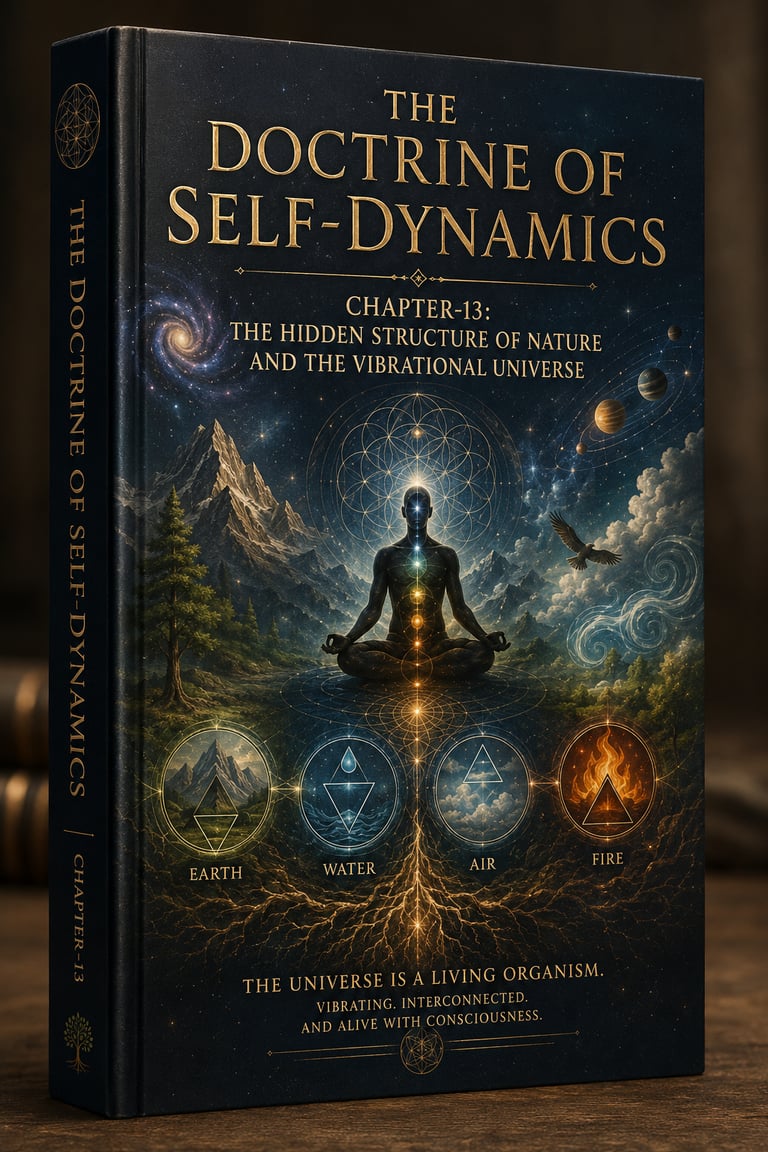
THE DOCTRINE OF SELF-DYNAMICS
CHAPTER-13: THE HIDDEN STRUCTURE OF NATURE AND THE VIBRATIONAL UNIVERSE
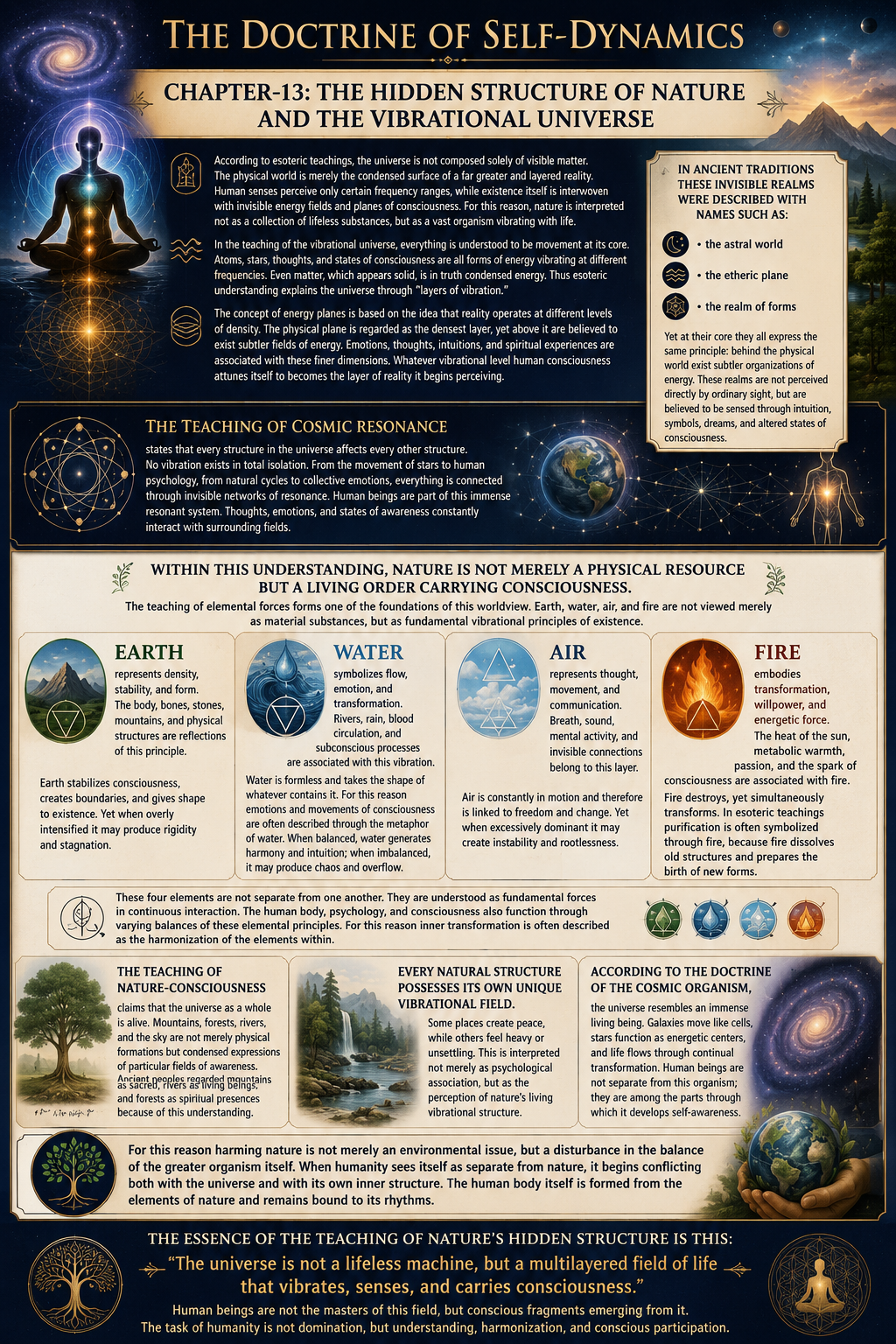
According to esoteric teachings, the universe is not composed solely of visible matter. The physical world is merely the condensed surface of a far greater and layered reality. Human senses perceive only certain frequency ranges, while existence itself is interwoven with invisible energy fields and planes of consciousness. For this reason, nature is interpreted not as a collection of lifeless substances, but as a vast organism vibrating with life.
In the teaching of the vibrational universe, everything is understood to be movement at its core. Atoms, stars, thoughts, and states of consciousness are all forms of energy vibrating at different frequencies. Even matter, which appears solid, is in truth condensed energy. Thus esoteric understanding explains the universe through “layers of vibration.”
The concept of energy planes is based on the idea that reality operates at different levels of density. The physical plane is regarded as the densest layer, yet above it are believed to exist subtler fields of energy. Emotions, thoughts, intuitions, and spiritual experiences are associated with these finer dimensions. Whatever vibrational level human consciousness attunes itself to becomes the layer of reality it begins perceiving.
In ancient traditions these invisible realms were described with names such as:
• the astral world,
• the etheric plane,
• the realm of forms.
Yet at their core they all express the same principle: behind the physical world exist subtler organizations of energy. These realms are not perceived directly by ordinary sight, but are believed to be sensed through intuition, symbols, dreams, and altered states of consciousness.
The teaching of cosmic resonance states that every structure in the universe affects every other structure. No vibration exists in total isolation. From the movement of stars to human psychology, from natural cycles to collective emotions, everything is connected through invisible networks of resonance. Human beings are part of this immense resonant system. Thoughts, emotions, and states of awareness constantly interact with surrounding fields.
Within this understanding, nature is not merely a physical resource but a living order carrying consciousness. The teaching of elemental forces forms one of the foundations of this worldview. Earth, water, air, and fire are not viewed merely as material substances, but as fundamental vibrational principles of existence.
The element of Earth represents density, stability, and form. The body, bones, stones, mountains, and physical structures are reflections of this principle. Earth stabilizes consciousness, creates boundaries, and gives shape to existence. Yet when overly intensified it may produce rigidity and stagnation.
The element of Water symbolizes flow, emotion, and transformation. Rivers, rain, blood circulation, and subconscious processes are associated with this vibration. Water is formless and takes the shape of whatever contains it. For this reason emotions and movements of consciousness are often described through the metaphor of water. When balanced, water generates harmony and intuition; when imbalanced, it may produce chaos and overflow.
The element of Air represents thought, movement, and communication. Breath, sound, mental activity, and invisible connections belong to this layer. Air is constantly in motion and therefore is linked to freedom and change. Yet when excessively dominant it may create instability and rootlessness.
The element of Fire embodies transformation, willpower, and energetic force. The heat of the sun, metabolic warmth, passion, and the spark of consciousness are associated with fire. Fire destroys, yet simultaneously transforms. In esoteric teachings purification is often symbolized through fire, because fire dissolves old structures and prepares the birth of new forms.
These four elements are not separate from one another. They are understood as fundamental forces in continuous interaction. The human body, psychology, and consciousness also function through varying balances of these elemental principles. For this reason inner transformation is often described as the harmonization of the elements within.
The teaching of nature-consciousness claims that the universe as a whole is alive. Mountains, forests, rivers, and the sky are not merely physical formations but condensed expressions of particular fields of awareness. Ancient peoples regarded mountains as sacred, rivers as living beings, and forests as spiritual presences because of this understanding.
Esoteric traditions hold that every natural structure possesses its own unique vibrational field. Some places create peace, while others feel heavy or unsettling. This is interpreted not merely as psychological association, but as the perception of nature’s living vibrational structure.
According to the doctrine of the cosmic organism, the universe resembles an immense living being. Galaxies move like cells, stars function as energetic centers, and life flows through continual transformation. Human beings are not separate from this organism; they are among the parts through which it develops self-awareness.
For this reason harming nature is not merely an environmental issue, but a disturbance in the balance of the greater organism itself. When humanity sees itself as separate from nature, it begins conflicting both with the universe and with its own inner structure. The human body itself is formed from the elements of nature and remains bound to its rhythms.
The essence of the teaching of nature’s hidden structure is this:
The universe is not a lifeless machine, but a multilayered field of life that vibrates, senses, and carries consciousness.
Human beings are not the masters of this field, but conscious fragments emerging within it.
True harmony is born not from dominating nature, but from entering once more into resonance with its cosmic rhythm.
SACRED CENTERS AND COSMIC GEOMETRY
In esoteric traditions, certain regions are believed to be more than mere geographical locations; they are regarded as powerful centers of consciousness and energy. According to this understanding, Earth is a living organism woven together by invisible networks of vibration. Mountains, temples, ancient cities, and certain natural locations are considered focal points where these energetic currents become concentrated. Ancient civilizations are believed to have selected sacred regions not only for strategic or aesthetic reasons, but because they sensed these invisible fields of resonance.
The Himalayas are symbolized in many mystical traditions as “the spine of the world.” Their towering peaks represent not merely physical elevation, but the ascent of consciousness itself. Thin air, silence, and isolation remove the mind from worldly noise. For this reason the Himalayan region became associated with inner transformation, retreat, and spiritual discipline. In esoteric teachings, high mountains are often seen as points of connection between heaven and earth.
Tibet is similarly regarded as one of the symbolic centers of inner knowledge traditions. Because of its isolated geography and mystical monastic culture, Tibet came to be described as a place where hidden teachings of consciousness were preserved. Practices involving silence, breath, vibration, and mental control transformed Tibet into not merely a physical location, but a psychological and spiritual center. In esoteric interpretation, Tibet is associated less with the outer world than with the map of the inner world.
Egypt, by contrast, is viewed as the center of cosmic architecture and the doctrine of death and rebirth. The pyramids are interpreted not merely as tombs, but as structures containing precise geometric and astronomical alignments. Esoteric traditions suggest that Egyptian temples were designed to transform human consciousness. Geometry, light, direction, and proportion were regarded as expressions of sacred knowledge. The idea that the human body and the cosmos share the same mathematical order became one of the foundational principles of Egyptian mystery systems.
Delphi in the ancient world was associated with the symbol of “the center of the Earth.” Oracular centers were understood not simply as places foretelling the future, but as locations where human consciousness attempted to contact invisible realms. The emergence of the teaching “Know thyself” in Delphi is therefore seen as deeply meaningful. According to esoteric understanding, the true center is not outside the human being, but within. Sacred centers are resonance fields helping humanity remember its own inner center.
According to the teaching of energy points, certain regions of Earth carry concentrated electromagnetic, geological, or consciousness-related fields. Ancient peoples are believed to have constructed temples, stone monuments, and sacred sites upon these locations intentionally. These energetic pathways have been described by names such as:
• ley lines,
• veins of the Earth,
• cosmic grids.
Within esoteric thought, Earth is not merely a planet of stone and soil, but a living organism through which energy circulates.
The doctrine of sacred geometry teaches that the order of the universe operates through mathematical proportions and vibrational forms. The spiral is one of its most fundamental symbols. Spiral structures appear constantly throughout nature — from galaxies and seashells to hurricanes and DNA strands. The spiral represents evolutionary movement and expanding consciousness, because life unfolds not linearly, but through cyclical expansion.
The golden ratio also stands at the center of sacred geometry. Certain mathematical proportions found throughout nature, the human body, plant structures, and galactic formations are interpreted as signs of universal harmony. Ancient architecture is believed to have deliberately employed these ratios in order to create not only aesthetic balance, but vibrational harmony as well.
In the teaching of cosmic architecture, temples, pyramids, and sacred buildings are not regarded merely as physical structures. They are designed to resonate with consciousness itself. Acoustic echoes, angles of light, geometric proportions, and directional alignments are arranged in ways intended to influence human awareness. Thus architecture becomes part of spiritual experience.
According to the concept of vibrational temples, structures do not generate energy independently; rather, they amplify existing resonance and influence states of consciousness. When human beings experience profound silence, peace, or expansion within certain places, esoteric interpretations explain this through the geometric and vibrational properties of those spaces.
These teachings claim that the essence of the universe is not chaos, but mathematical harmony. Geometry is viewed not simply as shape, but as the language through which conscious order expresses itself. If the human body, nature, and the cosmos all share the same underlying ratios, this strengthens the idea that existence emerges from a common source.
The essence of the doctrine of sacred centers and sacred geometry is this:
Earth is not a random formation, but a living organism woven together through consciousness, energy, and mathematical order.
Human beings explore this order not only to study the outer world, but to understand the architecture of their own inner being.
For according to ancient teachings, the ultimate sacred temple is the center of human consciousness itself.
THE PATH OF INITIATION: THE DEATH OF THE OLD SELF
In esoteric traditions, true transformation begins not through acquiring a new identity, but through the dissolution of the old one. For this reason, the path of initiation is not merely a process of gaining knowledge. Human beings must first confront the false centers upon which their identity has been constructed. Social roles, habitual thoughts, fears, desires, and the egoic structures of selfhood must dissolve before deeper layers of consciousness can emerge. This process is symbolized in many teachings as “death,” though what is meant is not biological death, but the dissolution of the false self.
The death of the old self begins when a person can no longer define themselves through the structures they once depended upon. One’s past, achievements, beliefs, or social identity cease to provide meaning in the same way. Many things that once seemed important begin appearing empty. This occurs because consciousness is beginning to move beyond its previous center. Yet this transition is not easy. The ego seeks to preserve itself, for to the ego, dissolution feels like annihilation.
Thus the first major stage of the initiation path is the dissolution of ego. Here the individual encounters their own shadow. Repressed fears, desires, anger, guilt, and deep loneliness rise into awareness. Esoteric traditions describe this process through symbols such as:
• the inner night,
• the dark cave,
• passing through fire.
For genuine transformation cannot occur until a person confronts their own darkness.
Inner darkness is not evil; it is the surfacing of the rejected parts hidden within the unconscious. Human beings usually know themselves only through the aspects they accept. Yet the initiation process forces even denied aspects into consciousness. For this reason, the spiritual path initially brings upheaval rather than peace, because the old structure is dissolving.
The trial of silence stands at the center of this stage. When human beings withdraw from the noise of the outer world, they are confronted by the chaos within themselves. Once constant speaking, thinking, and distraction begin to quiet, suppressed fears emerge. Therefore true silence often produces discomfort before it brings peace. Esoteric teachings define silence not merely as the absence of speech, but as the dissolution of mental noise itself.
The second great stage of initiation is cosmic loneliness. Here a person can no longer fully return to their old identity, yet has not entirely entered a new state of consciousness. A feeling of being suspended between worlds arises. The world still appears familiar, but no longer carries its previous meaning. Many mystical traditions symbolize this condition through the image of the “inner desert.”
The desert represents a state where external supports disappear. In this space, individuals are stripped of habits, social masks, and mental dependencies. What remains is only naked consciousness itself. During this process, a profound spiritual emptiness may emerge, because as the ego dissolves, the individual temporarily feels connected to nothing at all.
Esoteric teachings interpret this emptiness not as failure, but as a transitional state. The old consciousness must die before the new can be born. Just as a seed dissolves within dark soil before sprouting, consciousness must also pass through periods of inner emptiness. Cosmic loneliness is therefore not punishment, but the rebirth process of consciousness itself.
At this stage, the teaching of silence deepens further. External answers begin losing their power. Knowledge no longer arises solely from books or teachings, but directly from inner experience. As inner silence increases, intuition strengthens, because deeper layers of awareness become perceptible once mental noise diminishes.
This is why many great sages in esoteric traditions pass through long periods of retreat. Mountains, caves, deserts, and places of solitude symbolize the spaces where the old self dissolves. In these places, human beings are separated from worldly identities and confronted directly with their own essential core.
At the deepest point of cosmic loneliness, a realization begins to emerge:
The force sustaining existence is not the ego.
Even within silence, there remains a deeper center of consciousness.
True transformation begins here. Human beings no longer live merely through thought, but through direct awareness of existence itself.
The essence of the initiation path is this:
Before reaching truth, human beings must pass through the false centers they themselves have created.
Without the dissolution of ego, the soul cannot awaken.
Without confronting inner darkness, consciousness cannot become clear.
Those who flee silence cannot hear their own essence.
And consciousness that never passes through cosmic loneliness cannot understand the meaning of true unity.
CONSCIOUSNESS GATES, THE DANGEROUS PATH, AND THE NATURE OF TRUE POWER
On the path of initiation, human beings begin exploring not only the external world, but also the hidden layers of their own consciousness. As the mind grows silent and the ego begins to dissolve, fields of perception previously unnoticed start to open. In esoteric teachings, this phase is described as “the opening of the gates of consciousness.” Yet these gates do not exist merely to grant power; they exist to deepen the realization of truth. For as consciousness expands, human beings approach not only greater clarity, but also greater trials.
One of the first gates to open is intuition. Intuition means knowing without deliberate thought. This knowledge is not opposed to reason; it is direct perception beyond rational analysis. Sometimes a person senses the outcome of an event without being able to explain why. Sometimes the intentions of another are perceived before words are spoken. At other times, one feels an inner direction without any logical evidence. Esoteric traditions regard intuition as the first voice of the spiritual center.
As intuition strengthens, inner vision begins to emerge. This does not merely mean seeing symbolic images; it is the capacity to perceive the patterns hidden behind appearances. Human beings begin sensing the difference between appearance and essence. Dreams, symbols, synchronicities, and moments of deep realization gain importance during this process, because consciousness is no longer perceiving solely through the physical senses, but through subtler layers of awareness.
When higher perception awakens, human beings begin experiencing time, identity, and reality differently. Moments of profound unity, slowed perception of time, or expanded states of consciousness may arise. Esoteric teachings describe such states as “the thinning of the veil.” At this stage, one begins intuitively sensing that existence is not limited to the physical world alone.
Spiritual awareness stands at the center of all these gates. This awareness is deeper than any particular mystical experience. Human beings become capable of observing their own thoughts, emotions, and structures of identity. Consciousness begins illuminating itself. The true spiritual path begins here, because for the first time one can see oneself independently of automatic reactions.
Yet the opening of the gates of consciousness is also a dangerous phase. Esoteric traditions therefore emphasize that the inner path requires balance and caution. If psychic realms open before the ego has truly dissolved, the individual may fall into illusion.
The first danger on this path is the desire for power. After experiencing intuitive or mystical states, a person may begin believing themselves superior to others. As consciousness expands, feelings of spiritual exceptionalism may arise. Many stories of downfall within esoteric traditions are connected to transforming spiritual knowledge into an instrument of personal power. Even when the ego abandons physical domination, it may return disguised as spiritual superiority.
Psychic distortions are another danger. Individuals may begin treating every symbol as divine revelation and every inner feeling as absolute truth. Intense experiences arising before inner balance has been established can detach a person from reality itself. For this reason esoteric teachings insist that the spiritual path requires not only experiences, but also purification and equilibrium.
False awakenings are among the greatest traps of this journey. Temporary expansions of consciousness may be mistaken for ultimate truth. A few mystical experiences do not constitute genuine transformation. True awakening produces greater humility, clarity, and balance. If spiritual experiences make a person arrogant, hostile, or obsessed with superiority, esoteric understanding interprets this not as authentic ascent, but as a new mask worn by the ego.
For this reason, true power is not found in extraordinary abilities, but in self-mastery. A person may control others while remaining enslaved by their own fears. According to esoteric teachings, the greatest dominion is mastery over one’s own mind, desires, and reactions.
Mastery of consciousness does not mean suppressing thoughts, but no longer being ruled by them. Human beings do not deny their emotions, yet neither are they carried away by them. They use the mind without becoming lost inside it. As the inner center strengthens, consciousness becomes calmer, clearer, and more balanced.
Inner discipline forms the foundation of this process. In esoteric traditions, discipline is not oppression, but the conscious direction of energy. Scattered consciousness loses strength; focused consciousness creates transformation. For this reason practices such as breath work, silence, attention training, ethical balance, and self-observation are considered essential in many teachings.
True power does not seek display. It is silent, balanced, and centered. As human beings transform their own inner chaos, the need to dominate others diminishes. Genuine mastery is established not in the outer world, but within the inner center.
The essence of the teaching of consciousness gates is this:
The spiritual path is not a path of gaining power, but of clarifying consciousness.
Intuition may open. Psychic experiences may arise. Higher perceptions may emerge. Yet all of these are temporary. What remains enduring is the human being’s establishment within their own essential center.
For the greatest awakening is becoming the master of one’s own consciousness.
THE HUMAN OF THE FUTURE AND A CONSCIOUSNESS-BASED CIVILIZATION
According to esoteric teachings, humanity is not merely a biological species undergoing technological evolution. The true evolution is the transformation of consciousness itself. Throughout history, humanity first learned survival, then learned thought, and eventually learned to control nature. Yet the human model of the future moves beyond civilizations built upon control and enters a consciousness-centered mode of existence. In this new stage, humanity becomes not merely more intelligent, but more aware, more intuitive, and more integrated.
The new human being sees reason and intuition not as opposites, but as complementary forces. Modern humanity has largely lived through analytical thought; the future human develops intuitive awareness consciously once again. This intuition is not blind belief or irrational mysticism. Rather, it is the capacity to directly perceive the invisible interconnections of life. Human beings begin evolving into a level of consciousness capable not merely of gathering information, but of sensing reality vibrationally.
In a society guided by intuition, education is no longer based solely on memorization and competition. Inner awareness, attention management, empathy, discipline of consciousness, and ethical development become essential aspects of human formation. Intelligence alone is no longer considered sufficient. Wisdom, intuition, and spiritual balance become necessary dimensions of development.
With this transformation emerges the concept of spiritual ethics. In modern systems, ethics are generally based upon external rules. The future human, however, generates ethical behavior from awareness itself rather than fear. One begins feeling that harming another being damages the shared field of consciousness. Ethics therefore evolve from imposed moral systems into direct understanding of conscious resonance.
Within spiritual ethics, power ceases being an instrument of domination. Knowledge is used for sharing rather than control. Technology develops in harmony with nature instead of against it. Humanity begins perceiving nature not as a resource to exploit, but as a living organism. As consciousness expands, the perception of separation weakens.
The idea of a consciousness-based civilization proposes that future societies will be shaped not merely by economics or politics, but by levels of consciousness. The true strength of societies will no longer be measured by weapons or machines, but by collective awareness. Once humanity establishes balance between external progress and inner development, the direction of civilization itself changes.
Collective awakening stands at the center of this transformation. Esoteric teachings claim that humanity is already connected through invisible networks of consciousness, though most people remain unaware of this fact. In the coming era, these connections will become more consciously experienced. Human beings will communicate not only through digital systems, but also through intuitive and empathic fields.
The concept of consciousness networks becomes essential here. Every thought, emotion, and intention creates resonance within the shared human field. Future humanity will begin perceiving these invisible interactions more clearly. Thus the relationship between individual consciousness and the collective field becomes increasingly visible.
Empathic communication is one of the defining characteristics of the new human model. People will begin perceiving not only words, but emotional and conscious vibrations themselves. Lies, manipulation, and false identities will become increasingly difficult to sustain, because as consciousness becomes more transparent, individuals will sense one another’s true intentions more directly.
Fields of spiritual resonance arise when collective frequencies of consciousness form coherent patterns. When people meditate together, share common intention, or live in deep harmony, collective consciousness fields emerge. Esoteric understanding suggests that future communities will be shaped not only by physical proximity, but also by alignment of consciousness.
This transformation will not occur suddenly. As old systems dissolve, humanity may experience profound crises, conflicts, and loss of direction. Humanity stands within a transitional age. The mechanistic model of civilization is slowly reaching its limits, while a new consciousness model struggles to emerge. For this reason, modern chaos is often interpreted in esoteric teachings as the birth pains of a new humanity.
The human of the future is neither a mystical figure rejecting technology nor a mind entirely mechanized. Rather, it is a consciousness capable of balancing intuition with reason, individuality with unity, science with spiritual awareness.
The fundamental esoteric vision of humanity’s future is this:
The ultimate evolution of humanity is not the creation of stronger bodies, but the opening of wider fields of consciousness.
For the true transformation of civilization will begin not in the outer world, but within the inner structure of the human being itself.
TECHNOLOGY AND SPIRIT: HUMANITY AT THE THRESHOLD OF A NEW WORLD CYCLE
For the first time in human history, technology has ceased to be merely a tool for transforming the external world and has begun directly touching the field of consciousness itself. Artificial intelligence, digital networks, biotechnology, and advanced energy systems no longer reshape only the environment surrounding human life; they are transforming perception, modes of thought, and the structure of identity itself. From an esoteric perspective, this age is not simply an era of technological advancement, but a profound threshold in the evolution of human consciousness.
Modern humanity long used technology as a means of dominating nature. Mechanization, automation, and data systems generated extraordinary external power. Yet at the same time, human beings gradually drifted away from their inner center. Information increased, but wisdom did not mature at the same pace. Communication networks expanded, yet spiritual isolation deepened. For this reason, the balance between technology and spirit has become one of the defining questions of the future.
Artificial intelligence stands as the clearest symbol of this transformation. Humanity has begun creating systems that imitate its own modes of thinking. Algorithms can learn, analyze, and participate in decision-making processes. Esoteric interpretations often view this development as the human mind encountering its own reflection. Humanity is no longer merely producing tools; it is externalizing its own mental structures.
Yet this development raises a deeper question:
What is consciousness?
Artificial intelligence may process information, but can it possess awareness? Esoteric teachings distinguish sharply between computation and consciousness. The mind can organize data, but consciousness is the center that experiences. For this reason, one of the greatest crises of the future may not be technological, but ontological. Humanity is attempting to create systems resembling itself before fully understanding the nature of its own inner awareness.
Energy technologies represent another dimension of this transformation. In future civilizations, energy may no longer be viewed merely as fuel, but as the fundamental resonance field of life itself. Esoteric teachings frequently describe a direct relationship between energy and consciousness. Thus future energy systems are envisioned not simply as efficient mechanisms, but as structures aligned with nature, sustainability, and vibrational harmony.
Symbolic parallels are increasingly drawn between ancient concepts of “life force” and modern explorations of energy fields. The human being is not only a biological organism, but also an electromagnetic system. Future technologies may therefore influence not only physical machinery, but also human consciousness itself. Because of this, ethical development becomes not optional, but an unavoidable stage of evolution.
From an esoteric perspective, technology without ethics generates unconscious power. Unconscious power eventually threatens its own creator. Many of humanity’s present crises — ecological destruction, mass manipulation, digital addiction, and spiritual emptiness — can be interpreted as symptoms of the imbalance between technological growth and inner maturity.
For this reason, the future human being must evolve not only technologically, but consciously. High technology combined with low consciousness becomes destructive. Esoteric teachings therefore insist that true progress must rest first upon the discipline of consciousness itself.
The concept of the “new world cycle” expresses this larger transition. Many ancient traditions describe humanity as passing through recurring phases of transformation. Civilizations emerge, rise, decay, and dissolve. When old systems can no longer sustain life, new forms of consciousness begin to emerge.
The global crises unfolding today are therefore interpreted not merely as political or economic disturbances, but as signs of dissolving consciousness structures. Systems built upon domination, endless consumption, mechanistic living, and separation consciousness are reaching their limits. In this view, collapse is not only destruction, but also the beginning of transformation.
At the center of this transformation lies consciousness itself. Humanity has spent immense energy changing the outer world; now it must confront its own inner structure. Most external crises are reflections of deeper inner conflicts. Unless humanity transforms fear, greed, and the illusion of separation within itself, no truly sustainable civilization can emerge.
The teaching of cosmic rebirth suggests that beyond this dissolution a new stage of consciousness will arise. This rebirth is not a return to the past, but the emergence of a higher synthesis. Science and spirituality, technology and intuition, individuality and unity will begin forming new fields of balance.
Esoteric traditions often symbolize rebirth through the image of the phoenix rising from ashes. Before new consciousness can emerge, old structures must burn away. Humanity itself is passing through such a fire of transition. The process may be painful, but it also signals the birth of wider awareness.
The essence of the new world cycle is this:
Humanity’s future depends not only on what technologies it develops, but on the level of consciousness to which it rises.
Technology increases human power.
But consciousness determines the direction in which that power is used.
And until consciousness itself transforms, no external system can truly liberate humanity.