THE DOCTRINE OF SELF-DYNAMICS CHAPTER-18: Aether–Akasha and Cosmic Consciousness
THE DOCTRINE OF SELF-DYNAMICS CHAPTER-18: Aether–Akasha and Cosmic Consciousness.The Doctrine of Self-Dynamics synthesizes these traditions within a single system and explains Arsh as follows: Arsh is the first cosmic horizon of orientation of the Absolute Source.
ÖZ-DEVİNİM KURAMI
THE DOCTRINE OF SELF-DYNAMICS
CHAPTER-18: Aether–Akasha and Cosmic Consciousness
THE THRONE (ARSH) AND THE FIELD OF COSMIC SOVEREIGNTY
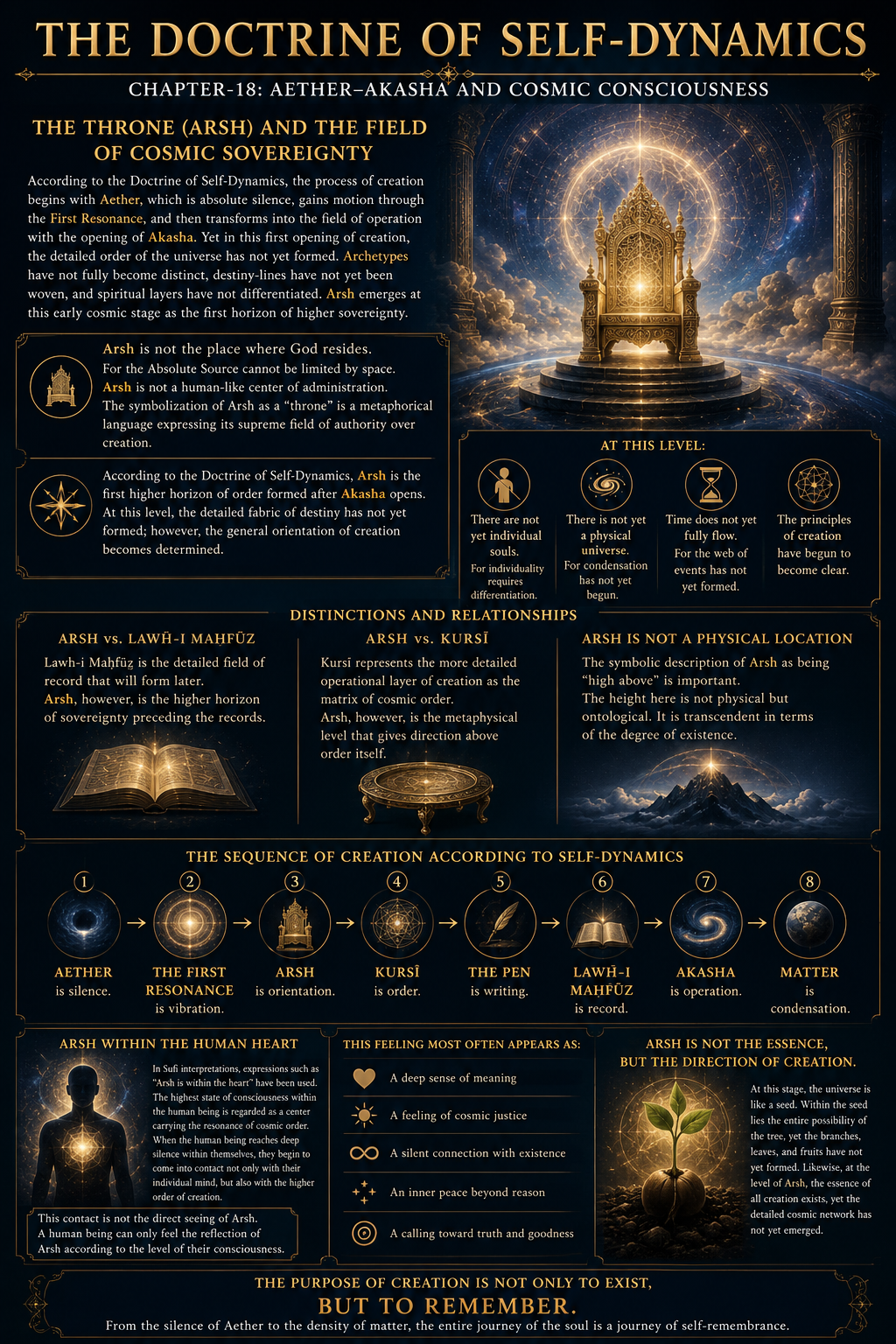
According to the Doctrine of Self-Dynamics, the process of creation begins with Aether, which is absolute silence, gains motion through the First Resonance, and then transforms into the field of operation with the opening of Akasha. Yet in this first opening of creation, the detailed order of the universe has not yet formed. Archetypes have not fully become distinct, destiny-lines have not yet been woven, and spiritual layers have not differentiated. Arsh emerges at this early cosmic stage as the first horizon of higher sovereignty.
In Qur’anic cosmology, Arsh is described as one of the highest metaphysical ranks. In traditional interpretations, Arsh has sometimes been explained as sovereignty, sometimes as power, and sometimes as the symbol of divine governance. The Doctrine of Self-Dynamics, however, interprets Arsh not as a physical throne or a spatial center, but as the first field of sovereignty within creation.
At this point, an important distinction must be made. Arsh is not the place where God resides. For the Absolute Source cannot be limited by space. Likewise, Arsh is not a human-like center of administration. The symbolization of Arsh as a “throne” is a metaphorical language expressing its supreme field of authority over creation.
According to the Doctrine of Self-Dynamics, Arsh is the first higher horizon of order formed after Akasha opens. At this level, the detailed fabric of destiny has not yet formed; however, the general orientation of creation becomes determined. In other words, Arsh is not the domain in which the details of creation appear, but the first cosmic field of sovereignty in which the direction of creation emerges.
Aether was absolute silence.
The First Resonance was the birth of motion.
Arsh is the first gaining of direction by this motion.
For this reason, Arsh is also defined in the Doctrine of Self-Dynamics as the “field of cosmic orientation.” For creation is no longer merely a vibrating potential; it has begun to flow toward a certain order.
In ancient esoteric systems, there are many concepts resembling Arsh. In Kabbalah, Keter is the highest point of the sefirotic structure and is regarded as the first manifestation of divine will. In Sufism, the idea of the first manifestation (tajallī) describes the first visible divine orientation appearing after the Essence. In Neoplatonism, the first emanation flowing from the One is the first cosmic opening before detailed layers of existence are formed. In Akashic cosmology, this may be called the field of cosmic will.
The Doctrine of Self-Dynamics synthesizes these traditions within a single system and explains Arsh as follows:
Arsh is the first cosmic horizon of orientation of the Absolute Source.
At this level, there are not yet individual souls. For individuality requires differentiation. There is not yet a physical universe. For condensation has not yet begun. Time does not yet fully flow. For the web of events has not yet formed. Yet the principles according to which all creation will unfold have begun to become clear.
Therefore, Arsh is not the essence of creation, but the direction of creation.
In the Doctrine of Self-Dynamics, the most important characteristic of Arsh is that order has not yet transformed into detail. Here, the universe is like a seed. Within the seed lies the entire possibility of the tree, yet the branches, leaves, and fruits have not yet formed. Likewise, at the level of Arsh, the essence of all creation exists, yet the detailed cosmic network has not yet emerged.
This distinguishes Arsh from Lawḥ-i Maḥfūẓ. For Lawḥ-i Maḥfūẓ is the detailed field of record that will form later. Arsh, however, is the higher horizon of sovereignty preceding the records. Likewise, Arsh is also different from Kursī. Kursī represents the more detailed operational layer of creation as the matrix of cosmic order. Arsh, however, is the metaphysical level that gives direction above order itself.
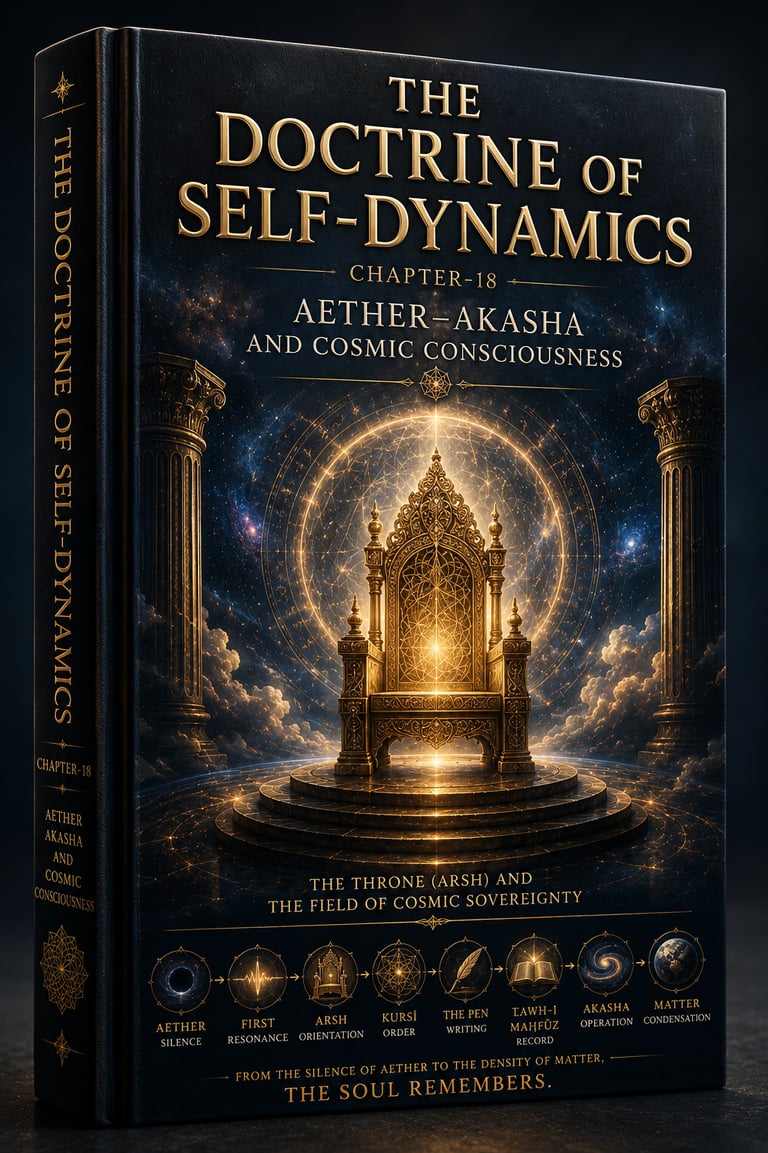
The Doctrine of Self-Dynamics explains these cosmic ranks in the following order:
Aether is silence.
The First Resonance is vibration.
Arsh is orientation.
Kursī is order.
The Pen is writing.
Lawḥ-i Maḥfūẓ is record.
Akasha is operation.
Matter is condensation.
This sequence describes the gradual unfolding of creation.
For this reason, the symbolic description of Arsh as being “high above” is important. The height here is not physical but ontological. In other words, Arsh is not spatially above; it is transcendent in terms of the degree of existence. Since the human mind struggles to understand abstract metaphysical levels, ancient texts often used symbols such as “height,” “heaven,” “throne,” “light,” and “crown.”
Therefore, in the Doctrine of Self-Dynamics, it is considered incorrect to think of Arsh as “a throne standing above the heavens.” Arsh is not a physical location, but a metaphysical field of sovereignty.
In Sufi interpretations, expressions such as “Arsh is within the heart” have sometimes been used. This understanding is symbolically significant. For the highest state of consciousness within the human being is regarded as a center carrying the resonance of cosmic order. When the human being reaches deep silence within themselves, they begin to come into contact not only with their individual mind, but also with the higher order of creation.
According to the Doctrine of Self-Dynamics, this contact is not the direct seeing of Arsh. For Arsh is not a physical object. A human being can only feel the reflection of Arsh according to the level of their consciousness. This feeling most often appears as:
a deep sense of meaning,
a feeling of cosmic unity,
higher intuition,
the desire to turn toward truth,
and the perception of inner order.
For this reason, mystical traditions have used expressions such as “the throne of the heart,” “the Arsh of the soul,” and “the inner heaven.”
Arsh is also the first balance point of cosmic order. For the vibration beginning with the First Resonance gains direction at the level of Arsh and ceases to be chaotic. Thus, Arsh is not only a field of sovereignty, but also the first center of cosmic harmony.
The idea in ancient cosmologies that the universe was established according to certain proportions and sacred geometries is also related to this understanding. For creation unfolds not randomly, but in an ordered manner. Arsh is the first metaphysical horizon of this order.
According to the Doctrine of Self-Dynamics, the inner journey of the human being also proceeds in reverse to the process of cosmic creation. The human being first transcends matter, then becomes aware of the Akashic operation, afterward begins to read the weaving of destiny, and finally approaches the level of consciousness capable of feeling the resonance of Arsh.
Yet there is an important danger here. The human mind often wishes to personify higher metaphysical levels. For this reason, Arsh has often been imagined in anthropomorphic ways. However, in the Doctrine of Self-Dynamics, Arsh is not a being. It is the higher sovereign level of creation.
Therefore, approaching Arsh is not a physical journey. To approach Arsh is to awaken to a higher perception of order within consciousness.
The fundamental teaching of the Doctrine of Self-Dynamics in this section is this:
Arsh is not the center of creation, but the direction of creation.
It is not a place that rules, but the metaphysical horizon in which sovereignty opens.
And it is here that all creation first begins to gain an ordered flow.
THE THRONE OF ORDER (KURSĪ) AND THE COSMIC MATRIX OF ORDER
According to the Doctrine of Self-Dynamics, the process of creation does not consist merely of the birth of vibration. The cosmic motion that begins with the First Resonance gains direction at the level of Arsh; yet it has not yet transformed into a detailed order. For creation to function, direction alone is not sufficient. Because direction, without order, may turn into chaos. It is precisely at this point that Kursī emerges.
In the Qur’an, it is stated that Kursī “encompasses the heavens and the earth.” In traditional interpretations, this concept has sometimes been explained as divine knowledge, sometimes as power, and sometimes as the field of sovereignty. The Doctrine of Self-Dynamics, however, interprets Kursī as the first matrix of order within creation.
Arsh is the horizon of sovereignty.
Kursī is the field of order in which this sovereignty transforms into operation.
In other words, Arsh determines the direction of creation; Kursī establishes how this direction will function.
For this reason, Kursī is called in the Doctrine of Self-Dynamics the “cosmic matrix of order.” Because here creation is no longer merely a potential orientation. For the first time, proportions, relations, flows, and cosmic connections begin to become distinct.
There is not yet physical matter. Stars, galaxies, and bodies have not yet formed. Yet the mathematical and metaphysical order that will make their formation possible has emerged. Therefore, Kursī is the invisible architecture of creation.
According to the Doctrine of Self-Dynamics, Akasha is not merely the field of cosmic record. In modern esoteric interpretations, Akasha has often been understood only as “universal memory.” Yet memory is only one of the results of operation. The first function of Akasha is not to keep records, but to establish order.
Kursī is the Qur’anic symbol of this order.
When Akasha opened, the vibrational field of creation was born. With Kursī, these vibrations begin to transform into ordered relationships. Frequencies move according to certain laws of harmony. Archetypes establish connections with one another. Cosmic proportions emerge. Thus, creation advances from chaotic vibrations toward an ordered universe.
The idea in ancient traditions that the universe was created according to “measure” is related to this understanding. The Qur’anic principle “We created everything according to a measure,” the Hermetic doctrine of cosmic proportion, the Pythagorean metaphysics of number, the sefirotic order in Kabbalah, and the concept of mīzān in Sufism are different expressions of the same metaphysical intuition.
For without order, creation cannot be sustained.
According to the Doctrine of Self-Dynamics, three fundamental laws become distinct for the first time within Kursī:
measure,
proportion,
and relation.
Measure determines the limits of creation. Proportion establishes the harmony of beings with one another. Relation connects all layers of creation to one another through invisible networks.
Therefore, Kursī is not only the “encompassing field,” but also the “connecting field.”
At the level of Kursī, the detailed fabric of destiny has not yet formed; however, the mathematical structure through which destiny will operate has been prepared. Just as a musical composition is arranged according to harmonic laws before it is performed, the universe also begins to take shape according to cosmic harmony at the level of Kursī.
According to the Doctrine of Self-Dynamics, the regularities within the physical universe are reflections of this cosmic matrix. The motions of planets, proportions in nature, mathematical constants, laws of vibration, and even processes of consciousness are lower-level manifestations of the principles of order of Kursī.
For this reason, ancient mystics regarded mathematics as sacred. Because number is not merely quantity; it is the language of order. The Pythagorean understanding that “the universe is number,” the doctrine of mīzān in Islamic thought, and the numerical emanation system in Kabbalah all carry the same primordial intuition:
The universe unfolds not randomly, but according to measure.
Kursī is precisely this field of measure.
In Sufism, the idea that “everything is in its proper place” is sometimes emphasized. This expression carries not only a moral meaning, but also a cosmological one. Because according to the Doctrine of Self-Dynamics, the places, relations, and flows of beings are formed according to the matrix of order at the level of Kursī.
Therefore, even chaos is not absolute. Even when the human being perceives disorder through limited vision, an unseen order may still be operating at a higher level.
The Doctrine of Self-Dynamics makes an important distinction here:
Arsh is the horizon of cosmic sovereignty.
Kursī is the first field of functioning order.
For this reason, Arsh is closer to transcendence, whereas Kursī is closer to the operation of creation.
Kursī is also the first geometric level of creation. Because here directions, proportions, and relations begin to become distinct for the first time. The origins of ancient sacred geometries are also connected to this understanding. Spiral structures, the golden ratio, cosmic symmetries, and mandalas are not merely aesthetic forms; they are symbolic projections of invisible order.
According to the Doctrine of Self-Dynamics, Kursī, which is the first layer of Akasha, is the mathematical spirit of creation.
Therefore, at the level of Kursī there are not yet events; yet there is the order that will make events possible. There are not yet individual destinies; yet the network in which destinies will operate has been prepared. Humanity has not yet emerged; yet the cosmic proportion within which humanity will exist has been determined.
For this reason, the statement that Kursī “encompasses the heavens and the earth” is symbolic. The encompassing here is not physical but ontological. In other words, Kursī encompasses everything because it is the foundational matrix of order for all levels of creation.
The idea among ancient mystics that “the universe is written like a book” also gains meaning at this point. For writing does not consist merely of letters; in order for writing to be readable, order is required. Kursī is the first cosmic arrangement that makes the book of creation readable.
According to the Doctrine of Self-Dynamics, human consciousness also carries the reflection of Kursī. The human mind seeks order. It establishes mathematics. It perceives proportions. It takes pleasure in music. It finds meaning in geometry. Because human consciousness is a small projection of the cosmic matrix of order.
For this reason, the human being is inwardly disturbed by chaos. Because within their essence there is the resonance of order.
Yet an important mystery exists here. If order is sought only in the outer world, the human being becomes mechanized. True order is the harmony between the outer and the inner. This is why ancient teachings concerning “inner order,” “balance of the heart,” “the middle way,” and “mīzān” are important.
Because Kursī is not only the principle of order of the cosmic universe, but also of the inner structure of the human being.
According to the Doctrine of Self-Dynamics, the spiritual journey of the human being is the process of bringing the disordered vibrations within oneself into harmony with cosmic order. Fears, anger, excessive desires, and fragmentations of consciousness disrupt the inner matrix of the human being. The person who approaches truth, however, begins to feel a greater harmony within themselves.
This harmony is the resonance of Kursī within human consciousness.
And the fundamental teaching of the Doctrine of Self-Dynamics in this section is this:
Akasha does not merely keep records.
It first establishes order.
Kursī is the first cosmic matrix of this order.
And all creation unfolds within an invisible measure.
THE PEN (QALAM), KALĀM, LOGOS, AND THE FIRST CREATIVE PRINCIPLE
According to the Doctrine of Self-Dynamics, creation does not begin merely with vibration; vibration must transform into a meaningful order. With the First Resonance, motion was born; with Arsh, direction was determined; with Kursī, the matrix of order was established. Yet creation is still not readable. For in order for order to transform into a visible operation, a “language of creation” is required. It is at this point that the Pen (Qalam) emerges.
In the Qur’anic tradition, the Pen is an extremely profound metaphysical symbol. The expression at the beginning of Sūrat al-Qalam, “Nun. By the Pen and what they inscribe,” has been interpreted as a mystery pointing not only to physical writing, but also to the metaphysical writing of creation. In the Sufi tradition, the Pen is associated with the writing of destiny, the unfolding of divine knowledge, and the transformation of the plan of creation into visible operation.
In the Doctrine of Self-Dynamics, however, the Pen is the first creative coding principle operating within Akasha.
The Pen is not an object.
It is the principle through which creation becomes writing.
The writing here should not be understood in the sense of physical letters. Writing is the transformation of potential into readable order. For energy alone is not sufficient for creation to function; energy must be arranged according to certain patterns of meaning. The Pen is precisely this principle of arrangement.
Aether was silent infinity.
The First Resonance was vibration.
Arsh was orientation.
Kursī was the matrix of order.
The Pen is the transformation of order into a meaningful language of creation.
For this reason, in the Doctrine of Self-Dynamics, the Pen is regarded as the first metaphysical encoder of creation.
It is no coincidence that in ancient traditions creation begins with the “Word.” For the Word is not merely sound; it is organized vibration. Concepts such as Logos, Kalām, the Command, Kun, AUM, and the Divine Word all point to the same primordial principle.
In the Hermetic tradition, Logos is the cosmic intellect that orders the universe. In Christian mysticism, Logos is interpreted as the divine word of creation. In Sufism, Kalām is understood as the vibrational expression of divine truth. The Qur’anic understanding of “Kun fa-yakūn” describes the command-like unfolding of creation.
The Doctrine of Self-Dynamics unites these concepts in the following way:
Logos is the cosmic intellect of creation.
Kalām is the vibration of meaning within creation.
The Pen is the principle through which this vibration transforms into destiny and order.
For this reason, the Pen is not merely the “writer,” but also the metaphysical principle that “forms the code.”
According to the Doctrine of Self-Dynamics, Akasha is the invisible network of creation. Yet for this network to function, certain orders must be defined. Which vibrations will transform into which forms, which archetypes will connect with which events, and which spiritual lines will move toward which destiny-fields all require a language of creation.
The Pen establishes this language.
For this reason, the Pen is the principle that transforms silent possibility into a readable plan.
In Sufism, interpretations such as “the Pen is the first thing created” have sometimes been made. The Doctrine of Self-Dynamics approaches this understanding symbolically. What is described here is not a physical sequence of creation, but a metaphysical sequence of function.
For in order for creation to become readable, coding must first exist. Just as thought requires language in order to become writing, cosmic creation also requires a metaphysical principle of writing in order to transform into events.
The Pen is precisely this.
For this reason, there is a powerful relationship between the Pen and destiny. Yet destiny here does not mean a mechanical necessity. Destiny is the web of possibilities written by the Pen. The human being lives within this web; yet as consciousness develops, the capacity to alter the meaning of the writing also develops.
According to the Doctrine of Self-Dynamics, the Pen possesses three fundamental functions:
to encode,
to organize,
and to transform.
To encode is to transform potential into a certain model of creation. To organize is to operate this model within cosmic harmony. To transform is to turn the plan into the flow of events.
For this reason, the Pen is not merely a principle operating at the beginning. It is a continuous metaphysical process operating throughout creation.
The ancient mystical understanding that “the universe is a written book” also gains meaning at this point. For the physical world does not consist merely of matter; it also consists of meanings. Every event is a sign. Every symbol carries a vibration. Every encounter is part of an invisible writing.
The Pen is the metaphysical source of this writing.
In the Doctrine of Self-Dynamics, the concept of Kalām also gains a special meaning here. Kalām is not merely speech. Kalām is vibration that carries meaning. Human language is its lower reflection. When the human being speaks, they produce sound; yet they also send vibration into the field of consciousness.
For this reason, speech was regarded as sacred in ancient traditions. Because speech is creative. Through speech, the human being may:
heal,
wound,
influence destiny,
and transform consciousness.
For human language is a small reflection of the cosmic Kalām.
According to the Doctrine of Self-Dynamics, all creation is in reality a vibrational text. Human beings usually read this text only as physical events. Yet as mystical consciousness develops, the web of meaning behind events begins to become visible.
For this reason, ancient mystics said that “truth is read.”
The Qur’anic concept of “āyah” is also important in this regard. An āyah is not merely a sentence in a book, but also a cosmic sign. In other words, the universe itself is a readable text. Stars, time, destiny, the human soul, and events may all be understood as āyāt.
The Pen is the writing principle of this cosmic text.
The association of creation with letters in Kabbalah, sacred alphabets in the Hermetic tradition, hurūfī interpretations in Islamic mysticism, and mantra vibrations in the Vedic tradition are all different reflections of the same metaphysical intuition:
The universe consists of vibrations carrying meaning.
For this reason, creation is not merely physical, but semantic. In other words, the universe does not merely exist; it also “produces meaning.”
According to the Doctrine of Self-Dynamics, the deepest mystery of the Pen is hidden here. The Pen does not merely write events; it gives meaning to events.
For this reason, two people may experience the same event yet transform in completely different ways. Because destiny is not merely an external event; it is how the event is read within consciousness.
For this reason, the writing of the Pen is not fixed. Lawḥ-i Maḥfūẓ is the preserved field of knowledge; yet since the operation within Akasha is dynamic, human consciousness may alter the interpretation of the writing.
At this point, the Doctrine of Self-Dynamics distinguishes between the human being who lives destiny and the human being who reads destiny.
The unconscious person is carried within the writing.
The awakened person notices the symbols of the writing.
The wise person begins to learn the language of the writing.
Therefore, the mystical journey is in reality the process of learning the cosmic script.
When the human being begins to read the fears, desires, recurring events, dreams, and intuitions within themselves, they begin to notice the personal layers of the Akashic writing. For the Pen writes not only the universe, but also the inner world of the human being.
According to the Doctrine of Self-Dynamics, the human soul is a living text. Every experience adds new vibrations to this text. Every choice opens new lines. Every awareness changes the meaning of the writing.
And the metaphysical principle operating behind all these processes is the Pen.
For this reason, the Pen is not a physical instrument, but the living language of creation.
The fundamental teaching of the Doctrine of Self-Dynamics in this section is this:
The Pen is the transformation of silent infinity into the language of creation.
Kalām is the vibration of this language.
Logos is the intellect of this language.
And the universe is the visible form of this cosmic writing.
THE PRESERVED TABLET (LAWH-I MAḤFŪẒ), AKASHA, AKASHIC RECORDS, AND COSMIC MEMORY
According to the Doctrine of Self-Dynamics, creation does not consist solely of processes of energy, vibration, and order. For the continuity of order requires memory. If nothing were recorded, if no vibration left a trace, and if no becoming were preserved, the universe would constantly dissolve. Therefore, one of the invisible foundational principles of creation is cosmic memory.
In the Qur’anic tradition, this memory is most often expressed through the concept of Lawḥ-i Maḥfūẓ. Meaning the “Preserved Tablet,” Lawḥ-i Maḥfūẓ represents the metaphysical domain in which divine knowledge is preserved. In traditional Islamic thought, Lawḥ-i Maḥfūẓ has been interpreted as a symbolic concept expressing that all becomings within the universe are recorded within the knowledge of Allah.
The Doctrine of Self-Dynamics symbolically compares Lawḥ-i Maḥfūẓ with the idea of Akashic Records; however, it does not regard the two concepts as completely identical.
For in modern esoteric thought, Akashic Records have often been interpreted as though they were an independent energy field. Yet in the Qur’anic context, Lawḥ-i Maḥfūẓ is not a cosmic data repository functioning independently of Allah. It is the preserved metaphysical dimension of divine knowledge.
This distinction is extremely important for the Doctrine of Self-Dynamics.
Akasha is the field of process-becoming.
Lawḥ-i Maḥfūẓ is the field of record.
The Pen is the principle of creative writing.
Kursī is the matrix of order.
Arsh is the horizon of sovereignty.
Therefore, Lawḥ-i Maḥfūẓ is not the point of origin of creation, but the preserved dimension of knowledge of creation.
The Pen initiates the writing of creation. Akasha forms the operational field of this writing. Lawḥ-i Maḥfūẓ, meanwhile, is the preserved memory of this operation.
According to the Doctrine of Self-Dynamics, no vibration occurring within the universe is ever completely lost. Every thought, every intention, every event, and every movement of consciousness leaves a trace within Akasha. The preserved totality of these traces forms the field of cosmic memory.
This is why ancient traditions held the belief that “the universe remembers.”
In Sufism, Lawḥ-i Maḥfūẓ has been interpreted as the field in which destiny is written. The understanding of divine plan in Kabbalah, the concept of cosmic memory in Vedic thought, and the modern doctrine of Akashic Records are different forms of this metaphysical intuition.
Yet the Doctrine of Self-Dynamics makes a very important distinction here:
Akasha is the living process.
Lawḥ-i Maḥfūẓ is preserved knowledge.
In other words, Akasha is the river; Lawḥ-i Maḥfūẓ is the invisible memory preserving the entire flow of the river.
For this reason, Lawḥ-i Maḥfūẓ is not merely the record of the past. Because time is not linear. Past, present, and future are interconnected at the Akashic level. Therefore, Lawḥ-i Maḥfūẓ contains not only what has happened, but also the webs of possibility.
According to the Doctrine of Self-Dynamics, destiny must be understood here. Destiny is not an unchangeable necessity engraved in stone. Destiny is the transformation into operation, within Akasha, of the webs of possibility contained in Lawḥ-i Maḥfūẓ.
For this reason, human consciousness is important.
Because the unconscious person merely experiences the effects of the records. The awakened person, however, begins to read the language of the records.
The ancient mystical saying, “Whoever knows themselves knows their destiny,” is related to this understanding. As the human being observes their inner world, notices their recurring fears, desires, relationships, and spiritual tendencies, they begin to read the traces of their own Akashic Records.
According to the Doctrine of Self-Dynamics, the human being is not merely a physical body. The human being is also a walking field of memory.
Every trauma,
every joy,
every fear,
every love,
every choice
leaves vibrational traces within the Akashic layers of the soul.
Over time, these traces shape character, tendencies of destiny, and spiritual orientation.
In Sufism, these have sometimes been called the veils of the nafs. In Jungian psychology, the concept of the collective unconscious points toward a similar domain. In Kabbalah, spiritual traces gain meaning within the sefirotic order. In Vedic thought, karmic records perform a similar function.
The Doctrine of Self-Dynamics unites all these concepts under the following idea:
The universe does not forget.
This non-forgetting is not a physical memory, but a vibrational memory.
Lawḥ-i Maḥfūẓ is the Qur’anic symbol of this cosmic preserved memory.
Here, the concept of the “tablet” is also symbolic. Because Lawḥ-i Maḥfūẓ is not a physical tablet. It is a metaphysical dimension of record. Since the human mind struggles to comprehend abstract truths, ancient texts often used symbols such as writing, tablet, book, and record.
For this reason, Qur’anic concepts such as “Kitāb-i Mubīn,” “Umm al-Kitāb,” and “Lawḥ-i Maḥfūẓ” may be interpreted not only as literal writing, but also as the cosmic order of knowledge.
According to the Doctrine of Self-Dynamics, the most important characteristic of Lawḥ-i Maḥfūẓ is its “preservedness.”
Preservedness means that knowledge is not lost.
For within the physical world, everything changes. Civilizations collapse. Bodies die. Stars fade. Yet cosmic memory does not disappear.
For this reason, mystical traditions held that some people could intuit the past, symbols, or unseen connections. The Doctrine of Self-Dynamics interprets this not directly as miracle, but as a partial resonance between consciousness and the Akashic Records.
However, an important danger exists here. The human mind can easily transform such ideas into claims of absolute knowledge. Therefore, the Doctrine of Self-Dynamics does not claim that the Akashic Records are fully readable. Because human consciousness is limited. Human beings can perceive only as much as corresponds to their own vibrational level.
For this reason, mystical intuitions are often symbolic. Dreams, metaphors, intuitions, and inner images are not direct knowledge; they are reflections of the field of knowledge within consciousness.
According to the Doctrine of Self-Dynamics, this is also why dreams are important. During sleep, physical consciousness weakens and the human soul enters into a more flexible resonance with the Akashic layers. Therefore, a person may sometimes perceive symbolic images of past records, webs of possibility, or subconscious residues.
Lawḥ-i Maḥfūẓ is also the foundation of collective memory.
Humanity carries not only an individual memory, but also a shared field of memory. Wars, traumas, beliefs, fears, myths, and archetypes continue to live within collective consciousness. Therefore, the past never completely disappears. History is not merely a sequence of physical events; it is a living vibrational field.
The Doctrine of Self-Dynamics calls this field the “Collective Akashic Residue.”
The fears, desires, and traumas of a society may affect future generations. Because cosmic memory is not only individual, but also collective.
For this reason, nothing the human being does is ever completely lost.
Every word,
every thought,
every intention
leaves a resonance within Akasha.
The Pen transforms this resonance into writing.
Lawḥ-i Maḥfūẓ preserves this writing.
Akasha is the living operational field of this writing.
According to the Doctrine of Self-Dynamics, the spiritual journey of the human being is also the process of purifying one’s own records. As the human being resolves fears, notices unconscious repetitions, and approaches truth, they begin to transform their own Akashic residues.
For this reason, salvation is not only a moral purification, but also a vibrational purification.
The concepts used by ancient mystics such as “purification of the heart,” “purification of the nafs,” “tazkiyah,” “purification,” and “awakening” are different expressions of this metaphysical process.
The fundamental teaching of the Doctrine of Self-Dynamics in this section is this:
The Pen initiates the writing of creation.
Akasha transforms this writing into a living process.
Lawḥ-i Maḥfūẓ is the preserved memory of this process.
And the universe is the infinite book of unforgettable vibrations.