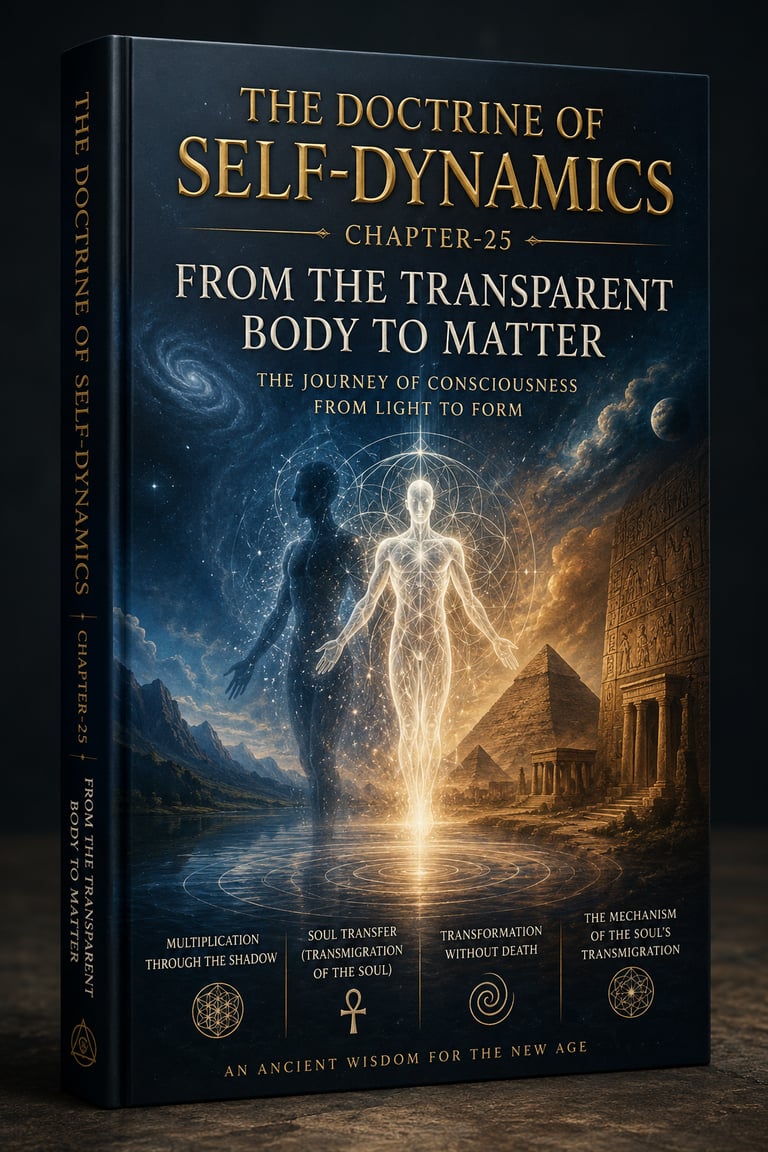
THE DOCTRINE OF SELF-DYNAMICS CHAPTER-25: FROM THE TRANSPARENT BODY TO MATTER
THE DOCTRINE OF SELF-DYNAMICS CHAPTER-25: FROM THE TRANSPARENT BODY TO MATTER. The concept of kundalini in Indian teachings is likewise based upon the same esoteric foundation. Kundalini is described as a spiral energy sleeping at the base of the spine. As this energy rises, it is said that the..
ÖZ-DEVİNİM KURAMI
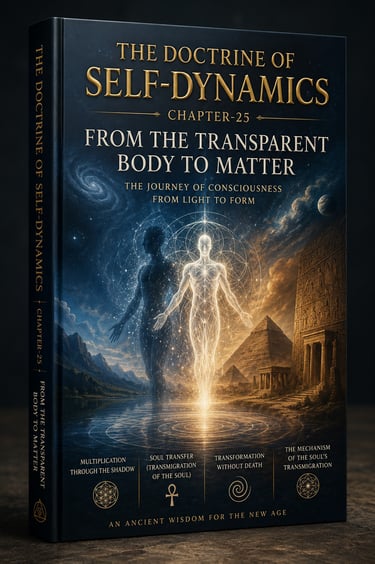
THE DOCTRINE OF SELF-DYNAMICS CHAPTER-25: FROM THE TRANSPARENT BODY TO MATTER
MULTIPLICATION THROUGH THE SHADOW
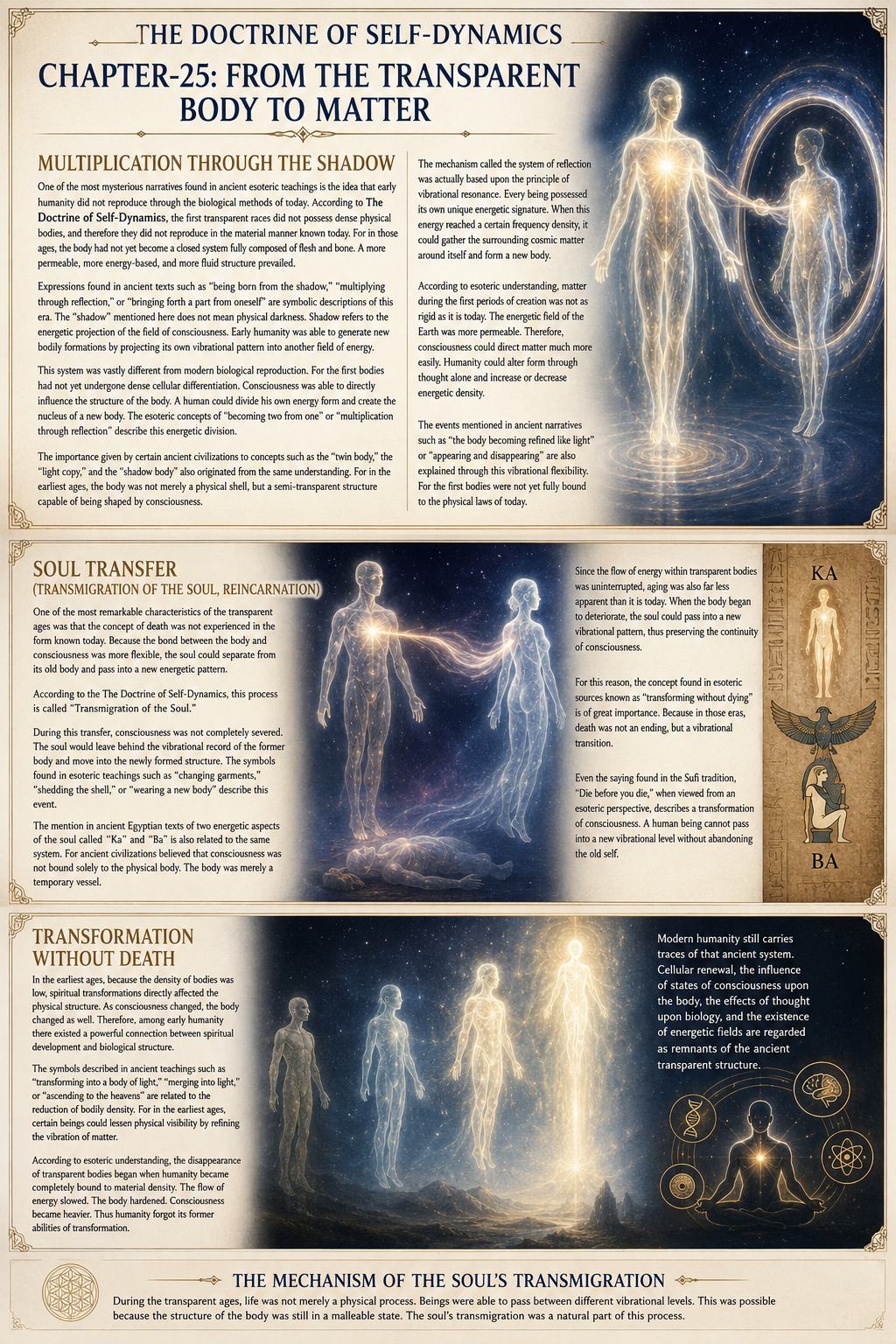
One of the most mysterious narratives found in ancient esoteric teachings is the idea that early humanity did not reproduce through the biological methods of today. According to The Doctrine of Self-Dynamics, the first transparent races did not possess dense physical bodies, and therefore they did not reproduce in the material manner known today. For in those ages, the body had not yet become a closed system fully composed of flesh and bone. A more permeable, more energy-based, and more fluid structure prevailed.
Expressions found in ancient texts such as “being born from the shadow,” “multiplying through reflection,” or “bringing forth a part from oneself” are symbolic descriptions of this era. The “shadow” mentioned here does not mean physical darkness. Shadow refers to the energetic projection of the field of consciousness. Early humanity was able to generate new bodily formations by projecting its own vibrational pattern into another field of energy.
This system was vastly different from modern biological reproduction. For the first bodies had not yet undergone dense cellular differentiation. Consciousness was able to directly influence the structure of the body. A human could divide his own energy form and create the nucleus of a new body. The esoteric concepts of “becoming two from one” or “multiplication through reflection” describe this energetic division.
The importance given by certain ancient civilizations to concepts such as the “twin body,” the “light copy,” and the “shadow body” also originated from the same understanding. For in the earliest ages, the body was not merely a physical shell, but a semi-transparent structure capable of being shaped by consciousness.
The mechanism called the system of reflection was actually based upon the principle of vibrational resonance. Every being possessed its own unique energetic signature. When this energy reached a certain frequency density, it could gather the surrounding cosmic matter around itself and form a new body.
According to esoteric understanding, matter during the first periods of creation was not as rigid as it is today. The energetic field of the Earth was more permeable. Therefore, consciousness could direct matter much more easily. Humanity could alter form through thought alone and increase or decrease energetic density.
The events mentioned in ancient narratives such as “the body becoming refined like light” or “appearing and disappearing” are also explained through this vibrational flexibility. For the first bodies were not yet fully bound to the physical laws of today.
SOUL TRANSFER (TRANSMIGRATION OF THE SOUL, REINCARNATION)
One of the most remarkable characteristics of the transparent ages was that the concept of death was not experienced in the form known today. Because the bond between the body and consciousness was more flexible, the soul could separate from its old body and pass into a new energetic pattern.
According to the The Doctrine of Self-Dynamics, this process is called “Transmigration of the Soul.”
During this transfer, consciousness was not completely severed. The soul would leave behind the vibrational record of the former body and move into the newly formed structure. The symbols found in esoteric teachings such as “changing garments,” “shedding the shell,” or “wearing a new body” describe this event.
The mention in ancient Egyptian texts of two energetic aspects of the soul called “Ka” and “Ba” is also related to the same system. For ancient civilizations believed that consciousness was not bound solely to the physical body. The body was merely a temporary vessel.
Since the flow of energy within transparent bodies was uninterrupted, aging was also far less apparent than it is today. When the body began to deteriorate, the soul could pass into a new vibrational pattern, thus preserving the continuity of consciousness.
For this reason, the concept found in esoteric sources known as “transforming without dying” is of great importance. Because in those eras, death was not an ending, but a vibrational transition.
Even the saying found in the Sufi tradition, “Die before you die,” when viewed from an esoteric perspective, describes a transformation of consciousness. A human being cannot pass into a new vibrational level without abandoning the old self.
TRANSFORMATION WITHOUT DEATH
In the earliest ages, because the density of bodies was low, spiritual transformations directly affected the physical structure. As consciousness changed, the body changed as well. Therefore, among early humanity there existed a powerful connection between spiritual development and biological structure.
The symbols described in ancient teachings such as “transforming into a body of light,” “merging into light,” or “ascending to the heavens” are related to the reduction of bodily density. For in the earliest ages, certain beings could lessen physical visibility by refining the vibration of matter.
According to esoteric understanding, the disappearance of transparent bodies began when humanity became completely bound to material density. The flow of energy slowed. The body hardened. Consciousness became heavier. Thus humanity forgot its former abilities of transformation.
Modern humanity still carries traces of that ancient system. Cellular renewal, the influence of states of consciousness upon the body, the effects of thought upon biology, and the existence of energetic fields are regarded as remnants of the ancient transparent structure.
THE MECHANISM OF THE SOUL’S TRANSMIGRATION
During the transparent ages, life was not merely a physical process. Beings were able to pass between energetic layers. For this reason, the concept of “spiritual migration” held great importance in ancient teachings.
Spiritual migration is not merely the separation of a soul from a body; it is the movement between different vibrational fields. For according to esoteric understanding, the universe is not composed of a single layer. There exist many interwoven energetic planes.
Early humanity perceived these layers far more easily than modern humans. Because the veil between consciousness and matter had not yet thickened.
ENERGY TRANSFERENCE
Ancient sages said that the human body exists in a continual exchange of energy. Humanity is nourished not only by food, but also by thought, emotion, sound, and cosmic vibrations.
The first transparent races were able to directly utilize this flow of energy. The Sun, the stars, and the energetic fields of the Earth were in direct connection with the body. Therefore, ancient texts contain expressions such as “feeding upon light” or “living through luminous essence.”
According to esoteric understanding, every human being possesses an invisible energetic field surrounding them. Ancient teachings called this the aura, the field of life, or the spiritual body. Early humanity was able to perceive these fields with the naked eye.
As matter became denser, these perceptions closed. Humanity began to trust only the physical senses. Yet the ancient energetic system did not completely disappear; it merely retreated into the subconscious.
The fact that some individuals possess strong intuition, can sense energy, or undergo intense spiritual experiences is regarded as a remnant of this ancient structure.
TRANSPARENT DWELLINGS
The concepts found in ancient teachings such as “cities of light,” “celestial palaces,” or “transparent dwellings” are also connected to the fields of consciousness belonging to this era.
Transparent dwellings were not composed of physical stone structures. They were rather concentrations of energy. Consciousness formed environments suitable to the vibration in which it existed. Early humanity was not separated from its surroundings as sharply as humanity is today.
In esoteric traditions, it is believed that certain sacred places still carry special energy. The reason for this is said to be that ancient vibrational records have been preserved within specific locations.
Narratives concerning certain ancient cities that “disappeared,” became “invisible,” or “opened only to the chosen” have also been associated with these energetic layers.
THE CONTINUITY OF CONSCIOUSNESS
The most important characteristic of the transparent ages was the uninterrupted continuity of consciousness. Humanity did not perceive itself as limited to a single body alone. It was able to directly perceive the continuity of the soul.
For this reason, the fear of death had not yet emerged.
Because death was not seen as an unknown ending, but as a natural transition.
As matter became denser, this knowledge was forgotten. Human consciousness became dependent upon the body. Thus the fear of death was born. As fear increased, the ego grew stronger. As the ego strengthened, humanity moved further away from its essence.
According to the Theory of Self-Motion, the future spiritual transformation of humanity will begin through remembering once again the continuity of consciousness. For humanity is not merely a body; it is a vibrational essence journeying between bodies.
THE BEINGS OF LIGHT BODIES
When ancient esoteric teachings describe the earliest periods of humanity, expressions such as “shadow peoples,” “phantom humans,” “beings of light bodies,” and “semi-visible entities” are frequently encountered. Modern thought has often interpreted these narratives as mythological stories or the imagination of primitive societies. Yet according to The Doctrine of Self-Dynamics, these narratives are distorted memories belonging to the earliest transparent phases of humanity.
Within certain ancient expressions found in the Torah, symbolic descriptions appear suggesting that the beings of the earliest ages possessed “phantom-like” structures. Hebrew mysticism developed various interpretations implying that humanity during the first periods of creation did not possess the dense body of today. In particular, concepts such as the “shadow body,” “beings of breath,” and “luminous forms” point toward a semi-transparent state of consciousness preceding matter.
In esoteric traditions, the word “phantom” is not used in the modern sense of a figure of fear. Here, the concept of the phantom refers to a being not yet fully materialized. In other words, it describes a form of life lacking dense physical structure and existing more as a field of energy and consciousness.
The reason early humanity is described as phantom-like is because it was not fully bound to the physical laws of today. During the transparent ages, bodies existed in a semi-energetic state, and therefore their visibility was variable. At certain frequencies they became visible, while at different vibrational levels they faded. Descriptions found in esoteric texts such as “appearing and disappearing,” “passing through walls,” and “transforming into light” arise from this structure.
According to The Doctrine of Self-Dynamics, the first two principal races were entirely transparent in structure. They did not possess the rigid skeletal system known today. For bone is the result of dense material vibration. The first bodies were instead fluid energetic fields carrying light. For this reason, the absence of fossil records from the earliest ages is considered natural within esoteric understanding.
Ancient teachings describe this period as the “Dream Ages.” For consciousness had not yet become fully individualized. Humanity did not perceive itself as a separate being. The boundaries between reality and thought were not as rigid as they are today.
The concept of the Dream Ages is not merely metaphorical. According to the Theory of Self-Motion, early humanity truly existed within a dream-like state of consciousness. Time was not perceived linearly, and thought could directly influence the environment. Humanity did not feel separate from the universe.
For this reason, concepts such as death, birth, and time were not as definite for the people of the earliest ages as they are today. Since consciousness existed in a fluid state, transformations of the body were accepted naturally. Narratives found in ancient texts such as “transition without dying,” “becoming a shadow,” and “vanishing within light” are reflections of this state of consciousness.
According to esoteric understanding, humanity during this period lived largely within a collective consciousness. The modern sense of “I” had not yet formed. Souls were not completely separate from one another, but vibrated within a shared ocean of consciousness. Therefore, communication was largely intuitive and vibrational.
This is also the reason why the people of the earliest ages did not fully possess spoken language. Communication occurred through the transmission of thought. Concepts found in ancient teachings such as “silent speech,” “understanding through the heart,” and “the language of the soul” describe the mode of consciousness belonging to this era.
The theory of the transparent body also gains importance here.
According to The Doctrine of Self-Dynamics, the first bodies were vastly different from today’s biological organisms. Dense organ systems had not yet developed. Energy could pass directly through the body. Transparent bodies existed in continual exchange with the surrounding vibrational fields.
For this reason, early humanity was not separated from nature as humanity is today. The energetic field of the Earth was felt within the body itself. The vibrations of the Sun, the Moon, and the stars directly affected consciousness. The great importance given to celestial bodies by ancient civilizations is regarded as a continuation of this ancient memory of consciousness.
Transparent bodies gradually began to densify. For the vibration of the universe was slowing, and matter was hardening. As the energetic field of the Earth became heavier, bodies too became bound to dense matter. Thus the transparent structure slowly disappeared.
This is considered one of the events expressed in esoteric narratives as the “fall from paradise.” Humanity passed from a light energetic body into a heavy biological structure. During this transition, consciousness narrowed, intuitive perceptions weakened, and the individual ego gained strength.
The eras described in ancient teachings as the “Golden Age,” the “Age of Light,” or the “First Paradise” are believed to belong to this transparent phase of consciousness. For in those ages, fear, possessiveness, and intense conflict had not yet fully emerged.
Yet this condition was also an unconscious peace. Humanity had not yet fully developed self-awareness. Individual experience was limited. Therefore, the descent into matter is regarded not merely as a fall, but also as a necessary stage in the evolution of consciousness.
According to The Doctrine of Self-Dynamics, the present journey of humanity is not to return to the former transparent state of consciousness, but to consciously regain it. The transparency of the earliest ages was instinctive. The transparency of the future, however, will be founded upon awareness.
For this reason, ancient teachings declare that humanity will ultimately once again attain the level of the “body of light.” Yet this time consciousness will not be lost, but fully awakened. For the purpose of creation is not to repeat the unconscious unity of the beginning, but to attain conscious wholeness through experience.
THE DENSIFICATION OF MATTER
Consciousness, Matter, and the Secret of the Fall
With the end of the transparent ages, one of the greatest transformations in the history of humanity began: the densification of matter. According to The Doctrine of Self-Dynamics, this process was not merely a physical change, but also a transformation of the structure of consciousness. For matter and consciousness are not separate from one another. As matter becomes denser, consciousness narrows; and as consciousness narrows, the soul remembers its essence less and less.
Ancient esoteric teachings describe the world as not originally being as solid as it is today. In the earliest periods, the Earth possessed a structure more fluid, more permeable, and more interwoven with energy. Narratives found in ancient texts such as the “misty world,” the “watery world,” or the “half-luminous Earth” symbolize this era.
According to The Doctrine of Self-Dynamics, the original state of the Earth was an energetic sphere vibrating beneath the level of today’s physical density. Since matter had not yet fully hardened, bodies were not as heavy as they are today. Humanity could directly perceive the energetic fields surrounding it and could more easily utilize the connection between thought and matter.
Yet as time passed, the universal vibration slowed. Cosmic energetic layers cooled. As energy condensed, the atomic structure began to harden. The magnetic field of the Earth changed. Thus the first great process of solidification began.
Narratives in ancient texts concerning the “fall into the earth” or “creation from clay” esoterically represent this densification. For “earth” signifies not merely physical mud, but condensed matter itself.
Humanity’s transition from the transparent structure into the physical body also occurred during this era.
As the Earth solidified, bodies grew heavier. The energetic centers slowed. The permeable structure of transparent bodies gradually began to harden. Structures that had once been purely vibrational slowly transformed into biological organs.
The skeletal system represents one of the most important stages of this transformation. For bone is the symbol of dense material vibration. Whereas the first transparent bodies lacked a rigid skeletal structure, internal support systems gradually developed as densification progressed.
The symbol of “turning into stone” found in esoteric teachings also describes this process. For as the vibration of humanity became heavier, freedom of movement diminished. Consciousness became confined within a narrower field.
One of the most important consequences of this densification was the closing of spiritual sight.
During the transparent ages, humanity could naturally perceive energetic fields, vibrations, and layers of consciousness. For there existed no thick veils between soul and matter. Yet as the body became denser, the senses began turning outward toward the physical world.
The intuitive center known as the “third eye” gradually weakened. Humanity began to accept only the visible as real, rather than the invisible. Thus material-centered consciousness was born.
This is the event described in ancient teachings as the “closing of the eyes” or the “veiling of the light.” Once humanity began trusting only the physical eyes, it forgot its former intuitive abilities.
Esoteric traditions regard this loss as a great rupture. For to early humanity, no absolute separation existed between the unseen realm and the visible world. Spiritual beings, energetic fields, and cosmic consciousness were naturally perceived.
As densification progressed, human perception narrowed. Consciousness became dependent upon the brain. Thus intuitive wisdom gradually gave way to analytical thought.
According to The Doctrine of Self-Dynamics, the modern system of rational thought developed after the closing of spiritual sight. For once humanity lost the unseen, it was compelled to develop the faculty of mental analysis in order to interpret the physical world.
For this reason, esoteric teachings do not completely reject reason; rather, they declare it incomplete. For reason analyzes only dense matter, whereas spiritual consciousness perceives holistically.
The emergence of the first physical body was also the result of this transformation.
The first human body differed from modern humanity. It was larger, more resilient, and more sensitive to energy. Narratives in ancient texts concerning “giant humans,” “long-lived ancestors,” and “semi-luminous bodies” are interpreted as remnants of this transitional period.
According to esoteric understanding, the first physical bodies still carried traces of the transparent ages. Human intuition remained powerful. Humanity existed in communication with nature. Dreams were experienced not merely as mental processes, but as transitions of consciousness.
Yet as matter became denser, the body transformed into a heavier structure. The digestive system developed. Respiration intensified. Humanity no longer lived through energy, but through physical nourishment.
Thus the concept of death also changed.
During the transparent ages, death had been merely a change in vibration; during the physical age, it became biological dissolution. Since the human body was composed of dense matter, it began to decay. This gave birth to the fear of death.
And the fear of death strengthened ego-consciousness.
For humanity had now begun perceiving itself solely as the body.
Narratives in ancient teachings concerning the “forbidden fruit” or the “tree of the knowledge of good and evil” also symbolize this transformation of consciousness. As humanity experienced matter, it perceived separation. As it perceived separation, the sense of self developed.
Yet according to The Doctrine of Self-Dynamics, this process is not entirely negative. For the soul gains awareness through experience within matter. The first transparent ages were peaceful, yet unconscious. The physical age, however, is painful, but it generates awareness.
For this reason, the purpose of humanity is not to flee back into the former transparent state, but to regain luminosity through attaining consciousness within matter.
The concepts found in esoteric teachings such as the “body of light,” “resurrection,” “transformation into a light body,” and the “second creation” describe this future evolution of consciousness.
According to The Doctrine of Self-Dynamics, humanity is now approaching the final stages of the era of dense matter. In the future, consciousness will once again begin to refine itself, and humanity will regain its former intuitive abilities in a more conscious manner.
Thus the journey of creation is not a fall, but a transformation from unconscious light into conscious light through the experience of matter.
THE BIRTH OF REASON AND THE FORBIDDEN TREE
One of the oldest symbols of humanity is the narrative of the “forbidden tree.” Different forms of this tree appear in the Torah, in interpretations of the Qur’an, in Hermetic traditions, and within the esoteric texts of many ancient civilizations. In some places it is described as the “Tree of the Knowledge of Good and Evil,” in others as the “Tree of Life,” and elsewhere as the “Tree of Immortality.”
Modern interpretations have often regarded this narrative merely as a moral prohibition. Yet within esoteric understanding, the forbidden tree is not a physical plant, but a cosmic symbol representing the transformation of human consciousness.
According to the Theory of Self-Motion, the “Tree of the Knowledge of Good and Evil” symbolizes the birth of reason.
During the transparent ages, humanity did not yet possess individual reason in the modern sense. Consciousness functioned more as a shared intuition. Humanity perceived directly, yet did not analyze. For the consciousness of separation had not yet fully formed.
Thus, the symbol of the forbidden tree describes the moment when humanity first began perceiving itself as separate from the whole.
It is no coincidence that ancient teachings describe the tree particularly through its “trunk,” “branches,” “roots,” and “fruit.” For within esoteric systems, the tree often represents the energetic axis of the human body.
Here emerges the theory of the spinal axis of reason.
According to The Doctrine of Self-Dynamics, the human spine is not merely a physical support structure. It is the principal energetic column between the soul and the body. Symbols found in ancient teachings such as the “Tree of Life,” the “ladder,” the “pillar,” the “sacred column,” and the “holy axis” all point toward the same structure.
The spinal cord became the center of the densification of consciousness during the transition from the transparent ages into the physical age.
According to esoteric understanding, energy in early humanity was distributed more equally throughout the body. Yet as matter became denser, energy began concentrating within specific centers. The spine became the principal carrier of these centers.
For this reason, the human spine was regarded as sacred in many ancient traditions.
The kundalini system in Indian teachings, the staff of Hermes in Hermetic traditions, the serpent staff of Moses, and the “pillar of the path” found within Sufi esoteric teachings are all connected to the same esoteric axis.
The symbolism of the spinal cord is not merely biological; it is a model of conscious transformation.
According to The Doctrine of Self-Dynamics, human consciousness is related to energetic layers ascending along the spine. In the earliest periods, this energy existed in a natural flow. Yet as individual reason developed, separation between the energetic centers began to emerge.
Thus, the narrative of “eating the forbidden fruit” symbolizes the activation of consciousness.
This event was not a physical sin, but a leap in consciousness.
Humanity began for the first time to say “I.”
Once the thought of “I” emerged, opposition appeared. Once opposition appeared, the concepts of “good” and “evil” came into existence. For comparison cannot exist without separation.
During the transparent ages, humanity existed directly within the flow of life. Yet when reason emerged, humanity began questioning its own actions. Thus the consciousness of choice developed.
Esoteric teachings regard this process as both an ascent and a fall.
It is a fall, because humanity lost the feeling of wholeness.
It is an ascent, because humanity became aware of itself for the first time.
For this reason, the forbidden tree is the symbol of wisdom. Yet this knowledge also gave birth to suffering. For as consciousness increases, the feeling of separation deepens.
The narrative in ancient texts concerning “becoming aware of nakedness” also expresses this transformation of consciousness. Humanity perceived itself for the first time as a separate individual, and thus the ego was born.
Within esoteric understanding, the ego is not regarded as entirely evil. It is the instrument of individual experience. Yet when the ego becomes the center, humanity forgets its essence.
Thus, the purpose of all ancient teachings is not to destroy reason, but to restore balance between reason and the essence.
Within the process of activating consciousness, the spinal cord is believed to possess a special role. For the spine is the principal neural pathway of the body. Esoteric teachings describe energy as rising along the spinal cord.
For this reason, the symbol of the serpent represents spinal energy in many ancient cultures.
In modern societies, the serpent is often regarded as a symbol of evil. Yet within ancient esoteric systems, the serpent signified conscious energy. For the serpent, through its coiling movement, symbolizes the flow of energy.
The double-serpent staff of Hermes, the uraeus symbol of Egypt, the kundalini teachings of India, and the “bronze serpent” narrative in the Torah are all different expressions of the same mystery.
According to The Doctrine of Self-Dynamics, human reason emerged through the dense connection established between matter and the energetic centers developing along the spine. The intuitive consciousness of the transparent ages gradually transformed into mental consciousness.
Thus humanity not only perceived, but also began to think.
Yet as thought increased, inner silence diminished.
For this reason, ancient sages spoke of the “closing of the eye of the heart.” As reason turned toward deciphering the external world, spiritual perception withdrew.
Humanity began taking the visible, rather than the invisible, as its foundation.
As a result, science, analysis, and physical civilization developed. Yet at the same time, humanity moved further away from its essence.
One important aspect of the event described in esoteric teachings as the “expulsion from paradise” is precisely this. Humanity departed from intuitive unity and entered the world of individual reason.
Yet according to The Doctrine of Self-Dynamics, the future of humanity is not the rejection of reason. The aim of the future is to reunite reason with spiritual consciousness.
For the peace of the earliest ages was unconscious. The reason of the modern age, however, is fragmented. The humanity of the future will be both conscious and intuitive.
The concepts described in ancient teachings such as the “second birth,” the “opening of the third eye,” and the “body of light” express this future transformation in which reason and essential consciousness will unite.
Thus, the forbidden tree is not the fall of humanity, but the beginning of its long journey of consciousness.
THE SYMBOL OF THE SERPENT
One of the most misunderstood symbols within ancient esoteric teachings is the serpent. In modern religious interpretations, the serpent is often associated with evil, deception, and the fall. Yet in the majority of ancient civilizations, the serpent was regarded as sacred. For the serpent symbolized life energy, the flow of consciousness, and the power of transformation.
According to The Doctrine of Self-Dynamics, the symbol of the serpent describes the movement of energy within the human body. For this reason, the same symbol appears repeatedly from the Torah to Egypt, and from Indian teachings to Hermetic traditions.
Within esoteric understanding, the serpent is not merely a crawling animal, but a symbol of vibrational energetic flow.
Ancient humanity did not observe nature solely through physical sight. They also perceived the energetic patterns behind movement. The zigzag motion of lightning across the sky, the coiling movement of energetic currents, and the branching structure of the nervous system were all associated with the symbol of the serpent.
For this reason, lightning energy was regarded in many esoteric systems as divine power.
In ancient ages, the fire descending from the heavens was not perceived merely as physical lightning. It was interpreted as the descent of celestial conscious energy onto the Earth. Concepts found in esoteric texts such as the “fire of heaven,” the “divine spark,” and the “lightning of light” are all parts of the same understanding.
According to The Doctrine of Self-Dynamics, the human spine is the principal axis carrying this celestial energy. For the spine is not merely a physical support structure, but the primary pathway of conscious energy within the body.
The symbols found in ancient teachings such as the “Tree of Life,” the “pillar,” the “staff,” and the “ladder” are all associated with the spine. The serpent represents the energetic movement rising along this axis.
The concept of kundalini in Indian teachings is likewise based upon the same esoteric foundation. Kundalini is described as a spiral energy sleeping at the base of the spine. As this energy rises, it is said that the level of human consciousness changes.
The Doctrine of Self-Dynamics interprets this narrative as a symbolic transformation of energy.
During the transparent ages, the flow of energy within the human body was more natural and uninterrupted. Yet as matter became denser, the energetic centers gradually began to close. As humanity turned outward toward the external world, it forgot the inner flow of energy.
Narratives resembling kundalini represent the reawakening of this lost energetic movement.
In ancient esoteric systems, different names were given to the energy rising along the spine. In Chinese teachings it was called “Chi,” in Egyptian tradition the “Fiery Breath,” in Hermetic systems the “Astral Current,” and in Sufi teachings sometimes the “secret energy.”
Even the upright structure of the human body was regarded as sacred from an esoteric perspective. For the spine was seen as an axis between heaven and Earth. Humanity was considered a small model of the cosmic tree.
For this reason, the columns of many ancient temples were designed to symbolize the human spine. The energetic channels of pyramids, the vertical axes of temples, and the symbols of sacred pillars are all products of the same cosmic understanding.
The relationship between the spine and radiant energy becomes important here.
According to The Doctrine of Self-Dynamics, the human spine is not merely a biological structure transmitting nerve signals. It is also a receiver of cosmic energy. Ancient humanity intuitively perceived the effects of stellar energies upon the body.
For this reason, they established connections between celestial movements and human consciousness.
Esoteric teachings describe certain energetic currents rising along the spine and influencing the centers of the brain. During this process, it is said that human perception changes, intuition strengthens, and different states of consciousness are entered.
The concept of the “third eye” is also associated with this ascent of energy.
In ancient Egypt, the serpent symbol placed upon the forehead of the pharaohs represented awakened conscious energy. For the forehead center was regarded as the gateway of intuitive perception.
The narrative of the “bronze serpent” found in the Torah possesses the same esoteric symbolism. The serpent raised in the desert represents the elevation of spiritual energy along the spine. The healing of those who gazed upon it symbolizes the balancing effect of conscious energy.
The modern identification of the serpent solely with evil arises from the forgetting of its ancient esoteric meaning.
Yet within ancient systems, the serpent was regarded as dual in nature.
Uncontrolled energy can lead humanity into darkness.
But consciously directed energy can elevate humanity.
For this reason, the serpent symbolizes both danger and wisdom.
According to The Doctrine of Self-Dynamics, one of the spiritual crises humanity experiences today is the disruption of the balance between energy and consciousness. Humanity has advanced technologically, yet has forgotten its inner energetic system.
The “sleeping serpent” described in ancient teachings is in fact the dormant potential of consciousness within the human being.
When this energy awakens, humanity begins realizing that it is not merely a physical existence. For it senses that within the body flows a greater consciousness.
For this reason, esoteric systems employed breathing techniques, dhikr, mantras, vibrational sounds, and bodily movements. The purpose was to restore balance to the energetic flow compressed along the spine.
Yet ancient teachings also offer a warning:
If energy rises before consciousness matures, balance may be lost.
For this reason, spiritual instruction in ancient esoteric schools was always accompanied by moral discipline. For when power is attained without consciousness, it may also lead humanity into darkness.
According to The Doctrine of Self-Dynamics, the humanity of the future will rediscover this lost connection between body and consciousness. Then the symbol of the serpent will once again recover its ancient meaning:
Not as a symbol of evil, but as a symbol of transformation and awakening…
THE THIRD EYE
Ancient esoteric teachings held that humanity does not see solely through two physical eyes. According to the ancient sages, true sight was not merely the ability to observe the outer world, but the capacity to perceive truth itself. For this reason, the concept of the “third eye” emerged in many mystical traditions.
The third eye is not a physical organ, but the center of spiritual perception. In the Sufi tradition it is called the “eye of the heart,” in Indian teachings “Ajna,” in Hermetic systems “inner sight,” and in ancient Egypt “the Eye of Horus.” Though different names are used, the essential meaning is the same: humanity’s ability to perceive the unseen.
According to The Doctrine of Self-Dynamics, during the earliest transparent ages the third eye was naturally open. For there existed no thick veils between consciousness and matter as there are today. Humanity could perceive not only physical forms, but also energetic fields, vibrations, and spiritual layers.
During the age of transparent bodies, spiritual perception was regarded as natural as physical sight is today. Humanity sensed the energetic flow of nature, perceived the fields of consciousness belonging to other beings, and established direct connection with cosmic vibrations.
Narratives found in ancient texts such as “seeing light,” “seeing angels,” “hearing voices,” or “receiving revelation” are associated with this intuitive mode of perception.
Yet with the densification of matter, the third eye gradually began to close.
As human consciousness turned outward toward the external world, inner perception withdrew. While the physical eyes grew stronger, spiritual vision weakened. Thus humanity began accepting only the visible as real, rather than the invisible.
An important aspect of the esoteric narrative of the “fall from paradise” is precisely this: the loss of spiritual sight.
Ancient sages declared that the third eye did not completely vanish, but merely fell asleep. For traces of the ancient intuitive structure still remain within the human being.
Inner intuition is one of the most fundamental remnants of this ancient system in the modern age.
According to esoteric understanding, the fact that some individuals sense events before they occur, experience powerful dreams, perceive energetic changes, or feel inexplicable attractions toward certain people are faint reflections of the third eye.
Modern humanity often dismisses intuition. For contemporary thought tends to accept only measurable knowledge as real. Yet ancient teachings regarded intuition not as unconscious coincidence, but as a form of spiritual perception.
According to The Doctrine of Self-Dynamics, the human mind was created with the capacity to perceive not only the physical world, but also vibrational fields. However, consciousness bound to dense matter has greatly suppressed this capacity.
The concept of the perception of the unseen becomes important here.
Within esoteric teachings, the “unseen” does not mean the unknown, but rather realms that cannot be perceived through the physical senses. For according to ancient understanding, the universe is not composed solely of visible matter. There exist many interwoven layers of consciousness.
Early humanity existed in a more direct relationship with these layers. During the transparent ages, the separation between the visible and invisible worlds was not as rigid as it is today.
For this reason, ancient texts describe prophets, sages, and enlightened beings as establishing connection with the unseen realm.
The Doctrine of Self-Dynamics interprets these narratives not entirely as supernatural miracles, but as experiences of transition between different levels of consciousness.
When the third eye becomes active, human perception of time may also change. For intuitive consciousness does not function linearly. Thus certain individuals may sense future events beforehand or experience profound intuitions concerning the past.
Ancient teachings placed great importance upon dreams. For dreams were regarded as one of the domains in which the third eye could function more freely when physical consciousness weakened.
During the transparent ages, human life itself existed in a semi-dreamlike condition. Yet as matter became denser, this gateway closed. Nevertheless, consciousness did not completely forget. Dreams, intuitions, and sudden realizations remained as fragments of the ancient system.
This is why ancient civilizations gave great importance to symbols of the eye.
The Eye of Horus in Egypt represented not merely physical sight, but cosmic awareness. The concept of “basirah” in Sufi teaching expresses the power of perceiving the truth hidden behind appearances. The forehead center in Indian teachings was regarded as the bridge between thought and intuition.
The third eye is also the point of connection between consciousness and energy.
Esoteric systems describe spiritual perception as strengthening when the energy rising along the spine reaches the centers of the brain. For this reason, breathing practices, dhikr, meditations, and vibrational disciplines were used to balance the third eye.
Yet ancient teachings once again emphasize balance here.
If spiritual perception combines with ego, illusion may arise.
For this reason, ancient esoteric schools sought to develop inner sight not solely through technical methods, but together with moral maturation.
For true intuition functions more clearly within a consciousness purified from fear and personal desire.
According to The Doctrine of Self-Dynamics, the future evolution of humanity will not be merely technological. As consciousness begins once again to refine itself, certain functions of the third eye will reopen.
Yet this time the aim will not be unconscious intuition, but conscious awareness.
The humanity of the earliest ages naturally sensed the unseen, yet did not fully know itself. The humanity of the future, however, will both know itself and consciously establish connection with the unseen.
The symbols described in ancient teachings as “awakening,” “resurrection,” and the “opening of the light” express this future transformation of consciousness.
For the third eye is not merely the ability to see the unseen, but the remembrance of humanity’s own essence.
THE QUESTION OF THE FALL
One of the most debated narratives in the history of humanity is the question of the “Fall.” The expulsion of Adam from paradise in the Torah, the doctrine of original sin in Christianity, and the narratives concerning the “loss of the Golden Age” found in many mystical traditions have been interpreted in different ways for centuries. Yet esoteric teachings do not regard this event merely as a moral transgression. According to The Doctrine of Self-Dynamics, the Fall is the symbolic expression of the great transformation within the structure of human consciousness.
According to this understanding, Adam did not literally fall from a physical place. For the place called “paradise” is not merely a geographical realm, but a level of consciousness. In ancient teachings, paradise often represents a state of existence possessing high vibration. Humanity in the earliest periods lived within this vibration. Transparent bodies, open intuition, and a collective structure of consciousness were the results of this condition.
Yet over time, matter became denser. The Earth grew heavier. The human body hardened. Consciousness began turning outward toward the external world. This is the event esoteric teachings describe as the “Fall.”
According to The Doctrine of Self-Dynamics, the Fall is not a moral punishment, but a necessary stage within the process of creation.
For the soul had to descend into dense matter in order to gain experience.
The peace of the transparent ages was great, yet consciousness remained limited. Humanity did not fully know suffering because it had not separated from the whole. Yet it also did not truly know itself. Since the feeling of separation had not emerged, the consciousness of free choice had not yet developed.
It is here that the “Tree of the Knowledge of Good and Evil” gains importance.
This symbol describes humanity’s first awareness of separation. Once humanity began perceiving itself as separate from the whole, the sense of self was born. Once the self emerged, choice appeared. Once choice appeared, responsibility began.
Thus, the Fall is also the birth of individual consciousness.
The expression found in ancient texts concerning “becoming aware of nakedness” is likewise a symbol of this transformation of consciousness. For humanity perceived itself for the first time as a separate being. This awareness gave birth to fear, and fear strengthened the ego.
The role of Iblis is also interpreted differently within esoteric teachings.
In modern religious narratives, Iblis has often been regarded as absolute evil. Yet within ancient mystical systems, Iblis is seen as the symbol of separation-consciousness. In other words, it represents the mental structure that says “I.”
According to The Doctrine of Self-Dynamics, Iblis is less an external being than the movement of division within consciousness itself.
For this reason, the symbol of “refusing to bow” signifies the rejection of dense matter and embodiment. Certain energetic beings opposed embodiment because they perceived physical matter as low-vibrational. Yet according to the law of creation, the soul cannot attain complete consciousness without passing through the experience of matter.
The “forbidden fruit” within the narrative of the Fall is likewise not a physical fruit. It is the symbol of the activation of consciousness. When humanity ate that “fruit,” it no longer merely lived it began analyzing life.
Here, reason was born.
Yet as reason developed, the inner feeling of unity weakened.
During the transparent ages, humanity felt united with the universe. In the physical age, however, it began perceiving itself as isolated and separate. This gave rise to the fear of death, possessiveness, and competition.
The concept of the densification of consciousness describes precisely this process.
According to the Doctrine of Self-Dynamics, density is not merely physical, but also mental. The more humanity becomes attached to matter, the heavier consciousness becomes. And as consciousness grows heavier, it begins forgetting its essence.
For this reason, the concept of the “veil” found in ancient teachings is of great importance.
The veil is the density of consciousness standing between the soul and the essence.
Within Sufism there exists the narrative of the “seventy thousand veils.” From an esoteric perspective, these veils are not physical walls, but layers of perception. As humanity develops fear, greed, arrogance, and ego, vision of the essence becomes veiled.
The soul’s entrance into the veil expresses humanity’s complete attachment to the physical world.
In the earliest periods, the soul could directly govern the body. The transparent structure permitted this. Yet as matter hardened, the influence of the soul became indirect. Humanity lost intuitive knowledge and became dependent upon the external senses.
For this reason, the concept of “awakening” is extremely important within ancient esoteric systems. For humanity is regarded as existing largely within a sleep of consciousness.
Modern humanity analyzes the external world very well, yet does not know its own essence.
For this reason, ancient teachings declared: “Who knows himself knows his Lord.” For the essence within the human being is connected to the source of creation.
According to the Theory of Self-Motion, the Fall is not permanent.
This process is not an ending, but the middle stage of the evolution of consciousness.
Humanity first separated from unity, then gained experience within matter, and is now beginning to return once again to its essence. Yet this return will not be unconscious as it was in the earliest ages.
The first paradise was pure, but lacking awareness.
The paradise of the future, however, will be conscious unity.
For this reason, concepts such as the “second birth,” “resurrection,” the “body of light,” and “awakening” possess great importance within esoteric teachings. For the aim of humanity is not to return to the past, but to become light once more through consciousness matured by experience.
Thus, the question of the Fall is not a curse, but the beginning of the great cosmic journey.