THE DOCTRINE OF SELF-DYNAMICS CHAPTER-28: The Rope of Allah and the Transparent Spinal Cord
THE DOCTRINE OF SELF-DYNAMICS CHAPTER-28: The Rope of Allah and the Transparent Spinal Cord. This truth has sometimes been called Sekine (Shekinah), sometimes Shekinah, sometimes Spenta Armaiti, and sometimes the Holy Spirit. Though these concepts appear to belong to different cultures, on the...
ÖZ-DEVİNİM KURAMI
THE DOCTRINE OF SELF-DYNAMICS CHAPTER-28: The Rope of Allah and the Transparent Spinal Cord
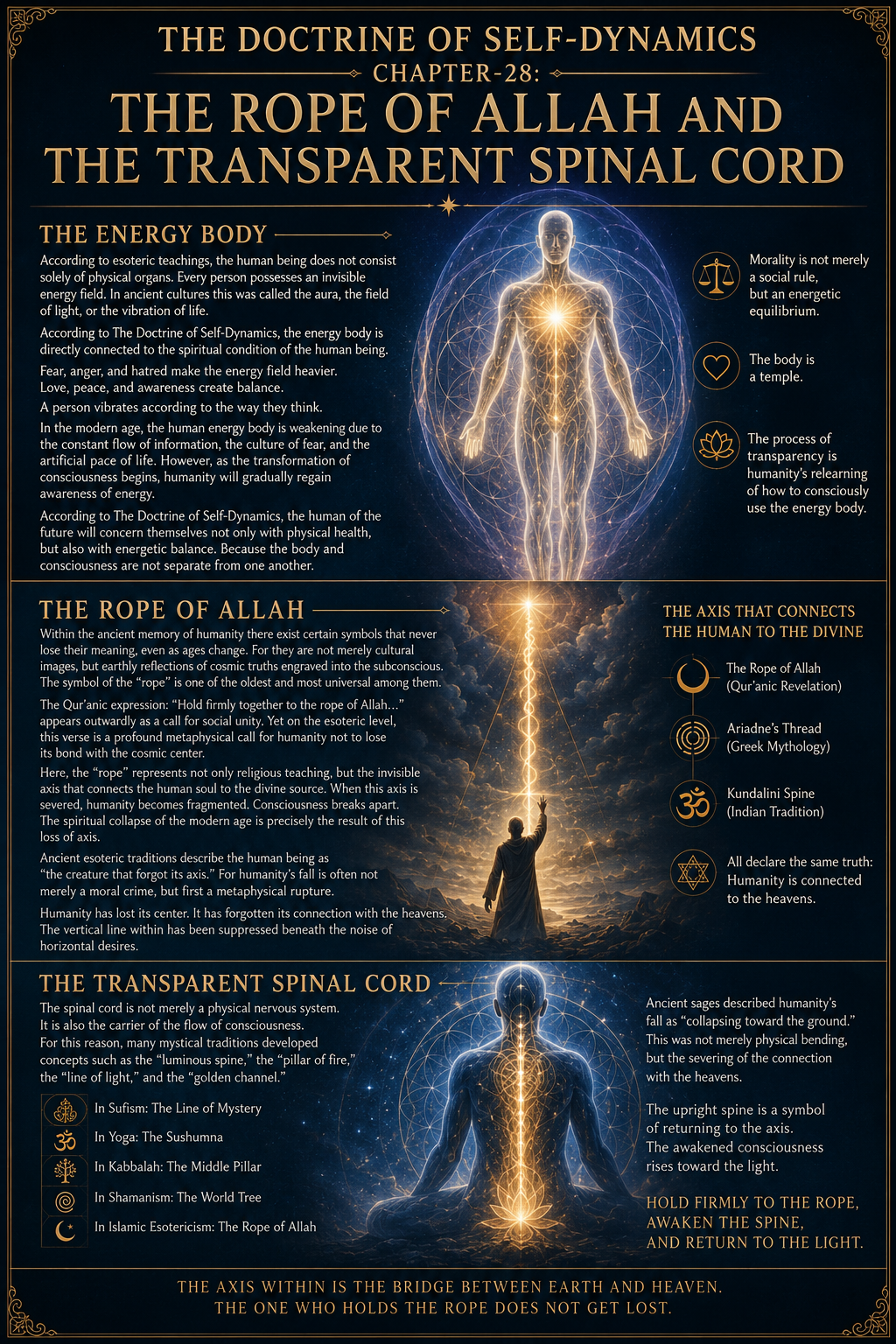
THE ENERGY BODY
According to esoteric teachings, the human being does not consist solely of physical organs. Every person possesses an invisible energy field. In ancient cultures this was called the aura, the field of light, or the vibration of life.
According to The Doctrine of Self-Dynamics, the energy body is directly connected to the spiritual condition of the human being.
Fear, anger, and hatred make the energy field heavier.
Love, peace, and awareness create balance.
For this reason, ancient teachings regarded morality not merely as a social rule, but as an energetic equilibrium.
A person vibrates according to the way they think.
In the modern age, the human energy body is weakening due to the constant flow of information, the culture of fear, and the artificial pace of life.
However, as the transformation of consciousness begins, humanity will gradually regain awareness of energy.
According to The Doctrine of Self-Dynamics, the human of the future will concern themselves not only with physical health, but also with energetic balance.
Because the body and consciousness are not separate from one another.
This is why ancient teachings spoke of the idea that “the body is a temple.”
A person cannot preserve spiritual balance without protecting their own energy field.
The process of transparency is humanity’s relearning of how to consciously use the energy body.
THE ROPE OF ALLAH
Within the ancient memory of humanity there exist certain symbols that never lose their meaning, even as ages change. For they are not merely cultural images, but earthly reflections of cosmic truths engraved into the subconscious. The symbol of the “rope” is one of the oldest and most universal among them. From ancient cave paintings to priestly texts, from temple architecture to traditions of revelation, humanity has always sensed that it is connected to an invisible center, and has often described this bond through the symbols of a “rope,” “line,” “axis,” “umbilical cord,” “pillar of light,” or “path reaching toward the heavens.”
For the human being is not merely a biological structure made of flesh. Humanity is also a vibrational existence composed of invisible layers. While the body is connected to the earth, consciousness remains in relationship with higher planes. Therefore, the truth of the human being does not emerge within horizontal life, but through awareness of the vertical connection.
The Qur’anic expression:
“Hold firmly together to the rope of Allah…”
appears outwardly as a call for social unity. Yet on the esoteric level, this verse is a profound metaphysical call for humanity not to lose its bond with the cosmic center. Here, the “rope” represents not only religious teaching, but the invisible axis that connects the human soul to the divine source. When this axis is severed, humanity becomes fragmented. Consciousness breaks apart. The spiritual center is lost. The spiritual collapse of the modern age is precisely the result of this loss of axis.
Ancient esoteric traditions describe the human being as “the creature that forgot its axis.” For humanity’s fall is often not merely a moral crime, but first a metaphysical rupture. Humanity has lost its center. It has forgotten its connection with the heavens. The vertical line within has been suppressed beneath the noise of horizontal desires.
For this reason, nearly all ancient civilizations described the idea of “the path ascending to heaven” through different symbols.
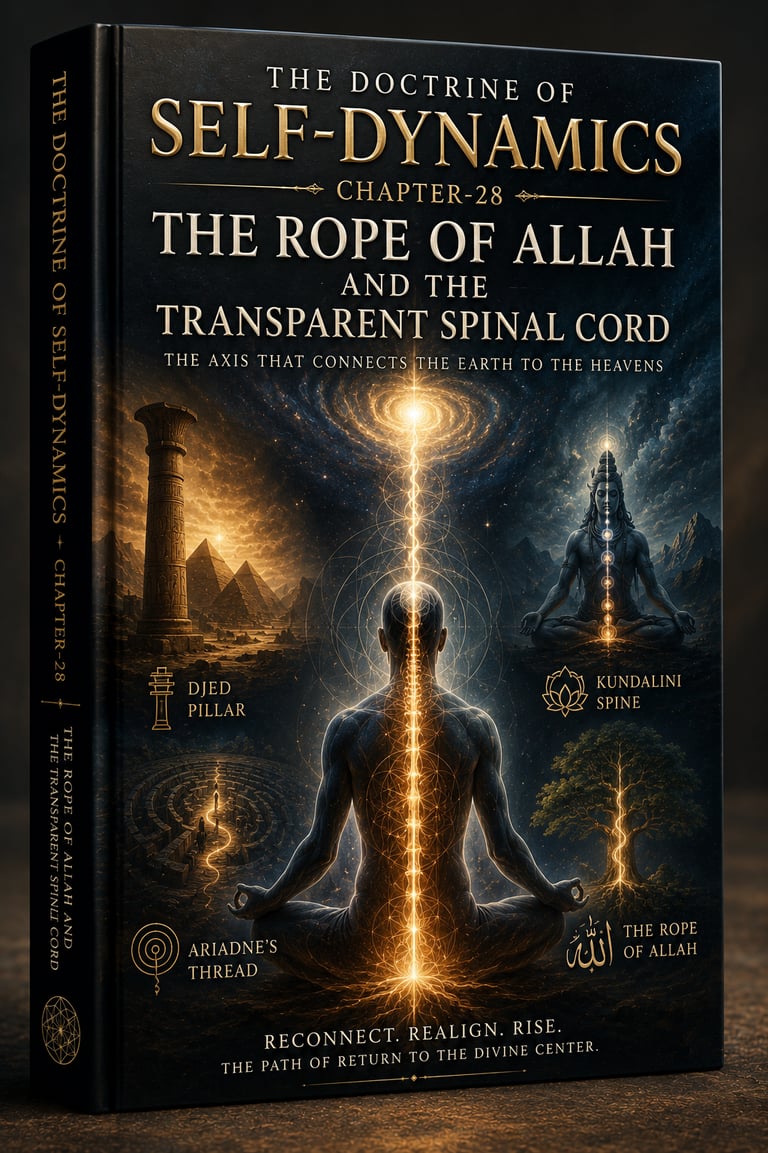
In Egypt this axis appeared as the “Djed Pillar.” The Djed represented the spine. For the spine was not merely a physical skeletal system, but the pillar of spiritual ascent. In pharaonic rituals, the raising of the Djed symbolized the restoration of consciousness to the vertical axis.
In Indian teachings, this axis emerges as the Kundalini system. The ascent of the spiritual energy sleeping at the base of the spine represents humanity transcending layers of consciousness and reaching divine awareness. This ascent is not merely an energetic movement; it is the re-centering of existence itself.
In Hellenic mysticism, Ariadne’s thread is another form of the same metaphysical truth. The thread that enables Theseus to escape the labyrinth appears outwardly as a physical guide. Yet esoterically, the labyrinth is the human mind. The Minotaur is the lower self of humanity. The thread is the path back to central consciousness. Humanity is saved not merely by slaying the monster, but by not losing the axis.
For this reason, “the Rope of Allah,” “Ariadne’s thread,” and “the Kundalini spine” are reflections of the same truth in different cultures.
One speaks through the language of revelation.
One through mythology.
One through the language of energy.
Yet all declare the same reality:
Humanity is connected to the heavens.
The modern materialist worldview cannot comprehend this axial structure because it sees the human body merely as a biological machine. Yet ancient teachings did not regard the spine solely as a nervous system. The spinal cord was also seen as the carrier of the flow of consciousness. For this reason, many mystical traditions developed concepts such as the “luminous spine,” the “pillar of fire,” the “line of light,” and the “golden channel.”
In Sufism this was sometimes called the “line of mystery.”
In yogic teaching, the “Sushumna.”
In Kabbalah, the “Middle Pillar.”
In shamanism, the “World Tree.”
And in Islamic esotericism, “the Rope of Allah.”
All these descriptions imply that within the human being exists a vertical path of consciousness.
Ancient sages described humanity’s fall as “collapsing toward the ground.” This was not merely physical bending, but the locking of consciousness into lower vibrations. When a person begins living solely within bodily desires, spinal consciousness closes. The inner axis becomes dull. Spiritual energy becomes trapped in the lower centers.
As a result, humanity becomes imprisoned within cycles of fear, anger, consumption, lust, and chaotic thought. For when the vertical connection is lost, the horizontal world devours the human being.
In esoteric teachings, the concept of “resurrection” is therefore interpreted not primarily as a physical event after death, but as the reactivation of the axis of consciousness. When humanity returns once more to its center, the inner spine becomes illuminated. It is here that the concept of the transparent spinal cord emerges.
The transparent spinal cord is the metaphysical spine beyond physical anatomy.
This spine carries:
light,
consciousness,
vibration,
and spiritual memory.
The descriptions in ancient texts of the “light” surrounding prophets, sages, and saints are not merely symbolic. According to esoteric interpretation, the spinal line of consciousness within these individuals had become activated. Their inner energy had ascended upward. The halo around the head was the outward reflection of the rising current of consciousness.
The parallels between the chakra system in Indian iconography and the latāif system in Sufism are therefore remarkable. Both traditions describe layered centers of consciousness within the human being.
The lower centers are associated with:
survival,
desire,
fear,
and physicality.
The higher centers are associated with:
wisdom,
intuition,
compassion,
the consciousness of unity,
and divine perception.
Here the esoteric similarity between the ascent of Kundalini and “holding firmly to the Rope of Allah” becomes evident. For both teachings describe humanity’s passage from lower consciousness into higher states of awareness.
The Sufi doctrine of the “stations of the nafs” is likewise another expression of the same inner transformation. Nafs al-ammārah is the chaotic vibration of the lower centers. Humanity here is scattered. Yet as consciousness rises, the nafs becomes purified. The heart center opens. The spiritual axis becomes clear. Ultimately, the person realizes the divine center within themselves.
This state is “grasping the rope once again.”
The greatest tragedy of the modern age is that while humanity has increased its connection with the outer world, it has lost connection with its inner axis. As technology expanded, consciousness narrowed. Information increased, yet wisdom diminished. Humanity created machines capable of reaching the heavens, yet forgot the heavenly line within itself.
Ancient teachings regarded the human body as a miniature model of the universe the microcosm. The spine was the axis of this small universe. Just as the Earth possesses a polar axis, humanity also possesses an axis of consciousness.
Some esoteric texts interpret the human spine as “Jacob’s Ladder.” For layers of consciousness ascend along this axis. The ascent and descent of angels are symbolic descriptions of the movements of consciousness.
The Tree of Life in Kabbalah likewise contains this same vertical structure. The lower sefirot represent material density, while the higher sefirot represent levels of divine consciousness. The Middle Pillar is the central line of the human being.
In shamanic traditions, the shaman climbing the World Tree is in truth ascending along their own spinal consciousness. For ascension to heaven is not physical, but conscious.
Thus narratives of “ascending to heaven” are often metaphors for mystical experience.
The narrative of the Mi‘rāj can likewise be interpreted esoterically not merely as a physical journey, but as the transcendence of layers of consciousness. The multiple heavens represent different vibrational realms of human consciousness. At the highest point exists the consciousness of unity.
That which all great mystical traditions share is this:
Humanity cannot reach truth without discovering the axis within.
Sometimes this axis opens through love.
Sometimes through dhikr.
Sometimes through silence.
Sometimes through suffering.
Sometimes through deep awareness.
Yet in every case, the “rope” within the human being becomes visible once more.
Ancient Sufis regarded the heart as “the earthly reflection of the Throne.” For the center of the human being is not merely the brain. The true center is the heart. When spinal energy finds balance within the heart, humanity becomes integrated for the first time in the truest sense.
For this reason, in many mystical traditions the heart point is the center of transformation. Lower energies are purified there. Higher consciousness is born there. Humanity begins to speak not merely of the individual self, but of the feeling of cosmic unity.
The doctrine of the transparent spinal cord represents precisely this new evolutionary stage of humanity.
According to this teaching, the future human being will become not denser, but more permeable.
Not harder, but more vibrational.
Not heavier, but more luminous.
For as consciousness rises, the body’s use of energy also changes. The concepts found in ancient texts such as the “body of light,” the “luminous body,” and the “resurrected body” are symbolic expressions of this transformation.
According to the esoteric understanding, the human spine carries not only physical signals, but frequencies of consciousness as well. Every thought, every emotion, and every intention generates vibration along this axis.
Fear contracts the spine.
Love opens it.
Anger disrupts the flow of energy.
Compassion creates balance.
And the sense of truth aligns the axis.
For this reason, ancient mystics did not regard morality merely as a social rule. Morality was also an architecture of energy.
Lies fragment the field of consciousness.
Hatred lowers vibration.
Greed increases density.
Compassion makes the human being lighter.
Thus “holding firmly to the Rope of Allah” is not merely devotional attachment, but conscious alignment.
The more centered a person becomes, the more transparent the inner spine grows.
And the more transparent the spine becomes, the more spiritual light it can transmit.
Descriptions in ancient texts such as “luminous people,” “saints with shining faces,” and “holy ones whose bodies became light” all carry traces of this metaphysical vision.
Perhaps all mystical quests of humanity have always tried to remember the same truth:
Humanity is not severed.
The rope still exists.
The spine is still connected to the heavens.
And consciousness can rediscover its center.
THE LABYRINTH: CONSCIOUSNESS OF MULTIPLICITY
In the ancient memory of humanity, the “labyrinth” is not merely an architectural structure made of stone corridors. It is the symbol of the scattered state of human consciousness. Ancient esoteric teachings interpreted the labyrinth not as physical confusion, but as the inner condition in which the soul has lost its center. For humanity’s greatest lostness does not occur in the outer world, but within its own inner universe. From the outside, the human being appears to be a conscious creature living in modern cities. Yet on the inner plane, most people wander inside an invisible labyrinth. Thoughts collide with one another. Desires change direction. Fears darken the pathways of consciousness. The human being searches for an exit, but has lost direction. This is exactly what esoteric traditions call the “labyrinth.”
In Ancient Greece, the labyrinth where the Minotaur lived is therefore an extremely profound symbol. Outwardly, it is a complex structure built on the island of Crete. Yet in mystical interpretation, the labyrinth is the human mind. The Minotaur is humanity’s animalistic lower nature. This being, half human and half bull, represents the divided structure of the human being. For humanity is both heavenly and earthly. It carries both light and shadow. The person who loses direction inside the labyrinth has, in truth, become lost within their own mind.
Ancient philosophers did not regard the production of thoughts as consciousness. For the multiplicity of thoughts is often not a sign of truth, but the result of inner fragmentation. The farther a person moves away from the center, the noisier the mind becomes. For this reason, silence is sacred in esoteric traditions. Silence is not emptiness; it is drawing closer to the center.
In Sufism, this has been called the “realm of multiplicity.” Multiplicity means many-ness. Yet what is meant here is not merely the abundance of objects. It is the scattering of consciousness. When a person is divided into hundreds of desires and dragged among thousands of thoughts, they lose their essential center. This is why the Sufis regarded not the world itself, but the aspect of the world that scatters the human being, as dangerous.
Truth brings one closer to unity. The nafs multiplies. As the human being approaches the center, they become simpler. As they move away from the center, they become more complex. For this reason, on the path of Sufism, “tawhid” is not merely a theological principle. It is the reunification of consciousness. It is the gathering of scattered inner fragments around a single center.
The spiritual crisis experienced by modern humanity arises precisely from this labyrinthine consciousness. Today’s world offers endless choices to the human being, but gives no direction. It produces information, but not wisdom. It constantly pulls the human being outward, but does not lead them to the inner center. As a result, the human being walks through countless corridors without knowing where they are going.
Esoteric teachings define this state as “horizontal consciousness.” Horizontal consciousness constantly moves among external objects. It consumes, compares, desires, fears, flees, and tries to possess. Yet it never turns upward. For the vertical axis has been forgotten. The labyrinth is the symbol of this horizontality. The corridors are endless. The turns never cease. The human being constantly moves, yet does not progress. For this reason, in many mystical traditions, true salvation lies not in movement, but in returning to the center.
The Gnostic tradition interpreted the material universe as a great veil of consciousness. According to them, the soul had been severed from the divine source and had fallen into dense material realms. For this reason, the world was not merely a physical field, but a place of forgetfulness. In Gnostic texts, the state in which humanity has forgotten the truth is called “sleep.” For the human being assumes themselves to be only a body. Yet the true self comes from a higher source. While wandering inside the labyrinth, the soul has forgotten its origin.
This state of forgetfulness also appears in modern psychology in other forms. Why does the human being constantly feel a sense of lack? Why does no material gain produce lasting satisfaction? Why does consciousness constantly turn into new corridors? Because the soul is searching for its center.
The human being often lives without knowing what they are seeking. They pass from one object to another, from one thought to another, from one desire to the next. Yet the emptiness within does not close. Esoteric traditions define this emptiness as the “lost center.”
In Rosicrucian teaching, the concept of the “labyrinth of spheres and worlds” describes the cosmic layers through which the human soul passes. The soul can become lost not only in the physical world, but also in mental and energetic realms. For every vibrational field is a separate corridor. The realm of lower desires, the realm of fears, the realm of ego, the realm of power, the realm of fame, and the realm of pleasures are all layers of consciousness that draw the soul away from the center.
This is why ancient mystics gave great importance to the concept of “wakefulness.” To awaken is not merely to open the eyes. It is to become aware of the inner labyrinth.
The human being often believes they are free. Yet they are wandering through the corridors of inner habits. They return to the same fears. They follow the same desires. They repeat the same cycles of thought. The labyrinth is precisely this mechanism of repetition.
In some esoteric schools, the human mind is described as a “chamber of reflections.” The human being does not see the outer world as it is; they see it through their own inner confusion. Therefore, the labyrinth is not outside, but inside. Fearful consciousness perceives the world as a threat. Angry consciousness produces enemies. Greedy consciousness feels that it is never satisfied. Fragmented consciousness sees chaos everywhere. In truth, the human being often lives inside their own labyrinth.
The Sufi teaching of the “mirror of the heart” is important for this reason. When the heart becomes purified, the human being begins to see the world clearly for the first time. For the mist disperses. The corridors dissolve. The inner noise decreases.
In ancient wisdom, at the center of the labyrinth there is often a “monster.” This monster carries different names in different cultures: Minotaur, dragon, devil, nafs, shadow self. Yet all of them represent the same thing: the uncontrolled lower nature of the human being. This lower nature feeds on suppressed fears. It grows through desires. It gains strength through anger. It darkens through ignorance.
The more the human being denies this being, the more complex the labyrinth becomes. For when the shadow is suppressed, it does not disappear; it withdraws into the subconscious. For this reason, esoteric transformation is not fleeing from the shadow, but confronting it.
Theseus’ encounter with the Minotaur is, in truth, the human being’s confrontation with their own inner monster. For the one who seeks to reach truth must first see their own darkness.
The Sufi practice of “self-accounting of the nafs” is another name for the same process. When the human being begins to observe themselves, they become aware of the labyrinth within. One thought comes, then another, then fear, then desire, then anger. Consciousness constantly changes direction. This state of dispersion is the consciousness of multiplicity.
Esoteric teachings say that the human being originally carries a pure consciousness. The clarity of childhood is therefore significant. Yet over time, society, fears, traumas, desires, and identities build walls around the human being. Eventually, the human being becomes lost inside the mental structure they themselves have built.
Even the complex structures of modern cities resemble the outer reflection of this inner labyrinth. Endless roads, lights, advertisements, streams of information… The human being is constantly occupied, yet inwardly directionless.
This is why ancient sages withdrew into seclusion. For silence makes the map of the labyrinth visible. Only when the human being stops can they realize what they have been wandering inside.
Meditation, dhikr, muraqabah, contemplation, and prayer all exist to slow down the mental corridors. For the human being can feel the center only when inner movement decreases.
The exit from the labyrinth is not outward, but toward the center. For this reason, in esoteric teachings, the center is sacred. The domes of temples, the center of mandalas, the circumambulation around the Kaaba, and the middle axis of the Tree of Life all symbolize the return of human consciousness to the center.
The farther the human being moves from the center, the more fragmented they become. The closer they come to the center, the more unified they become. The labyrinth is the consciousness of multiplicity. The center is the consciousness of unity.
This is why “the Rope of Allah” is not merely a salvific symbol; it is the sense of direction within the labyrinth. For even if the human being is lost, the axis still exists. The center has not disappeared. The rope has not been severed. The human being has only forgotten it.
ARIADNE’S THREAD AND THE ROPE OF ALLAH
Although ancient symbols appear in different civilizations, they are often the same metaphysical truth clothed in different languages. One of the most striking shared images in human history is the symbol of the “thread” or “rope.” For at the level of consciousness, humanity has always intuited that it is connected to a center. This bond is invisible, but vital. When it is severed, the human being loses not only direction, but also their own truth.
Ariadne’s thread in Ancient Greece and the concept of the “Rope of Allah” in the Qur’an appear, on the surface, to belong to completely different traditions. One is a mythological narrative. The other is a sacred expression centered on revelation. Yet on the esoteric level, both point to the same cosmic principle: the human being must not lose their center.
Theseus’ entrance into the labyrinth is not an ordinary heroic tale. It represents the descent of the human soul into the realm of multiplicity. The labyrinth is the complex layers of consciousness. The Minotaur is the lower nature of the human being. As Theseus descends into the darkness, Ariadne gives him a thread. Outwardly, this thread is meant to provide the physical path of return. Yet in mystical interpretation, this thread is the principle of not losing one’s bond with the center.
For the human being may enter darkness. They may fall into chaos. They may confront their lower self. But if they forget the center, they cannot return. This is the true meaning of the thread.
Esoteric traditions do not regard “being lost” as a physical condition. The human being can become spiritually lost. They can become mentally scattered. They can move away from their own essence. For this reason, in ancient teachings, salvation is often described as a process of “remembering.”
Ariadne’s thread is the symbol of this remembrance. No matter what darkness the human being enters, if they can preserve their bond with the essential center, they can return.
The Qur’anic expression, “Hold firmly together to the Rope of Allah…,” carries the same metaphysical axis. What is described here is not merely social unity. In the inner dimension of the verse, human consciousness is being advised not to become scattered. For the human being is inclined to fragmentation within multiplicity.
Thoughts multiply. Identities conflict. Desires change direction. The nafs pulls the human being in different directions. As a result, consciousness loses its center. The “Rope of Allah” represents the divine axis against this loss of center.
The people of Sufism have often interpreted this expression as the “bond of truth.” In order not to become lost within the nafs, the world, and mental confusion, the human being must remain in continuous contact with the center.
This contact may be dhikr, awareness, prayer, wisdom, revelation, or love. Yet at its essence, all of them do the same thing: they bind the human being to the center.
For this reason, there is a profound esoteric parallel between Ariadne’s thread and the Rope of Allah. Ariadne’s thread gives direction in the labyrinth. The Rope of Allah gives the sense of center within multiplicity. Ariadne’s thread is the path of return. The Rope of Allah is the path of union. Ariadne’s thread prevents being lost. The Rope of Allah prevents fragmentation.
In both symbols, the rope is not merely a tool; it is the principle of continuity. For the greatest problem of the human being is not directionlessness. It is centerlessness. A person who loses direction can find it again. But a person who loses their center begins to forget their own essence.
In esoteric teachings, the center is not merely a physical point. It is the state of balance in consciousness. It is the inner pole. When the human being remains connected to the center, the chaos of the outer world cannot fully drag them away.
For this reason, the “middle way” is sacred in all mystical traditions. The Middle Way in Buddhism, moderation in Sufism, the Middle Pillar in Kabbalah, balance in Taoist teaching, and the central channel in Indian mysticism are all different expressions of the same truth.
When the human being remains in the center, the flow of consciousness becomes balanced. Lower impulses and higher intuitions become harmonized. A balance forms between fear and courage. Mind and heart draw closer to one another. The rope is precisely this line of balance.
Ancient teachings often describe the human being’s arrival into the world as a “descent.” When the soul enters the dense field of matter, forgetfulness begins. Among environmental influences, desires, and fears, the human being moves away from their own center.
Yet within the human being there is always a call to return. The rope is the visible symbol of this call.
In Sufism, this has sometimes been called the “primordial covenant.” The first bond the human soul made with its source never disappears completely. No matter how far the human being moves away, the sense of center within never fully dies.
This is why the human being sometimes feels an inexplicable longing. Worldly achievements do not satisfy. Pleasures do not last. Crowds do not remove loneliness. Because the soul feels the pull of the rope.
For this reason, Ariadne’s thread is not merely a tool of salvation, but a line of memory. Through that thread, the human being does not forget where they came from.
Likewise, the “Rope of Allah” in the Qur’an is the axis of consciousness that binds the human being to the divine center. So long as this bond is not severed, the human being does not fall completely into darkness.
In Sufi interpretations, dhikr is seen as the vibrational form of this rope. As the human being remembers truth, consciousness becomes centered again. For forgetting is dispersion; remembering is unification.
One of the greatest problems of the modern age is humanity’s loss of this sense of center. The human being is now surrounded by constant external stimuli. Screens, sounds, information, speed, consumption, and mental bombardment constantly pull consciousness outward.
This creates the modern labyrinth. In the past there were stone corridors. Now there are digital corridors. In the past the human being became physically lost. Now they become lost in consciousness.
For this reason, the symbol of the “rope” is even more important today. If the human being cannot preserve their inner axis, the complexity of the outer world will scatter them. The mind breaks into a thousand pieces. Attention is dispersed. The spiritual center grows faint.
In esoteric teachings, the preservation of attention was regarded as sacred. For attention is the energy of consciousness. Wherever the human being directs their attention, life energy flows there.
The labyrinth scatters attention. The rope calls attention back to the center.
For this reason, repeated rhythms are important in mystical traditions: rosary, mantra, breath, prayer, dhikr, and turning movements. Their purpose is not only to silence the mind, but also to reconnect consciousness to the axis.
Ariadne’s thread extends backward physically. The Rope of Allah extends upward consciously. One provides the way out from the center of the labyrinth. The other provides the ascent from the realm of multiplicity into unity.
From the esoteric perspective, every human being is inside their own labyrinth. And every human being holds an invisible rope in their hand.
KUNDALINI REINTERPRETED
In the modern age, the concept of kundalini is often approached superficially. Many people see it merely as a mysterious energy circulating within the body, a mystical vibration, or a psychic force. Yet when the deeper structures of ancient teachings are examined, it becomes clear that the doctrine of kundalini is not merely about energetic experiences. In reality, it is a great teaching of consciousness that describes humanity re-establishing contact with its cosmic origin.
According to classical Indian teaching, kundalini is described as a spiral force sleeping at the base of the spine. This force has often been symbolized as a coiled serpent. Here, the serpent is not an evil being, but the representation of potential consciousness. For the serpent sheds its skin, transforms, and renews itself. For this reason, in many ancient cultures the serpent became the symbol of wisdom and transformation.
According to Indian mysticism, when this sleeping force within the human being is activated, it rises along the spine and opens the centers of consciousness called chakras. Each chakra represents a different layer of consciousness. While the lower centers are connected to bodily existence, the higher centers relate to spiritual perception.
Over time, however, the doctrine of kundalini was largely reduced to phenomena. Sensations of vibration, bodily heat, experiences of light, visions, telepathic feelings, and extraordinary psychic events began to be presented as though they were the essence of the teaching itself.
Yet most esoteric traditions regarded fixation on phenomena as a form of deviation. For extraordinary experiences may bring the human being closer to truth, but they may also enlarge the ego. When a person becomes attached to the experience itself, they may once again lose the center.
For this reason, true mystics were concerned not with experiences, but with transformation. The issue is not seeing light, but becoming conscious. The issue is not feeling energy, but comprehending truth.
Ancient Sufis likewise regarded the pursuit of miracles as dangerous. For when the human being becomes captivated by experiences of power, the ego may expand instead of the essential center.
It is precisely at this point that the concept of kundalini must be reinterpreted.
In this synthesis teaching, kundalini is not merely an energetic movement. It is the movement of remembrance of the soul within the body.
What rises here is not electrical current, magnetic vibration, or merely a biological process. What rises is consciousness itself. More precisely, it is the soul beginning once again to recognize its own source.
For this reason, viewing kundalini solely as an energy system remains incomplete. Energy is only the instrument; consciousness is the essence.
Ancient teachings say that within the human being exists a divine essence. In Sufism this was called the “nafha,” the divine breath. Humanity was not created merely from earth. Within it exists a heavenly essence.
According to this teaching, kundalini is the orientational principle of the spirit from Allah within the body. And this orientation is always upward. For the soul longs to return to its source.
Just as fire rises, consciousness also moves upward. Lower consciousness becomes denser. Higher consciousness becomes lighter. This is why all mystical traditions possess symbols of ascent: ladders, mountains, pillars, trees, and paths ascending to heaven. All of them describe the movement of human consciousness from dense matter toward subtle awareness.
This is precisely the deeper structure of the kundalini teaching.
Why is the lower spine the point of beginning? Because the human being first lives within the densest field of consciousness: fear of survival, bodily needs, the desire for security, sexual impulses, and egoic identities. These are the first layers of consciousness.
Yet when the human being begins to transform, awareness expands. The heart opens. Intuition strengthens. The ego begins to dissolve. The person begins to feel not only themselves, but the whole. This process has therefore been symbolized as “ascent.”
In this teaching, awakening is not gaining something new. It is remembering what was forgotten. For the soul already knows the truth, but within dense material existence, it has forgotten.
In Sufism this is called “ghaflah” heedlessness. In the Gnostic tradition, “sleep.” In Buddhism, “ignorance.” In Indian teaching, “maya.” Though different names are used, the same condition is being described: consciousness forgetting its essential source.
Therefore, kundalini awakening is not the acquisition of an external power, but the remembrance of the essential self.
For this reason, true transformation is silent.
In modern popular narratives, kundalini is often associated with dramatic experiences. Yet among most ancient sages, transformation occurred through profound simplicity.
The human being becomes more compassionate, thinks more clearly, fears less, hates less, and becomes less fragmented. This is true ascent. For as the soul rises, consciousness becomes simpler.
In the lower centers there is chaos. In the higher centers arises the sense of unity.
For this reason, the “opening of chakras” has also been misunderstood. According to this teaching, chakras are not physical disks or mystical energy wheels, but layers of consciousness.
The root center represents fear of existence.
The lower abdominal center represents desire and impulse.
The power center represents ego and the will to control.
The heart center represents compassion and union.
The throat center represents expressing truth.
The brow center represents intuition and inner vision.
The crown center represents consciousness of unity.
Therefore, the opening of chakras is not an explosion of energy, but the dissolution of layers of perception. At each center, the human being transcends a different illusion. Fear is transcended. Attachment is transcended. Ego is transcended. Separation is transcended. And finally consciousness approaches the sense of unity.
It is here that the great connection between “the Rope of Allah” and kundalini emerges. For in both teachings, the movement of the human being from lower consciousness toward higher consciousness is described.
The Sufi doctrine of seyr ü sülûk is the same inner journey. The stations of the nafs are the same ascent. The purification of the heart is the same axial movement. Only the language differs.
Indian mysticism speaks in the language of energy. Sufism in the language of love. The Gnostics in the language of knowledge. Kabbalah in the language of symbols. Yet all describe the same cosmic movement: the soul is returning to the center.
Within this synthesis, the spine is not merely a physical structure. It is the axis of spiritual ascent. The concept of the transparent spinal cord emerges from this understanding.
As the human being becomes purified in consciousness, the inner axis becomes more permeable. Fears increase density. Anger constricts the spinal flow. Hatred makes the field of consciousness heavier. Love opens it. Compassion lightens it. Truth makes it transparent.
For this reason, true kundalini work is, before techniques, a moral transformation.
THE TRANSPARENT SPINAL CORD
When the human body is viewed only through biological eyes, the spine appears to be merely a physical structure composed of bones, nerves, and networks of electrical transmission. Yet ancient esoteric teachings regarded the spine with a far deeper meaning. According to them, the spine is not only the bodily balance of the human being, but the axis of consciousness itself.
The doctrine of the transparent spinal cord is one of the most refined expressions of this understanding.
Here, “transparency” does not mean physical translucence. Transparency means spiritual permeability. It is the condition of not resisting the divine flow. As the human being becomes denser through ego, fears, desires, and mental confusion, the inner axis hardens. Consciousness becomes heavy. The spiritual flow is interrupted.
Yet as the human being becomes purified, the inner structure gradually becomes permeable.
The transparent human being is one who does not resist truth, who does not struggle against the current, and who does not sever themselves from the center.
For this reason, the transparent spinal cord is not merely the physical spine. It is the invisible vertical line within the human being. It is the bridge of consciousness between heaven and earth.
Ancient teachings describe humanity’s essential problem as “disconnection.” The human being forms relationships with the outer world, yet loses connection with their own center. This disconnection produces spiritual heaviness. The inner axis becomes blocked. Consciousness becomes trapped within lower layers.
According to the doctrine of the transparent spinal cord, the aim of the human being is not to accumulate energy, but to reduce resistance. For the divine flow already exists. The problem is not the absence of the flow, but the dense structure of the human being.
In Sufism this was called the “rusted heart.” In Buddhism, the “veiled mind.” In the Gnostic tradition, the “darkened spark.” All describe the same thing: the veiling of humanity’s essential light.
To become transparent is for the veils to grow thinner.
For this reason, great mystics spoke less about becoming powerful and more about becoming light. For the ascent of the soul occurs not through force, but through the dissolution of density.
The transparent spinal cord is the axis of this dissolution.
Along this axis, consciousness moves upward. Yet here “upward” is not a spatial direction.
Upward means subtler awareness, greater unity, and deeper realization of truth.
Lower consciousness feels separation. Higher consciousness feels unity.
Lower consciousness lives through fear. Higher consciousness through surrender.
Lower consciousness seeks possession. Higher consciousness joins the flow.
The spinal ascent is this very process of transformation.
The transparent spinal cord is also the end of fragmentation. The divided selves within the human being gradually begin to unite around the center.
Thought and emotion become harmonized. Heart and mind cease their conflict. The struggle between the nafs and the soul becomes quiet.
For this reason, “istiqāmah” — inner uprightness — is extremely important in esoteric teachings. Istiqāmah is not merely moral correctness, but the straightening of the inner axis.
Distorted consciousness loses direction. Centered consciousness settles upon the vertical line.
Ancient sages regarded the human body as a “living temple.” What the pillar is to the temple, the spine is to the human being. For if the pillar collapses, the structure falls apart.
For this reason, many traditions possess the symbol of the sacred pillar: the Djed of Egypt, the Middle Pillar of Kabbalah, the shamanic World Tree, the Indian Sushumna channel, and the “line of mystery” in Sufism. All represent the same metaphysical spine.
When the human being begins to feel this axis, life is perceived differently. Time slows down. Inner silence deepens. Even within crowds, the sense of center becomes perceptible.
For according to the doctrine of the transparent spinal cord, truth is not sought outside. It becomes visible when the inner axis becomes clear.
THE VERTICAL AXIS IN THE QUR’AN
The Qur’an is not merely a text containing historical narratives and legal rulings. From an esoteric perspective, it contains multilayered symbols pointing toward the transformation of human consciousness. A significant portion of these symbols is connected to the idea of the vertical axis.
Concepts in the Qur’an such as ascent, rising, turning toward heaven, urūj, and mi‘rāj cannot be read merely as spatial movements. For metaphysical language often expresses processes of consciousness through symbols.
The Mi‘rāj is one of the deepest symbols in Islamic thought. On the outward level, this event is seen as a celestial journey. Yet in esoteric interpretation, the Mi‘rāj is the layered ascent of human consciousness.
Each heaven represents a different level of consciousness. Each ascent is a transition into a subtler field of awareness.
The fact that the Mi‘rāj occurs during the night is also symbolic. For spiritual ascent often begins within inner darkness. The human being first descends into their own night. They confront silence. They face their nafs. Then the ascent begins.
During this process, the spinal axis becomes activated. For the essence of the Mi‘rāj is not physical distance, but conscious ascent.
In Sufi traditions, the expression “prayer is the Mi‘rāj of the believer” points to the same mystery. Prayer is not merely bodily movement; it is the alignment of the human being’s inner axis toward heaven.
Prostration represents the dissolution of the ego. Standing represents the return to the vertical axis. Bowing represents the softening of the self.
The entire structure of prayer is, in essence, a movement of conscious alignment.
The Qur’anic expression, “The angels and the Spirit ascend unto Him,” is also profoundly important from an esoteric perspective.
The ascent described here is not movement toward a physical heaven. For divine truth is not confined by space.
This ascent is the movement of consciousness from dense matter toward subtle truth.
The symbol of the angel often represents pure forces of consciousness. The Spirit represents the divine essence within the human being. Their “ascent” is the movement of drawing nearer to the center.
Ancient mystics interpreted this process as the opening of the latāif. As the human being transcends inner densities, consciousness rises toward higher levels of perception.
For this reason, urūj is also the process of purification, lightening, and becoming transparent.
It is here that the doctrine of the transparent spinal cord unites with Qur’anic metaphysics.
Sidrat al-Muntahā is one of the most mysterious symbols in Islamic metaphysics.
“The Lote Tree of the Utmost Boundary.”
Esoterically, this symbol represents the threshold at which the individual self dissolves.
Here the human being leaves self-centered consciousness and approaches the field of unity.
The symbol of the tree is associated in many traditions with the spinal axis. The roots are below. The branches extend upward. The human being is the same: the body is directed toward the earth, the soul toward heaven.
Sidrah is the highest point of this tree. It is the limit of conscious ascent.
At this stage, individual perception begins to dissolve. The human being approaches the experience of feeling not only themselves, but the whole.
For this reason, Sidrat al-Muntahā is also the summit of the transparent spinal cord.
It is the point of consciousness where the inner axis becomes fully aligned with the divine center.
PARALLELS WITH KABBALAH
When ancient mystical traditions are examined, teachings that appear unrelated are often found to describe the same metaphysical structure through different symbols. Jewish mysticism, Kabbalah, is one of the important parts of this shared axial teaching.
The Tree of Life in Kabbalah is not merely an abstract mystical diagram. It is a cosmic map describing the structure of human consciousness and the layers of divine flow.
The most important part of this tree is the “Middle Pillar.”
The Middle Pillar is regarded as the axis of balance, the central line, and the path of divine flow.
Its similarity to the doctrine of the transparent spinal cord is extremely striking.
The Middle Pillar in Kabbalah corresponds to the inner vertical line of the human being. It extends from lower densities toward the upper field of unity.
In Kabbalah, Tiferet is the heart center. Here mercy, balance, and beauty unite.
In Sufism, too, the heart is accepted as the center. For the heart is not merely the field of emotion, but the mirror of divine perception.
Keter is the highest point. The field of pure unity.
This point represents the level of consciousness nearest to divine truth. It bears great resemblance to the highest state of consciousness in the doctrine of the transparent spinal cord.
The concept of Shekinah in Kabbalah is also remarkable.
Shekinah means the descent of divine presence, the becoming perceptible of divine existence.
It bears profound similarity to the concept of Sekine (Shekinah) in Sufism.
Sekine (Shekinah) is the peace descending into the heart, inner tranquility, and divine stillness.
When this peace emerges, the human being’s inner axis becomes calm. The labyrinth dissolves. The consciousness of multiplicity falls silent.
CHRISTIAN ESOTERICISM
When the great mystical traditions of humanity are examined, symbols that appear independent from one another are often found to describe the same cosmic truth. Christian esotericism is also an important link in this shared metaphysical axis. In particular, the doctrine of the Holy Spirit bears profound parallels with the transparent spinal cord and the concept of divine descent.
In outward interpretation, the Holy Spirit is understood as divine grace, divine assistance, and spiritual support.
Yet in esoteric interpretation, the Holy Spirit is the conscious fire descending into the inner axis of the human being.
For this reason, in Christian iconography the Holy Spirit is often symbolized as light, fire, a dove, radiance, or tongues of flame.
For what is being described here is not merely an external blessing, but inner resurrection.
Ancient Christian mystics said that humanity lives in spiritual death. When the human being identifies solely with the body, they lose their inner center. The soul sleeps. Consciousness becomes scattered. The descent of the Holy Spirit is the reawakening of this scattered structure.
The narrative of Pentecost is therefore deeply symbolic.
The descent of heavenly fire upon the apostles, their beginning to speak in different tongues, and their gaining of inner courage can all be read as the activation of centers of consciousness.
The fire here is not physical. It is transformative consciousness.
For fire burns the old structure. It illuminates darkness. It dissolves density.
From an esoteric perspective, Pentecost is the descent of divine light into the human spinal axis.
When this descent occurs, the inner centers of the human being awaken. Fear dissolves. The sense of truth strengthens. An openness of heart emerges.
For this reason, many Christian mystics interpreted the concept of “rebirth” not biologically, but consciously.
The human being dies with the old self and rises with a new consciousness.
This process bears striking parallels with the Sufi teaching of “die before you die.”
According to the doctrine of the transparent spinal cord, the Holy Spirit is the divine flow of consciousness descending into the human being.
This flow is not coercive. It is a burning yet non-destructive fire.
It does not make the human being heavier; it makes them lighter.
For this reason, after genuine spiritual experiences, mystical traditions say the human being becomes not more arrogant, but simpler; not more aggressive, but more compassionate; not more fragmented, but more integrated.
For the divine fire descends not to enlarge the ego, but to melt the hardness of the self.
Ancient monastic traditions contain many accounts of the sensation of light rising along the spine. Particularly in the Hesychast tradition of Eastern Christian mysticism, it is said that through silence and continuous prayer, divine light is born within the heart.
ZOROASTRIANISM AND SPENTA ARMAITI
The concept of Spenta Armaiti in ancient Persian metaphysics is one of the deepest mystical symbols in human history. Though often regarded merely as a mythological figure, esoterically Spenta Armaiti represents cosmic peace, surrender, divine harmony, and the principle of inner tranquility.
In Zoroastrian teaching, the human being is a conscious entity participating in the struggle between chaotic forces and divine order within the universe. Humanity is not merely a living body, but the carrier of cosmic order.
Spenta Armaiti represents the spiritual dimension of this order.
Here, the “feminine” principle is not biological in meaning. In ancient traditions, the feminine principle often signifies the receptive, carrying, unifying, and harmonizing force.
For this reason, Spenta Armaiti is consciousness surrendered to truth.
As the human ego hardens, it moves away from divine flow. As surrender develops, the inner axis begins to soften.
At this point, the concept of Sekine (Shekinah) in Sufism shows great parallelism.
Sekine (Shekinah) is the peace descending into the heart, tranquility, and divine stillness.
Likewise, Spenta Armaiti is the settling of cosmic peace within human consciousness.
In both teachings, the calming of chaos, the unification of multiplicity, and the centering of scattered consciousness are described.
When Sekine (Shekinah) descends, the inner wars of the human being diminish.
When Spenta Armaiti settles, consciousness approaches cosmic harmony.
For this reason, peace was not regarded in ancient teachings as passivity.
True peace is conscious alignment.
In the doctrine of the transparent spinal cord, the inner axis can become permeable only within this state of peace.
Fear hardens the spine. Anger disturbs vibration. Chaos scatters consciousness.
But inner surrender opens the current, calms the spiritual line, and aligns consciousness with the center.
This is the essence of Spenta Armaiti.
SHAKTI IN THE INDIAN TRADITION
One of the most important concepts in Indian mysticism is Shakti. In traditional interpretation, Shakti is regarded as the creative force, cosmic energy, and the universal principle of movement. The fact that the universe is not static, but in a constant state of vibration, is explained through Shakti. For creation is not merely a beginning, but an ongoing living flow.
Over time, however, the concept of Shakti came to be understood primarily within the framework of energy systems. Especially in modern spiritual approaches, Shakti began to be interpreted as psychological power, emotional energy, or psychic potential.
This synthesis teaching carries the concept of Shakti onto a deeper metaphysical foundation.
Here, Shakti is not merely energy. It is the movement of the soul toward the divine center.
For the essence of movement is not physical, but conscious.
Ancient teachings say that at the foundation of the universe lies not stillness, but orientation.
The soul constantly longs to return to its source. Consciousness constantly seeks to approach the center.
Shakti is the movement of this inner call.
For this reason, the true interpretation of Shakti leads the human being not toward the search for power, but toward the search for the center.
True transformation is not gathering more energy, but becoming more open to truth.
The doctrine of the transparent spinal cord interprets Shakti here as the vertical flow of the soul, its orientation toward the divine axis, and the inner movement of ascent.
For this reason, ascent is not mechanical, but conscious.
As the soul remembers its essential source, the inner axis becomes transparent.
GNOSTIC READING
Gnostic teachings are among the deepest metaphysics of consciousness in human history. The Gnostics said not that humanity does not belong to this world, but that it carries a consciousness trapped within this world.
According to them, there exists a divine spark within the human being. But this spark has been forgotten.
For this reason, the human being assumes itself to be only a body. It accepts matter as the sole reality and forgets its spiritual origin.
In Gnostic teaching, salvation is not so much believing as remembering.
In this respect, it bears profound parallels with the deeper structure of the kundalini teaching.
Within this synthesis, kundalini equals pneuma, the divine spark of spirit.
Pneuma is the heavenly essence within the human being. Yet it sleeps beneath dense layers of consciousness.
Awakening is the renewed recognition of this essence.
The Rope of Allah here becomes the connection to the pleroma.
Pleroma is the field of divine fullness.
The human being appears separated from this fullness, yet the bond is never entirely lost.
The inner axis still exists.
The transparent spinal cord is the line along which the soul ascends once more toward this connection.
The concept of the “body of light” found in Gnostic texts is also important here.
As the human being becomes purified of dense identities, it approaches a more permeable state of consciousness.
A SUFI READING
Sufism is one of the traditions that most deeply examines the inner axis of the human being. The essence of Sufism is not merely moral training, but conscious centering.
For this reason, practices such as dhikr, muraqabah, tawajjuh, khalwah, and seyr ü sülûk are not merely methods of worship.
They are practices of consciousness that reactivate the inner axis.
Dhikr draws the human being from scattered thoughts toward the center.
Muraqabah deepens inner awareness.
Tawajjuh aligns the flow of consciousness.
Many concepts within Sufism can be directly connected to the doctrine of the transparent spinal cord.
Sirat is often described merely as the bridge to be crossed after death.
Yet on the esoteric level, Sirat is the inner axis of the human being.
This is why it is described as subtle and narrow.
For remaining in the center is difficult.
The human being falls either into fear, into desires, or becomes lost within the self.
Sirat is the line of the center.
It is the vertical line of consciousness.
When the human being settles upon this line, the consciousness of multiplicity begins to grow quiet.
In Sufism, the heart is not a biological organ.
It is the center of perception, the point of divine awareness, and the mirror of truth.
For this reason, Sufis gave greater importance to the purification of the heart than to the intellect.
For the intellect may divide. The heart unifies.
When the heart center opens, the human being begins for the first time to feel not only themselves, but others, nature, the universe, and even the invisible bond itself.
This is the most important station of the transparent spinal cord.
For the true purpose of spinal ascent is not gaining power, but the awakening of the heart.
When the heart awakens, the human being no longer lives alone.
They begin to live together with the center.
And at that moment, “the Rope of Allah” ceases to be merely a sacred expression.
It becomes a living axis felt within the human being.
SEKINE — SHEKINAH — SPENTA ARMAITI — THE HOLY SPIRIT
All the great mystical traditions of human history, though using different names, have attempted to describe the same invisible truth. This truth has sometimes been called Sekine (Shekinah), sometimes Shekinah, sometimes Spenta Armaiti, and sometimes the Holy Spirit. Though these concepts appear to belong to different cultures, on the esoteric level they are different reflections of the same metaphysical core.
For humanity shares one common intuition:
The human being is not merely a living body.
Within exists the echo of a higher center.
And when the human being aligns with that center, an indescribable peace is born within.
Yet this peace is not ordinary psychological comfort.
It is the return of the soul to its own axis.
For this reason, the concept of Sekine (Shekinah) in the Qur’an possesses an extremely profound metaphysical dimension. Sekine (Shekinah) does not merely mean calmness or peace. It is the stability of the center that emerges when conscious fragmentation dissolves.
The human being normally lives in a fragmented state.
One part fears.
Another desires.
One part wishes to flee.
Another wishes to cling.
The mind constantly changes direction.
Emotions fluctuate.
The nafs pulls the human being toward different poles.
For this reason, the inner world of the human being resembles an invisible battlefield.
Sekine (Shekinah) is the ending of this war.
The people of Sufism described Sekine (Shekinah) as “the divine tranquility descending into the heart.” Yet this tranquility is not passive stillness. On the contrary, it is centered vitality.
The surface of the sea may be stormy. But the depths are silent.
Sekine (Shekinah) is this axial silence formed within the inner depths of the human being.
According to the doctrine of the transparent spinal cord, Sekine (Shekinah) is the conscious balance that arises when the soul becomes fully aligned with the Rope of Allah.
The human being is no longer easily scattered by external events.
For their center is no longer located in the outer world.
This is precisely the greatest tragedy of modern humanity: searching for the center outside oneself.
In success, in relationships, in social approval, in power, in pleasure, and in identities.
Yet the outer world constantly changes.
For this reason, consciousness attached to it is constantly shaken.
Sekine (Shekinah), however, is connection to the unchanging center.
For this reason, when Sekine (Shekinah) descends, fear begins to dissolve.
For at the root of fear lies the feeling of separation.
When the human being feels alone and vulnerable, fear is produced.
But when the bond with the center is felt, consciousness enters another vibration.
For this reason, the Sufi teaching of tawakkul is not passivity, but axial trust.
When the human being ceases trying to control everything, the inner spine begins to soften.
Resistance decreases.
Flow emerges.
This is the essence of Sekine (Shekinah).
The concept of Shekinah in Jewish mysticism represents the same metaphysical field.
Shekinah means the descent of divine presence, the becoming perceptible of divine existence, and sacred nearness.
In Kabbalah, Shekinah is often described as the sacred presence withdrawn from the world. Humanity’s fall is not merely moral, but conscious disconnection.
When the human being loses its center, Shekinah becomes invisible.
Yet when the human being rediscovers the inner axis, divine peace begins once again to be felt.
For this reason, Shekinah is not a force coming from outside, but the divine center becoming visible once more within the human being.
The same mystery exists within the teaching of Spenta Armaiti.
In Zoroastrian metaphysics, Spenta Armaiti is cosmic surrender, sacred stillness, and the bearer of divine wisdom.
The feminine symbolism here is not biological, but metaphysical.
In ancient traditions, the feminine principle signifies the receptive, carrying, harmonizing, and centering force.
For this reason, Spenta Armaiti is consciousness surrendered to truth.
As the ego hardens, the inner axis closes.
As surrender increases, transparency emerges.
The great parallel between Sekine (Shekinah) and Spenta Armaiti appears precisely here.
Both represent the dissolution of chaos, the centering of consciousness, and the calming of inner war.
The Holy Spirit in Christian esotericism is another expression of the same metaphysical axis.
The Holy Spirit is symbolized as descending fire from heaven, inner resurrection, and spiritual awakening.
In the narrative of Pentecost, the fire descending upon the apostles may be read as the opening of centers of consciousness.
This fire is not physical.
It is transformative consciousness.
For fire illuminates darkness, dissolves density, and transforms the old structure.
The descent of the Holy Spirit is the settling of divine light within the inner axis of the human being.
For this reason, genuine mystical experiences do not make the human being louder, but simpler; not more aggressive, but more compassionate; not more arrogant, but more permeable.
For divine peace does not enlarge the ego.
It dissolves the hardness of the ego.
Ancient mystics therefore valued the inexplicable peace felt in the presence of certain people.
For Sekine (Shekinah) is not merely an individual experience; it radiates outward.
The person whose heart is centered calms the environment around them.
They reduce conflict.
They begin dissolving fear.
For consciousness produces vibration.
Scattered consciousness spreads chaos.
Centered consciousness produces order.
Sekine (Shekinah) is the spiritual form of this order.
The fact that the Qur’an describes Sekine (Shekinah) descending during times of war is therefore not accidental.
For true peace does not arise in the absence of chaos, but in preserving the center within chaos.
The absence of storms is not peace.
Peace is not losing the axis in the midst of the storm.
In the doctrine of the transparent spinal cord, Sekine (Shekinah) is the complete alignment of the inner spine.
The soul no longer lives within horizontal fragmentation.
It settles upon the vertical axis.
And then, for the first time, the human being realizes that it is possible to live without fragmentation, to remain centered without fear, and to feel unity even within multiplicity.
THE SEVEN-LAYERED ASCENT
Most ancient teachings speak of the layered structure of human consciousness. Symbols such as the seven heavens, seven stations, seven stages, seven centers, and seven gates repeatedly appear across different cultures.
This number is not merely mathematical, but a map of consciousness.
In the doctrine of the transparent spinal cord, ascent is not the process of accumulating energy, but the deepening of perception.
At each stage, the human being transcends another veil, dissolves another density, and becomes free from another illusion.
The first layer is the material self. Here consciousness exists in a dense field. The human being perceives itself only as a body. The fear of survival dominates. Identities, the desire for possession, and the need for security stand at the center.
Consciousness is horizontal. It constantly turns toward external objects.
At this level, the human being sees the world as a field of competition.
This layer is not evil. But it is the beginning level.
The soul has not yet remembered its center.
In the second stage, the human being begins to confront its inner wounds.
Suppressed fears, anger, addictions, and traumas emerge.
This process is often difficult.
For the human being begins, for the first time, to see its own labyrinth.
Esoteric teachings called this the “fire of purification.”
Here the ego begins to crack.
The person realizes that not every emotion is their true self.
Without this dissolution, ascent is impossible.
In the third layer, mental noise decreases.
For the first time, the human being begins observing thoughts.
The mind still functions, but it ceases to be the center.
Silence here is not emptiness.
It is the gathering together of consciousness.
Muraqabah in Sufism, mindfulness in Buddhism, and inner prayer in Christian mysticism all aim toward this mental stillness.
The human being is no longer dragged behind every thought.
The corridors of the labyrinth slowly become visible.
The fourth layer is the heart center.
This is the most critical threshold of transformation.
For here consciousness begins, for the first time, to experience the sense of unity.
Compassion deepens.
Empathy increases.
The feeling of separation decreases.
The human being becomes capable of feeling not only their own suffering, but the suffering of others.
This is precisely what Sufism means by the “awakening” of the heart.
When the heart center opens, the spinal axis begins to soften.
Inner rigidity dissolves.
The true spiritual journey begins here.
At the fifth stage, the human being ceases seeing itself merely as an individual being.
A deeper connection is felt with nature, the universe, living beings, and even the flow of time itself.
Some mystics described this state as hearing “the language of existence.”
The human being no longer merely looks at objects.
They feel the bond between them.
For this reason, cosmic perception is not information, but an intuitive awareness of wholeness.
At the sixth stage, the self begins to dissolve.
The sense of “I” does not disappear entirely, but it ceases to be the center.
The human being no longer lives solely for itself.
It begins to feel truth flowing through the whole.
The Sufi understanding of unity, the consciousness of unity in Kabbalah, and the experience of non-separation in Buddhism are all related to this stage.
Here consciousness completely departs from horizontality.
The vertical axis becomes distinct.
The seventh stage is Sekine (Shekinah).
This is the summit.
Here the human being no longer struggles against the center.
It no longer resists the flow.
Inner conflicts dissolve.
Sekine (Shekinah) is not immobility, but complete alignment.
At this point, the transparent spinal cord becomes entirely permeable.
The human being no longer lives merely as an individual consciousness.
It lives together with the consciousness of the center.
And this state is the complete conscious meaning of “holding firmly to the Rope of Allah.”
HORIZONTAL AND VERTICAL CONSCIOUSNESS
Esoteric teachings often explain human consciousness through two fundamental movements: horizontality and verticality.
Horizontal consciousness is scattered.
It constantly moves among external objects.
It becomes divided among desires.
It is directed by fears.
This form of consciousness is the foundational operating system of the modern world.
The human being constantly wants more, compares, competes, avoids, and consumes.
Yet it can never become centered.
For horizontal consciousness endlessly produces corridors.
One desire is satisfied, another emerges.
One fear dissolves, another appears.
For this reason, there is no lasting peace within horizontal consciousness.
Vertical consciousness is entirely different.
Vertical consciousness is axial, centered, and oriented toward unity.
Even though the human being lives within the outer world, its center is no longer outside.
The spinal axis is felt.
The heart becomes the center.
Consciousness turns upward.
Here, “upward” is not a physical direction, but conscious depth.
Within vertical consciousness, the human being becomes less divided, less scattered, and less fearful.
For the inner axis has become stronger.
“The Rope of Allah” is precisely the metaphysical symbol of this transformation.
The Rope transforms horizontal fragmentation into a vertical center.
It transforms the consciousness of multiplicity into the consciousness of unity.
When the human being becomes aware of the Rope, life is no longer seen merely as a chain of events.
Everything begins to be felt as connected to the center.
THE CRISIS OF MODERN HUMANITY
Never in human history has any age produced as much information as the present one. Humanity can now calculate the movements of stars, split the atom, observe distant galaxies, and establish communication with the opposite side of the world within seconds.
Yet despite all these developments, there exists a growing emptiness within the inner world of modern humanity.
For knowledge has increased, but the center has been lost.
Ancient teachings said that the human being must become not merely one who “knows,” but one who is “centered.”
Knowledge alone does not produce consciousness.
Indeed, knowledge without a center may lead the human being into even greater chaos.
This is the tragedy of the modern age:
while humanity discovered the outer world, it lost the inner world.
For this reason, modern humanity constantly seeks experiences.
New teachings,
new techniques,
new excitements,
new identities…
Yet deep within, the same unrest continues.
For while experiences multiply, unity has been lost.
Humanity now lives through many things, yet understands very little.
Esoteric teachings emphasize not the sacredness of experiences, but the truth of transformation.
For experiences are temporary.
Transformation of consciousness is lasting.
Within modern spiritual culture, the concept of kundalini has likewise often become part of this search for experiences.
People pursue sensations of energy, vibrations, visions, psychic events, and mystical excitements.
Yet such processes experienced without a center may become dangerous.
For fields of consciousness opened before the inner axis is established may fragment the person rather than integrate them.
For this reason, ancient mystics regarded spiritual ascent without preparation as dangerous.
For experiences of power arising before the ego is purified may lead not toward truth, but toward the expansion of the self.
When kundalini experiences occur without a center, the individual may imagine themselves “chosen,” develop feelings of superiority, lose their sense of reality, or undergo psychological disintegration.
For this reason, many traditions place moral purification first.
Discipline of the nafs in Sufism, mindfulness discipline in Buddhism, humility in Christian mysticism, and balance teachings in Kabbalah all protect the same principle:
Power without a center is destructive.
This is the greatest problem of modern humanity.
External instruments have grown stronger, but the inner spine has weakened.
Human beings carry enormous loads of information while losing their sense of direction.
For this reason, anxiety has become the fundamental condition of the age.
Consciousness constantly moves horizontally.
Social media, endless streams of notifications, digital speed, and the culture of comparison transform the human mind into a new form of labyrinth.
Ancient humanity became lost in stone corridors.
Modern humanity becomes lost in corridors of information.
For this reason, Sekine (Shekinah) is more precious today than ever before.
Human beings are no longer capable of remaining silent.
As silence disappears, the sense of the center also disappears.
As the center disappears, spinal consciousness fragments.
The human being ultimately begins to be scattered within its own mind.
For this reason, true esoteric teachings are not teachings of escape, but teachings of centering.
The authentic path is not gathering more experiences, but becoming more integrated.
TRUE AWAKENING
Modern spiritual culture has largely misunderstood the concept of awakening. Awakening is often equated with special powers, extraordinary experiences, energy explosions, mystical visions, and psychic abilities.
Yet for the ancient mystics, none of these constituted the essence of true awakening.
True awakening is the soul remembering its own source.
This remembrance does not need to be dramatic.
It may be silent.
It may be gradual.
It may even pass unnoticed from the outside.
But the inner axis of the human being has changed.
A person who experiences genuine awakening becomes capable of feeling more love, less fear, less hatred, and less fragmentation.
For the center has returned.
Authentic transformation does not make the human being grandiose, but simple.
For as the soul approaches the center, the ego diminishes.
What stands out in most ancient sages is not the display of power, but profound stillness.
In their presence, people felt calmer.
This is the reflection of Sekine (Shekinah).
True awakening does not separate the human being from the world.
It allows the world to be seen more truthfully.
The human being no longer perceives things merely through relationships of utility and self-interest.
Instead, one begins to feel that all things are connected through invisible bonds.
For this reason, true mystics were often close to nature.
They loved silence.
They spoke little.
For the deepest knowledge of truth is often wordless.
The signs of genuine awakening are not power, but centeredness; not spectacle, but transparency; not display, but Sekine (Shekinah).
This is also the essence of the doctrine of the transparent spinal cord.
The human being awakens not in order to ascend to heaven, but in order to return to its essence.
THE COSMIC SPINE
One of humanity’s oldest metaphysical intuitions is the idea that the universe is organized around an invisible axis. When ancient human beings looked at the sky, they did not merely see stars randomly scattered across emptiness. They felt that all existence moved within a profound order. For this reason, nearly every mystical tradition developed the idea of a “cosmic axis.”
This axis represents the bond between heaven and earth. At the same time, it is the passageway between the visible world and invisible truth.
In shamanic traditions, this axis was symbolized as the World Tree. With roots extending into the underworld and branches rising into heaven, this sacred tree is not merely a symbol of nature. It is the pathway between layers of consciousness.
During rituals, the shaman experiences ascending along this axis. The journeys between the underworld, the earthly realm, and celestial layers are in reality journeys of consciousness.
For the World Tree represents the connection between the human soul and the universal center.
In Hindu metaphysics, the same truth is expressed through the symbol of Mount Meru. Meru is less a physical mountain than the central axis of the universe. It is regarded as the sacred center around which divine realms revolve.
All cosmic order is shaped around this axis.
The ascent of the human soul is likewise interpreted symbolically as an inner climb toward Meru.
For ascent here is not spatial movement, but the dissolution of conscious density.
In Islamic metaphysics, this axis appears through the symbol of Sidrat al-Muntahā.
Sidrah is the ultimate boundary of conscious ascent.
It represents the highest threshold at which human awareness can move beyond individual identity and approach the divine center.
In the narrative of the Mi‘rāj, reaching Sidrah may be read as the movement of human consciousness toward its highest level of awareness.
At this stage, the human being begins to feel itself not merely as an isolated entity, but as part of the whole.
In Kabbalah, this axis appears as the Middle Pillar.
The central line of the Tree of Life, this pillar is the axis of balance through which divine flow passes.
Extending from lower densities toward the upper field of unity, it resembles the metaphysical counterpart of the human inner spine.
For according to Kabbalah, the human being is not merely a material existence, but the living reflection of cosmic order.
In the Hermetic tradition, the same truth is expressed through the term Axis Mundi, the “Axis of the World.”
Axis Mundi is the central line connecting all existence together.
The sacredness attributed to vertical pillars in many ancient temples emerged from this understanding.
For the pillar is not merely architectural support, but the representation of the metaphysical bond between heaven and earth.
Although all these symbols emerged in different cultures, they are expressions of the same truth in different languages.
Ancient humanity did not perceive the universe as fragmented, but centered.
Existence was experienced not as chaos, but as conscious order.
The doctrine of the transparent spinal cord interprets the human body precisely here as the miniature model of cosmic order.
The human spine is the axis mundi of the microcosm.
It is the reflection of the universal axis within the human body.
For this reason, the spine is not merely a biological structure carrying nerves.
It is the axis of conscious ascent.
This is why ancient traditions emphasized the sacredness of the spine.
Finding the inner center was associated with the activation of the spinal axis.
When the human being lives inwardly fragmented, this axis becomes imperceptible.
Consciousness becomes divided among horizontal desires.
Yet when the human being begins turning toward the center, the metaphysical meaning of the spine becomes visible once more.
For this reason, the concept of the transparent spinal cord is not merely an anatomical metaphor.
It is the line of consciousness through which the soul rises toward heaven.
As the human being becomes purified of inner density, this axis becomes increasingly permeable.
As fear decreases, consciousness expands.
As the ego dissolves, the center becomes clearer.
And for the first time, the human being begins to feel within itself a silent yet powerful vertical current.
The high domes, vertical pillars, and central structures of ancient temples likewise symbolize the human inner spine.
For the temple is ultimately the human being itself.
The sacred structure outside is the crystallized form of the cosmic axis within.
For this reason, mystics described the human body as a “living temple.”
The spine is the pillar of this temple.
If the pillar collapses, the structure falls apart.
If the center is lost, consciousness fragments.
Yet when the human being rediscovers the inner axis, life ceases to be merely the sum of daily events.
One begins to feel an invisible resonance between oneself and the universe.
A profound harmony between nature, stars, time, and consciousness becomes perceptible.
HUMANITY AS MICROCOSM
One of the central principles of ancient Hermetic teachings has been summarized for centuries in the statement: “As above, so below.”
At first glance, this may seem like a poetic phrase.
In reality, it is one of the deepest keys of ancient metaphysics.
According to this understanding, the human being is not separate from the universe; it is the small-scale reflection of the universe itself.
What the macrocosm is, the microcosm is also.
The laws operating in the great universe also operate within the human being at another scale.
Ancient sages observed the sky not merely to study the movement of stars, but to understand the rhythms of the human soul.
For they believed that an invisible parallel existed between cosmic order and inner human structure.
The cycles of planets, the rhythms of seasons, the alternation of day and night, the constantly changing flow of nature — all were seen as cosmic rhythms resonating within human consciousness.
For this reason, the human body was never regarded merely as a structure of flesh, bone, and biological processes.
Ancient teachings viewed the body as a small universe.
For within the human being there are, just as within the cosmos, centers, flows, layers, and processes of transformation.
The doctrine of the transparent spinal cord carries this Hermetic understanding onto a deeper metaphysical level.
Within this teaching, the body is not merely a material vehicle, but a conscious temple.
The spinal cord is the cosmic axis of this temple.
Just as the universe is thought to possess an invisible center, the human being is understood to possess a conscious center within.
The spine is the vertical line of this center.
It is the reflection within the human body of the cosmic bond between heaven and earth.
The soul is the subtlest and deepest dimension of this structure.
Ancient mystics described the soul as the “divine spark.”
For the human being does not belong solely to the earth.
Within exists the trace of a higher source.
For this reason, the truth of humanity must be sought not merely in biological structure, but within the essence of consciousness it carries.
Hermetic alchemists therefore regarded the human being as a “living laboratory.”
Alchemy was never merely the art of transforming metals.
Even the symbolism of lead turning into gold represented the transformation of human consciousness.
Lead symbolized density, heaviness, and darkness.
Gold symbolized purification, clarity, and spiritual maturity.
Likewise, the human being initially lives within dense consciousness.
Fears, desires, fragmented thoughts, and the heaviness of the nafs pull consciousness downward.
Yet when inner transformation begins, density gradually dissolves.
Scattered consciousness unifies.
Darkness becomes transparent.
The human being begins to perceive the cosmic order within itself.
This is the essence of the doctrine of microcosm:
the human being is not separate from the universe.
Cosmic order resonates within it.
For this reason, ancient sages looking at the sky did not merely see stars.
They felt the order within themselves.
For to them, the universe was not an alien emptiness standing outside humanity.
It was a living whole resonating with human consciousness.
When the human being perceives itself merely as a body, it becomes diminished.
For attention is directed solely toward material identity.
Yet when the inner cosmic axis begins to be perceived, the meaning of life changes.
The human being no longer feels like a creature trapped within individual desires.
It begins to perceive itself as a conscious part of a greater order.
For this reason, the doctrine of the transparent spinal cord does not diminish humanity; it reconnects humanity with cosmic order.
The spine is not merely a biological canal carrying nerves.
It is the inner axis mundi of the human being.
The invisible pillar of consciousness rising toward heaven.
This understanding unites different traditions around a common center.
The doctrine of kundalini, the symbol of the Rope of Allah, Ariadne’s thread, the Middle Pillar of Kabbalah, the World Tree, Sidrat al-Muntahā, and Axis Mundi are all expressions of the same metaphysical truth in different cultures.
In this teaching, kundalini is not merely energy.
It is the conscious ascent of the soul.
As the human being becomes purified of inner density, consciousness turns upward.
This ascent is not physical, but perceptual.
The soul begins remembering its source.
The Rope of Allah is not merely an external symbol, but the central axis of the human being.
It is the state of consciousness that does not fragment within multiplicity.
As the human being holds firmly to this axis, inner fragmentation dissolves.
The heart becomes centered.
Consciousness begins to unify.
The transparent spinal cord is the visible manifestation of this cosmic line within the body.
As the human being approaches the center, spinal consciousness becomes more permeable.
Fears diminish.
The rigidity of the ego dissolves.
And the inner flow begins to be felt.
Ariadne’s thread is likewise the mythological expression of the same truth.
The human being may become lost within the labyrinth; yet as long as the bond with the center is preserved, the way out can always be found.
For truth is never completely lost.
It is only forgotten.
Ancient teachings may have spoken different languages.
Yet all whisper the same secret:
The human being has never been completely severed from its source.
Within still exists a path ascending toward heaven.
Modern humanity has largely forgotten this path.
For this reason, while knowledge has increased, unity has been lost.
Experiences have multiplied, yet the center has become faint.
Humanity has explored the outer world while neglecting its own inner axis.
Yet the inner spine still exists.
The divine axis can still be felt.
As the human being holds firmly to the Rope of Allah, it approaches its center.
As it approaches the center, consciousness unifies.
When consciousness unifies, Sekine (Shekinah) is born.
When Sekine (Shekinah) emerges, the soul remembers its source.
And ultimately, the human being realizes this:
Truth is not a distant secret to be searched for outside oneself.
Within the silent depths of the spine, within the center of the heart, and within the purest point of consciousness already exists the divine axis that has always been there.
ACADEMIC FOOTNOTES
The expression “the Rope of Allah” has classically been interpreted as communal unity, revelation, and the axis of truth. In esoteric interpretation, this concept is expanded into the line of conscious centrality.
The myth of Ariadne has been associated with the symbolism of initiatory death and rebirth within the Eleusinian Mysteries.
Reading kundalini not as energy but as a conscious process bears parallels with modern transpersonal psychology.
Many scholars of comparative religion have drawn parallels between the Middle Pillar of Kabbalah and the yogic sushumna channel.
The concept of Sekine (Shekinah) bears both etymological and symbolic similarities to the Shekinah of Jewish mysticism.
The concept of the transparent spinal cord belongs not to classical anatomy, but to the symbolic language of metaphysical anthropology.
The Gnostic concept of pneuma refers to the forgotten dimension of divine essence within the human being.
The Sufi understanding of the “eye of the heart” may be interpreted in harmony with theories of vertical consciousness.
The narrative of the Mi‘rāj has been interpreted by many Sufis as an inner ascent.
The symbol of Axis Mundi is regarded across world mythologies as the common metaphysical axis of existence.