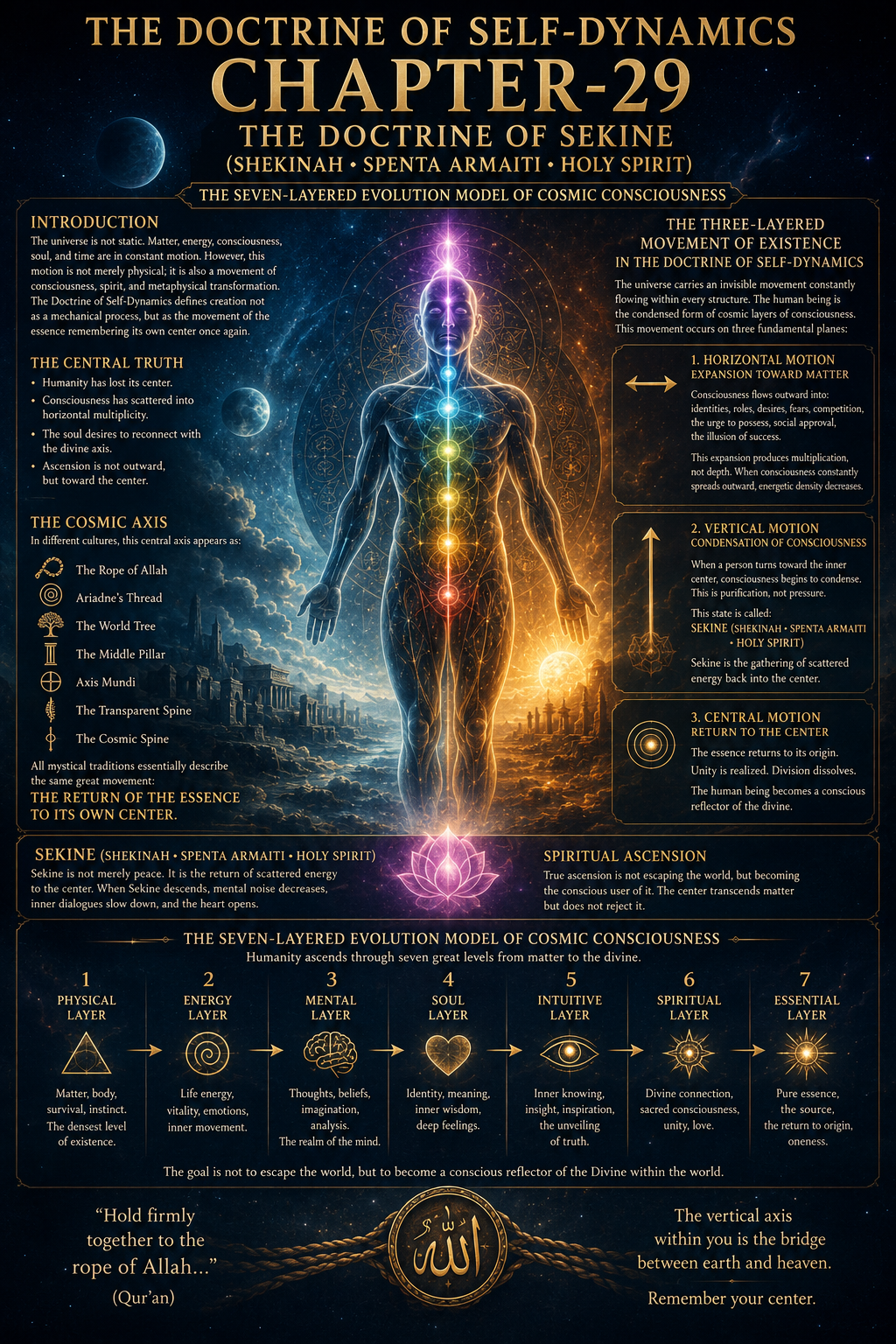
THE DOCTRINE OF SELF-DYNAMICS CHAPTER-29: THE DOCTRINE OF SEKINE (Shekinah-Spenta Armaiti-Holy Spirit)
THE DOCTRINE OF SELF-DYNAMICS CHAPTER-29: THE DOCTRINE OF SEKINE (Shekinah-Spenta Armaiti-Holy Spirit). Mercy is not merely emotional pity. It is the feeling of cosmic nearness that connects all existence. As the human being approaches the field of Sekine (Shekinah-Spenta Armaiti-Holy Spirit),..
ÖZ-DEVİNİM KURAMI
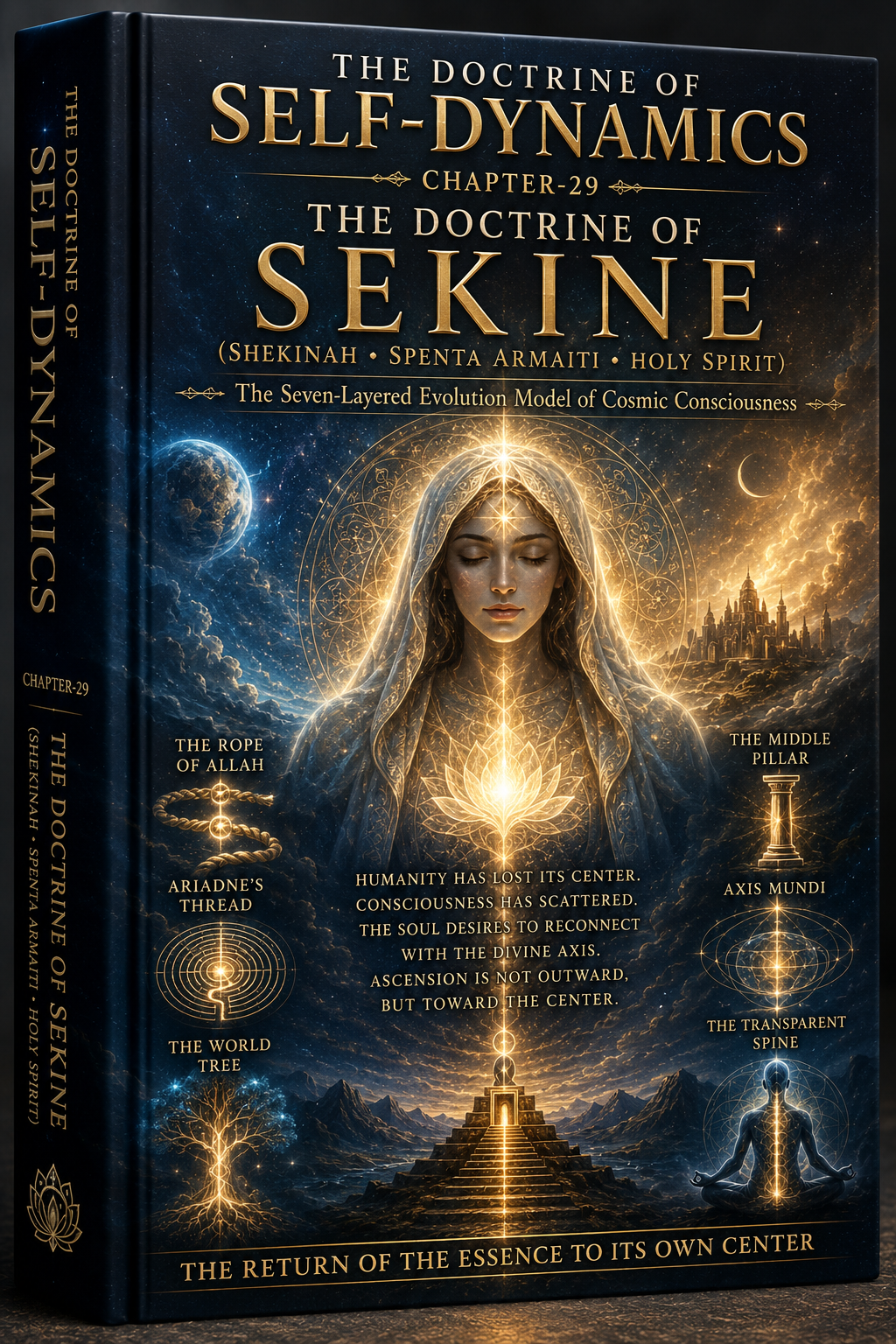
THE DOCTRINE OF SELF-DYNAMICS CHAPTER-29: THE DOCTRINE OF SEKINE (Shekinah-Spenta Armaiti-Holy Spirit)
The Seven-Layered Evolution Model of Cosmic Consciousness
INTRODUCTION
The universe is not static. Matter, energy, consciousness, soul, and time are in constant motion. However, this motion is not merely physical; it is also a movement of consciousness, spirit, and metaphysical transformation. The Doctrine of Self-Dynamics defines creation not as a mechanical process, but as the movement of the essence remembering its own center once again.
According to this doctrine, the human being is not merely a biological organism. The human is the condensed form of cosmic layers of consciousness. The body is the visible face; the soul is the invisible center. Human life is the great movement between the forgetting of this center and its remembrance once again.
Although ancient teachings used different symbols, they all describe the same fundamental truth:
• Humanity has lost its center.
• Consciousness has scattered into horizontal multiplicity.
• The soul desires to reconnect with the divine axis.
• Ascension is not outward, but toward the center.
In The Doctrine of Self-Dynamics, this central axis appears in different cultures as:
• The Rope of Allah,
• Ariadne’s Thread,
• The World Tree,
• The Middle Pillar,
• Axis Mundi,
• The Transparent Spine,
• The Cosmic Spine.
Therefore, all mystical traditions essentially describe the same great movement:
The return of the Essence to its own center.
THE THREE-LAYERED MOVEMENT OF EXISTENCE
According to The Doctrine of Self-Dynamics, the universe is not static. Existence carries an invisible movement constantly flowing within every structure that appears motionless. The human body, thoughts, societies, civilizations, and even stars are different density forms of the same cosmic motion. What ancient teachings described as the “breath of life” is actually the continuous vibrational movement through which existence moves from its own essential center outward and back toward the center again.
For this reason, the human being is not merely a living biological organism.
Humanity is:
moving consciousness.
The Doctrine of Self-Dynamics states that this movement occurs on three fundamental planes:
• horizontal motion,
• vertical motion,
• central motion.
These three movements are not merely psychological processes. They are also cosmic stages of spiritual evolution. Whichever plane a person lives within, reality is perceived from that plane.
Horizontal motion is humanity’s expansion toward matter. On this plane, consciousness flows outward. The human being continuously expands within:
identities,
roles,
desires,
fears,
competition,
the urge to possess,
social approval,
the illusion of success.
However, this expansion is not true growth.
Because horizontal motion produces multiplication, not depth.
The greatest paradox of the modern age emerges here. Humanity has reached more information than at any other time in history, yet it has also lost its center more than ever before. Data has multiplied, but wisdom has diminished. Humanity has learned to control its surroundings, yet has become alienated from its own inner world.
According to The Doctrine of Self-Dynamics, a human being living on the horizontal plane is constantly nourished by external stimuli. The mind moves endlessly. Attention becomes fragmented. Consciousness scatters. Humanity begins defining itself through layers of consumption, speed, and identity.
For this reason, the greatest problem of modern humanity is not lack of information.
It is the absence of center.
Ancient esoteric traditions described this condition as “scattered consciousness.” In Hermetic teachings, humanity’s spiritual fall begins with the forgetting of the center. In the Sufi tradition, this was called “heedlessness.” Buddhist teachings describe it as the mind constantly attaching itself to external objects.
The Doctrine of Self-Dynamics reinterprets this ancient knowledge within a new systematic structure.
According to the doctrine, when humanity lives only on the horizontal axis, it loses its own essential frequency. Because when consciousness constantly spreads outward, energetic density decreases. Just as light loses its power when dispersed across a vast area, humanity loses its inner clarity as it moves away from its center.
This is where vertical motion begins.
Vertical motion is not an upward physical movement. This movement is:
the condensation of consciousness.
When a person withdraws from the chaos of the external world and begins turning toward the inner center, consciousness begins not to compress, but to condense. This condensation is not pressure; it is purification.
Ancient mystics described this state with concepts such as:
awakening,
realization,
the opening of the heart,
Sekine (Shekinah-Spenta Armaiti-Holy Spirit),
inner light.
Sekine (Shekinah-Spenta Armaiti-Holy Spirit) holds a very important place in The Doctrine of Self-Dynamics. Because Sekine (Shekinah-Spenta Armaiti-Holy Spirit) is not merely peace. Sekine (Shekinah-Spenta Armaiti-Holy Spirit) is:
the gathering of scattered energy back into the center.
When a person reaches the state of Sekine (Shekinah-Spenta Armaiti-Holy Spirit), mental noise decreases. Inner dialogues slow down. Ego-centered fears begin dissolving. Consciousness transitions from fragmented perception to the perception of unity.
At this point, the human being no longer sees the world merely as a collection of objects. One begins intuitively sensing that everything is connected through invisible bonds.
According to The Doctrine of Self-Dynamics, true spiritual ascension is not escaping the world. Because hating matter is still being attached to matter. This is why many mystical paths eventually collapsed. When the human body was declared the enemy, balance was destroyed.
Yet the body is:
the carrier of the soul.
Matter is:
condensed consciousness.
For this reason, The Doctrine of Self-Dynamics accepts neither rigid materialism nor extreme mysticism completely detached from the world. Because both are distorted forms of imbalance.
This is where the third movement emerges:
central motion.
Central motion is the union of horizontal and vertical movement. A person lives within the world while remaining connected to the center. One works, produces, loves, speaks, and exists within society; yet does not lose the inner center.
This condition resembles the doctrine of the “middle pillar” in esoteric traditions. In Kabbalistic traditions, the central pillar represents balance. In Sufism, the concept of “istikamet” expresses the same equilibrium. The Taoist understanding of the “middle way” is also close to this.
Because true wisdom is born not at the extremes, but at the center.
The consciousness of a person who reaches central motion begins to become transparent. This is the fundamental aim of The Doctrine of Self-Dynamics:
transparency.
Transparency is not annihilation.
It is the dissolution of the ego.
Transparency is not the erasure of personality.
It is personality beginning to serve the center.
As a person becomes more transparent, fears decrease. The mind loses its rigidity. Consciousness becomes permeable. Thus humanity begins living in greater harmony with the universal flow of consciousness.
The transformation described in ancient teachings as the “body of light,” “luminous body,” or “subtle body” is actually the transformation of conscious density. According to The Doctrine of Self-Dynamics, the human of the future will live more centrally. Because humanity is experiencing the crisis of excessive horizontalization.
The chaos of the modern world is not merely economic or political.
This crisis is:
the crisis of losing the center.
Humanity has expanded infinitely outward, yet neglected its inner axis. As a result:
anxiety,
identity fragmentation,
the feeling of meaninglessness,
spiritual emptiness,
burnout
have increasingly grown.
For this reason, The Doctrine of Self-Dynamics is not merely a metaphysical theory.
It is also an architecture of consciousness.
The aim of the doctrine is not to detach humanity from the world, but to reconnect humanity with its own essential center. Because a person who finds the center begins transforming not only oneself, but also the surrounding world.
Consciousness rooted in the center is not aggressive.
Because it does not feel incomplete.
Consciousness rooted in the center is not excessively ambitious.
Because it does not need to prove its existence.
Consciousness rooted in the center does not act through fear.
Because it has begun transcending the illusion of separation.
This is the fundamental principle of The Doctrine of Self-Dynamics:
Humanity is neither merely body,
nor merely soul,
nor merely thought,
nor merely an energetic entity.
Humanity is:
consciousness attempting to return to the center.
THE MULTI-LAYERED STRUCTURE OF CONSCIOUSNESS
According to The Doctrine of Self-Dynamics, the human being is not merely a biological organism composed of flesh, bones, and the nervous system. Humanity is a living cosmic structure composed of multilayered fields of consciousness interwoven within one another. The visible body is merely the outer shell. The true human being is the sum of invisible layers.
Most ancient teachings described this truth through different symbols. Egyptian mysteries viewed humanity as a “living pillar connected to the heavens,” while the Hermetic tradition defined humanity as the microcosm. The chakra system in Hindu teachings, the Tree of Life in Kabbalah, the stations of the nafs in Sufism, and the vibrational layers in Hermeticism are reflections of the same truth within different cultures.
The Doctrine of Self-Dynamics reinterprets this ancient knowledge under a single architecture of consciousness and states that the human being consists of seven fundamental layers.
These layers are not independent from one another. Each penetrates the others. Just as light passes through different layers of density, consciousness also becomes visible in different forms across different planes.
The first layer:
The Physical Body.
The physical body is the densest-frequency field of the human being. It is associated with the earth element. Birth, hunger, sleep, survival, and biological impulses function on this plane. When a person lives only at the level of the physical body, life is perceived entirely materially. Reality consists only of things that can be touched.
Most of the modern world lives within this layer. Humanity nourishes the body while starving the soul.
Yet the physical body is merely the vessel.
Ancient alchemists said that the body existed in the state of “lead.” Because dense matter is consciousness that has not yet transformed. According to The Doctrine of Self-Dynamics, humanity’s spiritual journey is the process of making this density transparent.
The second layer:
The Life Body.
In many traditions, this field was described as invisible life energy. What Hindu teachings call “prana,” Chinese tradition calls “chi,” and Sufism calls the “breath of life” is actually the flow of the life body.
The life body is like the energetic matrix of the physical body. A person may appear physically healthy yet still feel exhausted. Because the life body has weakened.
According to The Doctrine of Self-Dynamics, one of the greatest problems of modern humanity is energetic fragmentation. Constant exposure to screens, intense mental noise, the culture of fear, and fragmented attention disrupt the natural rhythm of the life body.
This is why ancient priests practiced breath exercises, zikr, mantra vibrations, and ritual movements. The purpose was not merely worship; it was to rebalance the flow of energy.
The third layer:
The Emotional Body.
Humanity is not merely a thinking being, but also a vibrating being. Every emotion creates a frequency within the field of consciousness. Fear contracts. Love expands. Anger intensifies. Compassion softens.
According to The Doctrine of Self-Dynamics, emotions are not merely psychological states; they are also energetic movements.
This layer, also described as the astral plane, is in constant interaction with the collective vibrations of humanity. Therefore, the fear of crowds can affect the individual. Waves of social anger can spread through the field of consciousness.
Modern media systems often target this layer. Because the frequency of fear distances humanity from its center.
A person who loses the center becomes easier to control.
The fourth layer:
The Mental Body.
The human mind is not merely a mechanism that produces thoughts. The mind is also the field of interpretation that shapes reality.
Ancient Hermetic teaching contains the principle:
“The universe is mental.”
This statement is symbolic. Because humanity perceives the world through mental filters. Every person lives in the same world, yet experiences different realities.
According to The Doctrine of Self-Dynamics, the mental body divides into two forms:
the scattered mind
and the central mind.
The scattered mind constantly reacts to external stimuli. The central mind, however, can observe. Inner silence begins to emerge here.
True spiritual transformation is not suppressing thoughts, but recognizing the silent center beyond thought.
The fifth layer:
The Soul Body.
This is where humanity’s true transformation begins.
The soul body is the essential existence beyond individual identity. The Sufi understanding of the “eye of the heart” points toward this layer. Because the heart here signifies not the biological organ, but the center of divine perception.
When the soul body begins activating, humanity starts seeing life differently. Coincidences gain meaning. Intuition strengthens. A sense of inner guidance emerges.
What ancient traditions called “awakening” is actually the soul body becoming visible within consciousness.
Yet The Doctrine of Self-Dynamics does not stop there.
The sixth layer:
The Body of Sekine (Shekinah-Spenta Armaiti-Holy Spirit).
Very few teachings openly describe this layer. Because the level of Sekine (Shekinah-Spenta Armaiti-Holy Spirit) is the transition point from individual consciousness to the collective field of consciousness.
Sekine (Shekinah-Spenta Armaiti-Holy Spirit) is:
the vibration of inner divine peace.
At this level, a person no longer acts solely through the individual self. Consciousness becomes more permeable. Ego rigidity dissolves. The mind becomes calm. Humanity ceases struggling against the universe.
The concept of Shekinah in ancient Hebrew mysticism, the state of sekine in Sufism, and the understanding of the body of light in Hermetic teachings are different expressions of the same great mystery.
According to The Doctrine of Self-Dynamics, the future evolution of humanity will occur through the collective awakening of the body of Sekine (Shekinah-Spenta Armaiti-Holy Spirit).
Because the crisis of humanity today is not lack of technology.
It is vibrational corruption.
The final layer is:
Lord Consciousness.
This level cannot be described; it can only be experienced.
Lord Consciousness is the level of consciousness where the individual ego completely dissolves and the awareness of unity is born. Here, the feeling of “I” ceases to be the center. Humanity begins feeling connected with the entirety of life.
The marifet of Sufism,
the Keter of Kabbalah,
the Sahasrara of Hinduism,
the consciousness of unity in Hermeticism
are different symbols of the same metaphysical orientation.
The Doctrine of Self-Dynamics does not claim that these correspondences are absolutely identical. Because every tradition expresses truth through its own language. Yet all great teachings sensed the multilayered nature of humanity.
Because humanity is:
not merely body.
Humanity is:
condensed consciousness.
And the entire spiritual journey is the process of this consciousness remembering its own essential source once again.
According to The Doctrine of Self-Dynamics, the purpose of humanity is not escaping the world.
It is bringing its layers into harmony.
The physical body opens to earth,
the life body to energy,
the emotional body to vibration,
the mental body to perception,
the soul body to truth,
the body of Sekine (Shekinah-Spenta Armaiti-Holy Spirit) to peace,
and Lord Consciousness to unity.
When humanity brings these seven layers into harmony, it ceases to be a fragmented being.
And for the first time:
begins living from the center.
THE SEVEN ENERGETIC BODIES IN THE DOCTRINE OF SELF-DYNAMICS
I. THE PHYSICAL BODY
According to The Doctrine of Self-Dynamics, the first and densest layer of the human being is the physical body. This body is not merely a mechanical structure made of flesh, bones, and biological organs. It is the heaviest vibrational plane of consciousness. Here, the soul condenses, slows down, and enters time. On this plane, the human being experiences birth, hunger, fear, fatigue, and death.
Ancient teachings often described the physical body through the symbol of “earth.” Because earth represents density. Here, the human being is limited. Bound to space. In need of energy in order to move. Capable of feeling pain. Exposed to time.
According to The Doctrine of Self-Dynamics, the physical body is:
the outer ring of the labyrinth.
When a human being lives at this level, matter is mistaken for absolute reality. Identities, social roles, and outer appearance replace the center. Thus consciousness spreads into the horizontal plane. The human being multiplies outwardly, yet cannot deepen inwardly.
But the physical body is not the enemy.
Most ancient mystics regarded the body as a sacred carrier. Because the soul cannot transform without experience. The human being cannot understand courage without experiencing fear. One cannot feel the meaning of light without seeing darkness.
Therefore, in The Doctrine of Self-Dynamics, the body is:
not a prison,
but a field of trial.
When the human being rejects the body, one cannot approach the center. Because the soul matures through contact with matter. But when the human being thinks oneself to be only the body, forgetting begins.
This forgetting is:
the beginning of the labyrinth.
II. THE LIFE BODY
Beneath the physical body lies the life body. This body is an invisible energy field. Ancient teachings gave it different names:
Prāṇa,
Qi,
Pneuma,
Ruah,
Nafas-i Rahmânî…
Although the names differ, what is described is the same:
The human being is not composed only of matter.
The life body is the vibrational flow that keeps the physical structure alive. Breath, circulation, rhythm, and vitality arise in this layer. When a person dies, the body still exists; yet life has withdrawn. What withdraws is the vibration of life.
According to The Doctrine of Self-Dynamics, breath is:
the entrance of the invisible into the visible.
For this reason, all mystical traditions placed breath at the center. Prāṇāyāma in Yoga, the breath of zikr in Sufism, Taoist circulation techniques, and Shamanic rhythmic breathing all seek to activate the same axis.
Because when breath changes, consciousness changes.
Fear narrows the breath.
Peace slows the breath.
Anger hardens the breath.
When the human being observes the breath, one begins to see one’s own inner state. Therefore, according to The Doctrine of Self-Dynamics, the life body is:
the source of movement.
When the human being becomes disconnected from rhythm, one becomes exhausted. The chaotic structure of the modern world weakens the life body. Constant speed, screens, artificial lights, and mental noise disrupt the human energetic rhythm.
But when the human being returns to the breath, the center begins to be felt again.
III. THE EMOTIONAL BODY
The emotional body is the inner ocean of the human being. Here arise fears, desires, longings, attachments, and the feeling of loneliness.
According to The Doctrine of Self-Dynamics, the human being often mistakes oneself for one’s feelings. Yet fear is not the essence. Anger is not the essence. These are waves around the center.
Buddhism describes the mind as a wavy lake.
Sufism uses the concept of nafs.
Hermeticism speaks of the astral field.
All of them describe the same field of consciousness:
the wavy cosmos.
Emotions are not evil.
But emotion without a center:
produces dispersion.
When the human being identifies with fear, one becomes fear itself. When one completely merges with desires, inner freedom is lost.
According to The Doctrine of Self-Dynamics, the solution is not suppression.
It is making transparent.
When the human being observes emotions, one begins to notice the silence behind the waves. Thus anger can transform into consciousness. Pain can give birth to compassion.
Transparent emotion:
turns into mercy.
IV. THE MENTAL BODY
The mental body is the layer where the human being first questions one’s own existence.
Here, the human being asks:
“Who am I?”
“What is reality?”
“What is essence?”
“Why does death exist?”
Philosophy is born here.
Religion is born here.
Metaphysics begins here.
According to The Doctrine of Self-Dynamics, the mind is:
both a door,
and a veil.
Thought can reveal truth; yet it can also replace truth.
For this reason, ancient mystics developed practices of mental silence. Meditation, murāqabah, contemplatio, and tafakkur carry the same aim:
to align the mind with the center.
Because thoughts are like clouds.
The center is the sky.
When the human being learns to observe thoughts, one feels the silent field beyond them.
This is where the center begins to appear.
V. THE SOUL BODY
The soul body is the center of The Doctrine of Self-Dynamics.
The soul is:
essential memory,
the vertical axis,
the point of divine contact.
Here, the human being begins to feel for the first time that one is not merely body and mind.
Conscience is born here.
But conscience is not merely social morality.
Conscience is:
the echo that the essence gives to the center.
Sometimes a person may feel inner unrest even when approved by everyone. Because the soul knows when it has moved away from the center.
According to The Doctrine of Self-Dynamics, the soul is:
the point where the Rope of Allah holds within the body.
For this reason, in all ancient teachings there are symbols such as:
the world tree,
the cosmic pillar,
the line of light,
the heavenly ladder.
When the soul connects to this axis, multiplicity begins to dissolve.
For the first time, the human being begins not to feel separate from the universe.
VI. THE BODY OF SEKINE (Shekinah-Spenta Armaiti-Holy Spirit)
The body of Sekine (Shekinah-Spenta Armaiti-Holy Spirit) is the most original field of The Doctrine of Self-Dynamics.
Sekine (Shekinah-Spenta Armaiti-Holy Spirit) is not merely peace.
Sekine (Shekinah-Spenta Armaiti-Holy Spirit) is:
cosmic mercy.
This layer appears as Shekinah in Jewish mysticism, Holy Spirit in Christianity, Sophia in Gnosticism, and Shakti in Hinduism.
According to The Doctrine of Self-Dynamics, all of these are different cultural reflections of the same metaphysical core.
Sekine (Shekinah-Spenta Armaiti-Holy Spirit):
makes the heart transparent,
dissolves ego density,
unifies consciousness.
Therefore, Sekine (Shekinah-Spenta Armaiti-Holy Spirit) is:
cosmic feminine consciousness.
The femininity here is not biological.
It is the generative principle of consciousness.
When Sekine (Shekinah-Spenta Armaiti-Holy Spirit) becomes active, the human being begins to feel not only oneself, but all existence.
I dissolves.
WE is born.
Compassion opens here.
Mercy descends here.
The human being no longer fights against life.
VII. LORD CONSCIOUSNESS
Lord Consciousness is the final stage of The Doctrine of Self-Dynamics.
This stage is not the level at which the human being becomes divine,
but the level of consciousness at which one becomes fully aligned with the center.
Here, the body,
emotion,
mind,
soul,
and Sekine (Shekinah-Spenta Armaiti-Holy Spirit)
cease to conflict.
Existence unites on a single axis.
Lord Consciousness is defined as:
the perception of unity,
central awareness,
absolute peace.
The marifet in Sufism,
Keter in Kabbalah,
unity consciousness in Vedanta,
and theosis in Christian mysticism
carry the same orientation.
Here, the human being no longer sees separation as absolute reality.
Because the axis has been completed.
ADDITIONAL INFORMATION
THE COSMIC FEMININE ARCHETYPE
According to The Doctrine of Self-Dynamics, human history is not merely the history of wars, civilizations, and political transformations. It is also the history of consciousness archetypes. From ancient ages until today, there have been certain symbols continuously repeating across different geographies of the world. Although these symbols carry different names, they point toward the same metaphysical core.
One of the most ancient of these cores is:
the Celestial Mother archetype.
For thousands of years, humanity did not view the heavens merely as masculine power. Ancient consciousness sensed that within the universe there existed an invisible field of mercy that carries, gives birth, nourishes, and transforms. For this reason, strikingly similar feminine sacred figures emerged in different civilizations.
Isis in Egypt,
Inanna in Sumer,
Ishtar in Babylon,
Cybele in Anatolia,
Mary in Christianity,
Sophia in Gnostic traditions,
Shekinah in Jewish mysticism,
Shakti in Hinduism…
The names changed, yet the essence of the figure largely remained the same.
Because humanity sensed the sacred carrying principle within the collective unconscious.
According to The Doctrine of Self-Dynamics, the shared aspects of these figures are not coincidence. All of them have been associated with:
birth-giving,
protection,
mercy,
compassion,
the carrying of light,
the transformation of consciousness.
For this reason, the Celestial Mother figure is not merely a mythological character.
She represents a layer of consciousness.
According to the doctrine, the cosmic feminine is not biological femininity.
It is the generative principle of consciousness within existence.
This distinction is extremely important. Because in The Doctrine of Self-Dynamics, femininity is not gender; it is metaphysical function. Regardless of whether human beings are male or female, both masculine and feminine poles of consciousness exist within every person.
The masculine pole is more associated with:
movement,
separation,
direction,
definition,
will.
The feminine pole is the movement of:
carrying,
unifying,
protecting,
transforming,
generating mercy.
This is why ancient civilizations constantly associated Celestial Mother figures with symbols of birth and light. Because the cosmic feminine represents not only physical birth, but the birth of consciousness.
The human being is born a second time into truth.
And this birth is not mental;
it is of the heart.
According to The Doctrine of Self-Dynamics, the central transformation of the human being is born not from hardness, but from softening. Because the center cannot be opened through force alone. The heart must become permeable. For this reason, the cosmic feminine archetype was often seen together with symbols such as:
the womb,
water,
the moon,
Venus,
golden light,
compassion,
the heart center.
Here, the womb is not merely a biological organ.
The womb is:
the field of carrying consciousness.
Ancient esoteric traditions described the universe as emerging from the idea of a “cosmic womb.” Because creation is not merely mechanical production; it is the movement of carrying consciousness. This is also why the symbol of water is important. Water does not impose shape; yet it carries life. It is not rigid; yet it is transformative.
The symbol of the moon represents the reflective field of consciousness. While the sun produces light directly, the moon reflects light. According to The Doctrine of Self-Dynamics, feminine consciousness similarly represents the permeable field that carries divine light.
Throughout history, the symbol of Venus has also been associated not only with beauty, but with harmony, attraction, and heartfelt connection. Because the cosmic feminine reduces separation and strengthens connection.
Most of the modern world has been shaped by excessively masculine structures of consciousness. Systems centered upon constant production, competition, control, speed, and power have disrupted humanity’s inner balance. According to The Doctrine of Self-Dynamics, as a result of this humanity has:
weakened compassion,
lost connection with nature,
moved away from the heart center.
For this reason, one of the greatest needs of our age is the remembrance of cosmic feminine consciousness.
However, this transformation is not a superficial romantic understanding. Because the cosmic feminine is not merely discourse about love. It is also the power of transformation.
The descent of Inanna into the underworld,
the gathering of the fragments by Isis,
the fall of Sophia,
the silent acceptance of Mary,
the energetic flow of Shakti…
All of these narratives are different metaphors for the transformation of consciousness.
According to The Doctrine of Self-Dynamics, the spiritual maturity of the human being becomes possible through reconnecting with the feminine principle within oneself. Because humanity can approach the center only when it develops consciousness capable of carrying.
THE SUN OF THE HEART AND THE SECRET OF RESURRECTION
According to The Doctrine of Self-Dynamics, ancient humanity did not look at the heavens merely as the physical universe. Planets, stars, and cosmic movements were also viewed as symbols of human consciousness. Because ancient wisdom traditions believed there existed an invisible resemblance between the universe and the human being. Whatever existed in the heavens also had its echo within humanity. Therefore, planets were accepted not merely as astronomical bodies, but as symbols of principles of consciousness.
Venus is one of the most important of these symbols.
According to The Doctrine of Self-Dynamics, Venus is not merely a planet moving through the heavens. It is the cosmic symbol of harmony, aesthetics, love, attraction, and conscious balance. Most ancient civilizations associated Venus with feminine sacredness. Inanna in Sumer, Ishtar in Babylon, Aphrodite in the Greek world, Venus in Roman tradition, and the figure of Mary in mystical Christianity emerged as different cultural manifestations of the same archetypal line.
The shared point of these figures is not merely beauty. All of them are associated with the principle that carries, transforms, and awakens consciousness. Because ancient consciousness sensed that within the inner world of the human being there existed an invisible force that dissolves hardness and draws the heart closer to the center.
According to The Doctrine of Self-Dynamics, this is why Venus is the celestial symbol of the heart center.
Here, the heart does not mean the biological organ. The heart is the spiritual center of balance within the human being. It is the inner sun of consciousness. The human being thinks with the mind; yet feels the center with the heart. Because the heart is the field where the human being can hear the echo of the essence.
When the center is lost, consciousness begins fragmenting. When the human being starts living only on mental and material planes, inner harmony deteriorates. Compassion decreases, the ego hardens, and humanity begins losing connection with other beings. For this reason, all great mystical traditions placed the heart at the center.
The understanding of Tiferet in Kabbalah, the doctrine of the heart in Sufism, the Sacred Heart symbol in Christian mysticism, and the center of compassion in Buddhism are different expressions of the same metaphysical field. Because true transformation does not occur through thought alone. Humanity can approach the center only when the heart becomes transparent.
According to The Doctrine of Self-Dynamics, the heart is the field of Sekine (Shekinah-Spenta Armaiti-Holy Spirit) within the human being. Here, the human being does not merely think; one also feels a deep inner harmony. For this reason, when the heart center opens, the perception of life begins changing. The sense of competition decreases. The constant need to prove oneself dissolves. The existence of others ceases being perceived as a threat. For the first time, the human being stops fighting life and learns to flow in harmony with it.
This is also why the Venus archetype has historically been associated with beauty and attraction. Because true beauty, before outer appearance, is conscious harmony. When the human being approaches the center, the inner frequency begins changing. This transformation was often described through the symbol of light in ancient esoteric systems.
For this reason, yellow light holds an extremely important place in The Doctrine of Self-Dynamics.
Here, the color yellow is not merely a physical color. It represents the awakening of consciousness, the opening of perception, and the activation of essential awareness. In ancient aura systems, yellow was associated with mental illumination and spiritual awareness. Tiferet in Kabbalah was often represented by golden light, in Hermetic systems the solar center was viewed as the inner sun of the human being, and in Sufism the concept of nur expressed the same field of consciousness.
According to The Doctrine of Self-Dynamics, yellow light is the reactivation of the human being’s essential consciousness.
When the human being approaches the center, an indescribable clarity forms within. The mind gradually becomes clearer. The heart becomes lighter. Fears begin dissolving. Humanity feels more alive. This condition is not merely psychological relaxation; it is the transformation of the density of consciousness.
Ancient mystical traditions often called this:
“resurrection.”
Here, resurrection is not used in the sense of an event occurring after biological death. Resurrection is the beginning of humanity remembering its own essence again. It is consciousness becoming alive once more.
In The Doctrine of Self-Dynamics, the symbol of the “yellow cow” represents precisely this conscious resurrection. In ancient esoteric interpretations, yellow represented the light of consciousness, while the cow symbolized the carrying and generative field. Because throughout history the cow was viewed as the figure representing nourishment of life, carrying, and productivity.
For this reason, the yellow cow is interpreted as:
the womb that gives birth to consciousness again.
Here, the human being is born a second time. Yet this is not physical birth. It is spiritual birth. The reopening of essential memory. The beginning of the return to the field of Sekine (Shekinah-Spenta Armaiti-Holy Spirit).
However, according to The Doctrine of Self-Dynamics, another symbol stands opposite this resurrection:
the golden calf.
The golden calf is not merely a historical idol. It is the symbol of the false center. It represents ego density, the worship of matter, addiction to power, and the forgetting of the essence. When the human being loses the center, external objects begin to be sanctified. Money, status, power, identity, or self-image replace the center.
Thus consciousness begins revolving around the false center.
According to The Doctrine of Self-Dynamics, most of the modern world lives within the consciousness of the golden calf. Because humanity has placed having in the place of being. As outward achievements increased, the inner center diminished.
The yellow cow is the complete opposite of this.
It represents resurrection, Sekine (Shekinah-Spenta Armaiti-Holy Spirit), essential memory, and conscious awakening. Here, the human being reconnects with the center. The heart once again becomes the inner sun. Consciousness begins freeing itself from the attraction of false centers.
For this reason, the difference between the yellow cow and the golden calf is not merely symbolic.
This difference is:
the difference between
the true center
and
the false center.
The true center leads humanity toward unity.
The false center leads toward fragmentation.
THE TRANSPARENT AXIS AND THE SECOND BIRTH
According to The Doctrine of Self-Dynamics, the human being is not merely a biological entity living in the horizontal world. Within the human being there is an invisible axis. This axis is the metaphysical line that connects the human being not only to the world, but also to the center. The doctrine calls this line the “transparent spinal cord.”
The transparent spinal cord is not an anatomical structure.
It is the metaphysical axis of consciousness.
Just as the physical spine in the human body keeps the body upright, the transparent spinal cord is the invisible pillar that keeps consciousness centered. This axis is the vertical line through which the soul ascends. According to The Doctrine of Self-Dynamics, the entire spiritual journey of the human being is related to remembering this axis again.
Most ancient teachings described this invisible center through different symbols. The Sushumna line in Indian mysticism, the middle pillar in Kabbalah, the Shamanic world tree, the Axis Mundi in Hermetic traditions, the cosmic pillar, and the line of light are reflections of the same metaphysical principle in different cultures.
Because throughout history humanity has sensed that there is an invisible bond between the human being and transcendent reality.
According to The Doctrine of Self-Dynamics, the transparent spinal cord is the metaphysical appearance of the Rope of Allah within the human body. Here, the concept of “rope” is not merely a religious expression. It is the ontological axis. It is the central bond that protects human consciousness from dispersion.
When the human being is connected to this axis, consciousness gathers at the center. Emotions do not completely drag the person away. The mind does not fragment. Fears cannot seize the whole being. Because within the human being there is an invisible field of attraction that constantly calls one back to the center.
But when the human being loses this axis, fragmentation begins.
This is also the greatest crisis of modern humanity. Experience has multiplied; yet unity has been lost. Information has increased; yet the center has weakened. The human being is exposed to thousands of stimuli at the same time, yet cannot hear one’s own essential voice.
Because when the axis is lost, consciousness scatters across the horizontal plane.
According to The Doctrine of Self-Dynamics, ego density arises precisely here. The human being begins to think of oneself as nothing more than body, identity, and mental stories. Thus transparency is lost. Consciousness hardens.
Yet transparency is one of the most important concepts of the spiritual journey.
Transparency is:
the dissolution of ego density.
As the human being becomes transparent, one begins to feel one’s own center more clearly. Defenses decrease. Inner hardness dissolves. The heart becomes permeable. Consciousness no longer tries only to protect the self.
At this point, Sekine (Shekinah-Spenta Armaiti-Holy Spirit) begins to descend.
According to The Doctrine of Self-Dynamics, Sekine (Shekinah-Spenta Armaiti-Holy Spirit) is not a state obtained by force. It is the natural result of central openness. As the human being approaches the axis, consciousness condenses. Inner dispersion decreases. The feeling of mercy begins to arise.
What ancient mystics described as the “descent of light,” “sacred peace,” “divine nearness,” or “inner light” is largely this state of consciousness.
For this reason, the transparent spinal cord is the line of ascension.
But this ascension is not physically moving upward. It is the purification of consciousness from dense matter toward the essential center. Here, the human being stops seeing oneself merely as an individual entity. Because when the axis becomes active, multiplicity slowly begins to dissolve.
According to The Doctrine of Self-Dynamics, humanity’s greatest problem is being trapped in “I-consciousness.”
I-consciousness:
produces separation.
Produces fear.
Produces competition.
Produces loneliness.
Produces constant defense.
Here, the human being feels disconnected from the universe. One perceives the existence of others as a threat. One constantly feels forced to protect and prove oneself.
But when the field of Sekine (Shekinah-Spenta Armaiti-Holy Spirit) opens, consciousness begins to change.
For the first time, the human being begins to feel not only oneself, but all existence.
The Doctrine of Self-Dynamics defines this transformation as “the transition from I to WE.”
This is not the disappearance of the individual.
It is the expansion of the center.
The human being now becomes sensitive not only to one’s own pain, but also to the pain of others. Compassion is born here. Because compassion is not weakness, but a sign of central consciousness.
Mercy also opens here.
Mercy is not merely emotional pity. It is the feeling of cosmic nearness that connects all existence. As the human being approaches the field of Sekine (Shekinah-Spenta Armaiti-Holy Spirit), the feeling of separation begins to weaken. Consciousness becomes more permeable.
This is the state that ancient mystical traditions called “unity consciousness.”
According to The Doctrine of Self-Dynamics, the greatest threshold of the spiritual journey is “dying before death.”
This expression has been repeated throughout history in many mystical traditions. But what is described here is not physical death. It is the dissolution of the false center.
As long as the human being assumes the egocentric identity to be absolute reality, the essence remains invisible. Because the false center covers the true center.
Dying before death is:
the dissolution of ego density.
Here, the human being begins to pass through the rigid structures of the old self. Identities may fragment. Fears may surface. A feeling of inner emptiness may arise. Yet all of these are parts of the process of becoming transparent.
Because new consciousness cannot be born before the old center dissolves.
According to The Doctrine of Self-Dynamics, this process is conscious rebirth.
In ancient mystical traditions:
second birth,
body of light,
the phoenix symbol,
resurrection,
rainbow body,
rebirth
are different expressions of the same transformation.
The phoenix rising from its ashes symbolizes the dissolution of the old egocentric structure and the rebirth of central consciousness. The doctrine of the body of light describes the transparency of dense consciousness. The understanding of the rainbow body is based on the idea that even the body can reach vibrational lightness.
The Doctrine of Self-Dynamics gathers all these symbols into one center:
When the human being remembers the essence, one is born again.
LORD CONSCIOUSNESS
According to The Doctrine of Self-Dynamics, the entire spiritual journey of the human being takes place toward a single center. This movement, which begins from the density of the physical body, passes through the rhythm of the life body, the waves of the emotional body, the questions of the mental body, the awakening of the soul body, and the mercy of the field of Sekine (Shekinah-Spenta Armaiti-Holy Spirit), and is finally completed in Lord Consciousness.
Lord Consciousness is the highest stage of consciousness in The Doctrine of Self-Dynamics. Yet this stage does not mean that the human being becomes divine. Because according to the doctrine, the human being never becomes the absolute source itself. The human being only aligns with the center. The ego density that produces separation dissolves, and consciousness enters full harmony with its true axis.
Therefore, Lord Consciousness is:
not deification,
but central harmony.
Here, the human being feels for the first time that all inner layers have ceased to conflict. The body is no longer against the soul. The mind does not fight silence. Emotions do not produce chaos. The soul does not carry loneliness. Sekine (Shekinah-Spenta Armaiti-Holy Spirit) does not disperse.
The whole structure begins to unite on a single axis.
According to The Doctrine of Self-Dynamics, most of human suffering arises from fragmentation. The human being lives among layers pulled in different directions. The mind wants one thing, the body moves another way, emotions produce different fears. Thus consciousness becomes divided within itself.
In Lord Consciousness, this dispersion dissolves.
For the first time, the human being feels inner wholeness.
This wholeness is not ordinary psychological relaxation. Because here, not only peace but also the perception of unity is born. The human being stops feeling oneself as a separate entity from the universe. Even if the perception of separation does not completely disappear, the center becomes decisive.
The Doctrine of Self-Dynamics defines this state as:
central awareness.
In central awareness, the human being no longer feels the constant need to defend oneself. Because ego-centered fears have begun to dissolve. Instead of trying to control life, the human being moves in harmony with it.
Here, deep silence emerges.
But this silence is not emptiness.
It is living consciousness.
For this reason, ancient mystical traditions often described the highest state of consciousness with symbols of light, unity, and peace. The understanding of marifet in Sufism expresses the human being’s direct inner recognition of truth. Keter in Kabbalah represents the level of consciousness closest to the divine center. Unity consciousness in Vedanta describes the harmony of the individual self with universal consciousness. Theosis in Christian mysticism expresses the full alignment of the human being with divine will.
According to The Doctrine of Self-Dynamics, all these teachings carry the same great orientation:
return to the axis.
Because the true problem of the human being is not lack of information;
it is loss of center.
In Lord Consciousness, the human being begins to free oneself from the attraction of false centers. The desire for power decreases. The constant need to prove oneself dissolves. Fear can no longer establish absolute domination over consciousness.
Here, for the first time, the human being begins to feel that there is no separation between essence and life.
Everything unites on a single axis.
For this reason, conflict decreases in Lord Consciousness. The human being does not see life as an enemy. Even death no longer produces the feeling of absolute annihilation. Because consciousness has begun to feel its center in a place deeper than the body.
According to The Doctrine of Self-Dynamics, true resurrection occurs exactly here.
Resurrection is not escaping the physical body.
It is the alignment of the body as well with the center.
Here, the human being does not abandon the world; one begins to look at the world with a different consciousness. Everything appears more transparent. Nature is not merely matter. The human being is not merely a biological entity. The universe is not merely a mechanical system.
Everything begins to be felt as different densities of the same central vibration.
In Lord Consciousness, love also changes.
Love is no longer the desire to possess.
It is the feeling of unity.
Compassion is no longer a duty.
It is a natural state of consciousness.
Mercy is no longer an external concept.
It is an inner reality.
According to The Doctrine of Self-Dynamics, the future spiritual evolution of humanity is possible through the collective opening of this central consciousness. Because humanity has lived for a long time within horizontal motion. Power, fear, separation, and ego-centered systems have produced density within consciousness.
But when the center is remembered again, a new consciousness will begin to be born.
This consciousness will be:
neither merely individual,
nor merely social,
nor merely mystical,
nor merely mental.
This consciousness will be:
central.
Here, the human being does not see oneself as disconnected from the universe. Because the axis has been completed.
And when the axis is completed,
unity begins to be felt even within multiplicity.
According to The Doctrine of Self-Dynamics, the essence of Lord Consciousness is this:
The human being does not magnify oneself.
One removes the veils between oneself and oneself.
And when the veils are lifted,
the essence is already there.
According to The Doctrine of Self-Dynamics, all human suffering is related to disconnection from the axis. When the human being becomes alienated from the center, fear grows. The feeling of separation intensifies. The ego hardens. The chaos of the modern world also largely arises from this loss of center.
But when the human being turns toward the axis again, transformation begins.
Emotions become transparent.
The mind calms.
The soul begins to remember.
Sekine (Shekinah-Spenta Armaiti-Holy Spirit) descends.
The heart softens.
Consciousness gathers at the center.
Here, the human being begins to see life differently. The world is no longer merely a collection of material objects. Everything begins to be felt as a vibrational field connected through invisible bonds.
This is the greatest aim of The Doctrine of Self-Dynamics:
not escape,
but transparency.
Because truth is not in escaping the world, but in the center becoming visible.
As the human being approaches the essence, false centers begin to dissolve. The desire for power decreases. The constant need to prove oneself disappears. Consciousness becomes calmer, clearer, and more permeable.
The transformation that ancient mystical traditions described as “resurrection,” “second birth,” “body of light,” and “dying before death” is largely this.
Here, the human being does not physically transform into another entity.
The density of consciousness changes.
And finally, the circle becomes a sphere.
The circle is the symbol of horizontal motion.
The sphere is the symbol of consciousness that has gained a center.
The human being is no longer a scattered being wandering only in the outer world. An inner axis has formed. One does not lose the center within multiplicity. One lives within the world, yet does not feel belonging only to the world.
According to The Doctrine of Self-Dynamics, the true transformation of the human being occurs exactly here.
The human being ceases to be merely a living body.
One becomes a conscious cosmos carrying the essence.
And when the center is remembered,
the human being begins to truly live for the first time.
ACADEMIC FOOTNOTES
The seven-layer model appears under different names in many mystical traditions. These parallels may not necessarily mean direct historical transmission; however, they reflect shared intuitions concerning the layered structure of human consciousness.
The concept of “essence” is used here in the sense of a metaphysical center. This usage bears phenomenological proximity to the concept of sirr in Sufism, atman in Vedanta, and nous in Hermeticism.
The term “motion” expresses not only physical movement, but also conscious transformation. In this respect, it may be associated with process philosophy and mystical cosmologies.
The concept of the transparent spinal cord is symbolic; it is not a claim of an anatomical structure. It interprets the vertical axis of the human body as metaphysical permeability.
The parallel between Sekine (Shekinah-Spenta Armaiti-Holy Spirit) and Shekinah is based on the idea of peace and divine presence dwelling in the heart.
Feminine interpretations of the Holy Spirit in early Christian mysticism are seen especially in Syriac traditions.
The myth of Sophia deals with the theme of divine consciousness fragmenting within matter and becoming whole again.
In the doctrine of Shakti, the relationship between energy and consciousness is central. The Doctrine of Self-Dynamics reinterprets this relationship on the axis of consciousness rather than energy.
The Venus archetype has been associated in many cultures with fertility, beauty, attraction, and the principle of conscious harmony.
The interpretation of Tiferet as a solar center explains the connection of the heart center with cosmic order.
The Rainbow Body doctrine in Tibetan Buddhism carries the symbolism of the body transforming into light.
The understanding of “dying before death” expresses egocentric dissolution in many mystical traditions, especially Sufism.
The Axis Mundi symbol appears in images of the world tree, sacred mountain, and celestial pillar.
Ariadne’s thread is the mythological form of the principle of not losing the center within the labyrinth.
The symbol of the golden calf may be interpreted as the false center and the worship of matter.
Yellow light has been associated in many esoteric systems with consciousness, the sun, and mental illumination.
The symbol of the womb carries the meaning of cosmic fertility and the production of consciousness beyond its biological meaning.
The principle of the cosmic feminine should be evaluated not as biological gender, but as a generative metaphysical principle.
The expression Lord Consciousness represents not incarnation or identification, but the servant’s central perception of unity.
The Doctrine of Self-Dynamics is a comparative esoteric model that attempts to bring different traditions together; it does not propose a new dogma replacing historical religions.