THE DOCTRINE OF SELF-DYNAMICS CHAPTER-34: APPENDIX-3: TORAH – QUR’AN PARALLELS
THE DOCTRINE OF SELF-DYNAMICS CHAPTER-34: APPENDIX-3: TORAH – QUR’AN PARALLELS. Abraham remaining unharmed by the fire symbolizes the human being who reaches essential consciousness overcoming systems of fear. The Qur’anic expression “O fire, be coolness and peace” and the idea of divine protection
ÖZ-DEVİNİM KURAMI
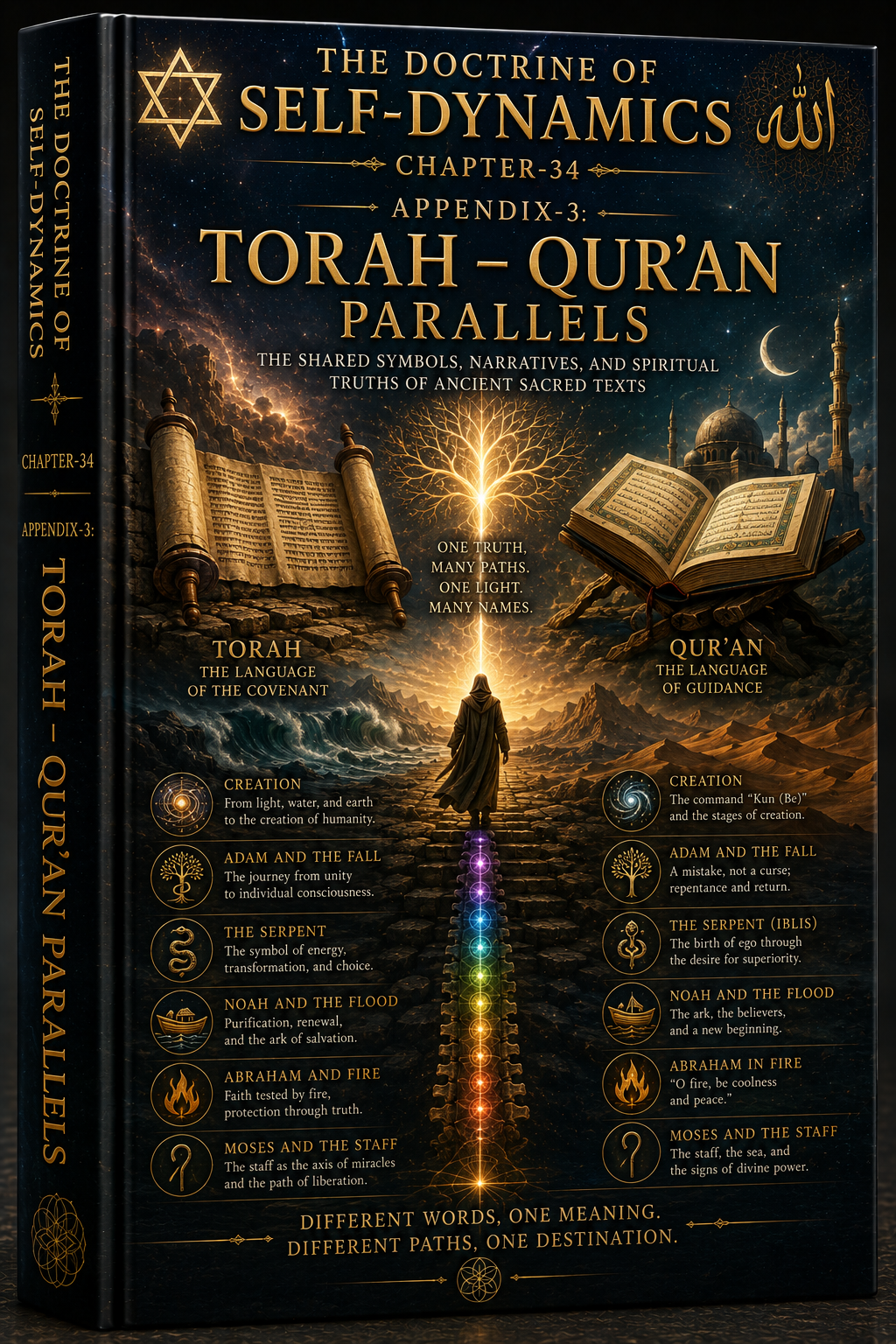
THE DOCTRINE OF SELF-DYNAMICS CHAPTER-34: APPENDIX-3: TORAH – QUR’AN PARALLELS
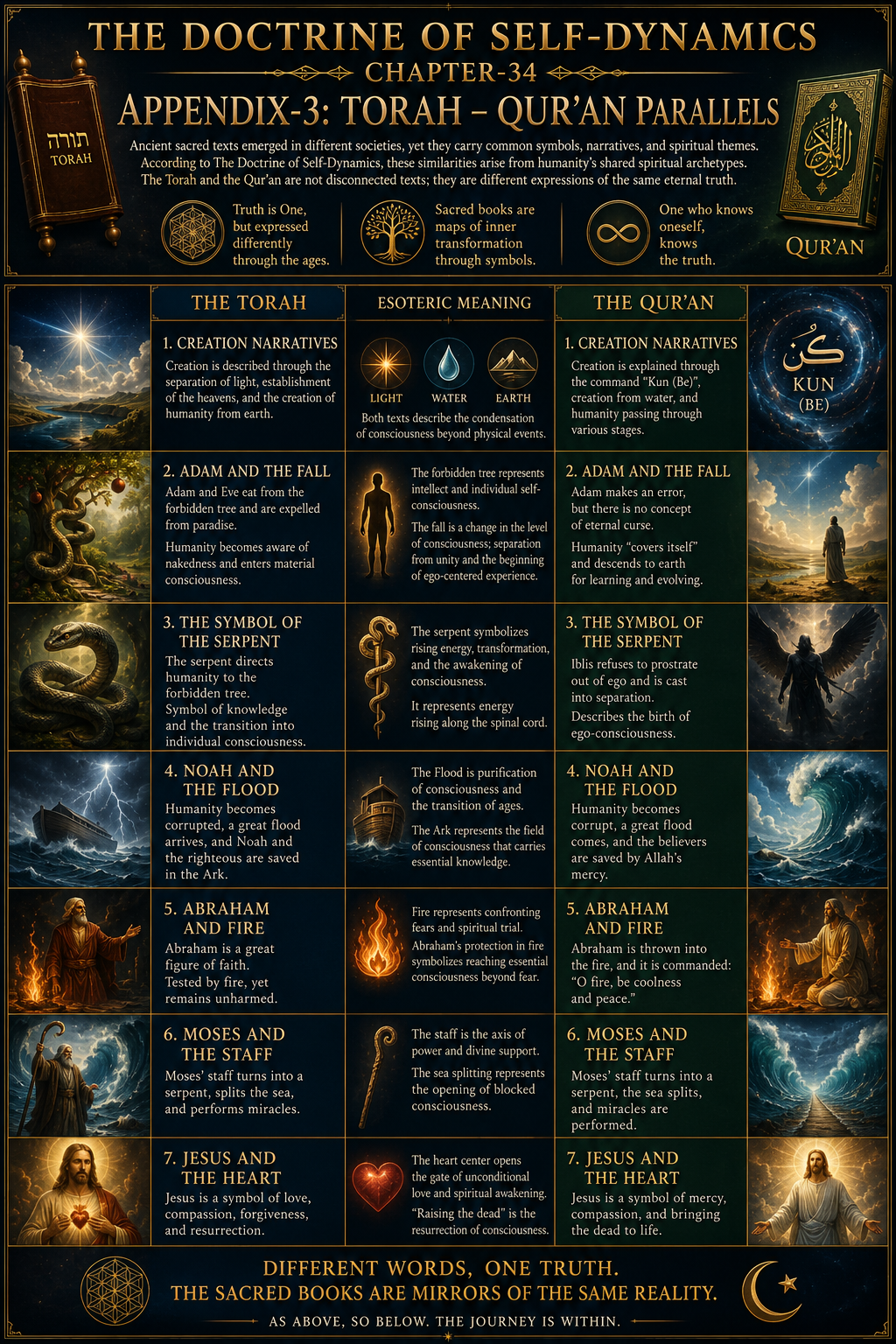
Although ancient sacred texts emerged within different societies, they carry many common symbols, narratives, and spiritual themes. According to The Doctrine of Self-Dynamics, the reason for these similarities is that humanity is nourished from the same collective consciousness memory. The Torah, the Qur’an, the Gospel, and other ancient teachings are not completely disconnected texts; rather, they are fragments of a shared truth emerging in different ages and at different levels of consciousness.
In the esoteric understanding, sacred books do not merely narrate history. They also convey the map of humanity’s inner transformation through symbols. Therefore, even if the same event is described in different languages across different texts, similar consciousness themes appear at their core.
According to The Doctrine of Self-Dynamics, the parallels between the Torah and the Qur’an are not merely the result of cultural interaction. These similarities arise from humanity’s common spiritual archetypes.
Ancient sages said that truth is one, but it is expressed differently according to the ages.
CREATION NARRATIVES
In the Torah, creation is described through the symbols of the “separation of light,” the “establishment of the heavens,” and the “creation of humanity from earth.” In the Qur’an, creation is explained through the command “Kun (Be),” creation from water, and humanity passing through various stages.
According to The Doctrine of Self-Dynamics, both narratives represent the condensation of consciousness beyond physical events.
The symbol of light represents the first vibration of consciousness…
The symbol of water represents the field of potential life…
And earth represents dense matter.
In ancient teachings, the “creation of humanity from clay” symbolizes the binding of the physical body to dense matter.
The Qur’anic understanding that “We created humanity stage by stage” and the layered creation narratives in the Torah both point esoterically to the same process of movement.
ADAM AND THE FALL
In the Torah, Adam and Eve are expelled from paradise after eating the forbidden fruit. In the Qur’an, Adam is seen to have made an error, yet the narrative does not present the idea of an “eternal curse.”
According to The Doctrine of Self-Dynamics, the center of both narratives is the condensation of consciousness.
The symbol of the forbidden tree represents intellect and individual self-consciousness.
Through the process of “knowing good and evil,” humanity departed from the state of unity and entered individual experience.
The awareness of nakedness in the Torah, and the symbol of “covering” in the Qur’an, represent humanity’s entrance into dense material consciousness.
In ancient esoteric teachings, the fall is not physical humiliation, but a change in the level of consciousness.
Humanity separated from essential unity and began ego-centered experience.
THE SYMBOL OF THE SERPENT
In the Torah, the serpent is the figure directing humanity toward the forbidden tree. In the Qur’an, Iblis stands at the center of the crisis of prostration.
The Doctrine of Self-Dynamics interprets these symbols not as satanic creatures, but as esoteric images of consciousness transformation.
In ancient teachings, the serpent was often associated with energy, transformation, and the awakening of consciousness.
The kundalini energy in Eastern teachings…
The sacred cobra in Egypt…
And the spiral serpent symbol in the Hermetic tradition…
All arise from the same root.
Esoterically, the serpent is the consciousness energy rising along the spinal cord.
For this reason, the serpent in the Torah is not merely a symbol of evil, but a representation of humanity’s transition into individual consciousness.
In the Qur’an, Iblis falling into separation by saying “I am superior” also describes the birth of ego-consciousness.
According to The Doctrine of Self-Dynamics, the true fall is not gaining knowledge, but severing oneself from the essence and placing the ego at the center.
NOAH AND THE FLOOD
One of the strongest parallels between the Torah and the Qur’an is the narrative of the Flood.
In both texts, humanity becomes corrupted, a great catastrophe arrives, and a chosen group is saved.
According to The Doctrine of Self-Dynamics, the Flood is not merely a physical inundation of water.
It is purification of consciousness and the transition of ages.
Noah’s Ark here represents the field of consciousness carrying essential knowledge.
In ancient teachings, the ship is a symbol of spiritual protection.
The taking of pairs of animals into the Ark in the Torah and the salvation narrative in the Qur’an symbolize the preservation of the essential seeds of life.
Esoterically, the Flood is the dissolution of the old world and the beginning of a new age of consciousness.
ABRAHAM AND FIRE
In the Torah, Abraham is described as a great figure of faith. In the Qur’an, there is the narrative of him being cast into the fire and being protected.
According to The Doctrine of Self-Dynamics, the fire here is not physical, but a symbol of consciousness transformation.
In ancient teachings, fire represents humanity confronting its fears.
Abraham remaining unharmed by the fire symbolizes the human being who reaches essential consciousness overcoming systems of fear.
The Qur’anic expression “O fire, be coolness and peace” and the idea of divine protection in the Torah carry the same spiritual core.
MOSES AND THE STAFF
Both in the Torah and in the Qur’an, the staff of Moses possesses great symbolic significance.
Its transformation into a serpent, the splitting of the sea, and its function as an instrument of miracles are striking.
According to The Doctrine of Self-Dynamics, the staff is the symbol of the spinal cord and the axis of consciousness.
The serpent represents the energy rising along the spinal cord.
Moses’ mountain, voice, and experience of revelation are allegorical descriptions of humanity’s ascent in consciousness.
In ancient esoteric teachings, ascending a mountain always symbolizes reaching a higher level of consciousness.
JESUS AND RESURRECTION
In both the Gospel and the Qur’an, Jesus is described as a special spiritual figure.
In the Qur’an, emphasis is placed on him “not dying” and being raised up, while resurrection is central in Christian traditions.
According to The Doctrine of Self-Dynamics, both narratives are symbols of the body of light and the ascension of consciousness.
Jesus represents love, compassion, and heart-centered consciousness.
The miracle of raising the dead esoterically signifies awakening dormant spiritual consciousness.
In ancient teachings, “death” often symbolizes the closure of consciousness.
Resurrection is the reopening of essential awareness.
THE FINAL PROPHET AND COMPLETION
In the Qur’an, Muhammed is described as the “final prophet.” In esoteric interpretations, this signifies not only historical finality, but completion of consciousness.
According to The Doctrine of Self-Dynamics, the completion of revelation represents the final stage of humanity’s great cycle of consciousness.
For this reason, the narratives of the “end times” and the “age of awakening” in ancient teachings are important.
Humanity is now beginning to move from external guidance toward inner awareness.
The Qur’anic understanding that “We are closer to the human than the jugular vein” and the Torah’s idea that humanity was created in the image of God carry the same esoteric essence:
Humanity carries a divine spark within its essence.
THE ESOTERIC UNITY OF SACRED TEXTS
According to The Doctrine of Self-Dynamics, the parallels between the Torah and the Qur’an are not historical coincidence.
Because humanity’s spiritual memory is shared.
Ancient texts revealed different faces of the same great truth to different societies in different ages.
In one place the symbol of fire was used…
Elsewhere, water…
In one place, the serpent…
Elsewhere, light…
Yet all of them describe humanity’s journey toward the essence.
In the esoteric understanding, sacred books are symbolic maps explaining not only the outer world, but also the inner universe of humanity.
For this reason, true reading requires understanding not only the words, but also the layers of consciousness.
As the ancient sages said:
Truth is never fragmented; it is only reflected differently in different mirrors.