THE DOCTRINE OF SELF-DYNAMICS CHAPTER 37: ABSOLUTE BEING AND THE PRINCIPLE OF SELF-DYNAMICS
THE DOCTRINE OF SELF-DYNAMICS CHAPTER 37: ABSOLUTE BEING AND THE PRINCIPLE OF SELF-DYNAMICS. THE ARK OF THE COVENANT AND THE ETERNAL PACT All ancient religions contain the motif of a covenant. In Judaism: the Covenant. In Christianity: the New Covenant. In Islam: the Assembly of Alast.
ÖZ-DEVİNİM KURAMI
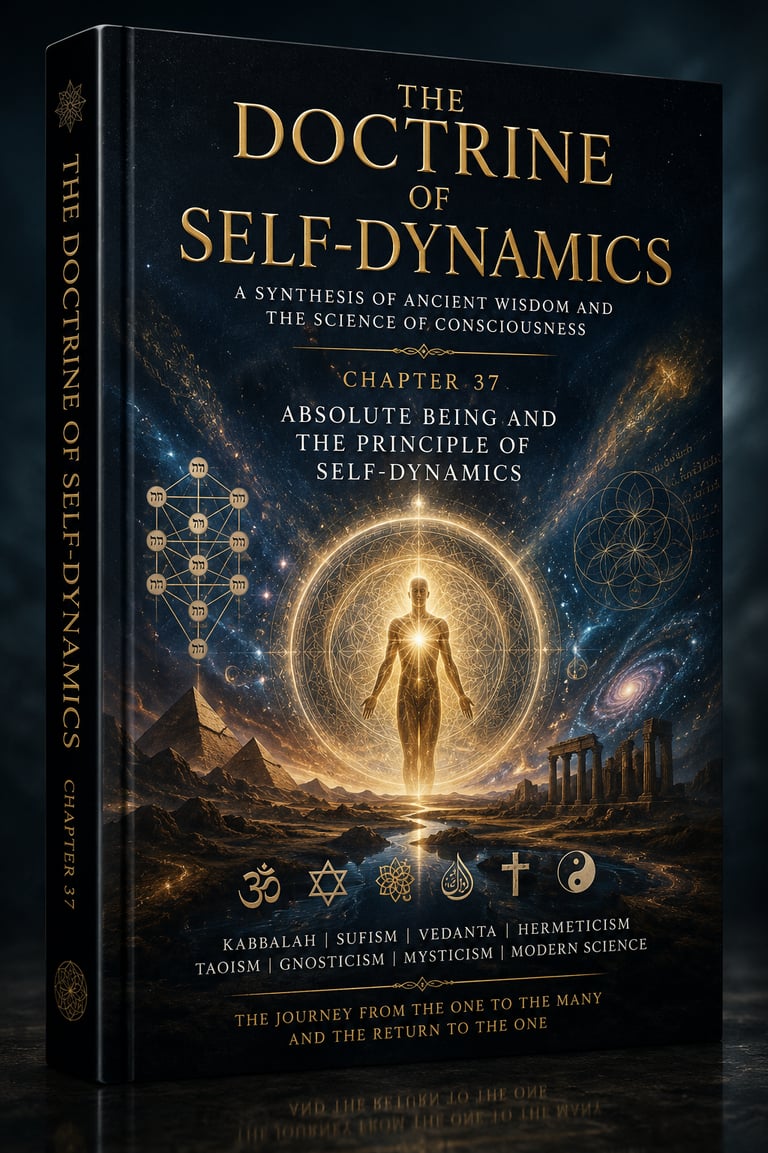
THE DOCTRINE OF SELF-DYNAMICS CHAPTER 37: ABSOLUTE BEING AND THE PRINCIPLE OF SELF-DYNAMICS
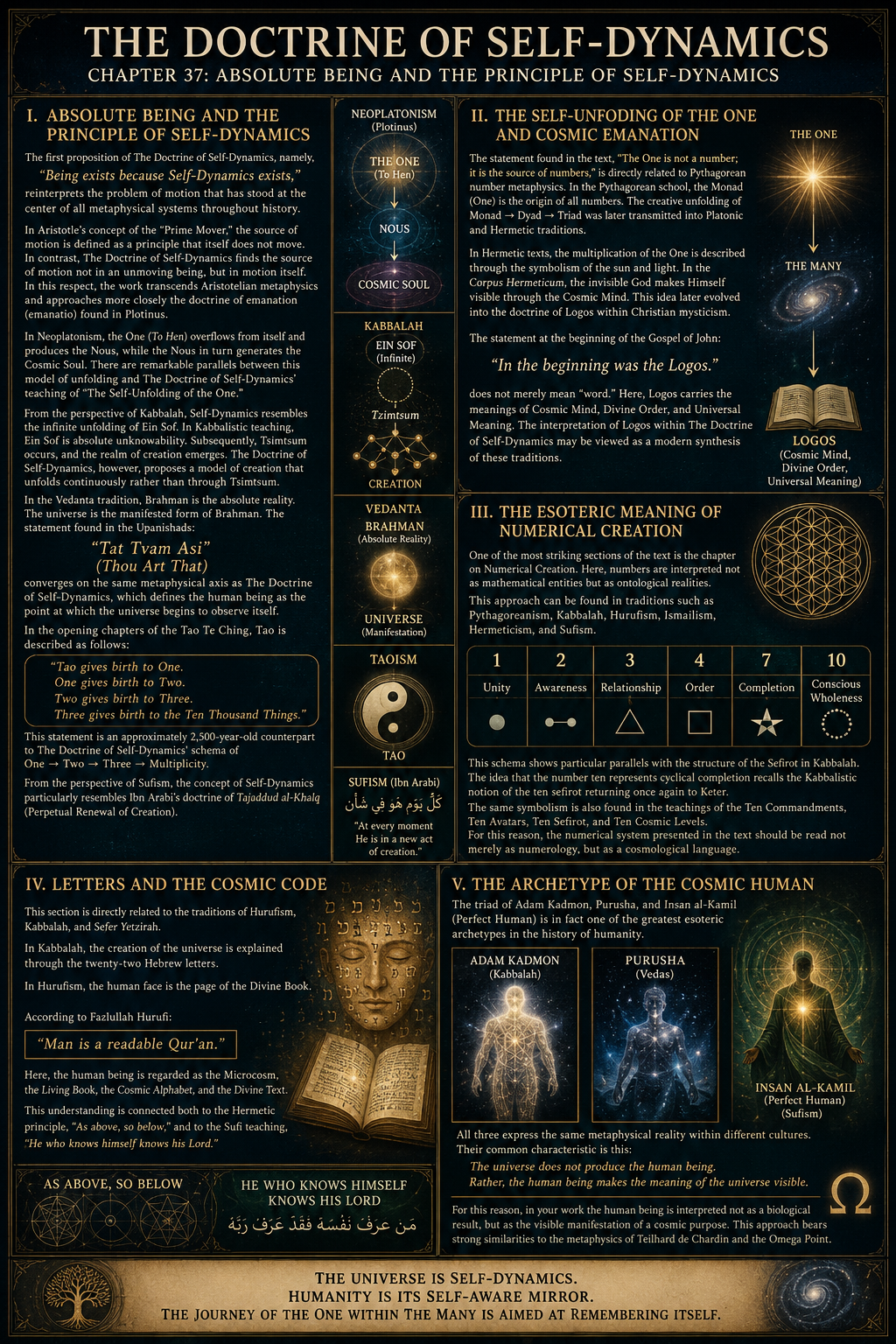
I. ABSOLUTE BEING AND THE PRINCIPLE OF SELF-DYNAMICS
The first proposition of The Doctrine of Self-Dynamics, namely, “Being exists because Self-Dynamics exists,” reinterprets the problem of motion that has stood at the center of all metaphysical systems throughout history.
In Aristotle’s concept of the “Prime Mover,” the source of motion is defined as a principle that itself does not move. In contrast, The Doctrine of Self-Dynamics finds the source of motion not in an unmoving being, but in motion itself. In this respect, the work transcends Aristotelian metaphysics and approaches more closely the doctrine of emanation (emanatio) found in Plotinus.
In Neoplatonism, the One (To Hen) overflows from itself and produces the Nous, while the Nous in turn generates the Cosmic Soul. There are remarkable parallels between this model of unfolding and The Doctrine of Self-Dynamics' teaching of “The Self-Unfolding of the One.”
From the perspective of Kabbalah, Self-Dynamics resembles the infinite unfolding of Ein Sof. In Kabbalistic teaching, Ein Sof is absolute unknowability. Subsequently, Tsimtsum occurs, and the realm of creation emerges. The Doctrine of Self-Dynamics, however, proposes a model of creation that unfolds continuously rather than through Tsimtsum.
In the Vedanta tradition, Brahman is the absolute reality. The universe is the manifested form of Brahman. The statement found in the Upanishads:
“Tat Tvam Asi”
(Thou Art That)
converges on the same metaphysical axis as The Doctrine of Self-Dynamics, which defines the human being as the point at which the universe begins to observe itself.
In the opening chapters of the Tao Te Ching, Tao is described as follows:
“Tao gives birth to One.
One gives birth to Two.
Two gives birth to Three.
Three gives birth to the Ten Thousand Things.”
This statement is an approximately 2,500-year-old counterpart to The Doctrine of Self-Dynamics’ schema of One → Two → Three → Multiplicity.
From the perspective of Sufism, the concept of Self-Dynamics particularly resembles Ibn Arabi’s doctrine of Tajaddud al-Khalq (Perpetual Renewal of Creation).
The Qur’anic verse:
“Kulle yevmin huve fî şe'n”
(At every moment He is in a new act of creation)
also supports the same metaphysical understanding through its esoteric interpretation.
At this point, The Doctrine of Self-Dynamics transforms creation from a historical event into an ongoing ontological process.
II. THE SELF-UNFOLDING OF THE ONE AND COSMIC EMANATION
The statement found in the text, “The One is not a number; it is the source of numbers,” is directly related to Pythagorean number metaphysics. In the Pythagorean school, the Monad (One) is the origin of all numbers. The creative unfolding of Monad → Dyad → Triad was later transmitted into Platonic and Hermetic traditions.
In Hermetic texts, the multiplication of the One is described through the symbolism of the sun and light. In the Corpus Hermeticum, the invisible God makes Himself visible through the Cosmic Mind. This idea later evolved into the doctrine of Logos within Christian mysticism.
The statement at the beginning of the Gospel of John:
“In the beginning was the Logos.”
does not merely mean “word.” Here, Logos carries the meanings of Cosmic Mind, Divine Order, and Universal Meaning. The interpretation of Logos within The Doctrine of Self-Dynamics may be viewed as a modern synthesis of these traditions.
III. THE ESOTERIC MEANING OF NUMERICAL CREATION
One of the most striking sections of the text is the chapter on Numerical Creation. Here, numbers are interpreted not as mathematical entities but as ontological realities.
This approach can be found in traditions such as Pythagoreanism, Kabbalah, Hurufism, Ismailism, Hermeticism, and Sufism.
The schema:
1 = Unity
2 = Awareness
3 = Relationship
4 = Order
7 = Completion
10 = Conscious Wholeness
shows particular parallels with the structure of the Sefirot in Kabbalah.
The idea that the number ten represents cyclical completion recalls the Kabbalistic notion of the ten sefirot returning once again to Keter.
The same symbolism is also found in the teachings of the Ten Commandments, Ten Avatars, Ten Sefirot, and Ten Cosmic Levels.
For this reason, the numerical system presented in the text should be read not merely as numerology, but as a cosmological language.
IV. LETTERS AND THE COSMIC CODE
This section is directly related to the traditions of Hurufism, Kabbalah, and Sefer Yetzirah.
In Kabbalah, the creation of the universe is explained through the twenty-two Hebrew letters. In Hurufism, the human face is the page of the Divine Book.
According to Fazlullah Hurufi:
“Man is a readable Qur’an.”
Here, the human being is regarded as the Microcosm, the Living Book, the Cosmic Alphabet, and the Divine Text.
This understanding is connected both to the Hermetic principle, “As above, so below,” and to the Sufi teaching, “He who knows himself knows his Lord.”
V. THE ARCHETYPE OF THE COSMIC HUMAN
The triad of Adam Kadmon, Purusha, and Insan al-Kamil (Perfect Human) is in fact one of the greatest esoteric archetypes in the history of humanity.
Adam Kadmon: The Cosmic Human of Kabbalah.
Purusha: The Cosmic Human of the Vedas.
Insan al-Kamil: The Cosmic Human of Sufism.
All three express the same metaphysical reality within different cultures.
Their common characteristic is this:
The universe does not produce the human being.
Rather, the human being makes the meaning of the universe visible.
For this reason, in your work the human being is interpreted not as a biological result, but as the visible manifestation of a cosmic purpose.
This approach bears strong similarities to the metaphysical systems of Ibn Arabi, Abd al-Karim al-Jili, and Sadr al-Din al-Qunawi.
VI. THE NATURE OF CONSCIOUSNESS AND COSMIC AWARENESS
One of the most radical propositions of The Doctrine of Self-Dynamics is that consciousness is not the result of the universe, but the cause of the universe. This proposition directly conflicts with the modern materialist paradigm. While modern science generally accepts consciousness as a phenomenon arising from the complex activities of the brain, The Doctrine of Self-Dynamics treats consciousness as an ontological principle.
This approach is not found only in Sufism or mystical traditions. Similar ideas have also begun to emerge in certain interpretations of modern physics. In particular, the quantum observer problem has reopened discussion concerning the role of consciousness in reality.
In the teaching of Vedanta, consciousness is not a product of the universe. Atman (the true self) and Brahman (absolute reality) are essentially one. When a person discovers his own essence, he is in fact discovering the fundamental reality of the universe.
In the deeper interpretations of Sufism, consciousness is not regarded as the final link of creation, but as the most intense manifestation of Divine self-disclosure.
In the teaching of Ibn Arabi, the human being is the ayn al-jamʿ, that is, the center in which all Divine Names are gathered.
Therefore, consciousness is not merely seeing.
Consciousness is:
the ability to see the one who sees.
the ability to know the one who knows.
the ability to think about thought itself.
It is here that The Doctrine of Self-Dynamics’ teaching of the “First Consciousness” emerges.
The First Consciousness is not yet individual.
It is not yet ego.
It is not yet human.
The First Consciousness is absolute self-awareness.
Here, the distinction between subject and object has not yet arisen.
The knower and the known have not yet been divided into two.
This state has been described as:
Turiya in Vedanta,
Ain in Kabbalah,
Ahadiyyah in Sufism,
and the One in Plotinus.
The ultimate goal of all mystical traditions is, in fact, a movement of return to this First Consciousness.
VII. THE WORLD OF IMAGINAL FORMS AND THE UNIVERSE OF SYMBOLS
In the teachings of Sadr al-Din Qunawi and Muhyiddin Ibn Arabi, the Alam al-Mithal (World of Imaginal Forms) occupies an extremely central place. This realm is neither completely material nor completely spiritual. It is an intermediate region. It is the Barzakh.
When Carl Gustav Jung’s theory of the collective unconscious is examined, the modern psychological equivalent of this realm can be observed.
Dreams are formed here.
Myths are born here.
Archetypes take shape here.
The visions of ancient prophets appear here.
The sacred symbols of esoteric traditions emerge here.
For this reason, a symbol is not merely a representation.
A symbol is a passage.
A doorway.
An interface between the visible and the invisible.
The priests of Egypt used the pyramid.
The Hindus used the mandala.
The Buddhists used the lotus symbol.
Kabbalah used the Tree of Life.
Sufism used the symbol of the heart.
For the symbol enables intuition to transcend the boundary that reason cannot cross.
The teaching of the Cosmic Alphabet in The Doctrine of Self-Dynamics is based upon the same principle.
The universe is a readable text.
Galaxies are sentences.
Stars are words.
The human being is both the reader and the text.
VIII. THE INNER APOCALYPSE AND ESOTERIC RESURRECTION
In esoteric traditions, the apocalypse has often been misunderstood. It has been interpreted as a cosmic catastrophe that will occur externally.
However, in the deeper interpretations of Sufism, the apocalypse takes place within the human being.
This is the transformation experienced by Hallaj.
This is the transformation experienced by Mawlana Rumi.
These are the ecstatic states of Bayazid al-Bistami.
This is Jung’s process of individuation.
This is the Nigredo stage of alchemy.
When the Inner Apocalypse occurs, false identities collapse.
The ego ceases to be the center.
For the first time, the individual begins to observe himself.
This stage is often painful.
For the human being is losing the structures that he believed himself to be for many years.
Sufism has called this Fana.
Fana is not annihilation.
Fana is the death of the false self.
Thereafter comes Baqa.
That is, the birth of the true self.
This process is also similar to the concept of the second birth in Christian mysticism.
The expression found in the Gospel:
“Unless one is born again”
describes, in esoteric traditions, not a physical birth but a birth of consciousness.
The teaching of the Inner Apocalypse in The Doctrine of Self-Dynamics is the contemporary form of this universal model of transformation.
IX. THE ARCHETYPE OF IBLIS AND COSMIC SEPARATION
Here, Iblis is not a historical being but a state of consciousness.
This approach is particularly compatible with Jung’s Shadow Theory.
Iblis is:
a part imagining itself to be the whole.
a thought imagining itself to be absolute truth.
an identity proclaiming itself to be the universal center.
Sufism has called this arrogance.
Buddhism has called it ignorance.
The Gnostics have called it forgetfulness.
The Hermetic tradition has called it the principle of separation.
All of them describe the same reality.
The human being has forgotten his essence.
That is Iblis.
Therefore, the opposite of Iblis is not the angel.
The opposite of Iblis is unity.
When a person confronts his shadow, Iblis begins to dissolve.
When he recognizes his own darkness, transformation begins.
When he accepts his shortcomings, the ego begins to diminish.
For this reason, the true jihad is not against the outside world, but against the separation within.
X. THE GREATER JIHAD AND THE FINAL AGE OF IGNORANCE
The teaching of the Final Age of Ignorance in The Doctrine of Self-Dynamics explains the crisis of modern humanity.
In ancient times, human beings possessed little knowledge.
In the modern age, knowledge has become limitless.
Yet wisdom has been lost.
Data has increased.
Meaning has diminished.
Connection has increased.
Inner closeness has diminished.
People know more things.
Yet they know less about why they live.
This is the Final Age of Ignorance.
Not lack of information.
But lack of meaning.
It is the condition that Sufism calls ghaflah (heedlessness).
The condition that Buddhism calls avidya (ignorance).
The condition that the Gnostics call sleep.
The teaching of the Final Age of Ignorance in The Doctrine of Self-Dynamics is the modern name for this universal crisis of humanity.
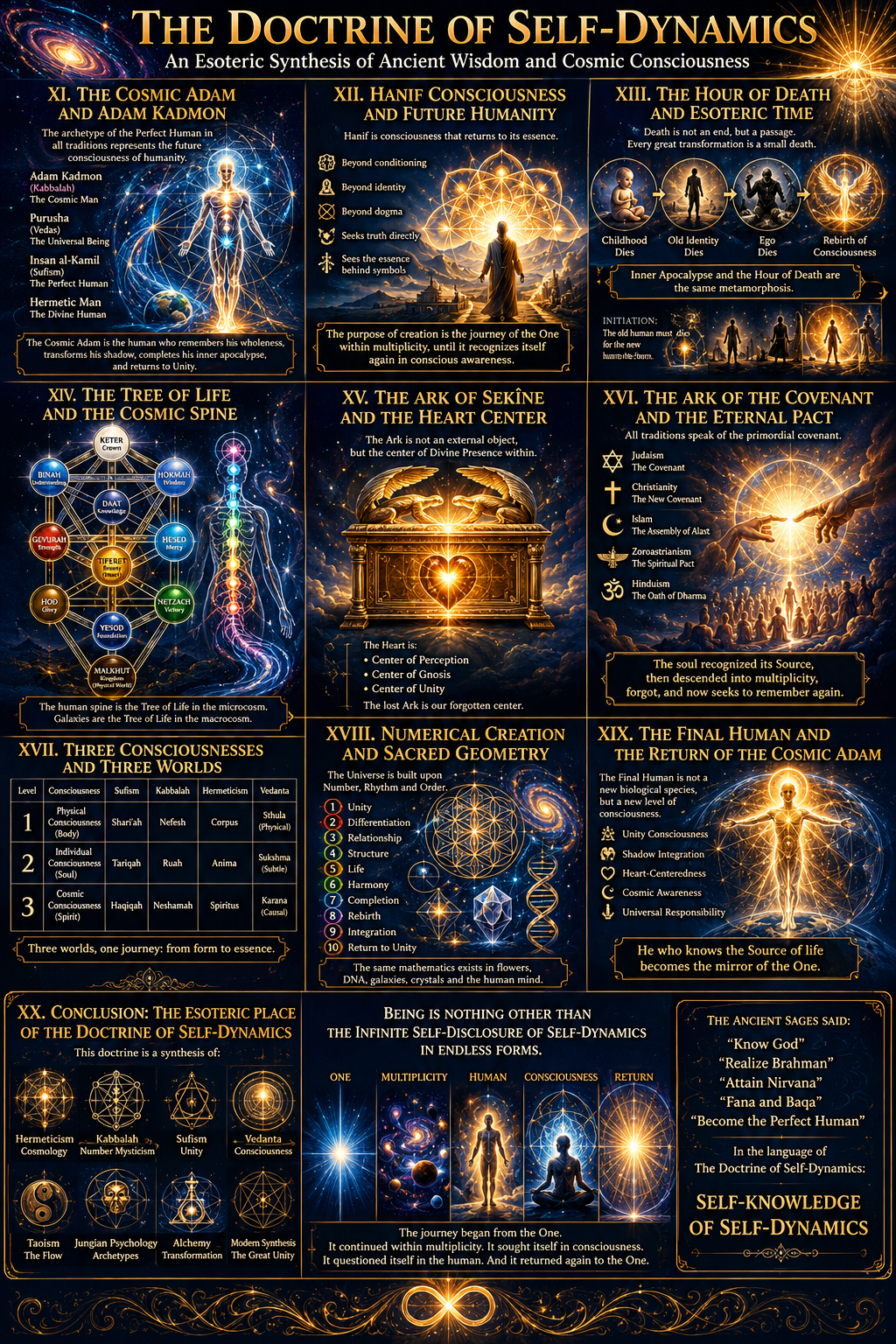
XI. THE COSMIC ADAM AND ADAM KADMON
Adam Kadmon is not merely a figure of Kabbalah. He is the common archetype of humanity. In the Vedas, he appears as Purusha. In Sufism, he appears as the Perfect Human (Insan al-Kamil). In the Hermetic tradition, he appears as the Cosmic Human. This figure actually represents the level of consciousness that humanity will attain in the future.
The Cosmic Adam is the human being who has remembered his wholeness.
The human being who has transformed his shadow.
The human being who has completed his Inner Apocalypse.
The human being who has returned to Unity.
For this reason, the doctrine of the Final Human describes not biological evolution, but the evolution of consciousness.
Nietzsche’s concept of the Übermensch, Teilhard de Chardin’s Omega Point, Sri Aurobindo’s Supramental Human model, and the doctrine of the Perfect Human are all different expressions of the same cosmic transformation.
XII. HANIF CONSCIOUSNESS AND FUTURE HUMANITY
Historically, the concept of Hanif means a person who turns toward truth. On the esoteric level, however, Hanif is consciousness returning to its essence.
Consciousness that has transcended conditioning.
Consciousness that has transcended identities.
Consciousness that has transcended dogmas.
Consciousness that directly seeks truth.
For this reason, Hanif Consciousness is the human model of the future.
This consciousness is not beyond religions.
It is not anti-religious.
On the contrary, it is capable of comprehending the essence of all traditions.
For Hanif Consciousness has begun to perceive the truth behind the symbols.
And it is here that the ultimate purpose of The Doctrine of Self-Dynamics becomes apparent:
The transition of humanity into a new stage of consciousness.
The human being remembering himself once again.
The completion of the journey of the One within multiplicity.
For in the beginning there was Self-Dynamics.
The journey began with Self-Dynamics.
And at the end of all creation, Self-Dynamics will once again recognize itself within its own consciousness.
The mystery described by ancient traditions as “Return,” “Rujuʿ,” “Homecoming,” “Omega,” “Nirvana,” “Fana-Baqa,” and “Salvation” is, in reality, nothing more than the echo of the same truth expressed in different languages.
XIII. THE HOUR OF DEATH AND ESOTERIC TIME
One of the most striking concepts of The Doctrine of Self-Dynamics is the teaching of the Hour of Death.
Throughout human history, death has generally been regarded as the opposite of life.
Yet the vast majority of ancient esoteric traditions have interpreted death not as an end, but as a transition.
In the Egyptian Book of the Dead, death is a doorway.
In the Tibetan teaching of Bardo Thödol, death is an intermediate state of consciousness.
In Sufism, death is Shab-i Arus, the Wedding Night.
In the Hermetic tradition, death is a necessary stage of transformation.
The Doctrine of Self-Dynamics approaches the common center of these ancient understandings.
For death is not annihilation.
It is a change of form.
Energy is conserved.
Matter transforms.
Consciousness also transforms.
Why, then, should death be an exception?
Here, the “Hour of Death” does not merely refer to the moment of biological death.
It refers to all the thresholds of consciousness that a human being experiences throughout life.
The death of childhood.
The death of youth.
The death of an old identity.
The death of old beliefs.
The death of the ego.
Every great transformation is, in reality, a small death.
For this reason, initiation rites in esoteric traditions begin with symbolic death.
For the old human cannot give birth to the new human until he dies.
The Inner Apocalypse and the Hour of Death are two different manifestations of the same metaphysical process.
XIV. THE TREE OF LIFE AND THE COSMIC SPINE
One of the greatest symbols of Kabbalah is the Tree of Life.
The system of the Sefirot is not merely a mystical diagram.
It is a map of consciousness.
A model of cosmic creation.
A map of the inner structure of the human being.
From the perspective of The Doctrine of Self-Dynamics, the Tree of Life may be read as the unfolding schema of Self-Dynamics.
Keter: Absolute Unity.
Hokmah: The First Unfolding.
Binah: The First Awareness.
Tiferet: The Cosmic Heart.
Yesod: The Realm of Formation.
Malkhut: The Visible Universe.
This structure displays remarkable similarities with the Vedic chakra systems.
The ascent described in the Kundalini teaching and the ascent described in the doctrine of the Sefirot are narratives of the same metaphysical journey expressed through different cultures.
The human spine is the Tree of Life within the microcosm.
Galaxies are the Tree of Life within the macrocosm.
Consciousness is the invisible sap flowing through this tree.
XV. THE ARK OF SEKINE (SHEKINAH-SPENTA ARMAITI-HOLY SPIRIT) AND THE HEART CENTER
In both the Qur’an and the ancient Hebrew traditions, the Ark of the Covenant occupies a profoundly central place.
On a superficial reading, this ark appears to be a historical object.
Esoteric interpretations, however, are different.
The Ark is the carrier of the Divine Presence.
The symbol of the inner center.
The symbol of the heart.
In Sufism, the heart is not merely a biological organ.
The heart is the center of perception.
The center of gnosis.
The center of unity.
In the system of Ibn Arabi, the heart is the field in which the Divine Names manifest.
For this reason, the Ark of Sekine (Shekinah-Spenta Armaiti-Holy Spirit) is the center that the human being carries within himself.
As long as he seeks it outside himself, he cannot find it.
For the Ark has not been lost.
The human being has forgotten his own center.
XVI. THE ARK OF THE COVENANT AND THE ETERNAL PACT
All ancient religions contain the motif of a covenant.
In Judaism: the Covenant.
In Christianity: the New Covenant.
In Islam: the Assembly of Alast.
In Zoroastrianism: the Spiritual Pact.
In the Indian traditions: the Oath of Dharma.
This shared symbol points toward an ancient metaphysical intuition residing within the collective memory of humanity.
In Sufism, the statement:
“Alastu bi Rabbikum”
is not merely a historical event.
It describes a state of consciousness before time.
The soul recognized its source.
Then it descended into multiplicity.
Then it forgot.
Then it began attempting to remember once more.
The entire structure of The Doctrine of Self-Dynamics is, in fact, a modern narration of this cycle of forgetting and remembering.
XVII. THREE CONSCIOUSNESSES AND THREE WORLDS
The doctrine of the Three Consciousnesses presented in the text is highly remarkable.
This system finds correspondence in many traditions.
First Consciousness: Physical Consciousness.
Second Consciousness: Individual Consciousness.
Third Consciousness: Cosmic Consciousness.
This tripartite structure appears as:
Shari‘ah–Tariqah–Haqiqah in Sufism.
Nefesh–Ruah–Neshamah in Kabbalah.
Corpus–Anima–Spiritus in Hermeticism.
Sthula–Sukshma–Karana in Vedanta.
Although humanity’s great esoteric traditions appear independent from one another, they describe the same map of consciousness under different names.
XVIII. NUMERICAL CREATION AND SACRED GEOMETRY
Pythagoras’ statement, “Everything is number,” has often been misunderstood.
Pythagoras was speaking not of quantity, but of order.
For this reason, the doctrine of Numerical Creation within The Doctrine of Self-Dynamics may be read as a modern continuation of Pythagoreanism.
One: Absolute Potential.
Two: Differentiation.
Three: Relationship.
Four: Structure.
Five: Life.
Six: Harmony.
Seven: Completion.
Eight: Rebirth.
Nine: Integration.
Ten: Return to Unity.
This structure is also the foundation of sacred geometry.
The same mathematical consciousness can be observed:
in the petals of flowers,
in the spiral of DNA,
in the rotation of galaxies,
in the formation of crystals.
XIX. THE FINAL HUMAN AND THE RETURN OF THE COSMIC ADAM
The concept of the Final Human appears in many traditions.
Nietzsche: The Overman.
Teilhard de Chardin: The Omega Human.
Sri Aurobindo: The Supramental Human.
Sufism: The Perfect Human.
Kabbalah: The Re-Manifestation of Adam Kadmon.
The Doctrine of Self-Dynamics: The Human of Self-Dynamics.
This figure is not a biologically different species.
It is a different level of consciousness.
Its fundamental characteristics are:
Unity Consciousness.
Shadow Integration.
Heart-Centeredness.
Cosmic Awareness.
Universal Responsibility.
Thus, the human being becomes not merely one who lives, nor merely one who knows that he lives, but one who knows the source of life itself.
XX. CONCLUSION: THE ESOTERIC PLACE OF THE DOCTRINE OF SELF-DYNAMICS
When The Doctrine of Self-Dynamics is examined, it becomes clear that it is not merely a new metaphysical system.
This doctrine brings together:
the cosmology of Hermeticism,
the numerical metaphysics of Kabbalah,
the doctrine of unity in Sufism,
the metaphysics of consciousness in Vedanta,
the doctrine of flow in Taoism,
Jung’s archetypal psychology,
and the transformational model of alchemy,
under a modern synthesis.
In this respect, the work presents itself not merely as a philosophical system, but also as an esoteric claim to a “Grand Unified Theory.”
Its central idea may be summarized in a single sentence:
Being is nothing other than the infinite self-disclosure of Self-Dynamics in endless forms.
The human being is the mirror within this unfolding that has begun to remember its own source.
The journey began from the One.
It continued within multiplicity.
It sought itself within consciousness.
It questioned itself within the human being.
And ultimately it returned once again to the One.
The mystery described by the ancient sages as “Knowing God,” “Realizing Brahman,” “Attaining Nirvana,” “Fana and Baqa,” and “Becoming the Perfect Human” may, in the language of The Doctrine of Self-Dynamics, be summarized as follows:
The Self-Knowledge of Self-Dynamics.