THE DOCTRINE OF SELF-DYNAMICS CHAPTER 38: REMEMBRANCE OF THE ESSENCE
THE DOCTRINE OF SELF-DYNAMICS CHAPTER 38: REMEMBRANCE OF THE ESSENCE. Abraham’s journey is the journey of the human being moving from the enchantment of visible things toward the perception of invisible truth. Although the light of the star, the brightness of the moon, and the splendor of the sun..
ÖZ-DEVİNİM KURAMI
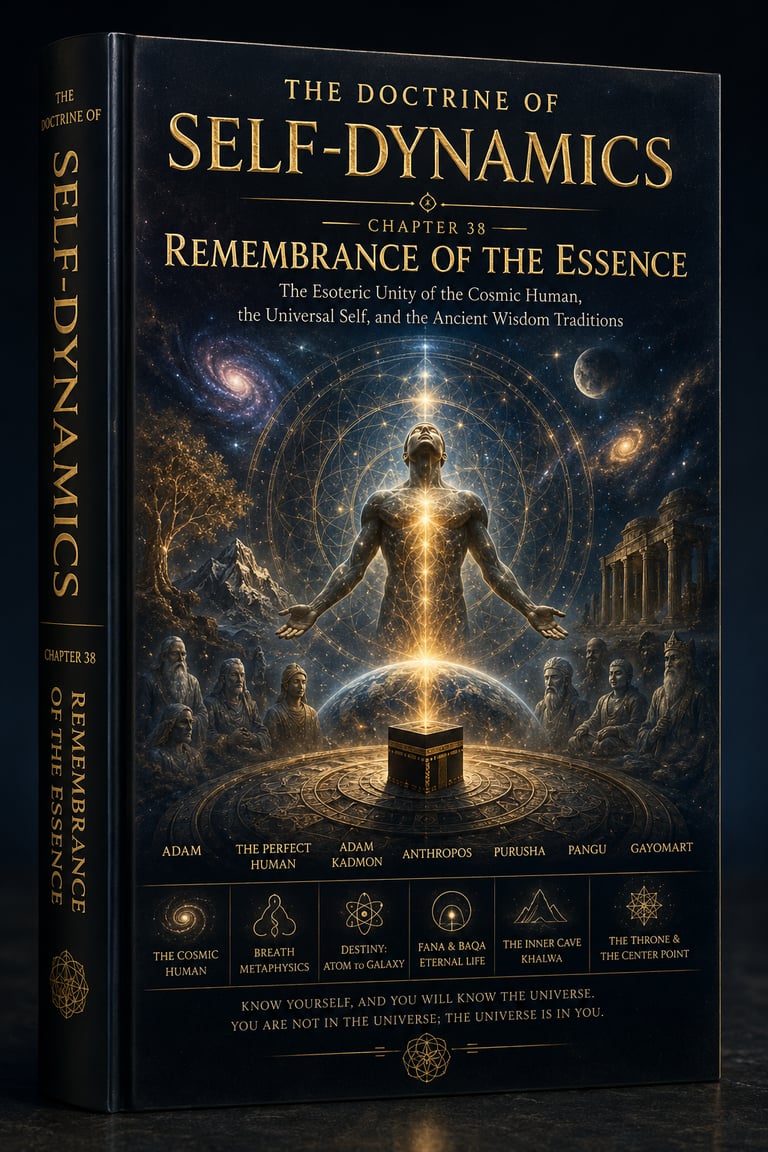
THE DOCTRINE OF SELF-DYNAMICS
CHAPTER 38: REMEMBRANCE OF THE ESSENCE
The Esoteric Unity of the Cosmic Human, the Universal Self, and the Ancient Wisdom Traditions
THE COSMIC HUMAN AND THE UNIVERSAL SELF: THE ESOTERIC JOURNEY OF THE PRIMORDIAL HUMAN ARCHETYPE
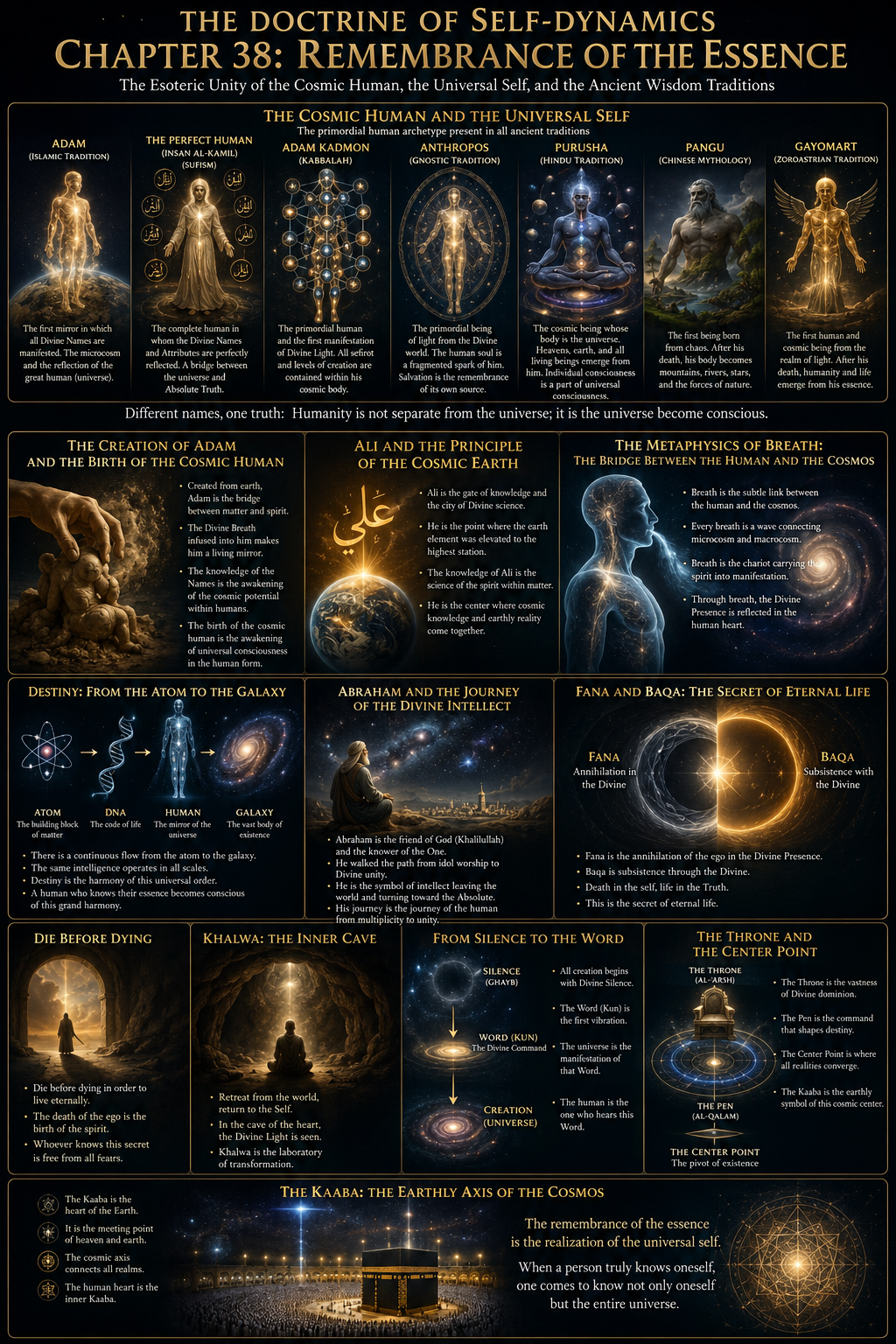
One of the oldest esoteric symbols in human history is the idea of the “Cosmic Human.” This ancient teaching, which emerged in different geographies, different cultures, and different religious traditions, explains that the human being is not merely a biological entity; rather, the essence, order, and meaning of the universe are symbolized in human form. The Cosmic Human is a model of universal consciousness that carries the entirety of existence within itself, beyond the individual human being. Therefore, in many traditions, the first human is not merely a being who lived in history, but a metaphysical archetype representing creation itself.
In the Islamic tradition, Adam is not merely the first human being. In esoteric interpretations, Adam is the first mirror in which all Divine Names are manifested. All the mysteries of existence are gathered within him. For this reason, while the human being is defined as the “microcosm,” the universe is seen as the “great human.” The creation of Adam is, in fact, the manifestation of universal consciousness into visibility. For a human being to know his essence means to rediscover the Adamic truth.
In Sufism, this understanding reaches its highest point through the concept of the Perfect Human (Insan al-Kamil). The Perfect Human is the complete human in whom the Divine Names and Attributes are perfectly reflected. He is like a bridge between the universe and Absolute Truth. The cosmic order becomes visible within him. The Perfect Human is not merely an individual but a symbol of the highest level of consciousness that humanity can attain. In this understanding, the human being is a conscious mirror standing at the center of the universe.
In Kabbalah, the Jewish mystical tradition, Adam Kadmon is the primordial human at the beginning of creation. He is not a physical being but the first manifestation of the infinite Divine Light. All the sefirot and levels of creation are contained within his cosmic body. Adam Kadmon is accepted as the Divine blueprint existing before the universe was created. The human being is a small reflection of this great cosmic model. One who knows oneself approaches the structure of Adam Kadmon and therefore the mysteries of the universe.
In Gnostic traditions, the primordial human called Anthropos is the being of light of the Divine world. Existing before the emergence of the material world, this cosmic human is the symbol of Divine wholeness. The human soul is regarded as a fragmented spark of him. Salvation is the remembrance of its own source by this fragment. Anthropos represents humanity’s forgotten celestial identity.
In the Hindu tradition, Purusha is the cosmic being encompassing the entire universe. Ancient texts describe how the heavens, the earth, living beings, and social order emerged from the body of Purusha. The universe is the unfolding of his body. The human being is like a cell within Purusha. Individual consciousness is a part of universal consciousness. Therefore, one who knows one's essence realizes unity with Purusha.
In Chinese mythology, Pangu is the first being born from chaos. Heaven and earth are separated through him. After his death, parts of his body transform into mountains, rivers, stars, and the forces of nature. This narrative is the Chinese expression of the idea that the universe emerged from the body of a cosmic human. The connection between humanity and the universe is symbolized in the body of Pangu.
In the Zoroastrian tradition, Gayomart is regarded as the first human and the first cosmic being. He is a pure being originating from the realm of light. After his death, humanity and life emerge from his essence. The body of Gayomart becomes the source of cosmic transformation. Thus, humanity is seen as the continuation of a primordial cosmic being. In this understanding, every human carries the essence of Gayomart.
A remarkable common theme emerges in all of these different traditions. The first human is not merely a biological starting point. He is a universal archetype representing the unity between the essence of the universe and the essence of humanity. Although the names Adam, the Perfect Human, Adam Kadmon, Anthropos, Purusha, Pangu, and Gayomart differ, the center to which they point is the same: Humanity is not separate from the universe; it is the universe become conscious.
From an esoteric perspective, the Cosmic Human is less a figure standing at the beginning of creation and more the universal self hidden within every human being. As a person begins to transcend their limited personality, they may perceive the greater being behind the individual self. This greater being is the Cosmic Human described by all traditions under different names.
Ultimately, all ancient teachings express the same secret in different languages: The human being is not an entity living within the universe; the universe is the greater body of the human being. The teaching of the Cosmic Human aims to enable humanity to see itself not merely as an individual but as a living part of all existence. The remembrance of the essence is precisely the renewed awareness of this universal self. For when a person truly knows oneself, one comes to know not only oneself but the entire universe.
THE CREATION OF ADAM FROM EARTH AND THE BIRTH OF THE COSMIC HUMAN
Adam, created from earth, is not merely the beginning of biological humanity; he is the entry of the Cosmic Human into the visible universe. For in many esoteric traditions, the creation of humanity has been interpreted not merely as the formation of a body but as the manifestation of universal consciousness within matter. Therefore, earth is not merely a substance composed of physical elements; it is the appearance of the Infinite in finite form.
In Islamic Sufism, the teaching of all names to Adam demonstrates that humanity carries the essential knowledge of the universe. For this reason, the human being is not merely a created entity but a living mirror carrying within itself the meaning of creation. Every element found within the human body has been regarded as a small-scale reflection of the cosmic order. This understanding demonstrates that humanity is not separate from the universe but rather its conscious form.
A similar structure appears in the doctrine of Adam Kadmon in Kabbalah. Adam Kadmon is the model of the cosmic human existing before creation. All the sefirot are contained within his cosmic body. The visible universe emerges through the gradual condensation of this primordial human. Thus, the creation of humanity means not the appearance of a later component of the universe but the manifestation of a cosmic plan existing from the very beginning.
In Gnostic traditions, the primordial human called Anthropos assumes a similar role. Anthropos is the body of light of the celestial world. When the material universe emerges, his light is divided into different layers. The human soul carries fragments of this light. Therefore, humanity’s task is not to acquire something new but to remember the forgotten primordial wholeness.
In Indian metaphysics, the emergence of the universe is described through the sacrifice of Purusha. The body of Purusha transforms into the heavens, the earth, the stars, and living beings. Here, the body is the source of the cosmic order. The resemblance between the human body and the universe is therefore not a coincidence but a kinship arising from the same essence. When a person knows oneself, one also comes to know the cosmic body of Purusha.
In the Chinese tradition, the body of Pangu transforms after his death into mountains, rivers, clouds, and stars. This narrative likewise expresses the idea that the universe emerged from the body of a cosmic human. Similarly, in Iranian metaphysics, the body of Gayomart becomes the source of humanity and life. Thus, nature and humanity are viewed as different manifestations of the same cosmic body.
The Hermetic tradition expresses this understanding through the principle: “As above, so below.” The cosmos and the human being are reflections of one another. The human body is a living map carrying the order of the stars and planets. For this reason, the alchemists of antiquity regarded the transformation of the human being and the transformation of the universe as the same process.
Hurufism explained this understanding of the cosmic human through letters. The human face was seen as the opened page of the Divine Book; the forehead, eyes, eyebrows, and lips were interpreted as visible forms of sacred letters. Thus, the body became not merely a structure of flesh and bone but a revealed text awaiting to be read.
When all these teachings are considered together, it becomes apparent that the narrative of Adam’s creation from earth is actually describing the birth of the Cosmic Human. Here, earth is not merely an element; it is the final point of condensation where Divine consciousness becomes visible. Humanity is the most developed mirror of this condensation.
Therefore, the common language of the esoteric traditions says the following:
Adam was not created from earth; rather, truth became visible as Adam within the earth.
Humanity was not formed from matter; rather, light assumed human form within matter.
And the Cosmic Human is not a being standing in the middle of the universe; it is the universe having become aware of itself.
ALI AND THE PRINCIPLE OF COSMIC EARTH
In esoteric traditions, the concept of “father” often refers not to a biological origin but to the source of a principle. Therefore, the expression “Father of Earth” does not describe the creator of physical soil but the bearer of the metaphysical truth represented by earth. Here, earth is not merely a physical element but a cosmic symbol representing the transformation of invisible truth into visible form.
From this perspective, Ali is interpreted not merely as a historical figure but as an archetype representing the manifestation of Divine knowledge in human form. Just as the Perfect Human gathers all Divine Names within himself, the figure of Ali becomes a symbol of light becoming visible within matter. Thus, the expression “Father of Earth” transforms into a metaphysical title describing the manifestation of the Divine meaning hidden within the earth.
This symbolism appears not only in Islamic esotericism but also in many traditions under different names. Adam Kadmon of Kabbalah, Anthropos of Hermeticism, Purusha of Hinduism, Gayomart of the Zoroastrian tradition, and Pangu of Chinese mythology may all be seen as different manifestations of the same archetype. In all of them, the common theme is this: the universe is the visible manifestation of a primordial human model.
Within this framework, Ali may be understood within the Islamic symbolism of the Cosmic Human. Just as Adam Kadmon is regarded as the first manifestation of Divine Light in human form, the Perfect Human is considered the most complete mirror of the Divine Names. Thus, a symbolic bridge is established between the historical personality and the cosmic principle.
In this system, earth represents not a fall but manifestation. For in esoteric thought, matter is not a separation from truth but its condensation. As light passes from the invisible state into the visible state, it traverses various levels and ultimately appears as matter. Earth is the final link in this process. Therefore, earth is not insignificant; on the contrary, it is the most concentrated manifestation of the Divine mystery.
In Hurufi interpretations, the understanding that the human face is a book composed of letters is a continuation of the same perspective. The human being is a text waiting to be read. The lines of the face, the proportions of the body, and the consciousness within existence carry the hidden geometry of creation. Therefore, to read the human being is to read the cosmic order.
Viewed in this way, the expression “Ali, Father of Earth” ceases to be a description of biological origin and acquires the following metaphysical meaning: The Divine mystery visible within the human body is the manifestation of the light hidden within the earth. Ali is one of the symbolic keys to this manifestation.
Ultimately, all teachings of the Cosmic Human converge at the same point: Humanity is not merely a being made of earth. Humanity is the visible form of universal truth. Earth is the final veil of light. The human being is a living text written upon that veil. Therefore, to know the human being is to know the universe; to know the universe is to follow the traces of invisible truth. For according to the common teaching of the esoteric traditions, the sought-after mystery is not hidden in the heavens but within human existence itself.
THE METAPHYSICS OF BREATH
The Cosmic Principle of Life Between Ruh, Ruah, Pneuma, and Prana
In most esoteric traditions, breath has not been regarded merely as a mechanism sustaining biological life. Breath has been accepted as the visible sign of invisible life, the movement of the soul within the body, and the first vibration of cosmic existence within the human being. For this reason, in many ancient languages of the world, the concepts of spirit, breath, wind, and life derive from the same root. When a human being breathes, one does not merely inhale air; one also participates in the universal flow of life.
At the moment of birth, a person takes the first breath, and at the moment of death, one releases the final breath. Therefore, breath has been regarded as the invisible bridge between life and death. All bodily functions may cease, but when breath stops, the visibility of life within the body comes to an end. For this reason, the ancient sages considered breath to be the touch of the soul upon the body.
The Arabic word Ruh (spirit, essence of life) has been associated with blowing, giving life, and reviving. The narrative of the Divine Spirit being breathed into the human being at creation expresses, in esoteric thought, the connection between the material body and the Divine Source. Here, breath carries a meaning far deeper than biological oxygen exchange. Breath is the beginning of the movement of invisible truth within the visible body.
The Hebrew concept of Ruah (wind, breath, spirit) shares the same symbolic field. According to Jewish mysticism, the Divine Wind moving at the beginning of creation is the first vibration of life. Ruah is not only within the human being but is also the principle of vitality circulating throughout the entire universe. The invisibility of the wind and the perceptibility of its effects became a powerful symbol used to explain the nature of the spirit.
The Greek concept of Pneuma (breath, spirit, life-breath) occupies a central place in Ancient Greek philosophy and the Hermetic tradition. The Stoics believed that the universe is alive and orderly through Pneuma. According to them, everything from the stars to the human body is held together by the same cosmic breath. Human breath is the individual-scale manifestation of the universal Pneuma.
In Indian metaphysics, the concept of Prana (life energy) carries the doctrine of breath to a much broader level. Prana is not merely the air passing through the lungs; it is the cosmic energy nourishing all life. The human body has been regarded as a channel system through which this energy flows. In yoga and meditation practices, regulating the breath has been accepted as a means of transforming not only the body but also the mind and consciousness. For there is a direct connection between breath and thought. When breath becomes calm, the mind also becomes calm; when breath becomes irregular, consciousness becomes scattered.
In the Chinese tradition, the concept of Qi (life energy) assumes a function similar to that of Prana. Qi is the flow of life circulating between heaven and earth. Human breath is one of the movements of this universal energy within the body. Thus, the human being is viewed not merely as an individual organism but as a living center through which cosmic energy continuously circulates.
In Sufism, breath has been regarded as the smallest unit of time. Many Sufis have expressed that the human being is recreated with every breath. For creation is not an event that occurred in the past and ended; it is a Divine activity continuing at every moment. With every inhalation, the human being is born into a new moment; with every exhalation, one leaves the former state behind. Therefore, breath represents the invisible connection between the flow of time and the continuity of creation.
Particularly in the Naqshbandi tradition, the principle of Hush dar Dam (awareness in breath) advises a person to be conscious of every breath. For an unnoticed breath means an unnoticed life. Every unconscious breath has been regarded as a forgotten truth. Every conscious breath, however, is a remembrance that brings the human being closer to one's own essence.
In the metaphysics of Ibn Arabi, creation is explained through the concept of the Divine Breath. Nafas al-Rahman (the Breath of Rahman) is the opening of invisible truth into the visible world. The universe is regarded as the unfolding of this Divine Breath. Thus, all beings become manifestations of a single cosmic breath at different degrees of density. Human breath is a small echo of this great cosmic breath.
In the Hermetic tradition, the universe has often been conceived as a living organism. The movements of the stars, the cycle of the seasons, the tides, and the rhythms of life have been regarded as parts of a great cosmic respiration. The universe is a vast living being that breathes, and the human being is a small rhythm within that great breath.
In shamanic traditions as well, breath has been one of the fundamental tools of spiritual journeying. Shamans believed that through breathing rhythms they could enter different states of consciousness. For breath was accepted as one of the gateways between the visible world and the invisible world.
When all these traditions are considered together, a common principle emerges: Breath is not merely a sign of life; it is life itself. Breath is the transformation of the invisible spirit into visible movement. When a human being breathes, one does not merely keep the body alive; one participates in the deepest rhythm of the universe.
Therefore, breath is not merely air. Breath is invisible life. Breath is cosmic rhythm. Breath is the movement of the soul within the body. Breath is the continual renewal of creation. With every breath, the human being relives the first day of the universe. For according to the common teaching of all esoteric traditions, life did not begin only once; life is recreated with every breath.
DESTINY FROM ATOM TO GALAXY
The Esoteric Unity of Fractal Consciousness, Microcosm, and Macrocosm
One of the oldest metaphysical intuitions in human history is the idea that the same order is repeated throughout all layers of existence. The idea that there is an invisible kinship between the smallest particle and the greatest cosmic structure appears in almost every esoteric tradition of the world. This understanding is summarized by the famous principle of the Hermetic teaching: “As above, so below; as below, so above.” This statement has been regarded not merely as a symbolic analogy but as a metaphysical law connecting all levels of existence to one another.
In modern mathematics, structures called fractals refer to the repetition of a form within its own smaller parts. The branch of a tree resembles the tree itself. The branches of a river are small reflections of the great flow. The patterns of a snowflake reappear within itself. Esoteric traditions expressed this idea thousands of years ago in a different language. According to them, the universe is a living whole that repeats its own order at every scale.
Therefore, the human being is not merely a living creature located within the universe. The human being is the small-scale reflection of the universe. In Sufism, this has been called alam al-saghir (the small world) and alam al-kabir (the great world). The human being is the small world; the universe is the great world. The two are not separate from one another. The secret found in one is also found in the other. When a person knows oneself, one begins to understand the structure of the universe; and when one begins to understand the universe, one discovers the depths of one’s own inner world.
In the metaphysics of Ibn Arabi, the human being is accepted as the summary of all creation. The Divine Names and manifestations scattered throughout the universe are gathered together in the human being. For this reason, the human being is not merely a created entity but a living book that carries the meaning of creation. The human heart has been regarded as a mirror connected to the center of the universe. The order found in the heart and the order found in the cosmos are seen as manifestations of the same source at different scales.
In Kabbalah, this relationship is explained through the Tree of Life. The sefirot represent not only the cosmic structure but also the inner order of the human soul. The Divine flow extending from Keter to Malkhut describes both the process of the creation of the universe and the layers of human consciousness. Thus, a relationship of reflection is established between the outer world and the inner world. The centers within the human soul and the invisible structures of the universe are regarded as parts of the same geometric order.
In the Hermetic tradition, the principle of microcosm and macrocosm becomes even more pronounced. The human body has been associated with planets, elements, and cosmic powers. The head represents the sky, the heart the sun, the breath the wind, and the blood the rivers of life. Therefore, the human being is not merely a product of nature; the human being is nature become conscious. The laws operating within the human body and the laws governing the movements of the stars have been seen as expressions of the same cosmic intelligence at different levels.
In Vedanta, the relationship between Atman (the essential self) and Brahman (universal reality) expresses the same unity. When a person descends into one’s own essence, one reaches universal consciousness. For there is no essential separation between individual consciousness and cosmic consciousness. Just as a drop is not separate from the nature of the ocean, the human being is not separate from universal consciousness. The difference is only a difference of scale.
In Buddhist thought, this relationship is explained through the principle of interdependence. Nothing in the universe exists alone. Everything is connected with everything else. Within a leaf are the sun, the rain, the earth, and the entire universe. Likewise, the whole universe is hidden within the human being. The bond between microcosm and macrocosm is the invisible web of mutual existence.
In Chinese metaphysics, Tao is the universal flow that unites all opposites and all levels. The human body, nature, and the heavens are merely different appearances of the same Tao. Therefore, it has been accepted that there is a fundamental harmony between the flow of energy within the human being and the movement of the stars. When a person lives in harmony with nature, one also lives in harmony with the cosmic order.
Although modern science does not directly confirm esoteric teachings, it shows that the universe possesses an extraordinarily orderly and mathematical structure. The behavior of atoms, the orbits of planets, the distribution of galaxies, and many structures in nature display certain patterns. Research in fractal geometry, chaos theory, and complex systems has revealed that nature produces similar orders at many levels. The idea of unity intuitively expressed by esoteric traditions opens the door to new interpretations in the modern age.
From this perspective, destiny is not merely an individual fate. Destiny is the appearance in human life of the common order operating throughout all layers of the universe. Although there is no exact identity between the movement of an atom and the rotation of a galaxy, both exist within the same universal laws. The human being is not outside this great order.
For this reason, the poet’s expression “the atom is a verse” carries a deep metaphysical meaning. For the atom is not merely a physical structure but is seen as a readable sign of creation. The galaxy is likewise a readable sign. The human heart is also a sign. Breath, thought, and star are different lines of the same great book.
Therefore, when a person begins to know oneself, one does not merely discover one’s own psychology. At the same time, one begins to discover the fundamental order of the universe. One becomes aware of invisible bonds between the rhythm of the heart and the rhythm of the stars, between breath and cosmic motion, between consciousness and creation.
And according to the common teaching of all esoteric traditions, the name of this bond is not only destiny.
The name of this bond is unity. The name of this bond is manifestation. The name of this bond is the appearance of the same truth in infinite forms. All paths extending from atom to galaxy arise from the same center. The human being is not outside that center; the human being is the universe having begun to think upon itself. Destiny is the invisible geometry of this great wholeness, rewritten at every scale.
ABRAHAM AND DIVINE INTELLECT
The Cosmic Journey of Consciousness Seeking Truth
In esoteric traditions, Abraham is not regarded merely as a prophet who lived in a particular historical period. He is a universal archetype representing the ascent of human consciousness toward truth. Therefore, the story of Abraham is not merely an account of events that occurred in the past but a symbolic expression of the inner journey that the human soul relives in every age. He is the representative of intellect, wisdom, and inner intuition seeking the reality beyond the visible world.
In the Qur’an, it is narrated that Abraham searched for truth by observing the stars, the moon, and the sun. Esoteric commentators have interpreted this story not as a narrative about celestial bodies but as a symbol of the gradual awakening of human consciousness. For the star, the moon, and the sun here are not merely heavenly objects; they are symbols of the relative truths to which the human being becomes attached.
Abraham first sees the star. He notices its light; but the star disappears. Then he turns toward the moon. The moon also appears, but it too sets. Then he sees the sun. The sun is the brightest and appears the most powerful; yet it too disappears. Thus Abraham realizes that everything visible is temporary.
This process is a metaphor for human consciousness abandoning attachment to objects, thoughts, ideologies, and symbols in the outer world and seeking the unchanging truth. For the star, the moon, and the sun all belong to the visible realm. What Abraham seeks, however, is the source of the visible.
In Sufism, this journey has been interpreted as the maturation of the intellect. Yet what is meant here is not merely logical thinking. In esoteric traditions, intellect carries a broader meaning than the calculating mind. True intellect is the consciousness capable of recognizing truth. For this reason, some Sufis have defined intellect as “light.” For what sees truth is not only thought but also inner perception.
This understanding shows striking parallels with the concept of Nous (universal intellect) that emerged in Ancient Greek metaphysics. According to Neoplatonic thinkers, Nous is the Divine intellect that carries the order of the universe. When human consciousness becomes aligned with this universal intellect, it begins to comprehend the unity behind existence. Thus, knowledge ceases to be merely the collection of data concerning the external world and becomes the direct intuition of truth.
In Kabbalah, the same principle is expressed through the concepts of Hokmah (wisdom) and Binah (understanding). Hokmah is the first flash of Divine wisdom. Binah is the shaping of this wisdom within consciousness. As the human soul ascends between these two principles, it moves from fragmented knowledge toward holistic comprehension. Abraham’s turning from the stars toward absolute truth may also be read as a symbolic expression of the same ascent.
In the Hermetic tradition, the aim of the human being is to remove the veil between universal intellect and one’s own mind. For the universe is not chaotic but meaningful. Everything moves within a certain order. The person who comprehends this order begins to understand not only the outer world but also one’s own inner world. Abraham’s journey is therefore a journey of discovering the cosmic order.
At this point, the concept of surrender at the center of the story acquires a new meaning. Surrender has often been misunderstood as passive submission. Yet in esoteric traditions, surrender is not unconscious obedience. Surrender is coming into harmony with the operation of truth after comprehending it. For individual desires and the deep order of the universe do not always move in the same direction. While the individual self tries to establish its own center, truth points to a greater center. Abraham’s greatness emerges in his recognition of this greater center.
In Sufism, this state is expressed as tawakkul. Tawakkul does not mean that a person abandons action; it means making one’s action harmonious with a higher wisdom. A person works, thinks, and struggles; yet one does not regard the results as the property of one’s own ego.
In the Vedanta tradition, this is called harmony with Dharma. Dharma is the reflection of universal order within individual life. When a person lives in accordance with one’s own essential nature, one enters into harmony with Dharma. Thus inner conflict decreases and integration with the flow of life begins.
In Taoism, the same principle has been expressed as harmony with Tao. The Taoist sage does not force life. He seeks to understand the flow of the universe and moves together with it. For resistance often gives rise to separation, while harmony gives rise to unity.
In the Buddhist tradition as well, enlightenment is the end of the conflict between individual desires and universal reality. When a person sees the nature of existence as it is, struggle gives way to understanding.
When all these teachings are considered together, Abraham’s surrender gains a new dimension. It is not the surrender of fear. It is not the surrender of ignorance. It is the surrender of a consciousness that has sought, investigated, questioned, and finally realized the existence of universal order.
Therefore, Abraham is not merely a prophet; he is the symbol of the human intellect seeking truth and of awakened consciousness. He represents the search that turns from the star to the moon, from the moon to the sun, and from the sun to the invisible source. This orientation expresses not so much the celestial bodies in the outer world as a profound transformation taking place within human consciousness.
Abraham’s journey is the journey of the human being moving from the enchantment of visible things toward the perception of invisible truth. Although the light of the star, the brightness of the moon, and the splendor of the sun may appear striking for a time, they all change, disappear, and give way to other appearances. Thus consciousness begins to seek the existence of an unchanging source beyond what is changing and temporary.
According to the common teaching of all esoteric traditions, the true journey of the human being is this: to transcend the temporary, to seek the invisible behind the visible, to reach the whole from the fragments, and finally to bring individual will into harmony with universal wisdom. For reaching truth is not so much acquiring something new as becoming aware of the existing order.
According to this understanding, Divine intellect is not a distant power hidden beyond the heavens. Divine intellect is the invisible order operating within all existence, the deep harmony connecting everything to everything else, and universal wisdom. The traces of the same order are found in the movement of the stars, the cycles of nature, the breath and thought of the human being.
Abraham is the name of the consciousness that perceives this order. He is the symbol of the human being who reaches the inner truth by setting out from the signs outside. Therefore, the story of Abraham is not merely an event that occurred in the past but the narration of the metaphysical journey that every person repeatedly experiences within oneself. Whenever a person begins to seek the permanent behind the temporary, whenever one perceives the unity beyond appearances, and whenever one brings one’s own will into harmony with universal wisdom, one begins to walk the path of Abraham once again.
FANA AND BAQA
The Metaphysics of Ego Death in Hallaj, Bayazid, and Ibn Arabi
One of the deepest and most misunderstood concepts of Sufism is fana. Although, in terms of its literal meaning, it signifies annihilation, erasure, and disappearance, in Sufi thought fana is not the annihilation of the human being’s existence. What disappears is not the person’s essence, but what the person mistakenly assumes to be the essence. What dissolves is not the soul, but the false identities woven over the soul. What vanishes is not truth, but the veil standing before truth.
Therefore, fana is not annihilation but purification.
It is not disappearance but manifestation.
It is not death but transformation.
Fana is the end of the human being’s habit of assuming oneself to be the center. In Sufi language, this is called the dissolution of the nafs. Here, the nafs is not merely a collection of desires; it is the perception of selfhood that sees itself as an independent and separate being. For a long time, the human being assumes this selfhood to be real. One takes its fears as one’s own fears, its desires as one’s own desires, and its story as one’s own identity. Fana is precisely the end of this false identification.
One of the figures who expressed this truth most strikingly in the history of Sufism was Hallaj. Hallaj’s statement “Ana al-Haqq,” meaning “I am the Lord,” has been debated for centuries. In an outward interpretation, this expression appears as though a person were divinizing oneself. However, in the Sufi interpretation, the situation is entirely different. What Hallaj meant was not the exaltation of the individual self but the disappearance of the individual self.
The one speaking is no longer the limited person. The one speaking is no longer the ego that imagines itself separate. The one speaking is the reflection of truth within him. Therefore, Hallaj’s statement has been understood not as the expansion of the self but as the melting of the self.
Similarly, Bayazid Bistami’s statement “Subhani, ma a‘zama sha’ni” (“Glory be to me, how great is my station”) appears, from a superficial view, like arrogance. Yet according to the people of Sufism, such expressions are shathiyyat arising in a state of mystical ecstasy, voicing not the person’s own selfhood but the truth revealed within him. For in the state of fana, the individual center dissolves, and in its place a broader perception and a more comprehensive consciousness arise.
Ibn Arabi explained this process within a systematic metaphysical framework. According to him, in truth, existence is one. The human being, however, under the influence of the perception of multiplicity, sees oneself as a separate and independent being. Fana is the dissolution of this illusion of separation. When the human being ceases to see oneself as an entity independent from the universe, from other people, and from the Divine Source, one begins to perceive the unity of existence.
Yet Sufism does not stop here. For fana is not the end; fana is a gate. Beyond this gate lies baqa. Baqa means permanence in truth and living in continuous harmony with truth. Through fana, the old self dissolves; familiar identities and the limited perception of selfhood melt away. Through baqa, however, a new consciousness is born; the human being begins to experience oneself not only through individual existence but as part of a greater truth.
Therefore, the aim on the Sufi path is not merely to abandon the self. The true aim is to transcend the narrow boundaries of selfhood and to exist anew with the consciousness of truth. Fana is not the person losing oneself; it is the person finding oneself again in the light of truth. Baqa is the continuity of this perception, the ability of the human being to live with the awareness of unity even within daily life. Thus, the mystical journey is completed not through annihilation but through transformation. As the old center disperses, a broader center emerges; individual consciousness becomes a mirror of universal truth.
Therefore, the Sufi journey is not merely a process of erasure. After leaving the false self behind, the human being does not remain in emptiness. On the contrary, one settles into a broader level of consciousness. One’s life is no longer guided by old fears, old identities, and the old sense of separation. The human being begins to look at the world anew. One lives within the same body, yet sees with a different consciousness.
This process appears in similar forms in many esoteric traditions. In Buddhism, Nirvana is the extinction of ignorance and the illusion of selfhood. Yet the Buddhist ideal is not merely to attain Nirvana. In the teaching of the Bodhisattva, after awakening, the person turns again toward the world and serves the awakening of all living beings. This situation bears a striking resemblance to the relationship between fana and baqa.
A similar structure is also seen in Vedanta. With the dissolution of ahamkara, the individual ego withdraws. Yet the process does not end there. The human being becomes aware of Atman. Then one continues to live within this awareness. This, in a sense, is another expression of baqa.
In Gnostic traditions, the Divine spark within the human being remains forgotten for a long time. When gnosis arises, one does not merely gain knowledge; the entire understanding of existence changes. The old self dies and a new consciousness is born.
Therefore, fana and baqa are not only Sufi concepts. They represent two faces of one of the oldest archetypes of transformation in human history. Although this archetype has been expressed under various names in different cultures and different metaphysical systems, at its essence it describes the same process: the dissolution of the old identity and the birth of a more comprehensive consciousness of existence.
First comes dissolution. The human being begins to move away from the patterns, habits, and narrow perception of self that limit oneself. Then rebirth takes place; yet this birth is not physical but a transformation of consciousness. First there is letting go; the human being stops clinging to the identities, fixed judgments, and sense of separation one believed one possessed. Then comes abiding in truth; individual existence finds its place within a greater meaning and order.
In symbolic terms, this process expresses first death and then the perception of eternal life. The death here is not the death of the body but the dissolution of the narrow self that produces separation. Eternal life is the recognition of the conscious bond established with truth existing beyond time. Thus, the human being begins to see the permanent within the temporary, the unchanging within the changing, and unity within multiplicity.
This movement between fana and baqa expresses not only Sufism but the universal law of transformation found at the heart of all deep mystical traditions: In order to reach truth, the human being first becomes free from the illusions that limit oneself, and then is reborn with the consciousness of a wider existence. Therefore, the end of the journey is not an ending but a higher beginning; for every dissolution opens the door to a new birth, every letting go to a deeper comprehension, and every symbolic death to a greater life.
TO DIE BEFORE DYING
The Doctrine of Great Transformation in Sufism, Buddhism, Vedanta, and Gnosticism
“Die before you die.”
This brief expression is regarded as one of the most concise teachings of Sufism. Yet the same teaching appears under different names in many mystical traditions of the world. For the death described here is not biological death. What is at stake here is the dissolution of the limited identity that the human being has constructed about oneself.
Throughout life, the human being constructs a story belonging to oneself. One acquires a name, develops a personality, and forms a past. Over time, one begins to think that these are oneself. Esoteric traditions, however, say that this story is only the outer layer and that the true essence of the human being lies deeper than this. Yet before this essence can emerge, the false center must withdraw.
In Sufism, this has been called the death of the nafs. In Buddhism, it has been expressed as the dissolution of the illusion of selfhood; in Vedanta, as the melting of ahamkara; and in Gnostic traditions, as the awakening of the sleeping light. Although the names differ, the process described is the same: the human being transcends the limited identity one has constructed and turns toward the deeper essence.
In Buddhism, the word Nirvana means “extinction.” Yet what is extinguished is not life. What is extinguished is ignorance, illusion, and the human being’s perception of oneself as a separate center. When the flame goes out, darkness does not appear; on the contrary, the smoke that obstructs vision disperses, and truth begins to appear more clearly.
In the Vedanta tradition, the fundamental question that teachers address to their students is “Who are you?” This question does not seek a biographical answer. It does not seek a name, a profession, or a social identity. The aim is to enable the person to question the definitions about oneself that one assumes to be certain. For when a human being sets aside everything one thinks one knows about oneself, what remains is the essence.
In Gnostic traditions as well, salvation is not the acquisition of something new but the remembrance of what has been forgotten. When the Divine spark hidden within the human soul awakens, the world does not change; rather, the consciousness looking at it changes. The same sky is seen, the same people are seen, the same life is lived; yet all of these are now perceived with a different understanding.
The symbolic laying of initiation candidates in a tomb in the ancient Egyptian mysteries is also a reflection of this archetype of transformation. The old self is left in the tomb, and a new consciousness emerges from the tomb. The experiences of dismemberment, being separated into bones, and being reconstructed described in shamanic traditions speak the same symbolic language. All of these express the human being’s shedding of the old identity and transition into a new level of consciousness.
First the old person dies. Then the new person is born. First the self dissolves. Then the essence appears. First the veil is lifted. Then truth emerges. Therefore, “dying before dying” is not a pessimistic teaching but a profound call to transformation expressing the beginning of true life.
According to the common view of esoteric traditions, the death feared by the human being is in fact the symbol of the inner transformation that must be lived continually. With every breath, an old thought dies; with every realization, an old identity dissolves; and with every awakening, a new consciousness is born. Fana is the name of this dissolution. Baqa is the name of this rebirth and abiding in truth.
The more the human being leaves behind the false, the closer one comes to the real. The temporary dissolves, and the permanent becomes visible. The veil is lifted, and the center is revealed. Thus, the human being begins for the first time to know one’s own essence.
For the same secret is hidden in the depths of all mystical traditions: It is not the human being that must die. What must die is what the human being assumes oneself to be. The true essence does not disappear; on the contrary, as illusions dissolve, it appears more clearly, more brightly, and more wholly. The human being’s journey of truth begins precisely here: to leave behind the things one realizes one is not, and to discover the essence that has always been there.
KHALWA AND THE INNER CAVE
The Womb of Inner Transformation in Sufism, Hermeticism, and Ancient Traditions
In the history of Sufism, khalwa has often been mistakenly understood as being alone or withdrawing from society. Yet in its true meaning, khalwa is the sacred inner space that a person creates in order to encounter one’s own essence. While the human being thinks one is escaping from the noise of the outer world, most of the time one is actually escaping from the silence within oneself. For when the sounds of the outer world fall silent, the human being comes face to face with one’s own truth for the first time.
Therefore, khalwa is not loneliness but encounter.
It is not escape but transformation.
It is not silence but listening.
According to the people of Sufism, the greatest distance of the human being is not measured by cities, mountains, or countries. The greatest distance is the distance between the human being and one’s own essence. Khalwa is the effort to remove precisely this distance. The Sufis withdrew into seclusion not because they hated the world, but in order to hear the inner voice that cannot be heard among the sounds of the world.
For this reason, many great Sufis practiced khalwa during certain periods. Yet their aim was not to break away from the world, but to be able to return to the world with a deeper consciousness. For true transformation begins not in the midst of crowds, but in the inner center of the human being.
At this point, the symbol of the cave emerges. The cave is one of the oldest and most universal symbols of world mysticism. The withdrawal of Prophet Muhammad into the cave of Hira, Moses’ Sinai experience, Elijah’s manifestation in the cave, the retreats of the Christian Desert Fathers, the cave meditations of Buddhist monks, and the dark initiation spaces of shamans may be seen as reflections of the same archetypal structure in different cultures. For the cave is not the symbol of separation from the outer world, but of return to the inner world.
In the Hermetic tradition, the cave represents the center of human consciousness. Alchemists often symbolized the hidden spaces where transformation takes place as a cave, furnace, or closed chamber. For transformation takes place not outside, but inside. Just as the transformation of lead into gold is an invisible process, the human being’s turning from the old identity toward the true essence is likewise an inner transformation.
Therefore, the alchemical laboratory is also the human soul. The furnace is the human heart. The fire is transformation itself. The human being cannot reach a new consciousness unless the old structures within are dissolved. The true stage of transformation is not the outer world, but the human being’s own existence.
Plato’s allegory of the cave also carries the same symbolism on a different plane. People mistake the shadows reflected on the wall of the cave for reality. To reach truth, they must go beyond the shadows. Yet according to esoteric interpretations, this journey takes place not only outwardly, but also inwardly. For the human being sometimes must become free not from the images of the outer world, but from the shadows produced within one’s own mind.
It is at this point that the symbols of the cave and the womb unite. In ancient traditions, the cave has often been regarded as the cosmic womb. The womb is dark; yet this darkness is not the darkness of death, but the darkness of birth. The seed sprouts in the darkness of the soil. The child develops in the silent darkness of the womb. Stars are born in the depths of cosmic emptiness. In the same way, the human being’s new consciousness takes shape in the silence of the inner cave.
Therefore, the cave is not the place of death, but the place of rebirth. In shamanic traditions, the confinement of the candidate shaman in a dark hut or cave is also a continuation of this archetype. The candidate is symbolically dismembered, the old identity dissolves, and then one is reconstructed. In alchemy, this stage is called Nigredo. Nigredo means blackening, dissolution, and the disintegration of the old structure.
First comes darkness. Then dissolution begins. Afterward, the new form emerges. This is the law of transformation of existence. The new cannot be born before the old disintegrates. The seed that does not break its shell cannot sprout. The consciousness that does not enter silence cannot discover its own depth.
Khalwa in Sufism is the spiritual counterpart of the same process. The human being leaves behind old thoughts, old identities, old habits, and gradually approaches one’s essence. Therefore, khalwa is not loneliness. Khalwa is the preparation for rebirth. It is the art of being able to hear the voice of the inner world by moving away from the noise of the outer world.
In this regard, the cave is not darkness. The cave is the womb in which the new light will be born. The human being enters the cave not to move away from truth, but to approach truth. For according to the common language of all mystical traditions, the light sought by the human being is not outside, but hidden in the depths of one’s own existence. The silence of the cave represents the threshold where this light becomes visible. There, the old self slowly dissolves, the veil becomes thinner, and the human being begins to journey toward the center of one’s own essence. When the newly born consciousness emerges from the cave, it is no longer the same person; it lives in the same body and in the same world, yet it begins to see the world with an entirely different eye.
FROM SILENCE TO THE WORD
The Cosmic Rhythm of Creation and the First Vibration
All mystical traditions ultimately converge around the same secret: Silence is not the end; silence is the beginning. For the place where creation is born is silence. According to esoteric metaphysics, before creation there is absolute silence. Yet this silence is not nonexistence. Silence is infinite potential in which all possibilities have not yet become manifest. All words not yet spoken, all forms not yet emerged, and all creations not yet realized are hidden within this silence.
Therefore, silence is not emptiness. Silence is fullness in its invisible state. Just as the invisible tree is hidden within a seed, countless possibilities not yet manifested are hidden within silence. Silence is the stillness before movement, the depth before sound, and the hidden source before creation.
In ancient teachings, the deepest experiences of truth have often been associated not with words, but with silence. For words are limited; silence points beyond limits. While language produces distinctions, silence makes unity felt. While words describe the parts, silence lets the whole be intuited. For this reason, mystics have said that after a certain point, truth cannot be explained, but only lived.
The states expressed in Sufism as the tranquility of the heart, in Buddhism as the stillness of the mind, in Vedanta as witnessing consciousness, and in other mystical traditions as inner silence all move toward the same center. As the human being moves away from the noise of the outer world, one begins to hear the deep layers of one’s own existence. For the voice of truth is often heard not in noise, but in silence.
Therefore, silence is not a deficiency, but a preparation. Just as music gains meaning through the spaces between notes, existence becomes manifest upon the ground of silence. Without silence, the word has no meaning; without stillness, movement is not noticed; without emptiness, form is not visible.
According to the mystical view, the deepest transformations within the human being also take place in silence. New consciousness sprouts in silence. New understanding takes shape in silence. The first spark of truth is born in silence. For this reason, silence is not a final stop, but the threshold of every birth.
The common secret indicated by all mystical traditions is this: Creation is born not from noise, but from silence. Silence is not the name of nonexistence, but of infinite possibility. There await all paths not yet opened, all words not yet spoken, and all formations not yet realized. And when the human being learns to descend into the silence within oneself, one begins to discover not only peace, but also the gate opening to the source of existence. For the deepest truths often do not speak; they only make themselves felt within silence.
The command “Kun” (Be) in the Qur’an symbolizes the transformation of this silence into the first vibration. What is meant here is not a word in human language. For Divine speech is not speech formed by vocal cords. Kun is the manifestation of creative will. It is the transformation of silent potential into active creation.
In Christian mysticism, the same principle has been expressed through the concept of Logos. The expression “In the beginning was the Word” explains that creation emerged through a principle carrying meaning and order. Logos is not merely word.
Logos is intellect.
Logos is order.
Logos is the creative principle.
Logos is silence becoming visible.
In Kabbalah, the concept of Dabar (word) has a similar function. Divine word and creative act are not separate from one another. What is spoken is realized at the same time. Thus, the word ceases to be merely a means of communication and becomes a creative power.
In the Vedanta tradition, the same metaphysical structure appears in the symbol Om. Om is not merely a sound that is pronounced. It is the symbol of the first vibration of the universe. It is the first wave born from silence. It is the sign of the cosmic resonance from which all beings spread forth.
The Hermetic tradition also defines the essence of the universe as vibration. Everything moves. Everything vibrates. Everything sustains its existence within an invisible rhythm. There are no absolute boundaries between matter and energy, or between energy and consciousness. These are seen as different densities of the same reality.
The doctrine of Nafas al-Rahmani (the Breath of Rahman), found in the deep metaphysics of Sufism, explains the same secret. According to this, the universe was not created once and then left aside. Creation continues at every moment. Every breath is a new manifestation. Every moment a new being is born.
Therefore, silence and word are not opposites. Silence is the source; word is the manifestation of that source. Silence is the essence; word is the appearance. Silence is the invisible ocean; word is the waves formed upon the surface of that ocean.
According to esoteric traditions, every word is born from the depths of silence. Word is not an independent reality existing on its own; it is the invisible essence becoming visible. Just as the wave is not separate from the ocean, the word is not separate from silence. The wave rises and disappears; yet the ocean remains. The word emerges and comes to an end; yet the silence that gives birth to it continues to exist.
For this reason, mystics have regarded silence not as the absence of word, but as the source of word. For meaning first takes shape in silence and then turns into word. Before thought arises, there is a silent awareness. Before sound is heard, there is a silent vibration. Before creation becomes visible, there is an invisible potential.
In the Sufi understanding as well, the deepest dimension of truth cannot fit into language. Words indicate, yet they cannot encompass the whole of truth. Therefore, word becomes a gate opening into silence. The more the human being can hear the silence behind the word, the closer one comes to the depth of meaning.
Silence is the essence. Word is the emergence of essence into appearance. Silence is the center. Word is the circumference. Silence is the field of unity. Word is the appearance of unity within multiplicity. Therefore, the whole of creation is nothing other than the transformation of invisible silence into visible word.
According to the common view of all mystical traditions, existence is a word born from silence. The universe is a great text waiting to be read, and the human being is one of the lines of that text that has become aware of itself. Every sound eventually returns to silence, every wave eventually merges into the ocean, and every appearance eventually turns back toward its essence. For the beginning is silence, the process is word, and ultimately all manifestations return again to their own source.
In this respect, the mystical journey is not escaping into silence, but discovering the creative source within silence. When the human being descends into the cave of khalwa, one first encounters silence. Then, within that silence, a new word is born. A new understanding, a new consciousness, and a new existence emerge.
For the great rhythm of creation repeats itself in every human being. First there is silence. Then breath comes. Then vibration is born. From vibration, word emerges. From word, forms arise. And together with forms, the world becomes visible. Thus, the order of cosmic creation is continually repeated within the human being’s own existence.
Every day, in every breath and every realization, the human being relives this process of creation within oneself. First one descends into an inner silence. One approaches one’s essence by going beyond thoughts, habits, and the noise of the outer world. In this silence, one encounters oneself. Then from this encounter, a new understanding, a new awareness, and a new word are born.
Therefore, creation is not merely an event that occurred in the past. Creation is a living process continuing in every moment of consciousness. Every new perception born within the human being, every new comprehension that transcends old boundaries, and every new gaze opened toward truth is the reoccurrence of creation. Every meaning born from silence is a new journey from the invisible toward the visible.
For this reason, ancient teachings did not regard silence as passivity. Silence is the center where creative power gathers. Like the waiting of the seed beneath the soil, silence is the field of invisible formations. Although it appears motionless from the outside, the deepest transformations take place here.
When the human being descends into silence, one does not merely move away from one’s thoughts; one approaches the deeper layers of one’s existence. There, one begins to feel the meaning that comes before words, the essence that comes before forms, and the balance that comes before movement. The voice of truth is heard precisely here.
Therefore, according to the common teaching of all esoteric traditions, the voice of truth is heard not within noise, but in the depth of silence. For while noise draws attention outward, silence directs consciousness toward the center. And when the human being reaches one’s own center, one begins to realize that the great rhythm of the universe and one’s own rhythm actually arise from the same source. Then silence ceases to be merely the absence of sound; it becomes a sacred threshold that reveals the essence of existence. There, the human being begins to hear the echo of the same invisible source that gives birth to oneself and the universe.
THE THRONE AND THE CENTER POINT
The Esoteric Metaphysics of the Kaaba, the Heart, and the Cosmic Axis
All narratives of the Miraj, celestial journeys, and teachings of the ascent of consciousness ultimately converge in a single symbol: the Center.
For when all esoteric traditions speak of ascent, they are in fact describing not a spatial movement, but a return to the center. The human being thinks one is ascending; yet in reality, one is approaching one’s own essential center.
In Sufism, the name of this center is the heart. In Kabbalah, it is the inner gate opening to Keter. In the Hermetic tradition, it is the Solar center. In Vedanta, it is Atman. In Buddhism, it is the awareness of emptiness. Although the names differ, the reality indicated is the same: the unchanging center within the human being.
Therefore, the symbol of the Throne is not merely a sign of Divine sovereignty. The Throne represents the metaphysical center upon which all existence rests. In esoteric interpretations, the Throne has been understood not as a physical seat standing above the heavens, but as the central principle that carries the unity of all being. It is unity behind multiplicity, balance behind motion, and continuity behind change.
According to the people of Sufism, the human heart is the earthly mirror of this center. For this reason, many Sufis have said that the heart is not merely a biological organ. The heart is the summary of the worlds and the point at which the human being comes into contact with the cosmic center. Whatever a person seeks in the outer world, its traces are also found in the depths of the heart. For the heart is the threshold between the visible and the invisible.
This understanding also carries the symbol of the Kaaba into a different dimension. The Kaaba is not merely a structure made of stones. The Kaaba is the center. It is the common axis toward which all believers turn. Just as planets revolve around invisible centers of attraction, human beings also symbolically turn toward the same center. This orientation is not merely the determination of a physical direction, but also the symbol of a conscious focusing.
Therefore, tawaf is not merely physical circumambulation. Tawaf is the cosmic symbol of revolving around the center. The movement around the atomic nucleus, the rotation of star systems, the spiral structures of galaxies, and the human being’s turning around the Kaaba have been seen in esoteric thought as different manifestations of the same archetypal pattern. The center remains fixed; the circumference moves. Truth does not change; appearances change.
In this regard, the final point of the Miraj is not the highest layer of the sky. The final point of the Miraj is the center. The human being passes through the seven heavens, transcends the seven spheres, leaves behind the seven layers of consciousness, and finally reaches the center. This journey represents a rise of consciousness rather than a spatial movement. At every stage, the feeling of separation diminishes, and the perception of unity becomes stronger.
The ascent from Malkhut to Keter in the Tree of Life of Kabbalah also describes the same process. The transcendence of the seven spheres in the Hermetic tradition is also the symbolic expression of the same transformation. The experience of Samadhi in Vedanta also points to the same center. The teaching of Nirvana in Buddhism also turns toward the same non-separate awareness. The maps change, the symbols differ, and the paths diversify; yet the center indicated remains the same.
Therefore, according to the common teaching of the mystical traditions, what the human being seeks is not a new place. It is not new knowledge. It is not a new identity. What the human being seeks is one’s own center. The Throne is the cosmic symbol of this center. The heart is its mirror in the human body. The Kaaba is its sign upon the earth. The Miraj is the name of the human being’s infinite journey from the circumference to the center.
For ascent is not going upward. Ascent is returning to the center. The human being’s approach to truth takes place not by traveling to distant lands, but by approaching one’s own essence. And according to the common secret of all esoteric traditions, the person who reaches the center does not find something new. One remembers what has always been there. For the truth sought has never been lost; it has only been forgotten amid the noise of multiplicity. At the end of the journey, the human being does not discover a new world; one begins to see the same world anew from the silence of the center.
FOOTNOTES
1. Muhyiddin Ibn Arabi, Fusus al-Hikam, trans. Ekrem Demirli, Istanbul: Kabalcı Publications, 2013, pp. 48–62.
2. Muhyiddin Ibn Arabi, al-Futuhat al-Makkiyya, trans. Ekrem Demirli, Istanbul: Litera Publishing, 2006, vol. I, pp. 112–128.
3. William C. Chittick, The Sufi Path of Knowledge: Ibn al-Arabi’s Metaphysics of Imagination, Albany: SUNY Press, 1989, pp. 15–43.
4. Seyyed Hossein Nasr, Knowledge and the Sacred, Albany: SUNY Press, 1989, pp. 157–184.
5. Gershom Scholem, Major Trends in Jewish Mysticism, New York: Schocken Books, 1995, pp. 208–245.
6. Daniel C. Matt, The Essential Kabbalah: The Heart of Jewish Mysticism, San Francisco: HarperCollins, 1995, pp. 27–54.
7. Ioan P. Couliano, The Tree of Gnosis: Gnostic Mythology from Early Christianity to Modern Nihilism, New York: HarperOne, 1992, pp. 37–65.
8. Hans Jonas, The Gnostic Religion, Boston: Beacon Press, 2001, pp. 71–102.
9. Wendy Doniger O’Flaherty (ed.), The Rig Veda: An Anthology, London: Penguin Classics, 1981, pp. 29–32 (Purusha Sukta).
10. Sarvepalli Radhakrishnan, The Principal Upanishads, New Delhi: HarperCollins, 1994, pp. 54–78.
11. Mircea Eliade, A History of Religious Ideas, Vol. I, Chicago: University of Chicago Press, 1978, pp. 246–275.
12. Anne Birrell, Chinese Mythology: An Introduction, Baltimore: Johns Hopkins University Press, 1993, pp. 96–103.
13. Mary Boyce, Zoroastrians: Their Religious Beliefs and Practices, London: Routledge, 2001, pp. 24–41.
14. Henry Corbin, Creative Imagination in the Sufism of Ibn Arabi, Princeton: Princeton University Press, 1969, pp. 179–214.
15. Titus Burckhardt, Introduction to Sufi Doctrine, Bloomington: World Wisdom, 2008, pp. 71–96.
16. Reynold A. Nicholson, The Mystics of Islam, London: Routledge, 2001, pp. 49–83.
17. Annemarie Schimmel, Mystical Dimensions of Islam, Chapel Hill: University of North Carolina Press, 1975, pp. 178–214.
18. Louis Massignon, The Passion of al-Hallaj, Princeton: Princeton University Press, 1982, vol. I, pp. 305–341.
19. Carl W. Ernst, Sufism: An Introduction to the Mystical Tradition of Islam, Boston: Shambhala, 2011, pp. 85–118.
20. Frithjof Schuon, Understanding Islam, Bloomington: World Wisdom, 1998, pp. 117–138.
21. Julius Evola, The Hermetic Tradition, Rochester: Inner Traditions, 1995, pp. 41–88.
22. Brian P. Copenhaver (ed.), Hermetica: The Greek Corpus Hermeticum and the Latin Asclepius, Cambridge: Cambridge University Press, 1992, pp. xiii–xxxii.
23. Plato, Republic, Book VII (Allegory of the Cave), trans. Sabahattin Eyüboğlu – M. Ali Cimcoz, Istanbul: Türkiye İş Bankası Publications, 2011, pp. 225–241.
24. Fritjof Capra, The Tao of Physics, Boston: Shambhala, 2010, pp. 177–215.
25. Benoit Mandelbrot, The Fractal Geometry of Nature, New York: W.H. Freeman, 1982, pp. 1–35.
26. Huston Smith, The World’s Religions, New York: HarperOne, 2009, pp. 12–38.
27. Mircea Eliade, Shamanism: Archaic Techniques of Ecstasy, Princeton: Princeton University Press, 2004, pp. 33–74.
28. Karen Armstrong, A History of God, New York: Ballantine Books, 1994, pp. 67–95.
29. Toshihiko Izutsu, Sufism and Taoism, Berkeley: University of California Press, 1984, pp. 15–42.
30. René Guénon, The Symbolism of the Cross, Hillsdale: Sophia Perennis, 2004, pp. 21–59.
BIBLIOGRAPHY
Birrell, Anne. Chinese Mythology: An Introduction. Baltimore: Johns Hopkins University Press, 1993.
Boyce, Mary. Zoroastrians: Their Religious Beliefs and Practices. London: Routledge, 2001.
Burckhardt, Titus. Introduction to Sufi Doctrine. Bloomington: World Wisdom, 2008.
Capra, Fritjof. The Tao of Physics. Boston: Shambhala, 2010.
Chittick, William C. The Sufi Path of Knowledge: Ibn al-Arabi’s Metaphysics of Imagination. Albany: SUNY Press, 1989.
Corbin, Henry. Creative Imagination in the Sufism of Ibn Arabi. Princeton: Princeton University Press, 1969.
Copenhaver, Brian P. (ed.). Hermetica. Cambridge: Cambridge University Press, 1992.
Couliano, Ioan P. The Tree of Gnosis. New York: HarperOne, 1992.
Doniger O’Flaherty, Wendy (ed.). The Rig Veda: An Anthology. London: Penguin Classics, 1981.
Eliade, Mircea. A History of Religious Ideas. Chicago: University of Chicago Press, 1978.
Eliade, Mircea. Shamanism: Archaic Techniques of Ecstasy. Princeton: Princeton University Press, 2004.
Ernst, Carl W. Sufism: An Introduction to the Mystical Tradition of Islam. Boston: Shambhala, 2011.
Evola, Julius. The Hermetic Tradition. Rochester: Inner Traditions, 1995.
Guénon, René. The Symbolism of the Cross. Hillsdale: Sophia Perennis, 2004.
Ibn Arabi, Muhyiddin. al-Futuhat al-Makkiyya. Trans. Ekrem Demirli. Istanbul: Litera Publishing, 2006.
Ibn Arabi, Muhyiddin. Fusus al-Hikam. Trans. Ekrem Demirli. Istanbul: Kabalcı Publications, 2013.
Izutsu, Toshihiko. Sufism and Taoism. Berkeley: University of California Press, 1984.
Jonas, Hans. The Gnostic Religion. Boston: Beacon Press, 2001.
Mandelbrot, Benoit. The Fractal Geometry of Nature. New York: W.H. Freeman, 1982.
Massignon, Louis. The Passion of al-Hallaj. Princeton: Princeton University Press, 1982.
Matt, Daniel C. The Essential Kabbalah. San Francisco: HarperCollins, 1995.
Nasr, Seyyed Hossein. Knowledge and the Sacred. Albany: SUNY Press, 1989.
Nicholson, Reynold A. The Mystics of Islam. London: Routledge, 2001.
Plato. Republic. Trans. Sabahattin Eyüboğlu – M. Ali Cimcoz. Istanbul: Türkiye İş Bankası Publications, 2011.
Radhakrishnan, Sarvepalli. The Principal Upanishads. New Delhi: HarperCollins, 1994.
Schimmel, Annemarie. Mystical Dimensions of Islam. Chapel Hill: University of North Carolina Press, 1975.
Scholem, Gershom. Major Trends in Jewish Mysticism. New York: Schocken Books, 1995.
Schuon, Frithjof. Understanding Islam. Bloomington: World Wisdom, 1998.
Smith, Huston. The World’s Religions. New York: HarperOne, 2009.