THE DOCTRINE OF SELF-DYNAMICS CHAPTER-39: From Qāba Qawsayn to the Cosmic Human
THE DOCTRINE OF SELF-DYNAMICS CHAPTER-39: From Qāba Qawsayn to the Cosmic Human.In esoteric traditions, certain names transcend their existence as historical personalities and become symbols of universal principles. For this reason, the figures of John and Elijah have been interpreted not merely..
ÖZ-DEVİNİM KURAMI
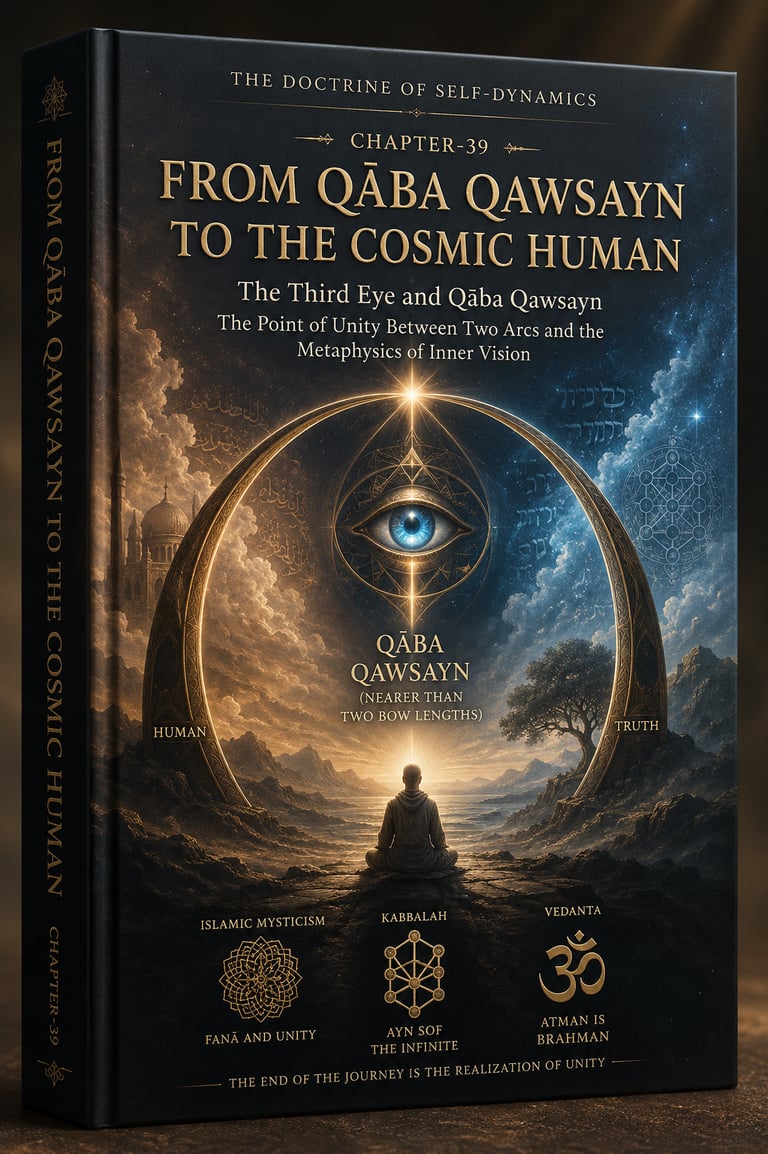
THE DOCTRINE OF SELF-DYNAMICS
CHAPTER-39: From Qāba Qawsayn to the Cosmic Human
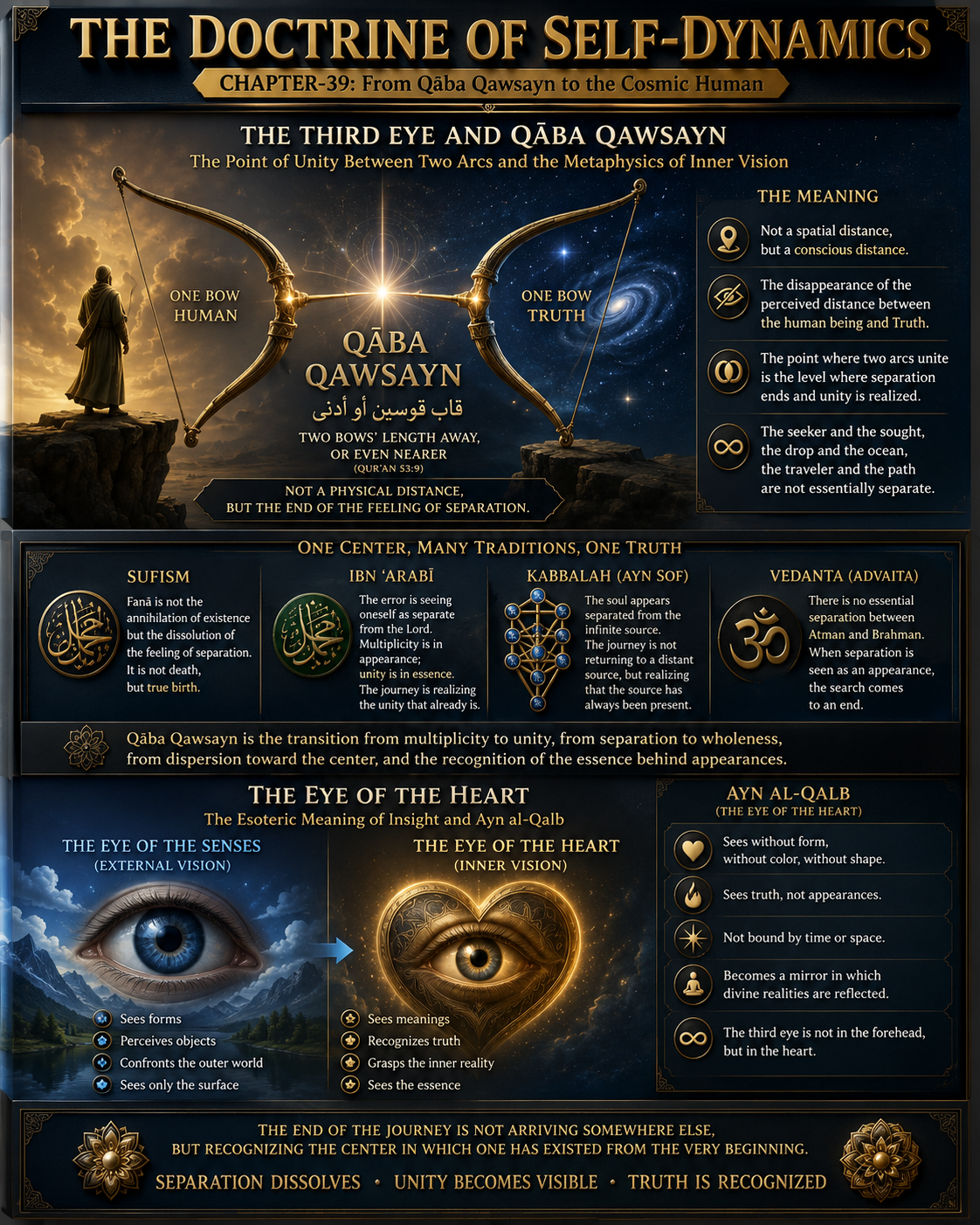
THE THIRD EYE AND QĀBA QAWSAYN
The Point of Unity Between Two Arcs and the Metaphysics of Inner Vision
In the vast majority of mystical traditions, the final stage of the spiritual journey is not the acquisition of new knowledge, but the dissolution of separation. For a long time, the human being experiences himself as an entity separate from the universe, from other people, and from the divine source. However, profound esoteric teachings assert that this separation is not an absolute reality, but the perception of a particular level of consciousness. It is precisely at this point that the symbol of Qāba Qawsayn emerges.
The expression Qāba Qawsayn aw adnā (“two bows' length away, or even nearer”), which appears at the summit of the Mi‘raj narrative in the Qur’an, has been regarded as one of the deepest metaphysical symbols of Islamic wisdom. Although in its outward meaning it expresses nearness, the Sufis have stated that no physical distance is being referred to here. For distance exists between things that are located within space. Yet divine truth is not limited by space.
For this reason, Qāba Qawsayn does not describe a physical distance between two points, but the end of the feeling of separation. The distance in question is not spatial but conscious. It signifies the disappearance of the presumed distance between the human being and truth.
The symbol of the two bows is therefore remarkable. One bow represents the human being. One bow represents truth. One bow symbolizes multiplicity. One bow expresses unity. At first glance these bows appear to be two separate poles, yet in reality they arise from the same center. The point at which the two bows unite represents the level of consciousness where separation ends, duality dissolves, and unity is realized.
In the Sufi tradition, this center has often been associated with the state of fanā. The human being does not disappear here. What disappears is the perception of self that regards itself as an independent and separate center. Fanā is not the annihilation of existence but the dissolution of the feeling of separation. For this reason, the Sufis have regarded fanā not as death, but as true birth. For only when the illusion of separation dissolves does the human being begin to see truth as it truly is.
In the metaphysics of Ibn ‘Arabī, the fundamental error of the human being is to see himself as a being separate from Lord. Multiplicity is in appearance; unity is in essence. The spiritual journey is not reaching a new truth, but realizing the unity that already exists. The human being does not approach truth; he realizes that he has never been distant from truth.
A similar understanding is found in the Ayn Sof teaching of Kabbalah. The soul appears to be separated from the infinite divine source. Yet this separation is not absolutely real. The journey is not so much a return to a distant source as it is the realization that the source has always been present. While the experience of separation occurs at the level of consciousness, unity continues to exist at a deeper level at all times.
The Advaita teaching of Vedanta expresses the same mystery through different concepts. There is no essential separation between Atman (the true self) and Brahman (absolute reality). As long as the human being sees himself as a limited individual, the journey continues. When he realizes that separation is merely an appearance, the search comes to an end. For it is understood that the seeker and the sought are in fact different manifestations of the same truth.
For this reason, Qāba Qawsayn is not merely the final station of the Mi‘raj. It represents the transition of human consciousness from multiplicity to unity. It describes the return from separation to wholeness, the movement from dispersion toward the center, and the recognition of the essence behind appearances. Here the human being acquires nothing new; he merely realizes the truth that has always been present.
Qāba Qawsayn is the meeting of the seeker and the sought at the same center. It is the realization that the traveler and the path, the question and the answer, the drop and the ocean, and the human being and truth are not essentially separate. Therefore, in the depths of all mystical traditions, the same secret is repeated: the end of the journey is not arriving somewhere else, but recognizing the center in which one has existed from the very beginning. Separation dissolves, unity becomes visible, and the human being understands that what he has always been seeking has in fact existed within the deepest layer of his own essence.
THE EYE OF THE HEART
The Esoteric Meaning of Insight and Ayn al-Qalb
Mystical traditions teach that human beings can see in two different ways. The first mode of seeing occurs through the eyes. The second mode of seeing occurs through consciousness. In the first, forms are seen; in the second, meanings are seen. In the first, objects are perceived; in the second, truth is recognized.
Seeing through the senses confronts the human being with the forms of the world. Colors, movements, faces, mountains, stars, and all visible beings are the subject of this perception. This mode of seeing is necessary for life; however, according to mystical teachings, it is not sufficient by itself. For the eye can see only the outer surface.
Seeing through consciousness, on the other hand, is directed toward grasping the meaning behind appearances. Here the human being begins to recognize not only what exists, but also what it signifies. A tree is no longer merely a tree; it becomes a symbol of the continuity of life. A star is no longer merely an object shining in the sky; it becomes a sign of order and cosmic harmony. Thus the world ceases to be a collection of objects and becomes a text woven with meanings.
In Sufism, this second mode of seeing has often been called basirah (inner insight). Basirah is the point at which the heart begins to see beyond what the eye perceives. The human being looks at the same world, yet now perceives not only forms but also the meanings they carry. For this reason, the Sufis have said that blindness is not the inability of the eyes to see, but the closure of the inner vision that recognizes truth.
Similar understandings exist in other mystical traditions as well. In Hermetic thought, the outer eyes perceive the world, while the inner eyes perceive the principles behind the world. In Vedanta, wisdom is the recognition of the unchanging essence behind changing forms. In Buddhism, awakening is the realization of the true nature behind visible events. Though the names differ, the experience described is the same.
For this reason, the mystical journey is not the acquisition of new eyes, but the deepening of one’s existing vision. The human being continues to see the outer world, yet now begins to perceive not only images but also the meanings to which they point. Forms may change, events may come and go, and appearances may continually transform. Yet as consciousness deepens, it becomes apparent that behind all these changes there exists a more enduring order.
According to the common teaching of all mystical traditions, truth is understood not merely by looking, but by truly seeing. Looking is the action of the eye; seeing is the awakening of consciousness. The eye perceives form, while consciousness grasps meaning. And the true transformation of the human being begins not on the day he first sees the outer world, but on the day he looks upon that same world and recognizes the truth behind it.
In Sufi literature, this second mode of vision is called basirah. Basirah is the ability to perceive not the outward appearance of events, but the meaning behind them. Two people may look at the same event and see completely different things. For what is seen depends not only on the capacity of the eye, but also on the openness of consciousness.
For this reason, the Sufis emphasized seeing rather than merely learning truth.
For knowledge can be accumulated.
But truth cannot be known until it is seen.
The Qur’anic statement, “The eyes do not become blind; rather, the hearts within the breasts become blind,” has been interpreted as one of the fundamental symbols of this understanding. The blindness referred to here is not physical. It is the inability to recognize truth.
The concept of Ayn al-Qalb (the eye of the heart) is a continuation of this teaching. Here the heart is not used in the sense of a biological organ. The heart is the spiritual center of the human being and the core of awareness. When this center opens, the human being begins to perceive not only what is happening, but also why it is happening.
In Kabbalah, the corresponding experience is expressed as Hokmah (Wisdom). Wisdom is different from collecting information. Information comes from outside. Wisdom arises from within.
A similar understanding is found in Zen Buddhism. What Zen masters call “direct seeing” is an awareness that occurs beyond concepts and interpretations. Rather than thinking about reality, the aim is to see reality as it is.
In Vedanta, Viveka (the power of discrimination) performs the same function. When the human being begins to distinguish between what is temporary and what is permanent, inner vision develops. Thus he begins to recognize the essence behind the visible world.
For this reason, when the eye of the heart opens, a new world does not appear.
The same world begins to be seen differently.
THE THIRD EYE AND INNER AWARENESS
The Deepening of Consciousness in Esoteric Traditions
The symbol of the third eye appears in many mystical traditions around the world. However, this symbol has often been misunderstood. The third eye is not a hidden organ located beside the physical eyes. It is a universal symbol representing the opening of consciousness to a deeper level of perception.
In the Indian tradition, this center is known as the Ajna Chakra. It has been associated with intuition, inner vision, and higher awareness. The purpose here is not to see a new world, but to recognize the order behind the visible world.
The Eye of Horus symbol in Ancient Egypt was likewise associated with consciousness and awareness. The eye became a symbol not only of seeing, but also of knowing and wakefulness.
In Western esotericism, the pineal gland has at times been associated with the doctrine of the third eye. Modern biology explains the pineal gland as a gland that secretes melatonin. Esoteric symbolism, however, has regarded it more as a metaphor for inner awareness.
In Tibetan Buddhism, the states of inner clarity that emerge during advanced stages of meditation have also been associated with the symbolism of the third eye. In shamanic traditions, experiences of perceiving invisible realms appear as different expressions of the same archetype.
In Sufism, the term “third eye” is not used. However, there is basirah, there is kashf, and there is mushahadah. All of these concepts point to the human capacity for inner realization. A person sees the world with the outer eye; with the inner eye he sees meaning. The outer eye perceives forms, while the inner eye recognizes unity. While the outer eye sees multiplicity, the inner eye is able to perceive the order and wholeness behind multiplicity.
For this reason, the essence of the teaching of the third eye is not seeing extraordinary visions or acquiring mysterious powers. At its core, what is being described is the recognition of the truth that has always been present. For according to mystical traditions, truth is not hidden from the human being; it is overlooked because attention is directed toward appearances. Inner awakening is not the creation of a new reality, but the ability to see what already exists with deeper clarity.
In Sufism, basirah is the beginning of the heart’s seeing. Kashf is the thinning of the veils and the becoming visible of truth. Mushahadah is the transformation of this realization into direct experience. Although each of these concepts emphasizes a different aspect, their common point is the same: the human being begins to recognize the meaning beyond appearances.
For this reason, the center where the two bows of Qāba Qawsayn unite and the center where the eye of the heart opens are regarded in esoteric interpretations as different symbols of the same truth. One is the point of unity expressed in cosmic language; the other is the center experienced within the inner world of the human being. Both signify the dissolution of separation and the realization of unity.
For the longest journey undertaken by the human being is not toward the heavens. The longest journey is the inner journey from the periphery to the center; from appearance to essence; from multiplicity to unity. Without traveling to distant lands, the human being accomplishes this journey by descending into the depths of his own being.
When he arrives there, what he sees is not a new truth. For truth has never disappeared and has never become distant. What changes is not truth itself, but the consciousness that perceives it. When the human being reaches the center, he does not discover something new; he remembers what has always been there. What emerges when the eye of the heart opens is not a new light, but the recognition of the light that has been shining from the very beginning.
For this reason, the same secret is repeated in the depths of all mystical traditions: What is sought is not far away. Truth is not hidden beyond the heavens. It is always present within the human essence, in the silent center of the heart, and in the deepest point of consciousness. The journey is not to reach it; it is to realize that it has always been there.
THE MYSTERY OF JOHN AND ELIJAH
Spiritual Continuity, Archetypal Consciousness, and the Principle of Eternal Guidance
In esoteric traditions, certain names transcend their existence as historical personalities and become symbols of universal principles. For this reason, the figures of John and Elijah have been interpreted not merely as two prophets, but as representatives of a particular spiritual function that appears repeatedly throughout human history.
In the Jewish tradition, the expectation of Elijah’s return occupies an important place. In Christian texts, it is stated that John came in the spirit and power of Elijah. Esoteric interpreters have understood this narrative not as a biological return, but as a symbol of spiritual continuity.
For from the perspective of mystical traditions, the important thing is not the name.
The important thing is consciousness.
The important thing is not the person.
The important thing is the function.
The important thing is not the body.
The important thing is the light it carries.
For this reason, the connection between Elijah and John carries a meaning deeper than a similarity between two individuals. What is involved here is the appearance throughout history of a particular spiritual principle in different forms. The same light burns in different lamps. The lamps change, but the light remains the same.
In Sufism, the teaching of Khidr possesses a similar structure. Khidr has become not so much a figure belonging to a specific historical period as a symbol of the principle of ever-present spiritual guidance. For many Sufis, the significance of Khidr arises not from his historical personality, but from the mystery of perpetual guidance that he represents.
In Gnostic traditions as well, sages and prophets have been regarded as manifestations of divine wisdom in different ages. Truth appears under different names, yet its essence does not change.
For this reason, the mystery of John and Elijah possesses a metaphysical meaning far broader than the doctrine of reincarnation. What is emphasized here is not merely the idea of a being appearing in another body, but the continuity of truth and the dimension of consciousness that cannot be confined within time.
The mystery of Elijah is not immortality. What he represents is the continuity of consciousness. It is the ability of the divine light carried by truth to continue existing beyond historical events and individual lives. For according to mystical traditions, what endures is not the body, but the meaning that becomes visible through the body.
The mystery of John is likewise not rebirth. It is the appearance of the same light in a new lamp. Lamps may change, but the light continues to burn from the same source. Names may differ, but the essence that gives them meaning remains unchanged. For this reason, what is important in mystical interpretations is not the identity of the person, but the quality of the truth he carries.
When one torch lights another, the first flame is not diminished. In the same way, the light of truth continues to appear in different ages, in different people, and under different symbols. Appearances change, but the source that illuminates them remains unchanged.
According to the common teaching of mystical traditions, bodies come and go. Names change. Languages change. Cultures and ages transform. Yet the light carried by truth continues to appear under different forms. In one age it may express itself through a prophet, in another through a sage, in another through a gnostic, or through a teaching. What changes is the bearer; what remains unchanged is the essence being carried.
For this reason, from the esoteric point of view, history is not merely the story of human beings. History is also the story of truth appearing in different forms. Each new appearance emerges not to repeat the old, but to express the same essence within new conditions. Just as the same sun appears to rise each morning from a different horizon, the light of truth shines from age to age under new forms.
In this understanding, what matters is not becoming attached to outer forms, but recognizing the essence they carry. For the secret hidden in the depths of mystical traditions is this: What endures is not the names. What endures is the light to which the names point. Forms are temporary. Lamps change. But the light continues to burn. And when the human being recognizes this continuity beyond forms, he begins to see that amid the seemingly scattered events of history, the same truth continues to flow silently.
ADAM KADMON AND THE UNIVERSAL SPIRIT
The Cosmic Human and the Great Organism of Unity
The concept of Adam Kadmon, one of the deepest teachings of Kabbalah, is among the most comprehensive models of the Cosmic Human in the history of humanity. However, this teaching is not unique to Jewish mysticism alone. Similar ideas have appeared under different names in many esoteric systems throughout the world.
Adam Kadmon is not the historical Adam.
He is the Cosmic Human before creation.
He is the first manifestation of the divine light.
He is the common root of all souls.
According to Kabbalah, this cosmic structure that emerged at the beginning of creation later became the source of all individual souls. Human beings appear separate from one another; yet deep within, they are parts of the same great organism.
This understanding displays remarkable parallels with the doctrine of the Insan al-Kamil (Perfect Human) in Sufism. The Insan al-Kamil is not merely individual perfection. He is the complete manifestation of all the divine potential carried by humanity.
In the Vedic tradition, Purusha fulfills the same function. The universe is born from the body of Purusha. The Sun becomes his eyes, the heavens his head, and the Earth his feet. Thus the entire cosmos is described as a living organism.
In Iranian metaphysics, Gayomart; in the Chinese tradition, Pangu; in the Hermetic tradition, Anthropos; and in Gnostic systems, the figure of the Primordial Human may all be seen as different expressions of the same archetype.
The common point of these teachings is this: The human being is not separate from the universe. Nor is the human being merely a small part existing within the universe. The human being is the universe in its conscious form. For this reason, there exists a deeper connection between individual consciousness and universal consciousness than is apparent at first glance.
Just as the cells of a body cannot sustain their existence independently of the whole, individual consciousness is not entirely disconnected from universal consciousness. Although the human being experiences himself as a separate entity, according to mystical traditions this separation is not an absolute reality, but the result of a particular perspective. At a deeper level, all life is interconnected and nourished from the same source.
For this reason, in esoteric teachings self-knowledge has never been regarded merely as an individual discovery. A person who knows his own essence simultaneously finds a gateway opening to the essence of all existence. The connection between the microcosm and the macrocosm emerges here. As the human being descends into his inner world, he begins to understand the fundamental structure of the universe more deeply.
The teaching of Adam Kadmon is therefore not merely a cosmic narrative belonging to the past. It is also a symbol directed toward the future. Just as it describes humanity’s emergence from primordial unity into multiplicity, it also expresses the return from multiplicity to conscious unity. What is involved here is not a physical union, but the recognition of a common origin and a common essence.
According to the perspective of mystical traditions, the greatest transformation of humanity will not be technological or political, but conscious. When human beings begin to realize that they are not entirely separate entities but different expressions of a greater whole, many conflicts built upon separation will lose their meaning. For the realization of unity does not eliminate differences; it is the understanding that differences arise from the same source.
For this reason, Adam Kadmon is not only the symbol of the first human being, but also of the great wholeness that will one day be remembered. He represents the rediscovery by scattered fragments of their common origin, the recognition of unity within multiplicity, and the remembrance of humanity’s shared truth.
This is also the common message that echoes through the depths of all mystical traditions: Separation is in appearance; unity is in essence. When a human being sees himself only as an individual, he experiences the fragment; but when he approaches his essence, he begins to feel the whole. And one day, the great mystery symbolized by Adam Kadmon is understood once again: Humanity is not the sum of disconnected consciousnesses, but the countless faces of the same truth and the countless reflections of the same light.
WAHDAT AL-WUJUD AND ADVAITA
The Metaphysics of Unity Between Ibn Arabi and Shankara
Two of the most powerful teachings of unity in human history are the doctrine of Wahdat al-Wujud in Sufism and the teaching of Advaita in Vedanta. Although they emerged in different cultures, both systems seek to explain the unity that lies behind multiplicity.
According to Ibn Arabi, true existence is one. According to Shankara, absolute reality is also one. Ibn Arabi calls it Wujud, while Shankara calls it Brahman. The names are different, but the horizon to which they point shows many similarities.
In Ibn Arabi’s metaphysical system, the universe consists of the manifestations of the divine names and attributes. Multiplicity is not denied; rather, multiplicity is accepted as the infinite appearances of truth. Yet these appearances are not independent. Every being is like the reflection of the same truth in a different mirror. Thus multiplicity and unity are understood not as opposites, but as two different appearances of the same reality.
In Advaita Vedanta, Brahman is the single absolute reality. The human being experiences himself as a separate individual; however, this separation is not accepted as the ultimate reality. When the identity between Atman (the true self) and Brahman is realized, the boundaries of the individual self begin to dissolve. The human being begins to see himself not merely as a limited being, but as an expression of a greater reality.
In both systems, the key to liberation is knowledge. However, the knowledge in question is not theoretical knowledge. Memorized concepts, intellectual definitions, or philosophical explanations are not regarded as sufficient by themselves. True knowledge is knowledge that is directly experienced. In Sufism this is called ma‘rifah. In Vedanta it is called jnana. In the Gnostic tradition it is expressed as gnosis. All three point to the same mystery: the knowing of truth through direct experience.
For this reason, truth is understood not merely through thought, but through realization. A human being may conceptually accept unity; yet when he truly lives it, his perspective begins to change. Then unity ceases to be an idea and becomes a direct experience.
Nevertheless, there are also important differences between the two systems. Ibn Arabi emphasizes the infinite manifestations of the divine names and regards the diversity of existence as a reflection of divine richness. Shankara, on the other hand, expresses the emphasis on absolute unity more sharply and treats all changing appearances as secondary in relation to ultimate reality. While Sufism speaks in the language of love, devotion, and manifestation, Advaita speaks more in the language of knowledge, awareness, and realization.
Yet despite all these differences, the horizon they reach is strikingly similar. The human being is not separate. Existence is not essentially fragmented. Truth is not divided. Multiplicity is in appearance; unity is in essence. The experience of separation that human beings undergo may be real, but it is not regarded as ultimate reality. At a deeper level, all existence rests upon the same source.
For this reason, Wahdat al-Wujud and Advaita are not merely two metaphysical systems. They are two great maps of the journey of human consciousness from separation to unity. One speaks in the language of love, the other in the language of knowledge. One emphasizes manifestation, the other identity. Yet both direct the human being toward the same center.
And from the depths of both traditions rises the same call: Know yourself. For the one who knows himself knows his essence. The one who knows his essence knows the Universal Spirit. And the one who knows the Universal Spirit begins to see the unity behind all separations. When unity is seen, the distance between the seeker and the sought disappears. For the place reached at the end of the journey is not a new world, but the truth that has always existed. In the end, the human being finds nothing else; he simply realizes the reality that he has always carried within himself. And this realization emerges as the ultimate fruit of the mystical journey.
SPIRIT AND WORD
The Esoteric Interpretation of Jesus and the Principle of Cosmic Mediation
In esoteric traditions, certain figures are not regarded merely as historical personalities. They also become symbols of universal principles, cosmic laws, and levels of consciousness. From this perspective, the figure of Jesus emerges not only as a prophet who lived in a particular period, but as a universal archetype representing the point of union between spirit and word.
The expressions Rūhun minhu (a spirit from Him) and Kalimatullah (the Word of Allah), used for Jesus in the Qur’an, have been the subject of profound interpretations in Islamic metaphysics. These expressions symbolize not only the station of prophethood, but also the two fundamental principles of creation.
Spirit is invisible life. Word is invisible meaning. Spirit gives motion; word gives direction. Spirit brings vitality; word brings meaning. For this reason, the union of spirit and word is understood as the union of life and meaning. Not only the existence of life, but also its knowing why it exists, becomes possible through this union.
In the Sufi tradition, prophets have often been interpreted as bearers of particular divine mysteries and spiritual truths. While Adam is associated with knowledge, Noah with fidelity, Abraham with surrender, and Moses with manifestation and divine address, Jesus has been identified with spirit, life, and divine breath. In these interpretations, prophets are seen not only as historical personalities, but also as symbols representing different spiritual dimensions of human consciousness.
For this reason, for many Sufis, Jesus’ raising of the dead is not merely a historical miracle. This event has been read as the symbol of the awakening of sleeping consciousness. It signifies the softening again of the hardened heart, the revival of the forgotten spirit, and the activation of the deep life-force within the human being. The resurrection here is not only bodily, but also conscious and spiritual.
In Gnostic traditions, the figure of the Savior has a similar function. He is the guide who awakens the forgotten divine spark within the human being. In the Hermetic tradition, the manifestation of divine intellect in the visible world has been understood as an illuminating principle that directs the human being toward his own essence. In Kabbalah, the becoming visible of divine wisdom within humanity is another expression of the same metaphysical structure. Different symbols are used, yet the process described remains the same: the remembrance of the forgotten essence and the becoming visible of the hidden light.
For this reason, the esoteric interpretation of Jesus goes beyond historical biography. He is the symbol of the awakened spirit within the human being. He is the becoming visible of invisible meaning. He is the beginning of silent truth to speak. He is the symbolic expression of spirit becoming word, essence becoming expression, and inner light becoming visible life.
From this perspective, the teaching of “Spirit and Word” does not describe only a particular prophet. It also describes the cosmic potential within the human being himself. Within every human being there is a life that has not yet fully emerged, a meaning that has not yet been fully expressed, and a consciousness that has not yet fully awakened. Spirit is the source of this potential; word is its expression in the visible world.
According to the shared view of all mystical traditions, the journey of the human being is to make this invisible life visible and to transform this silent meaning into a lived truth. For spirit does not merely want to live; it wants to express itself. Word does not merely want to speak; it wants to make truth visible. And in this union of spirit and word, the human being begins to recognize the divine possibility within his own essence. Then life ceases to be merely existence; it becomes a conscious process of creation that carries meaning.
THE DOCTRINE OF LOGOS
Word, Intellect, and the Principle of Cosmic Order
One of the most powerful metaphysical concepts in human history is Logos. Logos does not mean only “word.” It also carries the meanings of intellect, order, principle, law, meaning, and creative power.
For this reason, Logos is far more than a word. It is the reason why the universe is intelligible. It is the principle by which the universe can function not randomly, but within a definite order and harmony. In esoteric and philosophical interpretations, Logos has been understood as the cosmic principle expressing the meaning, order, and intellect behind existence.
The famous statement at the opening of the Gospel of John expresses this understanding symbolically: “In the beginning was the Word.” The word here is not ordinary speech in the sense of human speaking. It is the ordering principle behind creation, the invisible logic of existence, and the meaning that gives form to the universe. Here, Word is not sound, but cosmic meaning itself.
However, the doctrine of Logos did not begin with Christianity alone. In Ancient Greek thought, Heraclitus and the Stoics defined Logos as the cosmic intellect that governs the universe. According to Heraclitus, human beings are often absorbed in their individual thoughts, yet fail to recognize the common Logos that governs the universe. The Stoics, on the other hand, regarded Logos as the principle of reason and order permeating the entire cosmos.
According to the Stoic understanding, human reason is a small spark of the universal Logos. For this reason, wisdom is not merely collecting information, but bringing individual reason into harmony with cosmic reason. The more the human being lives in accordance with this universal order, the more he approaches truth.
In the Hermetic tradition, Logos gains a more mystical dimension. In the Corpus Hermeticum, Logos is seen as the creative manifestation of the divine mind. Invisible thought becomes the visible universe through Logos. Thus the universe is interpreted not as a randomly formed structure, but as a living expression that carries meaning.
In Neoplatonic thought as well, Logos has been understood as the principle mediating between absolute unity and visible multiplicity. The One is invisible; Logos makes visible. The One is silent; Logos expresses. The One is essence; Logos is the emergence of that essence into appearance. Thus Logos becomes the bridge established between the invisible and the visible.
For this reason, the identification of Jesus with Logos can be read in esoteric interpretations not as the deification of a historical personality, but as the teaching of divine meaning becoming visible within humanity. The emphasis here is directed less toward the identity of a person than toward the expression of truth in the visible world. Through Logos, humanity experiences invisible meaning in visible form.
Logos is not spoken speech. Logos is the language of creation. Logos is the logic of the universe. Logos is the transformation of invisible meaning into visible order. In the movement of the stars, the cycles of nature, the harmony of mathematics, and the search for meaning in consciousness, the traces of the same principle are seen. For Logos is the principle that holds the seemingly scattered parts of existence together within an invisible wholeness.
For this reason, in the depths of all mystical and metaphysical traditions, Logos appears not only as a concept but as the symbol of the intelligibility of existence. It is the beginning of the silent essence to speak, the taking form of invisible meaning, and the expression of unity within multiplicity. The presence of the Word in the beginning therefore points not so much to the first sound of creation as to the first meaning of creation. For meaning comes first; forms are merely the appearances of that meaning within time and space.
KUN AND DABAR
The Metaphysics of the Creative Word
In most esoteric traditions, creation has been associated with a kind of divine word or command. For here, word is not communication, but the symbol of creation.
In the Qur’an, this principle is expressed through the phrase Kun fa-yakūn (“Be, and it is”). The “Kun” here is not understood as an ordinary sound or a sequence of letters. In esoteric interpretations, Kun means the becoming visible of divine will, the realization of potential, and the manifestation of the hidden. Thus creation is interpreted not so much as a command given from outside, but as truth making itself visible.
According to Sufi interpreters, creation is not merely an event that occurred in the past. A new Kun is taking place at every moment. A new manifestation emerges at every moment. Existence is constantly renewed, and the universe is recreated at every instant. For this reason, creation is not seen as a completed process, but as an ongoing becoming.
In Kabbalah, the concept of Dabar fulfills a similar function. Dabar means both word and event. This is extremely striking. For here there is no separation between what is said and what happens. Word is also action. Word is not merely an expression, but a creative power. Meaning turns into existence, and invisible thought becomes visible reality.
The letter mysticism of Kabbalah is also founded upon this understanding. Letters are not merely written signs. Each letter represents a particular aspect and a particular power of creation. The universe is seen as the unfolding of divine letters and meanings.
The Hurufi tradition expresses the same metaphysical intuition in a different way. The universe is a book. The human being is a book. The face is a book. Existence is a readable word. Everything visible is the form into which invisible meaning has been transformed into letters and forms. For this reason, creation is understood not only as a material process, but also as the becoming visible of meaning.
In this respect, although Kun and Dabar belong to different cultures, they point to the same creative principle: the visible emergence of the invisible, the transformation of meaning into form, and truth acquiring existence.
OM AND COSMIC VIBRATION
From Silence to Sound, From Sound to the Universe
In Indian metaphysics, the origin of creation has often been explained through the symbolism of sound. At the center of this symbolism stands Om. Om is not merely a sound. Nor is it merely a letter or mantra. Om is the symbol of the first vibration of creation.
In the Upanishads, Om is described as the cosmic sound encompassing the past, the present, and the future. Beyond this, it is said to represent the truth beyond time. According to the teaching of Vedanta, invisible consciousness becomes the visible universe through vibration. Om is the symbol of this first motion, first unfolding, and first visibility. It is the first wave of silence and the first echo of the invisible.
In the Yoga and Tantra traditions, concentrating on Om has been regarded as the attunement of the human being to the fundamental rhythm of the universe. For it is accepted that there is a deep connection between the inner rhythm of the human being and the rhythm of the universe. Om has become the symbolic expression of this connection.
A similar understanding exists in the Hermetic tradition as well. Everything moves. Everything vibrates. Everything exists within an invisible rhythm. Even things that appear stationary are in motion at deeper levels. The essence of existence has been understood as a vibrational order.
The teaching of Nafas al-Rahmani in Sufism is another expression of the same mystery. The universe continuously exists through the divine breath. Creation is not a finished event, but an ongoing state of becoming. Every breath is a new manifestation, every moment a new creation. For this reason, breath is not merely a biological function, but a symbol of the continuity of existence.
When Om, Logos, Kun, and Dabar are considered together, a striking common structure emerges. First there is silence. Then breath is born. Then vibration emerges. From vibration, word is formed. From word, forms become visible. And finally, the universe takes shape. Although different cultures have described this process through different symbols, the metaphysical pattern indicated is largely similar.
The human being is not outside this great process of creation. The human being is also a word. The human being is also a vibration. The human being is also one of the visible forms of invisible meaning. Thoughts, feelings, words, and actions are visible manifestations born from invisible consciousness.
For this reason, according to the common teaching of all esoteric traditions, the universe is not a structure composed only of matter. The universe is a living word waiting to be read. The human being is the conscious letter of that word, capable of reading itself. When the human being looks at the universe, he does not see only stars, mountains, and living beings; he also begins to read the meaning carried by existence. And as this reading deepens, it becomes clearer that the universe and the human being are different expressions of the same invisible source. For although appearances differ, the silence, breath, meaning, and truth that give birth to them are one.
LIBER MUNDI
The Book of the World and the Esoteric Mystery of Cosmic Writing
One of the deepest teachings of esoteric traditions is the idea that the universe is not only an existing reality, but also a readable reality. Mystics, Sufis, Kabbalists, Hermetic thinkers, and philosophers who appeared in different periods of human history reached the same fundamental intuition: The universe speaks. Yet this speech does not occur through sounds. The universe writes. Yet this writing is not written with ink.
For this reason, the teaching of Liber Mundi, that is, “The Book of the World,” which emerged in the Medieval Hermetic tradition, is not merely a poetic metaphor. It expresses the idea that all existence is a readable text. According to this understanding, the human being lives between two great books. The first is the revealed book. The second is the created book. The first consists of words. The second consists of stars, mountains, trees, rivers, animals, and human beings. Yet the source of both books is the same.
According to Hermetic thinkers, nature is not a randomly formed mechanism. Nature is the visible writing of divine intellect. For this reason, the growth of a tree, the rotation of a planet, the blooming of a flower, or the birth of a human being is not regarded merely as physical events. Each of these is a different line of the same cosmic text. The universe carries meaning, and this meaning can be read by a consciousness that looks carefully.
Every river is a sentence. Every star is a letter. Every life is a paragraph. Every age is a new page. For this reason, in the Hermetic tradition, astronomy is not merely the study of the sky. Alchemy is not merely the transformation of metals. Investigations of nature are not merely the collection of physical knowledge. All of these have been seen as activities aimed at reading the cosmic book. For the universe is not a meaningless mass of matter, but a living text waiting to be read.
In some profound interpretations of Sufism, a similar understanding exists. The universe is seen as a whole of “ayat,” that is, signs. The fact that the Qur’an repeatedly calls the creation of the heavens, the earth, the night, the day, and the human being ayat gains meaning from this perspective. For an ayah is not only a sentence of the sacred book. An ayah is also existence itself. Every being becomes a symbol that points to a truth greater than itself.
For this reason, the Sufis did not separate reading the Qur’an from reading the universe. In one, there are written ayat. In the other, created ayat. In one, words speak. In the other, existence speaks. Yet both direct toward the same truth. The one who seeks truth must learn to read not only texts, but also life, nature, and his own inner world.
In the metaphysics of Ibn Arabi, the universe is the visible form of the divine names. Every being carries the manifestation of a particular divine name. For this reason, the world does not consist only of objects; it consists of meanings. Stone is the symbol of durability and continuity. Water is the symbol of flow and transformation. Fire is the symbol of change and transformation. The sky is the symbol of infinity and boundlessness. The human being is the living text in which all these symbols come together.
In this respect, in the teaching of Liber Mundi, nature is sacred. For it is a readable revelation. It is a silent word. It is a mystery made visible. Everything carries the sign of a deeper meaning beyond itself. The task of the human being is not only to look, but to read; not only to see, but to understand.
According to the common teaching of all mystical traditions, the universe is not silent. It speaks at every moment. Every season forms a sentence, every star gives a sign, every life carries a meaning. Yet to hear this language, more than the ear is required. To understand this language, consciousness must awaken. For the letters of the cosmic book are seen with the eye; but their meaning can only be read with the heart. And when the human being learns this reading, the universe ceases to be merely a place in which he lives; it becomes a living text that tells him the truth.
THE LIVING LETTERS OF GOD
Sefer Yetzirah, Hurufism, and Cosmic Writing
Sefer Yetzirah (The Book of Creation), one of the oldest works of Kabbalah, is one of the most remarkable mystical texts explaining creation through letters and numbers. In this text, letters are not merely instruments of communication. They are seen as creative powers, cosmic principles, and the building blocks of existence.
According to Sefer Yetzirah, the universe came into being through the combination of divine letters in particular orders. Just as a book is formed through meaningful combinations of letters, creation emerges through the cosmic order of divine letters. For this reason, letters are not merely sounds; they are understood as energy, vibration, and potential. Every letter represents a particular creative power. Every number expresses a particular order. Every word is the sign of a particular cosmic pattern.
This understanding later spread throughout the entire system of Kabbalah. The Tree of Sefirot, letter combinations, and numerical symbolism were interpreted as different layers of the same great metaphysical writing. Thus the universe began to be seen as a readable text and a meaningful order.
In Hurufism, this understanding was carried even further. According to Hurufi thought, the human face is a living book. The eyebrows are letters. The eyes are letters. The lips are letters. The face is the visible page of divine writing. Thus the human being is not only the reader; he is also the text to be read. The human being carries the signs of creation in his own face, body, and existence.
For this reason, creation becomes not so much a process of construction as a process of writing. God does not build like a carpenter, does not plan like an architect; He writes like a writer. Before being a building, the universe is a text. It is a web of meaning. It is a texture of word. All visible forms are considered as the letters and sentences of invisible meaning.
In modern biology, the fact that DNA forms a genetic alphabet operating through four basic nucleotides also offers a striking symbolic parallel. What esoteric traditions mean is not scientific genetics; however, the fact that life itself also possesses a structure resembling writing gives a new dimension to the metaphor of the “cosmic text.” DNA is biological writing. Nucleotides are like letters. Cells are like lines. Livingness is like the meaning that emerges through the reading of this writing.
For this reason, the human being is both inside the book and reading the book. He is both line and reader. He is both letter and the search for meaning.
From the esoteric point of view, the cosmos is a book. Stars are words. Atoms are letters. Living beings are sentences. The human being is the reader. Truth is the invisible meaning hidden between all the lines.
The cosmos is a book, and the atom is an ayah. Every being carries the sign of a greater meaning beyond itself. The visible world is like the text of invisible truth written in symbols.
For this reason, to read oneself is to read the universe. To read the universe is to read truth. To read truth is to be able to perceive the invisible Writer behind the visible letters. For according to the common teaching of all mystical traditions, existence is not merely a world to be seen, but a text to be understood. The journey of the human being is also the journey of gradually discovering the meaning hidden among the lines of this great book.
TRUTH AS FIRE
Nur, Logos, and the Burning Light of Gnosis
One of the oldest symbols in human history is fire. Fire is not merely a natural phenomenon. In ancient traditions, fire became a universal metaphor describing the transformation of consciousness. For the nature of fire contains the qualities of truth.
Fire illuminates. Fire burns. Fire transforms. Fire purifies. For this reason, the different mystical traditions of the world have often explained truth not through water or earth, but through fire. For truth does not merely give knowledge to the human being; it changes the human being.
In Sufi metaphysics, the concept of Nur stands at the center of this transformation. Nur is not merely physical light. Nur is the becoming visible of the invisible. It is the revealing of the unknown. It is the emergence of what is hidden. When the human being encounters Nur, he does not merely acquire new information; he begins to see in a new way. He looks again at the things he had looked at before. He hears again the things he had heard before. He reinterprets the life he had lived before.
Yet this process is not always peaceful. For light does not show only beauty; it also reveals shadows. For this reason, encountering truth often means encountering one’s own darkness. In Sufism, this has been called self-accounting. The soul’s seeing itself, the opening of the veils, and the becoming visible of the things a person has hidden from himself are parts of this process.
This is why Nur is sometimes felt like fire. For truth does not merely illuminate; it also burns. What is burned is not the essence of the human being. What is burned are illusions, habits, false identities, and the veils that cover reality.
From this perspective, the fire encountered by Prophet Moses on Mount Tur in the Qur’an is extremely meaningful. While walking in the desert, Moses thought what he saw was an ordinary fire. Yet that fire was not merely a fire that warms the body. That fire was the fire of awareness. That fire was the fire of the call. That fire was the turning point of consciousness. When Moses saw the fire, he did not merely acquire new knowledge; he entered a new life. For true revelation transforms consciousness more than it transmits information.
For this reason, in many mystical traditions, divine manifestation appears in the form of fire. The burning bush in Judaism, the sacred fire in Zoroastrianism, the alchemical fire in the Hermetic tradition, and Nur in Sufism may be seen as different expressions of the same archetypal structure. All of them represent the transformative power of invisible truth.
In Christian mysticism, Logos has a similar function. Logos is not merely a principle that gives information; it is meaning that transforms the human being. A person who encounters the true Logos cannot remain the old person. For Logos changes not only the mind, but the whole of existence. For this reason, when the divine word is heard, not only thoughts change; life changes, vision changes, identity changes, and the human being’s relationship with the world begins to transform.
In the Gnostic tradition, this transformation is expressed even more clearly. Gnosis, that is, the direct knowledge of truth, is described like fire. For true knowledge does not leave the human being as he was. Gnosis is not learning. It is awakening. It is remembering. It is burning. It is the dissolution of the old self and the birth of new consciousness. For this reason, in Gnostic texts, truth has often been described through metaphors of light and fire. For light reveals, fire transforms; truth does both at once.
In the alchemical tradition as well, fire plays a central role. While alchemists tried to transform lead into gold, they were describing not only metals but also the transformation of the human soul. Lead represents heaviness, density, and forgetfulness. Gold represents the awakened essence, the purified soul, and remembered truth. The place where this transformation takes place is fire. For transformation always passes through fire. There is no alchemy without fire. There is no truth without transformation.
For this reason, in all esoteric traditions, fire is not merely a physical element. Fire is the symbol of initiation. It is the dissolution of the old self. It is the birth of new consciousness. The same structure is seen in the Sufi teaching of sayr wa suluk. At every stage, the traveler is freed from an old veil. Every realization is a new burning, every understanding a new purification, and every unveiling a new death. And every death prepares a new birth.
For this reason, truth is not always comfortable. Sometimes it is shaking. Sometimes it is destructive. Sometimes it breaks apart the identities that a person has built for years. Sometimes it reshapes entire systems of thought. Yet precisely for this reason, it is transformative. For truth does not merely add new information; it changes the human being’s mode of existence.
In this respect, the warning to “tear the veil” gains a deeper meaning. For truth is not an object of knowledge. Truth is a power. It is a fire. It can be burning for an unprepared consciousness. For a matured consciousness, however, it is illuminating. The fire is the same. Nur is the same. Truth is the same. What changes is only the level of preparation of the person who approaches it.
For this reason, according to the common teaching of all mystical traditions, truth is not given to the human being. Truth is not seized. Truth is not taken by force. The human being only prepares himself. He purifies himself. He matures. He lifts his veils. And at the proper time, truth begins to show itself.
For when the sun rises, you do not produce its light; you only open your eyes. Truth is like this. It already exists. The human being only becomes capable of seeing it. And when that moment comes, the same light becomes fire for some and illumination for others. For the fire of truth burns not to destroy, but to transform. The journey of the human being is not to resist this transformation, but to accept it consciously and allow the light within his essence to emerge.
THE COSMIC HUMAN AND THE UNIVERSAL SELF
The Mystery of Unity in Adam, the Perfect Human, Adam Kadmon, Anthropos, and Purusha
One of the oldest and most widespread metaphysical teachings in human history is the idea that there is a deep resemblance between the universe and the human being. Although this teaching has appeared under different names in different cultures, in essence it expresses the same truth. In Islamic wisdom it appears as the Perfect Human, in Kabbalah as Adam Kadmon, in the Hermetic tradition as Anthropos, in the Vedic tradition as Purusha, in the Iranian tradition as Gayomart, in Chinese mythology as Pangu, and in Gnostic systems as the Primordial Human. All of these figures may be seen as manifestations of the same archetype in different cultures. The name of this archetype is the Cosmic Human.
The Cosmic Human is not a historical person. He is the metaphysical plan of creation, the living template of the universe, and the common essence of all existence. For this reason, esoteric traditions have not regarded the human being merely as a biological organism. The human being is not a small part of the universe; he is the aspect of the universe that experiences itself consciously.
In Sufism, the Perfect Human is seen as the most complete mirror of the divine names. While the divine names appear in dispersed forms throughout the universe, they are gathered in unity within the Perfect Human. Thus the human being becomes the summary of creation and the living reflection of wholeness.
A similar structure exists in the teaching of Adam Kadmon in Kabbalah. Adam Kadmon, described as the first manifestation of Ayn Sof, the infinite divine reality, constitutes the cosmic body of all the sefirot. Human souls are parts of him. Although they appear as separate individuals, at a deep level they are connected to one another like organs of the same whole.
In the Hermetic tradition, Anthropos is the mediating being standing between divine intellect and the material world. He belongs both to heaven and to earth; he carries infinity and also experiences limitation. For this reason, the human being is accepted as a living bridge established between two worlds.
In the Vedic tradition, Purusha gains an even more cosmic dimension. Purusha is not merely a being within the universe; Purusha is the universe itself. The moon is described as his mind, the sun as his eye, the heavens as his head, and the earth as his feet. This narrative depicts the universe as a vast organism that is living and conscious.
The birth of livingness from the body of Gayomart in Iranian metaphysics, and the transformation of Pangu’s body into mountains, rivers, and the sky in Chinese mythology, are different interpretations of the same great archetype.
All these teachings unite at a common point: The human being is not separate from the universe. The human being is not outside nature. The human being is the knot of consciousness standing at the center of creation. For this reason, in esoteric traditions, the call “know yourself” is not merely psychological advice, but a metaphysical principle. For when the human being begins to know himself, he does not discover only his individual identity; he also begins to discover the fundamental structure of the universe.
The veil between the microcosm and the macrocosm gradually becomes thinner. The human being sees in the stars the same order he sees in his heart. He recognizes in the galaxies the rhythm he feels in his breath. He begins to understand that the light within himself arises from the same source as the light of the universe. Thus the distinction between the inner world and the outer world gradually fades, and all layers of existence begin to appear as different reflections of a single truth.
At this point, the Hurufi teaching of the cosmic human gains a new meaning. The human face is a book; the universe is the great book. The human being is the small Qur’an; the cosmos is the great Qur’an. The letters on the face and the letters in the stars are parts of the same writing. For creation is not a building, but a text; it is a word, a texture of meaning. In every layer of existence, there are traces of the same divine writing.
For this reason, the conclusion reached by all teachings of the cosmic human is the same: The human being does not only live within the universe; the universe also lives within the human being. When the human being knows his own essence, he is in fact remembering again the forgotten face of the Cosmic Human. Multiplicity is in appearance, while unity is in essence. The human being is an individual; yet at the same time, he is the whole. He is a drop; yet he carries the essence of the ocean. He is a letter; yet he belongs to the entire book.
According to the common mystery of all esoteric traditions, the Cosmic Human is not hidden in the heavens. He is hidden within the human being’s own existence. The one who seeks him does not travel to distant lands; he descends into the depths of his own essence. And there, he encounters the same truth indicated by all religions and all mystical paths: the infinite appearances of the One, and the One within infinite appearances. This truth reveals itself at every point of existence, making the inner world of the human being and the boundless horizons of the universe different manifestations of the same meaning.
FOOTNOTES
1. Muhyiddin Ibn Arabi, Fusus al-Hikam, trans. Ekrem Demirli, Istanbul: Kabalcı Publications, 2013, pp. 55-78.
2. Muhyiddin Ibn Arabi, al-Futuhat al-Makkiyya, trans. Ekrem Demirli, Istanbul: Litera Publishing, 2006, vol. II, pp. 95-142.
3. William C. Chittick, The Sufi Path of Knowledge: Ibn al-Arabi’s Metaphysics of Imagination, Albany: SUNY Press, 1989, pp. 79-126.
4. Henry Corbin, Alone with the Alone: Creative Imagination in the Sufism of Ibn Arabi, Princeton: Princeton University Press, 1969, pp. 181-237.
5. Annemarie Schimmel, Mystical Dimensions of Islam, Chapel Hill: University of North Carolina Press, 1975, pp. 220-289.
6. Gershom Scholem, Major Trends in Jewish Mysticism, New York: Schocken Books, 1995, pp. 214-268.
7. Daniel C. Matt, The Essential Kabbalah: The Heart of Jewish Mysticism, San Francisco: HarperCollins, 1995, pp. 41-86.
8. Aryeh Kaplan, Sefer Yetzirah: The Book of Creation, York Beach: Weiser Books, 1997, pp. 1-54.
9. Moshe Idel, Kabbalah: New Perspectives, New Haven: Yale University Press, 1988, pp. 97-145.
10. Hans Jonas, The Gnostic Religion, Boston: Beacon Press, 2001, pp. 105-161.
11. Ioan P. Couliano, The Tree of Gnosis, New York: HarperOne, 1992, pp. 88-137.
12. Brian P. Copenhaver (ed.), Hermetica, Cambridge: Cambridge University Press, 1992, pp. xiv-xlvi.
13. Julius Evola, The Hermetic Tradition, Rochester: Inner Traditions, 1995, pp. 55-127.
14. Plotinus, The Enneads, trans. Stephen MacKenna, London: Penguin Classics, 1991, V.1–V.5.
15. Heraclitus, Fragments, trans. T. M. Robinson, Toronto: University of Toronto Press, 1987, frag. 1–2.
16. Marcus Aurelius, Meditations, trans. Gregory Hays, New York: Modern Library, 2002, pp. 41-67.
17. Sarvepalli Radhakrishnan, The Principal Upanishads, New Delhi: HarperCollins, 1994, pp. 447-520.
18. Śaṅkara, Vivekachudamani, trans. Swami Madhavananda, Kolkata: Advaita Ashrama, 2004, pp. 21-89.
19. Wendy Doniger (ed.), The Rig Veda: An Anthology, London: Penguin Classics, 1981, pp. 29-36.
20. Mircea Eliade, Yoga: Immortality and Freedom, Princeton: Princeton University Press, 2009, pp. 165-247.
21. Toshihiko Izutsu, Sufism and Taoism, Berkeley: University of California Press, 1984, pp. 35-112.
22. Frithjof Schuon, Understanding Islam, Bloomington: World Wisdom, 1998, pp. 121-164.
23. René Guénon, The Symbolism of the Cross, Hillsdale: Sophia Perennis, 2004, pp. 61-103.
24. Karen Armstrong, A History of God, New York: Ballantine Books, 1994, pp. 87-144.
25. Seyyed Hossein Nasr, Knowledge and the Sacred, Albany: SUNY Press, 1989, pp. 185-242.
26. Carl W. Ernst, Sufism: An Introduction to the Mystical Tradition of Islam, Boston: Shambhala, 2011, pp. 97-149.
27. Louis Massignon, The Passion of al-Hallaj, Princeton: Princeton University Press, 1982, vol. I, pp. 291-354.
28. Elaine Pagels, The Gnostic Gospels, New York: Random House, 1989, pp. 31-76.
29. Fritjof Capra, The Tao of Physics, Boston: Shambhala, 2010, pp. 191-238.
30. Mircea Eliade, A History of Religious Ideas, Vol. I–III, Chicago: University of Chicago Press, 1978–1985.
BIBLIOGRAPHY
Armstrong, Karen. A History of God. New York: Ballantine Books, 1994.
Capra, Fritjof. The Tao of Physics. Boston: Shambhala, 2010.
Chittick, William C. The Sufi Path of Knowledge. Albany: SUNY Press, 1989.
Corbin, Henry. Alone with the Alone. Princeton: Princeton University Press, 1969.
Copenhaver, Brian P. (ed.). Hermetica. Cambridge: Cambridge University Press, 1992.
Couliano, Ioan P. The Tree of Gnosis. New York: HarperOne, 1992.
Doniger, Wendy (ed.). The Rig Veda: An Anthology. London: Penguin Classics, 1981.
Eliade, Mircea. A History of Religious Ideas. Chicago: University of Chicago Press, 1978–1985.
Eliade, Mircea. Yoga: Immortality and Freedom. Princeton: Princeton University Press, 2009.
Ernst, Carl W. Sufism: An Introduction to the Mystical Tradition of Islam. Boston: Shambhala, 2011.
Evola, Julius. The Hermetic Tradition. Rochester: Inner Traditions, 1995.
Guénon, René. The Symbolism of the Cross. Hillsdale: Sophia Perennis, 2004.
Heraclitus. Fragments. Toronto: University of Toronto Press, 1987.
Idel, Moshe. Kabbalah: New Perspectives. New Haven: Yale University Press, 1988.
Ibn Arabi, Muhyiddin. al-Futuhat al-Makkiyya. Trans. Ekrem Demirli. Istanbul: Litera Publishing, 2006.
Ibn Arabi, Muhyiddin. Fusus al-Hikam. Trans. Ekrem Demirli. Istanbul: Kabalcı Publications, 2013.
Izutsu, Toshihiko. Sufism and Taoism. Berkeley: University of California Press, 1984.
Jonas, Hans. The Gnostic Religion. Boston: Beacon Press, 2001.
Kaplan, Aryeh. Sefer Yetzirah: The Book of Creation. York Beach: Weiser Books, 1997.
Massignon, Louis. The Passion of al-Hallaj. Princeton: Princeton University Press, 1982.
Matt, Daniel C. The Essential Kabbalah. San Francisco: HarperCollins, 1995.
Nasr, Seyyed Hossein. Knowledge and the Sacred. Albany: SUNY Press, 1989.
Pagels, Elaine. The Gnostic Gospels. New York: Random House, 1989.
Plotinus. The Enneads. London: Penguin Classics, 1991.
Radhakrishnan, Sarvepalli. The Principal Upanishads. New Delhi: HarperCollins, 1994.
Schimmel, Annemarie. Mystical Dimensions of Islam. Chapel Hill: University of North Carolina Press, 1975.
Scholem, Gershom. Major Trends in Jewish Mysticism. New York: Schocken Books, 1995.
Schuon, Frithjof. Understanding Islam. Bloomington: World Wisdom, 1998.
Śaṅkara. Vivekachudamani. Kolkata: Advaita Ashrama, 2004.