THE DOCTRINE OF SELF-DYNAMICS CHAPTER-4: THE SECRET FIRE AND INNER TRANSFORMATION
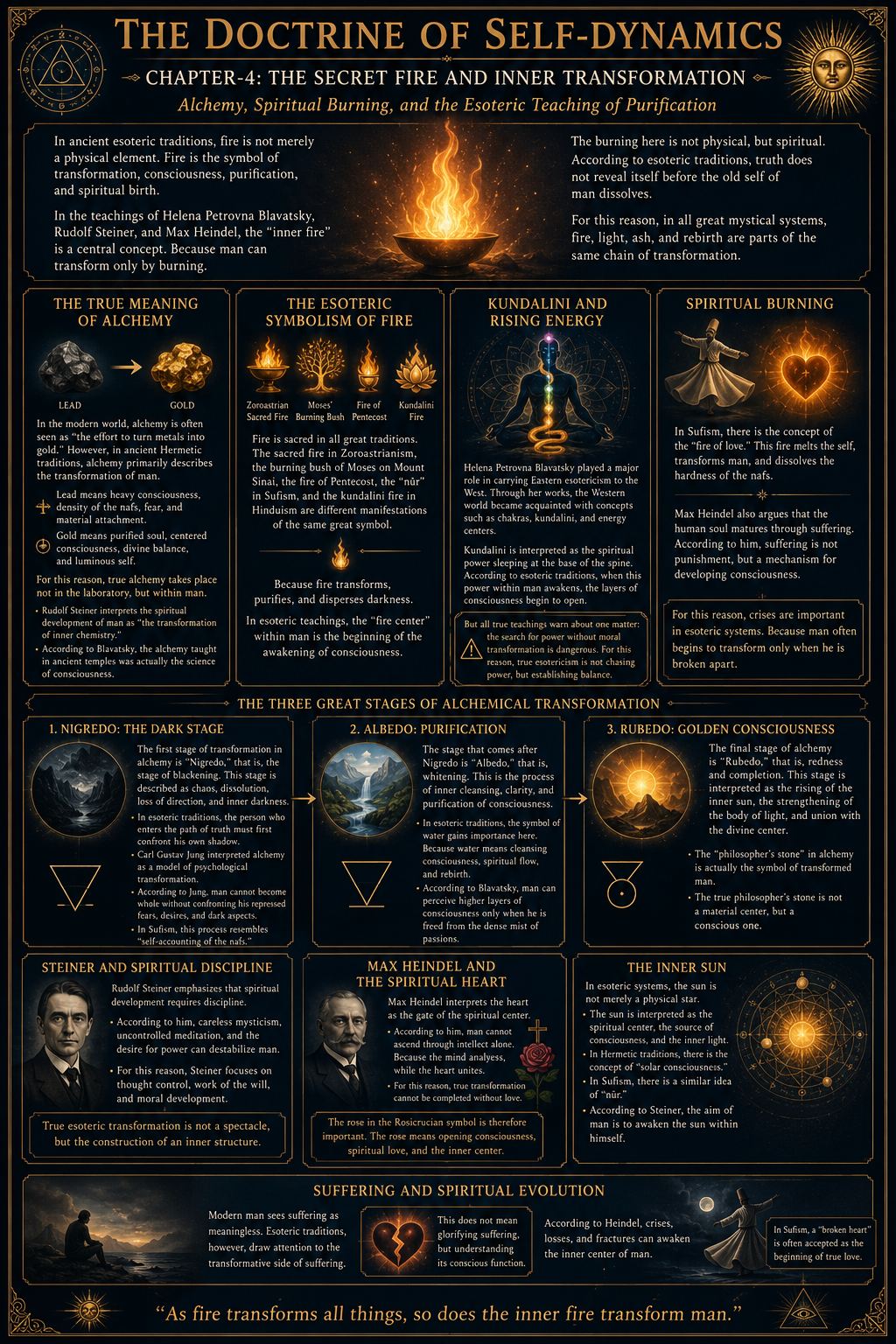
THE DOCTRINE OF SELF-DYNAMICS CHAPTER-4: THE SECRET FIRE AND INNER TRANSFORMATION. Helena Petrovna Blavatsky played a major role in carrying Eastern esotericism to the West. Through her works, the Western world became acquainted with concepts such as chakras, kundalini, and energy centers.
ÖZ-DEVİNİM KURAMI
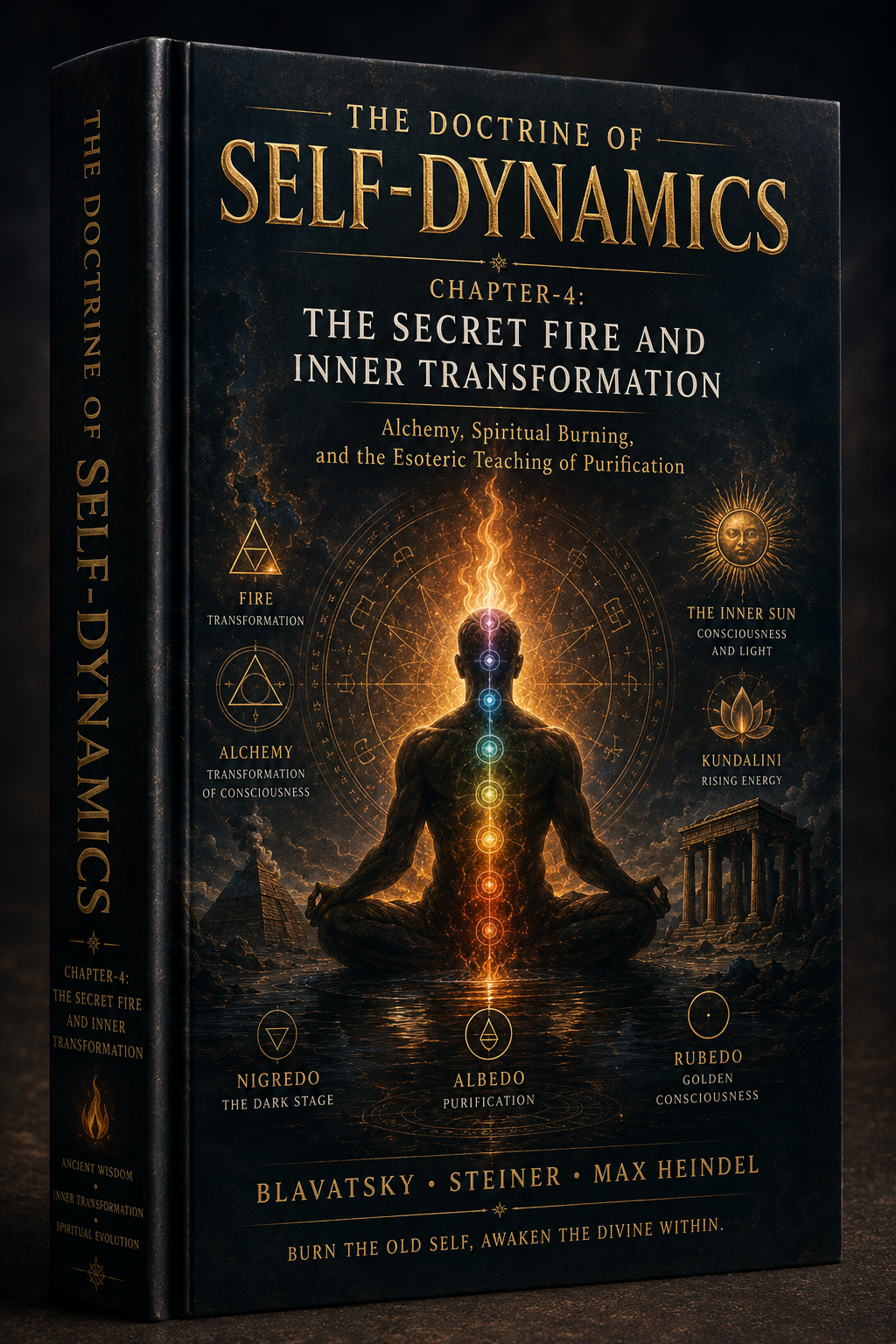
THE DOCTRINE OF SELF-DYNAMICS
CHAPTER-4: THE SECRET FIRE AND INNER TRANSFORMATION
Alchemy, Spiritual Burning, and the Esoteric Teaching of Purification
In ancient esoteric traditions, fire is not merely a physical element. Fire is the symbol of transformation, consciousness, purification, and spiritual birth.
In the teachings of Helena Petrovna Blavatsky, Rudolf Steiner, and Max Heindel, the “inner fire” is a central concept. Because man can transform only by burning.
The burning here is not physical, but spiritual. According to esoteric traditions, truth does not reveal itself before the old self of man dissolves.
For this reason, in all great mystical systems, fire, light, ash, and rebirth are parts of the same chain of transformation.
THE TRUE MEANING OF ALCHEMY
In the modern world, alchemy is often seen as “the effort to turn metals into gold.” However, in ancient Hermetic traditions, alchemy primarily describes the transformation of man.
Lead means heavy consciousness, density of the nafs, fear, and material attachment. Gold means purified soul, centered consciousness, divine balance, and luminous self.
For this reason, true alchemy takes place not in the laboratory, but within man. Rudolf Steiner interprets the spiritual development of man as “the transformation of inner chemistry.” According to Blavatsky, the alchemy taught in ancient temples was actually the science of consciousness.
THE ESOTERIC SYMBOLISM OF FIRE
Fire is sacred in all great traditions. The sacred fire in Zoroastrianism, the burning bush of Moses on Mount Sinai, the fire of Pentecost, the “nûr” in Sufism, and the kundalini fire in Hinduism are different manifestations of the same great symbol.
Because fire transforms, purifies, and disperses darkness. In esoteric teachings, the “fire center” within man is the beginning of the awakening of consciousness.
KUNDALINI AND RISING ENERGY
Helena Petrovna Blavatsky played a major role in carrying Eastern esotericism to the West. Through her works, the Western world became acquainted with concepts such as chakras, kundalini, and energy centers.
Kundalini is interpreted as the spiritual power sleeping at the base of the spine. According to esoteric traditions, when this power within man awakens, the layers of consciousness begin to open.
But all true teachings warn about one matter: the search for power without moral transformation is dangerous. For this reason, true esotericism is not chasing power, but establishing balance.
SPIRITUAL BURNING
In Sufism, there is the concept of the “fire of love.” This fire melts the self, transforms man, and dissolves the hardness of the nafs.
Max Heindel also argues that the human soul matures through suffering. According to him, suffering is not punishment, but a mechanism for developing consciousness.
For this reason, crises are important in esoteric systems. Because man often begins to transform only when he is broken apart.
NIGREDO: THE DARK STAGE
The first stage of transformation in alchemy is “Nigredo,” that is, the stage of blackening. This stage is described as chaos, dissolution, loss of direction, and inner darkness.
In esoteric traditions, the person who enters the path of truth must first confront his own shadow. Carl Gustav Jung interpreted alchemy as a model of psychological transformation. According to Jung, man cannot become whole without confronting his repressed fears, desires, and dark aspects.
In Sufism, this process resembles “self-accounting of the nafs.”
ALBEDO: PURIFICATION
The stage that comes after Nigredo is “Albedo,” that is, whitening. This is the process of inner cleansing, clarity, and purification of consciousness.
In esoteric traditions, the symbol of water gains importance here. Because water means cleansing consciousness, spiritual flow, and rebirth.
According to Blavatsky, man can perceive higher layers of consciousness only when he is freed from the dense mist of passions.
RUBEDO: GOLDEN CONSCIOUSNESS
The final stage of alchemy is “Rubedo,” that is, redness and completion. This stage is interpreted as the rising of the inner sun, the strengthening of the body of light, and union with the divine center.
The “philosopher’s stone” in alchemy is actually the symbol of transformed man. The true philosopher’s stone is not a material center, but a conscious one.
STEINER AND SPIRITUAL DISCIPLINE
Rudolf Steiner emphasizes that spiritual development requires discipline. According to him, careless mysticism, uncontrolled meditation, and the desire for power can destabilize man.
For this reason, Steiner focuses on thought control, work of the will, and moral development. True esoteric transformation is not a spectacle, but the construction of an inner structure.
MAX HEINDEL AND THE SPIRITUAL HEART
Max Heindel interprets the heart as the gate of the spiritual center. According to him, man cannot ascend through intellect alone. Because the mind analyzes, while the heart unites.
For this reason, true transformation cannot be completed without love. The rose in the Rosicrucian symbol is therefore important. The rose means opening consciousness, spiritual love, and the inner center.
THE INNER SUN
In esoteric systems, the sun is not merely a physical star. The sun is interpreted as the spiritual center, the source of consciousness, and the inner light.
In Hermetic traditions, there is the concept of “solar consciousness.” In Sufism, there is a similar idea of “nûr.” According to Steiner, the aim of man is to awaken the sun within himself.
SUFFERING AND SPIRITUAL EVOLUTION
Modern man sees suffering as meaningless. Esoteric traditions, however, draw attention to the transformative side of suffering. This does not mean glorifying suffering, but understanding its conscious function.
According to Heindel, crises, losses, and fractures can awaken the inner center of man. In Sufism, a “broken heart” is often accepted as the beginning of divine nearness. Because when the ego weakens, deeper layers of consciousness can open.
CONFRONTING THE SHADOW
One of the most difficult stages of esoteric teachings is man’s confrontation with his own shadow. The shadow consists of repressed desires, fears, arrogance, anger, and false identities.
According to Blavatsky, many people do not want truth, but power. For this reason, the true esoteric path is narrow and difficult. Because man must first transcend himself.
THE INNER TEMPLE
In ancient teachings, the temple is not merely a stone building. The true temple is within man. The initiation centers of Egypt, the Temple of Solomon, Gnostic caves, and Sufi lodges carry the same metaphor: Man cannot find truth unless he enters his own inner temple.
MODERN MAN AND THE EXTINGUISHED FIRE
The modern world weakens the inner fire of man. Systems that constantly produce distraction, consumption, speed, and superficiality fragment man’s center.
For this reason, esoteric traditions emphasize silence, rhythm, discipline, and inner observation. Because the inner fire can be heard only in silence.
CONCLUSION: THE HUMAN BORN FROM ASHES
In the teachings of Blavatsky, Steiner, and Max Heindel, true transformation is not external, but internal. Man cannot be purified without burning, cannot transform without dissolving, and cannot carry light without seeing darkness.
For this reason, fire is not only a destroying force, but also a rebirthing power.
And at the center of all true esoteric teachings lies this idea: When man awakens the secret fire within himself, he can be reborn from the ashes of his old self.
SECRET MASTERS AND THE INVISIBLE HIERARCHY
Mahatmas, Rijal al-Ghayb, and the Teaching of Cosmic Guidance
One of the most controversial and most mysterious subjects of esoteric traditions is the teaching of “secret masters.” According to ancient systems, humanity is not guided only by visible leaders. In the background of history, there is a spiritual hierarchy that is not directly visible but affects the flow of consciousness.
Although Helena Petrovna Blavatsky, Rudolf Steiner, and Max Heindel use different languages, they approach the same metaphysical idea: Humanity is not entirely abandoned.
According to esoteric traditions, invisible guidance appears sometimes through intuition, sometimes through inspiration, sometimes through great teachers, and sometimes through historical ruptures.
THE CONCEPT OF MAHATMA
In the Theosophical tradition, the word “Mahatma” means “great soul” in Sanskrit. Helena Petrovna Blavatsky especially speaks of masters named Morya and Koot Hoomi.
According to her, these figures are not ordinary people. They are carriers of higher consciousness guiding the spiritual evolution of humanity.
Blavatsky claimed that she established contact with these masters through telepathic contact, spiritual communication, and inner visions.
This caused great controversy in the Western world. Some declared her a fraud; others saw her as the continuation of the ancient chain of initiation.
But what is important here is not literal accuracy as much as the symbolic structure.
Because the teaching of the Mahatma actually carries this idea: Human consciousness is not alone.
THE IDEA OF SPIRITUAL HIERARCHY
In esoteric systems, the universe is not considered random, but layered. Therefore, minerals, plants, animals, humans, and beings of higher consciousness are parts of a chain of evolution.
Rudolf Steiner interpreted this structure as “spiritual hierarchies.” In his system, angels, archangels, archai, and beings of power represent stages of cosmic consciousness.
The concept of “angel” here is not treated only as a religious figure, but as a principle of consciousness.
According to Steiner, humanity is not alone in the universe. There is constant interaction between layers of cosmic consciousness.
SUFISM AND RIJAL AL-GHAYB
In Islamic Sufism, there is the concept of “rijal al-ghayb,” meaning “men of the unseen.”
According to this teaching, there are invisible spiritual centers such as qutbs, awtad, abdals, and ghawth.
This structure bears a remarkable parallel with the Mahatma teaching in Theosophy.
In both traditions, the ideas of invisible guidance, conscious protection, and spiritual balance come to the forefront.
However, in true Sufi teaching, these people are not seen as figures who display power, but as centers of consciousness serving truth.
THE SYMBOLIC MEANING OF SECRET MASTERS
In esoteric traditions, the master figure is not only an external person. In fact, the guide represents man’s higher self, inner guidance, and spiritual center.
For this reason, Blavatsky’s figure of “Morya” has been evaluated by some commentators as an archetype of consciousness rather than a literal person.
In Sufism, too, it is said that the true guide must direct man not to himself, but to his essence.
The true guide does not create dependency; he liberates.
STEINER AND THE LUCIFERIC–AHRIMANIC BALANCE
Rudolf Steiner speaks of two fundamental forces that affect humanity’s spiritual development: the Luciferic force and the Ahrimanic force.
The Luciferic field produces excessive mysticism, detachment from reality, and ego-centered spirituality.
The Ahrimanic field, on the other hand, creates excessive materialism, mechanical thought, and spiritual blindness.
According to Steiner, modern man must establish balance between these two extremes.
This idea bears parallels with the balance of ifrat and tafrit in Sufism, the yin-yang understanding in Taoism, and the Hermetic principle of balance.
MAX HEINDEL AND COSMIC BROTHERHOOD
Max Heindel emphasizes the idea of an “invisible brotherhood” in Rosicrucian teaching.
According to him, certain consciousnesses work for the development of humanity.
But this work is not political, not secretly organizational, but on the level of consciousness.
True esoteric guidance does not frighten man, does not take away his freedom, and returns him to his own center.
For this reason, Heindel warned against false mediumship and unconscious spiritualism.
FALSE MASTERS AND THE ESOTERIC TRAP
In ancient traditions, one of the greatest dangers is “false light.”
Because the ego can easily use the ideas of power, superiority, mystery, and chosenness.
Blavatsky says that the true esoteric path requires discipline, humility, and inner work.
Steiner emphasizes that uncontrolled mysticism can lead man into illusion.
In Sufism, too, the principle of “not miracle, but uprightness” is important.
Because true transformation is measured not by spectacle, but by the balance of consciousness.
INNER GUIDANCE
In esoteric traditions, it is thought that there is a higher center of consciousness within man.
This center has been given names such as higher self, inner guide, spiritual ego, and divine spark.
Meditation, dhikr, contemplation, and consciousness practices are used in order to hear this center.
But all true traditions unite on one matter: Inner guidance can only be heard when the ego becomes silent.
Because as mental noise increases, man moves away from his center.
TELEPATHY AND THE FIELD OF CONSCIOUSNESS
In Blavatsky and some Theosophical teachings, the concept of telepathic communication occupies an important place.
The idea here is this: Consciousnesses are not completely separate from one another.
Although modern science does not offer definitive proof, intuitive connections, experiences of synchronicity, and intense feelings have been constantly narrated throughout human history.
Esoteric traditions explain this through the idea of a shared field of consciousness.
Carl Gustav Jung’s concept of “synchronicity” also approaches this field.
INVISIBLE SCHOOLS
In ancient teachings, true knowledge was not given openly to everyone. For this reason, Egyptian temples, Pythagorean schools, Gnostic circles, Sufi lodges, and Rosicrucian communities carried the understanding of the “inner school.”
The aim here was not elitism, but preparation of consciousness.
Because according to esoteric traditions, consciousness that is not ready can misuse truth.
SPIRITUAL SERVICE
The fundamental quality of the true master figure is not power, but service.
Blavatsky’s Mahatma teaching, Steiner’s spiritual hierarchy, and Heindel’s invisible brotherhood unite at the same point: Higher consciousness tries to awaken humanity.
For this reason, great teachers aim to create awareness rather than fear, freedom rather than dependency, and consciousness rather than blind belief.
FALSE ESOTERICISM IN THE MODERN AGE
In the modern age, the idea of “secret knowledge” has largely become commercialized.
False spiritualism spreads through the feeling of chosenness, the desire for superiority, and paranormal curiosity.
Yet the true esoteric tradition requires simplification, inner discipline, and moral transformation.
In true teaching, the ego does not grow; it dissolves.
THE INVISIBLE HAND
The symbol of the “invisible hand,” frequently found in ancient traditions, carries the meanings of divine guidance, conscious protection, and spiritual direction.
This hand appears sometimes as a teacher, sometimes as an intuition, sometimes as a crisis, and sometimes as an inner calling.
According to esoteric teachings, some ruptures in human life are not coincidence.
Some events occur in order to awaken man to his center.
CONCLUSION: WHERE IS THE TRUE MASTER?
Although the teachings of Blavatsky, Steiner, and Max Heindel appear different, they move toward the same fundamental question: Who is the true guide?
The answer given by ancient esoteric traditions is surprising: The true master is guidance that begins outside but is completed inside.
As man transcends his fears, ego, and false identities, he begins to hear the silent center within himself.
And the final message of all true esoteric teachings is this: The final gate that leads man to truth is the invisible light within himself.
IX. COSMIC FALL AND HUMANITY’S FORGETFULNESS
Atlantis, Materialization, and the Loss of Spiritual Memory
In esoteric traditions, the history of humanity is not merely the rise of civilizations. On the invisible side, another story is also told: man’s distancing from his essence. According to ancient teachings, humanity initially possessed a higher state of consciousness. Man was in more direct connection with nature, the stars, and his own spiritual center. But over time, this connection weakened.
Helena Petrovna Blavatsky, Rudolf Steiner, and Max Heindel interpreted human history not only as material development, but as a process of conscious fall and re-ascent.
According to them, although modern man has advanced technically, he is spiritually fragmented.
THE IDEA OF THE GOLDEN AGE
In many ancient cultures, the “first age” is considered sacred.
The Golden Age in Greek mythology, Satya Yuga in Hinduism, the pre-eternal covenant in Sufism, the realm of light in the Gnostic tradition, and the first period of unity in the Hermetic tradition are different reflections of the same metaphysical idea.
In these narratives, man is described as being in harmony with nature, more open in consciousness, and connected with the divine center.
According to esoteric thought, the fall is not physical, but conscious.
Man forgets his essence, becomes attached to matter, and develops walls of selfhood.
Thus, the perception of unity is fragmented.
ATLANTIS: MORE THAN A LOST CONTINENT
Helena Petrovna Blavatsky and Rudolf Steiner do not interpret Atlantis merely as a physical continent.
Atlantis is the symbol of humanity’s previous level of consciousness.
In this age, man is described as being closer to intuitive perception, integrated with nature, and strong in the feeling of collective consciousness.
But over time, the desire for power emerges.
In esoteric traditions, the fundamental cause of collapse is the use of knowledge for the ego.
For this reason, the myth of Atlantis is not merely a catastrophe that occurred in the past; it is the symbol of humanity’s inner collapse.
TECHNOLOGY AND SPIRITUAL BLINDNESS
Steiner saw the excessive materialization of the modern age as a great danger.
According to him, as man develops technology, moves away from nature, and begins to think mechanically, he loses his spiritual center.
This idea has become even more visible today.
Modern man lives constantly connected, yet inwardly disconnected; full of information, yet deprived of meaning.
Esoteric traditions do not reject technology completely. The problem is not technology itself, but man’s forgetting of his spiritual center within it.
THE AHRIMANIC AGE
Rudolf Steiner interpreted modern civilization as “Ahrimanic condensation.”
Ahriman is the symbol of excessive mechanization, cold reason, soulless order, and rigid materialism.
This force pushes man to believe only in the physical, deny the spiritual dimension, and suppress inner intuition.
According to Steiner, the greatest danger of the modern age is that man considers himself only a biological machine.
THE LUCIFERIC ILLUSION
Steiner saw not only materialism, but also excessive mysticism as dangerous.
The Luciferic field produces escape from reality, ego-centered spirituality, false enlightenment, and intoxication with power.
For this reason, the true esoteric path requires balance, centering, and conscious awareness.
The principle of “uprightness” in Sufism is important here.
Because the path of truth is not in extremes, but at the center.
BLAVATSKY AND THE LOSS OF ANCIENT KNOWLEDGE
According to Blavatsky, humanity has experienced a great metaphysical loss of memory.
The symbols, geometry, rituals, and astrological knowledge of ancient temples are not accidental.
These are codes that describe the cosmic structure of man.
But over time, religions became formalized, rituals became mechanical, and symbols were forgotten.
Thus, knowledge ceased to be “living consciousness” and turned into dogma.
MAX HEINDEL AND EVOLUTIONARY SUFFERING
Max Heindel argues that humanity develops consciousness through suffering.
According to him, wars, crises, and collapses are not merely historical events.
They are collective transformations of consciousness.
In esoteric traditions, great catastrophes are associated with imbalance of consciousness, moral collapse, and deviation of power.
This is also the essence of the Atlantis narrative.
Man may possess technology; but if consciousness does not develop, he produces his own catastrophe.
THE SYMBOLIC FLOOD
Flood narratives are seen commonly in Sumerian, Torah, Qur’anic, Greek, and Mayan traditions.
In esoteric interpretation, the flood does not mean merely a physical inundation, but the cleansing of consciousness and the dissolution of the old order.
Water here is the symbol of chaos, the unconscious, and rebirth.
Humanity passes from time to time through great inner cleansings.
THE ALIENATION OF MODERN MAN
According to esoteric traditions, the greatest problem of modern man is his alienation from himself.
Man has lost nature, rhythm, silence, and the meaning of symbols.
For this reason, modern society produces speed, distracts attention, and creates constant consumption.
But the inner center of man weakens within this chaos.
For this reason, Steiner emphasized nature-based education, rhythmic life, and conscious art.
LONELINESS WITHIN THE CROWD
Modern man lives among crowds more than ever before in history; yet at the same time, he is passing through one of his loneliest periods.
Esoteric traditions explain the reason as follows: Man has lost his inner center while living within the collective network.
For this reason, constant speech, constant images, and constant information cover man’s spiritual silence.
Silence is therefore sacred in ancient teachings.
Because the voice of truth cannot be heard in noise.
THE BEGINNING OF SPIRITUAL AWAKENING
According to esoteric traditions, the dark periods of humanity are also opportunities for transformation.
Crisis is not only fragmentation, but also the gate of rebirth.
Blavatsky thought that humanity would remember ancient knowledge again.
Steiner argued that the conscious individual would form the new human type in the future.
Heindel believed that spiritual evolution was inevitable.
THE IDEA OF THE NEW HUMAN
In esoteric systems, the “new human” is not biological, but conscious transformation.
This human will be more centered, more aware, in harmony with nature, and possessing spiritual balance.
In Sufism, this is called “insan al-kamil.”
In the Hermetic tradition, “solar human.”
In Rosicrucian teaching, “rose-cross human.”
All point to the same ideal of transformation.
THE AWAKENING OF INNER MEMORY
According to esoteric teachings, humanity is not completely lost.
Cosmic memory is still within man.
For this reason, some symbols feel familiar, some places awaken deep feelings, and some teachings feel as if they are being “remembered.”
Because truth is not learned entirely from outside.
A part of it is remembered from within.
CONCLUSION: FROM FALL TO ASCENT
Blavatsky, Steiner, and Max Heindel interpreted the history of humanity as a cycle of ascent, forgetfulness, and reawakening.
According to them, the modern age is not the end, but a transitional period.
Humanity is passing through excessive materialism, fragmentation of consciousness, and spiritual forgetfulness.
But the common message of esoteric traditions carries hope: Man has not completely lost his essence.
And when man can find the silent center within himself again, the lost memory can awaken once more.
THE SECRET OF LETTERS AND COSMIC SOUND
Hurufism, Kabbalah, Logos, and the Vibrational Language of Creation
In ancient esoteric traditions, letters are not merely written signs. Each letter carries vibration, consciousness, and creative power. Modern man uses words as tools of communication; however, according to the Hermetic tradition, Kabbalah, Hurufism, Theosophy, and Rosicrucian teachings, sound and letters are among the fundamental building blocks of the universe.
In the teachings of Helena Petrovna Blavatsky, Rudolf Steiner, and Max Heindel, the universe is also interpreted as a vibrational, rhythmic, and conscious structure. For this reason, the “word” is not merely sound. It is the form through which cosmic order becomes manifest.
“IN THE BEGINNING WAS THE WORD”
The famous expression in Christian mysticism is as follows: “In the beginning was the Word.”
The “Word” here is based on the Greek concept of “Logos.” Logos means cosmic reason, creative vibration, and the consciousness that orders the universe.
In esoteric traditions, creation is seen as a movement of thought, sound, and vibration.
The command “Kun” in Sufism, meaning “Be,” also approaches the same metaphysical idea.
Creation here is not physical construction, but the condensation of conscious vibration.
THE ESOTERIC POWER OF LETTERS
In ancient systems, letters are sacred. Because every letter carries a certain vibration, numerical value, and principle of consciousness.
In Kabbalah, Hebrew letters are accepted as the building blocks of creation.
In Hurufism, even the human face is associated with letters.
In Hermetic traditions, sacred alphabets are thought to carry cosmic energy.
Helena Petrovna Blavatsky argued that ancient alphabets did not arise randomly. According to her, ancient civilizations knew the connection between sound, number, and symbol.
KABBALAH AND THE LETTERS OF CREATION
According to “Sefer Yetzirah,” one of the fundamental texts of Kabbalah, the universe was created with letters.
The idea here is this: the letter is vibration, vibration produces form, and form gives birth to matter.
For this reason, Hebrew letters were associated with planets, elements, and layers of consciousness.
In esoteric interpretation, God’s “speaking” does not mean a literal sound, but creative frequency.
HURUFISM AND THE HUMAN FACE
One of the most striking movements in Islamic esotericism is Hurufism.
In the Hurufi tradition, letters, numbers, the human face, and the cosmos are considered connected to one another.
In particular, symbolic connections were established between the 28 Arabic letters, the 28 lunar mansions, and the lines on the human face.
The purpose here is not literal mathematics, but to show that man is the mirror of cosmic order.
The Sufi understanding that “man is a small universe” is also seen here.
STEINER AND THE SPIRITUAL EFFECT OF SOUND
Rudolf Steiner gave great importance to sound. According to him, sound carries not only physical vibration, but spiritual movement.
For this reason, Steiner worked on speech rhythms, poetic intonation, and music.
The system of “Eurythmy” that he developed aimed to reveal the spiritual connection between movement and sound.
According to Steiner, when man speaks, he does not merely produce words; he creates a field of consciousness.
MAX HEINDEL AND COSMIC VIBRATION
Max Heindel placed the vibrational structure of the universe at the center of Rosicrucian cosmology.
According to him, thoughts, prayers, music, and intentions create effects upon the cosmic field.
For this reason, hymns, rhythmic prayers, and mantras were used in ancient temples.
Because it was believed that sound had a transformative effect on human consciousness.
MANTRA AND DHIKR
There are remarkable parallels between mantra in Indian teaching and dhikr in Sufism.
In both traditions, repetition, rhythm, and sound vibration are accepted as instruments of the transformation of consciousness.
According to esoteric traditions, the human mind is scattered. Rhythmic sound centers the mind, reduces inner noise, and balances the field of consciousness.
For this reason, the repetition of sacred names is thought to carry a different effect from ordinary speech.
THE RELATIONSHIP BETWEEN NUMBER AND LETTER
In ancient systems, letters also carry numerical values. For this reason, systems such as Gematria, Abjad, and isopsephy developed.
The purpose here is not simple numerology.
Esoteric traditions try to establish a connection between number, sound, symbol, and consciousness.
For example, the number 7 may represent stages of consciousness, 12 the cosmic cycle, and 28 the fields of creative vibration.
THE HUMAN VOICE AND CONSCIOUSNESS
In esoteric traditions, the human voice is accepted as a carrier of spiritual energy. For this reason, tone, emphasis, and rhythm are important.
According to Steiner, mechanical speech weakens man’s spiritual center.
The fact that poetry was considered sacred in ancient traditions is also related to this.
Poetry changes the rhythm of consciousness, opens a symbolic field, and breaks the linear structure of the mind.
For this reason, mystical texts are often poetic.
THE COSMIC ALPHABET
In Hermetic traditions, the universe is seen as a “living book.”
This book is written with stars, symbols, numbers, and sounds.
According to Blavatsky, ancient priests saw astronomy, mathematics, music, and metaphysics as a single system of knowledge.
The modern age, however, divided knowledge into parts.
Esoteric traditions try to reunite these parts.
SECRET NAMES
In many esoteric systems, the concept of the “true name” is important. Because the name is considered connected with the essence.
This is why some names were kept secret in ancient traditions.
In Egypt, it was believed that the person who knew one’s true name gained power.
In Kabbalah, sacred names were used carefully.
In Sufism, too, some names are thought to carry a state of consciousness, spiritual effect, and vibrational center.
THE MODERN WORLD AND THE COLLAPSE OF THE WORD
In the modern age, words have multiplied excessively; yet the depth of meaning has weakened.
According to esoteric traditions, constant speech, superficial communication, and rapid consumption disturb man’s inner rhythm.
For this reason, silence is important in ancient teachings.
Because the true word is born from silence.
POETRY AND ESOTERIC LANGUAGE
Esoteric traditions often use symbol, poetry, and metaphor instead of direct explanation.
Because some realities cannot be fully explained through plain logic.
Sufi poetry, Hermetic texts, Gnostic hymns, and Rosicrucian symbols carry the same approach.
The purpose here is not so much to give information as to awaken consciousness.
THE INNER VOICE
In the teachings of Blavatsky, Steiner, and Heindel, true guidance ultimately turns toward the inner center of man.
Ancient traditions say that outer voices must decrease, the mind must become calm, and inner awareness must increase.
Because the deepest voice of truth is heard in man’s own center.
CONCLUSION: IS THE UNIVERSE A VIBRATION?
The common view of esoteric traditions is this: the universe is not silent, unconscious, or without vibration.
Everything is founded upon sound, rhythm, number, and vibration.
And man is not only a speaking being, but also the living echo of the cosmic Word.
THE WORLD OF MIRRORS AND THE SECRET SCIENCE OF SYMBOLS
Hermetic Reflections, Archetypes, and the Esoteric Interpretation of the Visible Universe
According to esoteric traditions, the world is not as it appears. Man often assumes the material universe to be the final reality; however, according to Hermetic thought, Theosophy, Anthroposophy, and Rosicrucian teaching, the physical world is the shadow of a deeper truth.
Helena Petrovna Blavatsky, Rudolf Steiner, and Max Heindel interpreted the universe as a network of symbols, a mirror of consciousness, and a multilayered system of reflection.
According to them, the visible world is the projection of the invisible order.
“AS ABOVE…”
One of the most fundamental principles of the Hermetic tradition is as follows: “As above, so below.”
This sentence is not merely an astrological expression.
What is described here is the connection between the microcosm and the macrocosm.
Man is the small universe. The universe is the great human.
For this reason, stars, the body, consciousness, nature, and symbols are not separate from one another.
Esoteric traditions argue that the universe is a holistic organism.
THE MIRROR STRUCTURE OF THE UNIVERSE
In Hermetic thought, the world is a “mirror.”
Man often sees reflections of his own inner state in the outer world.
For this reason, fears, desires, and patterns of consciousness are considered not only psychological, but vibrational.
Rudolf Steiner argued that human consciousness actively shapes the world.
Although this idea is sometimes associated with modern quantum interpretations, Steiner’s approach was not physical, but metaphysical.
According to him, man does not merely observe the world; he also produces meaning.
THE LANGUAGE OF SYMBOLS
Esoteric traditions use symbols rather than direct speech.
Because certain realities cannot be defined; they can only be indicated.
For this reason, symbols such as the circle, triangle, cross, spiral, eye, sun, mountain, and sea repeat universally.
Carl Gustav Jung explained these symbols through the concept of the “archetype.”
According to Jung, humanity carries shared patterns of consciousness.
Esoteric traditions, however, argue that these symbols carry not only psychological meaning, but cosmic meaning as well.
THE CIRCLE: ETERNITY AND UNITY
The circle is the symbol of movement without beginning, unity, and eternity.
For this reason, images such as the sun, the eye, the mandala, and the halo are circular.
The movement of tawaf in Sufism, mandalas in Buddhism, and solar symbols in Hermeticism are connected to the same idea of the center.
The circle represents unfragmented truth, the divine center, and wholeness.
THE TRIANGLE AND SPIRITUAL ASCENT
In esoteric traditions, the triangle carries the meanings of balance, ascent, and the union of consciousness.
The upward-facing triangle represents fire, spirit, and ascent.
The downward-facing triangle symbolizes water, matter, and descent.
When these two triangles unite, the six-pointed star that emerges expresses the union of heaven and earth and the intersection of man and the divine.
THE ESOTERIC MEANING OF THE CROSS
Max Heindel gives great importance to the symbol of the cross in Rosicrucian teaching.
In esoteric interpretation, the cross is not so much a symbol of suffering as it is a symbol of the descent of the soul into matter.
The vertical line is the spiritual axis. The horizontal line is worldly experience.
The intersection of these two axes is the point where man stands.
In the rose-cross symbol, the blooming rose represents transformed consciousness and spiritual unfolding.
THE MIRROR AND THE SHADOW
In esoteric systems, the “shadow” is an important concept.
The shadow means repressed aspects, fears, subconscious desires, and unaccepted sides.
According to Jung, man cannot become whole without knowing his shadow.
In Sufism, this is seen as self-accounting of the nafs and inner confrontation.
Blavatsky says that on the path of truth, man will first encounter his own darkness.
Because light becomes visible only when darkness is recognized.
IS NATURE A BOOK?
According to esoteric traditions, nature is not lifeless, but a symbolic organism that carries consciousness.
The Hermetic tradition says, “Nature is a living book.”
Steiner interpreted plants not merely as biological organisms, but as beings that carry spiritual structure.
For this reason, flowers, colors, stones, and animals carry symbolic meanings.
The alignment of ancient temples with nature is not a coincidence.
DREAMS AND SYMBOLIC CONSCIOUSNESS
In esoteric traditions, dreams are interpreted as subconscious messages, astral experiences, and symbolic communication.
According to Blavatsky, when man sleeps, he does not merely rest; consciousness can move on other planes.
Steiner says that dreams carry fragmented symbols and spiritual impressions.
In Sufism, some dreams have been evaluated as “true dreams.”
Because symbols may sometimes be the language not of the mind, but of deeper consciousness.
THE ESOTERIC MEANING OF COLORS
In esoteric traditions, colors represent states of consciousness.
Red means life force, will, and fire.
Blue means intuition, depth, and spiritual openness.
Gold means divine consciousness, the spiritual center, and the sun.
Black means mystery, dissolution, and the Nigredo stage.
Steiner believed that colors carried spiritual effects.
For this reason, he gave importance to the use of color in art and architecture.
MANDALA AND CENTER
In many esoteric traditions, central patterns are found.
The mandala is interpreted as a map of consciousness, the spiritual center, and inner order.
The geometric structure within the circle represents the re-centering of the fragmented mind.
The movement of sama in Sufism similarly expresses turning around the center.
THE COSMIC THEATER
In esoteric traditions, the world is sometimes described as a stage, a dream, or a theater.
The purpose here is not to belittle the world.
What is meant is that visible reality is not absolute.
Man plays roles, develops identities, and wears masks.
But truth is beyond these masks.
In Sufism, these are called “veils.”
THE CORRUPTION OF SYMBOLS
The modern age has largely made symbols superficial.
In ancient traditions, the symbol was a gate of consciousness.
Now it has often become decoration, fashion, and an object of consumption.
According to Blavatsky, when the true meaning of symbols is forgotten, civilization turns into only an outer shell.
INNER READING
Esoteric traditions say that symbols must be read not only outside, but within man.
The true temple is within man.
True symbols are movements of consciousness.
And the true journey is not to conquer the outer world, but to cleanse the inner mirror.
CONCLUSION: DOES THE UNIVERSE SPEAK?
According to the common understanding of Blavatsky, Steiner, and Max Heindel, the universe is not silent, meaningless, or random.
Nature, dreams, numbers, colors, letters, geometry, and the human face are parts of the same great language.
What esoteric traditions say is this: Man does not only look at the world. The world also speaks to human consciousness.
And the person who can read symbols begins to perceive the hidden order behind the visible universe.