THE DOCTRINE OF SELF-DYNAMICS CHAPTER-40: The Seven Energetic Bodies, the Architecture of Consciousness, and the Doctrine of Returning to the Center
THE DOCTRINE OF SELF-DYNAMICS CHAPTER-40: The Seven Energetic Bodies, the Architecture of Consciousness, and the Doctrine of Returning to the Center. The Upper Triad consists of the Spirit, Sekine (Shekinah-Spenta Armaiti-Holy Spirit), and Lord layers.
ÖZ-DEVİNİM KURAMI
THE DOCTRINE OF SELF-DYNAMICS
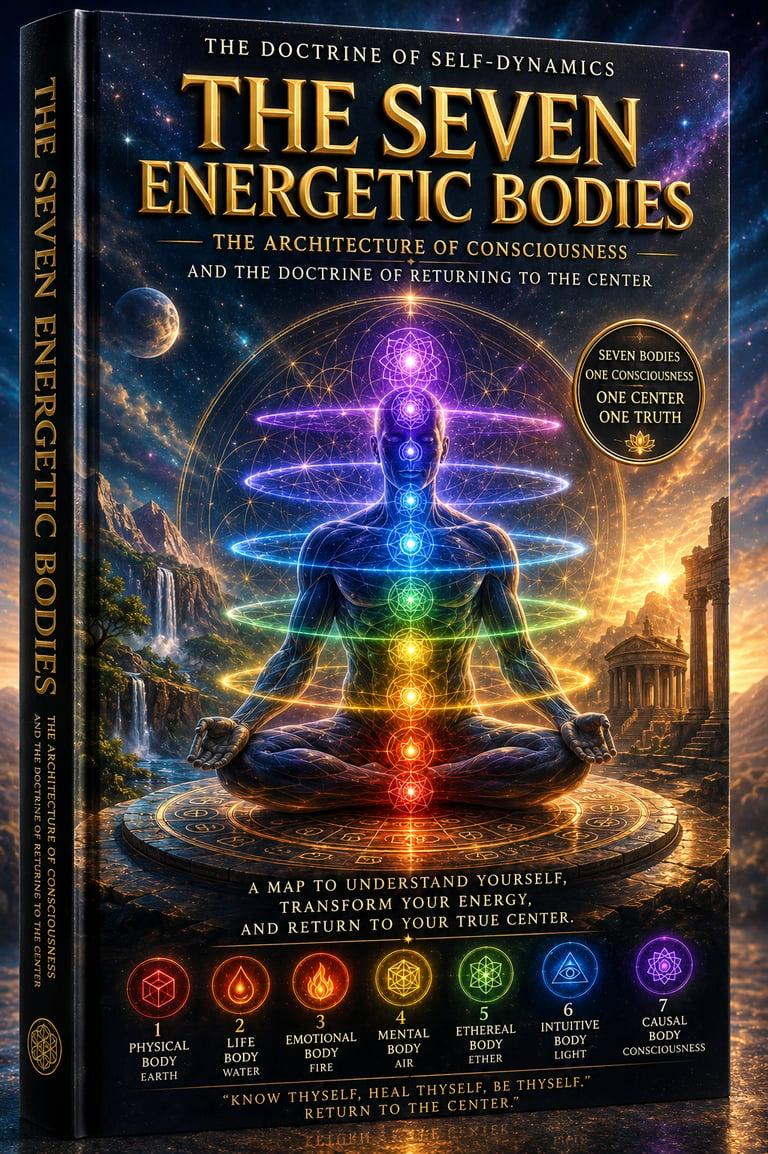
CHAPTER-40: The Seven Energetic Bodies, the Architecture of Consciousness, and the Doctrine of Returning to the Center
THE THEORY OF THE SEVEN ENERGETIC BODIES
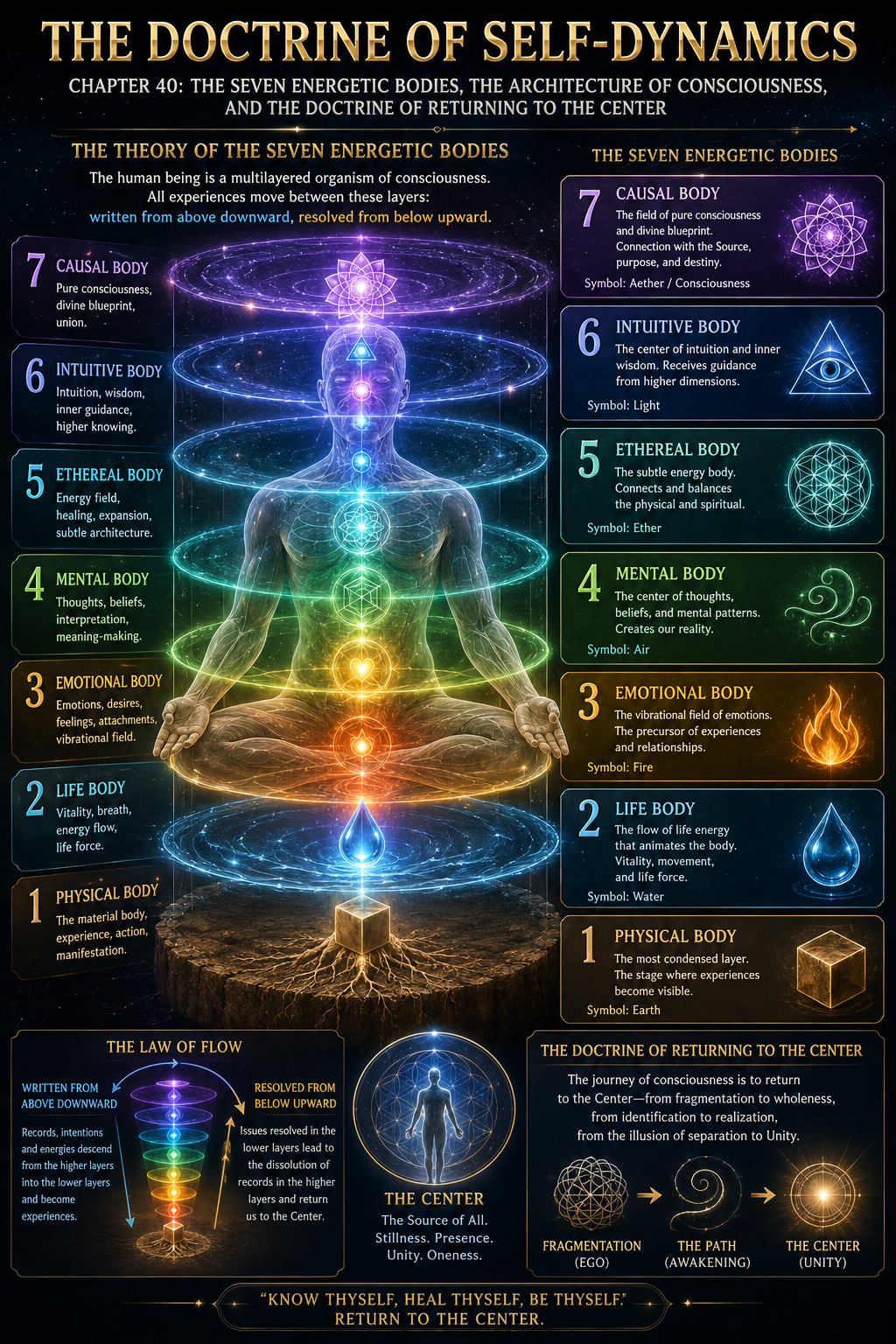
According to The Doctrine of Self-Dynamics, the human being is not a single-layered entity. The physical body is only the visible face. Behind the visible body exist seven fundamental fields of consciousness and energy that are interconnected. These fields are not independent structures; they are different levels of density of the same being. The human being is a multilayered organism of consciousness that emerges through the simultaneous operation of these seven layers.
All experiences encountered throughout life move between these layers. Processes that begin as records in the higher layers become visible as events in the lower layers. Problems resolved in the lower layers lead to the dissolution of records in the higher layers. Thus, the human being lives within a continuous flow of consciousness that is written from above downward and resolved from below upward.
THE PHYSICAL BODY
The physical body is the most condensed and slowest-vibrating layer of consciousness. Most people identify themselves solely with this body. However, the physical body is not the beginning of the system but its result. The records of consciousness formed in the upper layers ultimately become visible within the physical body.
The fundamental function of the physical body is to materialize experience. Thoughts become behavior here, emotions become biological reactions here, and energy flows are reflected in organic structures here. The physical body is, in a sense, the image of the consciousness system projected onto a screen.
Disturbances within this layer generally manifest as illnesses, chronic pain, bodily weaknesses, unexplained disorders, and constantly recurring physical problems. According to The Doctrine of Self-Dynamics, these are not merely biological events; they are the final links of imbalances that have formed in higher layers.
From the perspective of karma, the physical body is the stage upon which past records of consciousness become visible. A theme unresolved within consciousness may, over time, become an experience within the body.
Symbolically, the physical body corresponds to the element of earth. Just as earth is the field where all seeds become visible, the physical body is the field where the seeds of consciousness become visible.
THE LIFE BODY
The life body is the flow of energy that animates the physical body. Breath, vitality, movement, endurance, productivity, and the power to remain connected to life are found within this layer.
Sometimes a person may be physically healthy and yet constantly feel exhausted. Sometimes one may experience burnout despite expending very little energy. The reason is often disturbances in the flow of the life body.
The task of the life body is to transfer energy from the upper layers to the physical body. This layer is like a river. When the flow is healthy, a person feels alive. When the flow is disrupted, life itself begins to become difficult.
Disturbances within this layer appear as low energy, chronic fatigue, lack of motivation, feelings of disconnection from life, and experiences of continual obstruction.
From the perspective of karma, the life body is the field in which previously created flows return. Patterns of consciousness that hinder the development of others, restrict their living space, or create energetic exploitation may be rebalanced at this level.
Its symbolic counterpart is water. Just as water continuously seeks to flow, life also seeks constant movement. When the flow stops, deterioration begins.
THE EMOTIONAL BODY
The emotional body is the vibrational field of consciousness records. Fear, anger, love, compassion, desire, jealousy, attachment, and surrender arise here.
Emotions are often misunderstood. People view them merely as psychological reactions. However, according to The Doctrine of Self-Dynamics, emotion is the precursor of events. An experience first arises as a vibration within emotion and later reflects into life.
The primary function of the emotional body is to set consciousness into motion. Where there is no emotion, experience does not deepen. Yet suppressed emotions gradually intensify and eventually become destiny.
Disturbances within this layer manifest as cycles of fear, addictions, outbursts of anger, persistent feelings of abandonment, feelings of worthlessness, and recurring emotional patterns.
From the perspective of karma, the emotional body carries the warm traces of past experiences. A person often continues to live today, as emotion, experiences that were not understood in the past.
Its symbolic counterpart is fire. For just as fire transforms, burns, and purifies, so do emotions.
THE MENTAL BODY
The mental body is the center of reality production. A human being does not see the external world as it is; one sees only as much as the mind allows.
Beliefs, judgments, thought patterns, mechanisms of interpretation, and processes of meaning-making take place here.
The fundamental task of the mental body is to give meaning to experiences. However, when the mind occupies the center, a person begins to live not the truth but one's own interpretations.
Disturbances within this layer manifest as obsessions, excessive judgment, rigid thought patterns, delusions, disconnection from reality, and mental noise.
From the perspective of karma, the mental body is the form that past records have taken as patterns of thought. Most of the time, a person is not living events themselves but rather old records about those events.
Its symbolic counterpart is air. Just as air is invisible yet fills everything, thoughts also influence the entirety of life.
THE SPIRIT BODY
The spirit body is the center of being. The core that makes a human being human is found here.
Self-awareness, witnessing, an inner sense of direction, a feeling of meaning, and intuition of truth are the fundamental characteristics of the spirit body.
When the spirit is active, a person does not become lost within life. While experiencing events, one can simultaneously observe them. This capacity for observation forms the center of consciousness.
Disturbances within the spirit body appear as aimlessness, a sense of meaninglessness, loss of identity, a persistent feeling of emptiness, and existential crises.
From the perspective of karma, the spirit body is the center of the fundamental lessons carried by individual consciousness. The main themes of a person's life are preserved here.
Its symbolic counterpart is the sun. For all lower layers receive their light from the center of the spirit.
THE SEKINE (SHEKINAH-SPENTA ARMAITI-HOLY SPIRIT) BODY
The Sekine (Shekinah-Spenta Armaiti-Holy Spirit) body is the center of balance within the system. Here, peace is not an emotion but a state of order.
Sekine (Shekinah-Spenta Armaiti-Holy Spirit) serves as a bridge between the upper and lower layers. The inner integrity of a human being depends upon the healthy functioning of this layer.
When Sekine (Shekinah-Spenta Armaiti-Holy Spirit) is active, a person can preserve one's center even under difficult circumstances. Even if there is a storm outside, balance remains within.
Disturbances within this layer are seen as constant restlessness, inner fragmentation, loss of direction, spiritual turbulence, and chronic dissatisfaction.
From the perspective of karma, the Sekine (Shekinah-Spenta Armaiti-Holy Spirit) body is the center to which areas of imbalance are recalled. Whatever area consciousness has lost its measure in, Sekine (Shekinah-Spenta Armaiti-Holy Spirit) draws attention to that area.
Its symbolic counterpart is the sky. Just as the sky contains all weather phenomena within itself, Sekine (Shekinah-Spenta Armaiti-Holy Spirit) balances all layers within itself.
THE LORD BODY
The Lord Body is the foundation of the entire system. This layer is the core field in which records of consciousness are preserved and destiny is generated.
No experience is ever lost here. Every thought, every emotion, and every action is preserved as a seed. When the time arrives, these seeds unfold and become life experiences.
The primary function of the Lord Body is to preserve universal balance. For this reason, the mechanisms of karma, retribution, and atonement originate here.
Disturbances within this layer are not directly visible. However, they reveal themselves as continually recurring problems within the lower layers.
From the perspective of karma, the Lord Body is the recording center of all karmas. Nothing is punished here; everything is merely brought into balance.
Its symbolic counterpart is light. For this is the source of all layers. Just as light makes the visible world possible, the Lord Body is the reason for the existence of all layers of consciousness.
As a result, the human being is not merely a body composed of flesh and bone. The human being is a multidimensional system of consciousness formed by the combined operation of the physical, life, emotional, mental, spirit, Sekine (Shekinah-Spenta Armaiti-Holy Spirit), and Lord layers. All experiences encountered throughout life are the result of movement between these layers. When a person begins to know oneself, one is in fact beginning to discover the relationship between these seven bodies. True self-dynamics also begins here.
THE UPPER TRIAD
The visible aspect of the human being lives within the lower layers; this is the part that thinks, feels, moves, and generates experience in bodily form. However, the true core that makes a human being human is located at a higher level. In The Doctrine of Self-Dynamics, this core is called the Upper Triad. The Upper Triad consists of the Spirit, Sekine (Shekinah-Spenta Armaiti-Holy Spirit), and Lord layers. Together they form the divine axis of the human being.
The Upper Triad is not the direct producer of experience; its task is to give meaning to what is experienced and to comprehend it. The actual living and production of experience takes place within the Lower layers. The Lower layers move, feel, think, and act within the flow of life. In contrast, the Upper layers represent the field of consciousness that observes, comprehends, and guides what is experienced.
While the Lower layers exist within the field of movement and change, the Upper layers provide direction to that movement. The Lower layers are born, develop, and transform within the flow of time, whereas the Upper layers preserve a continuity that extends beyond time. Therefore, while the Lower layers create the experience of life, the Upper layers carry the meaning, purpose, and wholeness of that experience. Within the human being these two structures are not separate from one another but are different functions of a complementary whole; one lives, the other knows; one moves, the other guides; one experiences within time, the other preserves continuity beyond time.
The Spirit is the center of the Upper Triad. When a person asks, “Who am I?”, the part seeking answers is not the spirit; the part observing the answers is the spirit. For the spirit is not an identity. The spirit is the center that observes identities. Throughout life a person may assume many roles. One becomes a child, an adult, a parent, a student, a teacher. Yet while all these roles change, there remains an unchanging point of witnessing. The spirit is that point.
Sekine (Shekinah-Spenta Armaiti-Holy Spirit) is the field of balance that prevents the awareness carried by the spirit from dispersing. A person may sometimes know what is right yet fail to find peace. One may possess knowledge yet remain uncentered. For knowledge does not create balance. Balance is produced by Sekine (Shekinah-Spenta Armaiti-Holy Spirit). Sekine (Shekinah-Spenta Armaiti-Holy Spirit) is the invisible axis of the consciousness system. Without it, the spirit cannot function harmoniously with the lower layers.
The Lord layer is the deepest dimension of the Upper Triad. The Lord is the field of record that exists beyond individual consciousness. All experiences in a human life are preserved here as seeds. The field of the Lord is not merely a memory that stores the past. It is also the seed of all experiences that will unfold in the future. Therefore destiny is not written here; it is generated here.
When the Upper Triad functions together, the human being becomes a centered being. The Spirit provides direction, Sekine (Shekinah-Spenta Armaiti-Holy Spirit) creates balance, and the Lord preserves continuity. In such a state, a person does not merely live; one knows that one is living. One does not merely think; one can observe one's own thinking. One does not merely feel; one can become aware of feelings without being lost within them.
The true humanity of a person begins at the point where the Upper Triad becomes active.
THE LOWER QUATERNARY
The Lower Quaternary consists of the mental, emotional, life, and physical layers. These are the instruments through which a human being relates to the world. Human experience takes place within these layers. One sees, feels, thinks, moves, and encounters consequences through them.
Human life experience in the world cannot occur without the Lower Quaternary. For all processes of thinking, feeling, generating energy, and physical action arise through these layers. However, the Lower Quaternary is not the essence of the human being itself; it is merely the system of instruments through which a person expresses and experiences oneself.
The first layer of this structure, the mental layer, interprets experiences and attempts to give them meaning. The emotional layer provides energy and direction to experiences. The life body transforms this energy into movement and maintains the continuity of vitality. The physical body makes it possible for all these processes to appear upon a visible and concrete plane. Thus all functional aspects of humanity’s relationship with the world are realized through the Lower Quaternary.
In the natural and balanced order, the Lower Quaternary is guided by the Upper Triad. While the Upper Triad represents the essence of the human being, awareness, and the enduring center of consciousness, the Lower Quaternary forms the operational instruments of that center within the world. Yet one of the greatest illusions in human history is that the instruments gradually begin to replace the center itself.
In this condition, a person believes that thoughts are the self. Yet thoughts are structures produced and processed by the mind. A person believes that emotions are the self; however, emotions are energetic movements that accompany experiences. A person believes that the body is the self; yet the body is merely the worldly appearance of being. Thus the instrument and the essence exchange places, and a person begins to assume that the systems one uses are the center of one’s existence.
This displacement causes the disruption of inner balance. When the mind begins to provide direction, interpretations replace truth. When emotions begin to provide direction, balance is lost and a person falls under the influence of momentary fluctuations. When the body begins to provide direction, meaning recedes into the background, and life begins to revolve solely around physical needs.
Yet the task of the Lower Quaternary is not to govern but to carry. These layers resemble the wheels of a carriage. Without wheels, movement is impossible; however, the wheels cannot decide the direction in which the carriage will travel. Although they provide movement, the center that determines direction is located elsewhere. Within the inner world of the human being, that center is the Upper Triad.
For this reason, the foundation of all inner conflicts experienced by human beings lies in the disruption of the natural balance between the Upper Triad and the Lower Quaternary. When the instruments begin to govern and the center begins to withdraw, a person becomes distanced from one's own essence. In contrast, a Lower Quaternary functioning under the guidance of the Upper Triad enables a person both to experience life in the world in a healthy manner and to preserve self-awareness. Thus a person can live within time while maintaining a connection with the meaning and continuity that transcend time.
WHY DOES A HUMAN BEING LOSE THE CENTER?
A person does not lose the center at birth. The loss of the center is a gradual process. Most of the time, this process occurs unnoticed.
The first cause of losing the center is identification.
A person begins to identify with one's instruments instead of using them. One accepts thoughts as absolute reality. One assumes emotions to be the measure of truth. One sees the body as the entirety of one’s existence.
Thus consciousness is gradually drawn into the outer layers.
The second cause is fear.
Fear narrows consciousness. A narrowed consciousness begins to lose its connection with the upper layers. When a person becomes focused solely on survival, the spirit withdraws and the lower systems take control.
The third cause is desire.
At first, desire produces movement. However, when it gradually takes the place of the center, it binds a person to the objects of the external world. When a person begins to define oneself through possessions, the essential center is forgotten.
The fourth cause is unconscious repetition.
The constant repetition of the same thoughts, emotions, and behaviors causes the system to become mechanical. Mechanical consciousness loses awareness. When awareness is lost, the center becomes invisible.
The loss of the center is not a sudden event; it is a slow process that usually occurs unnoticed. During this process, a person gradually becomes less capable of perceiving the guidance arising from one's own essence. The quiet yet profound guidance of the spirit increasingly recedes into the background. Following this, Sekine (Shekinah-Spenta Armaiti-Holy Spirit), that is, the state of inner peace and balance, begins to weaken. A person finds it increasingly difficult to preserve the inner wholeness and tranquility that once felt natural.
As the connection with the center weakens, the voice of the mind grows stronger. Thoughts multiply, analyses deepen, and interpretations follow one another. The mind ceases to be an instrument and begins to transform into a center that seeks to direct life. As the noise of the mind increases, emotions also intensify. Anxieties, desires, fears, expectations, and reactions occupy increasingly more space within the inner world. As the intensity of emotions increases, the flow of life energy also loses its balance.
In time, this condition is reflected in the body. The body becomes heavier, movements become mechanical, and the experience of life is increasingly drawn into the limitations of the physical world. Attention becomes directed entirely toward external stimuli; possessions, events, and external circumstances begin to overshadow inner truth.
At the end of the process, a person transforms from a center of consciousness carrying one's essence into a system that merely reacts to the external world. Life continues, thoughts persist, emotions are felt, and the body moves; yet the center that gives meaning, direction, and unity to all of these has retreated into the background. Thus a person forgets one's essential being and begins to live within the world created by one's instruments. This is the essence of the loss of the center: the silencing of the essence and the assumption of control by the instruments.
THE THEORY OF FRAGMENTATION
Fragmentation is not the division of the human being into different parts. Fragmentation is the beginning of the parts moving independently from the center.
In a healthy and balanced system, all layers function in harmony around a common axis. At the center of this structure is the spirit. While the spirit carries the fundamental orientation of being and self-awareness, Sekine (Shekinah-Spenta Armaiti-Holy Spirit) preserves the balance around this center. The mind serves as an instrument that interprets and gives meaning to what is experienced. Emotion gives energy and vitality to experiences. While the life body transforms this energy into flow, the physical body makes the entire process visible and concrete. In such an order, each layer fulfills its own function; none interferes with the domain of another.
However, when the process of fragmentation begins, this harmony is disrupted. Instead of functioning around a single center, the system begins to divide into substructures that attempt to move on their own. The mind accepts its own interpretations as absolute reality and constructs a world of its own. Emotions place their own desires and reactions at the center. The body, by turning its needs into the ultimate purpose, attempts to determine the direction of being. Thus, the essential center begins to be replaced by numerous temporary and false centers.
This condition appears in the inner world of the human being as contradictions. A person may carry opposite orientations at the same time. One side wants to move forward while another side clings to fear. One side turns toward love while another side tries to withdraw. One side sees the truth while another side denies it. These opposing movements actually show that more than one center has formed within a single system.
Inner conflict is the first and most obvious sign of fragmentation. For conflict arises from the attempt of parts pulled in different directions to become active at the same time. As fragmentation deepens, the energy of the human being also begins to disperse. The system is no longer governed from a single center; different layers and substructures turn toward different aims and act in competition rather than harmony with one another. As a result, consciousness moves away from being a holistic and harmonious structure and turns into a scattered operation formed by subsystems struggling against one another.
For this reason, the essence of fragmentation is not a war. The real issue is the loss of unity. For war is only one of the results that appears after unity has been disrupted. The real problem is the weakening of the common axis that enables all layers to function in connection with the same center. When unity is preserved, different layers complete one another; when unity is lost, the same layers begin to conflict with one another. The inner wholeness of the human being becomes possible not by eliminating the layers, but by allowing each of them to function in its proper place and in harmony around a common center.
THE COLLAPSE OF CONSCIOUSNESS AND THE LOSS OF ESSENCE
The following section has been transformed into prose while preserving the same academic and philosophical style as the previous texts:
The final stage of the process of fragmentation is the collapse of consciousness. However, the collapse of consciousness does not mean, as is often assumed, that a person loses the ability to think or the accumulation of knowledge. It essentially refers to the loss of the spiritual center. At this point, a person may still think, feel, work, and maintain a functional life within society. From the outside, such a person may appear to continue life normally. Yet beneath this visible continuity, a deeper change has taken place: the essential axis of being has been lost.
When the axis of essence weakens, the human being begins to seek the meaning of life in the external world rather than finding it in the inner center. The pursuit of new experiences, new achievements, new relationships, and new identities is often a result of this search. For the center lost within is attempted to be regained through objects and events outside. Yet by its very nature, the center cannot be found outside. No matter how far a person goes, what one seeks is the center of one's own essential being, and this center never exists among the objects of the external world.
As the collapse of consciousness deepens, the spirit begins to withdraw. The inner balance provided by Sekine (Shekinah-Spenta Armaiti-Holy Spirit) dissolves, the bond established with the Lord field weakens, and the system increasingly comes to depend solely on the operation of the Lower Quaternary. The mind continues to think, emotions continue to flow, the life body produces movement, and the physical body continues its activities in the world. Yet all of this now takes place within a structure without a center.
At this stage, a person lives but cannot fully know why one lives. One moves but is not aware of the direction in which one is going. One desires but cannot define what one is seeking. For the guiding center has fallen silent, while the instruments have begun to move on their own. Thus life continues, yet the axis that holds together the meaning of life is lost.
For this reason, from the perspective of The Doctrine of Self-Dynamics, salvation does not mean acquiring new information or constructing more complex systems of thought. Salvation is the return to the center. For the fundamental problem of the human being is not a lack of knowledge, but having become distanced from one's own essential center. No matter how much knowledge a person possesses, if the connection with the center has been severed, that knowledge will continue to remain scattered within the fragmented system.
The loss of essence is therefore not an end, but a call. This call is an inner invitation that directs the human being back toward one's own center. When a person remembers the spirit again, reestablishes Sekine (Shekinah-Spenta Armaiti-Holy Spirit), and reopens the connection with the Lord field, the process of fragmentation begins to reverse. The elements of consciousness that had previously dispersed in different directions gather once again around a center. Gathered consciousness gains strength; consciousness that gains strength returns to its own essential axis.
Consciousness that returns to the center also begins to comprehend the true meaning of self-dynamics. In this understanding, the purpose of being is not to conquer the external world, to bring everything under control, or to accumulate an infinite number of experiences. The true purpose is for the human being to bring together again the parts that have dispersed within, to reestablish inner unity, and to make all layers harmonious around a single center. For true wholeness does not arise from domination outside, but from the reestablishment of unity within. When this unity is established, the human being does not merely live; one also knows why one lives. Thus consciousness reunites with its own essential source, and the movement of being begins once again to flow from the center toward the circumference.
FOOTNOTES
1. The “Seven Energetic Bodies Model” defined in The Doctrine of Self-Dynamics is the author’s original approach to the architecture of consciousness.
2. Carl Gustav Jung, Aion: Researches into the Phenomenology of the Self, Princeton: Princeton University Press, 1978, pp. 3-42.
3. Ken Wilber, The Spectrum of Consciousness, Wheaton: Quest Books, 1993, pp. 15-57.
4. Roberto Assagioli, Psychosynthesis, New York: Penguin Books, 1975, pp. 21-84.
5. William James, The Varieties of Religious Experience, New York: Modern Library, 2002, pp. 301-347.
6. Abraham Maslow, Toward a Psychology of Being, New York: Wiley, 1999, pp. 53-112.
7. Stanislav Grof, Psychology of the Future, Albany: SUNY Press, 2000, pp. 67-124.
8. Toshihiko Izutsu, Sufism and Taoism, Berkeley: University of California Press, 1984, pp. 97-145.
9. Muhyiddin Ibn Arabi, al-Futuhat al-Makkiyya, trans. Ekrem Demirli, Istanbul: Litera Publishing, 2006, vol. II, pp. 213-255.
10. Annemarie Schimmel, Mystical Dimensions of Islam, Chapel Hill: University of North Carolina Press, 1975, pp. 189-246.
11. Frithjof Schuon, The Transcendent Unity of Religions, Wheaton: Quest Books, 1993, pp. 45-89.
12. René Guénon, Man and His Becoming According to the Vedanta, Hillsdale: Sophia Perennis, 2001, pp. 17-64.
13. Sarvepalli Radhakrishnan, The Principal Upanishads, New Delhi: HarperCollins, 1994, pp. 93-154.
14. George Ivanovich Gurdjieff, Views from the Real World, London: Routledge, 1984, pp. 25-77.
15. P. D. Ouspensky, In Search of the Miraculous, New York: Harcourt Brace, 1949, pp. 43-121.
16. Mircea Eliade, Shamanism: Archaic Techniques of Ecstasy, Princeton: Princeton University Press, 2004, pp. 51-104.
17. Henry Corbin, Creative Imagination in the Sufism of Ibn Arabi, Princeton: Princeton University Press, 1969, pp. 177-236.
18. Seyyed Hossein Nasr, Knowledge and the Sacred, Albany: SUNY Press, 1989, pp. 205-261.
19. Ken Wilber, Integral Psychology, Boston: Shambhala, 2000, pp. 5-73.
20. Carl Gustav Jung, Psychology and Alchemy, Princeton: Princeton University Press, 1980, pp. 17-98.
21. Roberto Assagioli, The Act of Will, New York: Viking Press, 1973, pp. 89-132.
22. Stanislav Grof, The Adventure of Self-Discovery, Albany: SUNY Press, 1988, pp. 113-178.
23. Abraham Maslow, Religions, Values and Peak Experiences, New York: Penguin Books, 1994, pp. 56-99.
24. Jean Gebser, The Ever-Present Origin, Athens: Ohio University Press, 1985, pp. 43-116.
25. Huston Smith, Forgotten Truth, New York: HarperOne, 1992, pp. 61-118.
26. William Chittick, The Self-Disclosure of God, Albany: SUNY Press, 1998, pp. 75-146.
27. Ervin Laszlo, Science and the Akashic Field, Rochester: Inner Traditions, 2007, pp. 33-94.
28. Fritjof Capra, The Tao of Physics, Boston: Shambhala, 2010, pp. 181-236.
29. Mircea Eliade, A History of Religious Ideas, Chicago: University of Chicago Press, 1978, vol. I, pp. 1-65.
30. In The Doctrine of Self-Dynamics, the “Doctrine of Returning to the Center” is the fundamental transformation model that expresses the reintegration of the human being’s layers of consciousness.
BIBLIOGRAPHY
Assagioli, Roberto. Psychosynthesis. New York: Penguin Books, 1975.
Assagioli, Roberto. The Act of Will. New York: Viking Press, 1973.
Capra, Fritjof. The Tao of Physics. Boston: Shambhala, 2010.
Chittick, William. The Self-Disclosure of God. Albany: SUNY Press, 1998.
Corbin, Henry. Creative Imagination in the Sufism of Ibn Arabi. Princeton: Princeton University Press, 1969.
Eliade, Mircea. A History of Religious Ideas. Chicago: University of Chicago Press, 1978.
Eliade, Mircea. Shamanism: Archaic Techniques of Ecstasy. Princeton: Princeton University Press, 2004.
Gebser, Jean. The Ever-Present Origin. Athens: Ohio University Press, 1985.
Grof, Stanislav. Psychology of the Future. Albany: SUNY Press, 2000.
Grof, Stanislav. The Adventure of Self-Discovery. Albany: SUNY Press, 1988.
Guénon, René. Man and His Becoming According to the Vedanta. Hillsdale: Sophia Perennis, 2001.
Gurdjieff, G. I. Views from the Real World. London: Routledge, 1984.
Ibn Arabi, Muhyiddin. al-Futuhat al-Makkiyya. Trans. Ekrem Demirli. Istanbul: Litera Publishing, 2006.
Izutsu, Toshihiko. Sufism and Taoism. Berkeley: University of California Press, 1984.
James, William. The Varieties of Religious Experience. New York: Modern Library, 2002.
Jung, Carl Gustav. Aion. Princeton: Princeton University Press, 1978.
Jung, Carl Gustav. Psychology and Alchemy. Princeton: Princeton University Press, 1980.
Laszlo, Ervin. Science and the Akashic Field. Rochester: Inner Traditions, 2007.
Maslow, Abraham. Religions, Values and Peak Experiences. New York: Penguin Books, 1994.
Maslow, Abraham. Toward a Psychology of Being. New York: Wiley, 1999.
Nasr, Seyyed Hossein. Knowledge and the Sacred. Albany: SUNY Press, 1989.
Ouspensky, P. D. In Search of the Miraculous. New York: Harcourt Brace, 1949.
Radhakrishnan, Sarvepalli. The Principal Upanishads. New Delhi: HarperCollins, 1994.
Schimmel, Annemarie. Mystical Dimensions of Islam. Chapel Hill: University of North Carolina Press, 1975.
Schuon, Frithjof. The Transcendent Unity of Religions. Wheaton: Quest Books, 1993.
Wilber, Ken. Integral Psychology. Boston: Shambhala, 2000.
Wilber, Ken. The Spectrum of Consciousness. Wheaton: Quest Books, 1993.