THE DOCTRINE OF SELF-DYNAMICS CHAPTER-41:The Unified Theory
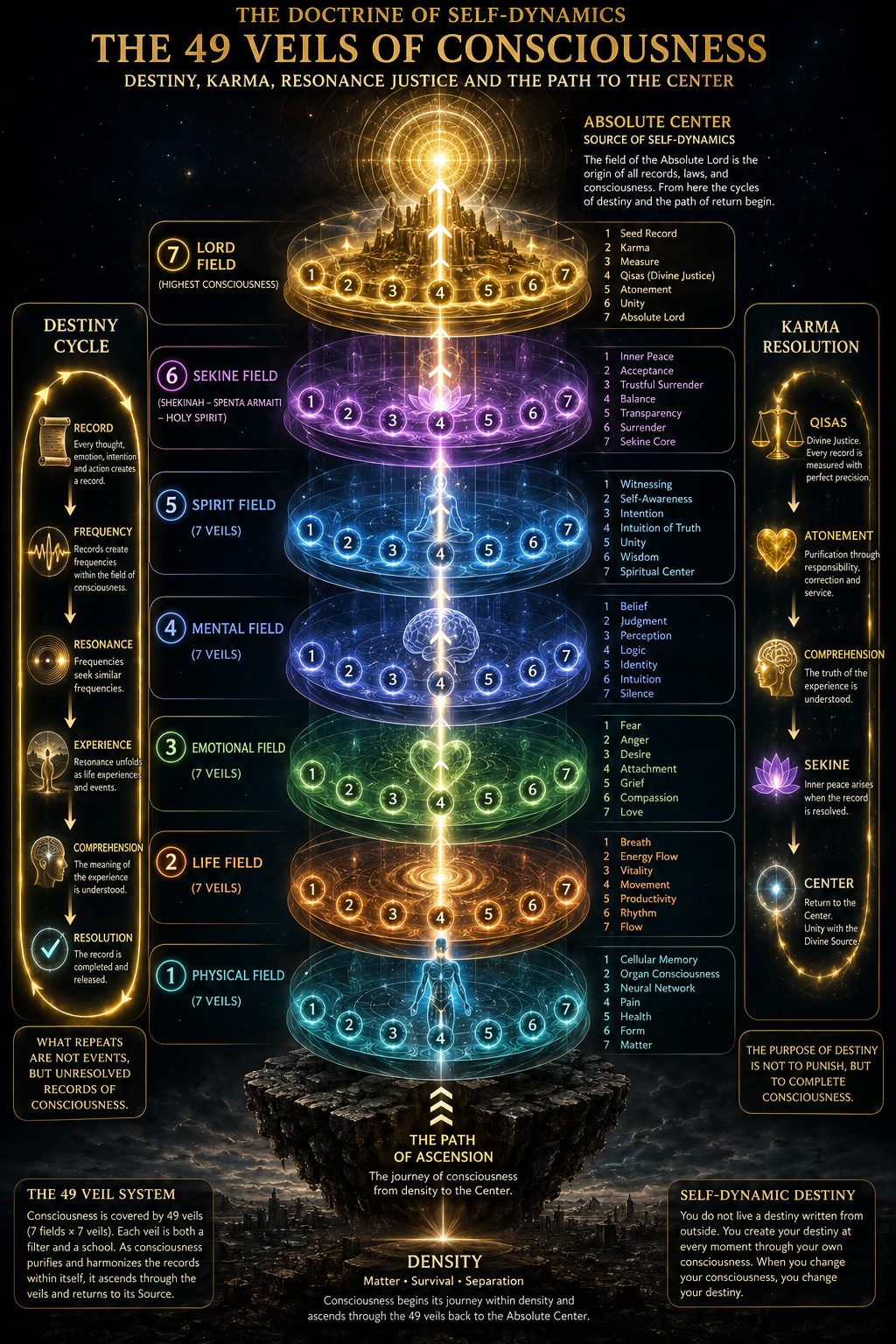
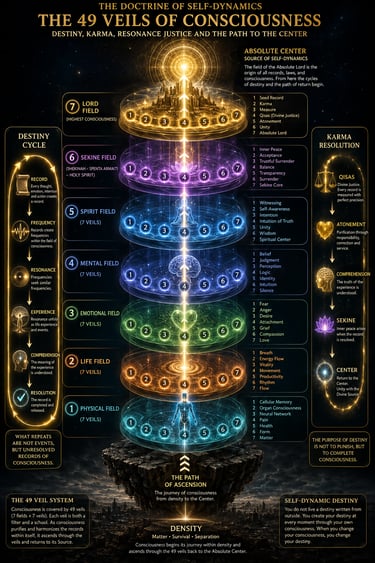
THE DOCTRINE OF SELF-DYNAMICS CHAPTER-41:The Unified Theory. .THE 7×7 MATRIX OF CONSCIOUSNESS Each of the seven primary bodies contains seven sub-layers within itself, and this multi-layered structure forms an extensive matrix of consciousness..
ÖZ-DEVİNİM KURAMI
THE DOCTRINE OF SELF-DYNAMICS
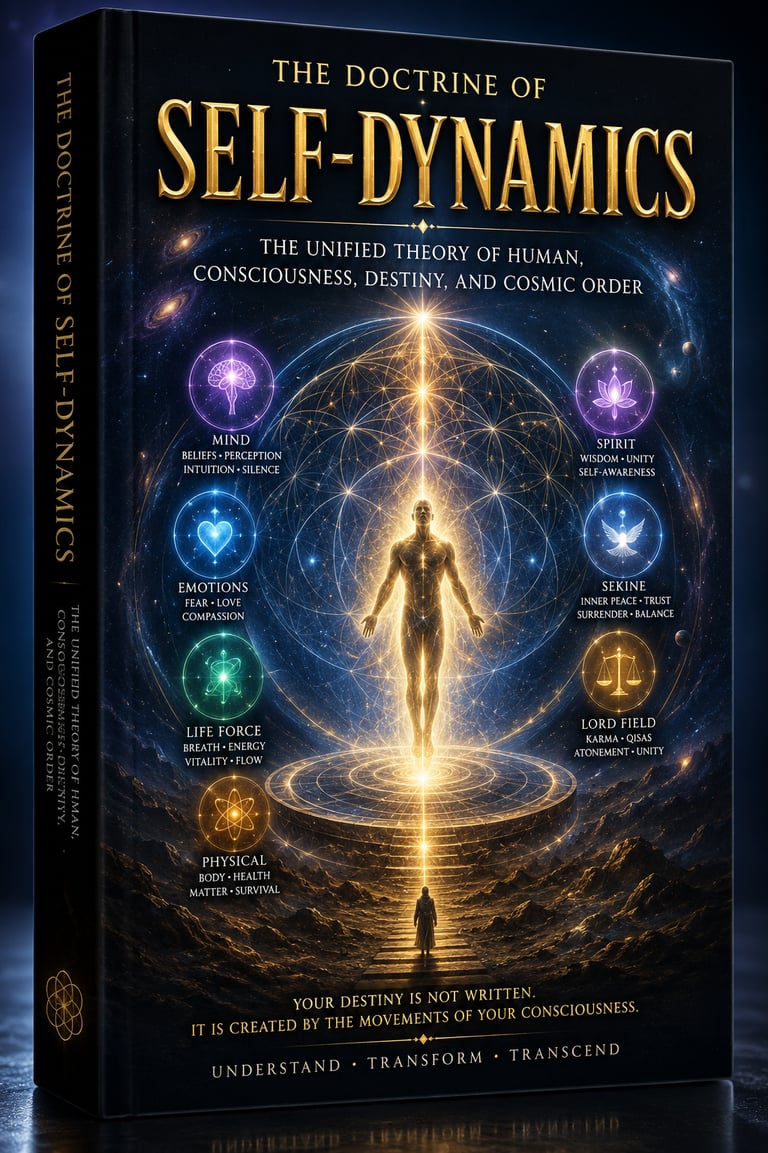
CHAPTER-41: The Unified Theory of Human, Consciousness, Destiny, and Cosmic Order
THE TRUE DEFINITION OF DESTINY
One of the oldest questions in human history is what destiny truly is. Most people think of destiny as the sum of events determined before a person is born and incapable of being changed. According to this understanding, life is nothing more than the gradual unfolding of a previously written script. A person believes that they are making choices, but in reality, they are only following a path that has already been determined for them. In such a perspective, human freedom becomes largely an illusion. However, when the concept of destiny is examined more deeply, it becomes clear that this understanding leaves many questions unanswered. If everything has already been predetermined, what is the meaning of learning? If all outcomes have been decided from the beginning, why does consciousness develop? If a human being is merely an actor in a script, upon what foundation does responsibility rest?
The Doctrine of Self-Dynamics approaches the concept of destiny from a different perspective. According to this doctrine, destiny is not a fate written from the outside. Destiny is the unfolding over time of the records that consciousness creates within itself. Throughout life, human beings do not merely produce events; they also leave traces within the field of consciousness. Every thought, every emotion, every intention, and every action creates a record within unseen layers. These records do not immediately become visible in the physical world. Just as a seed placed in the soil waits for the proper time, records of consciousness remain hidden until suitable conditions emerge. Later, when specific conditions appear, they unfold and become visible as experience.
For this reason, destiny is not something that exists in the future. Destiny is the totality of records hidden within the depths of consciousness that become visible when their time arrives. Most people attempt to explain the events they experience through external causes. They see the people they encounter, the circumstances they find themselves in, or coincidences as the cause. Yet all of these are merely the final stages of a process that originated much deeper. The visible event is not the cause but the last link. The true cause is the record that was formed much earlier within the field of consciousness.
At the foundation of the theory of records lies the following principle: No movement of consciousness is ever lost in the universe. Every orientation, every intention, and every experience leaves an imprint within the deep structure of existence. These imprints preserve not only actions themselves but also the state of consciousness behind those actions. For the universal system records not behaviors, but frequencies of consciousness. This is why two people who perform the same action may encounter different outcomes. Although their actions appear similar from the outside, the level of consciousness behind them differs. The system responds not to the form of the action but to the quality of consciousness it carries.
At this point, the concept of self-dynamic destiny emerges. Self-dynamic destiny is the guidance of a human being by the movements of their own consciousness. A person does not create destiny once and then live it; they recreate it at every moment. Every thought generates a new frequency. Every emotion establishes a new direction. Every choice produces new records. Thus destiny ceases to be a frozen structure and becomes a dynamic system in constant motion. Existence unconsciously constructs its own future and later begins to live within the structures it has created.
This understanding differs from the classical model of cause and effect. The cause-and-effect model is successful in explaining the functioning of the physical world, yet it remains insufficient in explaining processes within the field of consciousness. This is because many human experiences appear to have no physical cause. Unexplainable fears, causeless attractions, recurring relationship patterns, or repeatedly encountered life experiences cannot be explained solely through physical causes. The Doctrine of Self-Dynamics explains this situation through the record-unfolding model.
According to the record-unfolding model, every experience first exists as a record. This record waits within unseen layers. Later, when it encounters similar frequencies, it becomes active and unfolds as experience. The individual lives through this experience, interprets it, and confronts it. If the meaning carried by the experience is understood, the record dissolves. If it is not understood, the record closes again and unfolds in different forms at other times. For this reason, many repetitions observed in life are not coincidences. What repeats are not events, but unresolved records of consciousness.
Human freedom emerges precisely at this point. Freedom is not the absence of records. Freedom is the ability to become aware of those records. As consciousness begins to perceive the mechanisms within itself, it gradually frees itself from their bondage. An unseen record is lived as destiny. A seen record becomes knowledge. An understood record is dissolved. Thus destiny ceases to be an unavoidable necessity and becomes an instrument of the development of consciousness.
According to The Doctrine of Self-Dynamics, the purpose of destiny is not to punish human beings. The purpose of destiny is to complete consciousness. The recurring events of life do not arise to condemn a person to suffering but to complete what remains lacking in understanding. For the universal system is concerned not with events but with consciousness. Events are temporary. Consciousness is enduring. Therefore, destiny is not a list of things that will happen; it is the unfolding of records of consciousness waiting to be understood.
In conclusion, destiny is not a script written from the outside but the visible manifestation of consciousness's own self-dynamics. Human beings are not victims of destiny. Human beings are the carriers of their own records of consciousness. Every experience encountered throughout life is a reflection of these records. And humanity's true freedom lies not in escaping destiny but in understanding the records that create destiny. For an understood record dissolves, a dissolved record does not reproduce itself, and consciousness that no longer reproduces such records ultimately reaches its own center.
THE ESOTERIC INTERPRETATION OF QISAS
Throughout history, the concept of qisas has often been evaluated within a narrow framework. In common understanding, qisas has been interpreted as the return of an action in the same form in which it was committed. However, within The Doctrine of Self-Dynamics, qisas is not a system of punishment but a mechanism for balancing consciousness.
The purpose of the universal system is not to produce suffering. Its purpose is to complete what remains lacking in consciousness. Therefore, qisas is not the return of the same behavior but the manifestation of the truth that remained unseen during the act itself.
When a person belittles another, the system is not obligated to make that person be belittled in return. Instead, it may create experiences through which the individual questions their own perception of worth. For the purpose is not humiliation but the completion of understanding.
When a person restricts another's freedom, the system does not return the exact same behavior. Instead, it may create conditions through which the meaning of freedom can be experienced.
This is why qisas often appears severe on the surface. Human beings see only the outer face of the experience they undergo. Yet the system is concerned not with the event itself but with the content of consciousness carried within the event.
Within The Doctrine of Self-Dynamics, qisas is not treated as a traditional mechanism of punishment or retribution. In this approach, qisas is defined as the re-encounter of an incomplete or unfinished state of consciousness with the frequency it has itself produced. For every thought, every emotion, and every action leaves a specific imprint within the field of consciousness. These imprints not only produce consequences in the external world but also remain recorded within the structure of consciousness itself.
For this reason, the encounters experienced by human beings are not evaluated as a simple system of reward and punishment but as a process through which incomplete understanding within consciousness is brought to completion. A person is not required to experience the exact same thing they caused another to experience. The essential matter is reaching a level of awareness capable of comprehending the state of consciousness they created in another person, together with its effects and consequences. The purpose of qisas is not the replication of experience but the completion of consciousness.
Within this perspective, qisas is completely separated from the concept of revenge. While revenge perpetuates the opposition between the one who is harmed and the one who causes harm, qisas allows truth to become visible. For only when a person sees the true nature of the state of consciousness they have produced can they confront it. This confrontation is not an externally imposed punishment but the natural result of the balancing mechanism established within existence itself.
Therefore, qisas is not a system of retaliation based on one person harming another; it is the process through which consciousness encounters the meaning of its own actions. When a person comprehends the true nature of the thoughts, emotions, and behaviors they direct toward others, the incomplete awareness begins to be completed. Thus qisas becomes an expression not of punishment but of understanding; not of revenge but of the revelation of truth. And when truth becomes visible, consciousness gains the opportunity to understand the results it has produced and once again move toward balance and wholeness.
RESONANCE JUSTICE
Modern humanity generally thinks of justice in terms of laws, rules, and sanctions. However, in The Doctrine of Self-Dynamics, justice is not merely a mechanism that maintains social order; it is a fundamental principle embedded within existence itself. According to this understanding, the universe operates not through visible events but through the frequencies of consciousness that lie behind them. Justice emerges within the natural order of these frequencies.
At the foundation of this process lies resonance. Resonance is the attraction and interaction of similar frequencies. Rather than matching events, individuals, or external circumstances, the universal system brings together the frequencies carried within the field of consciousness. For this reason, recurring experiences in a person's life are often not coincidences. Although their appearances may differ, they carry the same conscious theme.
A person who continuously carries a fear of abandonment may experience similar separations at different times and with different people. Someone who carries a deep sense of worthlessness may encounter events under various conditions that bring forth the same feeling again. A consciousness that misuses power may repeatedly confront themes of power, authority, and control throughout different periods of life. For the system establishes connections not between people but between frequencies.
This is the principle upon which resonance justice is built. This justice is not a mechanical accounting system. It is alive, dynamic, and functions differently within every individual. For each person's structure of consciousness, carried records, and inner patterns are different. The universal order applies the same principles, but the resulting experiences take unique forms within each consciousness.
The most important characteristic of resonance justice is that it is not based upon punishment. The system does not punish a person; it confronts a person with their own field of consciousness. The events encountered in life are often not external coincidences but the visible manifestations of records residing within. Over time, a person begins to realize that many things seen in the external world are reflections of their own structure of consciousness.
At this point, justice ceases to be a judgment imposed from the outside and becomes a cycle of consciousness turning back upon itself. Whatever a person has produced, they encounter; whatever they have amplified, they make visible; and what becomes visible awaits understanding and transformation. Thus justice emerges not as the decision of an external authority but as a movement of balance established by existence within itself.
THE CONSCIOUS MECHANICS OF ATONEMENT
Within The Doctrine of Self-Dynamics, qisas and atonement represent two different modes of learning within the same process. Qisas is the learning of consciousness through experience. A person gains awareness by encountering the consequences of a state of consciousness they have not yet understood. Atonement is the conscious form of the same learning. The individual is no longer affected merely by the events they experience; they begin to perceive the meaning those events carry.
When this awareness emerges, the system enters a new stage. Rather than continually producing challenging experiences for consciousness to learn from, the mechanism of conscious transformation becomes active. The process of atonement begins when a person starts to recognize their own deficiencies, errors, or imbalances.
Atonement is not the payment of a penalty for a wrongdoing; it is the completion of an incomplete consciousness. This process does not occur solely through behavior; it begins first at the level of consciousness. A person turns toward understanding the essence, causes, and consequences of what they have done. Then they begin to produce new behaviors aligned with this understanding. In this way, old patterns of consciousness dissolve and are replaced by new structures.
For example, a consciousness that once generated selfishness may begin to understand the meaning of sharing. A consciousness accustomed to exerting pressure may come to feel deeply the value of freedom. A consciousness that conditions love upon circumstances may learn to release love and accept unconditionally. What is decisive here is not the magnitude of the actions but the quality of the awareness that carries them.
For atonement is not a debt-payment system. It is a transformation of consciousness. When a person ceases to identify with the frequency that created the old records, those records begin to dissolve. Change occurs not as an externally imposed obligation but as an inner restructuring arising from within.
Therefore, atonement is essentially the name of the new relationship a person establishes with themselves. An individual does not merely change their behaviors; they transform themselves. As consciousness changes, choices change; as choices change, the flow of life changes. Thus destiny ceases to be a fixed and unchangeable fate and begins to take new forms as the natural result of a transforming consciousness.
From the perspective of The Doctrine of Self-Dynamics, justice, qisas, and atonement are not separate mechanisms. All of them are different expressions of a single process of transformation through which consciousness moves from fragmentation to wholeness, from unconsciousness to awareness, and from the loss of the center to a return to the center. When a person begins to see and transform the disorder within themselves, justice ceases to be a judgment sought outside and becomes a living balance operating within existence. A consciousness that reaches this balance begins to perceive not only the events it experiences but also the meaning behind those events. Thus self-dynamics becomes not merely the name of movement, but also the name of conscious transformation.
THE RESOLUTION OF KARMA THROUGH COMPREHENSION
Within The Doctrine of Self-Dynamics, the highest stage of karmic resolution is comprehension. For comprehension is the capacity of consciousness to understand a truth without being required to experience it directly. Throughout much of human history, learning has occurred through experience. Mistakes were made, consequences were lived, suffering was endured, and certain truths were understood at the end of these processes. For this reason, experience has been one of the primary tools of the development of consciousness. However, when consciousness reaches a certain maturity, a higher form of learning emerges. The name of this new stage is comprehension.
At the level of comprehension, consciousness turns not toward the outer appearance of events but toward the meaning and mechanism they carry within their essence. Thus learning ceases to be a result that follows experience and becomes something that can occur before experience itself. A person begins to learn not only through what they live but also through what they see, understand, and intuit. Just as a person can understand the burning nature of fire without touching it, consciousness can grasp the nature of certain consequences without having to experience them directly.
At this point, karma begins to dissolve before becoming concrete events in the physical world. The record carried within the field of consciousness becomes visible, is recognized, and is understood. A record that is understood ceases to move unconsciously. For what drives it is its unseen and incomplete nature. When consciousness fully comprehends it, the record dissolves and begins to lose its influence. Thus karma ceases to be a predetermined line of destiny that must inevitably be lived and becomes a movement of consciousness that can be transformed through awareness.
For this reason, comprehension is regarded within The Doctrine of Self-Dynamics as the highest form of freedom. A person is no longer a being carried along by events but becomes the observer of their own consciousness. A consciousness capable of seeing the causes, origins, and directions of what is experienced is not compelled to repeat them blindly. Thus it rises from being a prisoner of experiences to becoming one who perceives and transforms their meaning.
As comprehension increases, the influence of destiny decreases. For within this doctrine, destiny is understood as the movement of records that have not yet been understood. Every record that has not been fully seen and resolved within consciousness continues to generate new experiences in order to express itself. However, when the record is understood, its movement ceases. A dissolved record produces no new events; and a consciousness that produces no new repetitive events begins to step outside recurring cycles.
Therefore, when karma ends, it does not truly disappear; rather, it fulfills its purpose. For the purpose of karma is not to punish or produce suffering. Its purpose is to complete consciousness, make visible the awareness that remains lacking, and make learning possible. When consciousness reaches the necessary understanding, karma becomes silent. Silent karma gives way to Sekine (Shekinah-Spenta Armaiti-Holy Spirit). And Sekine (Shekinah-Spenta Armaiti-Holy Spirit) is the state of inner balance that carries a human being back to their essential center.
One of the deepest principles of The Doctrine of Self-Dynamics also emerges here. Qisas teaches consciousness through experience; a person learns by confronting consequences. Atonement teaches consciousness through transformation; a person begins consciously balancing the deficiencies they have recognized. Comprehension teaches without requiring demonstration; for truth is grasped directly without the need for experience. Therefore, the highest freedom is not to experience every lesson of life one by one, but to understand them by perceiving their essence. The maturation of consciousness occurs not through the multiplication of necessary experiences but through the clearer perception of truth. A person becomes free to the extent that they can understand without being required to live through everything; as they become free, they approach the center; and as they approach the center, they begin to comprehend more deeply the inner wholeness of existence itself.
WHAT IS A VEIL?
One of the most fundamental concepts of The Doctrine of Self-Dynamics is the concept of the veil. In traditional thought, a veil has often been understood as an obstacle that conceals truth. However, in the meaning used here, a veil is not a wall that hides truth but a filter that makes truth transportable and experienceable.
Absolute truth is limitless. Human consciousness, however, is limited. It is impossible for that which is limited to perceive the limitless directly. Therefore, layers are placed between consciousness and truth. These layers do not exist to conceal reality but to make it experienceable.
Just as one cannot look directly at the sun, one cannot look directly at absolute truth. The atmosphere refracts light, softens it, and makes it livable. Veils perform the same function. Consciousness experiences truth not directly but through its refracted and filtered forms.
Human beings do not see truth directly; they experience the reflections that truth creates within their own structure of consciousness. For this reason, the same event may be perceived differently by different people. What is perceived is not merely the event itself but also the characteristics of the consciousness that observes it. Human beings often believe they are seeing the external world; in reality, what they see is the reflection of the external world within their own inner world. Truth does not change, but the veils through which truth is perceived do change. The source of differences emerges precisely here.
According to The Doctrine of Self-Dynamics, a human being consists of seven fundamental bodies that interact with one another. Each of these bodies contains seven distinct sub-veils within itself. Thus, human consciousness becomes a forty-nine-veiled structure containing seven sub-levels within each of the seven layers. This structure forms the fundamental matrix that determines human perception, character formation, patterns of experience, movements of destiny, and the capacity for the development of consciousness.
The forty-nine veils are not merely a theoretical classification; they are the operational map of consciousness. Human beings perceive, interpret, and experience the world through these veils. Each veil creates a particular perspective, a particular limitation, and at the same time a particular field of learning. Therefore, the events encountered in life are not random but are connected to the mechanisms of perception and reaction generated by the active veils.
From this perspective, recurring events in a person's life are not accidental. Continuously forming similar relationships, experiencing the same kinds of disappointments, confronting the same fears, or repeating the same conflicts in different forms are often reflections in the external world of a knot formed within a particular veil. Although the outward events may change, similar patterns continue to emerge as long as the conscious knot that generates them remains unchanged.
For this reason, The Doctrine of Self-Dynamics does not attribute the problems experienced by human beings solely to external conditions. According to the doctrine, a person does not essentially have problems; rather, they become stuck within a particular veil. Situations perceived as problems are the visible manifestations of the limited perception and unresolved movement of consciousness generated by that veil. Human beings often try to change external circumstances, whereas the source of recurring experiences lies within the structure of consciousness that perceives them.
When a veil is resolved, not only does a particular problem disappear, but a person's way of perceiving the world also changes. Events that once seemed inevitable lose their importance, and meanings that were previously unseen become visible. For what changes is not the external world but the level of consciousness observing it. Thus development becomes less a process of adding new things and more a process of recognizing and transcending the veils that limit perception.
In this approach of The Doctrine of Self-Dynamics, destiny is not an unchangeable script written from the outside but the moving manifestation of the matrix of consciousness composed of forty-nine veils. As human beings come to know their veils, they come to know themselves; as they know themselves, they transform their perception; and as their perception transforms, the flow they experience as destiny also begins to change. For human beings do not change truth itself; however, the veils that determine how truth is perceived can be transformed. The essence of the development of consciousness lies in this transformation. The task of humanity is not to create a new truth but to recognize and transcend the veils that cover truth. In this way, the possibility arises to move beyond reflections and advance toward the center of existence.
THE 7×7 MATRIX OF CONSCIOUSNESS
Each of the seven primary bodies contains seven sub-layers within itself, and this multi-layered structure forms an extensive matrix of consciousness consisting of forty-nine gateways of consciousness. This matrix serves as a holistic map that seeks to explain human existence not only on the physical level but also in conscious, emotional, spiritual, and transcendent dimensions. Each veil represents a particular mode of operation of consciousness, a level of perception, and a field of experience.
As one progresses upward through this structure, density decreases while awareness increases. The lower layers constitute denser, more concrete, and more limited fields of experience, whereas the upper layers represent subtler, more inclusive, and more holistic levels of consciousness. Thus consciousness expands from dense material experiences toward increasingly broader fields of awareness.
The first seven veils constitute the physical field. This field is associated with the existence of the body, the senses, material needs, and the direct experience of the physical world. The most tangible dimension of human life unfolds here. The second seven veils form the life field. Vitality, energy flow, movement, life-force dynamism, and the instinct for survival operate within this layer.
The third seven veils form the emotional field. Love, fear, anger, attachment, longing, joy, and other emotional processes take shape within this layer. The fourth seven veils constitute the mental field. Thought, analysis, conceptualization, interpretation, and the production of meaning function here. Human beings largely perceive and evaluate the world through these mental filters.
The fifth seven veils form the spiritual field. At this level, consciousness begins to move beyond individual identity and establish contact with deeper layers of meaning. The spiritual field is connected to humanity's essential orientation, inner calling, and existential purpose. The sixth seven veils constitute the field of Sekine (Shekinah-Spenta Armaiti-Holy Spirit). Here consciousness approaches a state of inner harmony, tranquility, balance, and wholeness. Conflicts diminish, harmony among the parts strengthens, and the connection with the center becomes more apparent.
The seventh and final seven veils constitute the field of Lord. This field represents the broadest, most inclusive, and most transcendent level of consciousness. Here individual perceptions and limited identities begin to recede, and consciousness turns toward contact with the holistic truth of existence. The field of Lord is a level of awareness in which separation diminishes and unity is felt more clearly.
Throughout life, human beings move among these forty-nine veils. However, this movement is not a physical relocation. Consciousness sometimes generates experiences within denser layers and at other times opens itself to higher levels of awareness. For this reason, ascension does not mean going to a new place or being transported to another realm. Ascension is the gradual transparency of the veils that limit consciousness.
As the veils become transparent, human perception expands. Consciousness that once saw only fragments begins to perceive the whole. Patterns that once imposed limitations dissolve, and the light of truth begins to be felt more directly. Thus development emerges not as the acquisition of a new identity but as the process through which the barriers between consciousness and truth become thinner. According to The Doctrine of Self-Dynamics, true ascension is not moving upward; it is the increasing transparency of the veils that cover truth and the progressively clearer orientation of consciousness toward its own essential center.
THE SEVEN SUB-LAYERS OF THE PHYSICAL VEIL
Cellular Memory Veil
The imprints left within the body by past experiences.Organ Consciousness Veil
The conscious resonances carried by the organs.Neural Network Veil
The center of reflexes and automatic responses.Pain Veil
The language through which the body communicates with consciousness.Health Veil
The mechanism of balance and imbalance.Form Veil
Physical appearance and structure.Matter Veil
The most condensed state of consciousness.
THE SEVEN SUB-LAYERS OF THE LIFE VEIL
Breath Veil
The gateway through which life energy enters.Energy Flow Veil
The inner circulation system.Vitality Veil
The capacity for aliveness.Movement Veil
The force that advances life.Productivity Veil
Creative energy.Rhythm Veil
Harmony with natural cycles.Flow Veil
The unobstructed movement of life.
THE SEVEN SUB-LAYERS OF THE EMOTIONAL VEIL
Fear Veil
The consciousness of survival.Anger Veil
The experience of power and boundaries.Desire Veil
The center of attraction and orientation.Attachment Veil
The foundation of relationships.Grief Veil
The field of confronting loss.Compassion Veil
The point at which the heart opens.Love Veil
The first threshold of the experience of unity.
THE SEVEN SUB-LAYERS OF THE MENTAL VEIL
Belief Veil
The system for interpreting reality.Judgment Veil
The mechanism of differentiation.Perception Veil
The way of seeing the world.Logic Veil
The capacity to establish order.Identity Veil
The construction of the self.Intuition Veil
The bridge between mind and spirit.Silence Veil
The space where the mind can become still.
THE SEVEN SUB-LAYERS OF THE SPIRIT VEIL
Witnessing Veil
The observing center.Self-Awareness Veil
The state of knowing oneself.Intention Veil
The power of determining direction.Veil of Intuition of Truth
The field of deep insight.Unity Veil
The threshold where separation begins to dissolve.Wisdom Veil
The essence of experiences.Spiritual Center Veil
The individual core.
THE SEVEN SUB-LAYERS OF THE SEKINE (SHEKINAH-SPENTA ARMAITI-HOLY SPIRIT) VEIL
Inner Peace Veil
The point of balance within the system.Acceptance Veil
The dissolution of resistance.Trustful Surrender Veil
The transcendence of the need for control.Balance Veil
The harmony of opposites.Transparency Veil
The unity of the inner and outer worlds.Surrender Veil
Trust in the center.Sekine (Shekinah-Spenta Armaiti-Holy Spirit) Core
The field of absolute tranquility.
THE SEVEN SUB-LAYERS OF THE LORD VEIL
Seed Record Veil
The field in which the seeds of destiny are formed.Karma Veil
The preservation of conscious imprints.Measure Veil
The law of universal balance.Qisas Veil
Resonance matching.Atonement Veil
Corrective movement of consciousness.Unity Veil
The complete dissolution of separation.Absolute Lord Veil
The source of Self-Dynamics.
VEILS AND DESTINY CYCLES
Destiny is the result of the flow of consciousness moving among the forty-nine veils. A knot formed within one veil gradually spreads into other veils. For example, a distortion formed within the Fear Veil first affects mental interpretations, then constricts the flow of life, and ultimately produces physical events.
For this reason, in The Doctrine of Self-Dynamics, destiny is not regarded as the sum of individual events but as the movement of conscious veils that have remained unresolved for long periods of time. An event is often not destiny itself; rather, it is the visible result of a structure that exists much deeper beneath the surface. The recurring experiences within a human life are not random repetitions but the emergence of knots formed within particular veils in different forms.
According to this perspective, the problems encountered by human beings do not begin in the external world. First, a specific record is formed within the field of consciousness. This record moves from the layer in which it exists into other veils, acquires new forms at different levels, and eventually becomes visible as an event within physical life. Thus the visible experience is actually the final link in a process that began much deeper.
For example, a person who continuously experiences abandonment may not actually be experiencing only a relationship problem. At a deeper level, they may be entangled within a veil related to attachment, trust, or belonging. A person who constantly feels worthless may be attempting to resolve a veil connected to self-worth and identity perception. Someone who continually experiences a loss of direction may carry a knot within layers related to intention, purpose, or inner orientation. Although the outward events may differ, the same conscious veil may continue to remain active behind them.
Human beings usually see only the final link. They focus on the events, people, and circumstances that appear before them. Yet events are not causes; they are results. Struggling with results may bring temporary changes, but as long as the veil producing them remains unresolved, the same theme will continue to reappear in different forms. Therefore, freedom begins not by trying to change events but by recognizing the unseen structure that generates them.
When a veil is resolved, the destiny cycle begins to break. For what sustains the cycle is not the events themselves but the conscious records that generate those events. Once the record is dissolved, the need to produce the same experience disappears. Thus consciousness moves beyond repetitive patterns and enters a broader field of awareness.
When a destiny cycle is broken, consciousness rises. As consciousness rises, the veil becomes more transparent. A transparent veil allows truth to be perceived more directly. Human beings begin to see not only events but also the causes behind those events. The relationship between the visible and the invisible becomes clearer, and dimensions of life that were previously unnoticed begin to emerge.
For this reason, the fundamental purpose of the doctrine of the Forty-Nine Veils within The Doctrine of Self-Dynamics is to prevent human beings from becoming lost within the events they experience. The aim is not merely to explain experiences but to make visible the unseen layers that generate those experiences. For when a person sees the veil behind events, they cease to be merely one who lives through destiny and begin to become a consciousness capable of understanding and transforming it. Thus development becomes less a matter of changing the conditions of the external world and more a process of recognizing and making transparent the inner structure of consciousness. Approaching truth becomes possible precisely through this process.
FOOTNOTES
1. In The Doctrine of Self-Dynamics, destiny is defined not as an external fate but as the unfolding of records of consciousness through time.
2. Carl Gustav Jung, Memories, Dreams, Reflections, New York: Vintage Books, 1989, pp. 321–348.
3. Carl Gustav Jung, Aion: Researches into the Phenomenology of the Self, Princeton: Princeton University Press, 1978, pp. 1–67.
4. Stanislav Grof, Psychology of the Future, Albany: SUNY Press, 2000, pp. 71–145.
5. Ken Wilber, Integral Psychology, Boston: Shambhala, 2000, pp. 35–112.
6. William James, The Varieties of Religious Experience, New York: Modern Library, 2002, pp. 311–389.
7. Muhyiddin Ibn Arabi, Al-Futuhat al-Makkiyyah, trans. Ekrem Demirli, Istanbul: Litera Publishing, 2006, Vol. III, pp. 87–156.
8. William C. Chittick, The Self-Disclosure of God, Albany: SUNY Press, 1998, pp. 112–189.
9. Toshihiko Izutsu, Sufism and Taoism, Berkeley: University of California Press, 1984, pp. 145–208.
10. Seyyed Hossein Nasr, Knowledge and the Sacred, Albany: SUNY Press, 1989, pp. 191–266.
11. Frithjof Schuon, Understanding Islam, Bloomington: World Wisdom, 1998, pp. 147–211.
12. René Guénon, Man and His Becoming According to the Vedanta, Hillsdale: Sophia Perennis, 2001, pp. 63–129.
13. Sarvepalli Radhakrishnan, The Principal Upanishads, New Delhi: HarperCollins, 1994, pp. 215–347.
14. Mircea Eliade, Yoga: Immortality and Freedom, Princeton: Princeton University Press, 2009, pp. 187–251.
15. Annie Besant, Karma, Adyar: Theosophical Publishing House, 2005, pp. 9–84.
16. Helena P. Blavatsky, The Secret Doctrine, Pasadena: Theosophical University Press, 1988, Vol. I, pp. 271–354.
17. P. D. Ouspensky, In Search of the Miraculous, New York: Harcourt Brace, 1949, pp. 92–171.
18. George Ivanovich Gurdjieff, Views from the Real World, London: Routledge, 1984, pp. 37–104.
19. Roberto Assagioli, Psychosynthesis, New York: Penguin Books, 1975, pp. 57–136.
20. Abraham Maslow, Toward a Psychology of Being, New York: Wiley, 1999, pp. 89–166.
21. Jean Gebser, The Ever-Present Origin, Athens: Ohio University Press, 1985, pp. 95–184.
22. Ervin Laszlo, Science and the Akashic Field, Rochester: Inner Traditions, 2007, pp. 49–121.
23. David Bohm, Wholeness and the Implicate Order, London: Routledge, 2002, pp. 11–96.
24. Fritjof Capra, The Tao of Physics, Boston: Shambhala, 2010, pp. 207–271.
25. Henry Corbin, Creative Imagination in the Sufism of Ibn Arabi, Princeton: Princeton University Press, 1969, pp. 233–298.
26. Annemarie Schimmel, Mystical Dimensions of Islam, Chapel Hill: University of North Carolina Press, 1975, pp. 301–371.
27. Huston Smith, Forgotten Truth, New York: HarperOne, 1992, pp. 71–152.
28. Mircea Eliade, A History of Religious Ideas, Chicago: University of Chicago Press, 1978, Vol. III, pp. 1–88.
29. The “49 Veil System” defined within The Doctrine of Self-Dynamics is an original matrix model of consciousness consisting of seven primary bodies and seven conscious layers associated with each body.
30. According to The Doctrine of Self-Dynamics, “Resonance Justice” refers to the balancing mechanism formed through the encounter of conscious frequencies with similar fields of consciousness.
31. Within The Doctrine of Self-Dynamics, “The Resolution of Karma Through Comprehension” is defined as the highest model of conscious learning that transcends the necessity of experience.
BIBLIOGRAPHY
Assagioli, Roberto. Psychosynthesis. New York: Penguin Books, 1975.
Besant, Annie. Karma. Adyar: Theosophical Publishing House, 2005.
Blavatsky, Helena P. The Secret Doctrine. Pasadena: Theosophical University Press, 1988.
Bohm, David. Wholeness and the Implicate Order. London: Routledge, 2002.
Capra, Fritjof. The Tao of Physics. Boston: Shambhala, 2010.
Chittick, William C. The Self-Disclosure of God. Albany: SUNY Press, 1998.
Corbin, Henry. Creative Imagination in the Sufism of Ibn Arabi. Princeton: Princeton University Press, 1969.
Eliade, Mircea. A History of Religious Ideas. Chicago: University of Chicago Press, 1978.
Eliade, Mircea. Yoga: Immortality and Freedom. Princeton: Princeton University Press, 2009.
Gebser, Jean. The Ever-Present Origin. Athens: Ohio University Press, 1985.
Grof, Stanislav. Psychology of the Future. Albany: SUNY Press, 2000.
Gurdjieff, G. I. Views from the Real World. London: Routledge, 1984.
Guénon, René. Man and His Becoming According to the Vedanta. Hillsdale: Sophia Perennis, 2001.
Ibn Arabi, Muhyiddin. Al-Futuhat al-Makkiyyah. Translated by Ekrem Demirli. Istanbul: Litera Publishing, 2006.
Izutsu, Toshihiko. Sufism and Taoism. Berkeley: University of California Press, 1984.
James, William. The Varieties of Religious Experience. New York: Modern Library, 2002.
Jung, Carl Gustav. Aion. Princeton: Princeton University Press, 1978.
Jung, Carl Gustav. Memories, Dreams, Reflections. New York: Vintage Books, 1989.
Laszlo, Ervin. Science and the Akashic Field. Rochester: Inner Traditions, 2007.
Maslow, Abraham. Toward a Psychology of Being. New York: Wiley, 1999.
Nasr, Seyyed Hossein. Knowledge and the Sacred. Albany: SUNY Press, 1989.
Ouspensky, P. D. In Search of the Miraculous. New York: Harcourt Brace, 1949.
Radhakrishnan, Sarvepalli. The Principal Upanishads. New Delhi: HarperCollins, 1994.
Schimmel, Annemarie. Mystical Dimensions of Islam. Chapel Hill: University of North Carolina Press, 1975.
Schuon, Frithjof. Understanding Islam. Bloomington: World Wisdom, 1998.
Smith, Huston. Forgotten Truth. New York: HarperOne, 1992.
Wilber, Ken. Integral Psychology. Boston: Shambhala, 2000.