THE DOCTRINE OF SELF-DYNAMICS CHAPTER 42: THE MATHEMATICS OF CONSCIOUSNESS
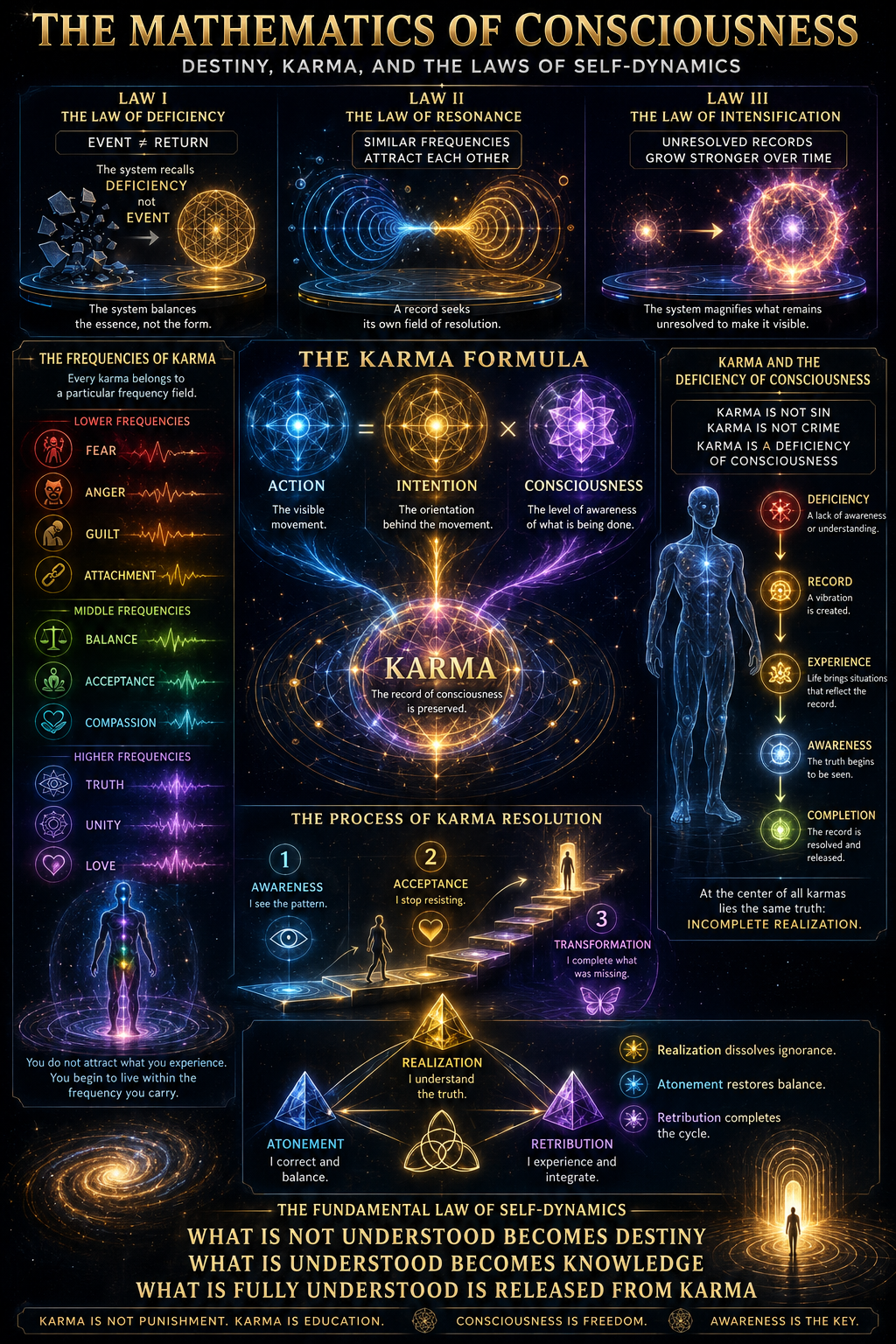
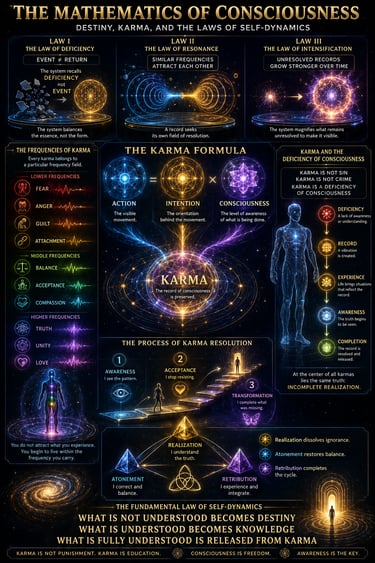
THE DOCTRINE OF SELF-DYNAMICS CHAPTER 42: THE MATHEMATICS OF CONSCIOUSNESS.According to The Doctrine of Self-Dynamics, karma is not linear. A behavior does not return in exactly the same form. The system balances frequencies, not behaviors. Therefore, the first law of the mathematics of karma is..
ÖZ-DEVİNİM KURAMI
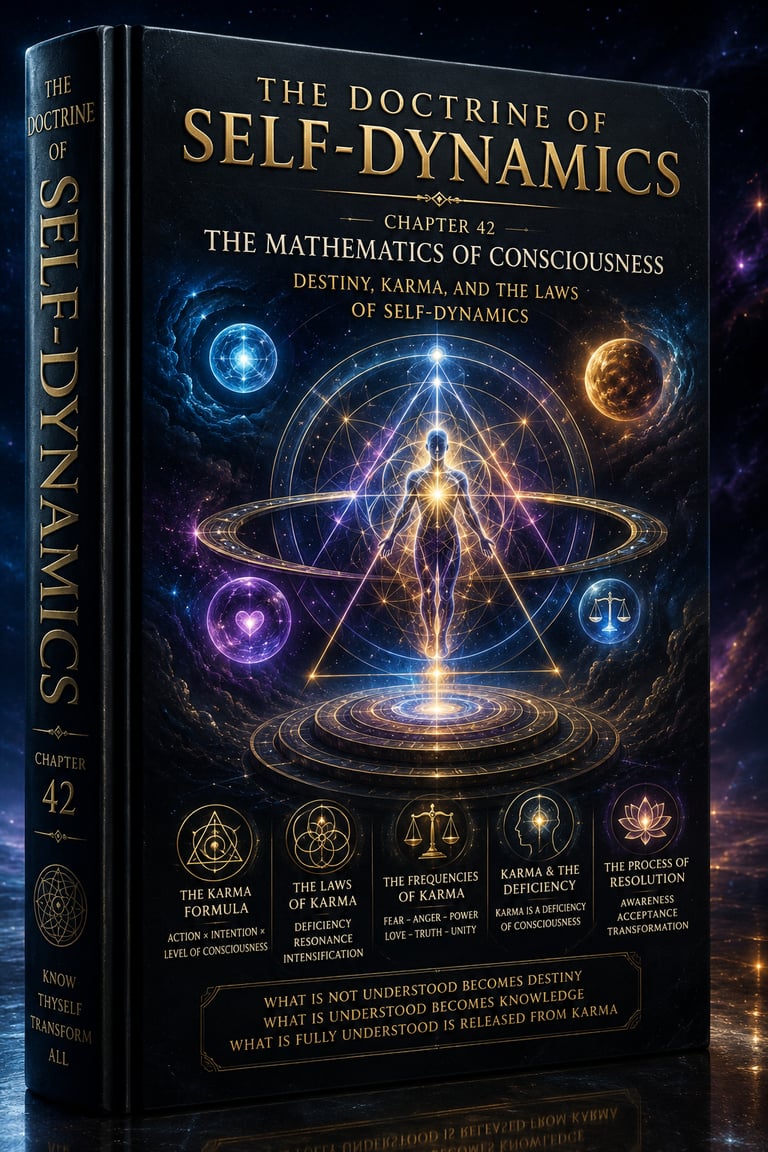
THE DOCTRINE OF SELF-DYNAMICS
CHAPTER 42: THE MATHEMATICS OF CONSCIOUSNESS
Destiny, Karma, and the Laws of Self-Dynamics
THE KARMA FORMULA
The concept of karma has often been misunderstood throughout history. Some teachings have interpreted it as a system of reward and punishment, while others have seen it as the invisible hand of destiny. However, in The Doctrine of Self-Dynamics, karma is neither a reward nor a punishment. Karma is the mechanism through which the points of incomplete balance created within consciousness are preserved and reopened.
Therefore, karma is not an event.
Karma is a form of record.
An action performed by a person does not by itself create karma. The same action can produce different outcomes at different levels of consciousness. This is because the universal system records not the outward appearance of behavior, but the structure of consciousness behind that behavior.
For this reason, karma is explained by the following formula:
Karma = Action × Intention × Level of Consciousness
In this formula, action represents the visible movement. Intention represents the orientation behind the movement. The level of consciousness determines whether the person is aware of what they are doing.
A person may cause harm accidentally.
Another person may cause the same harm consciously.
Even if the action is the same, the record that is created is not the same.
Because the system looks not only at what is done, but at what one is while doing it.
Intention is the invisible part of the formula. Intention determines the frequency of the action. Two people may say the same words. One speaks from compassion, while the other speaks in order to humiliate. Although the words are the same, the record that is formed is completely different.
The level of consciousness is the most important factor determining the depth of karma. The more aware a person is, the stronger the record they create becomes. As consciousness increases, responsibility also increases. An action performed unknowingly does not produce the same vibration as an action performed knowingly.
Therefore, karma is not merely what is done.
It is the state of consciousness carried during the action.
THE MATHEMATICS OF KARMA
The physical universe operates according to mathematical laws. The universe of consciousness also possesses its own mathematics. However, this mathematics functions not through numbers, but through relationships of balance.
According to The Doctrine of Self-Dynamics, karma is not linear. A behavior does not return in exactly the same form. The system balances frequencies, not behaviors.
Therefore, the first law of the mathematics of karma is this:
The system recalls not the event, but the deficiency.
If a person has belittled another, the system is not required to make that person be belittled in return. Instead, it may create experiences through which the person questions their own sense of worth.
If a person has blocked another's path, the system may create obstacles within that person's own life flow rather than returning the exact same behavior.
Because the universal system balances not the form, but the essence.
The second law in the mathematics of karma is resonance.
Similar frequencies attract one another.
A record seeks its own field of resolution.
For this reason, a person may continually encounter the same types of people, experience the same problems, or return to the same fears.
This is not coincidence.
The record is attempting to resolve itself.
The third law is the law of intensification.
An unresolved record grows stronger over time.
A theme that first appears as a minor disturbance may later spread into relationships, health, career, and life direction.
The system magnifies what remains unresolved in order to make it visible.
THE FREQUENCIES OF KARMA
Karma is not composed solely of events. Every karma belongs to a particular frequency field.
There is a frequency of fear.
There is a frequency of anger.
There is a frequency of power.
There is a frequency of love.
There is a frequency of truth.
In life, a person often repeats these frequencies rather than repeating events.
A person may experience similar disappointments with different people again and again.
From the outside, the people have changed.
However, the frequency in operation remains the same.
The frequencies of karma function like invisible magnetic fields. They attract similar records and reproduce the same theme until it is resolved.
Therefore, karma should be understood not through events, but through vibrations.
A consciousness carrying anger calls forth fields of anger.
A consciousness carrying fear calls forth fields of fear.
A consciousness carrying compassion expands fields of compassion.
A person does not attract what they experience.
They begin to live within the frequency they carry.
For this reason, destiny is actually the manifestation of frequencies becoming visible.
KARMA AND THE DEFICIENCY OF CONSCIOUSNESS
Karma is often incorrectly interpreted as a moral system. However, according to The Doctrine of Self-Dynamics, karma is not a moral mechanism but a mechanism of consciousness.
Karma is not sin.
Karma is not crime.
Karma is a deficiency of consciousness.
Every record created by a person is actually the result of a truth that could not be seen at that moment. If the truth had been fully perceived, the record would not have been created.
Therefore, karma is fundamentally incomplete realization.
A person causes harm because they cannot perceive the consciousness of unity.
A person lies because they cannot understand the power of truth.
A person fears because they cannot feel wholeness.
A person clings because they feel deficient.
At the center of all karmas lies the same thing:
Incomplete consciousness.
For this reason, the system does not seek to punish the individual.
The system seeks to complete the consciousness that remains incomplete.
The experiences encountered throughout life are the instruments of this process of completion.
A person lives through the same theme repeatedly because the same deficiency is appearing repeatedly.
The event changes.
The people change.
The place changes.
But as long as the deficiency of consciousness remains the same, the experience continues.
THE PROCESS OF KARMA RESOLUTION
Karma does not remain forever in the form in which it was created. Every record carries the potential for resolution. In fact, the fundamental purpose of life is not to produce new records, but to make existing records visible and resolve them.
Karma is resolved through three fundamental stages.
The first stage is awareness.
A person begins to see that the experience they are living through does not originate solely from the external world. The accusatory perspective dissolves. The individual begins to return to their own structure of consciousness.
The second stage is acceptance.
Acceptance is not passive submission. It is the acknowledgment that the experience has made a knot within consciousness visible. At this stage, resistance decreases and energy begins to be released.
The third stage is transformation.
The person completes the consciousness that was lacking. They see what they could not previously see. They understand what they could not previously understand. They accept what they had previously rejected.
It is at this point that the record is resolved.
In The Doctrine of Self-Dynamics, there are three levels of resolution:
Retribution.
Atonement.
Realization.
In retribution, consciousness learns through experience.
In atonement, consciousness learns through restitution.
In realization, consciousness learns through direct understanding.
Realization is the highest form of resolution. Because at this level, there is no need for the event to descend into the physical world. The deficiency of consciousness is directly recognized and completed.
For this reason, one of the most fundamental laws of The Doctrine of Self-Dynamics is the following:
What is not understood becomes destiny.
What is understood becomes knowledge.
What is fully understood is released from karma.
The ultimate purpose of karma is not to produce suffering.
The ultimate purpose of karma is to complete consciousness.
And when consciousness is completed, the cycle comes to an end.
Because what repeats is not time.
What repeats is deficiency.
FOOTNOTES
1. In The Doctrine of Self-Dynamics, karma is defined not as a system of reward and punishment, but as a mechanism for the preservation and balancing of consciousness records.
2. Annie Besant, Karma, Adyar: Theosophical Publishing House, 2005, pp. 7–54.
3. Helena P. Blavatsky, The Secret Doctrine, Pasadena: Theosophical University Press, 1988, Vol. I, pp. 207–318.
4. Sarvepalli Radhakrishnan, The Principal Upanishads, New Delhi: HarperCollins, 1994, pp. 203–281.
5. Mircea Eliade, Yoga: Immortality and Freedom, Princeton: Princeton University Press, 2009, pp. 166–248.
6. René Guénon, Man and His Becoming According to the Vedanta, Hillsdale: Sophia Perennis, 2001, pp. 55–118.
7. Carl Gustav Jung, Aion: Researches into the Phenomenology of the Self, Princeton: Princeton University Press, 1978, pp. 35–91.
8. Carl Gustav Jung, Psychology and Alchemy, Princeton: Princeton University Press, 1980, pp. 92–164.
9. Roberto Assagioli, Psychosynthesis, New York: Penguin Books, 1975, pp. 61–128.
10. Ken Wilber, Integral Psychology, Boston: Shambhala, 2000, pp. 41–136.
11. Stanislav Grof, Psychology of the Future, Albany: SUNY Press, 2000, pp. 73–155.
12. William James, The Varieties of Religious Experience, New York: Modern Library, 2002, pp. 289–373.
13. David Bohm, Wholeness and the Implicate Order, London: Routledge, 2002, pp. 17–103.
14. Ervin Laszlo, Science and the Akashic Field, Rochester: Inner Traditions, 2007, pp. 37–128.
15. Fritjof Capra, The Tao of Physics, Boston: Shambhala, 2010, pp. 211–279.
16. Toshihiko Izutsu, Sufism and Taoism, Berkeley: University of California Press, 1984, pp. 131–204.
17. Muhyiddin Ibn Arabi, al-Futuhat al-Makkiyya, trans. Ekrem Demirli, Istanbul: Litera Publishing, 2006, Vol. III, pp. 122–217.
18. William C. Chittick, The Self-Disclosure of God, Albany: SUNY Press, 1998, pp. 101–181.
19. Henry Corbin, Creative Imagination in the Sufism of Ibn Arabi, Princeton: Princeton University Press, 1969, pp. 199–284.
20. Seyyed Hossein Nasr, Knowledge and the Sacred, Albany: SUNY Press, 1989, pp. 187–279.
21. Annemarie Schimmel, Mystical Dimensions of Islam, Chapel Hill: University of North Carolina Press, 1975, pp. 281–351.
22. George Ivanovich Gurdjieff, Views from the Real World, London: Routledge, 1984, pp. 29–101.
23. P. D. Ouspensky, In Search of the Miraculous, New York: Harcourt Brace, 1949, pp. 81–163.
24. Jean Gebser, The Ever-Present Origin, Athens: Ohio University Press, 1985, pp. 87–176.
25. Abraham Maslow, Toward a Psychology of Being, New York: Wiley, 1999, pp. 95–171.
26. Huston Smith, Forgotten Truth, New York: HarperOne, 1992, pp. 69–158.
27. In The Doctrine of Self-Dynamics, the formula “Karma = Action × Intention × Level of Consciousness” is an original theoretical model explaining the intensity of the formation of consciousness records.
28. According to The Doctrine of Self-Dynamics, the Law of Resonance is the principle that similar frequencies of consciousness attract one another and create fields of resolution.
29. In The Doctrine of Self-Dynamics, the Law of Intensification expresses the process by which unresolved consciousness records become stronger over time and transform into more visible experiences.
30. In The Doctrine of Self-Dynamics, the three stages of karma resolution are defined as retribution, atonement, and realization.
31. According to The Doctrine of Self-Dynamics, realization is the highest form of resolution, occurring through the direct comprehension of truth without the need for experience.
BIBLIOGRAPHY
Assagioli, Roberto. Psychosynthesis. New York: Penguin Books, 1975.
Besant, Annie. Karma. Adyar: Theosophical Publishing House, 2005.
Blavatsky, Helena P. The Secret Doctrine. Pasadena: Theosophical University Press, 1988.
Bohm, David. Wholeness and the Implicate Order. London: Routledge, 2002.
Capra, Fritjof. The Tao of Physics. Boston: Shambhala, 2010.
Chittick, William C. The Self-Disclosure of God. Albany: SUNY Press, 1998.
Corbin, Henry. Creative Imagination in the Sufism of Ibn Arabi. Princeton: Princeton University Press, 1969.
Eliade, Mircea. Yoga: Immortality and Freedom. Princeton: Princeton University Press, 2009.
Gebser, Jean. The Ever-Present Origin. Athens: Ohio University Press, 1985.
Grof, Stanislav. Psychology of the Future. Albany: SUNY Press, 2000.
Gurdjieff, G. I. Views from the Real World. London: Routledge, 1984.
Guénon, René. Man and His Becoming According to the Vedanta. Hillsdale: Sophia Perennis, 2001.
Ibn Arabi, Muhyiddin. al-Futuhat al-Makkiyya. Translated by Ekrem Demirli. Istanbul: Litera Publishing, 2006.
Izutsu, Toshihiko. Sufism and Taoism. Berkeley: University of California Press, 1984.
James, William. The Varieties of Religious Experience. New York: Modern Library, 2002.
Jung, Carl Gustav. Aion. Princeton: Princeton University Press, 1978.
Jung, Carl Gustav. Psychology and Alchemy. Princeton: Princeton University Press, 1980.
Laszlo, Ervin. Science and the Akashic Field. Rochester: Inner Traditions, 2007.
Maslow, Abraham. Toward a Psychology of Being. New York: Wiley, 1999.
Nasr, Seyyed Hossein. Knowledge and the Sacred. Albany: SUNY Press, 1989.
Ouspensky, P. D. In Search of the Miraculous. New York: Harcourt Brace, 1949.
Radhakrishnan, Sarvepalli. The Principal Upanishads. New Delhi: HarperCollins, 1994.
Schimmel, Annemarie. Mystical Dimensions of Islam. Chapel Hill: University of North Carolina Press, 1975.
Smith, Huston. Forgotten Truth. New York: HarperOne, 1992.
Wilber, Ken. Integral Psychology. Boston: Shambhala, 2000.