THE DOCTRINE OF SELF-DYNAMICS CHAPTER 43: REINCARNATION, TRANSMIGRATION, AND BARZAKH
THE DOCTRINE OF SELF-DYNAMICS CHAPTER 43: REINCARNATION, TRANSMIGRATION, AND BARZAKH.Reincarnation and transmigration are often assumed to be the same thing. However, in The Doctrine of Self-Dynamics, these two concepts are completely different from one another.
ÖZ-DEVİNİM KURAMI
THE DOCTRINE OF SELF-DYNAMICS
CHAPTER 43: REINCARNATION, TRANSMIGRATION, AND BARZAKH
THE MECHANICS OF REINCARNATION
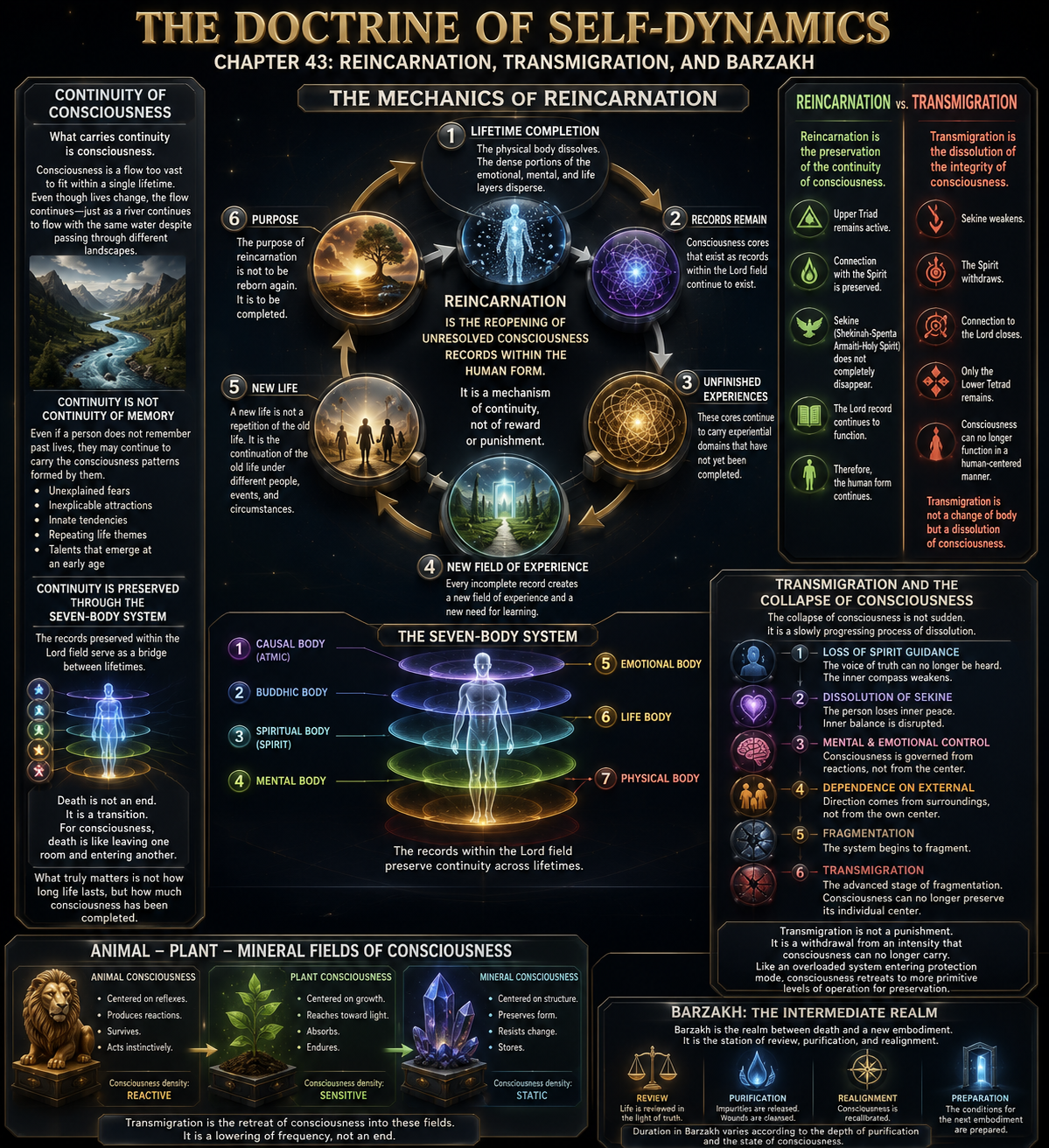
Throughout history, reincarnation has most often been defined as a person dying and being reborn in another body. However, in The Doctrine of Self-Dynamics, reincarnation is not merely a biological rebirth. Reincarnation is the reopening of unresolved consciousness records within the human form.
What is reborn here is not the personality.
What is reborn is the continuity of consciousness.
When a person completes a lifetime, the physical body dissolves. The dense portions of the emotional, mental, and life layers disperse. However, the consciousness cores that exist as records within the Lord field continue to exist. These cores continue to carry experiential domains that have not yet been completed.
Every incomplete record creates a new field of experience.
Every theme that has not been understood generates a new need for learning.
Every unresolved knot of consciousness seeks a new unfolding.
Therefore, reincarnation is not a system of reward or punishment.
It is a mechanism of continuity.
A new life is not a repetition of the old life.
A new life is the continuation of the old life.
What changes are the people, events, and circumstances.
What does not change is the consciousness core awaiting resolution.
For this reason, a person does not live the same life again.
The same consciousness is reopened under different conditions.
The purpose of reincarnation is not to be reborn again.
It is to be completed.
CONTINUITY OF CONSCIOUSNESS
Human beings often assume that they are merely the product of this life. Yet personality is temporary. Identity is temporary. A name is temporary. Even the body itself is temporary.
What carries continuity is consciousness.
Consciousness is a flow too vast to fit within a single lifetime. Even though lives change, the flow of consciousness continues. Just as a river continues to flow with the same water despite passing through different landscapes.
Therefore, continuity of consciousness is not continuity of memory.
Even if a person does not remember past lives, they may continue to carry the consciousness patterns formed by them.
Unexplained fears,
inexplicable attractions,
innate tendencies,
repeating life themes,
talents that emerge at an early age,
may all be seen as reflections of the continuity of consciousness.
According to The Doctrine of Self-Dynamics, the continuity of consciousness is preserved through the seven-body system. In particular, the records preserved within the Lord field serve as a bridge between lifetimes.
Therefore, death is not an end.
It is a transition.
For consciousness, death is like leaving one room and entering another.
What truly matters is not how long life lasts, but how much consciousness has been completed.
WHAT IS TRANSMIGRATION?
Reincarnation and transmigration are often assumed to be the same thing. However, in The Doctrine of Self-Dynamics, these two concepts are completely different from one another.
Reincarnation is the preservation of the continuity of consciousness.
Transmigration, on the other hand, is the dissolution of the integrity of consciousness.
In reincarnation, the Upper Triad remains active.
The connection with the Spirit is preserved.
Sekine (Shekinah-Spenta Armaiti-Holy Spirit) does not completely disappear.
The Lord record continues to function.
For this reason, the human form continues.
In transmigration, however, the process is different.
Here, the central system that makes a human being human begins to disintegrate.
First, Sekine (Shekinah-Spenta Armaiti-Holy Spirit) weakens.
Then the Spirit withdraws.
Afterward, the connection to the Lord begins to close.
In the end, only the Lower Tetrad remains.
At this point, consciousness can no longer function in a human-centered manner.
For this reason, transmigration is not a change of body but a dissolution of consciousness.
A person may appear to continue existing.
However, the center has been lost.
In The Doctrine of Self-Dynamics, transmigration means that consciousness has become so fragmented that it can no longer sustain the station of humanity.
TRANSMIGRATION AND THE COLLAPSE OF CONSCIOUSNESS
The collapse of consciousness is not sudden.
It is a slowly progressing process of dissolution.
In the first stage, a person begins to lose the guidance of the Spirit.
The voice of truth can no longer be heard.
The inner compass weakens.
Later, Sekine (Shekinah-Spenta Armaiti-Holy Spirit) begins to dissolve.
The person loses inner peace.
Their inner balance is disrupted.
Then the mental and emotional fields take control.
Consciousness is no longer governed from the center but from reactions.
As this process deepens, the person becomes dependent on external stimuli.
They take direction not from their own center but from their surroundings.
Eventually, the system begins to fragment.
Transmigration is the advanced stage of this fragmentation.
Here, human consciousness does not disappear completely.
However, it can no longer preserve its individual center.
Therefore, transmigration is not a punishment.
It is a withdrawal from an intensity that consciousness can no longer carry.
Just as an overloaded system enters a protection mode, consciousness similarly retreats to more primitive levels of operation.
The purpose of this retreat is not destruction but preservation.
ANIMAL – PLANT – MINERAL FIELDS OF CONSCIOUSNESS
In The Doctrine of Self-Dynamics, the concepts of animal, plant, and mineral do not merely refer to biological species.
They are also symbolic fields that represent different densities of consciousness.
Animal consciousness is centered on reflexes.
It produces reactions.
It survives.
It acts instinctively.
However, its capacity for self-observation is limited.
Plant consciousness represents the flow of life.
Here there is growth.
There is harmony.
Yet there is no individual sense of direction.
The plant field of consciousness is the consciousness of flow.
Mineral consciousness, on the other hand, is the frozen state of potential.
Here movement exists at a minimum level.
Change is extremely slow.
Yet all possibilities exist in a seed form.
These three fields are levels of consciousness that lie beneath the human state.
The station of humanity is built upon them.
For the Spirit to connect actively, a certain level of complexity and awareness is required.
For this reason, being human is not merely a biological condition.
It is a threshold of consciousness.
The animal, plant, and mineral fields of consciousness are not humanity’s past; they are the foundational layers of the structure of consciousness.
Within every human being, traces of these three fields can be found.
THE COLLECTIVE SPIRIT FIELD
Just as there is individual consciousness, there is also collective consciousness.
A human being experiences themselves as an independent existence. However, at deeper levels, all consciousnesses are connected to one another through invisible networks.
The Doctrine of Self-Dynamics gives this structure the name Collective Spirit Field.
The Collective Spirit Field is the common ocean of consciousness that exists above individual centers.
The shared instincts of animals,
the shared patterns of growth in plants,
the common rhythms of nature,
the shared symbols of humanity,
are all reflections of this field.
A human being does not carry only their own consciousness records.
They also move through the collective records of humanity.
For this reason, some fears are not individual.
Some desires are not individual.
Some tendencies are not individual.
They arise from the collective field of consciousness.
When the individual center weakens during the process of transmigration, consciousness becomes increasingly dependent upon these collective fields.
In reincarnation, however, the individual center is preserved, and consciousness continues its unique journey.
This distinction is extremely important.
For what makes a human being human is not merely possessing consciousness.
It is the ability to preserve the individual center without becoming lost within collective consciousness.
From the perspective of The Doctrine of Self-Dynamics, the station of humanity begins precisely here.
A person becomes truly human when they realize that they are a part of collective consciousness without losing their own center.
And this is the purpose of the journey of consciousness:
To realize unity without becoming lost within it.
THE ONTOLOGY OF BARZAKH
Barzakh has often been interpreted in esoteric traditions as the transitional realm between death and rebirth. However, in The Doctrine of Self-Dynamics, Barzakh is not merely a waiting place after death. Barzakh is the intermediate ontological field in which existence resides between different levels of consciousness. Therefore, Barzakh is not a place but a state of being.
The human mind generally perceives reality through dualities. Oppositions such as life and death, existence and non-existence, matter and spirit are products of this perception. However, at the level of consciousness, there are many transitional fields between these opposites. Barzakh is the most important of these transitional fields.
Barzakh is neither completely the world nor entirely beyond the world.
Neither wholly movement nor wholly stillness.
Neither a beginning nor an end.
Barzakh is the threshold itself between becoming and dissolution.
According to The Doctrine of Self-Dynamics, human consciousness does not always pass directly between different layers. In certain situations, consciousness remains suspended at a particular density. This suspended condition ontologically constitutes the state of Barzakh.
Therefore, Barzakh can be experienced not only after death but also during life. At times, a person has left behind an old identity but has not yet reached a new one. The old consciousness has dissolved, yet the new consciousness has not yet formed. During such periods, a person feels as though they are in a void. This condition is a small-scale experience of Barzakh.
On a greater scale, Barzakh is the intermediate field of consciousness in which the Spirit is preserved.
The purpose here is not to wait.
The purpose is to prevent dissolution.
The ontological function of Barzakh is to preserve the consciousness core that has not yet been completed.
For the fundamental law of the system is this:
No incomplete consciousness is ever destroyed.
SUSPENDED CONSCIOUSNESS
Human consciousness is not continuously active. Consciousness possesses different modes of operation. One of these is the state of suspended consciousness.
Suspended consciousness is not destroyed consciousness.
Nor is it repressed consciousness.
This state is the temporary withdrawal of the capacity to produce active experience.
According to The Doctrine of Self-Dynamics, during the process of transmigration or deep dissolutions of consciousness, the Spirit does not disappear completely. The Spirit ceases its role as the active center and withdraws into the field of Barzakh. In this way, the consciousness core is preserved.
This condition resembles a seed waiting beneath the soil throughout the winter.
The seed is not dead.
Nor is it growing.
It is merely waiting for the appropriate time.
Consciousness within the field of Barzakh is the same.
It continues to exist without activity.
For this reason, suspended consciousness is largely independent of the perception of time. The human mind functions through the flow of time. Yet within the field of Barzakh, time does not operate as it does in the physical world. This is because the mental layers that generate experience are largely inactive.
Therefore, Barzakh is less a state of waiting than a process of preservation.
It is the intermediate phase in which the system reorganizes itself.
Consciousness does not learn here.
Yet it does not disperse.
It cannot advance.
Yet it does not cease to exist.
This is the fundamental characteristic of suspended consciousness.
THE CONSERVATION OF THE SPIRIT
One of the fundamental assumptions of The Doctrine of Self-Dynamics is the Principle of the Conservation of the Spirit.
Just as energy is not destroyed, the consciousness core is not destroyed.
Forms may change.
Identities may change.
Personalities may change.
Yet the spiritual center never disappears completely.
One of the most misunderstood aspects of the doctrine of transmigration is the belief that the Spirit descends into lower forms. In The Doctrine of Self-Dynamics, the Spirit does not enter lower forms. This is because the vibrational density of the Spirit and the density of lower consciousness fields are not the same.
Instead, the Spirit withdraws.
It is preserved within the field of Barzakh.
The lower systems continue to function within their own collective fields.
This situation resembles a high-voltage system disconnecting itself from a circuit in order to protect itself. The system does not shut down completely. The center temporarily severs the connection.
Through the conservation of the Spirit, the human core is not destroyed.
For the purpose of the universal system is not punishment but the preservation of potential.
Every consciousness core carries the possibility of completion.
Every Spirit carries the capacity to return to its center.
Therefore, Barzakh is also a field of hope.
It is the place where that which has not yet been completed is preserved.
It is the place where that which has not yet unfolded is kept.
It is the place where that which has not yet been learned awaits.
The Spirit does not become lost here.
It preserves itself.
And when suitable conditions arise, it approaches the field of experience once again.
BARZAKH AND COLLECTIVE CONSCIOUSNESS
There is a continuous interaction between individual consciousness and collective consciousness. Although a human being experiences themselves as a separate existence, at deeper layers all consciousnesses are connected to one another through common fields.
Barzakh is one of the most interesting manifestations of this connection.
For within the field of Barzakh, while individual consciousness does not produce active experience, the fields of collective consciousness continue to operate.
The animal field of consciousness,
the plant field of consciousness,
the mineral field of consciousness,
and the shared pool of human consciousness,
are different manifestations of collective fields.
These fields function independently of individual identities.
Instincts,
shared fears,
archetypes,
symbols,
collective memories,
continue to exist at these levels.
When the individual center withdraws during the state of Barzakh, consciousness does not completely lose its connection with these collective fields. However, since there is no active center to direct them, experience occurs primarily through the flows of collective consciousness.
For this reason, Barzakh is not merely an individual process.
It is also a collective process.
Here, while the individual Spirit is preserved, the fields of collective consciousness continue their activity.
This condition resembles a ship resting upon a vast ocean.
Even if the ship does not move, the ocean continues to move.
The Spirit is the center.
Collective consciousness is the ocean.
Barzakh is the moment when the ship is drawn into a safe harbor during a storm.
According to The Doctrine of Self-Dynamics, humanity’s great journey is not merely the development of individual consciousness. It is also the understanding of the relationship between individual consciousness and collective consciousness.
Barzakh is the threshold at which this relationship becomes visible.
For here, the human being begins to realize for the first time:
Individual consciousness is not alone.
It has always existed within a greater field of consciousness.
And the journey of the Spirit is the process of learning how to exist within that greater whole without losing its own center.
FOOTNOTES
1. In The Doctrine of Self-Dynamics, reincarnation is defined not as the rebirth of personality, but as the reopening of the continuity of consciousness within different fields of experience.
2. Sarvepalli Radhakrishnan, The Principal Upanishads, New Delhi: HarperCollins, 1994, pp. 327–418.
3. Bhagavad Gita, trans. Eknath Easwaran, Tomales: Nilgiri Press, 2007, II:13–30.
4. Annie Besant, Reincarnation, Adyar: Theosophical Publishing House, 2003, pp. 5–76.
5. Helena P. Blavatsky, The Secret Doctrine, Pasadena: Theosophical University Press, 1988, Vol. I, pp. 593–711.
6. Mircea Eliade, Myths, Dreams and Mysteries, New York: Harper Torchbooks, 1967, pp. 81–137.
7. Carl Gustav Jung, Archetypes and the Collective Unconscious, Princeton: Princeton University Press, 1981, pp. 3–78.
8. Carl Gustav Jung, Memories, Dreams, Reflections, New York: Vintage Books, 1989, pp. 279–346.
9. Stanislav Grof, The Adventure of Self-Discovery, Albany: SUNY Press, 1988, pp. 149–241.
10. Ken Wilber, Integral Psychology, Boston: Shambhala, 2000, pp. 125–214.
11. William James, The Varieties of Religious Experience, New York: Modern Library, 2002, pp. 367–432.
12. Henry Corbin, Spiritual Body and Celestial Earth, Princeton: Princeton University Press, 1977, pp. 1–93.
13. Henry Corbin, Creative Imagination in the Sufism of Ibn Arabi, Princeton: Princeton University Press, 1969, pp. 217–301.
14. Muhyiddin Ibn Arabi, Al-Futuhat al-Makkiyya, trans. Ekrem Demirli, Istanbul: Litera Publishing, 2006, Vol. IV, pp. 17–129.
15. Muhyiddin Ibn Arabi, Fusus al-Hikam, trans. Ekrem Demirli, Istanbul: Kabalcı Publishing, 2013, pp. 109–173.
16. William C. Chittick, The Sufi Path of Knowledge, Albany: SUNY Press, 1989, pp. 281–354.
17. Toshihiko Izutsu, Sufism and Taoism, Berkeley: University of California Press, 1984, pp. 209–296.
18. Seyyed Hossein Nasr, Knowledge and the Sacred, Albany: SUNY Press, 1989, pp. 251–334.
19. Annemarie Schimmel, Mystical Dimensions of Islam, Chapel Hill: University of North Carolina Press, 1975, pp. 391–475.
20. Frithjof Schuon, Understanding Islam, Bloomington: World Wisdom, 1998, pp. 177–242.
21. René Guénon, The Multiple States of Being, Hillsdale: Sophia Perennis, 2001, pp. 23–97.
22. René Guénon, Man and His Becoming According to the Vedanta, Hillsdale: Sophia Perennis, 2001, pp. 103–176.
23. Jean Gebser, The Ever-Present Origin, Athens: Ohio University Press, 1985, pp. 173–261.
24. David Bohm, Wholeness and the Implicate Order, London: Routledge, 2002, pp. 87–162.
25. Ervin Laszlo, Science and the Akashic Field, Rochester: Inner Traditions, 2007, pp. 95–171.
26. Huston Smith, Forgotten Truth, New York: HarperOne, 1992, pp. 141–226.
27. Mircea Eliade, A History of Religious Ideas, Chicago: University of Chicago Press, 1978, Vol. III, pp. 179–261.
28. In The Doctrine of Self-Dynamics, transmigration is defined not as the Spirit passing into another body, but as the dissolution of the individual center of consciousness and its withdrawal to the level of the Lower Tetrad.
29. In The Doctrine of Self-Dynamics, the Collective Spirit Field is defined as the common matrix of consciousness existing above individual consciousnesses.
30. In The Doctrine of Self-Dynamics, Barzakh is explained not as a waiting place after death, but as an intermediate ontological field existing between different levels of consciousness.
31. According to The Doctrine of Self-Dynamics, suspended consciousness is not destroyed consciousness, but a state of consciousness whose capacity to generate experience has been temporarily withdrawn.
32. In The Doctrine of Self-Dynamics, the Principle of the Conservation of the Spirit is the fundamental law stating that the consciousness core can never be completely destroyed under any circumstances.
BIBLIOGRAPHY
Besant, Annie. Reincarnation. Adyar: Theosophical Publishing House, 2003.
Bhagavad Gita. Translated by Eknath Easwaran. Tomales: Nilgiri Press, 2007.
Blavatsky, Helena P. The Secret Doctrine. Pasadena: Theosophical University Press, 1988.
Bohm, David. Wholeness and the Implicate Order. London: Routledge, 2002.
Chittick, William C. The Sufi Path of Knowledge. Albany: SUNY Press, 1989.
Corbin, Henry. Creative Imagination in the Sufism of Ibn Arabi. Princeton: Princeton University Press, 1969.
Corbin, Henry. Spiritual Body and Celestial Earth. Princeton: Princeton University Press, 1977.
Eliade, Mircea. A History of Religious Ideas. Chicago: University of Chicago Press, 1978.
Eliade, Mircea. Myths, Dreams and Mysteries. New York: Harper Torchbooks, 1967.
Gebser, Jean. The Ever-Present Origin. Athens: Ohio University Press, 1985.
Grof, Stanislav. The Adventure of Self-Discovery. Albany: SUNY Press, 1988.
Guénon, René. Man and His Becoming According to the Vedanta. Hillsdale: Sophia Perennis, 2001.
Guénon, René. The Multiple States of Being. Hillsdale: Sophia Perennis, 2001.
Ibn Arabi, Muhyiddin. Al-Futuhat al-Makkiyya. Translated by Ekrem Demirli. Istanbul: Litera Publishing, 2006.
Ibn Arabi, Muhyiddin. Fusus al-Hikam. Translated by Ekrem Demirli. Istanbul: Kabalcı Publishing, 2013.
Izutsu, Toshihiko. Sufism and Taoism. Berkeley: University of California Press, 1984.
James, William. The Varieties of Religious Experience. New York: Modern Library, 2002.
Jung, Carl Gustav. Archetypes and the Collective Unconscious. Princeton: Princeton University Press, 1981.
Jung, Carl Gustav. Memories, Dreams, Reflections. New York: Vintage Books, 1989.
Laszlo, Ervin. Science and the Akashic Field. Rochester: Inner Traditions, 2007.
Nasr, Seyyed Hossein. Knowledge and the Sacred. Albany: SUNY Press, 1989.
Radhakrishnan, Sarvepalli. The Principal Upanishads. New Delhi: HarperCollins, 1994.
Schimmel, Annemarie. Mystical Dimensions of Islam. Chapel Hill: University of North Carolina Press, 1975.
Schuon, Frithjof. Understanding Islam. Bloomington: World Wisdom, 1998.
Smith, Huston. Forgotten Truth. New York: HarperOne, 1992.
Wilber, Ken. Integral Psychology. Boston: Shambhala, 2000.