THE DOCTRINE OF SELF-DYNAMICS CHAPTER 44: THE LAW OF FIFTY THOUSAND YEARS
THE DOCTRINE OF SELF-DYNAMICS CHAPTER 44: THE LAW OF FIFTY THOUSAND YEARS. According to The Doctrine of Self-Dynamics, the human being is not an entity that appeared suddenly. The human being is the result of a very long preparation of consciousness.
ÖZ-DEVİNİM KURAMI
THE DOCTRINE OF SELF-DYNAMICS
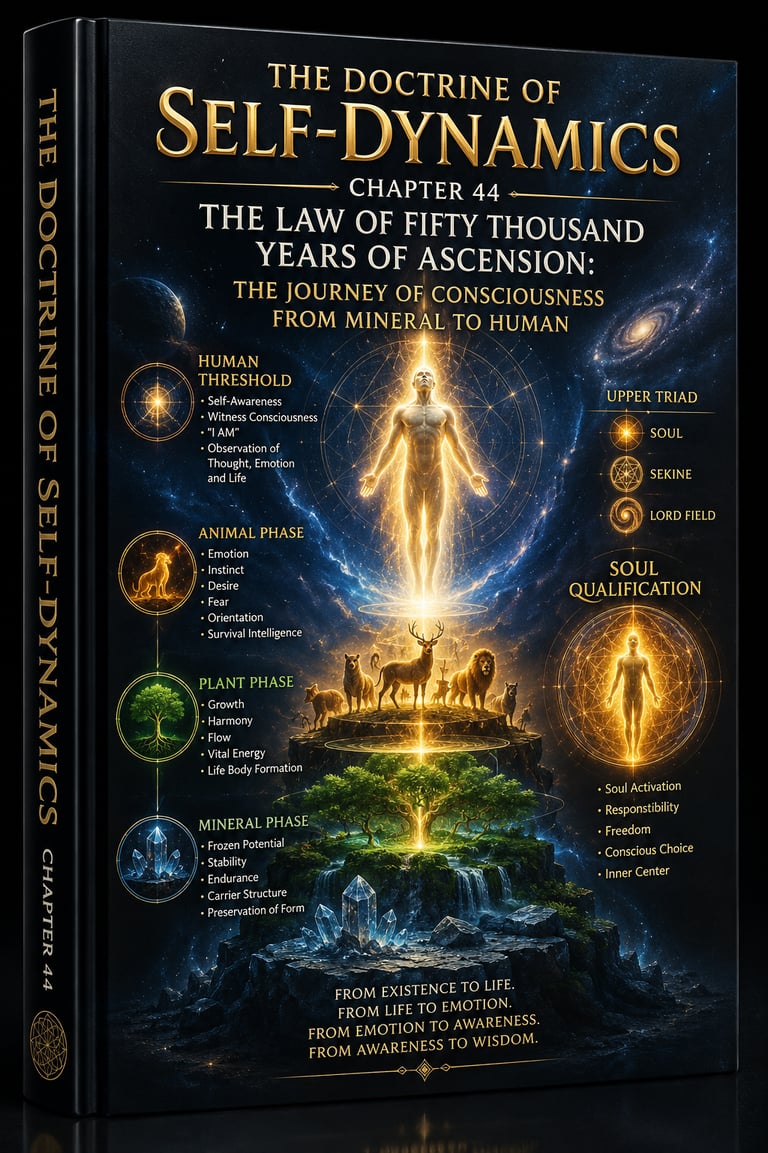
CHAPTER 44: THE LAW OF FIFTY THOUSAND YEARS OF ASCENSION: THE JOURNEY OF CONSCIOUSNESS FROM MINERAL TO HUMAN
THE MINERAL PHASE
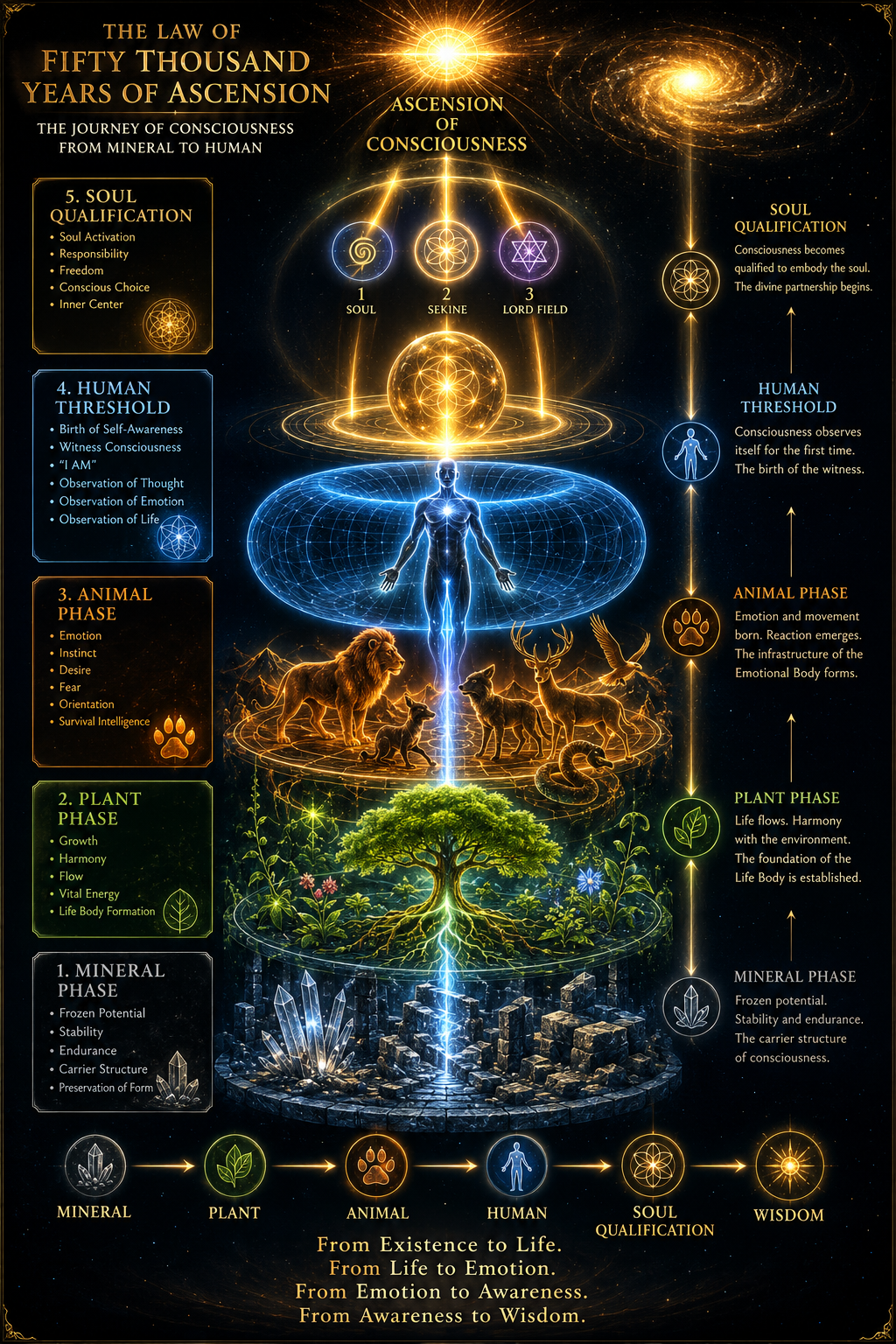
According to The Doctrine of Self-Dynamics, the human being is not an entity that appeared suddenly. The human being is the result of a very long preparation of consciousness. This process of preparation is symbolically expressed through the Law of Fifty Thousand Years of Ascension. The time used here is not merely a chronological measure; it represents the cosmic maturation required to form the carrier structure of consciousness.
The first stage of this process is the Mineral Phase.
The Mineral Phase is the realm of frozen potential.
Here, movement is at a minimum level.
Change is extremely slow.
Consciousness is not yet individual.
In fact, it is not even possible to speak of active consciousness.
However, the seed of the entire future is hidden here.
Just as the future tree is hidden within a seed, the entire potential of the human being also exists in the Mineral Phase in a seed form.
The fundamental function of the Mineral Phase is to create a carrier.
There is not yet experience.
There is not yet emotion.
There is not yet thought.
But there is durability.
There is continuity.
There is the preservation of form.
Therefore, the Mineral Phase is the skeleton of existence.
From the perspective of The Doctrine of Self-Dynamics, the mineral is not a symbol of unconsciousness; it is a symbol of consciousness that has not yet unfolded.
It is silence.
It is waiting.
It is potential.
The entire journey of ascension begins here.
THE PLANT PHASE
The carrier structure formed in the Mineral Phase gradually reaches the capacity to carry the flow of life. Thus, the second stage, the Plant Phase, begins.
The Plant Phase is the first great awakening of life.
Here, consciousness is not yet individual, but movement now exists.
There is growth.
There is harmony.
There is relationship with the environment.
The plant turns toward the light.
It turns toward water.
It establishes harmony with the seasons.
This means that consciousness encounters flow for the first time.
The fundamental teaching of the Plant Phase is harmony.
The mineral has learned stability.
The plant learns flow.
The mineral represents endurance.
The plant represents development.
The self has not yet formed here. The plant does not experience itself as a being separate from its environment. It is a part moving within the great flow of life.
Therefore, the Plant Phase is the cosmic preparation of the Life Body.
Vitality takes shape here.
The circulation of energy is learned here.
Growth emerges here for the first time.
The life force that the human being will possess in the future is grounded at this stage.
THE ANIMAL PHASE
Life has emerged in the Plant Phase. However, life is not yet aware of itself. In the next stage, consciousness gains a new intensity and the Animal Phase begins.
The Animal Phase is the realm where emotion and movement are born.
For the first time, choice appears here.
For the first time, fear emerges.
For the first time, desire appears.
For the first time, the selection of direction is seen.
Animal consciousness is centered on reflexes.
It seeks to preserve life.
It avoids danger.
It seeks security.
It feeds.
It reproduces.
During this process, the fundamental infrastructure of the Emotional Body is formed.
Fear is learned.
Attachment is learned.
The instinct of protection is learned.
Struggle is learned.
However, all of these occur not through awareness, but through instinct.
The Animal Phase is a very important threshold in the history of consciousness.
Because for the first time, "reaction" emerges.
The mineral merely exists.
The plant merely grows.
The animal responds.
This capacity to respond prepares the necessary ground for the future formation of human consciousness.
When the Animal Phase is completed, the carrier structure becomes capable of carrying not only life, but also emotion and orientation.
THE HUMAN THRESHOLD
The most important point of the Law of Fifty Thousand Years of Ascension is the Human Threshold.
This threshold is not a biological transformation.
It is a birth of consciousness.
Form was created in the Mineral Phase.
Life was created in the Plant Phase.
Emotion was created in the Animal Phase.
But there is still something missing:
Witnessing.
The Human Threshold is the point at which consciousness can observe itself for the first time.
Up to this point, the system is living.
But it is not living itself consciously.
At the Human Threshold, the experience of "I Am" emerges for the first time.
This selfhood is not the selfhood of the ego.
This is the birth of the center of awareness.
The human is no longer merely one who feels.
The human becomes one who is aware of feeling.
No longer merely one who thinks.
The human becomes one who sees that he thinks.
No longer merely one who lives.
The human becomes one who knows that he lives.
This is the essence of the station of humanity.
Therefore, human birth is not a beginning, but a threshold of completion.
After millions of experiences, the seed of consciousness has finally reached the capacity to carry the soul.
To be human is not a right.
It is a qualification.
And this qualification is attained as the result of a long preparation.
SOUL QUALIFICATION
One of the most fundamental principles of The Doctrine of Self-Dynamics is this:
The soul is not given.
Qualification for the soul is earned.
This statement is symbolic. For the soul is always present within the essence of existence. However, for the soul to function as an active center, the carrier system must reach a certain level of maturity.
Just as a high-voltage energy source cannot be connected to a weak system, the soul likewise cannot be fully connected to an unprepared structure of consciousness.
Therefore, the station of humanity is not an end, but a new beginning.
When Soul Qualification is attained, the Upper Triad begins to connect to the system.
The Soul becomes the center.
Sekine (Shekinah-Spenta Armaiti-Holy Spirit) establishes balance.
The field of the Lord becomes active.
Thus, for the first time, consciousness ceases to be merely a living system.
It transforms into a system that knows itself.
Soul Qualification is also the beginning of responsibility.
For as awareness increases, freedom increases.
As freedom increases, responsibility also increases.
Therefore, the human being is not the most privileged being in the universe.
It is the being that carries the greatest responsibility.
The mineral merely exists.
The plant grows.
The animal feels.
The human knows.
And to know is the heaviest burden of the cosmic journey.
This is also the ultimate purpose of the Law of Fifty Thousand Years of Ascension:
To carry consciousness from existence to life,
from life to emotion,
from emotion to awareness,
and from awareness to wisdom.
The human being is not the end of this journey.
It is the beginning of consciousness that can see itself for the first time.
FOOTNOTES
1. In The Doctrine of Self-Dynamics, the "Law of Fifty Thousand Years of Ascension" is a symbolic developmental model explaining how consciousness reaches the center of awareness by passing through the thresholds of mineral, plant, animal, and human existence.
2. Mircea Eliade, A History of Religious Ideas, Vol. I, Chicago: University of Chicago Press, 1978, pp. 1–97.
3. Pierre Teilhard de Chardin, The Phenomenon of Man, New York: Harper Perennial, 2008, pp. 37–116.
4. Sri Aurobindo, The Life Divine, Pondicherry: Sri Aurobindo Ashram, 2005, pp. 123–264.
5. Ken Wilber, Up from Eden, Boston: Shambhala, 1996, pp. 15–108.
6. Ken Wilber, Integral Psychology, Boston: Shambhala, 2000, pp. 89–176.
7. Jean Gebser, The Ever-Present Origin, Athens: Ohio University Press, 1985, pp. 31–127.
8. Ervin Laszlo, Science and the Akashic Field, Rochester: Inner Traditions, 2007, pp. 41–119.
9. David Bohm, Wholeness and the Implicate Order, London: Routledge, 2002, pp. 19–91.
10. Fritjof Capra, The Tao of Physics, Boston: Shambhala, 2010, pp. 181–254.
11. Carl Gustav Jung, Archetypes and the Collective Unconscious, Princeton: Princeton University Press, 1981, pp. 52–136.
12. Carl Gustav Jung, Aion: Researches into the Phenomenology of the Self, Princeton: Princeton University Press, 1978, pp. 83–157.
13. Abraham Maslow, Toward a Psychology of Being, New York: Wiley, 1999, pp. 101–184.
14. Roberto Assagioli, Psychosynthesis, New York: Penguin Books, 1975, pp. 73–149.
15. Stanislav Grof, Psychology of the Future, Albany: SUNY Press, 2000, pp. 91–183.
16. Sarvepalli Radhakrishnan, The Principal Upanishads, New Delhi: HarperCollins, 1994, pp. 331–427.
17. Bhagavad Gita, trans. Eknath Easwaran, Tomales: Nilgiri Press, 2007, XV:1–20.
18. René Guénon, Man and His Becoming According to the Vedanta, Hillsdale: Sophia Perennis, 2001, pp. 27–114.
19. Frithjof Schuon, The Transcendent Unity of Religions, Wheaton: Quest Books, 1993, pp. 57–126.
20. Seyyed Hossein Nasr, Knowledge and the Sacred, Albany: SUNY Press, 1989, pp. 219–308.
21. Henry Corbin, Spiritual Body and Celestial Earth, Princeton: Princeton University Press, 1977, pp. 15–109.
22. Henry Corbin, Creative Imagination in the Sufism of Ibn Arabi, Princeton: Princeton University Press, 1969, pp. 211–286.
23. Muhyiddin Ibn Arabi, al-Futuhat al-Makkiyya, trans. Ekrem Demirli, Istanbul: Litera Publishing, 2006, Vol. IV, pp. 171–289.
24. Muhyiddin Ibn Arabi, Fusus al-Hikam, trans. Ekrem Demirli, Istanbul: Kabalcı Publishing, 2013, pp. 177–243.
25. William C. Chittick, The Sufi Path of Knowledge, Albany: SUNY Press, 1989, pp. 187–279.
26. Toshihiko Izutsu, Sufism and Taoism, Berkeley: University of California Press, 1984, pp. 227–317.
27. Annemarie Schimmel, Mystical Dimensions of Islam, Chapel Hill: University of North Carolina Press, 1975, pp. 285–392.
28. Huston Smith, Forgotten Truth, New York: HarperOne, 1992, pp. 119–214.
29. In The Doctrine of Self-Dynamics, the Mineral Phase is defined as the symbolic stage of consciousness representing unopened potential and the carrier structure.
30. In The Doctrine of Self-Dynamics, the Plant Phase is the stage in which the flow of life, growth, and the consciousness of harmony emerge.
31. In The Doctrine of Self-Dynamics, the Animal Phase is the stage of consciousness in which emotion, instinct, and the capacity for orientation develop.
32. In The Doctrine of Self-Dynamics, the Human Threshold is defined as the birth of the witnessing center where consciousness can observe itself for the first time.
33. According to The Doctrine of Self-Dynamics, Soul Qualification is the attainment of the maturity necessary for the Upper Triad (Soul–Sekine (Shekinah-Spenta Armaiti-Holy Spirit)–Lord) to actively connect to the consciousness system.
34. In The Doctrine of Self-Dynamics, the human being is regarded not as the final point of evolution, but as the initial stage of consciousness capable of observing itself.
BIBLIOGRAPHY
Assagioli, Roberto. Psychosynthesis. New York: Penguin Books, 1975.
Aurobindo, Sri. The Life Divine. Pondicherry: Sri Aurobindo Ashram, 2005.
Bhagavad Gita. Trans. Eknath Easwaran. Tomales: Nilgiri Press, 2007.
Bohm, David. Wholeness and the Implicate Order. London: Routledge, 2002.
Capra, Fritjof. The Tao of Physics. Boston: Shambhala, 2010.
Chardin, Pierre Teilhard de. The Phenomenon of Man. New York: Harper Perennial, 2008.
Chittick, William C. The Sufi Path of Knowledge. Albany: SUNY Press, 1989.
Corbin, Henry. Creative Imagination in the Sufism of Ibn Arabi. Princeton: Princeton University Press, 1969.
Corbin, Henry. Spiritual Body and Celestial Earth. Princeton: Princeton University Press, 1977.
Eliade, Mircea. A History of Religious Ideas. Chicago: University of Chicago Press, 1978.
Gebser, Jean. The Ever-Present Origin. Athens: Ohio University Press, 1985.
Grof, Stanislav. Psychology of the Future. Albany: SUNY Press, 2000.
Guénon, René. Man and His Becoming According to the Vedanta. Hillsdale: Sophia Perennis, 2001.
Ibn Arabi, Muhyiddin. al-Futuhat al-Makkiyya. Trans. Ekrem Demirli. Istanbul: Litera Publishing, 2006.
Ibn Arabi, Muhyiddin. Fusus al-Hikam. Trans. Ekrem Demirli. Istanbul: Kabalcı Publishing, 2013.
Izutsu, Toshihiko. Sufism and Taoism. Berkeley: University of California Press, 1984.02
Jung, Carl Gustav. Aion. Princeton: Princeton University Press, 1978.
Jung, Carl Gustav. Archetypes and the Collective Unconscious. Princeton: Princeton University Press, 1981.
Laszlo, Ervin. Science and the Akashic Field. Rochester: Inner Traditions, 2007.
Maslow, Abraham. Toward a Psychology of Being. New York: Wiley, 1999.
Nasr, Seyyed Hossein. Knowledge and the Sacred. Albany: SUNY Press, 1989.
Radhakrishnan, Sarvepalli. The Principal Upanishads. New Delhi: HarperCollins, 1994.
Schimmel, Annemarie. Mystical Dimensions of Islam. Chapel Hill: University of North Carolina Press, 1975.
Schuon, Frithjof. The Transcendent Unity of Religions. Wheaton: Quest Books, 1993.
Smith, Huston. Forgotten Truth. New York: HarperOne, 1992.
Wilber, Ken. Integral Psychology. Boston: Shambhala, 2000.
Wilber, Ken. Up from Eden. Boston: Shambhala, 1996.