THE DOCTRINE OF SELF-DYNAMICS CHAPTER 45: THE COMMON ESOTERIC ARCHITECTURE
THE DOCTRINE OF SELF-DYNAMICS CHAPTER 45: THE COMMON ESOTERIC ARCHITECTURE. The process described in Sufism as the stages of the nafs can be read in The Doctrine of Self-Dynamics as the purification process of the Lower Tetrad. The fundamental aim of Sufism is not to change the human being but..
ÖZ-DEVİNİM KURAMI
THE DOCTRINE OF SELF-DYNAMICS CHAPTER 45: THE COMMON ESOTERIC ARCHITECTURE: THE QUR'AN, SUFISM, HINDUISM, BUDDHISM, AND KABBALAH
THE QUR'AN AND SELF-DYNAMICS
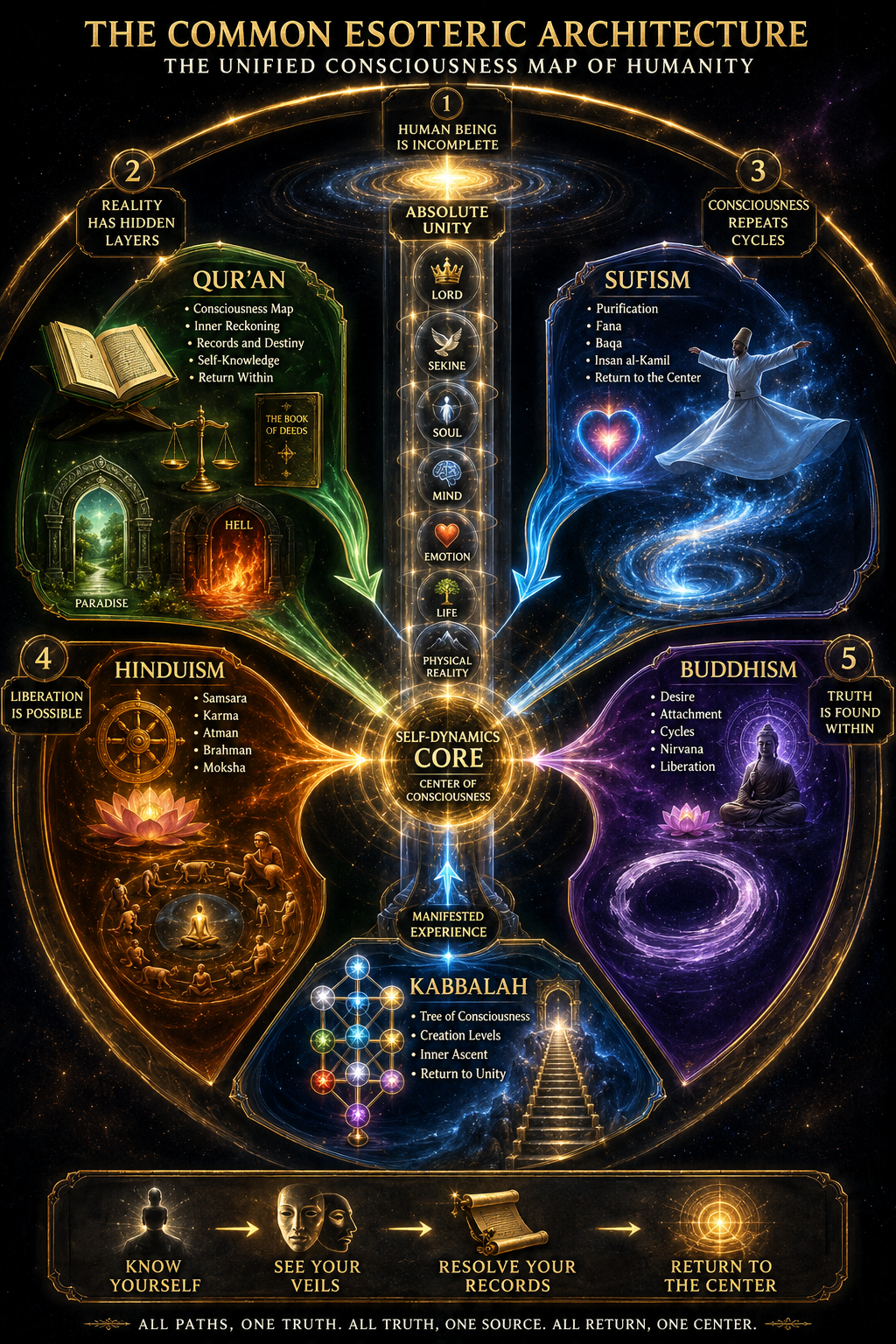
The Qur'an has often been read merely as a book of law, morality, or belief. However, from an esoteric perspective, the Qur'an is also a symbolic map describing the structure of consciousness. From the perspective of The Doctrine of Self-Dynamics, the primary subject of the Qur'an is not the external world but the inner world of the human being.
The Paradise and Hell mentioned in the Qur'an can be read not only as places after death but also as states of consciousness. When a person lives in peace, balance, and unity, the consciousness of Paradise emerges. When a person lives in fragmentation, fear, and inner conflict, the consciousness of Hell arises.
The recurring Qur'anic concepts of reckoning, balance, the book of deeds, and destiny can also be associated with the Record Theory of The Doctrine of Self-Dynamics. For every action leaves a record. Every record opens when its time arrives. Every unfolding makes it possible to see the effect it has created within consciousness.
One of the deepest calls of the Qur'an is for the human being to know himself. Therefore, the central struggle of the Qur'an is not with external enemies but with the fragmentation within the human being.
From the perspective of Self-Dynamics, the fundamental message of the Qur'an is this:
Before correcting the external world, the human being must see the records within himself.
For the destiny of the human being is written not outside, but within the layers of his own consciousness.
SUFISM AND SELF-DYNAMICS
Sufism is a doctrine of consciousness that examines the inner dimension of Islam. There are many common concepts between The Doctrine of Self-Dynamics and Sufism.
The process described in Sufism as the stages of the nafs can be read in The Doctrine of Self-Dynamics as the purification process of the Lower Tetrad.
The fundamental aim of Sufism is not to change the human being but to make visible the truth that already exists within the human being.
For this reason, Sufism constantly speaks of the purification of the heart, the cleansing of the nafs, and the dissolution of the ego.
For truth is not something acquired later.
It already exists behind the veils.
The concept of fana in Sufism refers to the dissolution of false centers. When a person ceases to identify himself with his thoughts, desires, and fears, the process of fana begins.
Baqa, on the other hand, is the emergence of the true center after dissolution.
Fana is the end of fragmentation.
Baqa is the beginning of the return to the center.
The doctrine of the Perfect Human (Insan al-Kamil) also corresponds to the completed consciousness model of The Doctrine of Self-Dynamics. The Perfect Human is a consciousness whose forty-nine veils have become transparent and which has established complete balance between the Upper Triad and the Lower Tetrad.
HINDUISM AND SAMSARA
In Hindu thought, samsara refers to the cycle of birth and death. However, this cycle is not merely a biological process. Its true meaning is the mechanism of repetition within consciousness.
According to The Doctrine of Self-Dynamics, what repeats is not lives but unresolved consciousness records.
From this perspective, samsara is the cosmic name of the cycle of destiny.
Karma is the recording mechanism that creates this cycle.
Every experience leaves an imprint.
Every imprint calls forth a new experience.
Every experience creates a new opportunity for learning.
For this reason, samsara is not a punitive system.
It is an instructive system.
While the concept of Atman in Hinduism represents the individual center of consciousness, Brahman represents the common source of all existence.
The relationship between these two can be read in a manner similar to the relationship between the Soul and Lord in The Doctrine of Self-Dynamics.
Moksha is the end of the cycle.
However, the end of the cycle is not annihilation.
It is the completion of the consciousness that remained incomplete.
When a person reaches a level of consciousness that no longer produces repetition, samsara comes to an end.
BUDDHISM AND NIRVANA
Unlike many other traditions, Buddhism emphasizes not a fixed essence but a continuously changing flow of consciousness.
In this respect, it is quite close to The Doctrine of Self-Dynamics.
According to Buddhism, human beings suffer because they mistake temporary things for permanent ones.
According to The Doctrine of Self-Dynamics, human beings suffer because they mistake temporary layers for the essential center.
The two approaches use different languages, yet they point to the same reality.
In Buddhism, desire is regarded as the primary source of suffering.
For desire continually creates new attachments.
New attachments create new records.
New records generate new cycles.
Therefore, desire is not merely wanting.
It is attachment.
Nirvana has often been incorrectly interpreted as annihilation.
However, the essence of Nirvana is extinction.
Yet what is extinguished is not consciousness.
It is the fire that produces records.
From the perspective of The Doctrine of Self-Dynamics, Nirvana is the exhaustion of unresolved consciousness records and the end of the capacity to generate cycles.
Thus, for the first time, consciousness becomes capable of standing within its own center.
KABBALAH AND THE TREE OF CONSCIOUSNESS
The Tree of Life, which stands at the center of Kabbalah, is a symbolic map that illustrates the levels of consciousness and the stages of creation.
This map describes not the outer universe but the inner universe.
According to Kabbalah, an unfolding occurs from absolute unity toward multiplicity. Consciousness differentiates into various levels and ultimately descends into the material world.
A similar movement can also be observed in The Doctrine of Self-Dynamics.
A record is formed within the field of Lord.
It is balanced within the field of Sekine (Shekinah-Spenta Armaiti-Holy Spirit).
It gains direction within the field of the Soul.
It becomes thought within the field of Mind.
It gains vibration within the field of Emotion.
It creates flow within the field of Life.
It becomes an event within the Physical field.
For this reason, there is a structural similarity between the Tree of Life of Kabbalah and the Seven-Layer Model of The Doctrine of Self-Dynamics.
Kabbalah also describes the inner ascent of the human being.
By moving from below to above, the human being remembers the unity that was lost.
In The Doctrine of Self-Dynamics, this movement is expressed as the process of resolving records and returning to the center.
THE COMMON ESOTERIC ARCHITECTURE
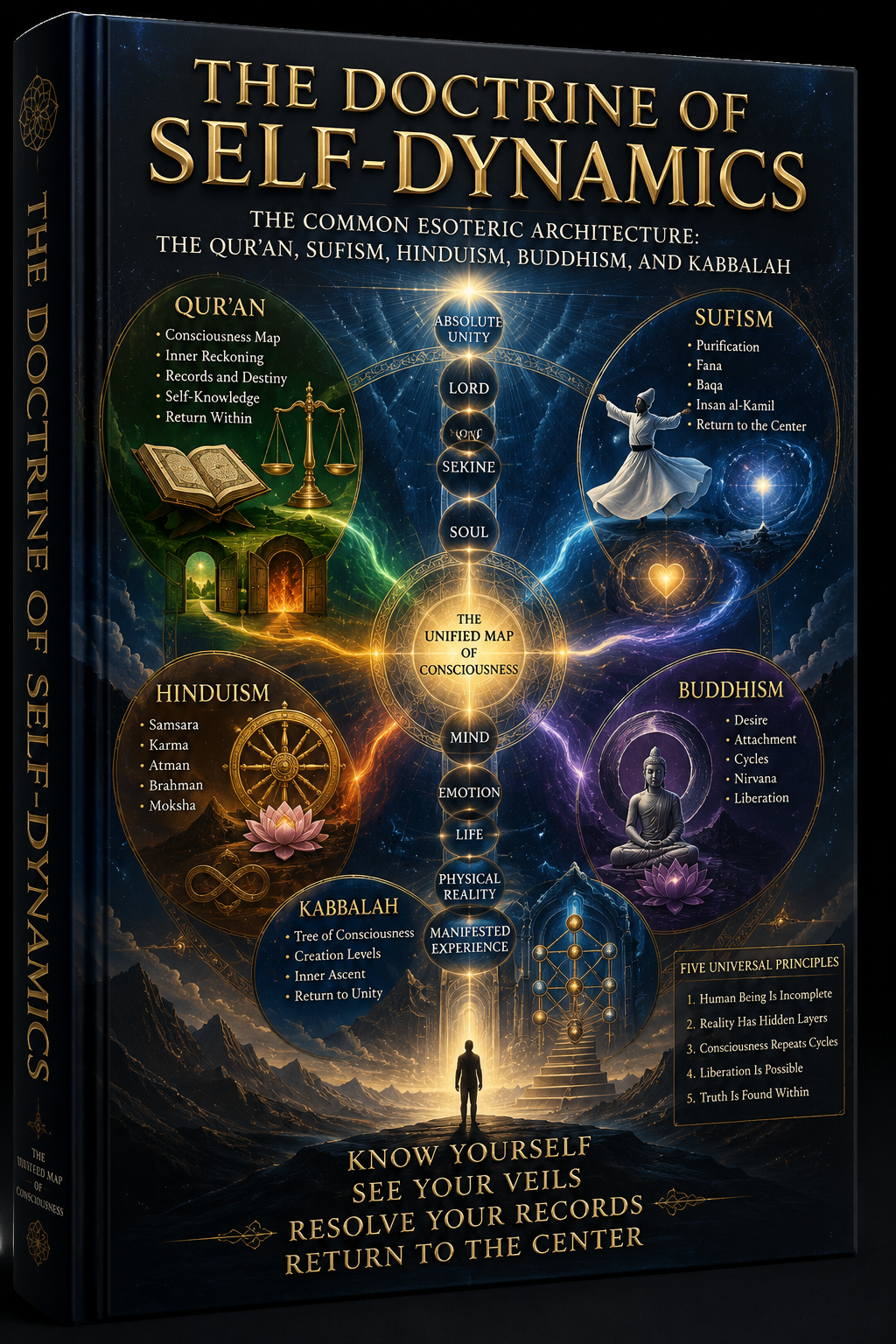
At first glance, the Qur'an, Sufism, Hinduism, Buddhism, and Kabbalah appear to be entirely different traditions. Their languages are different. Their symbols are different. Their histories are different.
However, when the deeper structure is examined, a common architecture emerges.
The first principle of this architecture is this:
The human being, in his present state, is not complete.
Every tradition says that the human being is on a journey.
The second principle is this:
The visible world is not the ultimate reality.
All traditions speak of the existence of unseen layers.
The third principle is this:
Human beings live within recurring cycles.
Some call these cycles karma.
Some call them samsara.
Some call them destiny.
Some call them the struggle with the nafs.
Yet all point to the same mechanism.
The fourth principle is this:
Human beings can transcend these cycles.
Purification is possible.
Completion is possible.
Returning to the center is possible.
The fifth and deepest principle is this:
Truth is not sought outside.
It is discovered within the layers of one's own consciousness.
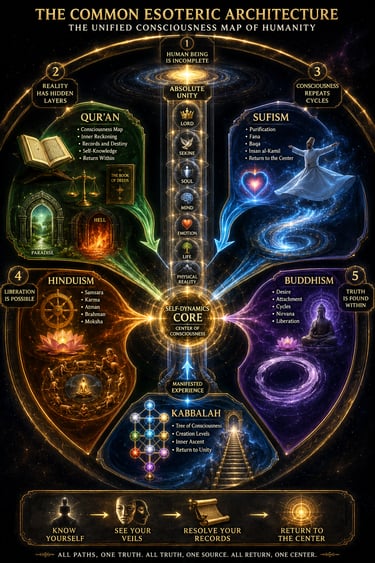
This is the common esoteric architecture presented by The Doctrine of Self-Dynamics.
Different traditions are like different paths leading to the same mountain.
The paths change.
The names change.
The symbols change.
Yet the center being indicated never changes.
For at the essence of all esoteric traditions lies the same call:
Know yourself.
See your veils.
Resolve your records.
Return to your center.
And become aware of your own self-dynamics.
FOOTNOTES
1. In The Doctrine of Self-Dynamics, the Qur'an is interpreted not merely as a collection of legal or moral rulings, but as a symbolic map explaining the layers of consciousness.
2. The Holy Qur'an, Al-Qiyamah 75:14; Ash-Shams 91:7–10; Ar-Ra'd 13:11.
3. Toshihiko Izutsu, God and Man in the Qur'an, Kuala Lumpur: Islamic Book Trust, 2002, pp. 117–203.
4. Fazlur Rahman, Major Themes of the Qur'an, Chicago: University of Chicago Press, 2009, pp. 19–96.
5. Seyyed Hossein Nasr (ed.), The Study Quran, New York: HarperOne, 2015, pp. 25–74.
6. Muhyiddin Ibn Arabi, al-Futuhat al-Makkiyyah, trans. Ekrem Demirli, Istanbul: Litera Publishing, 2006, Vol. II, pp. 145–248.
7. Muhyiddin Ibn Arabi, Fusus al-Hikam, trans. Ekrem Demirli, Istanbul: Kabalcı Publishing, 2013, pp. 65–139.
8. William C. Chittick, The Sufi Path of Knowledge, Albany: SUNY Press, 1989, pp. 59–178.
9. Annemarie Schimmel, Mystical Dimensions of Islam, Chapel Hill: University of North Carolina Press, 1975, pp. 111–239.
10. Henry Corbin, Creative Imagination in the Sufism of Ibn Arabi, Princeton: Princeton University Press, 1969, pp. 165–276.
11. Toshihiko Izutsu, Sufism and Taoism, Berkeley: University of California Press, 1984, pp. 91–203.
12. Bhagavad Gita, trans. Eknath Easwaran, Tomales: Nilgiri Press, 2007, II:11–72.
13. Sarvepalli Radhakrishnan, The Principal Upanishads, New Delhi: HarperCollins, 1994, pp. 287–419.
14. Heinrich Zimmer, Philosophies of India, Princeton: Princeton University Press, 1969, pp. 271–401.
15. Mircea Eliade, Yoga: Immortality and Freedom, Princeton: Princeton University Press, 2009, pp. 203–317.
16. René Guénon, Man and His Becoming According to the Vedanta, Hillsdale: Sophia Perennis, 2001, pp. 85–177.
17. Walpola Rahula, What the Buddha Taught, New York: Grove Press, 1974, pp. 15–86.
18. Edward Conze, Buddhist Thought in India, Ann Arbor: University of Michigan Press, 1967, pp. 33–118.
19. D. T. Suzuki, Essays in Zen Buddhism, New York: Grove Press, 1961, pp. 77–163.
20. Thich Nhat Hanh, The Heart of the Buddha's Teaching, New York: Broadway Books, 1999, pp. 87–172.
21. Karen Armstrong, Buddha, New York: Penguin Books, 2001, pp. 54–118.
22. Gershom Scholem, Major Trends in Jewish Mysticism, New York: Schocken Books, 1995, pp. 205–312.
23. Daniel C. Matt, The Essential Kabbalah, San Francisco: HarperCollins, 1995, pp. 37–126.
24. Aryeh Kaplan, Sefer Yetzirah: The Book of Creation, York Beach: Weiser Books, 1997, pp. 11–104.
25. Moshe Idel, Kabbalah: New Perspectives, New Haven: Yale University Press, 1988, pp. 91–187.
26. Z'ev ben Shimon Halevi, Kabbalah: Tradition of Hidden Knowledge, London: Thames & Hudson, 1991, pp. 71–149.
27. Frithjof Schuon, The Transcendent Unity of Religions, Wheaton: Quest Books, 1993, pp. 1–95.
28. Huston Smith, The World's Religions, New York: HarperOne, 2009, pp. 1–117.
29. Aldous Huxley, The Perennial Philosophy, New York: Harper Perennial, 2004, pp. 1–88.
30. Mircea Eliade, The Sacred and the Profane, New York: Harcourt, 1987, pp. 8–75.
31. In The Doctrine of Self-Dynamics, the “Doctrine of the Forty-Nine Veils” is the fundamental model explaining the process of conscious transparency.
32. According to The Doctrine of Self-Dynamics, samsara is interpreted as the cycle of destiny, while karma is interpreted as the mechanism of records.
33. In The Doctrine of Self-Dynamics, Nirvana is not the extinction of consciousness but the ending of the cycles that generate records.
34. In The Doctrine of Self-Dynamics, a structural parallel is established between the Tree of Life of Kabbalah and the Seven-Layer Model.
35. According to the Common Esoteric Architecture approach of The Doctrine of Self-Dynamics, different traditions express the same consciousness-based truth through different symbols.
BIBLIOGRAPHY
Armstrong, Karen. Buddha. New York: Penguin Books, 2001.
Bhagavad Gita. Translated by Eknath Easwaran. Tomales: Nilgiri Press, 2007.
Chittick, William C. The Sufi Path of Knowledge. Albany: SUNY Press, 1989.
Conze, Edward. Buddhist Thought in India. Ann Arbor: University of Michigan Press, 1967.
Corbin, Henry. Creative Imagination in the Sufism of Ibn Arabi. Princeton: Princeton University Press, 1969.
Eliade, Mircea. The Sacred and the Profane. New York: Harcourt, 1987.
Eliade, Mircea. Yoga: Immortality and Freedom. Princeton: Princeton University Press, 2009.
Fazlur Rahman. Major Themes of the Qur'an. Chicago: University of Chicago Press, 2009.
Guénon, René. Man and His Becoming According to the Vedanta. Hillsdale: Sophia Perennis, 2001.
Halevi, Z'ev ben Shimon. Kabbalah: Tradition of Hidden Knowledge. London: Thames & Hudson, 1991.
Huxley, Aldous. The Perennial Philosophy. New York: Harper Perennial, 2004.
Idel, Moshe. Kabbalah: New Perspectives. New Haven: Yale University Press, 1988.
Ibn Arabi, Muhyiddin. al-Futuhat al-Makkiyyah. Translated by Ekrem Demirli. Istanbul: Litera Publishing, 2006.
Ibn Arabi, Muhyiddin. Fusus al-Hikam. Translated by Ekrem Demirli. Istanbul: Kabalcı Publishing, 2013.
Izutsu, Toshihiko. God and Man in the Qur'an. Kuala Lumpur: Islamic Book Trust, 2002.
Izutsu, Toshihiko. Sufism and Taoism. Berkeley: University of California Press, 1984.
Kaplan, Aryeh. Sefer Yetzirah: The Book of Creation. York Beach: Weiser Books, 1997.
Matt, Daniel C. The Essential Kabbalah. San Francisco: HarperCollins, 1995.
Nasr, Seyyed Hossein (ed.). The Study Quran. New York: HarperOne, 2015.
Radhakrishnan, Sarvepalli. The Principal Upanishads. New Delhi: HarperCollins, 1994.
Rahula, Walpola. What the Buddha Taught. New York: Grove Press, 1974.
Schimmel, Annemarie. Mystical Dimensions of Islam. Chapel Hill: University of North Carolina Press, 1975.
Scholem, Gershom. Major Trends in Jewish Mysticism. New York: Schocken Books, 1995.
Schuon, Frithjof. The Transcendent Unity of Religions. Wheaton: Quest Books, 1993.
Smith, Huston. The World's Religions. New York: HarperOne, 2009.
Suzuki, D. T. Essays in Zen Buddhism. New York: Grove Press, 1961.
Zimmer, Heinrich. Philosophies of India. Princeton: Princeton University Press, 1969.