THE DOCTRINE OF SELF-DYNAMICS CHAPTER-46: THE EQUATION OF SELF-DYNAMICS
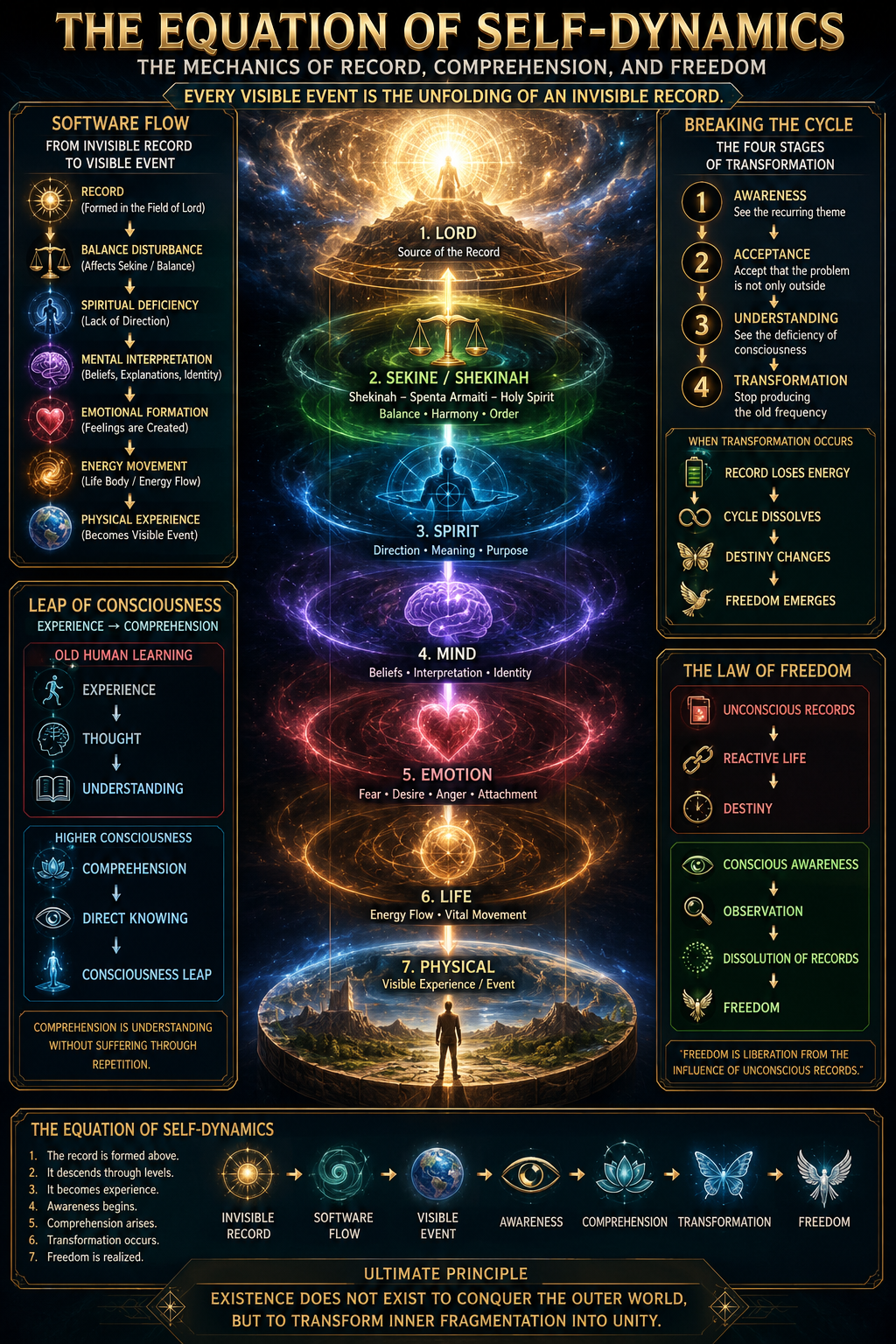
THE DOCTRINE OF SELF-DYNAMICS CHAPTER-46: THE EQUATION OF SELF-DYNAMICS. Therefore, the fundamental algorithm of The Doctrine of Self-Dynamics is expressed as follows: Lord → Sekine (Shekinah-Spenta Armaiti-Holy Spirit) → Spirit → Mind → Emotion → Life → Physical
ÖZ-DEVİNİM KURAMI
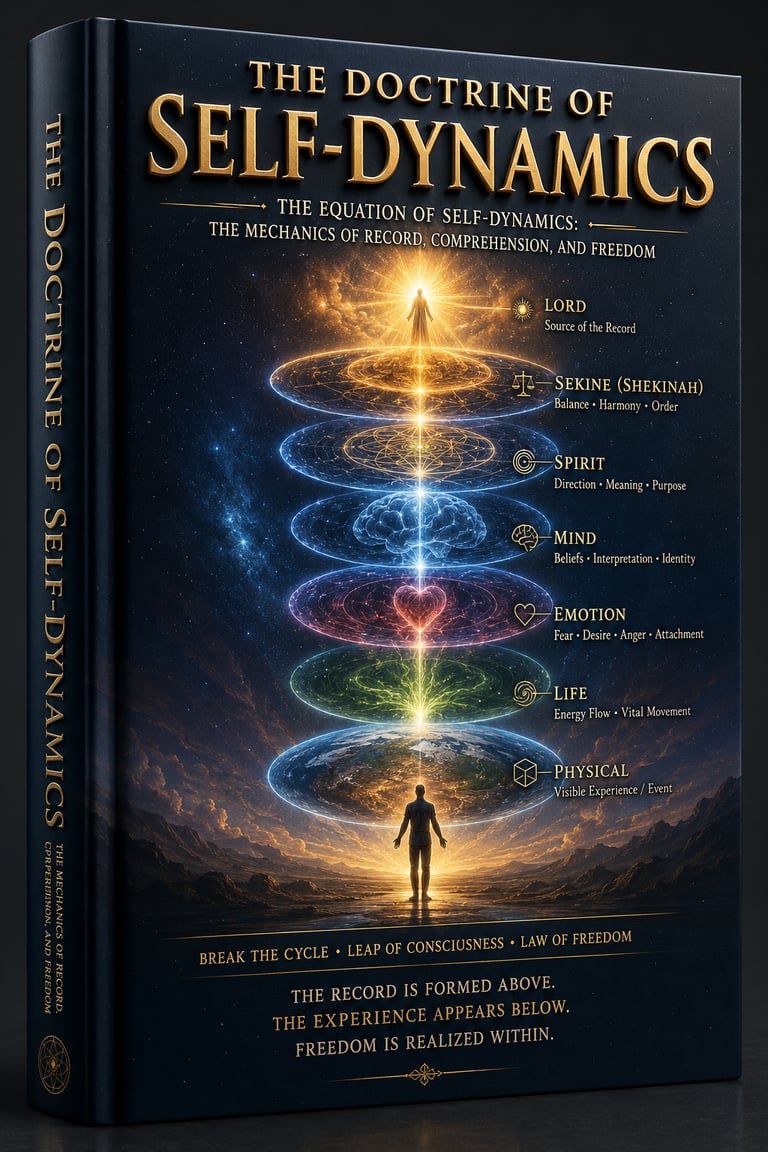
THE DOCTRINE OF SELF-DYNAMICS CHAPTER-46: THE EQUATION OF SELF-DYNAMICS: THE MECHANICS OF RECORD, COMPREHENSION, AND FREEDOM
THE EQUATION OF SELF-DYNAMICS
At the center of The Doctrine of Self-Dynamics lies a single fundamental law:
Every visible event is the unfolding of an invisible record.
This law constitutes the algorithm of the entire system. No event that occurs in human life begins directly on the physical plane. The physical world is not the beginning of the process but its final link. The actual movement begins in the higher layers of consciousness and, becoming progressively denser, transforms into experience.
Therefore, the fundamental algorithm of The Doctrine of Self-Dynamics is expressed as follows:
Lord → Sekine (Shekinah-Spenta Armaiti-Holy Spirit) → Spirit → Mind → Emotion → Life → Physical
This flow is called the Software Flow.
A record is formed in the field of Lord.
This record is not yet an event.
It is a potential.
It is a core.
It is a seed.
The record then descends into the field of Sekine (Shekinah-Spenta Armaiti-Holy Spirit).
Here it begins to create an effect upon balance.
Since Sekine (Shekinah-Spenta Armaiti-Holy Spirit) is the balance center of the system, every record first creates a vibration here.
When balance is disrupted, the Spirit layer is affected.
The Spirit begins to feel a deficiency in its sense of direction.
The person does not know exactly what is missing.
Yet feels that something is not in its proper place.
This deficiency then descends into the mind.
The mind begins to produce explanations for the record.
Beliefs are formed.
Interpretations are formed.
Identities are formed.
Then the record passes into the field of emotion.
Thoughts now become feelings.
Fear emerges.
Desire emerges.
Anger emerges.
Attachment emerges.
When emotions descend into the life body, the flow of energy takes shape.
Some areas open.
Some areas close.
Some areas accelerate.
Others slow down.
And eventually the entire process becomes visible as an event on the physical plane.
Human beings see only the final stage.
Therefore, they assume events are the cause.
Yet the event is the result.
The cause is above.
This is what the Equation of Self-Dynamics expresses:
The record is formed above.
The experience appears below.
Therefore, if a person wishes to change his life, he must work not with the results, but with the layers that produce those results.
HOW IS THE CYCLE BROKEN?
Nothing that repeats in human life is accidental.
The repetition of the same fears,
the repetition of the same relationships,
the repetition of the same failures,
the repetition of the same pains,
the repetition of the same longings,
are all products of the same mechanism.
The record has not been resolved.
The cycle is not fate.
The cycle is the movement of unresolved consciousness.
When people attempt to break the cycle, they usually change only the results.
They change cities.
They change jobs.
They change people.
They change identities.
Yet because the veil remains the same, the record opens again.
Therefore, the cycle is not broken outside.
It is broken inside.
According to The Doctrine of Self-Dynamics, there are four fundamental stages in breaking the cycle.
The first stage is awareness.
A person begins to see the recurring theme.
The second stage is acceptance.
The person accepts that the problem is not only outside.
The third stage is understanding.
The person sees the deficiency of consciousness carried by the experience.
The fourth stage is transformation.
The person no longer produces the old frequency.
At this point, the record loses its energy.
A record that loses its energy can no longer produce new experiences.
And a record that produces no new experiences dissolves.
Thus the cycle comes to an end.
For it is not events that repeat.
It is consciousness that repeats.
COMPREHENSION AND THE LEAP OF CONSCIOUSNESS
Most of humanity learns through experience.
First they live.
Then they think.
Then they try to understand.
This form of learning is slow.
Because knowledge comes after suffering.
Comprehension, however, is different.
Comprehension is the capacity to understand without having to experience.
When this capacity emerges, consciousness passes to a new level.
The Doctrine of Self-Dynamics calls this transition the Leap of Consciousness.
The Leap of Consciousness is the result of cumulative development.
It appears to occur suddenly.
Yet it is the product of long periods of preparation.
A person may suddenly understand an issue that could not be resolved for years.
A burden carried for years may suddenly disappear.
A cycle that has repeated for years may suddenly come to an end.
Because consciousness has seen the missing piece.
When comprehension emerges, energy is released.
Resistance dissolves.
The record loses its meaning.
Therefore, comprehension is not merely knowledge.
It is a transformation.
The person remains the same person.
Yet does not remain the same consciousness.
As comprehension increases, the meaning of life changes.
The person begins to see not the events, but the mechanisms behind the events.
Sees not the causes, but the root causes.
Sees not the results, but the records.
At this point, the Leap of Consciousness occurs.
The person is no longer someone carried along by life.
The person becomes one who begins to see the mechanism that produces life.
THE LAW OF FREEDOM
One of humanity's oldest desires is freedom.
However, freedom has often been misunderstood.
Freedom is not doing whatever one wants.
Freedom is not escaping consequences.
Freedom is not lawlessness.
According to The Doctrine of Self-Dynamics, freedom is liberation from the influence of unconscious records.
If a person is controlled by anger, that person is not free.
If a person is controlled by fears, that person is not free.
If a person is controlled by desires, that person is not free.
If a person is controlled by past records, that person is not free.
Because in all these situations, although the person believes he is making choices, he is actually being directed by his records.
True freedom first emerges when observation begins.
When a person realizes that he is thinking,
when he realizes that he is feeling,
when he realizes that he is reacting,
when he begins to see his own records,
the gate of freedom opens.
Freedom is not the absence of records.
It is awareness of records.
A record that is recognized begins to dissolve.
A dissolved record loses its influence.
A record that loses its influence ceases to be destiny.
Therefore, the final law of The Doctrine of Self-Dynamics is this:
Destiny is the movement of unconscious records.
Freedom is the movement of conscious awareness.
A human being is not born free.
But can become free.
Liberation is the becoming transparent of the forty-nine veils.
Liberation is the rebalancing of the Upper Triad and the Lower Tetrad.
Liberation is the dissolution of records.
Liberation is the return to the center.
And all the teachings of The Doctrine of Self-Dynamics ultimately arrive at a single point:
Existence does not exist to conquer the outer world,
but to transform the inner fragmentation into unity.
For the ultimate purpose of self-dynamics is not movement.
It is the remembrance of consciousness of its own source.
FOOTNOTES
1. According to the fundamental proposition of The Doctrine of Self-Dynamics, every visible event is the unfolding of an invisible record of consciousness.
2. Muhyiddin Ibn Arabi, al-Futuhat al-Makkiyya, trans. Ekrem Demirli, Istanbul: Litera Publishing, 2006, Vol. II, pp. 203–311.
3. Muhyiddin Ibn Arabi, Fusus al-Hikam, trans. Ekrem Demirli, Istanbul: Kabalcı Publishing, 2013, pp. 81–173.
4. William C. Chittick, The Self-Disclosure of God, Albany: SUNY Press, 1998, pp. 93–207.
5. Henry Corbin, Creative Imagination in the Sufism of Ibn Arabi, Princeton: Princeton University Press, 1969, pp. 177–296.
6. Toshihiko Izutsu, Sufism and Taoism, Berkeley: University of California Press, 1984, pp. 151–273.
7. Seyyed Hossein Nasr, Knowledge and the Sacred, Albany: SUNY Press, 1989, pp. 173–281.
8. Carl Gustav Jung, Aion: Researches into the Phenomenology of the Self, Princeton: Princeton University Press, 1978, pp. 63–149.
9. Carl Gustav Jung, Psychology and Alchemy, Princeton: Princeton University Press, 1980, pp. 91–197.
10. Roberto Assagioli, Psychosynthesis, New York: Penguin Books, 1975, pp. 81–173.
11. Ken Wilber, Integral Psychology, Boston: Shambhala, 2000, pp. 121–236.
12. Stanislav Grof, Psychology of the Future, Albany: SUNY Press, 2000, pp. 101–215.
13. William James, The Varieties of Religious Experience, New York: Modern Library, 2002, pp. 301–401.
14. Jean Gebser, The Ever-Present Origin, Athens: Ohio University Press, 1985, pp. 119–231.
15. David Bohm, Wholeness and the Implicate Order, London: Routledge, 2002, pp. 27–119.
16. Ervin Laszlo, Science and the Akashic Field, Rochester: Inner Traditions, 2007, pp. 81–171.
17. Abraham Maslow, Toward a Psychology of Being, New York: Wiley, 1999, pp. 117–211.
18. Pierre Teilhard de Chardin, The Phenomenon of Man, New York: Harper Perennial, 2008, pp. 189–287.
19. Frithjof Schuon, The Transcendent Unity of Religions, Wheaton: Quest Books, 1993, pp. 71–167.
20. René Guénon, The Multiple States of Being, Hillsdale: Sophia Perennis, 2001, pp. 33–121.
21. Mircea Eliade, The Sacred and the Profane, New York: Harcourt, 1987, pp. 31–109.
22. Huston Smith, Forgotten Truth, New York: HarperOne, 1992, pp. 101–196.
23. In The Doctrine of Self-Dynamics, the "Software Flow" refers to the process of descent from consciousness into matter occurring in the sequence: Lord → Sekine (Shekinah-Spenta Armaiti-Holy Spirit) → Spirit → Mind → Emotion → Life → Physical.
24. According to The Doctrine of Self-Dynamics, the physical plane is the final layer where not causes, but results become visible.
25. In The Doctrine of Self-Dynamics, the breaking of cycles occurs in four stages: Awareness, Acceptance, Understanding, and Transformation.
26. In The Doctrine of Self-Dynamics, the "Leap of Consciousness" is the transformation of consciousness that occurs when truth is directly comprehended without the necessity of lived experience.
27. According to The Doctrine of Self-Dynamics, comprehension is not the acquisition of knowledge; it is a mechanism for dissolving records.
28. In The Doctrine of Self-Dynamics, freedom is not the absence of external conditions; it is the capacity to become free from the influence of unconscious records.
29. According to The Doctrine of Self-Dynamics, liberation is the becoming transparent of the forty-nine veils and the reestablishment of balance between the Upper Triad and the Lower Tetrad.
30. The ultimate purpose of The Doctrine of Self-Dynamics is for consciousness to remember its own source and to transform inner fragmentation back into unity.
BIBLIOGRAPHY
Assagioli, Roberto. Psychosynthesis. New York: Penguin Books, 1975.
Bohm, David. Wholeness and the Implicate Order. London: Routledge, 2002.
Chardin, Pierre Teilhard de. The Phenomenon of Man. New York: Harper Perennial, 2008.
Chittick, William C. The Self-Disclosure of God. Albany: SUNY Press, 1998.
Corbin, Henry. Creative Imagination in the Sufism of Ibn Arabi. Princeton: Princeton University Press, 1969.
Eliade, Mircea. The Sacred and the Profane. New York: Harcourt, 1987.
Gebser, Jean. The Ever-Present Origin. Athens: Ohio University Press, 1985.
Grof, Stanislav. Psychology of the Future. Albany: SUNY Press, 2000.
Guénon, René. The Multiple States of Being. Hillsdale: Sophia Perennis, 2001.
Ibn Arabi, Muhyiddin. al-Futuhat al-Makkiyya. Trans. Ekrem Demirli. Istanbul: Litera Publishing, 2006.
Ibn Arabi, Muhyiddin. Fusus al-Hikam. Trans. Ekrem Demirli. Istanbul: Kabalcı Publishing, 2013.
Izutsu, Toshihiko. Sufism and Taoism. Berkeley: University of California Press, 1984.
James, William. The Varieties of Religious Experience. New York: Modern Library, 2002.
Jung, Carl Gustav. Aion. Princeton: Princeton University Press, 1978.
Jung, Carl Gustav. Psychology and Alchemy. Princeton: Princeton University Press, 1980.
Laszlo, Ervin. Science and the Akashic Field. Rochester: Inner Traditions, 2007.
Maslow, Abraham. Toward a Psychology of Being. New York: Wiley, 1999.
Nasr, Seyyed Hossein. Knowledge and the Sacred. Albany: SUNY Press, 1989.
Schuon, Frithjof. The Transcendent Unity of Religions. Wheaton: Quest Books, 1993.
Smith, Huston. Forgotten Truth. New York: HarperOne, 1992.
Wilber, Ken. Integral Psychology. Boston: Shambhala, 2000.