THE DOCTRINE OF SELF-DYNAMICS CHAPTER-6: THOUGHT FORMS AND THE ESOTERIC STRUCTURES OF THE COLLECTIVE MIND
Blog gönderi açıklaması.
ÖZ-DEVİNİM KURAMI
THE DOCTRINE OF SELF-DYNAMICS
CHAPTER-6: THOUGHT FORMS AND THE ESOTERIC STRUCTURES OF THE COLLECTIVE MIND
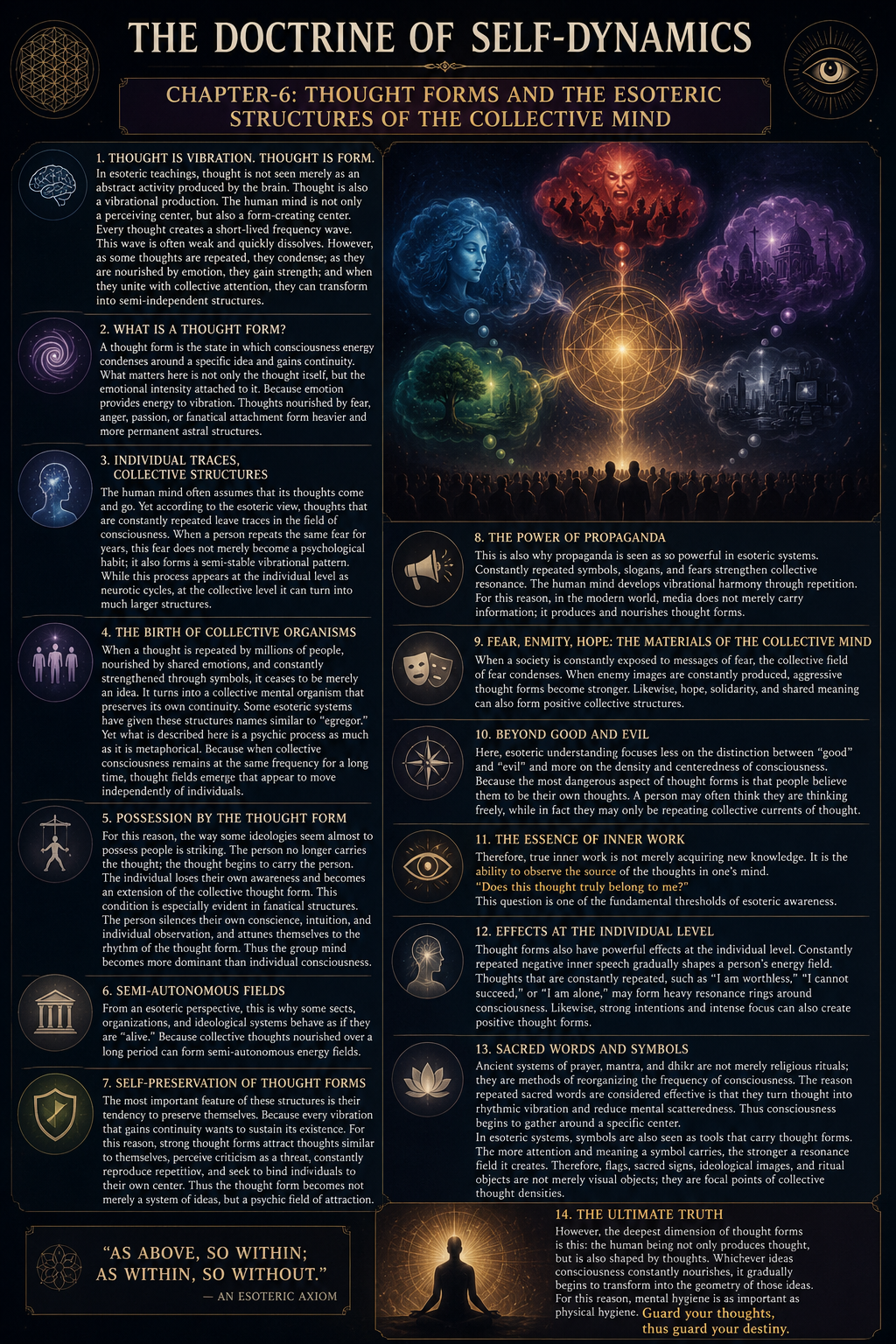
In esoteric teachings, thought is not seen merely as an abstract activity produced by the brain. Thought is also a vibrational production. The human mind is not only a perceiving center, but also a form-creating center. Every thought creates a short-lived frequency wave. This wave is often weak and quickly dissolves. However, as some thoughts are repeated, they condense; as they are nourished by emotion, they gain strength; and when they unite with collective attention, they can transform into semi-independent structures.
In esoteric systems, these structures are called “thought forms.”
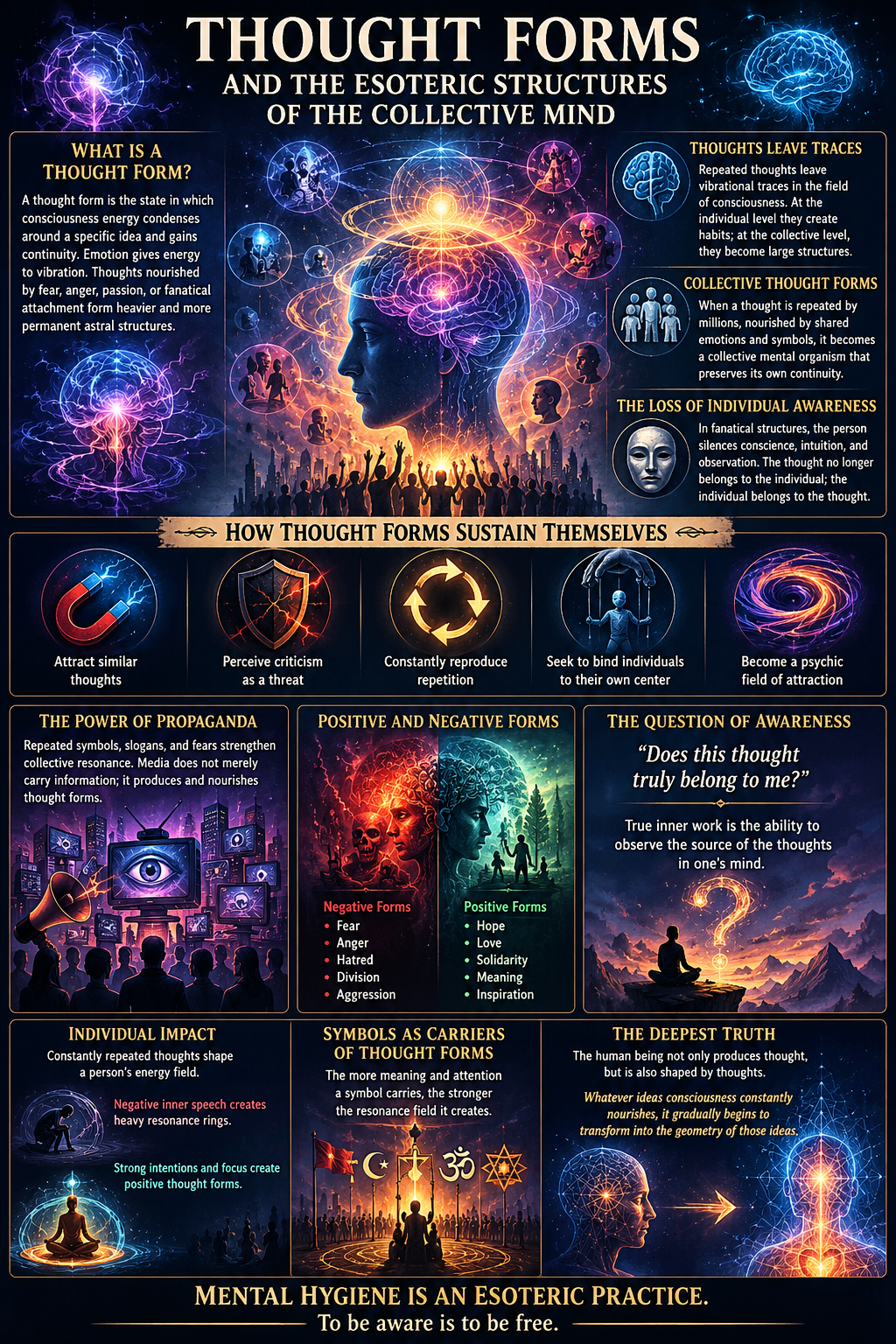
A thought form is the state in which consciousness energy condenses around a specific idea and gains continuity. What matters here is not only the thought itself, but the emotional intensity attached to it. Because emotion provides energy to vibration. Thoughts nourished by fear, anger, passion, or fanatical attachment form heavier and more permanent astral structures.
The human mind often assumes that its thoughts come and go. Yet according to the esoteric view, thoughts that are constantly repeated leave traces in the field of consciousness. When a person repeats the same fear for years, this fear does not merely become a psychological habit; it also forms a semi-stable vibrational pattern.
While this process appears at the individual level as neurotic cycles, at the collective level it can turn into much larger structures.
When a thought is repeated by millions of people, nourished by shared emotions, and constantly strengthened through symbols, it ceases to be merely an idea. It turns into a collective mental organism that preserves its own continuity.
Some esoteric systems have given these structures names similar to “egregor.” Yet what is described here is a psychic process as much as it is metaphorical. Because when collective consciousness remains at the same frequency for a long time, thought fields emerge that appear to move independently of individuals.
For this reason, the way some ideologies seem almost to possess people is striking. The person no longer carries the thought; the thought begins to carry the person. The individual loses their own awareness and becomes an extension of the collective thought form.
This condition is especially evident in fanatical structures. The person silences their own conscience, intuition, and individual observation, and attunes themselves to the rhythm of the thought form. Thus the group mind becomes more dominant than individual consciousness.
From an esoteric perspective, this is why some sects, organizations, and ideological systems behave as if they are “alive.” Because collective thoughts nourished over a long period can form semi-autonomous energy fields.
The most important feature of these structures is their tendency to preserve themselves. Because every vibration that gains continuity wants to sustain its existence. For this reason, strong thought forms attract thoughts similar to themselves, perceive criticism as a threat, constantly reproduce repetition, and seek to bind individuals to their own center.
Thus the thought form becomes not merely a system of ideas, but a psychic field of attraction.
This is also why propaganda is seen as so powerful in esoteric systems. Constantly repeated symbols, slogans, and fears strengthen collective resonance. The human mind develops vibrational harmony through repetition.
For this reason, in the modern world, media does not merely carry information; it produces and nourishes thought forms.
When a society is constantly exposed to messages of fear, the collective field of fear condenses. When enemy images are constantly produced, aggressive thought forms become stronger. Likewise, hope, solidarity, and shared meaning can also form positive collective structures.
Here, esoteric understanding focuses less on the distinction between “good” and “evil” and more on the density and centeredness of consciousness. Because the most dangerous aspect of thought forms is that people believe them to be their own thoughts.
A person may often think they are thinking freely, while in fact they may only be repeating collective currents of thought.
Therefore, true inner work is not merely acquiring new knowledge. It is the ability to observe the source of the thoughts in one’s mind.
“Does this thought truly belong to me?”
This question is one of the fundamental thresholds of esoteric awareness.
Thought forms also have powerful effects at the individual level. Constantly repeated negative inner speech gradually shapes a person’s energy field. Thoughts that are constantly repeated, such as “I am worthless,” “I cannot succeed,” or “I am alone,” may form heavy resonance rings around consciousness.
Likewise, strong intentions and intense focus can also create positive thought forms. Ancient systems of prayer, mantra, and dhikr are not merely religious rituals; they are methods of reorganizing the frequency of consciousness.
The reason repeated sacred words are considered effective is that they turn thought into rhythmic vibration and reduce mental scatteredness. Thus consciousness begins to gather around a specific center.
In esoteric systems, symbols are also seen as tools that carry thought forms. The more attention and meaning a symbol carries, the stronger a resonance field it creates. Therefore, flags, sacred signs, ideological images, and ritual objects are not merely visual objects; they are focal points of collective thought densities.
However, the deepest dimension of thought forms is this: the human being not only produces thought, but is also shaped by thoughts.
Whichever ideas consciousness constantly nourishes, it gradually begins to transform into the geometry of those ideas.
For this reason, mental hygiene is very important in esoteric teachings. Because not every thought is temporary. Some build structures within the inner universe of the human being.
And in the end, the human being becomes the form inhabited by the thought they repeat the most.
ECHO CITIES AND THE ASTRAL REMNANTS OF COLLECTIVE CONSCIOUSNESS
In esoteric cosmology, no thought disappears completely. No civilization is entirely erased. Because existence does not leave only material traces; it also produces vibrational echoes. Physical structures collapse, cities are destroyed, languages are forgotten, belief systems dissolve; yet the intense resonance fields they created in collective consciousness continue to exist for a while longer.
These remnants are called “Echo Cities.”
Echo Cities are not physical places. They are collective memory sediments accumulated within the Astral Field. The thought patterns, fears, belief systems, symbols, and emotional intensities of great civilizations gradually form semi-stable astral structures. When a civilization disappears, its material form dissolves; yet its imprint in consciousness does not vanish completely.
According to esoteric systems, human history consists not only of archaeological layers. It also contains invisible layers of consciousness.
For this reason, some people encounter cities in their dreams that they have never seen. They may experience endless stairways, familiar yet nonexistent streets, enormous empty libraries, corridors filled with light, or places that feel inexplicably “ancient.”
These images are not seen merely as random productions of the individual subconscious. According to esoteric understanding, some dreams touch the echoes of collective astral memory.
The most striking feature of Echo Cities is the feeling of “familiar strangeness.” A person sees these places for the first time, yet feels as if they have known them for a long time. Because here, what operates is not individual memory, but deep collective resonance.
Ancient esoteric traditions maintained that these fields carry the thought geometries of old civilizations. Great civilizations do not build only stone structures; they also create collective networks of symbols. The emotional and mental intensity of millions of people living for a long time with the same beliefs leaves traces in the astral layers.
For this reason, even if some cities physically disappear, their “psychic architecture” may continue to exist.
The esoteric narratives surrounding Atlantis, Babylon, ancient Egypt, lost temple cities, or forgotten sacred centers are not merely historical curiosity. Human consciousness may still be carrying the echoes of these great collective fields.
However, Echo Cities are not direct, exact records of the physical past. The Astral Field works symbolically. Therefore, the structures seen are not literal cities so much as architectures of collective states of consciousness.
For example, endless corridors may represent mental labyrinths. Giant libraries may symbolize forgotten fields of knowledge, empty palaces collapsed egos, and abandoned temples lost spiritual centers.
In esoteric dream systems, place is always a state of consciousness.
For this reason, it is significant that some people repeatedly see the same unknown city in their dreams. Because consciousness may have entered into resonance with a particular echo field.
Echo Cities may also carry unresolved collective traumas. Great wars, destructions, mass fears, and fanatical ages leave heavy sediments in the astral layer. A consciousness that touches these fields may experience inexplicable pressure, sorrow, or a sense of threat.
In some mystical traditions, the narrative of “cities where the soul is lost” emerged for this reason. The loss here is not physical, but conscious. A person may forget their own center within collective echoes.
This understanding is also valid for modern cities. Because every age produces its own Echo Cities. Giant metropolises are not merely concrete structures; they are dense astral nodes where billions of thoughts, desires, and fears accumulate upon one another.
For this reason, people living in large cities may often feel inexplicable mental fatigue, dissolution of identity, or inner fragmentation. Because individual consciousness is constantly exposed to a bombardment of collective resonance.
This is why the tradition of retreat is considered important in esoteric teachings. To withdraw into a field of silence is to move away from the noise of collective echoes and feel one’s own central frequency again.
Echo Cities do not belong only to the past. The human mind can also create potential cities belonging to the future. Because the Astral Field operates outside linear time. Some visions may sense in advance collective structures that have not yet manifested.
For this reason, some mystics have claimed to see the cities of the future, collapsed towers, or symbols that do not yet exist. The esoteric view interprets this not so much as prophecy, but as possibility resonance.
In the Astral Field, time is not linear; the layers of past, present, and possible future may intermingle.
At the center of Echo Cities, there is often a theme of “forgotten knowledge.” Because humanity has lost not only its physical history, but also its history of consciousness. The lost libraries, hidden chambers, sealed temples, and underground archives mentioned in ancient teachings are important for this reason.
They are not merely historical objects; they are symbols of fields closed within consciousness.
And sometimes, while a person wanders through the streets of an unknown city in a dream, they are actually walking through the forgotten inner layers of their own being.
Because the greatest Echo City is the deep consciousness of the human being itself.
THE NON-FLOWING STRUCTURE OF TIME AND THE VIBRATIONAL FOCUSING OF CONSCIOUSNESS
One of the most striking teachings of esoteric cosmology is the idea that time does not actually flow. The human mind perceives time as a linear river. It thinks that the past has been left behind, that the future has not yet come into existence, and that the present is a thin line between two infinite voids. Because physical consciousness experiences change sequentially. Yet at deeper levels of consciousness, time is seen not as a moving flow, but as simultaneous vibrational layers.
According to this understanding, what “flows” in the universe is not time. What changes is the focal point of consciousness.
At every moment, the human being aligns with a particular vibrational density and calls it “now.” Yet according to esoteric systems, neither the past nor the future exists within absolute nothingness. They all continue to exist at different levels of density.
Therefore, time is not linear, but layered.
This is why the concept of the “eternal moment” exists in ancient teachings. Because in deep meditation, mystical experience, or intense states of consciousness, people sometimes feel that time has stopped. In truth, what has stopped is not time; consciousness has briefly moved out of linear focusing.
In esoteric understanding, the universe is a vast field of vibration. Every event, every possibility, and every experience exists within this field as specific clusters of frequency. Consciousness produces experience by connecting to one of these frequencies.
Therefore, the “now” is not a universal point, but a state of conscious alignment.
Similar to block universe models in modern physics, esoteric systems also maintain that the past and the future exist simultaneously. However, the issue here is not only the coexistence of physical events. Conscious possibilities also exist together.
The past does not vanish completely because every lived experience leaves a vibrational trace. These traces may continue to exist in Echo Fields, astral layers, and records of consciousness. For this reason, some people do not merely remember past events; they feel as though they are living them again.
The timeless effect of traumas holds an important place in this system. Even if years pass physically, a part of a person’s consciousness may still be focused on an old vibrational point. For this reason, the person returns again and again to the same emotional cycles.
The aim of esoteric therapies is not to erase the past. It is to dissolve the old vibrational knot upon which consciousness is focused.
Likewise, the future is not completely empty. The future consists of fields of possibility that have not yet condensed. Through continuous choice, the human being strengthens certain vibrational paths. Thus some possibilities condense while others weaken.
For this reason, in esoteric teachings destiny does not mean fixed fate. Destiny is the dominant tendency of resonance. Whichever frequencies a person constantly nourishes, consciousness aligns more strongly with those layers of possibility.
The source of some mystical intuitions or premonitions is also sought here. Consciousness may sometimes sense possibilities that have not yet physically occurred but have begun to condense vibrationally.
Thus seeing the future does not literally mean “watching something that has not yet formed.” It means perceiving strengthening lines of possibility.
In esoteric systems, the concept of time travel is also related not to physical machines, but to the focusing of consciousness. Because consciousness, under certain conditions, can establish resonance with different densities of time. This is why time may feel bent in deep dreams, at the threshold of death, in mystical experiences, or in intense intuitive moments.
Some people feel as if they have seen their entire life in an experience lasting only a few seconds. Others say they have perceived the past and future simultaneously within a single moment. The esoteric view interprets this not as mental disorder, but as a temporary loosening of the linear time filter.
In this understanding, the concept of “living in the moment” also gains a different meaning. Because the present is not merely a short period of time; it is the center of consciousness. The more fragmented human consciousness becomes, the more it is tossed between the echoes of the past and the fears of the future.
Centered consciousness, however, can gather attention at a single point. For this reason, meditation practices are not merely relaxation techniques, but methods for reorganizing the perception of time.
When the flow of thought slows in a state of silence, a person may feel time expanding. Because as mental movement decreases, consciousness moves away from the pressure of linear focus.
In esoteric cosmology, death is not the end of time either. The physical body is bound to the dense layer of time. When consciousness separates from the body, it may begin to experience different geometries of time.
For this reason, in many death experiences, people describe seeing scenes from their past lives all at once, entering timeless fields of light, or witnessing their entire life unfold within a single moment.
Because when consciousness exits the linear time filter, it approaches the ability to perceive events not sequentially, but holistically.
The concepts of “azal” and “abad” in ancient mystical traditions are therefore important. Azal is not the beginning of the past; it is the timeless root point. Abad is not endless future; it is supra-temporal continuity.
From this perspective, the human being is not actually a being progressing within time.
Consciousness is a vibrational center that changes focus among infinite layers of possibility.
And what we call life is a narrow line of experience selected from within that great simultaneity.
POSSIBILITY LINES AND THE VIBRATIONAL BRANCHING OF CONSCIOUSNESS
According to esoteric cosmology, human life does not progress along a single line. Every thought, every emotion, and every decision creates small vibrational distinctions within the field of consciousness. Over time, these distinctions turn into different paths of experience. These invisible changes of direction are called “Possibility Lines.”
In this understanding, the universe is not a mechanical structure woven with fixed destinies. Nor is it entirely random. Existence advances through vibrational tendencies constantly branching and producing new possibilities.
Human beings often think that the great transformations in their lives occur through dramatic events. Yet esoteric systems say that the greatest ruptures sometimes begin with very small choices. A glance, a fear, an unspoken sentence, a postponed decision, or a momentary act of courage may change the entire vibrational line.
Because consciousness does not merely experience events; it chooses direction.
Every choice strengthens certain frequencies while weakening others. Thus the human being unknowingly aligns themselves with particular fields of possibility. Therefore, destiny is not a fixed fate, but the dominant line of resonance.
From an esoteric perspective, the concept of a “crossroads” is therefore very important. Sometimes a person realizes that their entire life changed after a decision that seemed insignificant from the outside. Because the decision changed not only behavior, but also the frequency of consciousness.
In this system, the future is not completely empty. Some lines of possibility have begun to become denser. The human mind often does not notice this; however, consciousness can sense approaching resonances in deeper layers.
The concept of intuition emerges here.
In esoteric teachings, intuition is not a mystical miracle, but the perception by the field of consciousness of vibrational densities that have not yet manifested. Sometimes a person senses the feeling of an approaching event in advance. They feel they should not go somewhere. They sense that they will encounter a person. They inwardly know an approaching rupture.
This situation seems impossible to explain through linear logic. Because the physical event has not yet occurred. Yet according to the esoteric view, the possibility line has begun to condense at the vibrational level.
When consciousness becomes especially silent, it perceives these subtle resonances more easily. Therefore, intuition often emerges when mental noise decreases. A mind that constantly produces thought suppresses approaching waves of possibility.
In ancient mystical systems, prophecy or inner visions were therefore regarded not as “knowing the future,” but as reading strengthening possibility lines.
However, no possibility is entirely certain. Because consciousness can change its alignment through new choices. The esoteric understanding of free will appears exactly here: the human being can make small frequency shifts at every moment.
Some people constantly enter the same cycles of possibility because they repeat the same vibrational choices. The same fears, the same relationships, and the same forms of escape reappear with different faces. In this case, consciousness thinks it is living different lives while actually repeating the same geometry of possibility.
True transformation is possible not only through a change of behavior, but through a change of resonance.
The experience of déjà vu is also interpreted in this context.
According to esoteric understanding, déjà vu is not merely a short-term perceptual error of the brain. It is an instant shift of consciousness between very close possibility lines.
A person feels as though they have lived a moment before because consciousness has briefly received echoes from neighboring vibrational layers. This may arise through a sense of place, through a conversation, or through a particular emotional intensity.
Esoteric systems have approached this with concepts similar to “reflective intersection.” Because some lines of possibility are very close to one another. Consciousness can briefly feel the trace of a neighboring resonance.
For this reason, during moments of déjà vu, people often experience a strange feeling of timelessness. It is as if the event had been seen before but cannot be fully remembered. Because the experience does not arise from linear memory, but from vibrational proximity.
In some mystical traditions, dreams are also thought to be connected with possibility lines. Dreams may sometimes be not echoes of the past, but symbolic reflections of approaching possibilities. However, this is not a definite image of the future. It is only the imaginal translation of lines that are becoming stronger.
Therefore, the same dream may not come true after different choices. Because the possibility line has changed.
Esoteric teachings maintain that the human being constantly emits vibration. Thought, emotion, and intention are not merely inner events; they shape the geometry of consciousness. Whichever emotions a person lives with, whichever thoughts they repeat, and whichever fears they nourish, they approach the fields of possibility belonging to that frequency.
For this reason, inner transformation is not merely psychological relief. It is the transformation of the experience of reality.
In ancient teachings, the expression “changing one’s path” is deeper than its literal meaning. Because the human being changes not only the path of behavior, but the vibrational line.
And sometimes an entire life shifts into another universe of possibility through a small change of direction made in a single moment of consciousness.
THE LAW OF CYCLE AND THE ESOTERIC RHYTHM OF THE SPIRAL UNIVERSE
One of the fundamental principles of esoteric cosmology is the idea that the universe works not linearly, but cyclically. The human mind perceives events as lines progressing from beginning to end. Because physical life is experienced within the sequence of birth, growth, and death. Yet at deeper levels of consciousness, nothing progresses along a straight line. Everything rhythmically expands, condenses, dissolves, and takes form again.
This movement is called the “Law of Cycle.”
However, in esoteric systems, cycle does not mean simple repetition. Because the universe does not return to exactly the same point. Every turn is a spiral movement. The spiral appears to repeat, but each time it re-forms at a different level of density.
Therefore, history does not repeat itself exactly; it repeats by echoing.
The birth, rise, corruption, and collapse of ancient civilizations are large-scale reflections of this cosmic rhythm. At the beginning, a civilization expands with creative energy. It produces new ideas, symbols, and orders. Then the structure begins to condense. Rules harden, centers strengthen, and the system becomes rigid. Then the flow of energy slows down and the period of dissolution arrives. In the final stage, the old structure breaks apart and opens space for a new cycle.
According to esoteric understanding, collapse is not failure, but a natural phase of the cycle.
Because no form can remain fixed forever. A structure that remains fixed loses its vitality. Therefore, dissolution in the universe is not destruction, but the process of re-entering circulation.
All rhythms in nature carry this law. Seasons turn. Cells die and renew themselves. Breath expands and contracts. The heart contracts and relaxes. Galaxies form and collapse. Even human consciousness rhythmically oscillates between wakefulness and sleep.
For this reason, esoteric systems associate stagnation with death. Because the essence of life is not movement alone, but rhythmic motion.
This rhythm has four fundamental stages: expansion, condensation, dissolution, and reconstruction.
The stage of expansion is the creative explosion. New ideas, new societies, and new forms of consciousness emerge. Energy flows outward. The great ages of discovery, periods of spiritual awakening, and cultural leaps in human history are examples of this phase.
In the stage of condensation, structure is formed. Systems are established, traditions become fixed, and institutions grow stronger. This period produces order; but it also carries the risk of hardening. Because energy has begun to be preserved rather than moved.
When the stage of dissolution arrives, the old structure can no longer carry life. People experience loss of meaning, systems crack, and symbols lose their power. This period often appears chaotic because the old world is dissolving while the new one has not yet been born.
Yet in esoteric understanding, chaos is not absolute disorder. Chaos is the liberation of vibration before re-formation.
The final stage is reconstruction. The new spiral begins here. However, it is no longer identical to the previous cycle. The echoes of old experiences mix into the new structure.
For this reason, human history constantly repeats similar themes: power and collapse, freedom and oppression, knowledge and forgetting, centralization and dispersion.
Yet every age experiences these in a different form.
In esoteric teachings, narratives of the “golden age,” “dark age,” or “turning of the age” are symbolic expressions of this law of cycle. Some traditions maintain that humanity passes through cycles of consciousness. Periods in which spiritual openness increases are followed by ages of intense materialism. Then another rupture occurs.
This understanding is also valid for individual human life.
The human being assumes that spiritual development is linear progress. Yet the person returns again and again to the same fears, the same desires, and the same inner crises. Because consciousness moves spirally. However, with every turn, a small difference appears.
Therefore, true transformation is not “never falling again.” It is being able to rise after every fall with another level of consciousness.
This is why initiation processes are difficult in esoteric systems. A person cannot pass into a new layer without dissolving their old identity. Every spiritual expansion first requires the fragmentation of the existing structure.
For this reason, symbols of death and rebirth are used in many mystical traditions. The death here is not physical death; it is the dissolution of the old structure of self.
The crises of the modern world can also be interpreted in this context. Social polarizations, loss of meaning, accelerating technological change, and collective unrest may be signs of the dissolution of old systems of consciousness.
From an esoteric perspective, humanity is passing through a great spiral threshold.
As old symbols lose their power, new ones have not yet been fully born. This is why a strong sense of directionlessness emerges in our age. Because collective consciousness is trapped between dissolution and reconstruction.
Yet according to the Law of Cycle, no collapse is final.
Because every dissolution opens space for a new spiral.
And the universe breathes not in endless repetition, but in endless transformation.
THE THREE ENERGY CURRENTS AND THE INNER BALANCE MECHANISM OF HUMAN CONSCIOUSNESS
In esoteric teachings, the human body is not seen merely as a physical structure composed of biological organs. The human being is also a living resonance system that carries energy, transforms vibration, and converts frequencies of consciousness into dense matter. For this reason, ancient traditions maintained that invisible energy currents circulate within the body.
These currents are not metaphors, but vibrational movements that carry different aspects of conscious experience. The doctrine of the “Three Energy Currents” explains that the spiritual and psychological wholeness of the human being depends on three fundamental orientations of energy.
These currents are defined as the Rising Current, the Circulating Current, and the Descending Current.
According to esoteric understanding, the inner balance of the human being depends on the harmonious functioning of these three movements. Because consciousness is not only a spiritual energy that wants to rise upward; it must also connect to the world, feel, and become centered.
The first current is the Rising Current.
The Rising Current is the force of consciousness expansion that moves along the spinal axis. In ancient systems, this current has often been symbolized as “awakening energy,” “inner fire,” or “upward life force.”
This energy allows the human being to open to broader states of awareness. Creativity, intuition, deep contemplation, mystical experience, and expansion of consciousness are associated with this current.
This is why the spine has been considered sacred in esoteric traditions. Because the spine is not merely a physical support system, but the symbolic axis of the ascent of consciousness. In many ancient teachings, images such as the “tree of life,” the “pillar reaching toward the heavens,” or the “inner ladder” represent the same principle.
When the Rising Current becomes active, a person may experience more intense intuitions, feel changes in the perception of time, perceive symbols more deeply, and approach expanded states of consciousness.
However, when this current functions in an unbalanced way, the person may begin to detach from matter. Excessively elevated yet uncentered consciousness may produce detachment from reality, excessive mystical dispersion, dissolution of identity, and uncontrolled visions.
For this reason, “early awakening” was considered dangerous in esoteric systems. Because if consciousness expansion occurs before the body and mind are sufficiently balanced, the energy system may fragment.
The second current is the Circulating Current.
The center of this current is the heart. Yet here the heart is seen not merely as a biological organ, but as a vibrational center of balance. The Circulating Current is the resonance field that connects the inner parts of the human being to one another.
Empathy, love, bonding, shared feeling, and emotional flow are associated with this energy.
From an esoteric perspective, the heart is one of the most important centers of the human being because upward and downward currents are balanced there. Without the heart, ascent becomes cold, and descent becomes heavy.
For this reason, many mystical systems contain the concept of “heart awakening.” Because mental awareness alone is not considered sufficient. Consciousness must soften vibrationally.
The Circulating Current brings the human being into harmony with collective consciousness. Compassion, mercy, aesthetic sensitivity, and spiritual connectedness arise through the balanced functioning of this field.
However, when this current opens excessively, the person may experience loss of boundaries, emotional exhaustion, carrying the energy of others excessively, and dependent attachment.
For this reason, in esoteric disciplines love has not been evaluated as blind emotionality, but as a state of centered resonance.
The third current is the Descending Current.
The Descending Current is often misunderstood because many spiritual systems glorify only ascent. Yet in esoteric understanding, downward-moving energy is just as important as upward-moving energy.
The Descending Current moves downward from the head center and connects consciousness to matter. If a human being can remain within the body, function in physical reality, and transfer thoughts into the world, this is possible through this current.
The Descending Current creates structure, provides focus, preserves the sense of reality, and maintains resonance with the physical world.
When this current weakens, the person may feel scattered, lose the perception of reality, drown in thought, and live disconnected from the body.
When it becomes excessively dominant, however, consciousness becomes completely locked into matter. The human being begins to concern themselves only with physical security, control, and dense reality. Thus the intuitive and spiritual field closes.
In esoteric systems, true balance is the ability of these three currents to function at the same time.
Only rising energy disconnects the human being from the world.
Only circulating energy drags the human being into emotional confusion.
Only descending energy makes consciousness heavy.
The balanced human being, however, can be open to the heavens, centered in the heart, and rooted in the earth.
For this reason, in ancient teachings spiritual work was not merely meditation. Breath, movement, ethical discipline, silence, body practices, and emotional balance were applied together. Because the human being is a multilayered energy organism.
From the esoteric perspective, most psychological collapses arise from the rupture between these three currents.
Some people drift away from reality because of excessively rising energy.
Some are lost in emotional mud because the circulating energy is disturbed.
Some become completely imprisoned in material fears because the descending energy has become overly dense.
Identity fragmentation also often arises from these currents pulling in different directions. While one side of the person wants to rise, another side clings to its fears. If the heart center closes, this conflict cannot be integrated.
The aim of esoteric systems is not merely to “enlighten” the human being.
The aim is to bring the three currents into harmony around the same center.
Because true expansion of consciousness is not escaping from the world, but establishing balanced vibration between matter and spirit.
THE TECHNIQUE OF SILENCE AND THE INVISIBLE CENTER OF CONSCIOUSNESS
In esoteric teachings, meditation has often been misunderstood. Most people interpret meditation as completely eliminating thoughts, emptying the mind, or stopping inner movement. Yet the fact that the mind produces movement does not mean that it is broken. The mind is fluid by nature. Producing thought is its basic function.
Therefore, the true esoteric technique is not to forcibly silence the mind.
Because suppressed thought does not disappear; it merely retreats into the subconscious and returns in other forms. When a person begins to fight with thoughts, mental noise usually increases even more. For this reason, many people cannot understand why more thoughts arise during meditation. In truth, the thoughts have not increased; the person has only begun to notice their own mental movement for the first time.
The fundamental discovery of esoteric systems is this: the human being is not conscious because they think. They are conscious because they can become aware of their thoughts.
This distinction is very important. Because thoughts change, come, and go. But the center that observes them is deeper.
The Technique of Silence is based precisely on becoming aware of this center.
The silence here is not physical silence. Because a person may experience mental chaos even in a completely silent room. Likewise, inner stillness may be felt even when there is great noise outside. Silence in the esoteric sense is not the absence of thought, but the still awareness behind thought.
In ancient mystical traditions, this has been given names such as inner emptiness, witnessing consciousness, center, and silent observer.
Yet all these definitions point to the same place: consciousness has a layer deeper than mental movement.
In ordinary life, the human being fully identifies with thoughts. When they say “I think,” they assume thought to be their own essence. But when attention deepens, something interesting is noticed: thoughts arise by themselves.
Most people cannot explain why a thought is born at that exact moment. Because thought is often not the product of conscious will, but the result of mental flow.
The aim of the Technique of Silence is not to stop thought, but to loosen identification with thought.
When a person begins to notice that thoughts come and go, the silent field behind them becomes visible. This field is accepted in esoteric systems as the true center.
This center does not move. It does not carry time. Even when thought changes, it does not change. Emotions rise and collapse, but it continues its witnessing.
For this reason, many mystical traditions maintain that the true self is not thought. Because thought is constantly changing. Something that constantly changes cannot be the permanent essence.
In the experience of silence, the human being begins for the first time to feel the difference between thought and consciousness.
At first, this silence appears in very brief moments. It feels like small gaps between two thoughts. Most of the time, the person does not notice this because mental movement is very fast. But when attention intensifies, the gaps between thoughts begin to widen.
This is why the concept of the “moment” is so important in esoteric systems. Because silence can only be felt in the present. The past is a mental record, the future is a mental projection. Silence is revealed only in direct awareness.
For this reason, breath practices have been one of the basic tools of meditation. Because breath always takes place in the present. When attention settles on the breath, the mental flow of time begins to slow down.
However, the Technique of Silence is not a method of escape. Some people try to use silence to escape from thoughts. Yet true silence does not produce suppression. The person also learns to observe their own fears, desires, and mental confusion.
For this reason, silence may not be peaceful at the beginning. Because the human being begins for the first time to truly hear their own inner noise.
Since modern humans live with constant external stimuli, they may fear inner silence. Phones, screens, conversations, and the constant flow of information are in fact often mechanisms of escape from inner confrontation.
This is why retreat has been considered important in esoteric disciplines. The person who enters the field of silence encounters not so much the noise of the outer world as their own mental echoes.
During this process, suppressed fears, forgotten memories, and unresolved emotions may rise to the surface. Because silence functions not only as peace, but also as a mirror.
But when a person can pass through this stage, a deeper awareness is born:
Thoughts come and go.
Emotions change.
Identity transforms.
But behind all of these, there is an unchanging witnessing.
In esoteric teachings, this has sometimes been called the “inner center,” sometimes “essential consciousness,” and sometimes the “silent field.”
And true meditation is not producing that silent field, but realizing that it has always already been there.
Because the deepest essence of the human being, even if it seems lost within noise, never falls completely silent.
SOUND, GEOMETRY, AND THE ESOTERIC FREQUENCY STRUCTURE OF WORDS
In esoteric teachings, sound is not seen merely as an auditory phenomenon. Sound is the audible form of vibration. And vibration is the fundamental fabric of the universe. For this reason, ancient systems regarded sound not merely as a tool of communication, but as a creative force that shapes reality.
At the center of this understanding lies the following principle: every sound produces a geometry.
In modern experiments, it can be observed that vibration creates forms upon matter. Certain frequencies produce regular geometries on sand, water, or fine particles. As the frequency changes, the shape changes as well. Esoteric systems have interpreted this principle not only on the physical level, but also on the level of consciousness.
Because consciousness is also a vibrational structure.
Therefore, every sound does not echo only in the ear; it also forms patterns upon the mental and energetic field. When a human being speaks, they do not merely produce meaning; they also emit frequency. This is why words leave deep effects upon human beings.
In esoteric traditions, the teaching that “in the beginning was the word” does not refer literally to spoken language. The word here is the first vibrational order that organizes existence. Sound here means creative rhythm.
For this reason, many ancient cultures believed that the universe was created through vibration. In Indian metaphysics, the concept of “Nāda,” meaning cosmic sound, the law of vibration in Hermetic teachings, and the concept of “Nefes-i Rahmânî” in Sufi traditions all approach the same principle:
Existence is arranged vibrationally.
The fact that sound produces geometry does not only mean that it forms physical shapes. Every sound creates specific resonance patterns in the field of consciousness. Some frequencies calm the mind, some create tension, and some generate a feeling of expansion.
For this reason, ancient mantra systems carried great importance.
A mantra is not merely a repeated sacred word. It is a sound geometry used to regulate specific vibrations within the field of consciousness. Repeated sound begins to reduce mental scatteredness and strengthen particular resonance fields.
In esoteric understanding, the vibration of a mantra is as important as its meaning. Because certain sound combinations can affect different layers of the mind. Rhythmically repeated sounds may alter the state of consciousness, increase the density of attention, and regulate inner movement.
This is why sacred words were not given randomly in ancient schools. Because the vibration carried by every word was considered different.
The fact that some words calm a person, some produce fear, and some names carry intense associations is not merely psychological. Esoteric systems explain this through the principle of resonance.
The human mind aligns with specific frequency fields through specific sounds.
Therefore, language is not merely a collection of symbols carrying meaning. Language is also vibrational architecture.
This is why ancient alphabets were considered sacred. Letters were seen not merely as signs, but as gates of vibration. In Hurufi traditions, Kabbalah, and many esoteric systems, letters were believed to carry cosmic power.
The fundamental idea here is this:
Form and sound are not separate from one another.
When a sound is repeated, it forms mental geometry. Over time, this geometry can influence the flow of energy within the field of consciousness. For this reason, the words a person constantly uses shape their inner structure.
The vibrational field of a person who constantly uses language filled with fear begins to contract. Words that constantly produce anger create heavy resonance. Likewise, words carrying compassion, stillness, and centeredness generate different energy patterns.
This is also why the concepts of curse and prayer are considered powerful in esoteric systems. Because sound combined with intense intention creates stronger echoes in the field of consciousness.
However, the issue here is not “magic words.” The real power is born from the combination of repetition, emotional intensity, attention, and resonance.
The relationship between sound and geometry can also be seen in sacred architecture. Ancient temples, domes, echo chambers, and ritual spaces were designed to carry certain sound frequencies. Because spatial geometry affects sound, and sound affects consciousness.
This is why in some sacred spaces a person feels an intensity they cannot explain. Because there is a relationship between geometry and resonance.
From an esoteric perspective, the human body is also a living geometry. The spinal axis, breath rhythm, heartbeat, and brain waves form specific frequency patterns. For this reason, sound practices can also produce physical effects upon the body.
In the modern world, the excessive consumption of words creates great vibrational noise. Human beings constantly speak, constantly receive information, and constantly live under mental frequency bombardment. For this reason, words gradually begin to lose power.
This is why silence was considered valuable in ancient traditions. Because true power has always been sought not in speaking much, but in the word that carries dense vibration.
The fact that a few sentences spoken by some people leave a deep impact, while others speak for hours and leave no trace, is associated with this difference in resonance.
In esoteric understanding, the true word does not merely carry information.
It changes the field.
This is why teachers chose words carefully. Because every word can touch the gates of consciousness.
Some words bring the human being closer to their own center.
Others drag them into greater inner confusion.
And in the end, the human being begins to transform into the geometry of the sounds they repeat the most.
THE NINE GATES AND THE ESOTERIC JOURNEY OF DISSOLUTION OF CONSCIOUSNESS
According to esoteric teachings, the spiritual journey of the human being is not a process of collecting knowledge. Because knowledge alone does not create transformation. True transformation occurs through the gradual dissolution of the layers of the self. For this reason, ancient systems defined the inner development of the human being not as linear learning, but as passage through thresholds.
The doctrine of the “Nine Gates” explains the nine fundamental fields of dissolution through which consciousness must pass in order to reach its own center. The gates here are not physical places. Each one is a vibrational threshold within the human being. As the human being passes through these gates, old fragments of identity dissolve and new levels of consciousness open.
Therefore, each gate is not a piece of knowledge, but a form of death.
The first gate is the Gate of Fear.
When human consciousness attaches to the physical world, it first confronts the fear of survival. Fear here is not merely the feeling of danger; it is the first echo of the experience of separation. When the human being begins to feel separate from the universe, they produce defense.
For this reason, fear is the foundation stone of the individual self.
In esoteric systems, the aim is not to completely eliminate fear. Because fear is an alarm mechanism for consciousness. However, when the human being identifies with fear, life begins to be governed by the reflex of defense. Thus consciousness contracts.
Passing through the Gate of Fear does not mean being fearless; it means being able to remain centered despite fear.
The second threshold is the Gate of Desire.
Desire is one of the fundamental forces that moves the human being. The principle of expansion in the universe appears at the individual level as desire. The human being constantly searches for what they feel they lack. They chase power, love, success, knowledge, approval, and pleasure.
However, in esoteric understanding, desire does not end when it is satisfied; it changes form. Because the emptiness that is being filled with an external object is actually the lack of an inner center.
Passing through the Gate of Desire does not mean suppressing desire. It means being able to see the directionless hunger at the root of desire.
The third threshold is the Gate of Power.
When consciousness develops a certain awareness, the desire for control is born. The human being wants to influence, direct, and dominate. This is not only political or physical power. The desire for spiritual superiority, the wish for mental dominance, and the urge to govern others are also within this gate.
In esoteric systems, power is considered one of the greatest tests. Because as power increases, the ego begins to believe itself to be the center.
True mastery appears here:
To possess energy, but not to be possessed by it.
Consciousness that cannot pass through the Gate of Power often becomes imprisoned within its own image of greatness.
The fourth threshold is the Gate of Knowledge.
This gate is especially dangerous on the spiritual journey. Because as a person accumulates knowledge, they may assume that they are approaching truth. Yet in esoteric systems, knowledge is only the map; it is not the path itself.
As the mind fills with symbols, teachings, and systems, a new form of ego may arise: the knowing ego.
For this reason, ancient schools held the understanding that “ignorance is the beginning of wisdom.” Because true awareness begins when the mind sees its own limits.
Passing through the Gate of Knowledge means opening to direct experience beyond knowledge.
The fifth threshold is the Gate of Silence.
Here, consciousness begins for the first time to notice the emptiness behind its own mental noise. Thoughts slow down, narratives of identity loosen, and the inner center begins to be felt.
However, the Gate of Silence is frightening as much as it is peaceful. Because the human being has identified with thought. When thought falls silent, the person may feel for a moment as though they are losing “who they are.”
This is why many people try to escape from true silence.
Passing through the Gate of Silence means realizing that one can exist even without thought.
The sixth threshold is the Gate of Dissolution.
This gate is one of the heaviest thresholds. Because here the person’s old identity begins to fragment. The human being no longer fully belongs to their old self, yet has not reached their new state either.
In esoteric traditions, this has sometimes been called the “dark night.” Because consciousness begins to lose all the systems of meaning to which it was accustomed.
At this stage, feelings of meaninglessness, loneliness, emptiness, and loss of direction may arise.
However, rebirth cannot occur without dissolution.
Consciousness that passes through the Gate of Dissolution can no longer cling to false centers.
The seventh threshold is the Gate of Light.
Here, the human being may experience expanded states of consciousness for the first time. A sense of unity, intense intuition, inner clarity, and heightened awareness may emerge.
Yet esoteric systems give great warnings at this stage. Because even the experience of light is not the end. Here, the human being may develop a new spiritual ego by believing that they have “arrived.”
For this reason, many mystical traditions regard attachment to experiences of light as dangerous.
Passing through the Gate of Light means orienting oneself not toward the experience, but toward truth.
The eighth threshold is the Gate of Nothingness.
This gate is one of the most difficult stages of the esoteric journey. Because here consciousness must let go of all definitions. The human being can no longer cling to identity, knowledge, experience, power, or even the idea of light.
Nothingness here is not annihilation. It is the emptiness of absolute potential.
In ancient mystical traditions, this stage has been described through concepts such as fanā, void, ayn, and the zero point.
Passing through the Gate of Nothingness means accepting the centerless essence of existence.
The ninth and final threshold is the Gate of Return.
The aim of the esoteric journey is not to escape from the world. Because true transformation is the ability of the human being to return to life again.
The consciousness that passes through the Gate of Return is no longer the old person. But it is not completely detached from the world either. The human being speaks, loves, works, and lives again; yet no longer seeks their center in the external world.
At this stage, the person sees fear but does not surrender to it, feels desire but is not dragged by it, uses knowledge but does not worship it, and carries silence but does not flee from life.
In esoteric systems, true mastery is not withdrawing into a cave, but being able to remain centered even after returning.
Because the secret of the final gate is this:
The true journey is not to escape from the universe, but to return consciously to the universe.