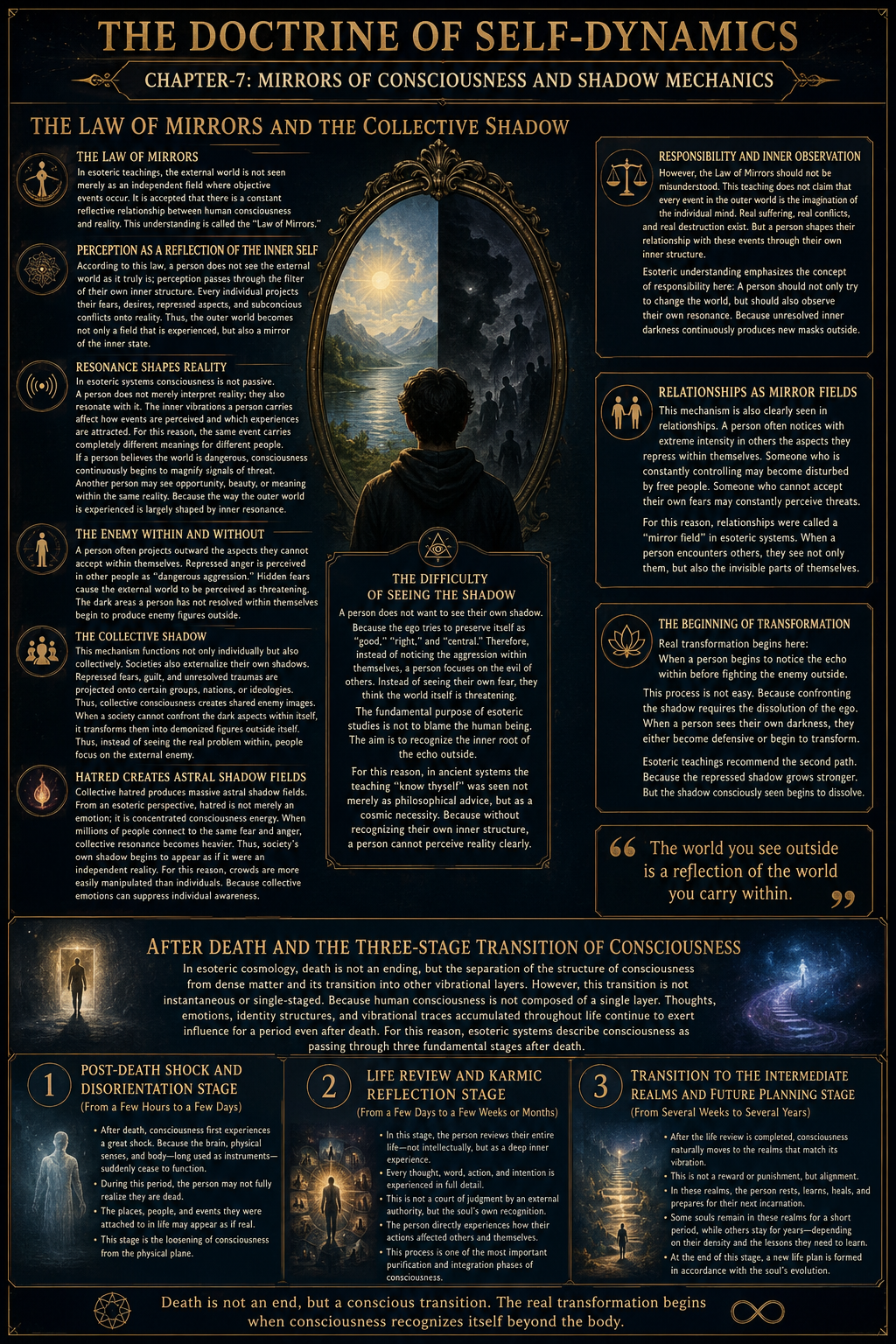
THE DOCTRINE OF SELF-DYNAMICS CHAPTER-7: MIRRORS OF CONSCIOUSNESS AND SHADOW MECHANICS
THE DOCTRINE OF SELF-DYNAMICS CHAPTER-7: MIRRORS OF CONSCIOUSNESS AND SHADOW MECHANICS..However, there is a deeper structure that does not dissolve: the vibrational core. For this reason, rebirth in esoteric understanding is not “the return of the same human being,” but the continuity of certain
ÖZ-DEVİNİM KURAMI

THE DOCTRINE OF SELF-DYNAMICS
CHAPTER-7: MIRRORS OF CONSCIOUSNESS AND SHADOW MECHANICS
The Law of Mirrors and the Collective Shadow
In esoteric teachings, the external world is not seen merely as an independent field where objective events occur. It is accepted that there is a constant reflective relationship between human consciousness and reality. This understanding is called the “Law of Mirrors.”
According to this law, a person does not see the external world as it truly is; perception passes through the filter of their own inner structure. Every individual projects their fears, desires, repressed aspects, and subconscious conflicts onto reality. Thus, the outer world becomes not only a field that is experienced, but also a mirror of the inner state.
Here, the concept of the mirror is deeper than simple psychological projection. Because in esoteric systems consciousness is not passive. A person does not merely interpret reality; they also resonate with it. The inner vibrations a person carries affect how events are perceived and which experiences are attracted.
For this reason, the same event carries completely different meanings for different people.
If a person believes the world is dangerous, consciousness continuously begins to magnify signals of threat. Another person may see opportunity, beauty, or meaning within the same reality. Because the way the outer world is experienced is largely shaped by inner resonance.
For this reason, the concept of the “enemy” is important in esoteric understanding.
A person often projects outward the aspects they cannot accept within themselves. Repressed anger is perceived in other people as “dangerous aggression.” Hidden fears cause the external world to be perceived as threatening. The dark areas a person has not resolved within themselves begin to produce enemy figures outside.
This mechanism functions not only individually but also collectively.
Societies also externalize their own shadows. Repressed fears, guilt, and unresolved traumas are projected onto certain groups, nations, or ideologies. Thus, collective consciousness creates shared enemy images.
The concept of the “collective shadow” in esoteric systems describes exactly this.
When a society cannot confront the dark aspects within itself, it transforms them into demonized figures outside itself. Thus, instead of seeing the real problem within, people focus on the external enemy.
For this reason, throughout history, witch hunts, mass hatred movements, fanatic ideologies, ethnic hostilities, and holy wars have repeated the same fundamental psychic mechanism.
Collective hatred produces massive astral shadow fields.
From an esoteric perspective, hatred is not merely an emotion; it is concentrated consciousness energy. When millions of people connect to the same fear and anger, collective resonance becomes heavier. Thus, society’s own shadow begins to appear as if it were an independent reality.
For this reason, crowds are more easily manipulated than individuals. Because collective emotions can suppress individual awareness.
The most difficult aspect of the Law of Mirrors is this:
A person does not want to see their own shadow.
Because the ego tries to preserve itself as “good,” “right,” and “central.” Therefore, instead of noticing the aggression within themselves, a person focuses on the evil of others. Instead of seeing their own fear, they think the world itself is threatening.
The fundamental purpose of esoteric studies is not to blame the human being. The aim is to recognize the inner root of the echo outside.
For this reason, in ancient systems the teaching “know thyself” was seen not merely as philosophical advice, but as a cosmic necessity. Because without recognizing their own inner structure, a person cannot perceive reality clearly.
However, the Law of Mirrors should not be misunderstood. This teaching does not claim that every event in the outer world is the imagination of the individual mind. Real suffering, real conflicts, and real destruction exist. But a person shapes their relationship with these events through their own inner structure.
Esoteric understanding emphasizes the concept of responsibility here:
A person should not only try to change the world, but should also observe their own resonance.
Because unresolved inner darkness continuously produces new masks outside.
This mechanism is also clearly seen in relationships. A person often notices with extreme intensity in others the aspects they repress within themselves. Someone who is constantly controlling may become disturbed by free people. Someone who cannot accept their own fears may constantly perceive threats.
For this reason, relationships were called a “mirror field” in esoteric systems. When a person encounters others, they see not only them, but also the invisible parts of themselves.
Real transformation begins here:
When a person begins to notice the echo within before fighting the enemy outside.
This process is not easy. Because confronting the shadow requires the dissolution of the ego. When a person sees their own darkness, they either become defensive or begin to transform.
Esoteric teachings recommend the second path.
Because the repressed shadow grows stronger.
But the shadow consciously seen begins to dissolve.
AFTER DEATH AND THE THREE-STAGE TRANSITION OF CONSCIOUSNESS
In esoteric cosmology, death is not an ending, but the separation of the structure of consciousness from dense matter and its transition into other vibrational layers. However, this transition is not instantaneous or single-staged. Because human consciousness is not composed of a single layer. Thoughts, emotions, identity structures, and vibrational traces accumulated throughout life continue to exert influence for a period even after death.
For this reason, esoteric systems describe consciousness as passing through three fundamental stages after death:
• The Echo Field,
• The Dissolution Field,
• The Realignment Field.
These fields are not physical places. They are different phases of the dissolution of consciousness. Here, a person passes not through external worlds, but through the layers of their own vibrational structure.
The first stage is the Echo Field.
The Echo Field is the region of consciousness resonance immediately after death. Here, the person encounters the thought forms created throughout life. Because when the physical body dissolves, mental filters weaken and repressed contents begin to emerge intensely.
In esoteric understanding, a person does not directly see “truth” after death. First, they confront the echoes of their own mental universe.
For this reason, someone carrying intense fears may experience dark visions. A consciousness carrying extreme guilt may find itself within punishing images. A person carrying obsessive desires may wander within unresolved attachments.
The images here are not absolute external realities, but vibrational condensations of consciousness content.
In esoteric systems, the following experiences described after death:
• tunnels,
• lights,
• judgment scenes,
• shadows,
• guide figures,
• heaven- or hell-like images
are often interpreted as symbolic projections of consciousness.
Because consciousness is still operating through its own symbolic language.
For this reason, death experiences across different cultures contain similar essences but different images. Although the essence of consciousness is shared, mental translation passes through personal and cultural layers.
The fundamental characteristic of the Echo Field is this:
A person cannot escape themselves here.
Everything repressed throughout life becomes more visible. Because the distracting density of the physical world no longer exists.
For this reason, the concept of the “mirror of death” is important in esoteric teachings. After death, a person first encounters their own inner echo.
The second stage is the Dissolution Field.
This field is one of the deepest thresholds. Because here, personal identity begins to dissolve. Throughout life, a person has defined themselves through:
• their name,
• their past,
• their roles,
• their story.
However, in the post-death process these structures become unsustainable.
In the Dissolution Field, the layers of the individual self gradually loosen. Mental boundaries begin to melt. The sense of time becomes distorted. The feeling of “I” loses intensity.
In esoteric traditions, this stage has sometimes been described as frightening because the ego wants to preserve itself. It perceives the dissolution of identity as annihilation.
For this reason, many mystical systems practiced ego dissolution during life. Meditation, silence, dhikr, and techniques of inner observation exist to prepare the human being for this great dissolution.
The important point in the Dissolution Field is this:
What dies is not the personality, but the granting of absolute reality to the personality.
Core consciousness does not completely disappear. But the network of identity woven around it dissolves.
In some esoteric teachings, this process has been described with symbols such as:
• purification,
• passing through fire,
• breaking the shell,
• spiritual stripping.
Because here, a person must release the densities they can no longer carry.
The third stage is the Realignment Field.
This field is one of the quietest and deepest layers of the post-death process. Because here, consciousness begins determining a new orientation.
In esoteric systems, consciousness is not entirely static. Every consciousness carries certain tendencies. After dissolution, these tendencies reorganize themselves.
Here, the concept of “rebirth” does not refer only to physical reincarnation. In a broader sense, consciousness is choosing a new direction of resonance.
Some consciousnesses may be drawn again toward unresolved desires.
Some move toward subtler vibrational fields.
Some may remain for long periods within silent density.
For this reason, the Realignment Field is not the place where fate is rewritten, but where resonance is reorganized.
This is why esoteric teachings consider everything done during life important. Because after death, a person does not become a completely new being. Whatever frequency they carry, the process of dissolution unfolds through it.
A consciousness living in fear produces echoes of fear.
A centered consciousness experiences a more balanced transition.
An obsessive consciousness experiences intense attachments.
A consciousness that has developed silence becomes more open to dissolution.
For this reason, ancient teachings contain the understanding: “As you live, so shall you pass.”
However, esoteric systems do not see post-death fields as punitive mechanisms. They are natural consequences of states of consciousness.
The universe does not function like a courtroom here.
It functions like resonance.
Whatever vibration a person has developed,
they encounter its echoes in the post-death process.
And ultimately, the journey after death is not so much the opening of the gate to another world,
but the confrontation of consciousness with its own deepest layers.
REBIRTH AND FREQUENCY CONTINUITY
In esoteric teachings, the concept of rebirth has often been misunderstood. People generally think of it as the same person living again in another body. Yet in deep esoteric systems, what returns is not the personality. Because personality is bound to time. Every structure bound to time dissolves. Names, memories, social roles, and individual identities are not fully preserved after death.
However, there is a deeper structure that does not dissolve:
the vibrational core.
For this reason, rebirth in esoteric understanding is not “the return of the same human being,” but the continuity of certain resonance patterns. This is called “frequency continuity.”
Throughout life, a person does not merely experience events; they produce vibration. Every fear, every desire, every form of love, every obsession, and every orientation of consciousness leaves traces upon the core resonance. Even if the personal story dissolves after death, this vibrational tendency does not disappear completely.
Thus, as consciousness moves toward new life experiences, it continues carrying certain frequency patterns.
For this reason, “soul” in esoteric systems is not seen as a static individual self. The soul is evaluated more as:
• tendency,
• resonance,
• orientation,
• tone of consciousness.
Therefore, a new life is not the exact repetition of an old one. Yet it carries certain echoes.
Some people are born with fears they cannot explain.
Some feel a natural closeness to certain talents.
Some feel intense attraction toward certain cultures, symbols, or historical periods.
Others carry deep longings whose meaning they do not know.
Esoteric understanding interprets these not as “memory recall,” but as frequency continuity.
Because in a new life, consciousness is reshaped not through the old personality, but through the tendencies of old resonance.
For this reason, in the teaching of rebirth, “remembering past lives” is not the central issue. What is truly important is recognizing which vibrational patterns are repeating.
From life to life, a person may carry:
• the same fear,
• the same desire for power,
• the same feeling of loneliness,
• the same creative impulse
again in different forms.
Because unresolved frequencies tend to condense again.
In esoteric teachings, the concept of karma is also understood within this context. Karma is not an external system of reward and punishment. It is the production of continuity by frequency itself.
Whatever vibration a person cannot resolve, consciousness carries that resonance once again into the field of experience. Thus, the soul may relive the same lesson not identically, but within similar geometries.
For this reason, some relationships feel “old.”
Some encounters feel inexplicably familiar.
Some people create intense closeness or powerful repulsion at first sight.
Esoteric systems interpret this not merely psychologically, but as echoic resonance.
However, there is an important principle here:
What is reborn is not the individual ego.
Many mystical teachings have been misunderstood on this point. A person wants to preserve their current personality forever. Yet in esoteric understanding, personality is a temporary organization. The frequency core remains, but its mode of expression changes.
This situation can be explained through the metaphor of fire:
The flame transferred from one candle to another appears the same, yet it is no longer burning the same material.
Spiritual continuity is similar to this.
In esoteric traditions, children being born with unexplained abilities, carrying intense fears, or feeling extreme closeness to certain symbols have been evaluated as examples of this transfer of resonance.
However, authentic esoteric systems did not encourage fascination with past lives. Because the human mind can transform this into new ego stories.
The thought, “Actually, I was someone great in a past life,” can begin producing spiritual arrogance. For this reason, the main aim in ancient teachings was not learning the past, but transforming the present frequency.
Because unresolved vibration repeats itself.
In esoteric understanding, a person’s present life is the intersection of past echoes and new choices. No destiny is completely fixed. Because consciousness can create new alignments at any moment.
For this reason, spiritual work is not so much about discovering past lives, but making present resonance conscious.
If fear dissolves, the old line of fear weakens.
If obsession is released, the old cycle breaks.
If consciousness becomes centered, new geometries of possibility open.
The deepest aspect of the teaching of rebirth is this:
The universe does not reproduce the human being in order to punish them.
It opens consciousness once again to experience,
so that unfinished vibrations may become integrated.
For this reason, life is not merely a single biological process.
It is cycles of consciousness echoing into one another.
And sometimes, a human being may sense
that a feeling they cannot explain in this present life
is the echo of a very ancient vibration.
THE FOUR-STAGE INNER WORK AND THE ALIGNMENT OF CONSCIOUSNESS
In esoteric teachings, true transformation is not seen as a sudden moment of enlightenment. Because human consciousness is layered, transformation also occurs gradually. For this reason, ancient systems did not leave spiritual development to random experiences, but structured it through specific inner disciplines.
The teaching of the “Four-Stage Work” describes the fundamental transformation process consciousness must pass through in order to approach its own center. These stages are not independent from one another. Each prepares and deepens the next.
These four stages are defined as:
• Purification,
• Observation,
• Silence,
• Alignment.
PURIFICATION AND THE FREQUENCY SIMPLIFICATION OF CONSCIOUSNESS
In esoteric teachings, the concept of purification has often been misunderstood throughout history. People have perceived purification as cleansing oneself from sins, punishing oneself, or submitting to strict moral rules. Yet in deep esoteric systems, purification is not moral pressure; it is the simplification of the field of consciousness.
Because the issue is not “appearing to be a good person.”
The issue is being able to dissolve the excessive density carried by consciousness.
According to esoteric understanding, the human being does not carry only physical burdens. Thoughts, emotions, fears, obsessions, and repressed energies also create accumulation within the field of consciousness. Over time, these accumulations make the inner vibration of the human being heavier.
For this reason, purification is not producing guilt; it is beginning to notice and dissolve unnecessary densities.
This is why certain emotions are felt as “heavy” in ancient systems. Constant fear, intense anger, obsessive addictions, and deep hatred compress the field of consciousness. As the human being lives with these emotions, the flow of vibration begins to narrow.
Fear keeps consciousness in defense mode.
Anger makes energy fragmented and aggressive.
Addiction binds the center of consciousness to external objects.
Hatred locks the inner field in a constant frequency of conflict.
Esoteric systems regard these emotions as important not because they are “forbidden,” but because they distort the geometry of consciousness.
Therefore, purification is not suppression.
Many people deny their anger, hide their fears, or try to forcibly suppress their desires in the name of spiritual development. However, suppressed energy does not dissolve. It descends into the subconscious and returns in a more intense form.
In esoteric understanding, true purification means seeing the energy, not identifying with it, and dissolving its density.
This is why observation lies at the center of purification in ancient teachings. When a person becomes aware of their fear, they begin not to feed it automatically. When they observe their anger, they may see the wound hidden beneath it. They may feel that beneath addiction there is often a fear of emptiness.
For this reason, purification requires inner honesty.
As long as the human being denies their own darkness, the field of consciousness continues to condense. Because energy that is not seen does not dissolve.
In esoteric systems, the concept of “lightness” is important. Lightness here is not physical, but vibrational. Some people feel more fluid even though they carry the same burdens. Because their energy has not hardened.
Some people, however, become heavy even in small events. Because their field of consciousness is filled with unresolved densities accumulated over years.
For this reason, purification is not merely mental work. The body, breath, and way of life also affect the frequency of consciousness.
This is why ancient systems included practices such as fasting, breath disciplines, silence, rhythmic movement, simple living, and being alone in nature.
The aim is not to punish the body, but to reduce the excessive burden upon consciousness.
Modern humans are very prone to accumulating inner density because they live under constant bombardment of stimuli. Constant fear-based news, digital fragmentation of attention, excessive consumption, repressed anger, and addiction to speed cloud the field of consciousness.
For this reason, many people become unable to feel their own essential frequency.
In esoteric teachings, simplification is considered sacred because simplified consciousness begins to perceive more clearly.
What matters here is not “being perfect.”
No human being becomes completely pure.
Because the human being is a living being and constantly produces vibration.
True purification is not denying energy, but not becoming its slave.
Fear may be felt, but the center is not lost.
Anger may arise, but consciousness does not turn it into blind violence.
Desire may appear, but the human being is not completely dragged by it.
In esoteric systems, mastery is not emotionlessness.
It is being able to remain conscious within emotions.
Another important aspect of purification is that it opens space.
When consciousness constantly carries density, it cannot feel subtler vibrations. Just as it is difficult to hear a faint sound in a very noisy room, excessive mental and emotional density suppresses inner intuition.
Therefore, purification is not merely cleansing negative energies.
It is opening space for inner silence.
Ancient mystics were simple people for this reason.
Because complex ways of life constantly pull consciousness outward.
According to esoteric understanding, the essence of the human being is already centered.
The problem is not that the center has been lost, but that it has become invisible beneath excessive density.
And purification is not so much the process of turning a person into someone else, but the process of bringing them closer again to their own essential vibration.
OBSERVATION AND THE DISSOLUTION OF THOUGHT
In esoteric teachings, true transformation begins not with knowledge, but with awareness. No matter how much a person learns, as long as they cannot see their own mental movements, they cannot escape the cycle of mechanical life. Because unconscious thought governs the human being.
For this reason, in ancient systems observation was placed at the center of spiritual work.
Observation here does not mean ordinary attention. Observation in the esoteric sense is the capacity of a person to watch their own inner movements from the outside. The human being must learn to observe not only the external world, but also their own mind.
Because most of the time, the human being is not aware of their thoughts.
They are inside them.
A thought arises, the person identifies with it, and automatically begins to act. When a thought of fear appears, defense arises. When anger rises, consciousness contracts. When guilt appears, energy collapses. The human being assumes these are “themselves.”
Yet the fundamental discovery of esoteric systems is this:
Thought and consciousness are not the same thing.
Thought is changeable.
Consciousness is the field that can become aware of thought.
Without understanding this distinction, true inner work cannot begin.
The practice of observation allows the human being for the first time to place a small distance outside the mental flow. Transformation begins not when the human being thinks the thought, but when they become aware of it.
This is why in esoteric systems observation is not seen as passive watching, but as a transformative force.
Because unnoticed thought works in darkness.
A noticed thought begins to lose its density.
For example, a person may constantly carry the thought of worthlessness. If they do not notice it, this invisible center governs their entire life. Their relationships, choices, and fears are shaped by this thought.
But if one day the person begins to observe that thought at the moment it arises, the identification between the thought and themselves loosens.
Dissolution begins here.
The concept of “witnessing consciousness” is therefore important in esoteric teachings. The human being is not only a living being, but a being capable of becoming aware of their own living.
When this awareness develops, the person begins to see the mechanical nature of their own mind: the same fears repeat, the same defenses appear, the same inner dialogues return, and the same desires reproduce themselves.
For the first time, the human being realizes that much of what they assumed to be “free thinking” is actually automatic repetition.
This stage may be uncomfortable because the ego wants to see itself as free and conscious. Yet as observation deepens, the human being begins to see their own inner machine.
In esoteric systems, this has sometimes been called “the first pain of awakening.”
Because the human being realizes for the first time that they were truly asleep.
However, this awareness is not meant to produce guilt. True observation is nonjudgmental. Because judgment too is another movement of the mind.
In ancient teachings, the one who observes does not suppress thought, does not fight it, does not try to justify it, but simply sees.
This “simply seeing” is far more powerful than it seems.
Because when the mental structure becomes visible, the energy of unconsciousness decreases. When hidden thought patterns come into the light, they begin to lose their automatic power.
Therefore, observation is the technique that changes without trying to change.
Many people assume inner transformation to be a battle of will. They try to overcome their fears, silence their thoughts, or suppress their desires by forcing themselves.
Yet esoteric systems say that pressure is not the solution. Because suppressed thought descends into the subconscious and returns stronger.
Observation, however, makes thought visible.
What is seen begins to dissolve.
This is especially important for emotions. In a moment of anger, the human being may completely become anger. But if they can observe anger while it is rising, a space forms between consciousness and emotion.
Freedom is born in this space.
In esoteric understanding, freedom is not thoughtlessness.
It is not being completely possessed by thought.
Over time, the practice of observation enables the human being to feel their own center. Because beneath mental movements there is a quieter field of awareness.
Thoughts change.
Emotions rise and collapse.
Identity constantly transforms.
But there is a center that watches all of these.
Ancient mystics gave this center names such as witness, silent observer, essential consciousness, and inner center.
Yet whatever the name may be, observation brings the human being closer to this center.
This is why true meditation is not forcibly silencing thought, but learning to watch it.
When the human being begins to watch their own mind, they realize for the first time that there is a field of consciousness beyond the mind.
And true transformation begins precisely in that silent moment of noticing.
THE DISCIPLINE OF SILENCE AND INNER NOISE
In esoteric teachings, silence does not merely mean not speaking. True silence is the clarity of consciousness that emerges when mental density slows down. Because the greatest noise of the human being does not arise in the outer world, but within themselves.
Modern humans constantly think, constantly react, constantly consume information, and constantly produce inner speech. For this reason, most people begin to assume mental movement to be “themselves.” Yet esoteric systems say that a large part of mental flow is automatic.
The aim of the Discipline of Silence is precisely to make this visible.
One of the basic suggestions of this discipline is to create a conscious field of silence for a certain period every day. The duration of forty minutes has symbolic importance because in many ancient systems the number forty represents the cycle of transformation. The human mind may remain on the surface during short periods of silence; but after a certain threshold, deeper mental movement begins to become visible.
Therefore, silence practice is not a relaxation technique, but a discipline of awareness.
The first step in the process of silence is reducing speech. Because speech is not only communication; it is also the spilling outward of mental energy. When the human being speaks constantly, they cannot hear their own inner movement.
This is why long periods of silence existed in ancient mystical traditions. The aim is not to escape from the world, but to notice inner echoes.
When speech decreases, the person first notices not the intensity of external noise, but the intensity of inner noise.
Thoughts may accelerate.
Old memories may rise to the surface.
Repressed fears may become clear.
The mind may constantly begin to search for new objects of attention.
This is not failure, but the real structure of the mind becoming visible.
Because in ordinary life, the human being constantly distracts their attention with external stimuli and therefore cannot fully see their own inner chaos.
Secondly, the Discipline of Silence involves reducing mental burden. The aim here is not to forcibly silence thought. Because the mind is naturally active. Producing thought is one of its functions.
Esoteric systems do not recommend fighting thought.
Because war produces new noise.
The real work is to observe the rhythm of thought.
When a person sits silently, they begin to notice how uncontrollably the mind moves: it goes to the past, constructs the future, produces fears, repeats arguments, creates fantasies, and turns identity stories over and over.
This awareness may be disturbing at first. Because the human being sees their mental mechanicalness nakedly for the first time.
But in esoteric understanding, transformation begins exactly here:
When the human being realizes not that they cannot stop their thoughts, but that they flow by themselves.
This realization creates distance between thought and consciousness.
The third element of the Discipline of Silence is directing attention toward the breath.
Breath is very important in esoteric systems because breath always occurs in the present. While the mind wanders between past and future, breath constantly flows in the present moment.
When attention settles on the breath, consciousness begins to partially separate from the linear flow of thought. Breath here is not merely a biological process; it is the center of inner rhythm.
This is why breath work is so widespread in ancient teachings. Because breath is the bridge that connects body and mind, consciousness and matter, movement and silence.
The most important point of the Discipline of Silence is this:
The aim is not to produce emptiness.
Many people think meditation means “not thinking at all.” Yet when thoughtlessness becomes the goal, the person produces a new mental pressure. When the war with the mind begins, silence moves even farther away.
In esoteric systems, the true aim is to see the structure of inner noise.
In silence, the human being begins to observe how fears are born, how the ego defends itself, how desires rise, and how thoughts trigger one another.
As this observation deepens, it is understood that not all mental movement is “I.”
And at one point, the silent field behind thoughts begins to be felt.
This field is not created by force.
It has always already existed.
But because the human being constantly lives within mental noise, they cannot notice it.
This is why silence has been considered sacred in esoteric teachings. Because in silence, the human being can temporarily move away from social masks, constant reactions, and mental roles.
During this process, repressed contents may rise to the surface. Some people feel not peace, but intense unease in silence. Because for the first time they are left alone with their own inner echoes.
Ancient systems saw this as natural.
Silence is not only stillness, but also a mirror.
Yet when the person can pass through this stage, a deeper awareness is born:
Thoughts move.
Emotions change.
Identity transforms.
But behind all of these there is a silent witnessing.
The true aim of the Discipline of Silence is not to empty the human being, but to bring them closer to their own central frequency.
And sometimes, when a person becomes truly silent for the first time, they realize how great a storm they have carried inside their mind throughout their life.
ALIGNMENT AND THE GATHERING OF CONSCIOUSNESS INTO A SINGLE FREQUENCY
In esoteric teachings, the fundamental problem of the human being is not weakness, but scatteredness. Most of the time, the human being thinks they do not have enough energy. Yet according to deep esoteric systems, the problem is not the lack of energy, but the fact that it is spent in a fragmented way.
While a person’s mind wants one thing, their emotions may pull in another direction. While their intention appears to be directed toward a goal, subconscious fears may move them in the opposite direction. Their actions may contradict the values they defend. This inner fragmentation produces vibrational conflict.
For this reason, in esoteric systems true power is not intense energy, but aligned energy.
Alignment is the ability of the human being to gather the layers of thought, emotion, behavior, and intention into the same frequency.
This is not merely psychological consistency. It is the resonance of different parts of consciousness around a shared center.
A scattered person constantly experiences inner friction. One part wants to change while another part is afraid. One part seeks freedom while another clings to safety. Even if the person appears determined from the outside, great energy loss occurs when the inner layers pull in different directions.
In esoteric understanding, an important part of fatigue is not physical, but vibrational conflict.
When the human being is divided within themselves, consciousness constantly produces opposing frequencies. This may appear as mental confusion, indecision, emotional collapse, weakness of will, and constant postponement.
Because energy is consumed in inner friction instead of moving forward.
This is why the idea of “single intention” was considered important in ancient systems. The more divided a person is internally, the weaker they feel in external reality.
The aligned person functions differently.
Thought, emotion, and behavior are not directed toward different directions.
The inner center begins to produce a single rhythm.
This is why an inexplicable intensity can be felt around some people. Even if they do not speak much, their influence is strong. Because their consciousness is not fragmented. Esoteric systems have called this “producing a field.”
The field here has not a metaphorical, but a vibrational meaning.
Aligned consciousness spreads a sense of order around itself. Because inner frequencies support one another instead of conflicting.
This has been observed throughout history in mystics, great teachers, deep artists, and centered leaders.
Their influence comes not only from what they say, but from the integrated resonance they carry.
This is why the harmony between word and being is important in esoteric teachings. If a person does not truly resonate with what they say, the vibration of their word becomes weak.
If a person speaks of love while carrying hatred within, the field of consciousness branches.
If they speak of truth while living in fear, resonance deteriorates.
If they defend freedom while acting through dependency, energy fragments.
Therefore, alignment requires honesty.
Honesty in the esoteric sense is not only telling the truth to others.
It is being able to see one’s own inner divisions.
A person cannot become aligned without noticing what they truly want, what they fear, and which masks they carry.
For this reason, alignment is considered one of the later stages of the spiritual journey. Because first fears must be seen, the shadow must be recognized, mental chaos must be observed, and silence must be felt so that the fragments of consciousness can gather in the same center.
This is why rituals, repetitions, and disciplines were used in ancient teachings. The aim is not blind obedience, but gathering scattered attention along a single axis.
When attention is scattered, energy leaks.
When the center is gathered, consciousness condenses.
This is also felt in physical life. The aligned person makes clearer decisions, experiences less inner conflict, hears their intuitions more easily, and is less swept away by fear.
Because the inner system functions in a single rhythm.
In esoteric systems, the concept of “will” is also redefined here. True will is not imposing pressure. It is the support of the same direction by the inner parts.
This is why some people cannot progress despite great effort, while others can create powerful transformations even though they appear calm.
Because one moves with fragmented energy, while the other moves with aligned resonance.
The deepest dimension of alignment is related to intention.
Intention is not merely a mental goal. It is the center that determines which frequency consciousness is oriented toward. If a person tries to appear one way externally while carrying another intention internally, the energy field becomes clouded.
In esoteric understanding, pure intention is therefore considered a great power. Because pure intention produces undivided attention.
And undivided attention is the most intense energy of consciousness.
In the end, alignment is not perfection.
The human being may still carry fears, make mistakes, and fluctuate.
But the inner layers no longer wage war against one another.
Thought, emotion, body, and intention begin to turn toward the same center.
At that moment, the human being ceases to be merely someone who lives.
They become a center of consciousness that creates order and a field of vibration around itself.