THE FIRST HUMAN
THE FIRST HUMAN. “ÂDEM was the first human!” — do not make me laugh with that! Find the first midwife who brought Âdem to the World intact! “‘The World came to ÂDEM!’” — not ÂDEM unto the Earth! “‘Sun, Moon, eleven constellations: bow to YUSUF by My word!’”
APOCALYPSE BOOK
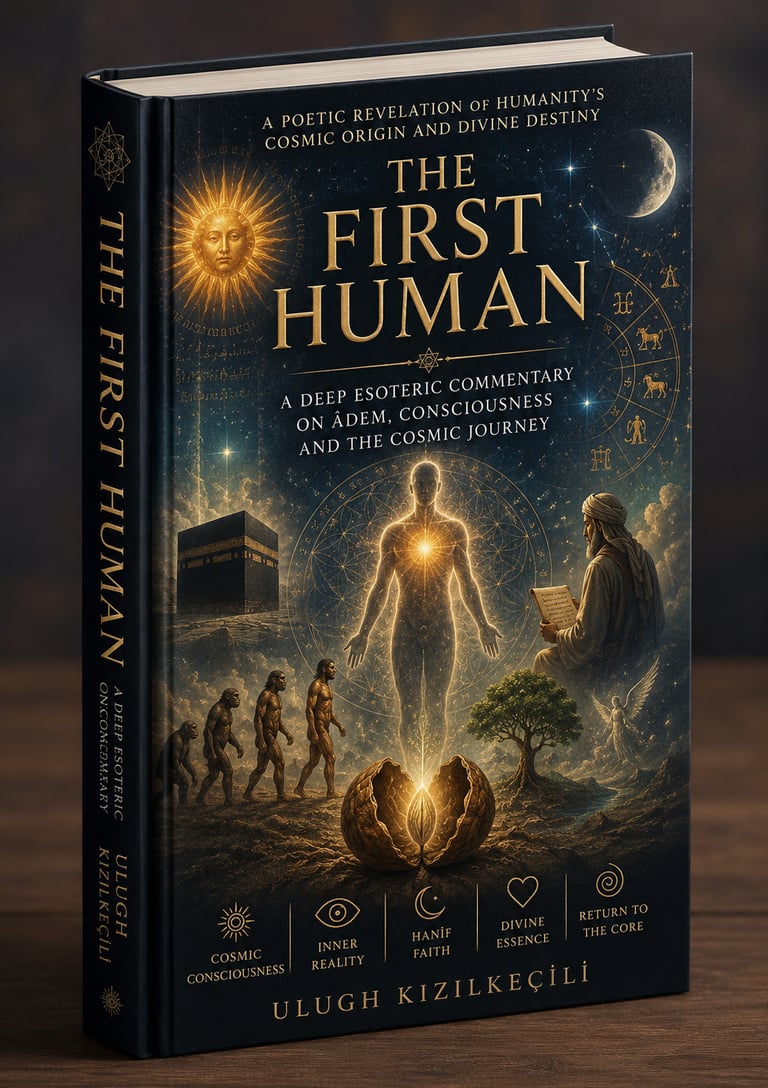
THE FIRST HUMAN
“ÂDEM was the first human!” — do not make me laugh with that!
Find the first midwife who brought Âdem to the World intact!
“‘The World came to ÂDEM!’” — not ÂDEM unto the Earth!
“‘Sun, Moon, eleven constellations: bow to YUSUF by My word!’”
ÂDEM is the RABB of every solar sphere above!
“‘The RABB’s first and final command: worship ÂDEM thereof!’”
Life is a dream! And see — “‘YUSUF interprets its sign!’”
To the dead He says: “Await a form fit for your mind!”
The ape still has not become human upon the Earth! Why so?
Because no human enters one devoid of self-conscious glow!
The gate of becoming human closed to the unconscious kind:
The first three races lacked self-awareness in their mind!
In the seventh race, the ape upon the Earth becomes human!
If not the “‘Unknowing,’” but the “‘Knowing,’” you summon!
“‘Animals’” are zodiac names in the Torah’s opening sûrah!
Call the giver of self-consciousness ÂDEM or RAHMÂN forever!
“‘Look in the second sûrah! The animals were created there!’”
The ape came from the human! The one who grasps will be aware!
The one who entered Eden and then fell was earthly ÂDEM — not RABB!
Mineral! Plant! Animal! And human! Living anguish without stop!
ÂDEM rescued the angels from the Satan-Imâm that day:
Then the angelic beings became the first human race on Earth’s way!
The milk the infant suckles comes from the breast near the heart!
Animal sustenance lies near the sexual organ apart!
Lord gives each being’s sustenance in rightful measure and share:
“‘Even in the cradle, ÎSÂ deserved the true word there!’”
Seek the honor of servanthood while becoming the Sun’s own flame:
“‘Wherever the Sun may turn, it beholds its own light the same!’”
While yet of earth, it produced light! Burning hydrogen bright!
“Escape from ‘earthly Âdem!’ The ‘RÛH’ has neither width nor height!”
Now wherever you may turn, you behold but your own face!
You are the Qiblah and the KA‘BAH! This is the “HANÎF FAITH” in place!
In seeming bodily prison stands “‘YUSUF!’” — yet Essence fills all space!
Awaken from the spell of five senses! Reach your “‘RÛH!’” through grace!
“‘The ÂDEM in the first sûrah’” is RABB! Dual-sexed! Cosmic might!
Bringing forth seven creative classes! And Its own threefold light:
HAKK! MUHAMMED! ÂLÎ — this is “‘ÂDEM!’” veiling Allah from sight!
Become a son of Âdem! Every veil is within you — unveil and rise aright!
“‘Lord calls the Resurrection Day!’” — “‘QADR,’” however, is called Night!
Reflect upon these matters — with Âdemic wisdom and insight!
Fear not — RAHMÂN does not punish meaningless absurdity:
Not the “kernel,” but the “hardened shell” burns in severity!...
Ulugh KIZILKEÇİLİ
ANKARA, 10 July 2005
(What is written after this point has no relation to the author, and the author cannot be held responsible for any mistakes made!)
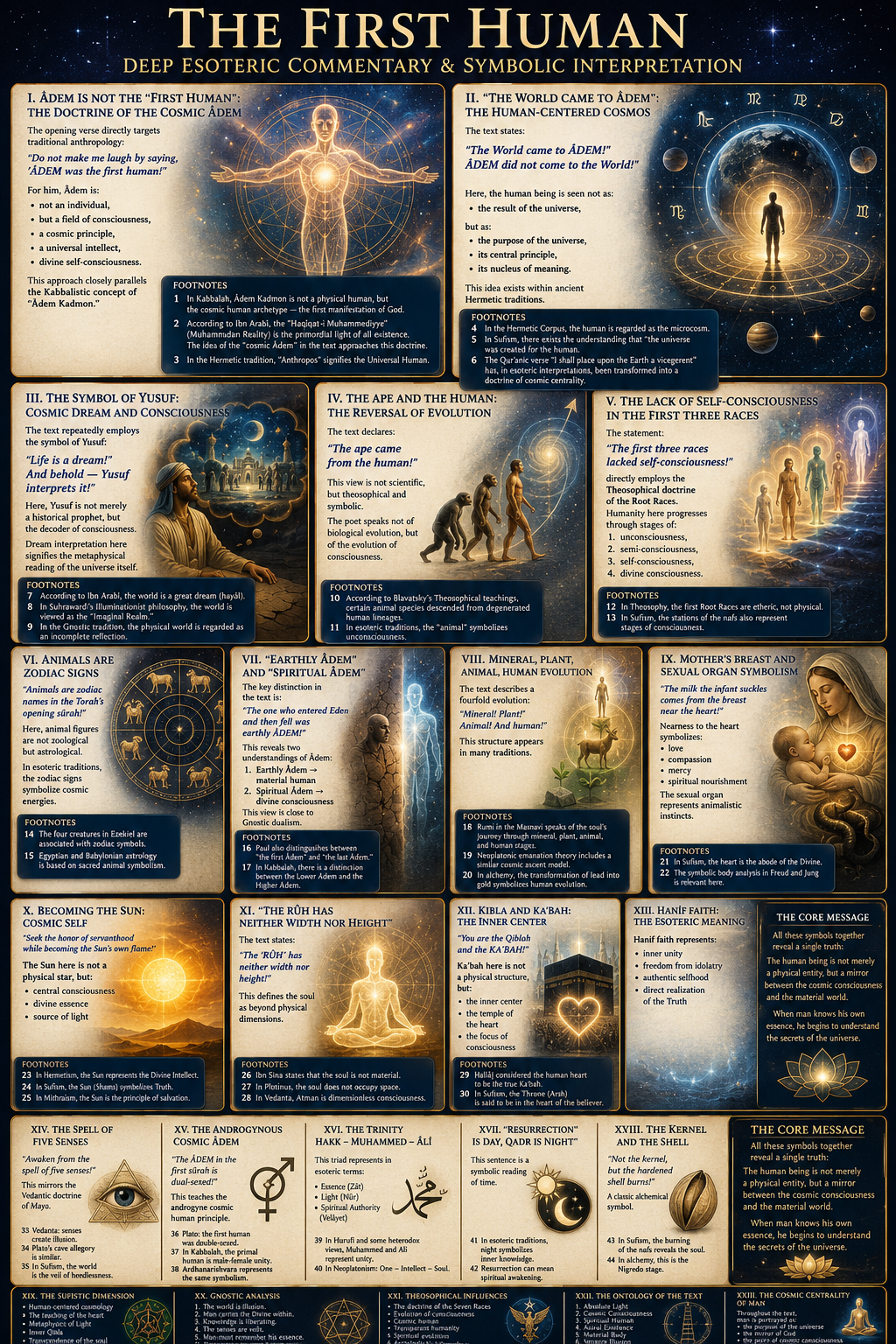
DEEP ESOTERIC COMMENTARY ON THE TEXT “THE FIRST HUMAN”
I. ÂDEM IS NOT THE “FIRST HUMAN”: THE DOCTRINE OF THE COSMIC ÂDEM
The opening verse directly targets traditional anthropology:
“Do not make me laugh by saying, ‘ÂDEM was the first human!’”
Here, the poet rejects the notion of a historical “first human.”
For him, Âdem is:
not an individual,
but a field of consciousness,
a cosmic principle,
a universal intellect,
divine self-consciousness.
This approach closely parallels the Kabbalistic concept of “Âdem Kadmon.”
Footnote 1
In Kabbalah, Âdem Kadmon is not a physical human, but the cosmic human archetype — the first manifestation of God.
Footnote 2
According to Ibn Arabî, the “Haqîqat-i Muhammediyye” (Muhammadan Reality) is the primordial light of all existence. The idea of the “cosmic Âdem” in the text approaches this doctrine.
Footnote 3
In the Hermetic tradition, “Anthropos” signifies the Universal Human.
II. “THE WORLD CAME TO ÂDEM”: THE HUMAN-CENTERED COSMOS
The text states:
“The World came to ÂDEM! ÂDEM did not come to the World!”
This is an extremely profound metaphysical statement.
Here, the human being is seen not as:
the result of the universe,
but as:the purpose of the universe,
its central principle,
its nucleus of meaning.
This idea exists within ancient Hermetic traditions.
Footnote 4
In the Hermetic Corpus, the human is regarded as the microcosm.
Footnote 5
In Sufism, there exists the understanding that “the universe was created for the human.”
Footnote 6
The Qur’anic verse “I shall place upon the Earth a vicegerent” has, in esoteric interpretations, been transformed into a doctrine of cosmic centrality.
III. THE SYMBOL OF YUSUF: COSMIC DREAM AND CONSCIOUSNESS
The text repeatedly employs the symbol of Yusuf:
“Life is a dream! And behold — Yusuf interprets it!”
Here, Yusuf is not merely a historical prophet, but the decoder of consciousness.
Dream interpretation here signifies the metaphysical reading of the universe itself.
Footnote 7
According to Ibn Arabî, the world is a great dream (hayâl).
Footnote 8
In Suhrawardî’s Illuminationist philosophy, the world is viewed as the “Imaginal Realm.”
Footnote 9
In the Gnostic tradition, the physical world is regarded as an incomplete reflection.
IV. THE APE AND THE HUMAN: THE REVERSAL OF EVOLUTION
The text declares:
“The ape came from the human!”
This view is not scientific, but theosophical and symbolic.
The poet speaks not of biological evolution, but of the evolution of consciousness.
Footnote 10
According to Blavatsky’s Theosophical teachings, certain animal species descended from degenerated human lineages.
Footnote 11
In esoteric traditions, the “animal” symbolizes unconsciousness.
V. THE LACK OF SELF-CONSCIOUSNESS IN THE FIRST THREE RACES
The statement:
“The first three races lacked self-consciousness!”
directly employs the Theosophical doctrine of the Root Races.
Humanity here progresses through stages of:
unconsciousness,
semi-consciousness,
self-consciousness,
divine consciousness.
Footnote 12
In Theosophy, the first root races are not physical, but etheric beings.
Footnote 13
In Sufism, the stages of the nafs likewise represent levels of consciousness.
VI. ANIMALS AS ZODIACAL SIGNS: AN ASTROLOGICAL READING OF THE TORAH
The poem says:
“Animals are zodiacal names in the Torah’s first sûrah!”
Here, animal figures are not zoological, but astrological.
In esoteric traditions:
Taurus,
Leo,
Scorpio,
Aries,
Pisces
symbolize cosmic energies.
Footnote 14
The four creatures of Ezekiel have been associated with zodiacal symbolism.
Footnote 15
Egyptian and Babylonian astrology were founded upon sacred animal symbolism.
VII. THE DISTINCTION BETWEEN “EARTHLY ÂDEM” AND “SPIRITUAL ÂDEM”
One of the central distinctions in the text is:
“The one who entered Eden and fell was earthly ÂDEM!”
This establishes two distinct understandings of Âdem:
Earthly Âdem → the material human
Spiritual Âdem → divine consciousness
This approach resembles Gnostic dualism.
Footnote 16
Paul likewise distinguishes between the “first Âdem” and the “last Âdem.”
Footnote 17
In Kabbalah, there exists a distinction between the Lower Âdem and the Higher Âdem.
VIII. THE EVOLUTION OF MINERAL–PLANT–ANIMAL–HUMAN
The text explains the human through a fourfold evolution:
“Mineral! Plant! Animal! And human!”
This structure appears in numerous traditions.
Footnote 18
In the Mesnevî, Mevlânâ describes the soul as passing through the stages of mineral, plant, animal, and human.
Footnote 19
The Neo-Platonic emanation system contains a similar model of cosmic ascent.
Footnote 20
In alchemy, the transformation of lead into gold symbolizes human spiritual evolution.
IX. THE SYMBOLISM OF THE BREAST AND THE SEXUAL ORGAN
The poem states:
“The milk the infant suckles comes from the breast near the heart!”
Here, bodily anatomy is transformed into an esoteric ethical teaching.
Proximity to the heart signifies:
love,
compassion,
mercy,
spiritual nourishment.
The sexual organ, meanwhile, is associated with animal impulses.
Footnote 21
In Sufism, the heart is the dwelling place of the divine center.
Footnote 22
The symbolic bodily analyses of Freud and Jung may also be evoked here.
X. “BECOMING THE SUN”: THE COSMIC SELF
The poet declares:
“Seek the honor of servanthood in becoming the Sun!”
Here, the Sun signifies not a physical star, but:
central consciousness,
the divine essence,
the source of light (nûr).
Footnote 23
In Hermeticism, the Sun symbolizes the divine intellect.
Footnote 24
In Sufism, the symbol of Shams represents ultimate truth.
Footnote 25
In Mithraism, the Sun is the salvific principle.
XI. “THE RÛH HAS NO LENGTH OR WIDTH”: DIMENSIONLESS BEING
The text states:
“The RÛH has neither length nor width!”
thus defining the spirit as existing beyond physical dimensions.
This approach accords with metaphysical ontology.
Footnote 26
Ibn Sînâ states that the soul is not corporeal.
Footnote 27
In Plotinus, the soul does not occupy space.
Footnote 28
In Vedanta, the Atman is dimensionless consciousness.
XII. THE KA‘BAH AND THE QIBLAH: THE INNER CENTER
One of the most important lines in the poem is:
“You are the Qiblah! You are the KA‘BAH!”
This approach is profoundly esoteric.
Here, the Ka‘bah is interpreted not as:
a physical structure,
but as:the inner center of the human being,
the sanctuary of the heart,
the focal point of consciousness.
Footnote 29
Hallâj-ı Mansûr interprets the human heart as the true Ka‘bah.
Footnote 30
In Sufism, there exists the understanding that “the Throne resides within the believer’s heart.”
XIII. THE ESOTERIC INTERPRETATION OF THE “HANÎF RELIGION”
The text interprets Hanîfism as:
inner unity,
freedom from idols,
essential selfhood,
direct truth.
Footnote 31
In the Qur’an, Hanîfism signifies pure orientation away from shirk (associationism).
Footnote 32
In esoteric interpretations, Hanîfism becomes the consciousness of unity beyond all forms.
XIV. “THE SPELL OF THE FIVE SENSES”: THE DOCTRINE OF MAYA
The poet says:
“Awaken from the spell of the five senses!”
This directly evokes the Vedantic doctrine of Maya.
Footnote 33
According to Vedanta, the senses generate illusion.
Footnote 34
Plato’s Allegory of the Cave carries a similar understanding.
Footnote 35
In Sufism, the world is regarded as the “veil of heedlessness.”
XV. “THE ANDROGYNOUS COSMIC ÂDEM”
The text states:
“The ÂDEM in the first sûrah is dual-sexed!”
thus defending the doctrine of the androgynous cosmic human.
This idea appears in many ancient traditions.
Footnote 36
According to Plato, the primordial human was dual-sexed.
Footnote 37
In Kabbalah, the primordial human is a unity of masculine and feminine principles.
Footnote 38
The figure of Shiva-Ardhanarishvara carries the same symbolism.
XVI. THE TRIAD OF “HAKK–MUHAMMED–ÂLΔ
The triad in the text:
“LORD! MUHAMMED! ÂLÎ!”
is highly significant.
In certain esoteric interpretations, this structure represents the triad of:
Essence,
Light,
Sainthood (Velâyet).
Footnote 39
In Hurûfî and certain heterodox interpretations, there exists a doctrine of the unity of Muhammed and Ali.
Footnote 40
In Neoplatonism, there exists the triad of the One–Intellect–Soul.
XVII. “RESURRECTION IS DAY, QADR IS NIGHT”
This statement is a symbolic interpretation of time.
Footnote 41
In esoteric traditions, the night symbolizes inward knowledge.
Footnote 42
Resurrection signifies not merely a physical end, but also the awakening of consciousness.
XVIII. THE SYMBOLISM OF THE KERNEL AND THE SHELL
The final section of the text declares:
“It is not the kernel that burns, but the hardened shell!”
This is an alchemical symbol.
The shell signifies:
ego,
lower self (nafs),
personality,
matter.
The kernel, meanwhile, signifies:
essence,
spirit,
truth,
the divine spark.
Footnote 43
In Sufism, the burning of the nafs is regarded as the unveiling of the spirit.
Footnote 44
In alchemy, the stage of nigredo signifies the dissolution of darkness.
XIX. THE SUFISTIC DIMENSION OF THE TEXT
The text displays strong parallels with Sufism in several respects:
human-centered cosmology,
the doctrine of the heart,
metaphysics of light (nûr),
the inner qiblah,
the transcendence of the RÛH,
the journey toward truth.
However, certain aspects move beyond classical Sufism:
Theosophical root races,
esoteric astrology,
cosmic anthropology,
the doctrine of consciousness evolution.
XX. THE GNOSTIC ANALYSIS OF THE TEXT
At its core, the text possesses Gnostic characteristics.
For:
the world is illusion,
the human bears a divine essence,
knowledge is salvific,
the senses are veils,
the human must remember his essence.
In this respect, it approaches Valentinianism and Manichaeism.
XXI. THEOSOPHICAL INFLUENCES
Several core elements in the text derive directly from Theosophy:
the doctrine of the seven races,
evolution of consciousness,
the cosmic human,
transparent humanity,
spiritual evolution,
astrological anthropology.
Footnote 45
There exists a strong parallel with Blavatsky’s The Secret Doctrine.
XXII. THE PHILOSOPHICAL ONTOLOGY OF THE TEXT
The ontology of the text consists of the following layers:
Absolute Light (Nûr),
Cosmic Consciousness,
Spiritual Human,
Astral Becoming,
Material Body,
Sensory Illusion,
Return and Re-ascent.
This structure evokes the Neoplatonic doctrine of emanation.
XXIII. THE COSMIC CENTRALITY OF THE HUMAN
Throughout the text, the human being is treated as:
the purpose of the universe,
the mirror of Allah,
the point of cosmic consciousness,
the essence of creation.
This approach closely resembles the doctrine of Insân-ı Kâmil (the Perfect Human).
Footnote 46
According to Ibn Arabî, the human is the most comprehensive mirror of Allah.
ÂDEM SYMBOLISM AND COSMIC CONSCIOUSNESS
In ancient traditions, ÂDEM is not merely a historical figure representing the first human. He is also the symbol of the Cosmic Human. In esoteric teachings, the human being is regarded as a small universe — a “microcosm.” For this reason, ÂDEM is seen as the summary of all existence in human form. The concept of “Âdem Kadmon” in Jewish mysticism expresses the same metaphysical truth. Âdem Kadmon is the primordial archetype of the human existing within the divine thought before creation. In Sufi interpretations, ÂDEM is the total mirror of the divine names. Thus, the human ceases to be an ordinary biological being and becomes the conscious essence of the universe.
The symbol of Yusuf represents the hidden connection between consciousness and dream. In ancient traditions, dreams were not considered ordinary mental images, but symbolic messages arriving from metaphysical realms. Yusuf’s power to interpret dreams symbolizes the spiritual perception capable of reading the layers of consciousness. In esoteric teachings, this condition is explained as the “knowledge of imagination” (hayâl). In Islamic metaphysics, the imaginal realm is the intermediate region between the physical world and the spiritual dimension. Through symbols, the human perceives truth there. Yusuf’s wisdom lies in his ability to decipher the unseen meaning behind visible events. Therefore, Yusuf is not merely a prophet, but an interpreter of consciousness.
The symbol of the Sun has been accepted in nearly all mystical systems as the sign of the divine center. The Sun, which is the source of light in the material world, becomes on the metaphysical plane the symbol of absolute truth. In Sufi terminology, this understanding is expressed through the concept of Nûr (Light). The divine light is the primordial vibration existing within the essence of all beings. While Hermetic teachings regard the Sun as the heart of the visible universe, Sufism associates it with the light of truth within the heart. Thus, the Sun becomes not merely a physical star, but a cosmic center awakening consciousness.
The concept of “Earthly Âdem” represents the material aspect of the human being. The human body is formed from the elements of the earth, yet what renders it alive is the spiritual essence within. In esoteric systems, the material human is regarded as a condensed form of consciousness. In Sufi understanding, this aspect is explained through the concept of the nafs. The nafs is the part of the human attached to worldly desires. Yet the nafs is not considered wholly evil; it is viewed as raw energy requiring transformation. Thus, Earthly Âdem becomes the symbol of the tension between spirit and matter.
The understanding of the Hanîf religion represents the idea of inner unity lying at the core of all religions. Hanîfism is the pure orientation existing prior to forms. The essence of this orientation rests upon tawhîd (unity). Tawhîd signifies not merely the oneness of God, but the realization that all existence emerges from a single source. In esoteric traditions, this is called “inner unity.” So long as the human perceives himself as separate from the universe, he remains trapped within fragmented consciousness. True tawhîd, however, is the transcendence of the illusion of separation, allowing one to perceive all existence as manifestations of the same divine essence.
The doctrine of the seven races describes not biological evolution, but the evolution of consciousness. In Theosophical systems, these stages are referred to as the “root races.” Each age represents a different vibrational level of human consciousness. All cosmic cycles described from the Golden Age to the Dark Age symbolize, in reality, the transformation of humanity’s collective spiritual condition. In Sufi interpretations, the stages of the nafs likewise represent a journey of consciousness. Thus, history ceases to be merely the chronology of civilizations and becomes the story of the descent and ascent of spiritual awareness.
The concept of the “spell of the five senses” refers to humanity’s confinement within material perception alone. In Indian philosophy, this is called “Maya.” Maya does not mean that the world is entirely unreal; rather, it is the veil of illusion covering truth. In Sufism, this condition corresponds to the concept of ghaflah (heedlessness). When the human becomes excessively attached to the sensory world, he forgets his essential truth. He begins to mistake appearances for absolute reality. The esoteric journey is therefore the unveiling of this veil. As the human discovers the field of consciousness beyond the senses, he approaches truth.
The symbol of the Ka‘bah carries meanings deeper than a physical structure. In esoteric interpretations, the Ka‘bah represents the inner center of the human being. In Sufism, the heart is regarded as the throne of divine truth. For this reason, a symbolic connection is established between the Ka‘bah and the heart. As the heart becomes purified, it transforms into the mirror of divine manifestation. The concept of the Throne (Arsh) also enters here, for the Throne is interpreted as the metaphysical center of divine sovereignty. Thus, a mystical parallel emerges between the inner world of the human and the cosmic order.
The symbol of the kernel signifies the essence of the spirit. The divine spark hidden within every human resembles the potential tree concealed within a seed. Esoteric teachings view the entirety of the spiritual journey as the process through which this essence is unveiled. The spirit enters the world because it has forgotten its own truth, and then seeks to remember itself once more. Thus, the kernel becomes the symbol of infinite potential.
The shell, meanwhile, represents the human’s external identity and egocentric structure. In Sufism, these are called the thick veils of the nafs. The shell is a necessary protection; yet if the human remains only within the shell, he cannot reach his essence. The purpose of esoteric disciplines is not to destroy the shell, but to reveal the essence contained within it. For the ego is not annihilated completely; it is transformed and placed into the service of the spirit.
When all these symbols are considered together, it becomes clear that the human being is not merely a physical entity. The human is a multilayered mirror standing between cosmic consciousness and the material world. Though ancient teachings employed different languages, they all point toward the same truth: when the human knows his own essence, he begins to know the mysteries of the universe as well.