THE GIANT (DEV)
THE GIANT (DEV). You become the “central tree” with neither east nor west to claim! Your oxygen tube is removed — with Sekine (Shekinah) you breathe the same! The Hindu gods called “DEVA” and “GIANT” arise from the selfsame root! There are thirty-three thousand Devas — meaning the spinal Giant abso
APOCALYPSE BOOK
THE GIANT
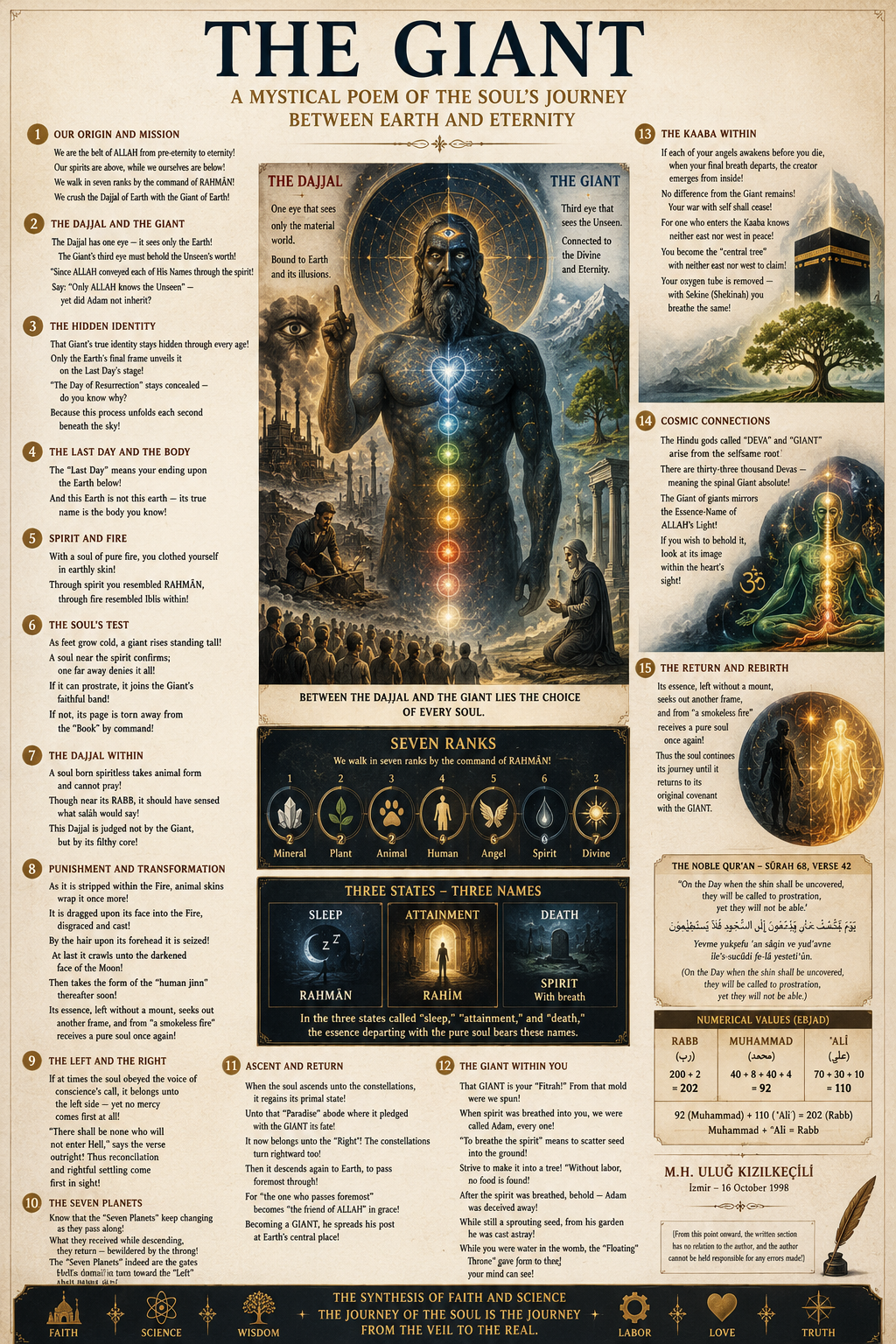
We are the belt of ALLAH from pre-eternity to eternity!
Our spirits are above, while we ourselves are below!
We walk in seven ranks by the command of RAHMÂN!
We crush the Dajjal of Earth with the Giant of Earth!
The Dajjal has one eye — it sees only the Earth!
The Giant’s third eye must behold the Unseen’s worth!
“Since ALLAH conveyed each of His Names through the spirit!”
Say: “Only ALLAH knows the Unseen” — yet did Adam not inherit?
That Giant’s true identity stays hidden through every age!
Only the Earth’s final frame unveils it on the Last Day’s stage!
“The Day of Resurrection” stays concealed — do you know why?
Because this process unfolds each second beneath the sky!
The “Last Day” means your ending upon the Earth below!
And this Earth is not this earth — its true name is the body you know!
With a soul of pure fire, you clothed yourself in earthly skin!
Through spirit you resembled RAHMÂN, through fire resembled Iblis within!
“As feet grow cold, a giant rises standing tall!”
A soul near the spirit confirms; one far away denies it all!
“If it can prostrate,” it joins the Giant’s faithful band!
If not, its page is torn away from the “Book” by command!
A soul born spiritless takes animal form and cannot pray!
Though near its RABB, it should have sensed what salâh would say!
This Dajjal is judged not by the Giant, but by its filthy core!
“As it is stripped within the Fire, animal skins wrap it once more!”
“It is dragged upon its face into the Fire, disgraced and cast!”
“By the hair upon its forehead it is seized!” — humiliation vast!
At last it crawls unto the darkened face of the Moon!
Then takes the form of the “human jinn” thereafter soon!
Its essence, left without a mount, seeks out another frame,
And from “a smokeless fire” receives a pure soul once again!
If at times the soul obeyed the voice of conscience’s call,
It belongs unto the left side — yet no mercy comes first at all!
“There shall be none who will not enter Hell,” says the verse outright!
Thus reconciliation and rightful settling come first in sight!
Know that the “Seven Planets” keep changing as they pass along!
What they received while descending, they return — bewildered by the throng!
The “Seven Planets” indeed are the gates of Hell’s domain!
Their nature is to turn toward the “Left” again and again!
When the soul ascends unto the constellations, it regains its primal state!
Unto that “Paradise” abode where it pledged with the GIANT its fate!
It now belongs unto the “Right”! The constellations turn rightward too!
Then it descends again to Earth, to pass foremost through!
For “the one who passes foremost” becomes “the friend of ALLAH” in grace!
Becoming a GIANT, he spreads his post at Earth’s central place!
That GIANT is your “Fitrah!” From that mold were we spun!
When spirit was breathed into you, we were called Adam, every one!
“To breathe the spirit” means to scatter seed into the ground!
Strive to make it into a tree! “Without labor, no food is found!”
After the spirit was breathed, behold — Adam was deceived away!
While still a sprouting seed, from his garden he was cast astray!
While you were water in the womb, the “Floating Throne” gave form to thee!
This Pen drew you resembling itself — now your mind can see!
You understood: the “Throne floating upon water” was the GIANT — meaning the RABB!
A seed not grafted with spirit becomes ruined and drab!
But if each of your angels awakens before you die,
Then when your final breath departs, the creator emerges from inside!
No difference from the Giant remains! Your war with self shall cease!
For one who enters the Kaaba knows neither east nor west in peace!
You become the “central tree” with neither east nor west to claim!
Your oxygen tube is removed — with Sekine (Shekinah) you breathe the same!
The Hindu gods called “DEVA” and “GIANT” arise from the selfsame root!
There are thirty-three thousand Devas — meaning the spinal Giant absolute!
The Giant of giants mirrors the Essence-Name of ALLAH’s Light!
If you wish to behold it, look at its image within the heart’s sight!
M.H. ULUĞ KIZILKEÇİLİ
İzmir – 16 October 1998
(From this point onward, the written section has no relation to the author, and the author cannot be held responsible for any errors made!)
The Noble Qur’an — Sūrah 68, Verse 42:
“On the Day when the shin shall be uncovered, they will be called to prostration, yet they will not be able.”
“Yevme yukşefu ‘an sâqin ve yud‘avne ile’s-sucûdi fe-lâ yestetî‘ûn.”
(On the Day when the shin shall be uncovered, they will be called to prostration, yet they will not be able.)
Numerical expansions of the Names according to the science of Ebced:
RABB / Rabb (رب)
Rā = 200
Bā = 2
Total: 202
MUHAMMAD / Muhammad (محمد)
Mīm = 40
Ḥā = 8
Mīm = 40
Dāl = 4
Total: 92
‘ALÎ / ‘Alî (علي)
‘Ayn = 70
Lām = 30
Yā = 10
Total: 110
Muhammad + ‘Alî
92 + 110 = 202
That is:
Muhammad (92) + ‘Alî (110) = 202 = Rabb (202)
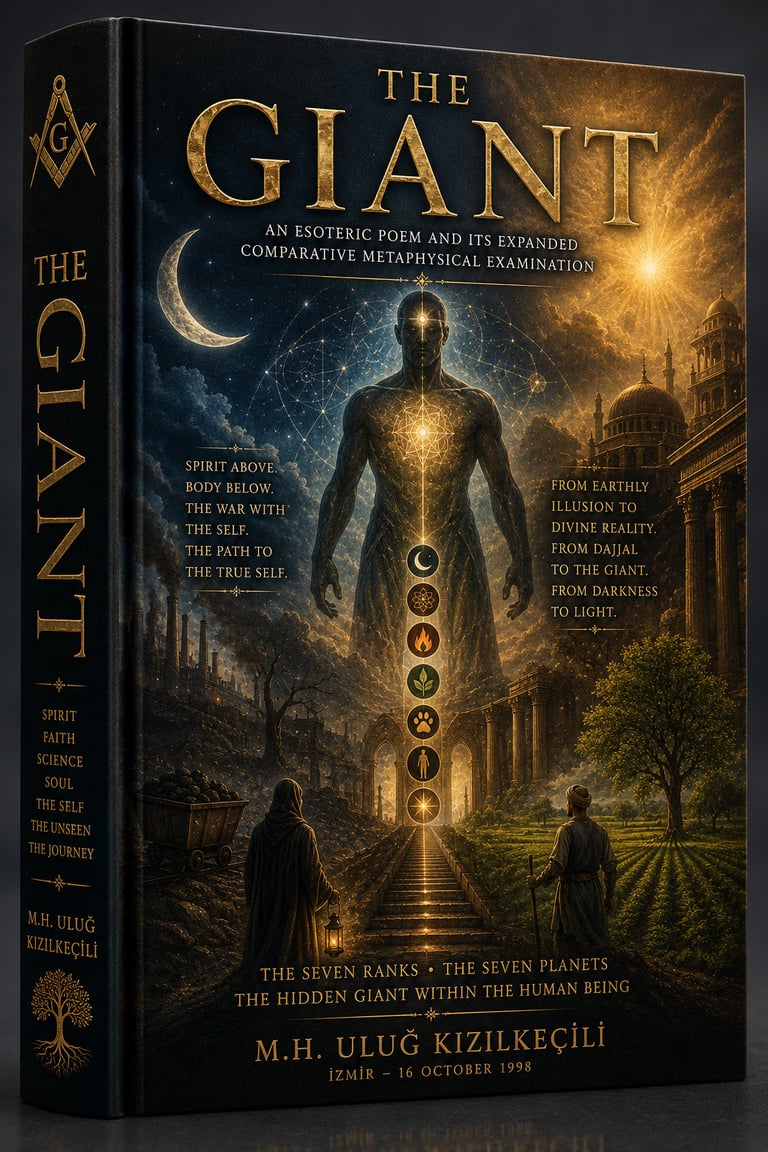
Expanded Esoteric Tafsir and Comparative Metaphysical Examination
Introduction
At first glance, the poem “DEV” appears to be a mystical poem; however, within its deeper structure it contains an extremely dense esoteric system built upon humanity’s cosmic origin, the spirit–body relationship, the layered structure of existence, postmortem transformation, degrees of consciousness, and the metaphysical center carried within the human being.
The poem is not limited solely to Sufi symbols; at the same time, it establishes a multilayered metaphysical language that may be read alongside the Hermetic tradition, Jewish Kabbalah, Christian mysticism, Hindu metaphysics, the Buddhist doctrine of awakening, Shamanic celestial journeys, Zoroastrian dualism, and ancient cosmological systems.
In this respect, the text is not merely a “poem” in the classical sense. It may also be regarded as an ontology, a cosmology, an anthropology, and a doctrine of inner apocalypse. Here, the poet interprets the human being not as a biological organism, but as a walking cosmos, a hidden realm, a micro-universe.
The figure of the “GIANT” at the center of the poem is not a creature of brute force from folk narratives. Rather, it is the symbol of the great truth hidden within the human being — the fitrah and the cosmic essence. Therefore, the opposition established throughout the poem between the GIANT and the Dajjal actually narrates the conflict between two different states of consciousness carried within the human being himself.
I. Esoteric Interpretation of the Concept of GIANT
GIANT: The Cosmic Human
In the poem, it is explicitly stated that the GIANT is the human being’s “fitrah”:
“That GIANT is your ‘Fitrah!’”
This expression is the metaphysical key at the center of the poem. For here, the GIANT is not an external creature; rather, it is the human being’s cosmic essence that has not yet fully awakened.
In Sufism, this understanding may be associated with the concepts of “Haqîqat-i Muhammadiyya” and “Insân al-Kâmil.” According to Ibn Arabi, the human being is the mirror of the divine names. Humanity is not merely a created being; at the same time, it is the field in which divine truth becomes manifest.
In Kabbalah, a similar structure appears in the concept of “Adam Kadmon.” Adam Kadmon is not the biological human being; rather, he is the prototype of the universal human. The entire cosmos symbolically exists within him.
In Hinduism, the concept of Purusha carries the same metaphysical structure. Purusha is the cosmic human; the entire universe is his body.
In the Hermetic tradition, the human being is viewed as the “microcosm.” Whatever the universe is, so too is the human being. The order above is repeated below.
For this reason, the GIANT in the poem may be read as the symbolic manifestation, within Turkish mystical poetry, of the cosmic human archetype that appears under different names in different traditions.
The Symbolism of the Dajjal and the Single Eye
The poem states:
“The Dajjal has one eye! All it sees is the Earth!”
Here, the Dajjal is not merely the eschatological figure mentioned in hadith literature. The poet transforms it into an epistemological symbol.
The single eye here represents one-dimensional perception.
A consciousness that sees only matter is one-eyed.
A mind that accepts only the physical as real is one-eyed.
A materialist intellect that believes only in what can be measured is one-eyed.
In Sufism, this is called “lack of basîrah” (inner sight).
In Buddhism, this condition is “avidyā,” the darkness of consciousness unable to perceive truth.
In Hinduism, consciousness trapped behind the veil of maya assumes that only the visible world is real.
In Plato’s allegory of the cave, human beings mistake shadows for reality itself.
The GIANT’s possession of a third eye in the poem points toward the unseen dimension of truth.
The third eye is not a physical organ.
Rather, it is:
• intuitive perception,
• esoteric vision,
• the eye of the heart,
• inner awareness,
• the ability to sense the unseen,
• the capacity to grasp truth directly.
In Hindu mysticism, the third eye is associated with the Ajna chakra.
In Sufism, there exists the concept of “‘ayn al-qalb,” meaning the eye of the heart.
Among Christian mystics, similar expressions such as “inner eye” or “eye of the heart” have also been used.
II. The Tension Between Spirit and Body
“Our Spirits Are Above, While We Ourselves Are Below”
This verse describes the dual-polar nature of the human being.
The spirit belongs above; the body belongs below.
The opposition of above and below here is not physical, but ontological.
Above signifies:
• transcendence,
• divinity,
• consciousness,
• pure perception,
• truth.
Below signifies:
• condensed matter,
• the body,
• the nafs (lower self),
• time,
• heaviness.
In Sufism, the human being is a tense existence living between these two poles.
Plato also states that the soul’s original homeland is the world of Ideas.
In the Gnostic tradition, the fall of the soul into matter is narrated.
In Vedanta, the Atman is not truly separate from Brahman; however, individual consciousness has forgotten this reality.
In the poem, this state of forgetfulness within the human being is deeply and clearly felt.
The Breathing of the Spirit and the Divine Breath
In the poem, the following expression appears:
“When spirit was breathed into you, we were called Adam!”
This is directly based upon the Qur’anic motif: “I breathed into him from My spirit.”
However, the poem transforms this motif from an ordinary narrative of creation into a doctrine of cosmic transformation.
Here, the breathing of the spirit is not merely animation.
Rather, it is:
• the attainment of consciousness,
• becoming aware of oneself,
• carrying the divine trust,
• connecting to cosmic memory,
• the capacity to bear truth.
For this reason, in the poem the human being is not merely a living organism.
He is also the potential bearer of the divine names.
In Kabbalah, it is believed that the names of God establish the universe.
In Sufism, the divine names manifest within the human heart.
In the Hermetic tradition, the human being is the mirror of the stellar intellect.
All of these structures are connected to the metaphysical foundation of the poem.
III. Seven Layers and Degrees of Consciousness
The Esoteric Meaning of the Number Seven
The recurring motif of “seven” in the poem is of immense importance.
• Seven ranks
• Seven planets
• Seven gates
• Seven passages
In all ancient traditions, the number seven is the number of transformation.
In Islam:
• the seven heavens,
• the sevenfold circumambulation (tawaf),
• the seven verses of al-Fātiḥah,
• the degrees of the nafs.
In Hinduism:
• the seven chakras,
• the seven centers of consciousness.
In the Hermetic tradition:
• the seven planetary spheres,
• the ascending layers of the soul.
In Jewish mysticism:
• the seven lower sefirot.
In the Shamanic tradition:
• the seven levels of ascent to heaven.
For this reason, the seven layers in the poem should be understood not as physical, but as a map of consciousness.
The human being approaches the center by transcending the layers within himself.
The Seven Planets and the Journey of the Soul
In the poem, the following line is striking:
“Know that the ‘Seven Planets’ are the gates of Hell!”
Here, the planets should be understood less in an astrological sense than as metaphysical gates.
In the ancient Hermetic tradition, while descending into the world the soul passes through planetary layers and acquires a characteristic at each stage.
After death, it passes back through the same layers, relinquishing the elements it had received.
For this reason, the poem states:
“What it received while descending, it gives back!”
This idea may be associated with:
• Hermetic ascent,
• Shamanic ascent to the heavens,
• the Gnostic journey of the soul,
• the Tibetan Book of the Dead,
• the symbolism of the Mi‘rāj in Islam.
IV. The Doctrine of Inner Apocalypse
The Individual Interpretation of the Last Day
One of the poem’s most remarkable metaphysical expansions concerns its understanding of the apocalypse.
The poet says:
“That is, the thing called the ‘Last Day’ is your end upon the Earth!”
Here, the apocalypse ceases to be an external historical event.
It becomes an inner transformation.
In Sufism, this is called:
• dying before death,
• the dissolution of the nafs,
• the burning away of the self,
• fanā’.
In Buddhism, the dissolution of the illusion of ego marks the beginning of the path toward nirvana.
In Christian mysticism, there exists the concept of “the death of the old man.”
In the Hermetic tradition, truth cannot be reached before the old self dies.
In the poem, apocalypse is the metaphysical dissolution experienced at every moment.
The Interpretation of the Earth as the Body
“And the Earth is not this earth! Its name is the body!”
This verse is one of the most esoteric statements in the poem.
Here, the world is not the external physical planet, but the human being’s own existence.
The human body is a micro-universe.
Therefore:
• the heavens are layers of consciousness,
• hells are processes of purification,
• apocalypse is the dissolution of the self,
• paradise is the return to the center,
• the ṣirāṭ is the passage of consciousness.
This structure is, in the fullest sense, the doctrine of the microcosm.
In the Hermetic tradition, there exists the principle:
“As above, so below.”
That is, the order above is repeated below.
The poem employs precisely this metaphysical principle.
V. Fire, Earth, and the Human Being
The Esoteric Meaning of Fire
In the poem, fire is not merely a physical element.
Fire signifies:
• consciousness,
• energy,
• will,
• movement,
• transformation,
• cosmic vitality.
The human being’s carrying a “soul of pure fire” signifies that he bears the spark of consciousness.
In Zoroastrianism, the sacred fire is the symbol of divine light.
In the Hermetic tradition, fire is the element of transformation.
In alchemy, the process that transforms lead into gold is associated with fire.
In Sufism, the fire of love transforms the human being.
In Buddhism, however, the fire of desire is the force that binds humanity.
The poem employs this multilayered symbolism within a single structure.
Earth and Condensation
Here, earth signifies embodiment and condensed existence.
Although the human being spiritually belongs above, bodily he remains bound below.
For this reason, the human being carries the potential of being:
• both Adam,
• and Iblis,
• both angel,
• and animal.
The dramatic power of the poem emerges precisely from this point.
The human being is the union of two poles.
VI. Prostration and the Dissolution of the Ego
Is Prostration an Ontology?
In the poem, prostration is not merely an act of worship.
Prostration signifies:
• the shifting of the center,
• the dissolution of the self,
• the withdrawal of the ego,
• bowing before truth,
• harmonizing with the cosmic order.
For this reason, the expression:
“If it can prostrate, it becomes one of the Giant’s company!”
is of immense importance.
A consciousness unable to prostrate becomes trapped within its own small center.
In Sufism, this is called the nafs.
In Buddhism, the illusion of selfhood.
In Christianity, pride.
In the Gnostic tradition, the Fall.
In the poem, prostration is in fact the correction of the inner axis.
VII. Death and Rebirth
Is Death Annihilation?
The poem removes the idea of death from the classical fear-centered understanding.
Here, death is described as:
• passage,
• transformation,
• shedding of the shell,
• changing of layers,
• transition toward a new center.
The poet says:
“The essence left without a mount finds another mold.”
Here, the body is the vehicle.
The spirit is the traveler.
This idea may be associated with:
• Plato,
• Sufism,
• the Hindu doctrine of reincarnation,
• Tibetan teachings concerning death.
Hell and Purification
In the poem, hell is not so much a realm of eternal torment as a process of purification.
This structure resembles:
• the Catholic understanding of purgatory,
• the Buddhist dissolution of karma,
• Hermetic purification,
• the burning of the nafs in Sufism.
The human being approaches his essence by being stripped of coarse shells.
For this reason, fire does not destroy.
It transforms.
VIII. The Symbolism of the Seed and the Tree
The Human Being as a Seed
In the poem appears the expression:
“To breathe the spirit means to scatter seed into the soil!”
This is one of the poem’s most important metaphysical symbols.
The human being is not complete.
He is potential.
Just as a seed must transform into a tree, so too must the human being grow inwardly.
In Sufism, this is called sayr wa sulūk.
In Buddhism, the path of awakening.
In the Hermetic tradition, transformation.
In Shamanism, initiation.
In Kabbalah, ascent upon the Tree of Life.
All of these systems describe the human being’s passage from the raw state toward the central state.
The Central Tree
The expression in the poem:
“the central tree without east or west”
connects to the symbolism of the axis mundi.
The world tree:
• binds heaven and earth,
• unites the layers,
• represents the center.
In the Norse tradition, it is Yggdrasil.
In Shamanism, the world pillar.
In Kabbalah, the Tree of Life.
In Islam, Sidrat al-Muntahā.
In Hinduism, the ashvattha tree.
All carry the same symbolism of the center.
In the poem, the human being’s becoming the central tree signifies transcending the poles.
IX. The Spinal Cord and the Cosmic Axis
Why Is the Spinal Cord the GIANT?
In the poem appears the expression:
“There are thirty-three thousand Devas! Meaning the ‘Spinal Cord’ is the GIANT!”
Here, the spinal cord is more than a biological structure; it is the metaphysical axis.
In the Hindu doctrine of kundalini, energy rises through the spinal column.
In Sufism, there exists the system of latā’if.
In Shamanism, the world pillar is repeated within the human body.
For this reason, the spinal cord is interpreted as:
• the axis,
• the center,
• the path of ascent,
• the column of consciousness.
X. The Mirror of the Heart and Divine Manifestation
Is the Heart a Physical Organ?
At the conclusion of the poem, it is said:
“If you wish to behold it, look at its image within the heart!”
The heart here is not a biological organ.
In Sufism, the heart is:
• the mirror of divine manifestations,
• the center of esoteric perception,
• the field where truth becomes visible,
• the spiritual center.
According to Ibn Arabi, the heart is in a state of perpetual transformation.
If the heart becomes purified, it reflects truth.
Pure awareness in Buddhism,
the inner Christ in Christian mysticism,
the spiritual center in Kabbalah,
the solar center in the Hermetic tradition
all approach the same symbolic structure.
XI. Conclusion
The poem “GIANT” is not merely a mystical poem.
It is:
• a metaphysical anthropology,
• a doctrine of inner apocalypse,
• a map of consciousness,
• a cosmology,
• a system of transformation,
• an esoteric doctrine of the human being.
The fundamental idea at the center of the poem is this:
The human being is not small.
The human being is not merely a body.
The human being is a hidden cosmos.
Within him dwell together:
• heavens,
• hells,
• planets,
• apocalypses,
• angels,
• devils,
• the central tree,
• the divine breath.
For this reason, the poem’s principal call is not to conquer the outer world.
It is to awaken the GIANT within.
For according to the poem, the human being shall find truth not outside, but within his own center.
And the human being who reaches his center is no longer merely human.
He has transformed into a walking universe.
Short Bibliography
• Mircea Eliade — Shamanism: Archaic Techniques of Ecstasy
• Henry Corbin — Creative Imagination in the Sufism of Ibn Arabi
• Gershom Scholem — Major Trends in Jewish Mysticism
• Carl Gustav Jung — Psychology and Religion
• William Chittick — The Sufi Path of Knowledge
• Ananda Coomaraswamy — Hinduism and Buddhism
• Mary Boyce — Zoroastrians
• Plato — Phaedo
• Chandogya Upanishad
• Tibetan Book of the Dead