THE IDENTITY OF IBLIS
THE IDENTITY OF IBLIS. When the “Age of the Sun” ended — behold, the Age of the Moon began! The same as today’s Moon — only its name was changed! For within it were Earth, Mars, and also the Moon; The core was fire, the shell was water — thus the event emerged:
APOCALYPSE BOOK
THE IDENTITY OF IBLIS
When the “Age of the Sun” ended — behold, the Age of the Moon began!
The same as today’s Moon — only its name was changed!
For within it were Earth, Mars, and also the Moon;
The core was fire, the shell was water — thus the event emerged:
Two classes stood opposed to one another, truly:
“The essence of Iblis was fire!” — the angels’ was water!
Iblis settled in the core together with devils,
And the angels in the shell — the war had already begun!
Earth and Moon were cast outward from within,
And Mars with Iblis — “Thus was Iblis exiled!”
Then the Moon too was cast away from the world,
Gabriel joined the Moon with his angels!
Know that the greatest human of the Moon Age was called Jehovah,
As a counterpart to RAHMAN or RABB in the Qur’an!
The humans of the Moon Age took the name “angel,”
Those who could not become angels remained as “devils”!
Gabriel is the name of the chief of angels;
And Iblis — of the devils! Mars became the dwelling of jinn!
Why is Mars called the “Red Planet”?
Because iron that makes red blood first descended from Mars!
“Iron was sent down to Earth by the hand of Iblis!”
Into the hot red blood the “SPIRIT” entered — and life arose!
With every breath iron burns and rusts in oxygen;
The Sun commands “Be!”, Mars commands “Die!” to humankind!
For this reason AZRAEL is another name of IBLIS —
He too had once been a member of the “SUPREME COUNCIL”!
RABB gave the command: “Build the Earth and Adam!”
GABRIEL obeyed — but “Iblis refused: ‘Clay is filthy!’”
THE PERMISSION OF IBLIS
“When expelled, IBLIS asked permission from his RABB!”
“RABB granted it — he became the enemy of us all!”
RAHMAN bound Iblis by the umbilical cord,
Granting him a chance for punishment within the womb:
Gabriel in Cancer binds the “first cell” to the heart,
Four months later Azrael says: “Take fire from Scorpio!”
In the eighth month, Pisces — the womb fills with water;
Azrael in Aries drives out the water — IBRAHIM is born!
Aries is fire; Cancer, Scorpio, and Pisces are water!
In the “Science of the Book,” this is the working of four signs!
The infant again passes through four stages in the womb —
Only a “master physician” can discern these micro-phases!
Azrael in Scorpio on Mars! Gabriel in Cancer on the Moon!
The zodiac are the “twelve imams” — pass beyond other sky-lore!
Trusting in his role within formation, Iblis said:
“If the human does not hold to the thread from the first gene,
With the chance You have given, I will corrupt their genes —
I will burn them with fire and drown them in blood!”
RABB replied: “Your words are indeed true;
For with the ‘human devils,’ your essence is one!”
“Thus shall the lineage of RAHMAN and Iblis be separated;
They shall be My vicegerents upon the Earth!”
“Iblis challenged RAHMAN!” — “For the first time!”
The battlefield is heart and brain — let everyone know!
Your spine is the middle judge — the “Tree of Good and Evil”!
Its forbidden fruit is both sweet and bitter!
“The Qur’an calls it the Rope of Allah!” — physician, the spinal cord!
Let the “essence fluid” flow upward — duality shall vanish!
Human means duality — the word twin is RAB:
R: Mother — RESULULLAH! B: Father — EBUTTURAB!
THE HUMAN DEVIL
Look! Water that is not pumped always flows downward;
In nature everything chooses the easiest path!
If the essence flows downward, one remains below;
But in inverted relations — a “Reversed Horror” is received!
Azrael is the envoy of the spirit of Mars — the first jinn alone;
The jinn-devil takes life when the appointed time is impure!
Do not underestimate — he is powerful by the permission he has;
“He may even create interference while a verse descends!”
In the Qur’an Azrael bears the name “Angel of Death”;
“His own stubbornness cast him down from the heights!”
For every human, Iblis appoints a devil, saying:
“Enter the brain! Complete your unfinished evolution!”
If that person does not aid their evolution,
He makes them a companion — ending the matter with shock!
The Satanist is called a “human devil” in the Qur’an —
Know them as humans worse than devils!
As soon as one dies, the devil seizes and swallows the soul;
The life of a jinn is long — it holds it until it burns away!
“The devil has no power” over one who relies on Allah;
“It was not Allah he opposed — but RAHMAN!”
Let me remind you of three crucial verses:
“The devil descends” upon those who do not believe in Allah!
“The devil fears Allah,” saying “His punishment is severe!”
Whoever does not fear Allah pays by ceasing to exist:
“Nothing truly disappears,” says the scholar LAVOISIER;
The Satanist is not even a ‘thing’ — mathematics reduces him to zero!
The Satanist and atheist vanish at once,
Melting into a black hole as if they never existed!
Master M.H. Ulug Kizilkecili
Türkiye/Ankara - 04 February 2002
IMPORTANT NOTE :The original text is poetic, and the author cannot be held responsible for any errors in the English translation! To read the original Turkish text, click HERE! The following section is not the author's work, and the author cannot be held responsible for any errors made!
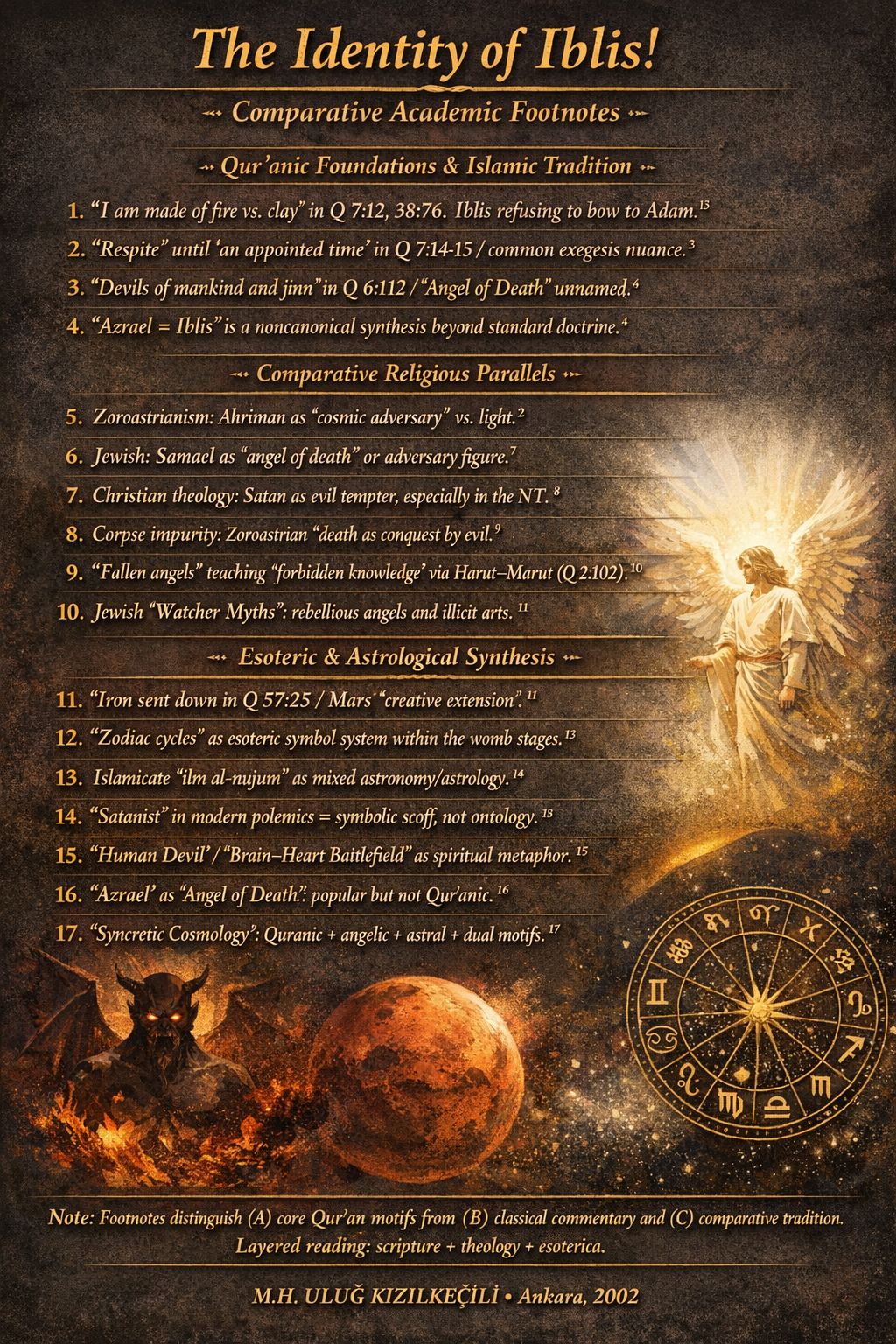
Expanded Comparative Academic Footnotes (English)
Iblis’ refusal and “fire vs. clay” rationale (Qur’anic anchor). The Qur’an repeatedly frames Iblis’ refusal to prostrate before Adam with the argument “I am better… You created me from fire and created him from clay,” making “fire” a central symbolic marker of Iblis’ self-justification.
“Respite / permission” motif (muhlā / ilā yawmi’l-baʿth vs. “appointed time”). The Qur’anic narrative has Iblis request respite “until the Day they are resurrected,” but classical commentary often stresses that the respite is “until an appointed time,” not necessarily identical with the final resurrection moment (a nuance your poem echoes by making “permission” a structured dispensation).
From “Shayṭān” as function to Iblis as named figure. Modern reference overviews treat Iblis as the chief progenitor of devils (shayāṭīn) in Islamic tradition, while “shayṭān” can operate more broadly as a category/function (tempter, whisperer). This helps contextualize the poem’s layered use of “Iblis / devil / human devil.”
“Devils among humans and jinn” (Q 6:112) as textual basis for “human devil.” The Qur’an explicitly speaks of “devils from humankind and jinn” who inspire one another with embellished speech. This verse is the cleanest scriptural grounding for the poem’s “human devil” section.
“Whisperer from jinn and mankind” (Q 114) in classical reading. Classical tafsir can interpret “the whisperer” as being “from jinn and mankind,” aligning with the broader Qur’anic picture that “satanic” influence can be human as well as non-human.
“Angel of Death” in the Qur’an vs. the name “Azrael.” The Qur’an refers to an “Angel of Death” (Malak al-Mawt), but the personal name “Azrael” is not stated in the Qur’anic text; it is widely used in later tradition and popular discourse. This matters because the poem’s “Azrael = Iblis” equation is not a mainstream Qur’anic identification and should be read as poetic/esoteric synthesis rather than standard doctrine.
Doctrinal caution: “Azrael = Iblis” is non-standard. Within mainstream Islamic theology, Iblis is the rebellious tempter figure, whereas the Angel of Death is typically treated as an obedient agent executing God’s decree. The poem collapses these roles for symbolic effect; academically, this is best labeled a creative conflation rather than a consensus teaching.
“Iron was sent down” (Q 57:25) and interpretive range. The Qur’an states that iron was “sent down,” a phrase that has been interpreted in exegetical and modern popular registers (from “bestowed/provided by God” to more literal cosmological readings). Your poem’s “Mars → iron → blood” chain is a further mythopoetic elaboration beyond the baseline verse.
The poem’s “Mars / iron / blood” cluster as mythic cosmology, not canonical scripture. No major Abrahamic canon directly teaches “iron first descended from Mars.” This motif resembles modern esoteric cosmologies that blend scriptural language with cosmography; academically, it is treated as syncretic myth-making. (Use this footnote to prevent readers from confusing poetic claims with textual attestation.)
Zoroastrian dualism (Ahriman/Angra Mainyu) as a comparative analogue to “cosmic opposition.” Zoroastrianism famously articulates a cosmic adversary principle (Ahriman/Angra Mainyu) in tension with the good creation. Your poem’s “two opposed classes” and “cosmic war” can be placed in comparative typology with Zoroastrian adversarial cosmology—without implying identity across traditions.
Corpse pollution and “death as conquest by evil” (Zoroastrian purity logic). Zoroastrian purity systems often treat the corpse as a site where the destructive principle has “won” a temporary conquest, hence strong cleansing rules. This is a useful cross-religious comparator for your poem’s “death/decay” imagery connected to a hostile spiritual agency.
Christian development of Satan as “representative of evil.” Encyclopedic Christian overviews stress that Satan becomes increasingly central in the New Testament and later Christian imagination as the representative of evil and temptation—useful for comparing the poem’s strongly personalized antagonist figure with Christian demonological trajectories.
Jewish tradition: Satan as prosecutor vs. later adversary roles. In parts of the Hebrew Bible (e.g., Job), “Satan” can function more as an accuser/prosecutor than an absolute cosmic enemy, while later Jewish and Christian developments intensify the adversarial profile. This helps explain why “Satan/Devil” is not a single stable concept across Abrahamic traditions—important when comparing the poem’s language across religions.
Judaism: Samael as a comparative “death/accuser” figure (caution). In some Jewish encyclopedic treatments, Samael appears as an angel/demonic figure associated with death and accusation. This can be cited as a loose parallel to the poem’s attempt to connect “death-agency” with a dark spiritual identity—though traditions differ sharply in details and authority.
“Human devils” as moral sociology: rhetorical function. The Qur’anic phrase “devils of humankind and jinn” is often read as describing networks of deception and rhetorical manipulation (“adorned speech”). Your poem extends this into a moral-psychological theory of “brain/heart battlefield,” which is best framed as reception and spiritualization of the Qur’anic motif rather than a direct doctrinal statement.
Astrology in medieval Islamic intellectual life: ‘ilm al-nujūm and its subdivisions. Medieval Islamic societies frequently discussed astronomy and astrology together under ‘ilm al-nujūm, sometimes distinguishing observational astronomy (hayʾa) from “judicial astrology” (‘ilm al-aḥkām). This background helps contextualize the poem’s “signs/zodiac/sky-lore” language as drawing on a historically real learned milieu (even if contested).
Method note on “zodiac stages in the womb.” The poem maps pregnancy stages onto zodiac signs (Cancer/Scorpio/Pisces/Aries). Academically, this is characteristic of esoteric/astrological anthropology rather than Qur’anic or Biblical embryology. Footnoting it as late cosmological speculation prevents category confusion.
“Forbidden knowledge / illicit teaching” as a cross-religious pattern (Harut–Marut). Though not central to this poem segment, your wider corpus links devilish agency to corruption via “knowledge.” Qur’an 2:102 (Harut–Marut in Babylon) is a key Islamic locus for “trial through dangerous arts,” and Iranica notes the “fallen angels teaching magic” framing in reception.
Late-antique parallels: Watchers traditions (comparative, not identical). Some academic discussions compare Harut–Marut reception with Jewish Second Temple “Watcher” narratives (descent, temptation, illicit arts). This supports your poem-world’s broader comparative architecture of “descent → corruption → judgment,” while maintaining that the corpora are not the same textually.
Polemic modern references: “Satanist” as symbol rather than ontology (modern contrast). Modern “Church of Satan” movements often treat “Satan” symbolically rather than as an ontological being; this sharply diverges from Abrahamic demonologies. The poem’s claims about “Satanists/atheists” belong to a polemical register; academically, it is helpful to note that “Satan” is not even construed as real in some modern Satanist self-descriptions.
Genre footnote: syncretic cosmology and layered authority. The poem blends (i) Qur’anic narrative motifs (Iblis, respite, human devils), (ii) popular angelology (Azrael naming), (iii) astrological anthropology, and (iv) comparative cosmic dualism (Zoroastrian-type adversary framing). In academic editing, it is standard to mark these layers explicitly so readers can distinguish scripture from commentary from esotericism.