THE LADDER OF SAINT YAKUB
THE LADDER OF SAINT YAKUB. “A man wrestled with Yakub through the entire night!” “The man struck a kick!” “Its force was fierce and tight!” “The blow touched the place of modesty!” “His hip came undone!” It was clear the stranger sought his life to be won!
APOCALYPSE BOOK
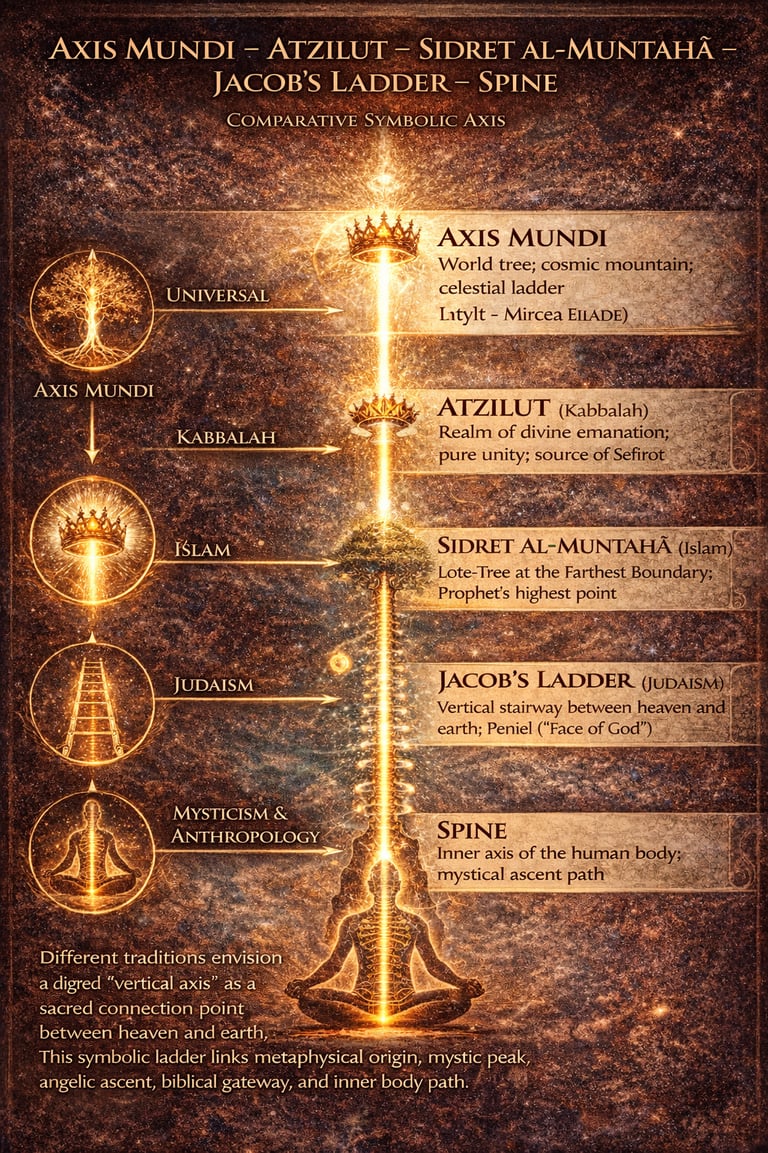
THE LADDER OF HAZRAT YAKUB
“A man wrestled with Yakub through the entire night!”
“The man struck a kick!” “Its force was fierce and tight!”
“The blow touched the place of modesty!” “His hip came undone!”
It was clear the stranger sought his life to be won!
“At dawn the man pleaded Yakub with a cry:
‘Let me go now!’ he said, ‘You proved stronger than I!’”
“I will not release you,” Yakub replied, “without your name!
You made me limp—tell me the reason, the aim!”
The man said: “First, learn the name that is your own;
Let me bless you—your subtle body shall be shown!”
“He baptized him and turned his name into Israel!”
“This name means one who strives with Elohim well!”
Israel—the warlike one! A name of “Mikail” in light!
Hosts of Elohim stand; Yehova’s subtle sight!
To the reborn, the father-saint grants a new name;
To die before dying—that is baptism’s aim!
But today’s baptism is a watery comedy;
Neither Allah nor Isa spoke such a decree!
Before Elohim departed, he spoke his final word:
“Last night, beyond yourself, your hidden essence you observed!”
You battled yourself until morning’s first ray;
Angel, alien, human—the greatest mystery’s way!
I bless you and celebrate you! You endured!
You learned your origin is none but the Lord!
“Do not wound the sinew!” “Do not walk astray!
To misuse the sacred place is forbidden, they say!”
“Yakub named that place ‘The Face of Allah!’—why?
Because he spoke face to face and did not die!”
“For Allah cannot show Himself directly!”
To see His Face within the heart is true piety!
When Yakub renewed his speech with the Lord again:
“I am the Lord of your father Ibrahim!” spoke the hidden domain!
“And he saw a ladder reaching from earth to the skies!
Who devotes himself ascends to the Throne that lies!”
“He set up a stone and anointed that place;
The oil he drew from a tree at the center’s base!”
“Neither east nor west grows this sacred tree!
It neither rises nor sets—RÛH! Awake and see!”
“A ladder of degrees—this ascent is Miraç!
The spine with thirty-three steps is the hidden path!”
“Within it lies the rope of Allah!” The spinal line!
“The straightest way is this!” For duality resigns!
The ladder serves both ascent and descent;
From the spine descending, reincarnation is sent!
Yakub beheld many Elohim descending there;
And the Lord’s Saints born to serve them in prayer!
“Yakub called that ladder the House of Elohim!”
Circle seven rings—circumambulate the dream!
The realm of “fixed essences” is the spine’s domain! (537)*
Reflect what the Hebrew measure might explain!
“Yakub had twelve sons and four wives in grace!
The moon takes four forms; twelve signs, one sun in space!”
NÛR bears four names: Havva, FÂTMA, Meryem, Asiye;
See them as the moon’s four changing displays!
Master M.H. Ulug Kizilkecili
Türkiye/Ankara - 23 February 2001
IMPORTANT NOTE :The original text is poetic, and the author cannot be held responsible for any errors in the English translation! To read the original Turkish text, click HERE! The following section is not the author's work, and the author cannot be held responsible for any errors made!
*537 = (Hebrew) ATZILUT (realm of fixed essences) = (Arabic) Hutha Şedreh (spinal axis)
📚 ACADEMIC FOOTNOTES
Jacob Wrestling Narrative: The poem’s opening mirrors Genesis 32:22-32, where Jacob wrestles a mysterious being and receives the name Israel. The injury to the hip reflects the biblical motif explaining dietary restrictions in Jewish law.
Peniel / “Face of God”: Genesis 32:30 records Jacob naming the place Peniel (“Face of God”), after surviving a divine encounter.
Jacob’s Ladder: Genesis 28:12 describes a ladder between heaven and earth—an archetypal axis mundi, symbolizing the vertical connection between realms.
Sacred Tree Imagery: The “neither east nor west” tree parallels Qur’an 24:35, often interpreted symbolically as divine light beyond polarity.
“Rope of Allah”: The reference echoes Qur’an 3:103 (“Hold firmly to the rope of Allah”), here interpreted mystically as the spinal axis.
Miraç Motif: Islamic narratives of the Prophet’s ascent (Mi‘raj) are used metaphorically as stages of spiritual elevation rather than literal cosmology.
Atzilut: In Kabbalah, Atzilut is the highest of the Four Worlds, associated with pure emanation; its pairing with the spine reflects esoteric anthropological symbolism.
🌍 COMPARATIVE RELIGIOUS PARALLELS
✡️ Judaism / Kabbalah
Jacob’s Ladder → axis mundi connecting divine and earthly realms.
Atzilut → realm of emanation; comparable to the poem’s “fixed essences.”
☪️ Islam / Sufism
Miraç → ascent through spiritual stations.
“Rope of Allah” → unity beyond duality.
The sacred tree → divine light imagery.
✝️ Christianity
Baptism as “dying before dying” parallels Pauline theology (Romans 6).
Ladder symbolism appears in monastic mysticism (e.g., Ladder of Divine Ascent).
🕉️ Hinduism
Mount Meru and Kundalini spine imagery resemble the ladder–spine equivalence.
Vertical ascent through chakras parallels mystical stages.
☸️ Buddhism
The vertical path of enlightenment and Bodhi tree symbolism echo the sacred axis motif.
🌌 Universal Mythology
Axis Mundi archetype: world tree, cosmic mountain, ladder, pillar.
The spine as microcosmic axis mirrors the macrocosmic world-axis.
Peniel / “Face of God”:
Genesis 32:30 records that Jacob named the place Peniel (or Penuel) after his nocturnal struggle. In the text, Jacob declares: “For I have seen God face to face, and yet my life was preserved.”
Brief Academic Explanation
Etymology: Panim (“face”) + El (“God”) → “Face of God.”
Theological Function: The naming represents a theophany, a moment in which the divine is encountered through a mediated or mysterious form rather than a direct, unveiled vision.
Symbolic Meaning: In biblical scholarship, Peniel is often interpreted as a liminal site—an existential threshold where identity transformation occurs (Jacob → Israel).
Comparative Perspective: Similar “face-to-face” divine encounter motifs appear in other traditions as metaphors for spiritual transformation, yet they rarely imply literal visual perception of the divine essence.
Atzilut (Hebrew: אֲצִילוּת, “Emanation”) is the highest of the Four Worlds in Kabbalistic cosmology. It represents the level closest to the Divine Essence, where separation, multiplicity, and form have not yet fully emerged.
ATZILUT — Academic Overview
1) Meaning and Etymology
Derived from the Hebrew root atzal (“to emanate,” “to draw forth”).
Refers to the realm of pure divine emanation, not creation in the material sense.
Often translated as “World of Emanation.”
Atzilut is therefore understood as a state where divine light is present without strong limitation or division.
2) The Four Worlds in Kabbalah
Kabbalistic metaphysics describes reality through four descending worlds:
Atzilut — Emanation (unity, divine proximity)
Beri’ah — Creation (intellect, archetypal forms)
Yetzirah — Formation (angelic/emotional structure)
Asiyah — Action (physical reality)
Atzilut stands at the summit of this structure.
3) Key Characteristics
Non-dual awareness; minimal distinction between subject and object
Associated with the Sefirot in their most unified state
Sometimes linked with the sefirah Keter (“Crown”), representing primordial will
Beyond ordinary time, space, and material limitation
4) Comparative Religious Parallels (Academic Perspective)
☪️ Islamic Mysticism
Comparable, functionally, to concepts such as Ahadiyyah or the unknowable Divine Essence in certain Sufi metaphysical frameworks.
Not an exact equivalent, but both refer to a level beyond multiplicity.
✝️ Christian Mysticism
Parallels the apophatic tradition (e.g., Pseudo-Dionysius), where God is described as beyond attributes and conceptual grasp.
🕉️ Hindu Vedanta
Often compared to Nirguna Brahman — the formless Absolute beyond qualities.
☸️ Buddhist Thought
Some scholars note structural similarities to Śūnyatā (emptiness) as a non-dual ground, though doctrinal meanings differ significantly.
5) Symbolic Imagery
In mystical literature, Atzilut may be represented through:
Light without form
A crown or summit
The uppermost point of a cosmic ladder or axis
Within symbolic systems like the “Axis Mundi” or Jacob’s Ladder imagery, Atzilut corresponds to the highest origin point from which spiritual ascent or emanation begins.
6) Academic Summary
Atzilut is not a physical place but a metaphysical level.
It signifies proximity to divine unity before differentiation occurs.
Comparative studies highlight structural similarities with other traditions’ notions of an ultimate, undivided reality, while maintaining theological distinctions.
Axis Mundi is a scholarly term from comparative religion and mythology meaning “the world axis” or cosmic center — a symbolic vertical link between heaven, earth, and the underworld. It describes how many cultures imagine a sacred point where different levels of reality connect.
AXIS MUNDI
1) Definition
The Latin phrase axis mundi literally means “axis of the world.”
In religious studies, it refers to:
A sacred center or vertical pathway
A symbolic structure connecting divine and human realms
A location where communication between worlds becomes possible
The concept was popularized in modern scholarship by historian of religions Mircea Eliade, who argued that sacred traditions often organize space around a central axis.
2) Typical Symbolic Forms
Across cultures, the axis mundi appears in many shapes:
Ladder (e.g., Jacob’s Ladder)
Mountain (e.g., Mount Meru, Sinai)
Tree (e.g., Tree of Life, Yggdrasil)
Pillar or column
Temple or sacred city
Human spine in mystical anthropology
Each represents a vertical orientation toward transcendence.
3) Religious Examples
✡️ Judaism
Jacob’s Ladder (Genesis 28:12)
Temple Mount as cosmic center
☪️ Islam
The Mi‘raj (ascension) narrative
Kaaba as symbolic center of the world
✝️ Christianity
The Cross interpreted as a cosmic axis
Monastic “ladder of ascent” imagery
🕉️ Hinduism & Buddhism
Mount Meru or the Bodhi Tree as central axes
🧿 Indigenous and Shamanic Traditions
World Tree connecting sky, earth, and spirit realms
4) Anthropological Interpretation
Scholars often see axis mundi as:
A way to map cosmic order onto geography or the body
A symbolic model of transformation or initiation
A bridge between mythic cosmology and ritual practice
It does not imply a literal physical structure; rather, it describes how sacred imagination organizes space.
5) Axis Mundi and Mystical Anthropology
In esoteric interpretations:
The spine may symbolize the internal axis
A ladder or ascending path represents stages of awareness
The center point becomes the place where unity replaces duality
This is why texts that describe ladders, sacred trees, or ascent journeys are often analyzed through the axis mundi framework.
6) Academic Summary
Axis mundi = symbolic cosmic center
Appears independently across many religions
Expresses a universal pattern of vertical sacred connection
Functions as both a mythological and psychological archetype